
2500W Sump Pump Battery Backup System
4.7Editor score
25A fast charging system
Automatic grid-to-battery transfer
Three AC and two USB ports
Looking for the best battery for sump pump backup? Our guide compares 10 systems for power, charging, switching, capacity, monitoring, and easy installation.
A dependable sump pump backup system can protect a finished basement from costly water damage when an outage interrupts the primary pump. The right system must deliver stable power, switch quickly, recharge effectively, and provide enough runtime for the pump to handle the storm conditions that caused the failure in the first place.
This guide compares 10 sump pump backup systems using the information published for each product. The evaluation focuses on inverter output, supported pump loads, battery compatibility, charging features, transfer behavior, monitoring, outlet configuration, protection circuitry, and installation requirements, while also identifying the compromises each design presents.
The list includes both inverter-and-charger units intended to power an existing pump and preassembled primary-and-backup pump combinations. Each review explains who the product is best suited for, while the comparison table makes differences easier to scan. Prices and availability can change, so confirm current listing details before purchasing.
4.7Editor score

4.8Editor score

4.4Editor score
This side-by-side comparison covers ten backup systems, separating inverter-based units from preassembled pump combinations and highlighting output, charging, monitoring, and installation differences.
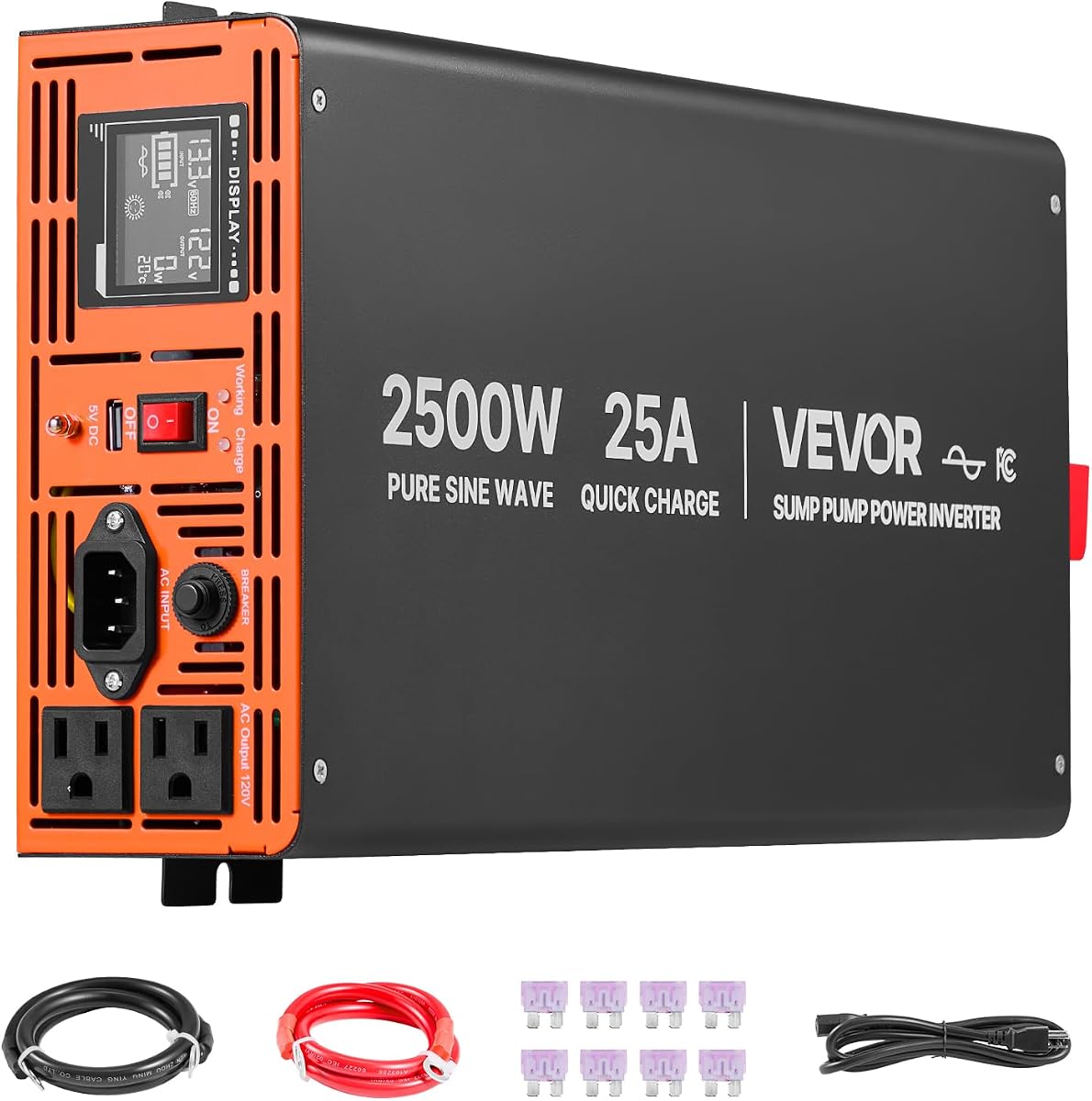


The 2500W Sump Pump Battery Backup System combines a 2500-watt pure sine wave inverter, a 25A fast charger, and an automatic transfer switch in one enclosure. With a 4.7 rating, it stands out for offering a broad collection of convenience features without sacrificing the core functions expected from a serious sump pump backup unit.
We may earn a commission when you buy through this link, at no additional cost to you.
Its strongest feature is the combination of output capacity and battery flexibility. The inverter is compatible with LiFePO4, AGM, GEL, and flooded deep-cycle batteries, allowing an owner to use an existing suitable battery or select a chemistry based on runtime and local availability. A 25A smart charger with selectable modes should help bring a properly sized battery back to readiness after outages, while overcharge, low-voltage, overload, short-circuit, and overheat protection add layers of operational safety.
The remote LCD controller is particularly useful because it displays battery voltage, load status, and operating mode without requiring the owner to approach the inverter. Three AC outlets and both USB and Type-C ports create opportunities to keep essential devices operating as well. Wall-mounting or flat-placement options and simple AC and DC connections make the unit more approachable for homeowners working with contractors, although the included battery is still necessary and must be installed correctly.
This is a strong choice for someone who wants one box to handle a substantial sump pump, reserve power for selected household needs, and detailed status information. It is also a logical premium option because the 25A charging system, remote monitoring, and expanded port selection add practical value. Buyers should confirm their pump’s running and starting requirements, match those figures to the inverter and battery, and have the electrical connections installed safely.
The integrated 25A charger is a major benefit for households that depend on the battery throughout storm season. A system that recharges efficiently can return usable capacity sooner after a power interruption, while multi-stage charging and protective cutoff functions help manage the battery responsibly.
The LCD remote makes system checks more convenient by exposing voltage, load, and operating-mode information. Homeowners can check readiness more easily during a storm or after an outage without moving equipment or opening a potentially damp enclosure.
We may earn a commission when you buy through this link, at no additional cost to you.
The VEVOR 2500W Sump Pump Battery Backup System is designed to keep sump pumps operating when grid electricity becomes unavailable. It has a 4.3 rating, a 2500-watt pure sine wave inverter, an LCD display, LED indicators, and an automatic changeover from utility power to battery power.
We may earn a commission when you buy through this link, at no additional cost to you.
A notable strength is its stated ability to support a dual-pump arrangement consisting of a 1 HP main pump and a 1/3 HP backup pump. That makes it relevant to homeowners who want one inverter to coordinate primary and backup equipment. Three-stage charging for lead-acid, AGM, GEL, and LiFePO4 batteries also gives buyers flexibility, while the LCD and indicators expose battery voltage, charge level, and working status.
The installation approach emphasizes simplicity. A standard three-prong plug and the claim that no complicated rewiring is required make this less intimidating than a hardwired transfer arrangement. Protection against overcurrent, overvoltage, short circuits, reverse polarity, and excessive temperature, together with a circuit breaker, provides a reassuring safety framework. The trade-off is that monitoring is local rather than remote, so the inverter must be checked directly.
This system is best suited to a household that values straightforward hookup, broad charger compatibility, and enough output for a common two-pump configuration. It is less compelling for someone seeking a remote panel or numerous convenience outlets, and the battery remains a separate purchase. Pump startup current, continuous draw, and the sump basin’s electrical requirements should be reviewed before installation.
Supporting a 1 HP primary pump and a 1/3 HP backup pump is the defining feature for buyers with a two-pump setup. That capability can simplify system planning by centralizing power conversion, automatic changeover, and charging in one unit.
The three-prong plug design lowers the barrier to entry for a retrofit installation. It does not eliminate the need for correct polarity, ventilation, secure placement, and code-compliant workmanship, but it can reduce the amount of new wiring required.
We may earn a commission when you buy through this link, at no additional cost to you.
The 2500 Watt Sump Pump Battery Backup Battery System earns the highest listed rating in this comparison at 4.8. It combines 2500 watts of pure sine wave output, automatic switching to battery power, a 25A charger, and a remote LCD controller in a package designed for professionally organized backup-power installations.
We may earn a commission when you buy through this link, at no additional cost to you.
Pure sine wave output is the central technical strength. The product description emphasizes smooth, grid-like AC output suitable for resistive and inductive loads, including motor-driven equipment such as sump pumps. Its built-in 25A charger supports fast and trickle charging for deep-cycle lithium, AGM, and other compatible deep-cycle battery types, while excluding ordinary non-deep-cycle batteries. That specificity is useful for buyers who understand that battery quality and chemistry directly affect backup performance.
The remote controller displays voltage, power, and battery charge status, reducing the need to access the main unit during bad weather. A cooling system, overload protector, and protections for overheating, short circuits, low voltage, and overcharging add useful safeguards. Installation requires connecting the AC and DC cables and plugging the pump into the unit; side fixing holes also allow flat or wall-mounted placement. The main limitation is that the battery is not included.
This is our top overall recommendation for a homeowner seeking substantial pure sine wave capacity, effective charging, and remote monitoring without adding a separate transfer controller. It balances core emergency-power performance with useful diagnostics. Before buying, verify the pump’s startup surge, confirm the selected battery is a supported deep-cycle type, and have the installation inspected for electrical and moisture safety.
Pure sine wave output is especially relevant to a sump pump because motor startup and cycling can expose sensitive electronics to unstable waveforms. This unit is designed to provide smoother AC output than basic modified sine wave alternatives.
The LCD remote gives owners a quick view of voltage, output, and battery charge. That visibility can help distinguish a depleted battery from a failed pump or an active high-load condition when troubleshooting after an outage.
We may earn a commission when you buy through this link, at no additional cost to you.
The Cantonape 2000W Sump Pump Backup Battery System provides a 2000-watt pure sine wave inverter, a 20A fast charger, an LED display, and three AC outputs. Its 4.4 rating and balanced feature set make it a practical choice for homeowners who want clean pump power without moving to the highest-capacity unit in the list.
We may earn a commission when you buy through this link, at no additional cost to you.
Automatic switching is central to the design: when utility power fails, the system is intended to move to battery inverter power quickly, and its fast charger helps replenish the battery afterward. The pure sine wave description says it can handle resistive and inductive loads, making it more appropriate for pump motors than many basic backup inverters. Three outputs also give it some flexibility for lights, phones, monitors, and other essentials.
Safety provisions include cooling, overload protection, and safeguards against overheating, short circuits, low voltage, and overcharging. The LED display provides immediate information about battery voltage and AC voltage, although it is less comprehensive than the remote LCD on the leading products. Installation is described as straightforward, with the pump plugging into an AC socket after the supplied cables are connected.
This is our budget pick for a typical single-pump installation where 2000 watts of pure sine wave output is sufficient. The compromise is reduced output compared with 2500-watt alternatives and no remote panel, but many households can gain more from the clean waveform and automatic charging than from additional capacity. Confirm pump requirements, select a compatible 12V GEL, AGM/SLA, or flooded deep-cycle battery, and ensure the inverter is installed in a dry, ventilated location.
A 2000-watt pure sine wave inverter offers a middle ground between basic modified-wave units and higher-capacity systems. It is well matched to many residential sump pumps whose startup and continuous demands remain comfortably inside the unit’s limits.
Three AC outlets mean the inverter can do more than run one pump during a short emergency. Carefully selected lights, communications equipment, or monitoring devices can share the available capacity, provided their combined load does not exceed the inverter and battery ratings.
We may earn a commission when you buy through this link, at no additional cost to you.
The 1500W Sump Pump Battery Backup System offers the feature pattern of a larger premium inverter in a lower-output package. It has a 4.7 rating, 1500 watts of pure sine wave output, a 25A fast charger, automatic grid-to-battery switching, and an LCD remote that reports battery voltage, load level, and operating mode.
We may earn a commission when you buy through this link, at no additional cost to you.
Its charger accepts LiFePO4, AGM, GEL, and flooded deep-cycle batteries, and the 25A multi-stage design is intended to optimize charging and battery life. Protection against overcharge, overload, short circuits, low voltage, and overheating provides a broad safety net. Three AC outlets, a USB port, and a Type-C port add emergency utility without turning the unit into a general-purpose power station.
The main trade-off is capacity. A 1500-watt inverter may suit a smaller or more efficient sump pump, but it offers less headroom for a demanding 1 HP pump, two simultaneous pumps, or several household devices. Remote access compensates for the lower output by making operating information easier to check. Flat placement and wall mounting are both supported, and the supplied AC and DC cables simplify the physical connection process.
This model is best for a homeowner with a modest pump load who values fast charging, battery choice, and remote status information. It may also work as a secondary backup inverter in a carefully managed installation. Buyers should compare the pump’s nameplate information, including starting current, with the inverter rating and avoid exceeding the unit’s limits. A compatible deep-cycle battery must be purchased separately.
The remote display is especially helpful when the inverter is placed near a sump pit or in another area that is inconvenient to access during rain. It allows a homeowner to check key status information without immediately approaching the installation.
Compatibility with four deep-cycle battery families makes this model adaptable to different household plans. The charger’s selectable behavior and protective circuitry are intended to support battery longevity, but the battery manufacturer’s charging guidance should remain the final reference.
We may earn a commission when you buy through this link, at no additional cost to you.
The 2500W Sump Pump Battery Backup emphasizes rapid response and high surge capability. It delivers 2500 watts of continuous power and 5000 watts of peak power through a pure sine wave inverter, with a stated transfer time under 10 milliseconds. Its 4.5 rating reflects a feature set that goes beyond basic automatic changeover.
We may earn a commission when you buy through this link, at no additional cost to you.
Soft-start technology is a standout for pump installations because it gradually increases power during motor startup, reducing damaging inrush current and potentially extending motor life. The LCD and LED indicators provide unusually broad status information, including output, battery level, frequency, internal temperature, and active protection states. This level of visibility can be valuable when diagnosing overloads or battery problems.
The built-in 25A three-stage smart charger supports common lead-acid types and LiFePO4 batteries, and the description states that a 100Ah battery can recharge in about four hours under appropriate conditions. Protection covers over-temperature, short circuit, voltage extremes, overload, overcharge, reverse polarity, and a circuit breaker. Heavy-duty 3AWG copper cables and a ground wire are included, while the three-pin plug design supports relatively straightforward installation.
This is an attractive option for a modern pump with a meaningful startup surge or for a household that values very fast transfer and detailed diagnostics. The caution is that a high peak rating does not make every pump safe to operate; battery capability, wiring, and actual surge demand must all align. Confirm those details and have a qualified professional assess the installation when required.
An under-10-millisecond transfer can minimize disruption to sensitive or motor-driven equipment. In a sump pump application, quick changeover also reduces the gap during which accumulated water could approach a pump’s float-switch activation point.
Soft start reduces the abrupt power surge associated with pump startup. That can lessen electrical stress on the motor and inverter, particularly when the battery is already carrying a substantial load after a power interruption.
We may earn a commission when you buy through this link, at no additional cost to you.
The 1500 Watt Sump Pump Battery Backup System is built around 1500 watts of pure sine wave output, three grounded AC outlets, and automatic switching between grid and battery power. With a 4.4 rating, it offers a practical combination of remote monitoring and charging features for installations with a moderate pump load.
We may earn a commission when you buy through this link, at no additional cost to you.
Its most distinctive function is adjustable input voltage from 9.5V to 11V, which the manufacturer says improves compatibility with lithium batteries and can reduce unnecessary battery consumption. The instruction to make the adjustment only while the inverter is off is important. A remote LCD shows voltage, power, and battery charge status, while USB and Type-C ports expand the available emergency outputs.
For safety, the unit includes a cooling system, self-recovering overload protection, and safeguards for overheating, short circuits, low voltage, and overcharging. It can be installed through AC and DC cable connections, and side holes support flat or wall-mounted placement. The practical limitation is its 1500-watt ceiling, which leaves less room for a large pump plus household loads than the 2500-watt alternatives.
This system is a good candidate for a smaller sump pump or a household that values adjustable battery behavior, remote diagnostics, and several output options. It may appeal to owners using a compatible lithium battery who understand the required voltage configuration. The pump’s startup requirements must remain within the inverter’s limits, and any settings should be confirmed with the manufacturer’s instructions before normal operation.
The adjustable input range can align inverter behavior more closely with a compatible lithium battery’s discharge characteristics. Because incorrect settings may affect performance or battery health, the owner should follow the current manual and make changes only while the unit is off.
Three grounded outlets support a pump and carefully chosen emergency devices, while USB and Type-C connections can handle lower-power charging needs. Total load across all outputs still needs to remain within the inverter’s rated limits.
We may earn a commission when you buy through this link, at no additional cost to you.
The Basement Watchdog CITS-50 is fundamentally different from the inverter-only products in this guide. It is a preassembled and preplumbed combination of a primary sump pump, a battery backup pump, and a monitoring controller. Its 4.3 rating reflects the appeal of an integrated package for homeowners who want working pump equipment rather than only a power converter.
We may earn a commission when you buy through this link, at no additional cost to you.
The primary pump uses a half-horsepower copper-wound permanent split capacitor motor and is rated to move 73 gallons per minute, or 4,400 gallons per hour, at zero feet of lift. At 10 feet, the listed rate is 59 gallons per minute. The backup pump handles 48 gallons per minute at zero feet and 35 gallons per minute at 10 feet, giving the system meaningful emergency capacity.
Monitoring is the defining advantage. The included battery backup system provides round-the-clock monitoring of pump, power, and battery conditions, with an alarm, warning light, and maintenance guidance. A separate Basement Watchdog CONNECT Module can enable text, email, push notifications, and app-based alerts. The system supports AGM and wet-cell batteries, and two batteries can be connected in parallel for longer runtime.
This combo is best for someone replacing an entire sump pump arrangement or building a new installation with a compatible basin. Preassembly can reduce labor, but basin dimensions, discharge routing, electrical requirements, and local code still need verification. The optional WiFi module and separate batteries make the package broader than a basic inverter. Buyers who only need to protect a good existing pump should compare that route with the inverter systems in this guide.
Including both primary and backup pumps removes the need to source and coordinate two separate pumping systems. The published flow rates also make it easier for buyers to compare capacity against the demands of a typical residential sump pit.
The optional CONNECT Module can turn controller warnings into remote notifications. That is valuable for homeowners who want to know that power, battery, or pump conditions require attention even when they are away from home.
We may earn a commission when you buy through this link, at no additional cost to you.
The PumpSpy 2000W Sump Pump Battery Backup is a compact inverter-and-charger designed to run existing pumps during outages. It has a 4.1 rating, a 2000-watt pure sine wave 120 VAC output, two grounded outlets, a USB charging port, and a stated ability to power two primary pumps when their combined current does not exceed 16.6 amps.
We may earn a commission when you buy through this link, at no additional cost to you.
Intelligent cooling is the product’s most distinctive feature. The cooling system is intended to support safe operation and extend service life by managing heat inside the unit. The overcharge-prevention design also uses trickle charging once the battery is full, helping it remain ready rather than repeatedly applying a heavy charge.
The product is physically compact at 17.5 by 6.75 by 4 inches and weighs 10.5 pounds, which can help in tight mechanical areas. It is described as tested and packaged in Kalamazoo, Michigan, using domestic and imported parts, with CE certification for electrical safety compliance. Technical support is also based in Kalamazoo. These details make it attractive to buyers who value a smaller footprint and a defined support location.
The principal drawback is that its 4.1 rating is the lowest among the listed systems, and buyers cannot infer a defect from that alone. More importantly, the two-pump claim depends on the combined 16.6-amp limit, so a household with a large primary pump should calculate the actual draw rather than assume support. This model is best for a compact installation with moderate loads and a preference for pure sine wave power, cooling, and local support.
Intelligent cooling can be valuable in an enclosed utility area where a backup inverter operates near other electrical equipment. It supports consistent performance and helps reduce the thermal stress associated with charging and powering a motor load.
The listed dimensions make this one of the more compact units in the comparison. A smaller footprint can make it easier to find a suitable dry location, although adequate clearance for airflow and protection from water remain necessary.
We may earn a commission when you buy through this link, at no additional cost to you.
The Wayne WSS30VN is a preassembled primary and battery backup sump pump combination intended for indoor use. It has a 4.6 rating and offers a conventional alternative to inverter-based systems: both pumping equipment and backup capability arrive as a coordinated system designed for a residential sump basin.
We may earn a commission when you buy through this link, at no additional cost to you.
The half-horsepower system is listed to pump up to 5,100 gallons per hour and remove up to 10,000 gallons on a single battery backup charge. The stated 75Ah battery requirement identifies the type of energy reserve this configuration expects, although that battery is not included. The design is also described as capable of installation in 15 minutes or less without drilling a weep hole, which is a significant practical advantage in a tight basin.
The manufacturer says the system was tested to one million cycles and includes an eight-foot SJTW power cord. It is assembled in the United States and covered by a three-year warranty, making the support commitment more substantial than the one-year terms attached to several inverter products. The trade-off is that this is indoor equipment rather than a general-purpose inverter for lights, communications, or other devices.
This combination is best for a homeowner with an indoor sump pit who wants primary and backup pumps supplied as a preassembled package. It is less suitable for outdoor installations, unusual basin layouts, or users who already own pumps and only need emergency power conversion. Confirm the basin is at least 16 inches in diameter, review existing discharge and electrical connections, and select a battery consistent with the manufacturer’s instructions.
Preassembly and the stated absence of weep-hole drilling can shorten installation time. The design also offers a clear basin-fit guideline, helping buyers rule out the system before installation if their pit is too small.
The claim of up to 10,000 gallons removed on one battery charge indicates meaningful emergency endurance. Actual performance will depend on pump cycling, head height, battery condition, and the duration and severity of the storm.
We may earn a commission when you buy through this link, at no additional cost to you.
The right backup system depends on pump demand, battery type, installation space, and the amount of monitoring and emergency utility you need. Use the following factors to narrow the field before choosing a product.
Continuous wattage tells you what the inverter can sustain, but a sump pump’s starting current may be much higher than its running current. Compare the pump nameplate information with the inverter’s continuous and peak ratings, leaving reasonable headroom for startup, aging, and other loads. A 1500-watt unit may suit a modest pump, while a larger 1 HP or two-pump arrangement generally calls for more capacity. Pure sine wave output is also worth prioritizing because it provides smoother AC power for motor-driven equipment and sensitive electronics.
Most serious sump pump backup systems require a 12V deep-cycle battery rather than a conventional automotive battery. The products here support various combinations of flooded, AGM, GEL, SLA, and LiFePO4 chemistry, while some explicitly exclude non-deep-cycle batteries. Battery amp-hour capacity and age determine runtime more directly than the inverter’s wattage label. Use a healthy, appropriately sized deep-cycle battery and follow the manufacturer’s compatibility, mounting, and charging guidance. Two batteries may be connected in parallel in systems designed for that configuration, which can extend runtime without doubling the inverter’s output.
A fast charger is especially useful in storm-prone regions because the battery may need to recover quickly after a prolonged outage. A 25A charger offers greater current than a 20A model, but the battery’s permitted charging rate remains essential; a large charger cannot safely compensate for an undersized or unsuitable battery. Multi-stage charging, float or trickle maintenance, and selectable modes help keep the battery conditioned. Confirm how the charger behaves after the battery reaches its target state and whether the selected chemistry appears in the product’s supported list.
Automatic changeover is essential because a manual switch would not help during a sudden outage. Most systems react rapidly, and the InsensVert model specifies a transfer under 10 milliseconds. Sump pumps may continue operating briefly during utility failure, so transfer speed should work together with the pump’s float-switch and check-valve behavior. Buyers should test automatic transfer in a safe, controlled manner and make sure the pump can restart after line power returns without an unexpected surge or control conflict.
A basic LED display can show voltage and operating status, while an LCD remote may report load, output, battery level, frequency, temperature, and active fault conditions. That information makes routine maintenance easier and helps separate battery depletion from pump or wiring failures. The Basement Watchdog combination goes further with a monitoring controller and optional WiFi module for text, email, push, and app alerts. Remote monitoring is especially useful for finished basements, vacant properties, or homeowners who cannot easily inspect equipment during bad weather.
Preassembled pump combinations can reduce labor, while inverter systems retrofit around an existing pump through AC and DC connections. Plug-in arrangements simplify the electrical side, but correct polarity, grounding, ventilation, and drip protection still matter. A sump pit is a damp location, so the inverter and battery should be installed according to electrical and local code requirements, with the device protected from splashing and the battery terminal area secured. Wall mounting, flat placement, clearance, and cable reach should be checked before purchase.
A backup inverter, battery, pump, float switch, discharge pipe, and check valve work as a system. The pump’s amperage, the battery’s capacity and chemistry, the inverter’s surge rating, and the existing discharge arrangement must remain compatible. Some systems are designed for one pump, while the VEVOR unit explicitly supports a 1 HP main and 1/3 HP backup configuration. Do not assume a larger outlet count means two pumps can run at full capacity simultaneously. Review the combined load against every relevant rating.
A meaningful warranty and accessible technical support can reduce the stress of troubleshooting a system during a storm. Warranty terms in this comparison range from one year for many inverter products to three years for the Wayne combination. PumpSpy also highlights a support team based in Kalamazoo, Michigan, and states that its product was tested and packaged there. Warranty length should not replace proper installation, but it can be a useful sign of manufacturer confidence. Also consider availability of replacement parts, monitoring accessories, and compatible batteries.
Begin by reading the manuals for the inverter, battery, and pump before making connections. Confirm battery voltage and chemistry, observe terminal polarity, attach the supplied cables securely, and position the inverter in a dry, ventilated location away from standing water. Install the battery and pump according to their respective instructions, and have the system checked by a qualified electrician when local rules or the installation complexity call for professional work.
Test the installation before severe weather arrives. Use the manufacturer’s recommended procedure to confirm that the display shows a healthy battery, that the unit accepts AC input, and that it transfers to battery power when utility power is removed. Observe whether the pump starts, runs, and stops normally on backup power. Restore grid power, confirm reconnection and charging, and repeat the test according to the manual’s recommended interval. Do not perform the test during a real storm or if water is present around the equipment.
For routine care, inspect the battery for swelling, corrosion, loose terminals, heat, or other visible damage. Keep ventilation openings clear, wipe moisture from the enclosure when it is safe to do so, and confirm that the sump basin and discharge line remain unobstructed. Review voltage and fault indicators regularly, keep the battery on the appropriate charging mode, and replace aging or damaged batteries. If the alarm sounds, the transfer fails, the pump does not start, or the display reports a fault, follow the diagnostic instructions and obtain service when needed.
A 12V deep-cycle battery designed for standby or renewable-energy use is the usual choice. AGM, GEL, flooded wet-cell, and some LiFePO4 batteries appear among the supported options in the products reviewed, but the inverter’s manual should be checked for exact compatibility. Capacity should be chosen around the pump’s power draw and the desired outage runtime, while the charger rate must not exceed the battery manufacturer’s recommendations.
It is beneficial because it provides smoother AC output for motors and sensitive electronics. The reviewed pure sine wave systems are better suited to demanding pump loads than basic modified sine wave inverters, although the pump’s startup current still has to fit within the inverter’s continuous and surge limits. Output quality cannot compensate for an undersized battery or inadequate wiring.
The correct capacity depends on the pump’s running watts or amps, starting surge, head height, and any devices connected at the same time. A 1500-watt model may be sufficient for a smaller pump, while a 2000-watt or 2500-watt unit offers more headroom for larger motors or multiple loads. Check the pump nameplate and compare both continuous and starting requirements before selecting an inverter.
The inverter-only products in this guide generally require a separate 12V deep-cycle battery, with some compatible chemistries listed for each system. The Basement Watchdog and Wayne combinations include backup pumping equipment, but their listed requirements also call for an appropriate battery. Always verify the exact package contents and battery requirements on the current listing before ordering.
Runtime depends mainly on battery capacity, pump power draw, water-entry frequency, head height, and the age and condition of the battery. A large pump cycling frequently will consume more energy than a smaller pump operating briefly. Sizing for the expected worst-case storm rather than the shortest outage is the practical approach, while routine testing helps reveal a weakened battery before it is needed.
Testing on a regular schedule is important, especially before storm season or the start of a rainy period. Follow the manufacturer’s recommended procedure and test both automatic transfer to battery power and reconnection to utility power. Confirm pump startup, battery charging, display status, and any alarms. A professional should perform or inspect electrical work if the installation involves new wiring or uncertain code requirements.
It depends on the inverter’s surge and continuous ratings and the combined current of both pumps. The VEVOR 2500W system specifically supports a 1 HP main pump and a 1/3 HP backup pump, while the PumpSpy unit states that two pumps may operate when their combined draw stays within 16.6 amps. Simply having multiple outlets does not guarantee that multiple pumps can start and run together.
A preassembled combo is convenient when both primary and backup pumps are needed and the existing basin, discharge, and electrical layout can accept the unit. An inverter system is usually more flexible when the homeowner already owns a suitable pump and wants to add emergency power for that pump or a few essential devices. The right choice depends on installation geometry, pump condition, monitoring goals, and the scope of the project.
The 2500 Watt Sump Pump Battery Backup Battery System stands out as the top overall choice because it combines 2500 watts of pure sine wave output, a 25A charger, automatic changeover, and remote monitoring. The 2500W Sump Pump Battery Backup System offers an equally strong premium package, while the Cantonape 2000W model delivers a more economical route to pure sine wave backup power.
Prioritize the complete system rather than choosing on wattage alone. Match the inverter to the pump’s running and startup demand, select a supported deep-cycle battery with adequate amp-hour capacity, provide correct grounding and ventilation, and choose the amount of monitoring that matches the property’s risk. Preassembled pump combinations may be simpler for a full installation, while inverter systems offer more flexibility for retrofitting around an existing pump.
Finally, confirm the current listing, package contents, battery compatibility, warranty, and installation requirements before ordering. Prices, ratings, configurations, and availability can change, and local electrical codes may affect what can be installed. A carefully sized and regularly tested system offers far more dependable protection than a larger unit selected without considering the pump and battery actually serving the basement.