
APC BX1500M
4.4Editor score
1500VA and 900W capacity
Ten protected AC outlets
Replaceable sealed battery
Detailed LCD status display
Discover the best 1000W UPS battery backup options, comparing capacity, runtime, outlets, wave quality, monitoring, and outage protection.
A 1000W UPS battery backup can keep computers, networking equipment, monitors, and other essential electronics running during outages and voltage fluctuations. The best model combines useful capacity, clean output, reliable controls, protected connections, and enough runtime for a safe shutdown or continued operation.
We compared ten products based on their stated 1000W-class power capacity, battery technology, waveform quality, outlet configuration, voltage regulation, monitoring features, communication options, and installation considerations. The list includes traditional and lithium models with different feature sets and physical designs.
Each review explains who the product is best suited for, along with the strengths and limitations visible in the supplied specifications. Ratings and availability can change over time, so compare current listing details, compatibility, and current prices before making a final purchase decision.
4.4Editor score

4.5Editor score

4.8Editor score
The following side-by-side comparison highlights each model's rated capacity, battery approach, output quality, and main connectivity or monitoring features. These details are intended to make it easier to identify the right balance of runtime, protection, and functionality.




The CyberPower CP1500PFCLCD is a 1500VA, 1000W line-interactive UPS built around a PFC sine wave output. It earns the top position for its balanced combination of usable capacity, abundant connections, clear monitoring, and everyday convenience. Its stated 4.5 rating also places it among the strongest-reviewed products in this guide.
We may earn a commission when you buy through this link, at no additional cost to you.
The most useful feature is its outlet arrangement. Six outlets provide battery backup and surge protection, while another six offer surge protection only, giving users a total of twelve NEMA 5-15R connections. Two USB charging ports, including one Type-A and one Type-C, are convenient for phones and tablets. The tilting color LCD provides detailed battery and power information, and the display can alert users before developing conditions interfere with connected equipment.
Automatic voltage regulation corrects minor fluctuations without unnecessarily consuming the battery. A right-angle NEMA 5-15P input plug with a five-foot cord simplifies placement near a wall, while the three-year warranty includes the battery. The main limitation is that only half of the AC outlets provide emergency power, so a network essential or computer must be connected to one of the six battery-backed positions. Management software is included as a free download rather than as a preinstalled application.
This is the most broadly suitable choice for a home office, professional workstation, or compact network installation. It offers true 1000W capacity, clean compatibility for active PFC and conventional power supplies, extensive outlet options, and an unusually informative screen. It is especially attractive for buyers who want a feature-rich UPS without moving to one of the larger lithium systems.
With a stated 1000W maximum output, this model has more useful capacity than several other units in the guide. That makes it appropriate for a computer, monitor, router, and selected peripherals, provided the combined load remains within the UPS rating and surge capacity.
The adjustable color LCD goes beyond a basic power-light arrangement by presenting detailed operating information. It can help users identify abnormal conditions and take action before an outage or battery issue disrupts critical equipment.
We may earn a commission when you buy through this link, at no additional cost to you.
The GOLDENMATE 1500VA/1000W Lithium UPS in white combines a full 1000W rating with lithium iron phosphate battery technology. Its stated 4.4 rating and long-life battery design make it a strong option for buyers who prioritize long service intervals over a lower-cost conventional battery design.
We may earn a commission when you buy through this link, at no additional cost to you.
The LiFePO4 battery is stated to last more than ten years and support more than 3,000 charge cycles. A pure sine wave output supports active PFC and conventional power supplies, while the eight NEMA outlets provide both surge protection and battery backup. The built-in battery management system, PP45 terminals, and upgraded cooling fan work together to support stable operation, with fan noise below 50 dB when the cooling system is not heavily working.
A communication port and included USB cable allow a properly configured Windows PC, Mac, or NAS to request a safe shutdown during an outage. Two front charging ports provide USB-C and USB-A connectivity with 10W total output. The intelligent LCD and separate display and mute controls are easy to understand. One important limitation is that generator power may not satisfy the stated voltage, frequency, waveform, or grounding requirements, potentially leaving the UPS in battery mode without recharging.
Choose this model for a long-term home or office installation where low battery maintenance matters. It is especially attractive for sensitive electronics, workstations, network devices, and telecom equipment. Users should verify that their supply operates within the supported 90–140V AC input range and should use compatible utility power.
The LiFePO4 battery is the defining feature of this model. Its stated endurance of more than ten years and 3,000-plus cycles makes it suitable for users who want to avoid routine lead-acid battery replacement and associated maintenance.
Pure sine wave output is well suited to modern computers and other sensitive devices. The communication connection adds another layer of protection by allowing compatible systems to shut down cleanly when extended backup is required.
We may earn a commission when you buy through this link, at no additional cost to you.
This gray GOLDENMATE model uses a 51.2V, 5.8Ah LiFePO4 battery pack and delivers a stated 1500VA/1000W output. It has a 4.2 rating, slightly below several neighboring products, but the long battery life, pure sine wave output, and flexible outlet panel make it a credible option for sustained workstation and network use.
We may earn a commission when you buy through this link, at no additional cost to you.
Its LiFePO4 battery is described as lasting more than ten years and supporting more than 3,000 charge cycles without the routine replacement associated with conventional lead-acid systems. Automatic voltage regulation helps correct voltage fluctuations, surges, drops, and other electrical issues. Eight NEMA outlets provide surge protection and battery backup, and their wider spacing is intended to make room for bulky plugs.
The front panel includes USB-A and USB-C charging ports with a total output of 10W. A communication port and USB cable support automatic shutdown signaling to compatible Windows systems, while the integrated control handles LCD and mute functions. The battery management system also includes a safety feature that halts charging and discharging if limits are exceeded. As with the white GOLDENMATE model, generator input may not recharge the battery, and the supported input range is 90–140V AC.
This is a good fit for users who want lithium battery benefits without needing a wall-mounted emergency light or an especially refined enclosure design. It works particularly well for computers, workstations, network devices, and telecom equipment. Confirm your outlet voltage and operating environment before installation.
The specified 51.2V, 5.8Ah LiFePO4 pack is positioned as a maintenance-free alternative to conventional lead-acid batteries. Buyers prioritizing fewer replacement cycles can benefit from its stated life of more than ten years under the manufacturer's intended operating conditions.
Wider spacing between the eight outlets reduces the chance that large power adapters will block neighboring connections. This is a small design detail that can materially improve usability in a crowded home-office or entertainment setup.
We may earn a commission when you buy through this link, at no additional cost to you.
The GOLDENMATE wall-mounted model is a 1500VA/1000W lithium UPS with a feature not found on most competing units: an automatic emergency LED. Its 4.3 rating, metal housing, and flexible installation method distinguish it from conventional desktop models, making it especially useful in workshops, home offices, and utility areas.
We may earn a commission when you buy through this link, at no additional cost to you.
During an outage, the built-in emergency light can turn on automatically, helping users check connections, locate equipment, and move safely in darkness. The UPS can also be mounted to a wall with included screws, conserving shelf or floor space. Its pure sine wave output and sub-10ms stated transfer time are designed to support active PFC and conventional power supplies without unnecessary interruption.
Eight outlets combine surge protection and battery backup, while USB-C and USB-A ports offer 10W total charging output. A communication port and included cable support automatic safe shutdown for compatible Windows PCs, Macs, and NAS devices. The intelligent LCD provides live battery and power status. The LiFePO4 battery is stated to offer more than ten years of use and over 3,000 charge cycles.
This model suits users who want a mounted, permanently installed solution rather than a frequently repositioned desktop unit. The emergency light makes it particularly helpful during outages and nighttime operation. Its limitations are the need for suitable mounting hardware and limited generator compatibility; the manufacturer also specifies a 90–140V AC operating input.
The automatic LED provides immediate illumination without requiring a separate flashlight. It can help users inspect equipment, find network connections, and move through a dark room safely until utility power returns.
Wall mounting helps organize a dedicated backup-power location and keeps the UPS from taking up a work surface. The metal housing and included screws give buyers a practical way to create a stable installation near the equipment they need to protect.
We may earn a commission when you buy through this link, at no additional cost to you.
The ADMLi 1500VA/1000W UPS is a lithium battery system with a stated 4.8 rating, tying for the highest customer rating among the products in this guide. Its core specification is unusually clear: 1000W maximum output, a 25.6V 9Ah LiFePO4 battery, pure sine wave output, and eight protected AC outlets.
We may earn a commission when you buy through this link, at no additional cost to you.
The integrated smart battery management system monitors charging, discharging, and temperature. The battery is rated for more than 3,000 charge cycles under laboratory conditions, offering the reduced-maintenance appeal associated with lithium chemistry. Pure sine wave output and a transfer time of no more than 10ms are intended to support stable power delivery to computers, NAS systems, gaming PCs, monitors, routers, modems, and security equipment.
A useful outage-recovery feature is automatic restart after a complete battery discharge. When utility power returns, the UPS can resume power output without manual operation, allowing connected equipment to come back online. The built-in LCD presents operating information, and USB-A and USB-C charging ports add convenient everyday device charging. Surge and overload protection provide additional layers of utility for the connected load.
This model is a strong recommendation for a modern gaming, professional, or network-focused setup that needs the full 1000W rating and long battery cycle life. Its 4.8 rating is compelling, although ratings should be considered alongside the relatively compact feature list. It is most appropriate for users who value lithium longevity, clean output, and automatic recovery over wall mounting or an integrated emergency lamp.
Combining a 1000W maximum output with a 25.6V 9Ah LiFePO4 pack gives this UPS a useful balance of load capacity and battery longevity. It is well matched to systems that need more headroom than smaller 600W models provide.
Resuming output after utility power returns can reduce the need for manual intervention following a deep battery discharge. This is particularly helpful for unattended network equipment and computers that need to return to service without a person physically resetting the UPS.
We may earn a commission when you buy through this link, at no additional cost to you.
The Everamp 1500VA/1000W combines a high customer rating of 4.8 with a more substantial physical design than many competitors. Its dual-metal case, heavy-duty transformer, five-side ventilation, and 1000W rated output make it a premium option for buyers who want durability, clean power, and flexible installation.
We may earn a commission when you buy through this link, at no additional cost to you.
The UPS uses a 25.6V 9Ah LiFePO4 battery stated to last more than ten years and support more than 3,000 cycles. Maximum backup time is listed at 24 minutes with a 500W load at 25°C, offering a more concrete runtime reference than most products in the guide. All eight outlets provide both battery backup and surge protection, so important peripherals can also remain powered during an outage.
A communication connection and included USB cable allow compatible PCs, Macs, and NAS systems to initiate a safe shutdown. The front LCD displays live operating information, while LED indicators provide quick fault identification. A one-touch silent mode suppresses the buzzer after a short press, while holding the control for three seconds keeps it muted until restart. USB-C and USB-A charging ports add device-charging convenience.
The Everamp is well suited to home entertainment systems, office workstations, network equipment, and quiet spaces where alarm noise would be disruptive. Its major physical trade-off is weight: the heavy-duty transformer and metal enclosure make it heavier than comparable designs. The stated runtime is also specific to a 500W load and temperature, so real-world duration will vary with the connected equipment.
The stated maximum of 24 minutes at a 500W load and 25°C provides a practical reference for capacity planning. It indicates that the unit can sustain a meaningful high load, while also showing that runtime should always be evaluated at the actual connected wattage.
The one-touch and long-press controls offer simple ways to reduce or disable the outage buzzer. That makes the model easier to use in a home office, bedroom, or shared workspace where an alarm could be distracting.
We may earn a commission when you buy through this link, at no additional cost to you.
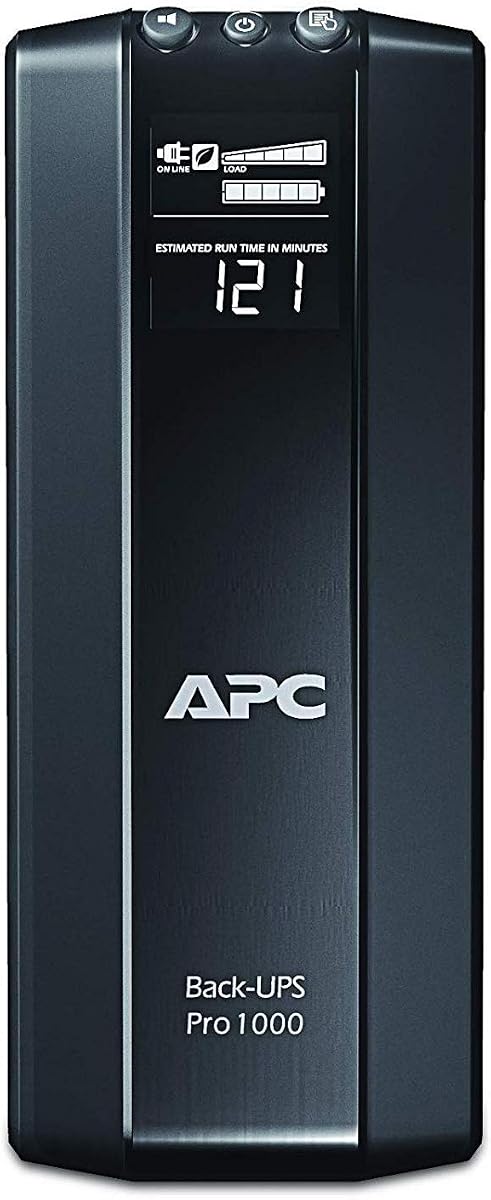
The APC Back-UPS Pro BR1000G is a 1000VA, 600W tower UPS with a 4.6 rating. Although its maximum output is below the full 1000W found in several leading products, it remains a practical choice for protecting a computer, external drive, router, and other essential electronics at a more modest capacity level.
We may earn a commission when you buy through this link, at no additional cost to you.
Its eight NEMA outlets are divided evenly: four provide battery backup and surge protection, while four are surge-protection-only connections. Automatic voltage regulation maintains safer voltage conditions without unnecessarily using the battery. This makes the BR1000G useful in offices and homes where keeping essential network infrastructure and a primary computer alive matters more than powering several large loads.
APC's intelligent battery management uses precision charging to support battery performance, life, and reliability. The product is also positioned for maintaining a wireless router during outages, helping connected devices remain online when the network connection is most valuable. The straightforward tower format fits easily beside a desk or network rack without requiring wall mounting.
The principal trade-off is the 600W maximum output, which is significantly below the 1000W capacity implied by the keyword. It is best for smaller, carefully selected loads rather than a high-power gaming desktop or workstation with several demanding peripherals. Buyers seeking a full 1000W should choose a model explicitly rated for it.
A computer, external storage, and network router can fit comfortably within a smaller UPS budget when the combined load is controlled. The four battery-backed outlets are enough to protect the most essential devices without implying that every connected item should remain on during a long outage.
Automatic voltage regulation helps correct minor line problems without switching to battery power. This can preserve battery reserves for a genuine outage while still stabilizing the power delivered to sensitive equipment.
We may earn a commission when you buy through this link, at no additional cost to you.
The APC Smart-UPS SMC1000C is a 1000VA, 600W line-interactive tower with a 5.0 customer rating. It stands out less for raw wattage than for network-oriented management, making it a compelling option for small businesses, retail systems, entry-level servers, and other installations where remote visibility is valuable.
We may earn a commission when you buy through this link, at no additional cost to you.
Its SmartConnect Ethernet port enables cloud-based monitoring of UPS status, firmware upgrades, remote diagnostics, and proactive email notifications. That visibility can help an administrator identify a developing battery or power problem before it interrupts operations. The pure sine wave output is suitable for a broad collection of sensitive electronics, while automatic voltage regulation keeps output within user-selectable acceptable levels.
Graceful shutdown can be handled through serial or USB connections with PowerChute Serial Shutdown software, helping protect data integrity during extended outages. All eight NEMA 5-15R outlets are included, and the package comes with a 16GB USB storage drive. The LCD gives users local status information when network monitoring is not required or available.
This UPS is best for administrators who value remote management and proactive notifications more than a full 1000W load rating. Its 600W output limit remains important when sizing a server, network switch, and workstation combination. For a small business seeking centralized oversight, however, the SmartConnect feature adds a level of practical control that many residential-oriented competitors do not provide.
The SmartConnect port turns the UPS into a network-aware device rather than an isolated desktop accessory. Cloud status checks, remote diagnostics, and proactive notifications can be valuable when no one is physically present at the installation.
Serial and USB shutdown options give compatible systems a way to power down in an orderly manner during a prolonged outage. This reduces the likelihood of file corruption and abrupt shutdowns compared with simply removing power.
We may earn a commission when you buy through this link, at no additional cost to you.
The APC Smart-UPS SMT1000 provides 1000VA and a stated 700W output in a pure sine wave design. Its eight outlets all offer battery backup and surge protection, and the 4.3 rating reflects a well-established feature set. It is a good option for sensitive office equipment that benefits from clean output and network-grade conditioning.
We may earn a commission when you buy through this link, at no additional cost to you.
Pure sine wave output provides a high degree of compatibility with active PFC power supplies and other sensitive electronics. Solid-state automatic voltage regulation boosts low input voltage and trims high voltage without battery operation, helping extend available runtime by avoiding unnecessary battery transfers. A network-grade conditioning system also helps protect against surges and disruptive noise.
The LCD provides local operating information, while serial, USB, and optional Ethernet connectivity offers management flexibility. A typical recharge time of three hours is stated, which is relevant for users who need the unit ready for successive outages. The output specifications include 120V nominal output and frequency behavior that varies with the synchronized mains frequency.
The SMT1000 is best for offices and home workplaces where every connected AC device should remain powered during an interruption. It offers more universally backed-up outlets than many similarly sized units, but its 700W output is still below the full 1000W capacity emphasized by the keyword. It is a strong fit for a carefully sized network, workstation, or communications installation.
With eight battery-backed and surge-protected outlets, the SMT1000 simplifies system planning. Users can connect several essential peripherals without carefully checking whether a particular outlet provides only surge protection.
Serial and USB connections support local administration, while optional Ethernet support extends remote management. This flexibility makes the unit adaptable to both standalone office equipment and professionally managed installations.
We may earn a commission when you buy through this link, at no additional cost to you.
The APC BX1500M is a 1500VA, 900W UPS with a 4.4 rating and a strong focus on home electronics, network equipment, and user-replaceable battery maintenance. Although it does not reach a full 1000W output rating, it offers a generous VA capacity and a clearly stated runtime benchmark for lighter loads.
We may earn a commission when you buy through this link, at no additional cost to you.
The manufacturer lists up to 68 minutes of runtime at a 100W load. That figure makes the model attractive for routers, modems, external drives, televisions, DVRs, and selected NAS systems that need to remain connected for a moderate period. Active PFC compatibility is also stated, which is useful for modern gaming PCs and other systems with demanding power supplies.
Ten NEMA outlets are provided: five support battery backup and five offer surge protection only. Built-in coaxial and Ethernet surge protection adds another layer of coverage for connected home systems. The replaceable battery uses the APCRBC124, sold separately, allowing a user-replaceable service approach instead of replacing the complete UPS when the battery ages.
The LCD displays battery charge, estimated runtime, load capacity, and input voltage, giving this model better operational visibility than a basic indicator-only unit. Automatic voltage regulation corrects low-voltage brownouts and surges without draining the battery. The main limitation is the 900W maximum output, so buyers with a power-hungry workstation should move to an explicitly 1000W-rated model.
The stated 68-minute runtime at 100W shows how long a network-focused setup can continue operating. Runtime will be shorter with more demanding computers, displays, and network storage, so the load figure is best used for comparing similar systems.
A user-replaceable sealed battery can make maintenance more convenient than a sealed unit requiring a complete replacement. The compatible battery is sold separately, so buyers should include its future availability and cost in their ownership plan.
We may earn a commission when you buy through this link, at no additional cost to you.
A useful UPS selection starts with the connected load, required runtime, and electrical environment. Capacity, waveform, battery life, outlet allocation, communication support, and installation constraints should then be weighed together rather than treated as isolated specifications.
The wattage rating is the maximum output the UPS is designed to support, while VA combines voltage and current characteristics. Search results for 1000W UPS battery backup systems include products with different stated outputs, including 600W, 700W, 900W, and a full 1000W. Buyers who want a meaningful match for the keyword should prioritize a model explicitly rated for 1000W, then confirm that the combined starting and running load of all connected devices remains within that limit. A higher headline VA figure alone does not guarantee more usable wattage.
Pure sine wave output closely resembles utility AC and is generally the most compatible choice for sensitive and modern electronics. The featured CyberPower and multiple lithium models explicitly support active PFC and conventional power supplies. A modified or less clearly specified waveform may be adequate for simple networking equipment but is not the first choice for a high-performance computer, NAS, or sensitive audio system. Confirm that the output specification covers every device you plan to connect.
Runtime depends on how much power you consume and how much usable energy remains in the battery. The APC BX1500M provides a useful example with a stated 68-minute runtime at 100W, while the Everamp lists up to 24 minutes at 500W. These figures should not be treated as universal. Check the manufacturer's load assumptions, leave some capacity headroom, and determine whether the goal is continued operation or simply enough time for an automatic safe shutdown.
Conventional sealed lead-acid batteries are common in affordable UPS units, while the lithium models in this guide use LiFePO4 chemistry. The listed lithium products claim more than 3,000 charge cycles and service lives exceeding ten years, reducing routine battery replacement concerns. A user-replaceable battery can also lower long-term maintenance inconvenience. Consider not only stated cycle life but also the availability of compatible replacement batteries, the expected operating temperature, and the manufacturer's maintenance guidance.
Eight or ten outlets sound generous, but the important distinction is how many provide battery backup. The CyberPower CP1500PFCLCD offers twelve total outlets, with six battery-backed and six surge-only. The APC SMT1000 has eight outlets with backup coverage, and the Everamp provides eight outlets with both functions. Count the equipment that must remain running during an outage, then add the peripherals that only need surge protection. Do not assume a surge-only outlet will keep a router or computer alive.
A detailed LCD helps users understand load, battery status, and estimated runtime without visiting a web portal. Communication support is valuable when a connected computer, Mac, or NAS can request a safe shutdown. The SMC1000C goes further with a SmartConnect Ethernet port, cloud-based monitoring, remote diagnostics, and proactive notifications. These features matter most in unattended or business environments, while a local display and simple alarm controls may be sufficient for a home setup.
Consider where the unit will live, how much space it occupies, and whether it must be mounted. Most models use a compact desktop format, while the wall-mounted GOLDENMATE includes screws and an automatic emergency LED. The GOLDENMATE and ADMLi models specify 90–140V AC input and warn that some generator output may not be recognized, potentially leaving the UPS in battery mode without recharging. Verify wall voltage, grounding, generator behavior, ventilation, and temperature before installation.
A UPS should be understandable during an emergency. Most featured models use a buzzer during abnormal mains conditions, with a button to mute temporarily or enter a persistent silent mode. Displays may shut off after inactivity and reactivate with a press, while some offer a continuous-on setting. Consider recharge time as well; the APC SMT1000 has a typical recharge time of three hours. A model that is quick to understand and clearly indicates its operating state is more useful during a real outage.
Before connecting equipment, place the UPS on a stable, dry surface or securely mount it if the model supports wall installation. Leave the ventilation openings unobstructed, confirm that the outlet voltage is compatible, and connect the input cord to a properly grounded source. Avoid placing the unit near excessive heat, moisture, or a location where its controls and display cannot be reached.
Connect only essential equipment to battery-backed outlets and use surge-only outlets for lower-priority peripherals. Connect a supported computer, Mac, or NAS through the communication port if you want automatic shutdown signaling, and configure the shutdown behavior through the operating system or supplied management software. Check the load indicator before adding more equipment, and use the LCD to become familiar with normal battery, voltage, and runtime readings.
Test the installation by disconnecting utility power or using the manufacturer's test procedure. Confirm that the UPS enters battery mode, the alarm behaves as expected, connected equipment remains running, and the display reports an appropriate runtime. Reconnect utility power afterward and allow the battery to recharge. Periodically check connections, vents, displayed warnings, and battery condition, and replace a compatible battery when the manufacturer indicates that its capacity has declined.
It depends on the model. The ADMLi explicitly states that it automatically restarts and resumes power output after utility power returns following a complete battery discharge. Other units may remain off until manually reset, so check the product instructions and test the behavior before relying on unattended recovery.
Pure sine wave output closely matches normal utility power and is well suited to modern active PFC power supplies, conventional power supplies, NAS devices, and other sensitive electronics. It can also help avoid compatibility issues that may occur with less refined backup waveforms, particularly during transfers to battery power.
A gaming PC can be connected, but the whole setup must remain within the UPS's maximum wattage and surge ratings. Include the PC, monitor, router, speakers, accessories, and any other powered devices in the calculation. Leave headroom because startup surges can temporarily increase demand.
Runtime depends on the connected load, battery condition, and efficiency rather than the nominal wattage alone. A light network load may run much longer than a 500W workstation load. Published examples in this guide include up to 68 minutes at 100W and up to 24 minutes at a 500W load under specified conditions.
A surge-only outlet protects connected equipment from voltage spikes but stops supplying power when utility electricity fails. A battery-backed outlet also supplies power from the internal battery during an outage. Always place computers, network equipment, and other essential devices in the battery-backed group.
Not necessarily. The GOLDENMATE models and ADMLi listing warn that generator output may fail to meet required voltage, frequency, waveform, or grounding conditions. In that situation, the UPS can remain in battery mode and may not recharge. Verify the generator specification and test the system before relying on it.
Avoid daisy-chaining UPS units unless the manufacturer explicitly permits it, as this can create overloaded or unsafe interactions. A surge protector can be useful for devices that do not need battery backup, but the UPS should connect directly to a properly grounded wall outlet and its total output must remain within specification.
Test the battery mode and safe-shutdown behavior at least a few times per year and after firmware or configuration changes. Keep the vents clear, inspect cables and outlets, and review LCD alerts for signs of a weakened battery. Follow the manufacturer's replacement guidance, particularly for user-replaceable sealed batteries.
The CyberPower CP1500PFCLCD is the strongest all-around choice for buyers specifically seeking full 1000W capacity, with a PFC sine wave output, twelve outlets, USB charging, and a detailed tilting color display. The ADMLi and Everamp lithium models are particularly strong for long battery life, clean output, and automatic recovery, while the APC BX1500M stands out for home network use, replaceable battery maintenance, and a useful runtime figure.
Prioritize the factors that match your installation rather than focusing on wattage alone. Confirm pure sine wave compatibility, count the number of battery-backed outlets, understand the expected runtime at your actual load, and decide whether a local LCD is enough or remote management and automatic shutdown communication are necessary. Battery chemistry and installation style also influence long-term convenience.
Finally, review the current listing details before ordering, because prices, availability, ratings, bundles, and included accessories can change. Check the product's input range, outlet coverage, replacement-battery requirements, and current operating specifications, then choose the model that provides the right balance of protection, runtime, and maintenance for your equipment.