
Air Tags for Android 4 Pack
4.2Editor score
Four Android-compatible trackers
Up to two-year battery life
98dB built-in alert speaker
IP65 splash resistance
Native Find Hub operation
Luggage Trackers for Android compared by app compatibility, range, alerts, battery life, water resistance, sharing, and ease of use, helping travelers choose.
Luggage trackers for Android can add valuable visibility to bags, suitcases, wallets, and other travel essentials. A useful tracker should connect to the native Find Hub ecosystem, remain easy to locate, and withstand the handling associated with airports, hotels, commutes, and outdoor trips.
We compared ten trackers based on Android compatibility, Bluetooth range, alert volume, battery design, water resistance, location sharing, encryption, and the availability of UWB or directional features. The list includes Android-only tags, cross-platform models, and rechargeable trackers with materially different setup requirements.
Each review explains the stand-out benefits, limitations, and ideal use for one model. Rankings reflect the supplied specifications and customer ratings rather than personal testing. Product availability and prices can change, so check the current listing and confirm that its platform requirements match your phone before buying.
4.2Editor score

4.8Editor score
4.3Editor score
This side-by-side comparison highlights the major differences among the ten luggage trackers, including platform support, audible range, battery strategy, water protection, and whether precision-finding features are available.

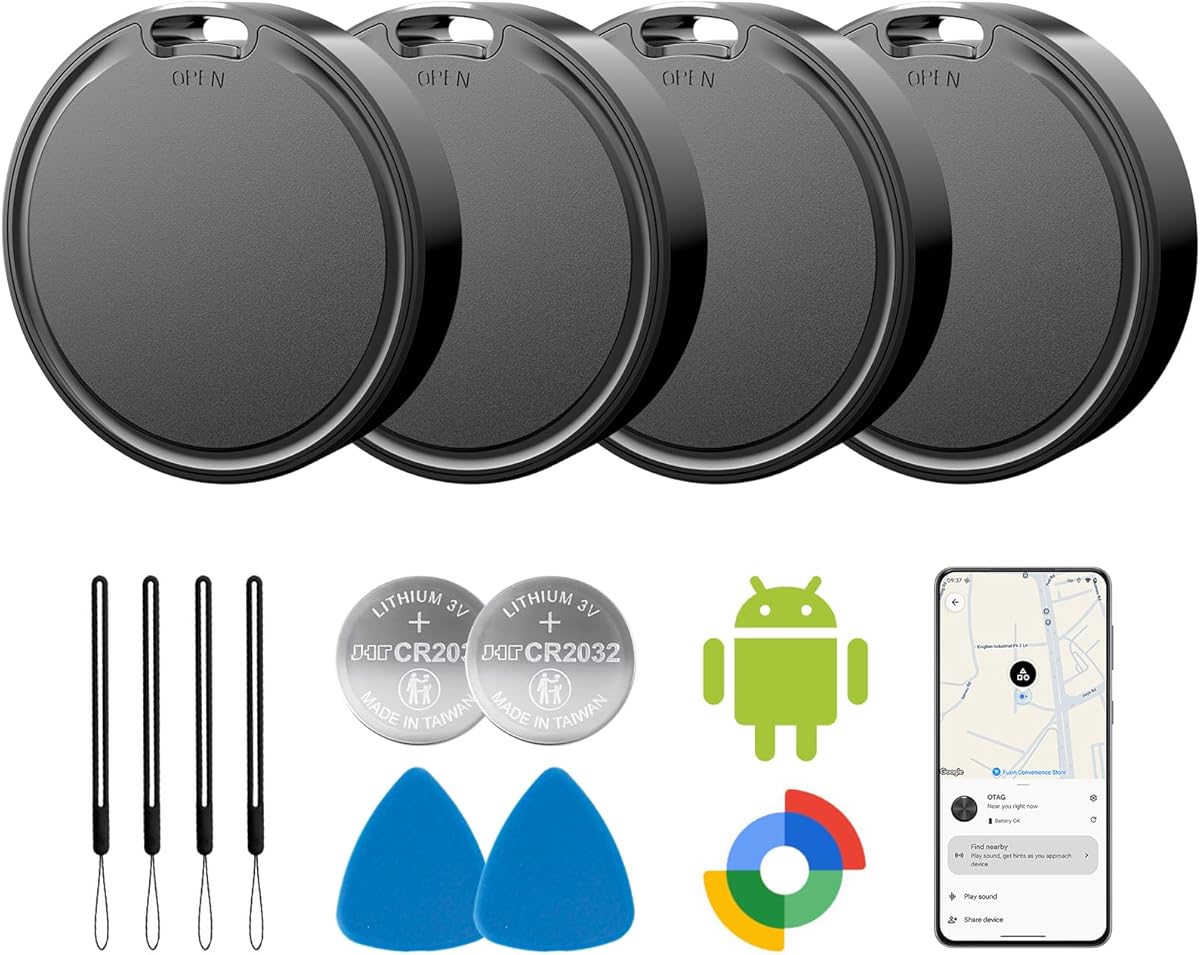
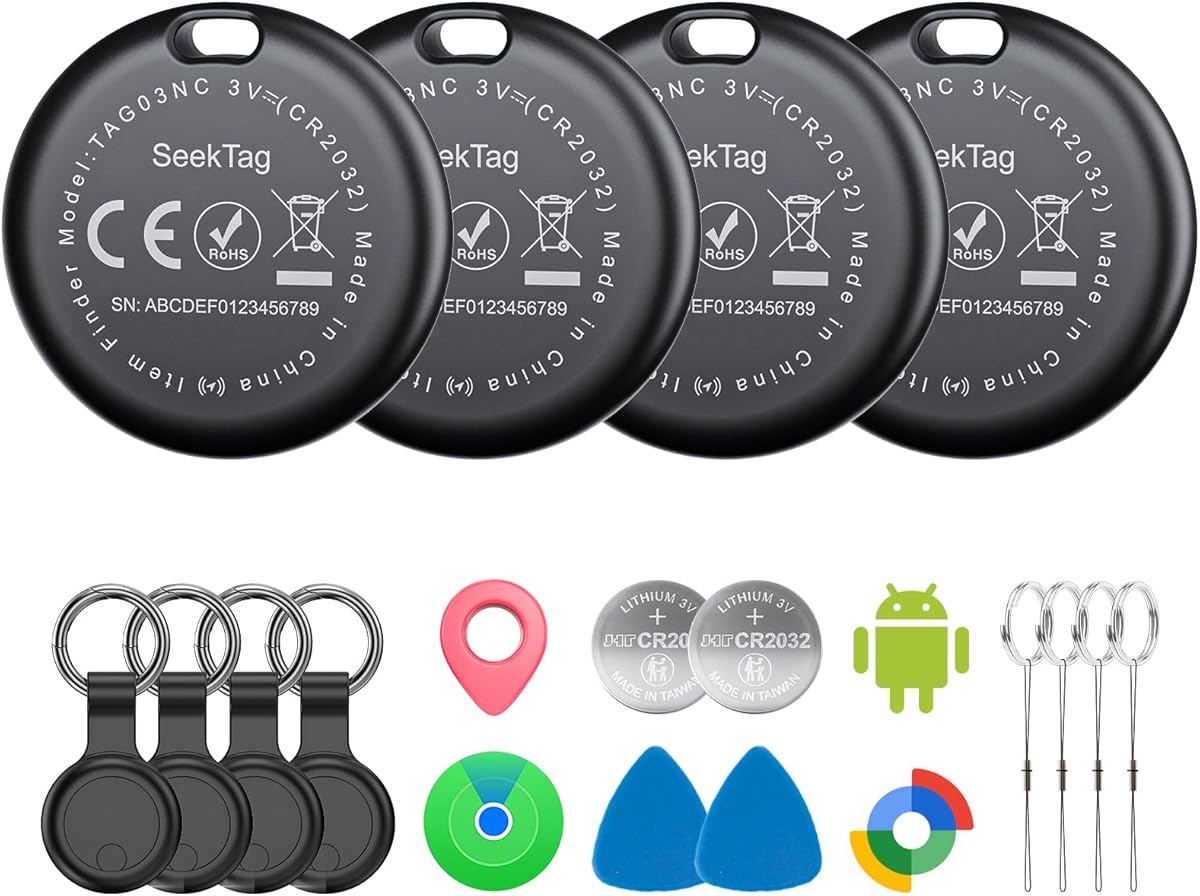

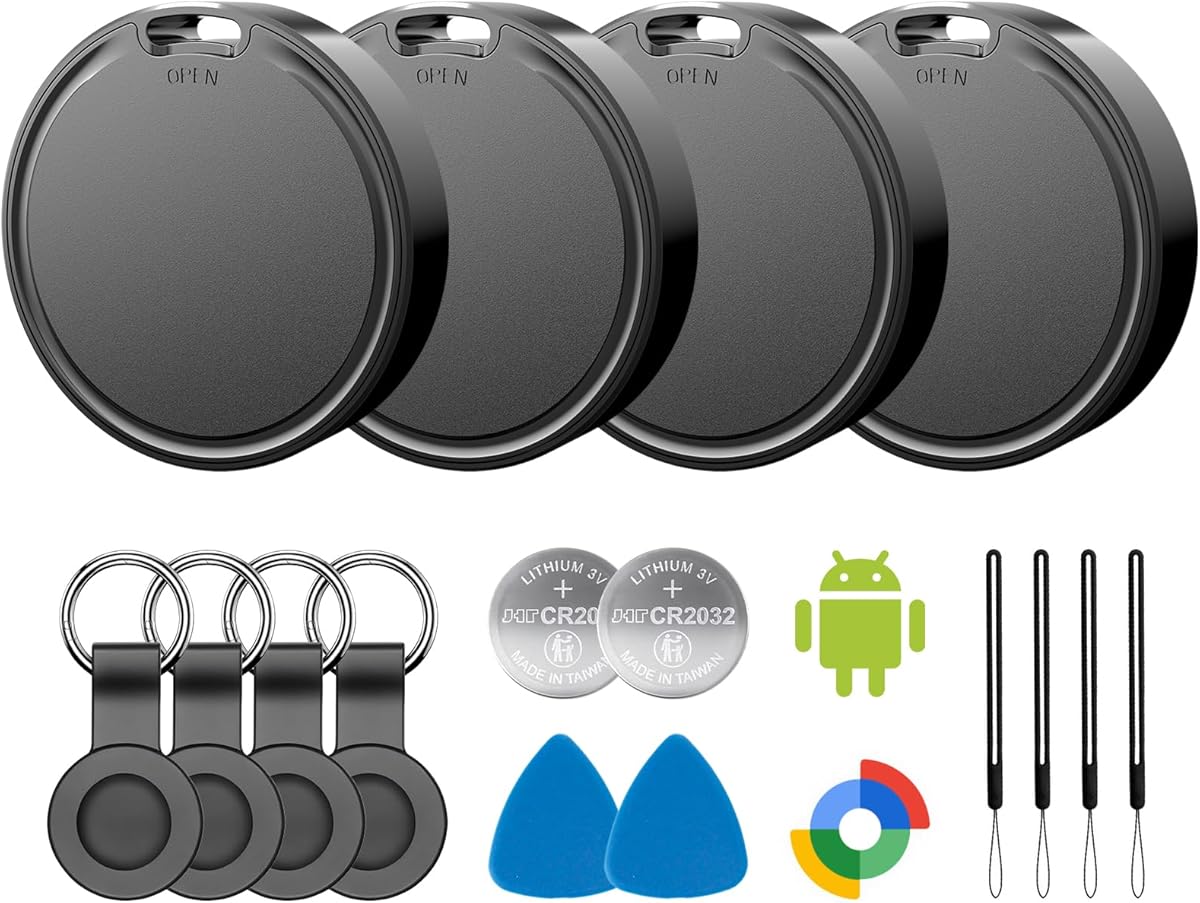


This four-pack is among the most versatile trackers in the roundup, combining support for Google's Find Hub and Apple's Find My with a stated 110dB speaker and up to two years of battery life. Its 4.5 rating reflects a strong combination of travel-friendly features, and the included cases make it easier to attach the tags to suitcases, backpacks, wallets, and other daily items.
We may earn a commission when you buy through this link, at no additional cost to you.
The main attraction is the unusually loud alert. That can be useful in a busy terminal, under furniture, or inside a concealed luggage compartment, although the practical result will depend on how the tag is positioned. UWB distance visualization adds another layer of convenience when the tracker is within Bluetooth range, while the IP66 rating gives it stronger water and dust protection than the IP65-rated alternatives in the list.
There are important platform qualifications. The supplied information says it supports Android 9 and above and works with Google Find Hub, but it excludes GPS and Huawei devices. It also operates through native applications rather than a dedicated app, and users should carefully distinguish cross-platform compatibility from simultaneous pairing across Android and iOS. Battery claims of up to two years are also dependent on real-world use and settings.
This is a strong choice for travelers who want a loud, long-lasting tag with broad phone compatibility. It is particularly suitable for households containing both Android and Apple users, provided each tag is associated with the appropriate native ecosystem. Choose it when audible finding, case accessories, and environmental resistance matter more than rechargeable convenience.
The listed 110dB speaker is the most prominent specification in this group. It should make the tag easier to hear around luggage, furniture, or travel clutter, but users should still check local rules and avoid covering the speaker.
Support for both Find Hub and Find My broadens the potential audience. Because this is a network tracker rather than a standalone GPS device, its remote location reports depend on compatible devices detecting the tag in the surrounding area.
We may earn a commission when you buy through this link, at no additional cost to you.
This Android-specific four-pack offers a straightforward route to locating luggage through Google's Find Hub, and it carries a 4.0 customer rating. Its combination of a two-year stated battery life, IP65 protection, an 85dB speaker, and UWB distance visualization makes it a practical option for travelers who do not need Apple compatibility.
We may earn a commission when you buy through this link, at no additional cost to you.
It works with Android 9 and later devices, including several major Pixel, Xiaomi, Sony, Sharp, Oppo, and Rakuten models listed in the product information. No separate application is required, which reduces setup friction. The tag can be attached to keys, wallets, backpacks, and suitcases, while shared location support lets family members assist with a search.
The main trade-offs are platform restriction and alert volume. It is explicitly not compatible with Apple or Huawei devices, so it is less versatile for mixed-device households. Its 85dB speaker is quieter than the 98dB, 105dB, and 110dB options elsewhere in the roundup, and IP65 protection is intended primarily for rain and splashes rather than prolonged submersion.
This model is best for an Android-only user who values native Find Hub operation, four included tags, and long maintenance intervals. It makes more sense than a premium rechargeable model when disposable-battery simplicity and a straightforward multipack are your primary requirements.
Using Google's native tracking application reduces the need to learn a separate interface. First-time users can add the tag to Find Hub and use the available map, sound, and sharing functions from the app they already use on an Android phone.
The UWB feature is useful when the bag is close but still difficult to identify, such as under a seat or beside a hotel desk. Remote accuracy still depends on the reporting network and the availability of nearby compatible Android devices.
We may earn a commission when you buy through this link, at no additional cost to you.
This four-pack combines a 4.2 rating with a 98dB speaker, up to two years of stated battery life, and four protective cases. It is a balanced Android luggage tracker for travelers who want more than a single tag without paying for a model that emphasizes rechargeable or premium industrial design.
We may earn a commission when you buy through this link, at no additional cost to you.
Its compatibility list includes Android 9 and above on devices from Google, Xiaomi, Sony, Sharp, Oppo, and Rakuten. The tracker uses Google's Find Hub natively, supports UWB distance visualization, and can share its location with family or friends. The supplied cases make attachment to different bag handles, wallets, and backpacks more practical than using an unencased tag alone.
The model is not designed for Apple users, and the product information also excludes Huawei devices. Its IP65 rating should be understood as protection against rain and splashes, not a guarantee against every form of water exposure. The two-year battery figure is a maximum claim, and using sound alerts, lost mode, or frequent map checks may shorten the interval between replacements.
This is a strong general recommendation for Android travelers who want four tags, a relatively loud speaker, and protective cases in the set. It also suits users who want to track several travel essentials at once, such as suitcases, backpacks, wallets, and keys, without relying on a dedicated third-party application.
Four trackers cover more than a single suitcase. You can assign tags to luggage, a backpack, a wallet, and keys, reducing the need to move a single device whenever you need to identify the bag that contains it.
The included cases are a meaningful convenience for luggage use. They provide a more secure attachment point and help protect the tag from everyday knocks while it rides inside a suitcase or rides attached to a bag.
We may earn a commission when you buy through this link, at no additional cost to you.
This four-pack sits between the louder models in the list and the more restrained Android-only options. It has a 4.3 rating, a claimed 105dB alert, up to two years of battery life, IP65 protection, and support for both Google's Find Hub and Apple's Find My. That makes it a well-rounded choice for travel groups using different phone brands.
We may earn a commission when you buy through this link, at no additional cost to you.
The tags support Android 9 and later as well as compatible iPhones and iOS devices. Four cases are included for attachment, and the built-in speaker offers more than enough stated volume for many close-range searches. UWB distance visualization, encrypted location information, and shared tracking round out the feature set without requiring a separate app.
Cross-platform support should not be confused with simultaneous cross-platform pairing. The supplied details do not claim that one tag can remain connected to Android and iOS networks at the same time. Huawei and GPS-device compatibility is excluded, and remote location updates rely on the relevant find network rather than continuous GPS reception. The stated battery duration also varies with usage.
Buy this model if your household or travel group includes both Android and Apple users and you want a four-pack with cases, loud alerts, and long claimed battery life. It is particularly suitable for shared luggage, although travelers with only Android devices may find a more focused Android model simpler.
The dual-ecosystem support is the defining benefit for a mixed household. A tag can work with the appropriate native service, allowing Android users to use Find Hub and Apple users to use Find My without requiring a manufacturer-specific mobile application.
A 105dB claimed speaker helps when a tracker is buried under clothing or luggage. Sound level can vary with distance, placement, ambient noise, and whether the speaker opening is obstructed, so test it in a quiet location after setup.
We may earn a commission when you buy through this link, at no additional cost to you.
This four-tag set provides a 95dB speaker, up to two years of stated battery life, IP65 protection, and UWB distance display. Its 4.1 rating and inclusion of four cases place it among the practical middle-ground options for Android users who want complete luggage and everyday-item coverage.
We may earn a commission when you buy through this link, at no additional cost to you.
Compatibility is listed for Android 9 and above on Google Pixel, Xiaomi, Samsung Galaxy, Sony, Sharp, Oppo, and Rakuten devices. Tags use Find Hub directly, require no separate application, and support location sharing. As with the other network-based trackers, remote updates depend on compatible devices nearby rather than a dedicated cellular connection.
The tag is limited to the Android ecosystem, and the listing specifically excludes Apple and Huawei devices. Its speaker is quieter than the 105dB and 110dB alternatives, although 95dB remains a useful level for finding a tracker in a nearby room. IP65 protection is best understood as resistance to splashes and rain rather than full submersion.
Choose it for an Android household that values a long claimed battery interval, included attachment cases, and support for a broad range of phone brands. It is especially suitable for travelers who want tags for several suitcases or related belongings and do not need cross-platform functionality.
The listed compatibility includes Google Pixel and Samsung Galaxy devices, covering two of the most common Android families. Check the tag's current setup instructions and your phone's operating version before attaching it to a bag.
The advertised battery duration of up to two years reduces the need to monitor a tag constantly. Actual runtime depends on alert frequency, connection behavior, and network reporting, so it is wise to verify the tag before every major trip.
We may earn a commission when you buy through this link, at no additional cost to you.
This Android four-pack delivers the core features most travelers expect from a luggage tag: native Find Hub operation, a stated two-year battery life, IP65 protection, shared location, and an 85dB speaker. Its 4.1 rating and inclusion of four cases make it a functional option for people who want to cover several belongings at once.
We may earn a commission when you buy through this link, at no additional cost to you.
It supports Android 9 and above on listed Google, Xiaomi, Samsung Galaxy, Sony, Sharp, Oppo, and Rakuten devices. The UWB distance display helps narrow down the search when the tag is nearby, while the map and remote network provide broader location information when other compatible Android devices are available to report it.
The speaker is the main compromise. At a listed 85dB, it is quieter than several competing models, which may matter in noisy terminals or when the tag is deeply buried in luggage. The product does not support Apple or Huawei devices, and IP65 is splash resistance rather than unrestricted waterproofing. Remote tracking is also network-dependent.
This model suits Android users who prioritize a multipack, long maintenance intervals, and a native application over maximum alert volume. For compact travel gear, keys, wallets, and luggage that will remain within audible range, it is a straightforward choice.
The lack of a separate app simplifies ownership. Pair and view the tag through Find Hub, then use sound, distance information, shared access, and the map without learning a separate interface.
Four tags and four cases provide enough coverage for a travel group or several bags. Assigning one tag to each item avoids removing and transferring a single tracker whenever a different piece of luggage needs attention.
We may earn a commission when you buy through this link, at no additional cost to you.
The Reyke four-pack is a Bluetooth item finder built for Android 9 and later or iOS 14 and later, with a 4.8 rating—the highest in this group. It works with Find Hub or Find My, provides a stated Bluetooth range of up to 180 feet, and includes Lost Mode without a subscription. Its clearest selling point is straightforward documentation of what the tag can and cannot do.
We may earn a commission when you buy through this link, at no additional cost to you.
Within Bluetooth range, the built-in speaker can help locate an item by sound. Outside that range, the corresponding native app displays the last reported location, and Lost Mode uses nearby Android or iOS devices in the relevant network to assist with recovery. Sharing with up to five additional people is available, subject to the stated Android 9 and iOS 17 system requirements.
This is not a GPS tracker and does not support UWB precision finding or directional arrows. A tag also cannot be paired with Android and iOS devices simultaneously. These limitations reduce its appeal for buyers who need detailed distance guidance, but they are clearly stated, allowing users to choose the tag without assuming capabilities that are not present.
This is the most balanced recommendation for travelers who value privacy, clear setup expectations, and native-network integration. It is particularly useful for shared luggage and mixed-device families. Its IP66 water and dust resistance also makes it better suited to demanding travel conditions than a tag with only basic splash protection.
Reyke explicitly explains that this is a Bluetooth finder rather than GPS hardware. That clarity makes it easier to decide whether the network-based location and sound-finding approach matches your expectations.
The product information states that location data is encrypted and not stored on the device. It also supports Lost Mode without a recurring fee, making it easier to keep tracking available throughout the life of the tag.
We may earn a commission when you buy through this link, at no additional cost to you.
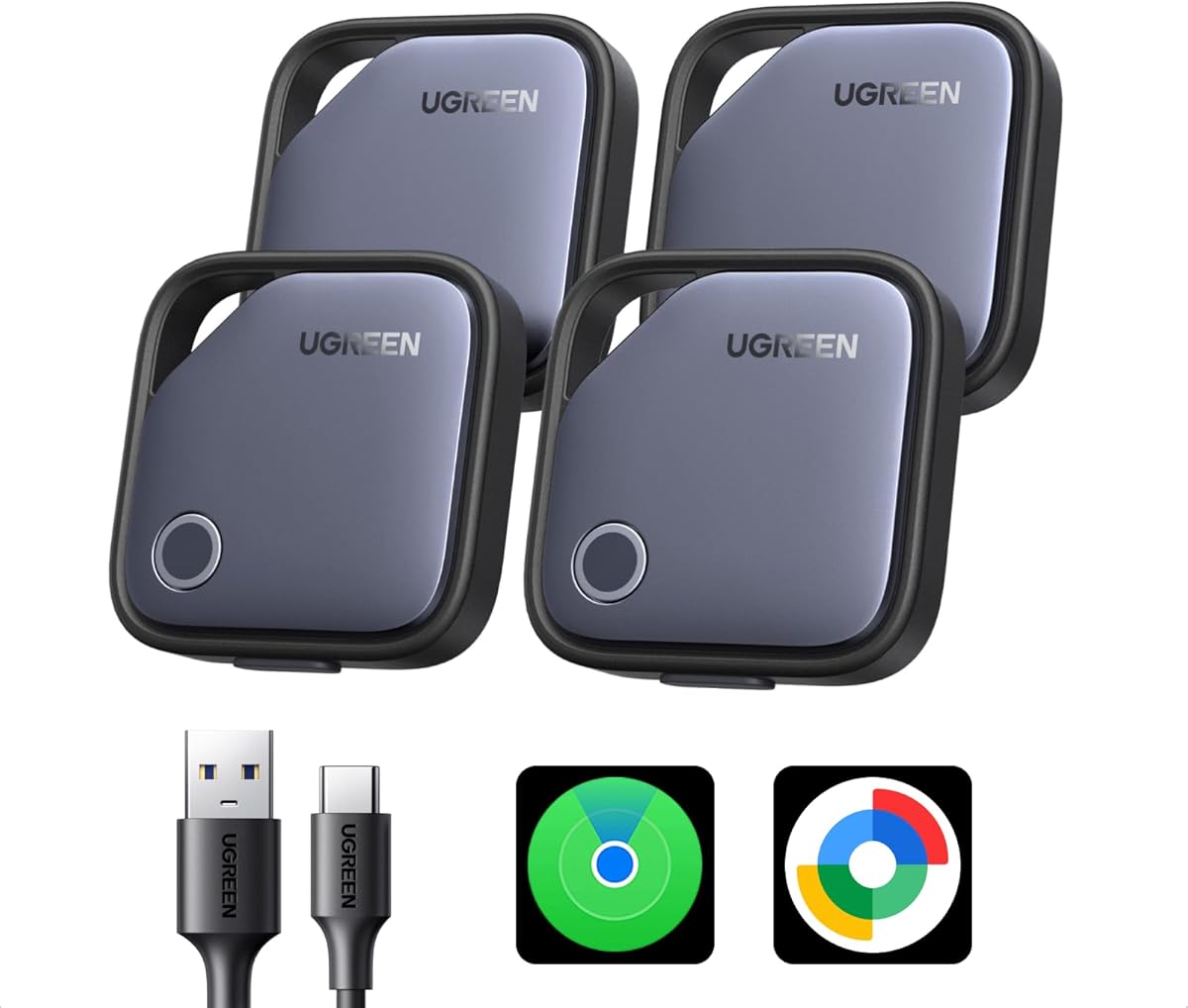
UGREEN's four-pack is the premium choice for users who prefer a rechargeable tracker over replaceable coin cells. It has a 4.3 rating, supports Find My or Find Hub, and promises up to 365 days of continuous use from one full charge. USB-C charging and a protective dust plug distinguish it from the disposable-battery alternatives.
We may earn a commission when you buy through this link, at no additional cost to you.
Setup is designed to be simple: pair the tag with an Android or iPhone and add it through the appropriate Items tab. Nearby searches use a sound, while remote location information comes from the extensive network of Apple or Android devices. Lost alerts, Lost Mode, and family sharing are included without subscription fees.
The main drawback is that rechargeable does not mean maintenance-free. A full year is a maximum claim, and you will need to check and recharge the tracker before a trip, especially if you rely on it for a long holiday. Each tag also connects to one platform at a time, and the product information notes that Google Find Hub does not support the same loss-reporting experience as Apple's service.
Choose this tracker when sustainable recharging, recognizable certification, strong encryption, and long intervals between charges matter more than disposable batteries. It is a polished option for frequent travelers and households that want a four-tag system with no recurring service charge.
USB-C charging works with the cable and charger many travelers already carry. The included dust plug helps protect the charging port, and the stated 365-day runtime reduces the frequency of charging compared with shorter-lived rechargeable designs.
The tracker is described as certified by Apple and Google, with end-to-end encryption, anonymous communications, and no location data stored on the device. These features make it appealing to users who want reduced cloud-data exposure.
We may earn a commission when you buy through this link, at no additional cost to you.
This four-pack stands out for its 110dB speaker, IP66 water resistance, up to two years of stated battery life, and six included cases. It has a 4.4 rating and uses Find Hub for Android users. The generous case count is particularly useful if you plan to attach the tags to several suitcase handles, bags, wallets, or travel accessories.
We may earn a commission when you buy through this link, at no additional cost to you.
The supplied information lists Android 9 and above compatibility across Google Pixel, Xiaomi, Sony, Sharp, and Oppo devices. It includes UWB distance visualization, encrypted location data, family sharing, and native-app operation. Those features make it a capable choice for travelers who want to know both approximately how far away a tracker is and where it was last reported.
There is some inconsistent platform wording in the listing: the title and main bullet emphasize Google's Find Hub and Android, while one compatibility bullet mentions iOS before excluding it. The safest interpretation is that this model is intended for Android and not for Apple or Huawei devices. Confirm the current packaging and instructions before purchasing if cross-platform use is essential.
This tracker is a good fit for Android users who prioritize a loud alert, several attachment cases, and a strong water rating. It is less suitable for mixed-platform households, but it provides an otherwise well-rounded Android package for frequent travelers.
The 110dB claimed output is ideal for users who expect to search noisy or cluttered environments. Placement matters, however, because a tag buried under clothing or luggage may not sound as clear as one with an unobstructed speaker.
Six cases exceed the case count offered by most four-packs. That makes the set easier to distribute across luggage and personal items, and provides spare cases if one is lost or a different attachment method is needed.
We may earn a commission when you buy through this link, at no additional cost to you.
This tracker offers a 4.5 rating, a 90dB buzzer, up to two years of stated battery life, and compatibility with both Apple Find My and Android Find My Device. It is designed for users who want one tag to work across widely used native ecosystems without downloading a third-party application.
We may earn a commission when you buy through this link, at no additional cost to you.
The tracking model combines a nearby Bluetooth sound alert with global location information from the relevant device network. It can be attached to keys, wallets, backpacks, purses, suitcases, travel bags, laptops, and pet carriers, giving it uses beyond formal air travel. The replaceable CR2032 battery is a familiar format that many travelers can source independently.
Its rugged outer casing is described as splash resistant rather than carrying a formal IP rating. That distinction matters if the bag will be exposed to rain, drink spills, or damp outdoor environments: the housing offers some protection but should not be treated as a fully waterproof device. The listing also does not mention UWB, so it is better suited to general sound and map-based finding than precision direction.
Choose this tracker if you want cross-platform ecosystem support, a long claimed battery interval, and a familiar replaceable battery. It is a sensible all-purpose option for keys, luggage, and everyday valuables, provided its splash-resistant construction matches the conditions it will face.
Compatibility with Apple Find My and Android Find My Device makes the tracker useful in homes that include different operating systems. As with other network tags, location reports depend on compatible devices encountering the tag.
The CR2032 format makes routine battery replacement more familiar than managing a proprietary rechargeable cell. Check the tag before leaving for a trip because the maximum two-year claim will vary with alert and network usage.
We may earn a commission when you buy through this link, at no additional cost to you.
The right Android luggage tracker depends on your phone, travel conditions, and tolerance for maintenance. Compare network compatibility, sound output, battery design, protection, and sharing features before making a choice.
First confirm that the tracker works with your version of Android and the native Find Hub application. The products in this roundup generally support Android 9 and above, while the Reyke model also lists iOS 14 and later. Google Find Hub requires nearby compatible Android devices to relay location reports, so it is fundamentally a crowd-sourced Bluetooth tracker rather than a device with continuous cellular or GPS connectivity.
Bluetooth range determines when you can trigger an audible search directly from your phone. Reyke states a range of up to 180 feet, while the other products do not provide a clearly specified range in their supplied information. Speaker outputs range from 85dB to 110dB, which can be meaningful in a busy airport, but placement, obstacles, luggage contents, and background noise will influence the result.
Several tags claim UWB-based distance visualization, allowing the phone to show how far away an item is within Bluetooth range. This is useful for distinguishing a bag under the nearest row of seats from one several rows away. Reyke explicitly does not support UWB precision finding or directional arrows, and the UGREEN listing does not mention UWB either. Do not treat network map coordinates and directional distance as interchangeable features.
Most options claim up to two years of battery life using replaceable cells, while UGREEN uses a rechargeable design with USB-C charging and a stated 365-day runtime. Replaceable batteries can be convenient for long trips, but you must carry a suitable cell or buy one separately. A rechargeable tag reduces disposable waste but needs a charging reminder before departure. Actual runtime varies with sound alerts, connection behavior, and network reporting.
Water-resistance ratings help indicate how well a tracker can handle travel exposure. IP65 models are described as resistant to rain and splashes, while Reyke and the strongest Air Tags option carry IP66 water and dust protection. The generic Bluetooth Tracker Tags has a rugged, splash-resistant casing but no stated IP rating. None of these descriptions should be interpreted as permission for prolonged submersion or deliberate immersion.
Shared location can be invaluable when another family member retrieves a bag or a traveler cannot access the phone. Most Air Tags models and Reyke support shared viewing, with Reyke allowing up to five additional users under its stated system requirements. UGREEN also supports family sharing, although the availability of location-sharing functions depends on operating-system versions. Confirm that everyone who needs access has a compatible device and permitted app version.
Location reports can reveal where you live, travel, and spend time. The supplied listings state that location information is encrypted, while UGREEN specifically claims end-to-end encryption, anonymous communications, and no location data stored on the device. Privacy protections are important because tracker networks depend on reports passing through participating devices. Review permissions, sharing settings, and platform privacy controls after pairing.
Lost Mode can make a missing item easier to recover by allowing compatible devices in the network to report its presence. The Air Tags models list global cloud positioning and sharing, Reyke supports Lost Mode without a subscription, and UGREEN provides Lost Mode and lost alerts. Android behavior has platform differences: UGREEN notes that Google Find Hub does not support loss reports and can only activate Lost Mode, which notifies the phone when other Android devices are nearby.
Begin by confirming that your Android phone meets the tag's operating-system requirements. Charge a rechargeable model fully, install the appropriate coin cell in a disposable-battery model, and then use Google's Find Hub to pair the tracker. For a cross-platform tag, complete setup with the ecosystem you intend to use rather than assuming the tag can remain paired to both Android and iOS simultaneously.
Place the tracker where it is unlikely to be removed or blocked. Attach it to a suitcase handle, inside a zipped pocket, or another secure location, and use the supplied case when available. Test the sound alert at a short distance before relying on it in a busy terminal. Open the map and shared-location features as well so you know how the tag behaves both nearby and when the location is supplied by another device.
Check the tag before every journey, especially after a long period in storage. Recharge a USB-C model, or replace the battery in a coin-cell model, and confirm that the tag appears in the app. Keep the charging port cover closed on rechargeable trackers, avoid prolonged submersion, and clean the housing with a lightly damp cloth. If the tag becomes missing, activate the appropriate Lost Mode and review the app's guidance for the connected platform.
Most trackers in this roundup are Bluetooth item finders that use Google's Find Hub network rather than dedicated GPS hardware. They can display a last reported location when compatible Android devices encounter the tag. Reyke is especially explicit that its product is a Bluetooth tracker and not a GPS tracker, so location updates may not be continuous or perfectly precise.
A direct Bluetooth sound alert can generally be triggered when the tag and phone are nearby, even without a remote location update. Finding the tag at a distant location depends on network reporting by compatible Android devices and therefore requires connectivity. The map may show only the last known report when the network cannot provide a newer one.
Several products support either ecosystem, but the supplied details clarify that a tag cannot be paired with Android and iOS devices simultaneously. You may need to disconnect and re-pair it when changing ecosystems, and location is not automatically synchronized between both apps. Choose based on the platform used most often or the needs of your household.
Most products in this list specify Android 9 and above. Reyke also supports iOS 14 and later, while some sharing features require newer system versions, including iOS 17 for certain functions. Confirm both the tracker's base requirement and the specific feature you want before purchasing.
The listed speaker outputs range from 85dB to 110dB. A higher rating may help in noisy spaces, although real-world audibility depends on distance, obstructions, bag construction, and ambient noise. Test the sound in a controlled area and keep the speaker opening unobstructed for the best result.
Most models here have IP65 protection, while Reyke and two Air Tags options have IP66 ratings. These ratings indicate improved resistance to rain, splashes, and dust, but they do not mean the tracker is intended for prolonged submersion. Keep rechargeable ports covered and avoid exposing any model to water beyond its stated rating.
The supplied information for Reyke and UGREEN states that no subscription is required for the described tracking and Lost Mode functions. Other models also use native tracking applications without mentioning a recurring fee. Still, review the current listing and platform terms when shopping, as service policies can change.
Choose a secure location that is unlikely to be opened or removed during handling. A suitcase handle, protected exterior pocket, or zipped interior pocket can work, but the tag should not be exposed in a way that encourages theft. Use a case and leave the speaker opening clear, then confirm that the tracker still sounds and updates in the app.
The Reyke Dual-System four-pack is the strongest all-around recommendation for its clear platform documentation, 4.8 rating, 180-foot stated Bluetooth range, IP66 protection, Lost Mode without a subscription, and support for sharing with several people. The Air Tags Android set with four cases represents the best budget-oriented package, while UGREEN Finder Duo is the premium rechargeable option for users who value USB-C charging and strong privacy protections.
Prioritize Android and network compatibility before any secondary feature. Confirm your operating-system version, decide whether you need iOS support, and choose between disposable batteries and a rechargeable design. Loud alerts and UWB guidance help in close-range searches, while IP65 or IP66 protection adds confidence during wet-weather travel.
Product listings, availability, and prices can change, so check the current offer before purchasing. Also review the included cases, the platform's Lost Mode behavior, and the need to pair with only one ecosystem at a time. A short test after setup can prevent surprises on your next trip.