
Samsung T7 1TB
4.7Editor score
Up to 1,050MB/s read speed
Compact aluminum unibody design
Four-terabyte capacity range
External SSD for Mac Mini M4 guide comparing 10 top models for speed, capacity, durability, compatibility, backups, and creative workflows.
An external SSD for Mac Mini M4 can transform a compact workstation into a more flexible creative system by adding fast, portable storage. The right drive should suit your Mac’s USB-C ports, sustain useful transfer speeds, remain cool under load, and provide enough capacity for media libraries, project files, and backups.
This guide compares ten external SSDs based on the supplied specifications, including interface speed, storage capacity, dimensions, durability, encryption, compatibility, and cooling features. It covers options using USB 3.2 Gen 2, USB 3.2 Gen 2×2, and Thunderbolt 3, from compact everyday drives to high-capacity professional models.
Each review explains who benefits most from a particular drive and where important compromises appear. The selections range from a budget-friendly Samsung T7 to a premium SanDisk Professional model, while an ORICO enclosure stands out for expanding a Mac mini with NVMe storage and additional ports. Prices and availability change.
4.7Editor score

4.4Editor score
The comparison below highlights each drive’s interface, headline transfer speed, capacity, and strongest practical feature. The products span different price tiers and use cases, so the most useful choice depends on whether your priority is Mac mini expansion, routine backups, maximum throughput, portability, or rugged professional storage.




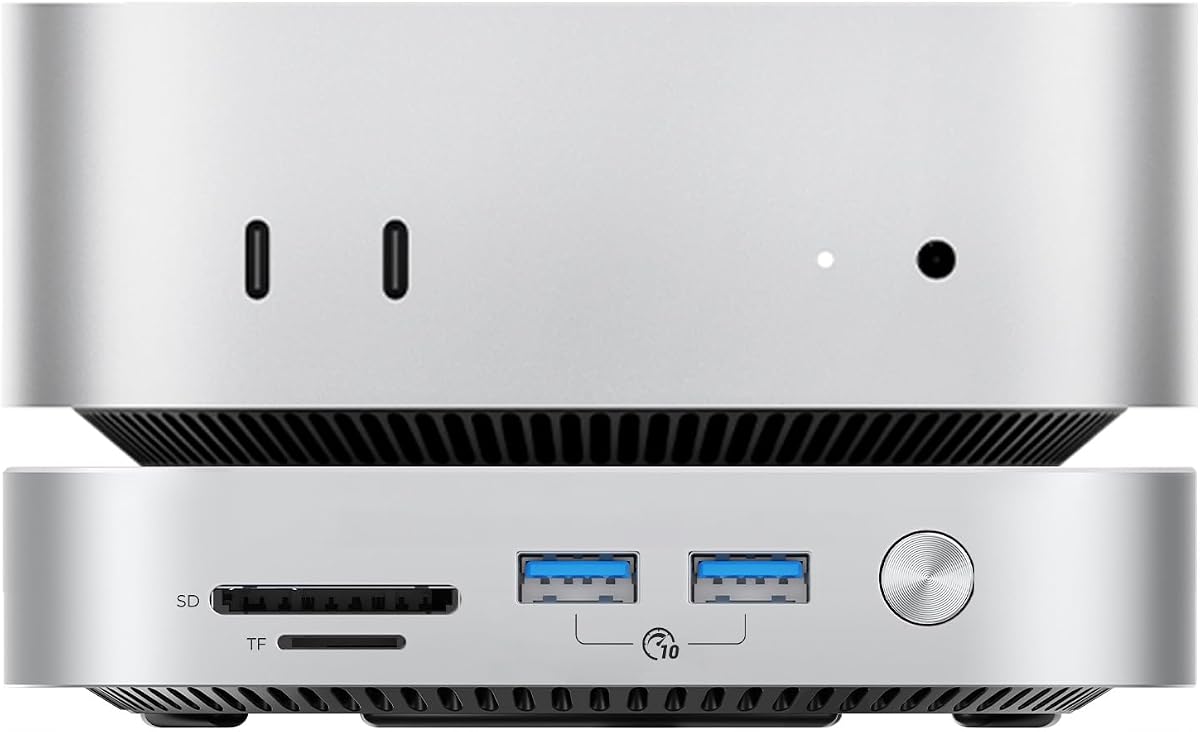
The ORICO 2TB Mac Mini Expansion is the most purpose-built option in this guide because it is designed to attach to the Mac mini rather than sit beside it as a generic external drive. Its supplied information highlights 2TB of NVMe storage, transfer speeds up to 3,200MB/s, and compatibility with M-series Macs, including the M4 and M4 Pro. The product has no listed customer rating, so its appeal here rests on its specified design rather than a numerical review score.
We may earn a commission when you buy through this link, at no additional cost to you.
Its main advantage is the combination of storage and connectivity. Attaching the unit beneath a Mac mini can add high-speed storage without occupying a desk with another full-size enclosure, while the three USB 3.0 ports and SD/TF 4.0 reader broaden the available connections. The included USB-C and USB-A cables, anti-slip base, and three-year warranty make the package feel focused on immediate use. Certification for macOS Sonoma, Time Machine compatibility, and support for M1 through M4 chips also suit users who want a coordinated Apple-style setup.
Cooling is another useful feature. The aerospace-grade aluminum body and internal thermal channels are intended to sustain peak performance, and the smart sleep function is claimed to reduce power use by 70% while idle. The trade-off is that this is a more specialized system than a conventional portable SSD. Its title also references Mac mini M6 and M5 Pro models, which may create confusion, and the product does not provide a conventional numerical rating that can be compared directly with the other picks.
This is the strongest recommendation for a Mac Mini M4 owner who wants a single accessory that adds storage, card-reader functionality, and USB ports while preserving a compact desktop arrangement. It is especially appealing to photographers, video editors, and developers who regularly move files between cameras, cards, and the Mac mini. Buyers who only need one dependable backup drive may find a simpler portable SSD easier to justify, but for integrated expansion, the ORICO is the most distinctive choice.
Attaching 2TB of NVMe storage directly to the Mac mini creates a dedicated workspace for active media, project files, and archives. The stated 3,200MB/s throughput is particularly relevant when moving large camera files or maintaining a high-volume editing library.
Three 10Gbps USB-A ports and an SD/TF 4.0 reader reduce the need for separate adapters around the computer. This makes the enclosure useful as a compact hub as well as a high-speed storage device.
We may earn a commission when you buy through this link, at no additional cost to you.
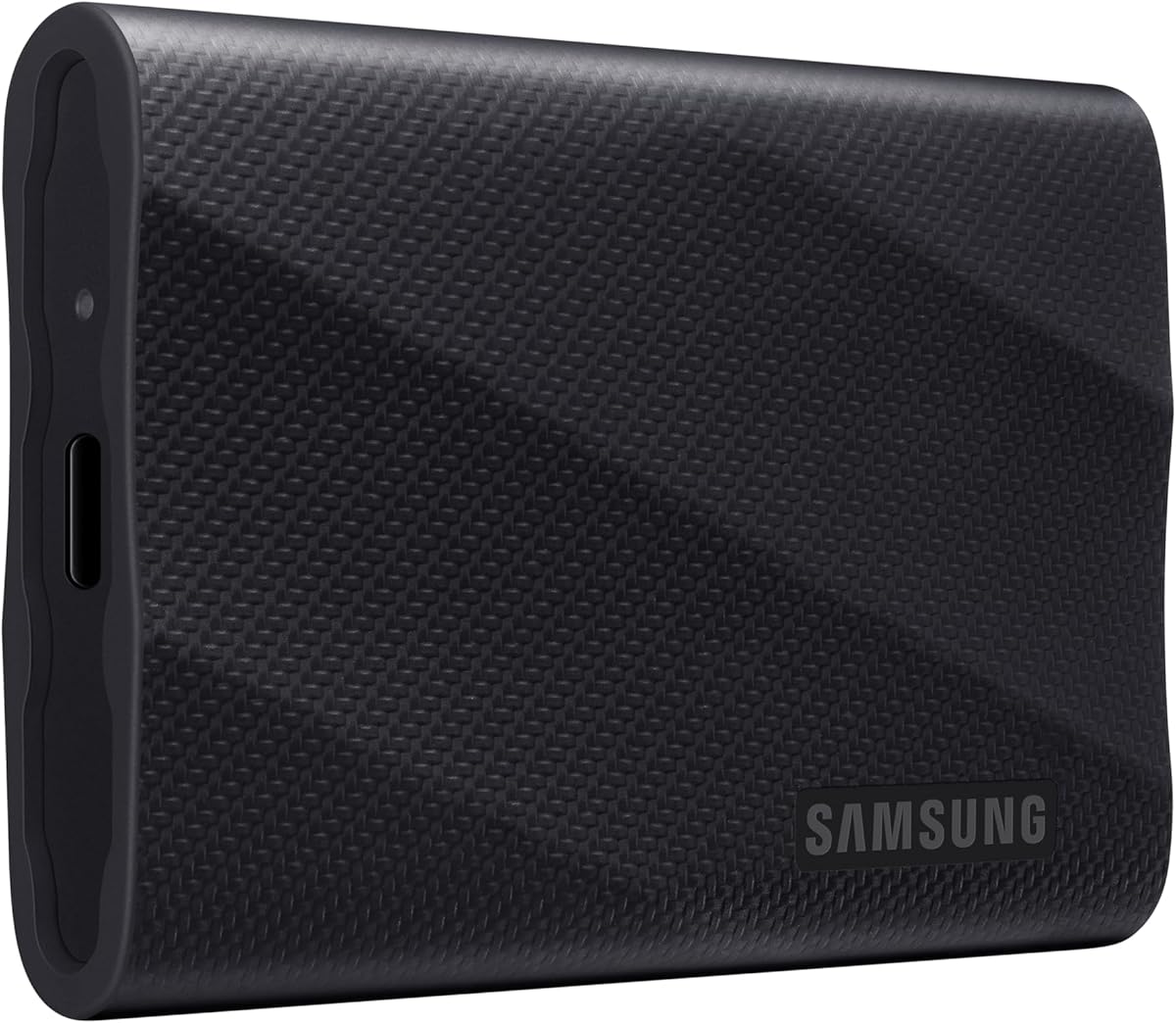
The Samsung T7 Portable SSD 1TB combines a 4.7 rating with a mature, approachable design, making it a strong all-purpose choice for a Mac Mini M4. It uses USB 3.2 Gen 2 and is specified at up to 1,050MB/s read and 1,000MB/s write. The compact aluminum enclosure is easy to carry, while the drive’s broad device support makes it useful beyond the Mac mini.
We may earn a commission when you buy through this link, at no additional cost to you.
This drive is well suited to routine creative work. Its PCIe NVMe foundation allows large photo collections and video projects to move quickly, and the stated speeds are nearly twice those of the preceding T5 generation. It can also serve as a direct-recording destination for 4K 60fps video from compatible cameras and mobile devices, including the iPhone 15 Pro in the supported high-resolution mode. That flexibility is valuable for users who move between desktop, camera, and phone workflows.
The design prioritizes durability without becoming bulky. Its solid aluminum unibody construction provides shock resistance and fall protection up to six feet according to the supplied information. Samsung also states that its firmware and components are produced in-house, including DRAM and NAND, which supports consistency across the product line. The main limitation is speed when compared with Gen 2×2 and Thunderbolt 3 alternatives. Its maximum capacity range goes up to 4TB, but this particular version is 1TB.
For most Mac users who need a dependable drive for Time Machine, project storage, media transfer, or a portable working library, the T7 offers an excellent balance of price-conscious practicality, strong ratings, durability, and manageable size. It is not the fastest option in the guide, but it does not require Thunderbolt hardware or a specialized workflow to deliver useful performance.
Up to 1,050MB/s read speed makes the T7 well suited to moving high-resolution photographs, editing caches, and completed video projects. It delivers the speed improvement that matters to many users without requiring a Thunderbolt connection.
The compact aluminum body and six-foot fall protection support use in a studio, at home, or on assignment. A single drive can therefore function as both a working file repository and a portable backup.
We may earn a commission when you buy through this link, at no additional cost to you.
The Lexar ES3 2TB is a capable general-purpose drive with a 4.5 rating, 2TB of capacity, and speeds up to 1,050MB/s read and 1,000MB/s write. That combination makes it particularly useful for Mac Mini M4 owners who need more room than a compact one-terabyte model but do not require a Thunderbolt 3 connection.
We may earn a commission when you buy through this link, at no additional cost to you.
A notable feature is the pair of built-in graphite sheets. These layers are intended to conduct heat away from the controller and NAND, helping the drive remain cool during fast transfers. That design is particularly relevant to users who copy large media libraries, work with compressed files, or run repeated backups without pausing the drive. The enclosure is also described as drop-resistant up to two meters, adding confidence for everyday office and travel use.
Connection and compatibility are straightforward. A 2-in-1 USB-C and USB-A cable allows the drive to be used with PCs, Macs, tablets, and smartphones, reducing the need to carry a different lead for every device. The two-terabyte capacity is useful for preserving an active project alongside source material and a separate backup, although the interface will not deliver the headline speeds available from USB 3.2 Gen 2×2 or Thunderbolt 3 drives.
The Lexar ES3 2TB is best for users seeking a balanced capacity, durability, and everyday performance. It works especially well for document storage, photo archives, media caches, and regular backups where a faster premium interface is unnecessary. For sustained professional workflows involving multi-gigabyte video files, a Gen 2×2 or Thunderbolt option may shorten transfer times further.
The double-layer graphite construction is intended to reduce heat buildup during demanding transfers. It is a meaningful design detail for users who want consistent performance from a conventional USB-C enclosure.
Two terabytes provides more flexibility than a compact backup drive. Users can divide the volume among active footage, project assets, and an archive while keeping the Mac mini’s internal storage available for applications.
We may earn a commission when you buy through this link, at no additional cost to you.
The SanDisk Extreme Portable SSD 1TB pairs a 4.6 rating with a 2,000MB/s transfer specification, placing it among the faster conventional portable drives in the guide. Its pocket-sized form makes it convenient to move between the Mac mini and a location where footage is being captured, edited, or transferred.
We may earn a commission when you buy through this link, at no additional cost to you.
The new model is described as nearly twice as fast as the previous generation, and SanDisk states that 1,000 high-resolution photos can be moved in under 60 seconds under specified conditions. Durability is another major attraction: an IP65 rating protects against dust and water, while drop protection extends to three meters. These characteristics make the drive more suitable for field work and travel than a basic office enclosure.
Security and content creation are also emphasized. The drive includes 256-bit AES encryption with password protection, useful when footage or client documents cannot remain freely accessible. Its stated capacity and speed are positioned for high-resolution clips, photo edits, and AI-related content. Real-world results will depend on the host connection, file sizes, and whether the Mac mini supports the required USB mode, so the advertised maximum should be treated as a best-case figure.
The SanDisk Extreme is a good recommendation for mobile creators who need more speed than USB 3.2 Gen 2 can offer but do not need Thunderbolt 3. It combines a strong rating, compact size, environmental resistance, and fast transfers. Its one-terabyte capacity is the key constraint, particularly for users assembling expansive 4K or 8K media collections.
The stated 2,000MB/s transfer rate can substantially reduce waiting time when moving high-resolution media from a fast card reader or another NVMe-based drive. It also helps keep an active editing workflow responsive.
The IP65 rating and three-meter drop protection add resilience for commuting and fieldwork. The pocket-sized enclosure makes those protections practical rather than merely decorative.
We may earn a commission when you buy through this link, at no additional cost to you.
The silver Lexar ES3 1TB is built around portability. It weighs 42g and is only 10.5mm thick, dimensions that make it easy to carry alongside a Mac Mini M4 in a laptop bag. Its 4.4 rating and USB 3.2 Gen 2 performance still provide more than enough speed for document storage, photo transfer, and lighter editing tasks.
We may earn a commission when you buy through this link, at no additional cost to you.
The listed transfer rates reach 1,050MB/s read and 1,000MB/s write, although Lexar notes that performance may be lower when a Mac or other system does not support USB 3.2 Gen 2. This qualification is useful because a modern M4 Mac can pair with accessories that negotiate lower USB speeds, and the last connection in the chain influences real performance.
Compatibility extends to iPhone 17-series devices, Android phones, laptops, cameras, Xbox X|S, PS4, PS5, and other gaming systems. The product supports 4K60Hz ProRes HDR capture for iPhone according to the supplied information, making it more than a passive archive. Lexar DataShield provides 256-bit AES encryption for users who need to protect files. One important product-specific note is that this version does not offer MagSafe.
This drive is a strong recommendation for travelers, students, and hybrid workers who want a low-profile drive for files, backups, and direct camera or phone workflows. It is less attractive for users with extensive video libraries because the capacity is only 1TB. Within that limitation, the unusually small size and broad device support give it a clear identity.
At 42g and 10.5mm thick, the ES3 occupies little space in a pocket or camera bag. It offers a practical one-terabyte buffer for active media while remaining easy to carry.
Compatibility with recent iPhones, Android devices, cameras, consoles, and computers broadens its role. Users can use one drive for capture, transfer, backup, and console storage rather than maintaining separate media.
We may earn a commission when you buy through this link, at no additional cost to you.
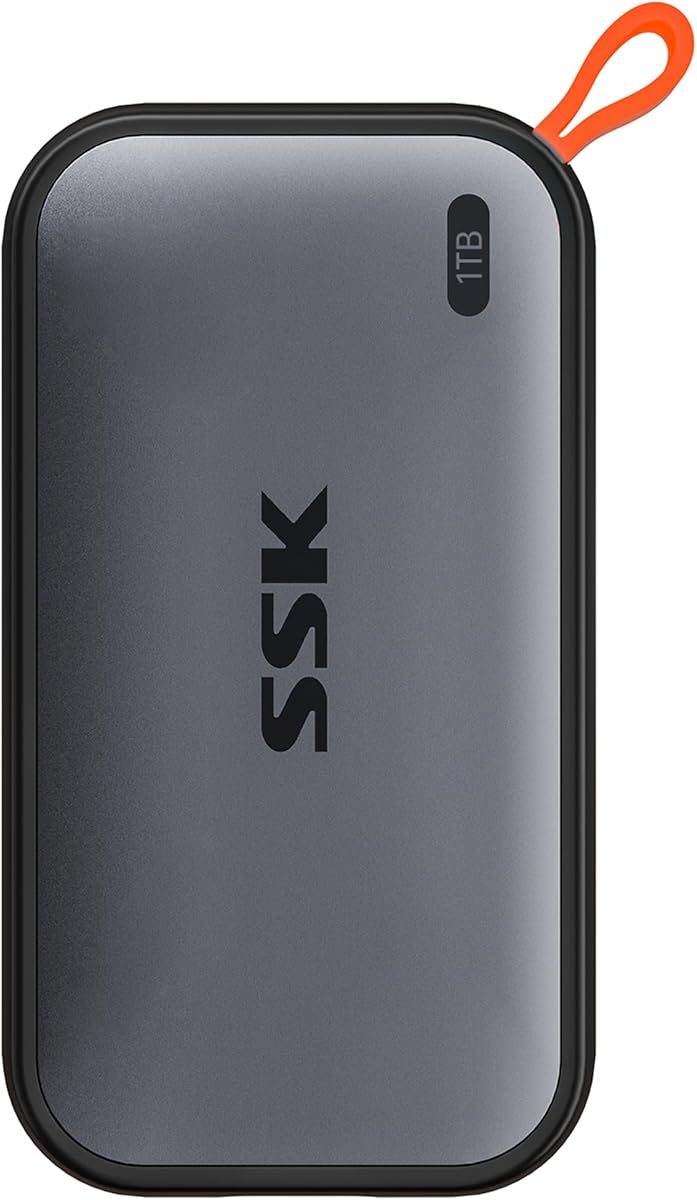
The SSK Portable SSD 1TB combines a 4.5 rating with a particularly light 36.6g body, making it a practical companion for a Mac Mini M4 that is frequently transported. Its 2.6 by 1.5 by 0.5-inch dimensions and 2mm aluminum alloy case keep the drive compact while providing a metal enclosure for heat dissipation.
We may earn a commission when you buy through this link, at no additional cost to you.
Performance is specified at up to 1,050MB/s read and 1,000MB/s write through 10Gbps USB 3.2 Gen 2. SSK explains that SLC caching reserves 25% of available capacity as high-speed cache, helping maintain strong transfer performance within that area. The included S.M.A.R.T. health diagnostics and adaptive TRIM support are useful for maintaining consistent write behavior and extending the drive’s usable longevity.
Both USB-C and USB-A cables are included, which simplifies transfers between the Mac mini, computers, tablets, and phones. The drive also supports 4K60Hz ProRes HDR capture for iPhone, adding a direct creative role. Its stated peak case temperature is 105.58°F, and low power consumption below 2.4 watts makes it suitable for mobile use where energy efficiency matters.
The SSK is recommended for users who want a conventional, lightweight USB-C drive for backups and media transfer without paying for a Thunderbolt model. The main caveat is that the supplied information specifically ties strong performance to the SLC cache, so buyers with very large or continuous write workloads should account for cache capacity. For typical file delivery, backups, and smaller project transfers, it offers a compelling combination of size and features.
At just 36.6g, the drive is easy to place in a laptop sleeve or camera pouch. Its aluminum shell also assists with heat dissipation during normal transfers.
S.M.A.R.T. diagnostics provide basic health visibility, while adaptive TRIM and SLC caching are intended to support efficient, consistent writes. These features are especially relevant for users who rely on the drive as a working volume.
We may earn a commission when you buy through this link, at no additional cost to you.
The Crucial X10 2TB delivers a 4.5 rating and an advertised read speed of up to 2,100MB/s. It is among the fastest portable SSDs listed here, yet unlike Thunderbolt 3 models, it remains a straightforward USB device designed for creators, students, and PC gamers who also need 2TB of capacity.
We may earn a commission when you buy through this link, at no additional cost to you.
The speed advantage is meaningful when moving large photo libraries, finished video, or game files between compatible storage. A matte-blue enclosure keeps the design understated, while the 2TB capacity is a more useful balance for active media than a small one-terabyte drive. The product also includes three months of Mylio Photos Plus and Acronis True Image when purchased and registered, adding useful starting points for photo management and backup.
Durability is a major strength. The X10 carries an IP65 rating for dust and water resistance and is drop-resistant up to nine-and-a-half feet, or three meters. Compatibility extends to Windows, Mac, iPad Pro, Chromebooks, Android, Linux, PS4, PS5, and Xbox systems through USB-C and USB-A. That broad support makes the drive practical for users who move between a Mac mini and multiple other platforms.
The Crucial X10 is a strong all-around recommendation for a Mac Mini M4 owner who wants high speed and two terabytes without moving to a larger Thunderbolt workflow. It is particularly suitable for photographers, editors, and gamers who need room for substantial collections. Buyers should still confirm that their Mac and connection hardware support the advertised USB mode, because the maximum speed cannot be reached through a slower port or cable.
The stated 2,100MB/s read rate is among the strongest specifications in this guide for a conventional portable USB drive. It offers a simpler connection method than Thunderbolt 3 while still supporting rapid media movement.
The capacity is suitable for large photo sets, game libraries, and multiple active projects. It can also serve as the primary external volume for a Mac mini with limited built-in storage.
We may earn a commission when you buy through this link, at no additional cost to you.
The Samsung T9 Portable SSD 1TB has a 4.6 rating and is specified at up to 2,000MB/s through USB 3.2 Gen 2×2. It is positioned for creators who need sustained speed and polished management features, while the simple black enclosure should sit comfortably beside a Mac Mini M4.
We may earn a commission when you buy through this link, at no additional cost to you.
Samsung emphasizes sustained read and write performance during longer processes, which matters more than a brief peak-speed result when editing a timeline, copying a large project, or managing a substantial photo archive. The Dynamic Thermal Guard is designed to control heat and maintain ideal operating temperatures. This cooling focus is useful because faster interfaces can create enough heat to reduce performance if it is not managed effectively.
The T9 also has one of the more complete software stories in the group. Magician Software provides firmware updates, extra encryption, and ongoing drive-health monitoring. Compatibility extends to desktops, cameras, and gaming consoles, and the supplied details state that the drive supports recording iPhone 15 Pro 4K video at 60fps when used with the recommended cable. Samsung’s in-house firmware and component production are also highlighted as quality-control advantages.
The T9 is best for creators who want fast sustained transfers, active thermal management, and a familiar software utility. It can serve as an editing scratch drive, a camera transfer destination, or a portable project repository. The one-terabyte capacity is the main limitation, so users with large libraries should consider whether one terabyte is enough for working files, scratch space, and backups.
The T9 is designed to maintain high throughput during longer operations rather than only short bursts. That makes it a better fit for repeated project transfers and active timeline work than a drive optimized primarily for portability.
Magician Software combines firmware maintenance, encryption options, and health monitoring. These tools can make it easier for a user to maintain the drive and verify that it remains reliable.
We may earn a commission when you buy through this link, at no additional cost to you.
The Sabrent Rocket Nano XTRM 2TB is the premium specialist in the guide, using Thunderbolt 3 to deliver up to 2,700MB/s while retaining a remarkably compact body. Its 4.4 rating does not lead the list, but the supplied specification clearly distinguishes it from conventional USB drives. It is a natural match for a Mac Mini M4 used for intensive 4K or 6K editing, RAW backups, and rapid project transfers.
We may earn a commission when you buy through this link, at no additional cost to you.
Thunderbolt 3 operates over a 40Gbps interface, allowing the drive to take full advantage of high-performance NVMe storage. It can also fall back to USB 3.2 Gen 2 at up to 900MB/s and remain compatible with ordinary USB ports. That flexibility means the drive remains useful across Mac, PC, and Linux systems, although a user without Thunderbolt will surrender much of its headline performance.
The enclosure measures only 2.95 by 1.34 by 0.71 inches and weighs 1.69 ounces, yet it contains 2TB. An aluminum chassis supports heat dissipation, while the included silicone sleeve provides added protection from drops and scratches. Both a Thunderbolt/USB-C cable and a USB-C-to-USB-A cable are included, and the drive is bus-powered and plug-and-play without drivers.
The Sabrent is best for professionals who routinely move large media and own compatible Thunderbolt hardware. The speed advantage can improve workflow fluidity, especially when projects repeatedly move between scratch media, archive storage, and other NVMe devices. Buyers should value portability and interface capability together; for simple document storage, the extra speed may not be necessary.
A stated 2,700MB/s makes the Rocket Nano XTRM well suited to 4K and 6K footage, RAW libraries, and project folders. The interface can also help keep an active editing session from becoming bottlenecked by transfers.
The 1.69-ounce aluminum body avoids the bulk often associated with Thunderbolt storage. An included silicone sleeve adds protection without requiring a separate full-size enclosure.
We may earn a commission when you buy through this link, at no additional cost to you.
The SanDisk Professional PRO-G40 4TB is the guide’s high-capacity, maximum-throughput option. It uses Thunderbolt 3 over a 40Gbps connection and is specified at up to 3,000MB/s read and 2,500MB/s write. With 4TB of storage, it is designed for users who need to keep extensive media, RAW files, and project assets in a single professional drive.
We may earn a commission when you buy through this link, at no additional cost to you.
The performance target is exceptional: SanDisk states that 50GB can be moved in one minute or less under supported conditions. A cool aluminum core draws heat away from the internal storage to help maintain fast transfers. The drive can also operate through USB-C at 10Gbps, giving users a second connection mode when Thunderbolt equipment is unavailable, although expected speeds will be lower.
Physical protection is exceptional as well. The PRO-G40 has an IP68 dust and water resistance rating, 4,000-pound crush resistance, and drop resistance up to three meters when tested on carpeted concrete. For a Mac Mini M4, the supplied specification notes an APFS format and Mac readiness, allowing the drive to fit naturally into an Apple-centered file-management setup.
This is the pick for professional media libraries, post-production houses, and users who prioritize capacity and maximum transfer speed over portability or value. Its 3.9 rating is the lowest among the listed products, but ratings alone cannot capture the importance of capacity for a specific archive. Because it is the most specialized and premium device here, it is best reserved for workloads that can genuinely use Thunderbolt 3 and need extensive storage.
The 4TB capacity offers room for large source libraries, multiple versions of a project, and separate backup sets. It reduces the need to divide a professional workflow across several external volumes.
IP68 protection, crush resistance, and three-meter drop resistance support demanding studio and field use. The robust enclosure is designed for a drive expected to travel with valuable data.
We may earn a commission when you buy through this link, at no additional cost to you.
The best external SSD for a Mac Mini M4 depends on interface compatibility, available capacity, transfer speed, portability, cooling, and security. A faster interface cannot help if the Mac or cable does not support it, while a highly compact drive may not satisfy users managing large creative libraries.
In short, confirm the interface and cable before prioritizing headline speed. A Gen 2×2 or Thunderbolt drive may still be limited by the host connection, and using the wrong cable can prevent a drive from operating at its intended rate.
In short, choose enough room for active files plus breathing space for temporary exports and backups. Avoid filling an external volume completely, since maintaining additional free space can help it remain responsive.
In short, prioritize sustained speed for large project folders and fast random access for active editing. For occasional backups, a dependable 10Gbps drive is usually more relevant than an expensive premium interface.
In short, look for an active or well-constructed cooling solution when sustained performance matters. For lighter duties, thermal design may be less significant than capacity, price, and physical portability.
In short, distinguish between a portable daily drive and a desktop-attached system. Choose a slim, durable model for travel, and favor a larger or more integrated design when the Mac mini stays in one workspace.
In short, choose stronger protection for travel, field recording, or frequently handled equipment. Physical ratings reduce risk but do not replace a separate backup, especially for irreplaceable work.
In short, enable password protection for sensitive data and use available health tools to monitor the drive. Encryption is especially useful for a portable drive that can be carried or lent outside the home or office.
In short, treat external storage as part of a backup routine rather than the only copy. Use convenient software when it helps, but maintain multiple copies and verify that important files can be restored.
Begin by checking the drive’s formatting and compatibility information. The SanDisk Professional is supplied in an APFS format for Mac use, while other drives may use a format that macOS can recognize but that may also be visible to Windows or other systems. Connect the drive through an appropriate USB-C port and a cable capable of supporting its interface. If a Gen 2×2 or Thunderbolt model is chosen, confirm that the Mac mini, hub, and cable support the same mode.
For routine use, create a clear folder structure for active projects, completed media, and backups. Format a newly purchased drive before placing important files on it, using the Mac Disk Utility utility when appropriate. Keep some free space available, avoid abruptly disconnecting the drive during writes, and use the Finder Eject command before unplugging it. For active editing, close or pause intensive file operations before ejecting the volume to reduce the risk of incomplete transfers.
Care for the drive by keeping its connector clean and dry, using the supplied protective sleeve where one is provided, and avoiding extreme heat or moisture. Monitor drive health when the manufacturer offers a utility, and periodically check important archives for missing or corrupted files. Treat an external SSD as a working or portable storage device rather than the sole location for irreplaceable media. A separate backup remains necessary even when the enclosure is encrypted, rugged, or capable of high transfer speeds.
No. A Mac Mini M4 can use standard external SSDs that support macOS and connect through USB-C. The most important requirements are a compatible file format, an appropriate cable, and enough capacity for the intended workload. Thunderbolt 3 models offer higher potential performance, but they are optional rather than mandatory.
The choice depends on workflow and budget. The SanDisk Professional offers the highest stated speed and four terabytes of capacity, while the Sabrent Rocket Nano XTRM provides 2,700MB/s over Thunderbolt 3 in a smaller body. For less demanding editing, the Crucial X10, Samsung T9, and Samsung T7 provide capable performance at lower capacity or more conventional dimensions.
Yes, provided the drive and connection use a compatible USB protocol. Drives such as the Samsung T7, Lexar ES3, and SSK support USB 3.2 Gen 2, making them broadly suitable for a Mac mini. The supplied Lexar information notes that actual performance can be lower when the connected Mac or system does not support USB 3.2 Gen 2.
No, but it can benefit workflows involving very large project folders, RAW libraries, and high-resolution footage. The Sabrent and SanDisk Professional Thunderbolt drives provide the strongest stated throughput in this guide. For document storage, routine backups, and moderate media work, a well-chosen USB 3.2 drive is often sufficient.
The ORICO listing specifically identifies Time Machine compatibility, and other macOS-compatible drives may also be used for backups depending on their format and current system behavior. Before configuring Time Machine, confirm that the drive is recognized, is not acting as the only copy of your files, and has enough room for backup history.
One terabyte can work for a focused collection or a single recent project, but two terabytes gives safer room for source files, exports, and scratch media. The four-terabyte SanDisk Professional is better suited to extensive professional libraries. Choose based on the size of your active projects and retain at least one separate backup.
Cooling matters most during large transfers, repeated writes, and long editing sessions. The Lexar ES3 2TB, Samsung T9, SanDisk Professional, Sabrent, and ORICO all incorporate cooling-oriented aluminum, graphite, thermal channels, or thermal management features. For light use, cooling is less likely to determine the outcome.
Keep the drive in a dry, temperature-stable location and protect the connector from dust or objects that could cause a poor connection. Use a pouch or sleeve for portable models, and retain the original packaging or documentation. If the drive contains sensitive files, enable its encryption and store the password separately from the device.
The ORICO 2TB Mac Mini Expansion is the most integrated recommendation because it adds NVMe storage, USB ports, and card reading directly to the desktop setup. The Samsung T7 1TB is the best balanced option for ordinary backups, media transfer, and portable creative work, while the Sabrent Rocket Nano XTRM 2TB is the premium choice for owners with Thunderbolt 3 who need high throughput in a compact enclosure.
Prioritize compatibility before maximum speed, then select the smallest capacity that comfortably holds your working files, exports, and backup history. USB 3.2 Gen 2 is broadly practical, while Gen 2×2 and Thunderbolt 3 make the most sense for users who repeatedly move large media. Cooling, encryption, durability, and management software become more important as the drive’s role expands from temporary storage to a critical production component.
Finally, check current prices and availability before purchasing, because drive pricing and promotions can change. Compare the selected model against the latest listing details, confirm the required cable and formatting, and keep a second copy of important work. An external SSD can make the Mac Mini M4 far more flexible, but a disciplined backup routine is what keeps that flexibility dependable.