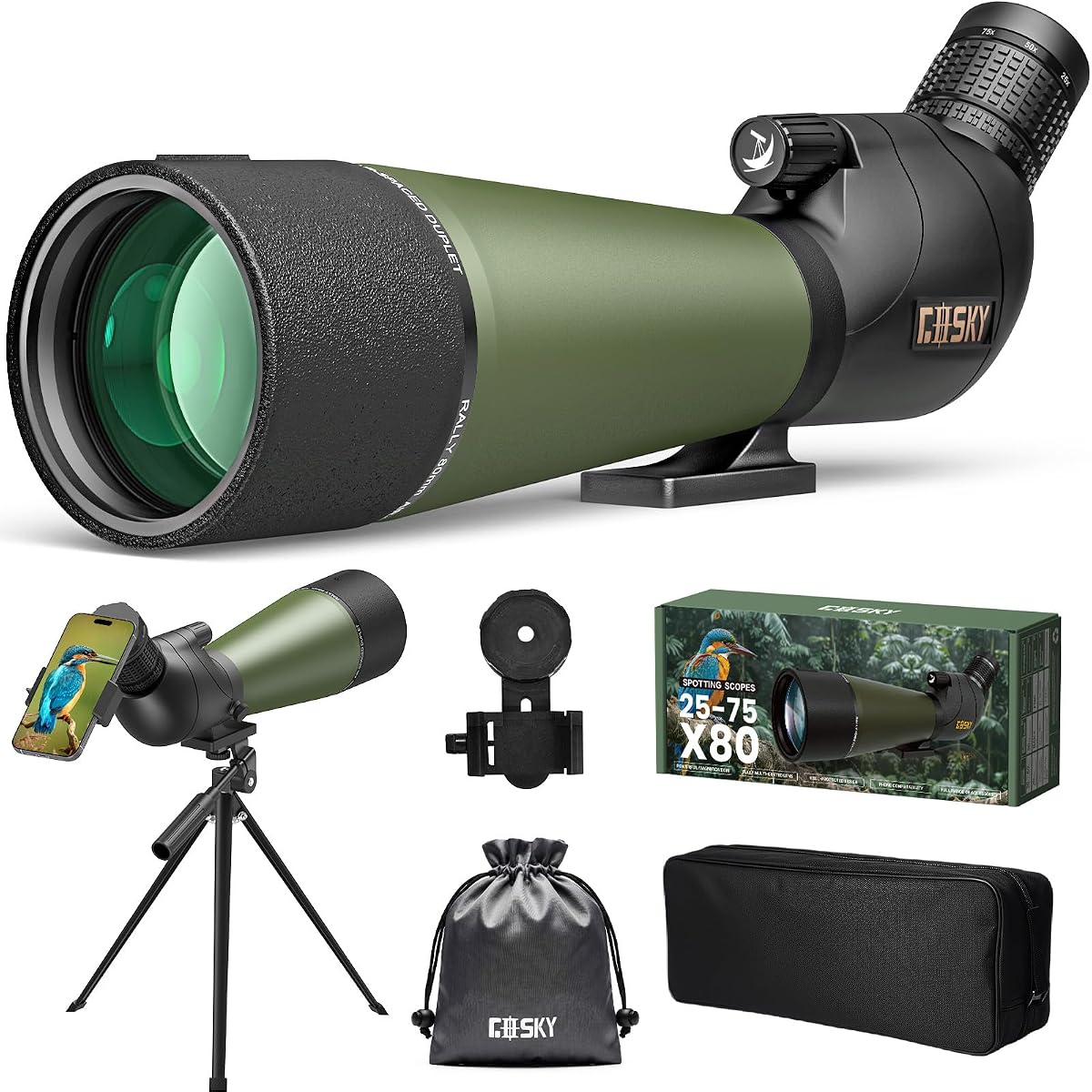
Gosky DiamondEdge 25-75×80
4.4Editor score
25-75x magnification
80mm objective lens
BAK4 FMC optics
Tripod and case included
Discover the best Long Range Spotting Scope for 1000 Yards, comparing magnification, objective lenses, optical clarity, durability, and field-ready features.
A spotting scope built for 1000-yard observation needs more than magnification alone. Optical clarity, light gathering, focus control, weather sealing, tripod compatibility, and a steady viewing position all influence whether distant targets remain sharp and easy to identify in changing conditions.
This guide compares ten scopes suited to long-range wildlife observation, target shooting, and serious glassing. The evaluation considers magnification range, objective diameter, prism and lens coatings, focus systems, mounting options, included accessories, and practical features such as sunshades and weather protection.
Each entry explains the strongest reasons to choose the scope, along with its meaningful limitations and the users most likely to benefit. Product details and availability can change, so readers should confirm the current listing and accessories before making a final purchasing decision.
4.4Editor score

4.6Editor score

4.6Editor score
The comparison below highlights the core optical and physical differences among all ten scopes. These specifications help reveal which models prioritize magnification, light gathering, portability, close focus, tripod compatibility, or premium optical performance.




The Gosky DiamondEdge 25-75×80 Spotting Scope with Desktop Tripod for Target Shooting DiamondEdge earns a 4.4 rating and stands out as a feature-rich option for observers who want meaningful magnification and a complete support kit. Its 25-75x range gives users enough latitude to scan a distant landscape at 25x and then narrow the view for close identification at 75x.
We may earn a commission when you buy through this link, at no additional cost to you.
Optically, the scope combines a BAK4 prism, fully multi-coated optics, an 80mm objective, and a relatively large 23mm eyepiece. That combination is well suited to long-range viewing because the objective gathers substantial light while the eyepiece supports a broad and immersive view. The rubber-armored body, retractable sunshade, rotating design, and standard 1/4-20 threaded base support practical field use.
The honest trade-off is that this is not a specialist flagship optic. Its image quality, color rendition, and premium optical refinement are unlikely to match the most advanced fluorite and apochromatic scopes in the guide. The 80mm objective also makes the unit larger than a more compact 65mm or 70mm design. Even so, those limitations are reasonable given the breadth of included equipment.
This scope is a strong recommendation for beginners, birders, hunters, hikers, target shooters, and wildlife viewers who want one adaptable instrument for distances around 1000 yards. The tabletop tripod, carrying case, lens covers, pouch, and cleaning cloth make it particularly appealing for buyers who want a ready-to-use package rather than assembling essential accessories separately.
The 25x lower end is useful for locating animals, targets, or terrain features without sacrificing too much surrounding context. Increasing to 75x then provides the detail needed for closer inspection at extended distances.
The included tabletop tripod, carrying case, objective and eyepiece covers, pouch, and cloth cover the basic needs for transport and routine protection. That makes the package especially convenient for users building a first spotting-scope kit.
We may earn a commission when you buy through this link, at no additional cost to you.
The Vortex Diamondback HD Spotting Scope 20-60×85 Angled carries a 4.6 rating and is the most balanced general choice in this guide. Its HD optical system emphasizes resolution, chromatic-aberration control, color fidelity, edge-to-edge sharpness, and light transmission, all important qualities when a subject at approximately 1000 yards occupies only a small part of the view.
We may earn a commission when you buy through this link, at no additional cost to you.
The 85mm objective provides a strong balance between light gathering and portability. At the same time, the 20-60x zoom range covers useful low magnification for target acquisition and higher magnification for detail. A built-in helical focus wheel supports rapid coarse movement and fine correction, while the pull-out sunshade helps control glare and shields the objective from rain and snow.
The angled eyepiece can make prolonged glassing more comfortable, but its placement requires enough space beneath the scope for a tripod. The scope also lacks the very high maximum magnification offered by a few models here. Users who need more than 60x, however, can gain that capability by using a compatible higher-power eyepiece rather than replacing the entire optic.
The Diamondback HD is recommended for hunters, target shooters, birdwatchers, and generalists who need dependable low-light performance in a practical package. Arca-Swiss compatibility, standard 1/4-20 support, argon purging, O-ring sealing, adjustable eyecups, and protective lens coatings make it particularly adaptable to a range of mounting systems and field conditions.
The HD system and anti-reflective coatings support brightness and contrast when ambient light declines. That makes the scope useful for wildlife activity that begins before sunrise or continues after sunset, when identifying subtle color and shape differences becomes difficult.
The integrated helical focus wheel permits quick initial acquisition followed by smaller corrections. This is especially helpful when wildlife moves across the viewing area or when a distant target shifts slightly in the wind.
We may earn a commission when you buy through this link, at no additional cost to you.
The Celestron Ultima 22-66×100 Spotting Scope for Long-Range Viewing has a 4.2 rating and centers on the needs of serious long-distance observers. Its standout feature is the 100mm objective lens, which provides a large light-gathering area for dim conditions, dawn and dusk observation, wildlife, and detailed views of distant terrain.
We may earn a commission when you buy through this link, at no additional cost to you.
A 22-66x zoom gives this model a useful combination of scanning and detailed inspection. The multi-coated lens surfaces are designed to improve brightness, color, and contrast, while the large focus dial is straightforward to operate. The 45-degree angled eyepiece provides a comfortable viewing position, and the rotating tripod mount allows the eyepiece to be positioned to suit the user.
The principal drawback is size. A 100mm objective makes this scope less convenient for hiking, backpacking, or moving quickly between observation locations. Its 4.2 rating also trails several alternatives in the guide, although ratings should be considered alongside verified optical features and intended use. Buyers should also determine whether a separate sturdy tripod is needed.
The Ultima 100 is best suited to stationary wildlife observation, long-range target viewing, and anyone who values a bright image more than compact portability. The integrated T-adapter, soft carrying case, eyepiece pouch, lens cloth, and extended tripod mounting plate also make it suitable for digiscoping and organized field sessions.
The oversized objective supports brighter views when light is limited. This can improve the ability to distinguish shape, posture, and movement on distant animals without requiring the same level of light available during full daylight.
The zoom eyepiece includes an integrated T-adapter, allowing compatible cameras to be used for digiscoping. That opens the door to recording distant subjects rather than relying exclusively on visual observation.
We may earn a commission when you buy through this link, at no additional cost to you.
The Vortex Crossfire HD Spotting Scopes (20-60×80 Angled) receive a 4.6 rating and offer a compelling mix of optical features, mounting convenience, and field-ready construction. Its HD optical system uses select glass elements to improve resolution, color fidelity, edge-to-edge sharpness, chromatic-aberration control, and light transmission.
We may earn a commission when you buy through this link, at no additional cost to you.
The wide field of view is especially valuable at 1000 yards because it helps a user locate and keep track of small subjects. An Arca-Swiss-compatible foot means the scope can often be mounted directly to a compatible tripod without an additional plate. The helical focus, adjustable twist-up eyecup, built-in sunshade, nitrogen purging, and O-ring sealing reinforce its practical appeal.
Compared with the Diamondback HD in this list, the Crossfire offers a smaller 80mm objective and the same 60x maximum magnification. It may therefore produce less of the premium low-light impression associated with a larger objective and higher-tier optical design. Users who need stronger maximum magnification must also accept that this stock configuration stops at 60x.
This is an excellent recommendation for value-conscious hunters, birdwatchers, and target shooters who want a wide view, convenient mounting, and dependable outdoor construction. Its 4.6 rating places it among the strongest-reviewed products here, while the angled eyepiece supports comfortable use once the scope is placed on a tripod.
A wide field of view provides more environmental context and makes it easier to spot distant movement. That advantage is particularly useful during initial scans across open hills, fields, or long shooting lanes.
The Arca-Swiss-compatible foot supports quick setup on common tripods and compatible heads. This reduces the number of adapters required and makes the scope easier to move between observation locations.
We may earn a commission when you buy through this link, at no additional cost to you.
The Vortex Razor HD Spotting Scope (22-48×65 Straight) has a 4.8 rating, the highest listed rating in this guide. Its defining strength is a triplet apochromatic lens combined with high-density, extra-low-dispersion glass and XR Plus anti-reflective coatings. Those features support high resolution, color fidelity, and brightness for critical low-light observation.
We may earn a commission when you buy through this link, at no additional cost to you.
Unlike many full-size scopes, the 65mm objective and 22-48x magnification range create a relatively compact package. The straight eyepiece can align more naturally in some shooting positions, while the multi-position twist-up eyecup helps achieve comfortable eye relief. A smooth helical focus wheel allows precise adjustment, and the locking collar lets the user rotate the scope to a preferred angle.
The main limitation is power. With a 48x maximum, the Razor is less suited to observers who want to push magnification beyond 60x, even if its image quality is excellent. Its 65mm objective gathers less light than the 85mm, 99mm, and 100mm alternatives. For many users, though, the sharper optical result and smaller size matter more than maximum light gathering or magnification.
This scope is a strong fit for serious wildlife viewers and target shooters who value premium resolution, compactness, and low-light color over raw zoom. Waterproof and fogproof construction, argon purging, Armortek coatings, and rubber armor make it appropriate for demanding field conditions, while the lifetime VIP warranty provides added ownership confidence.
The triplet apochromatic design is intended to reduce chromatic aberration while maintaining resolution and color fidelity. That helps produce cleaner edges and more natural colors when examining fine details on distant subjects.
The 65mm objective limits the scope's physical footprint compared with larger 85mm, 99mm, and 100mm models. That makes the Razor easier to carry between observation sites while retaining a substantial upper magnification range.
We may earn a commission when you buy through this link, at no additional cost to you.
The Celestron TrailSeeker 22-67×100 Spotting Scope for Extreme Range carries a 3.9 rating, but its specifications clearly target demanding long-distance work. The 100mm objective and 22-67x zoom range offer the combination of light gathering and power expected from a dedicated extreme-range spotting scope.
We may earn a commission when you buy through this link, at no additional cost to you.
Fully multi-coated lenses with Celestron XLT coatings are intended to maximize light transmission, while phase-coated BAK4 prisms are designed to improve resolution and contrast. The magnesium alloy chassis is waterproof and nitrogen-purged. A rotating tripod collar, twist-up eyecup, and compatibility with standard 1.25-inch astronomical eyepieces provide practical flexibility for extended sessions.
Its 3.9 rating is the lowest numeric score listed, so prospective buyers should weigh the specifications against their own needs and consider customer feedback carefully. The large objective also makes the scope less convenient to carry. The supplied package includes a padded view-through case, lens covers, and a cleaning cloth, but tripod and camera-adapter arrangements may require additional equipment.
The TrailSeeker is a compelling choice for observers whose priorities include maximum magnification, a very large objective, and the ability to use astronomical eyepieces. It suits serious wildlife glassing, target observation, and digiscoping when paired with compatible equipment. Buyers primarily interested in portability should compare it with the smaller Vortex and Athlon designs.
The combination of 67x maximum magnification and a 100mm objective is unusual in this group. It allows the user to reach substantial magnification without reducing the light-gathering size offered by the scope.
Support for standard 1.25-inch astronomical eyepieces lets users explore wider fields or greater magnification. This makes the scope adaptable for specialized observing setups beyond its included zoom eyepiece.
We may earn a commission when you buy through this link, at no additional cost to you.
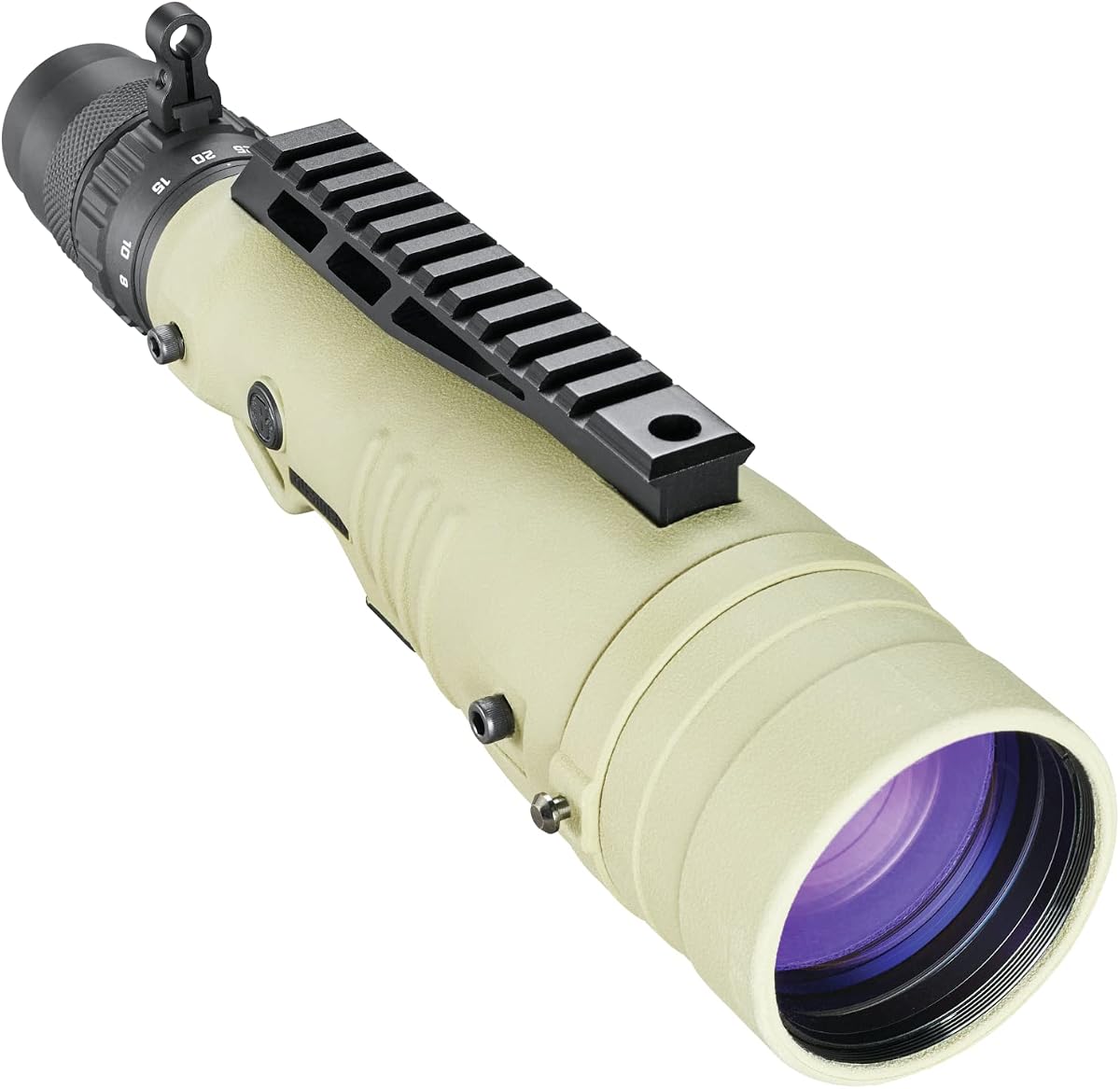
The Bushnell Elite Tactical LMSS2 Spotting Scope, Tremor 4 Reticle, Competitive Shooting, Long Range Shooting is unlike most general-purpose scopes in this guide because it is explicitly oriented toward precision shooting. Its Tremor 4 reticle is the defining feature, offering a targeting reference designed for long-range competitive applications.
We may earn a commission when you buy through this link, at no additional cost to you.
A tactical reticle can help shooters estimate holdover and target position without repeatedly changing magnification or disturbing a stable tripod setup. That makes this scope potentially relevant to anyone observing or calling distant targets at approximately 1000 yards, particularly when precision placement matters more than casual wildlife viewing.
The supplied information is much more limited than for the other products, and no numeric customer rating is listed. Magnification, objective diameter, optical coating details, field of view, focus mechanism, weather-sealing specifications, and included accessories are not provided in the source data. Those unknowns make a detailed optical comparison difficult and should prompt buyers to inspect the current product listing closely.
The LMSS2 is best recommended for long-range and competitive shooters who specifically want a Tremor 4 tactical reticle. Wildlife viewers and generalists may prefer an angled scope with a wider field of view and more detailed optical specifications. Because the available data is limited, confirm the magnification range, mounting pattern, and required accessories before finalizing a purchase.
The Tremor 4 reticle provides a structured aiming reference for shooters who need to communicate precise target placement. It can help reduce repeated verbal ranging adjustments during a long-range session.
Unlike general wildlife scopes, this model is designed around competitive and long-range shooting. That specialization may be valuable to target shooters, but buyers should compare the limited specifications with more fully documented alternatives.
We may earn a commission when you buy through this link, at no additional cost to you.
The KOWA TSN-99A PROMINAR 30-70x99mm Angled Spotting Scope with TE-11WZ II carries a 4.6 rating and represents the most specialized premium optical design in this guide. Its pure fluorite crystal objective, paired with Kowa's XD concave lens, is engineered for resolution, contrast, color fidelity, and controlled chromatic aberration from dawn through dusk.
We may earn a commission when you buy through this link, at no additional cost to you.
The 30x lower magnification provides a more detailed starting view than many competing scopes, while the 70x upper end supports close inspection of targets around 1000 yards. The included TE-11WZ II wide zoom eyepiece supports the stated viewing range. Kowa's dual focus system separates rapid subject acquisition from pinpoint fine adjustment, a useful division for moving wildlife and precision target work.
The large 99mm objective and premium construction make this a substantial instrument. It is more suited to dedicated glassing locations, productive hunting areas, and organized target sessions than rapid movement across rough terrain. Buyers should also account for the needs of a stable tripod and consider whether the added optical refinement is worth the larger physical footprint.
This scope is the premium recommendation for observers who place resolution, color accuracy, and refined optical construction at the top of their priorities. Its waterproof, nitrogen-filled magnesium chassis, moisture- and dirt-repellent KR coating, and compatibility with interchangeable eyepieces, smartphone adapters, DSLRs, and astronomy accessories make it a versatile foundation for advanced optical systems.
The pure fluorite crystal objective is a premium optical material intended to support high resolution, contrast, and color accuracy. Its benefits are particularly relevant when small distinctions at long distance determine identification or target placement.
Quick Focus acquires the subject, while Fine Focus provides precise corrections. Separating those actions lets a user respond to movement without overshooting the focal point during a long observation session.
We may earn a commission when you buy through this link, at no additional cost to you.
The Celestron Regal M2 100ED Spotting Scope with Zoom Eyepiece for Long-Range has a 4.3 rating and pairs a large 100mm objective with extra-low-dispersion glass. The ED elements are intended to virtually eliminate chromatic aberration and color fringing, producing cleaner edges and more natural-looking detail on distant subjects.
We may earn a commission when you buy through this link, at no additional cost to you.
XLT multi-coatings cover all air-to-glass surfaces to maximize light transmission, while the included 22-67x zoom eyepiece spans a broad working range. A rotating tripod mount lets users place the eyecup in a comfortable position. The package also includes a padded view-through case, objective cover, eyecup cover, and a T-mount adapter for attaching a DSLR camera.
The trade-off is size. A 100mm objective and rotating mount create a long, substantial scope that is better suited to stationary use than fast-moving observation. Although the ED glass and coatings elevate the optical design, this model does not have the specialized fluorite objective or apochromatic triplet found in the KOWA and Vortex Razor HD.
The Regal M2 100ED is recommended for serious wildlife observers, target shooters, and digiscopers who want a large objective and high magnification in one instrument. It is especially attractive when image brightness, color control, and camera integration matter more than compact transport. Users should plan for a stable tripod and sufficient room when setting the angled eyepiece.
Extra-low-dispersion glass helps keep color fringes away from high-contrast edges. On a distant animal or target, that can improve the clarity of fine contours that might otherwise appear softened by chromatic aberration.
The included T-mount adapter allows compatible DSLRs to connect to the scope. Combined with the large objective and 22-67x zoom, this creates a practical route to magnified digital observation and long-range photography.
We may earn a commission when you buy through this link, at no additional cost to you.
The Athlon Optics Argos HD 20-60×85 Spotting Scope – 45 Degree, Green/Black has a 4.3 rating and offers a balanced combination of magnification, objective size, and angled viewing. Its 20-60x zoom range is familiar and versatile, while the 85mm objective provides more light-gathering potential than compact 65mm and 70mm alternatives.
We may earn a commission when you buy through this link, at no additional cost to you.
HD glass and fully multi-coated lenses are designed to produce bright, sharp images with accurate color, including under challenging light. The 45-degree angled eyepiece and rotating tripod collar make it practical for prolonged observation. Waterproof, fogproof, argon-purged construction improves confidence in changing weather, and a rubber-armored body protects against everyday handling.
Its upper magnification limit of 60x is lower than the 66x, 67x, 70x, and 75x offered by several competitors. It also lacks the large 99mm or 100mm objectives and premium fluorite construction available in this guide. A soft protective case is included, but the supplied information does not indicate that a tripod is included.
The Argos HD is a sound recommendation for birders, hunters, and target shooters who want a conventional 85mm-class scope without moving to a much larger 100mm body. The angled design, rotating collar, weather protection, and useful zoom range make it a flexible option for wildlife observation, open-field scanning, and distance work around 1000 yards.
The 85mm objective provides a middle ground between compact 65mm scopes and light-heavy 100mm models. It offers meaningful light gathering while avoiding the largest and most cumbersome designs in the guide.
The 45-degree eyepiece and rotating tripod collar help place the eyepiece comfortably and keep the scope usable across different tripod heights. This is useful during long wildlife-watching or target-shooting sessions.
We may earn a commission when you buy through this link, at no additional cost to you.
Choosing a long-range spotting scope requires balancing magnification, image brightness, optical correction, portability, and mounting needs. The following factors are more useful for judging performance at approximately 1000 yards than headline magnification alone.
Choose a scope that moves smoothly from scanning power to detail power without sacrificing usability. Stable tripod support becomes increasingly important as magnification rises.
Prioritize an 85mm-class objective for general field use and a 100mm-class objective for maximum brightness. Expect added size with larger apertures.
BAK4, ED glass, and thorough multi-coating are useful indicators of optical refinement. Confirm that the full optical path is treated.
Choose a broad field for scanning and locating wildlife or targets. Use higher magnification only after the subject is centered and the tripod is stable.
Prefer fast initial focus with accessible fine adjustment. This matters most when subjects move or when the image shifts because of wind.
Match the mount to your tripod and confirm clearance around an angled eyepiece. A stable platform matters more than minor head-position preferences.
Look for gas purging, sealed construction, rubber armor, and a sunshade. These features improve reliability in wet and changing conditions.
Verify eyepiece standards and camera-adapter support before buying. Treat a small table tripod as a convenience, not a substitute for a stable field tripod.
Begin by establishing a stable tripod at a legal and safe observation point. Extend the legs evenly, avoid overextending them, and orient the scope toward the subject. Begin at low magnification, locate the target, center it, and then increase magnification gradually. Adjust the focus only after the subject is centered, since focusing while searching can make a moving subject harder to track.
For maximum useful detail at 1000 yards, wait for stable atmospheric conditions when possible. Heat shimmer near roads, rooftops, and open ground can move the apparent image even when the tripod is motionless. Avoid touching the scope while observing, use the sunshade when glare is strong, and clean the objective only with the supplied cloth or another appropriate optical cleaning material.
After use, retract the sunshade, cap the objective, and store the scope in its case away from moisture and direct heat. Do not leave objective lenses exposed to dust or insects. Clean exterior surfaces with a soft dry cloth, avoid solvents around coatings and rubber armor, and inspect the mount, threads, and tripod attachment for looseness before the next session.
A useful range usually begins near 20x or 25x for locating a subject and extends to 60x or more for identification and detail. The best maximum magnification is the highest power the scope can render clearly and steadily. Atmospheric conditions, tripod quality, and the observer's eye all affect practical performance.
A 100mm objective generally gathers more light and can appear brighter in dim conditions or heavy shade. An 80mm objective is usually easier to carry and can still provide a clear image in good daylight. Choose based on the balance between light-gathering needs and the importance of portability.
Yes, a stable tripod is strongly recommended, particularly above 40x. Higher magnification amplifies hand movement and makes small focus corrections difficult. A table tripod may be useful for brief observation, but a full-height field tripod is more appropriate for sustained long-range viewing.
An angled eyepiece is comfortable for many users because it allows a more natural viewing position, especially on uneven ground. A straight eyepiece may align better with certain shooting positions or compact mounting arrangements. Consider tripod clearance, sitting height, and personal comfort rather than choosing by eyepiece shape alone.
No. Magnification enlarges the image but does not create new detail. Optical quality, light transmission, focus stability, atmospheric clarity, and vibration all determine whether a highly magnified image looks useful. A sharp image at 40x is often more valuable than an unstable or dim image at 70x.
Some models support digiscoping through integrated T-adapters, included T-mounts, smartphone adapters, or interchangeable astronomical eyepieces. Compatibility depends on the exact model and camera connection. Verify the supplied adapter and thread size before purchasing additional equipment.
Allow the scope to acclimate gradually before checking the optics, since rapid temperature changes can cause temporary condensation. Models with nitrogen purging and O-ring sealing are designed to resist internal fogging and moisture. Keep the objective capped while the scope warms, and never use a heat source that could damage coatings or seals.
Use a rigid tripod, extend its legs evenly, and avoid leaning on the eyepiece while adjusting focus. Begin at low magnification and center the target before zooming in. A backpack or field bag can add stability, but the primary support should come from the tripod rather than an improvised rest.
The Vortex Diamondback HD 20-60×85 is the strongest all-around choice for most buyers because it combines a large 85mm objective, an HD optical system, rapid focus control, and convenient tripod compatibility. The Gosky DiamondEdge 25-75×80 stands out as the best budget-oriented package, while the KOWA TSN-99A PROMINAR 30-70×99 offers the most premium optical specification for dedicated observers.
Prioritize brightness, color fidelity, focus control, and stable mounting rather than maximum magnification alone. A 60x view with a clear image is more useful at 1000 yards than an unstable image at higher power. For low-light or stationary observation, consider 99mm or 100mm objectives; for mobility, look closely at 65mm and 80mm designs.
Before ordering, confirm the current product details, included accessories, mounting requirements, and camera compatibility. Product configurations and availability can change, so the latest listing is the best source for final specifications and the most current purchase decision.