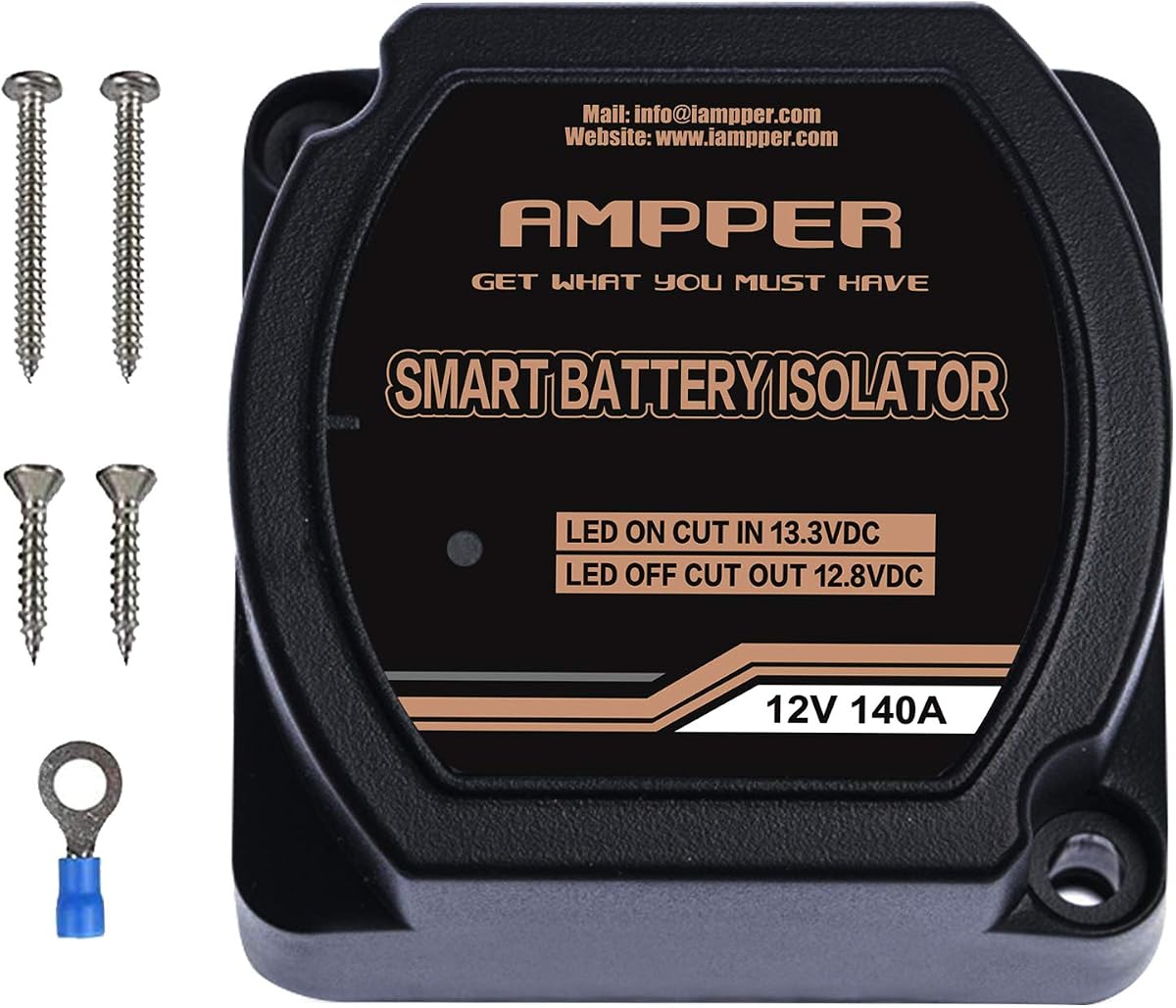
Ampper 140A Dual Battery Isolator
4.5Editor score
Automatic voltage sensing
140-amp relay capacity
Weather-resistant construction
Mounting hardware included
Discover the best 12V DC dual battery isolator options, comparing voltage sensing, current capacity, weather resistance, wiring, and compatibility for every
A 12V DC dual battery isolator protects a vehicle’s starting battery while allowing a second battery to support accessories, recreation equipment, or marine systems. The best unit coordinates charging correctly, disconnects at the appropriate time, and withstands the vibration, moisture, and heat found in demanding installations.
The products in this guide were compared using the specifications and feature details supplied for each model, including relay behavior, rated current, weather protection, included wiring, control modes, and intended vehicle applications. The list includes conventional 140-amp units, a 200-amp marine-oriented relay, and a 500-amp copper-equipped model.
Each review explains the strongest reasons to consider one product while calling out important limitations, particularly lithium compatibility, missing wiring, and differing control features. Product ratings and technical details can change over time, and prices also fluctuate, so readers should confirm current specifications and listings before purchasing.
4.5Editor score

4.6Editor score
4.6Editor score
This side-by-side comparison highlights the most important differences among the 10 dual battery isolators, including relay architecture, current rating, voltage thresholds, waterproofing, control options, and installation hardware.

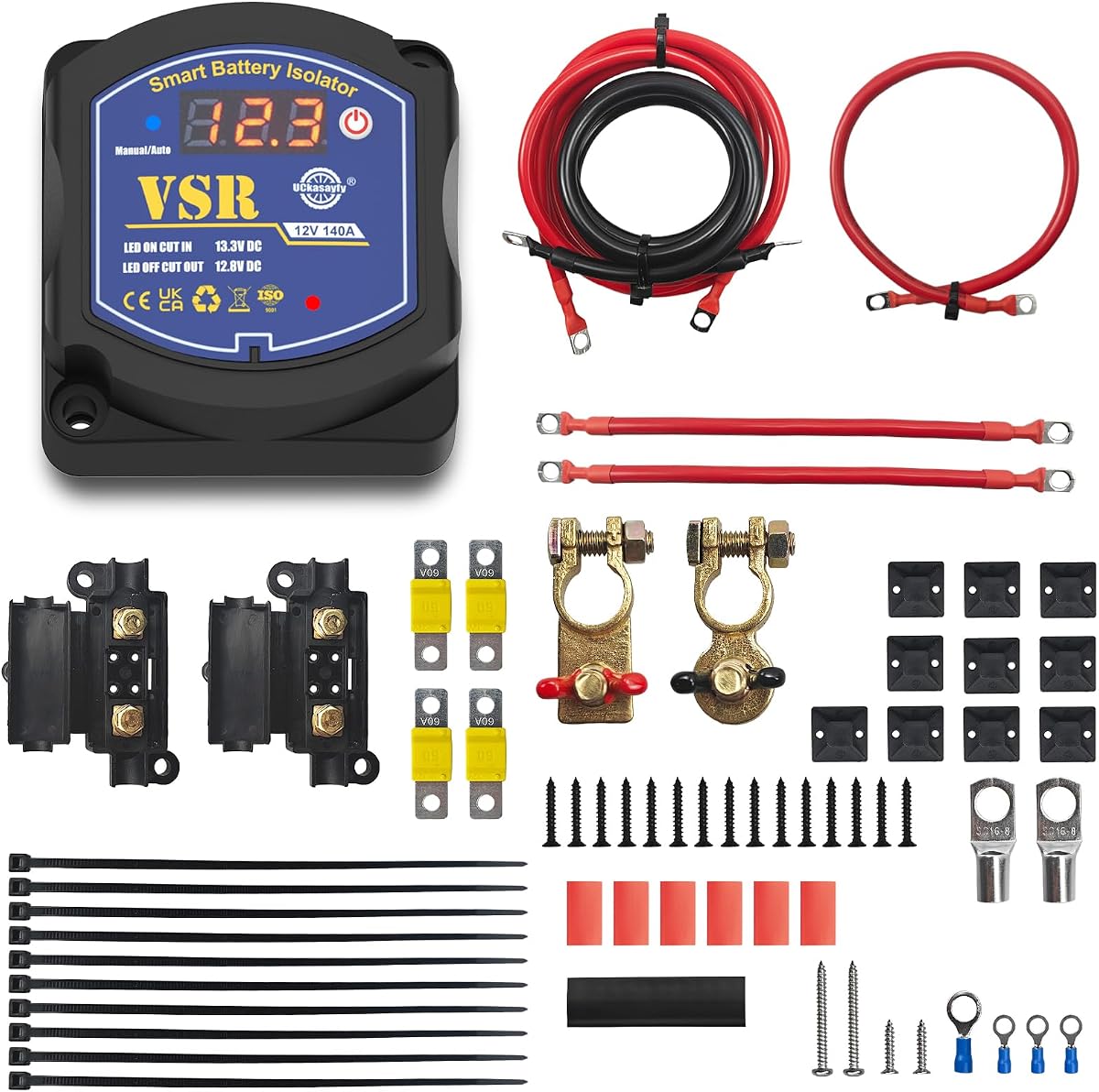


The VEVOR Split Charge Relay Kit combines a 140-amp, 12-volt dual battery relay with a broad collection of installation accessories. It carries a 4.4 rating and stands out for a compact housing, automatic voltage-sensitive operation, and an IP65 waterproof rating. The unit is positioned as a versatile solution for cars, off-road vehicles, campers, caravans, RVs, boats, yachts, and other 12V systems.
We may earn a commission when you buy through this link, at no additional cost to you.
Its voltage-sensitive relay cuts in at 13.3 volts and cuts out at 12.8 volts. That timing allows the primary battery to take priority while the auxiliary battery is charged from the same alternator. When the vehicle is turned off, the batteries can be isolated from one another, helping accessory loads remain separate from the starting power source. The housing is described as shockproof, dustproof, and suitable for vibration-prone installations.
The main limitation is that the supplied information does not explicitly state whether the relay is compatible with lithium chemistry. It is also less visually informative than products with an integrated voltage display. Installation quality still depends on correct cable sizing, secure grounding, sound terminals, and following the included directions, none of which can be guaranteed merely by the presence of accessories in the package.
This is a strong choice for RV, marine, camper, and off-road builders who want a conventional 140-amp VSR with weather resistance and a broad range of included components. It is particularly useful when a compact unit and straightforward automatic operation matter more than a specialized display or a very high current rating.
The 13.3-volt cut-in and 12.8-volt cut-out thresholds coordinate charging without keeping the auxiliary battery permanently connected. This arrangement helps preserve the starting battery while allowing the second battery to receive charge during operation.
An IP65 rating, shock-resistant construction, and dust protection make the relay a practical fit for under-hood, marine, camper, and off-road environments where moisture and vibration may be significant concerns.
We may earn a commission when you buy through this link, at no additional cost to you.
The Nilight 12V 140A Dual Battery Setup earns a 4.6 rating and stands out for the completeness of its installation package. It combines a voltage-sensitive relay with heavy-gauge battery cables, ground cable, marine battery terminals, battery clamps, fasteners, heat-shrink tubing, insulated ring terminals, and cable ties. That level of inclusion is particularly useful for installers who want the principal electrical components in one place.
We may earn a commission when you buy through this link, at no additional cost to you.
Operating at a 13.3-volt cut-in and 12.8-volt cut-out, the relay manages charging from one alternator across two batteries. The primary battery remains the designated starting source, while the auxiliary battery can feed accessories when the engine is not running. A high-quality casing, silicone seal, IP66 waterproof rating, and resistance to vibration support use in automotive, marine, camper, truck, caravan, ATV, UTV, and boat installations.
The product information explicitly states that it is not compatible with lithium batteries and is intended for a dual battery setup rather than a single-battery vehicle. Those restrictions reduce flexibility but are important to acknowledge before installation. The listed package is extensive, although wire length and gauge still need to be checked against the dimensions of a specific vehicle or boat.
Among the 140-amp choices, this is one of the most convincing options for someone who wants a relay and a broad hardware kit together. It suits installers working on RVs, trucks, boats, campers, and off-road vehicles who value organized components, weather protection, and a straightforward automatic charging strategy.
The package includes cables, ground leads, marine terminals, clamps, fasteners, heat-shrink materials, ring terminals, and ties. This reduces the need to source several small parts separately, although installers should still confirm cable lengths suit the vehicle.
The voltage-sensitive control charges the auxiliary battery from the same alternator while isolating it from the starting battery when the engine is off. That arrangement gives accessories a separate power source without compromising the primary battery's starting role.
We may earn a commission when you buy through this link, at no additional cost to you.
This 140-amp smart battery isolator offers a useful combination of voltage visibility and operating flexibility. It has a 4.3 rating, an integrated display for checking battery voltage, and both automatic and manual operating modes. The relay is designed for ATVs, UTVs, boats, RVs, marine applications, trucks, trailers, caravans, and other 12V vehicles.
We may earn a commission when you buy through this link, at no additional cost to you.
The standard charging sequence cuts in at 13.3 volts and cuts out at 12.8 volts, preserving the primary battery as the starting source. Input outside the stated 11-to-17-volt window causes the circuit to disconnect automatically, adding an additional protection layer. The IP67 waterproof rating is suitable for wet and dusty environments, and the manual mode can connect the batteries in reverse so the auxiliary battery can help recharge a depleted primary battery.
The emergency reverse-charging function should be used carefully because it changes the normal direction of current. The product is not intended for lithium batteries, so owners of lithium systems must choose another solution. The supplied data also gives less detail about included cables and mounting hardware than some competing kits, making it important to confirm what arrives with the unit.
The product is most attractive to users who want to see system voltage at the relay and appreciate having a manual recovery option. It suits trailers, boats, campers, UTVs, and off-road vehicles where a depleted auxiliary battery can become a common problem and immediate diagnostic information is valuable.
The integrated display provides a convenient way to check battery voltage without relying entirely on a remote meter. It is particularly useful during installation, fault diagnosis, and periodic system checks.
Manual mode can connect the auxiliary and primary batteries in reverse, allowing the auxiliary battery to help recharge the starting battery. This adds recovery flexibility but should not be treated as a substitute for sound battery maintenance.
We may earn a commission when you buy through this link, at no additional cost to you.
The Ampper 12V 140A Dual Battery Isolator is a focused voltage-sensitive relay with a 4.5 rating. It provides the core function many dual battery installations need: charging two battery systems from one alternator while isolating them when appropriate. Its lack of extra displays or modes keeps the design simple, while the 140-amp rating aligns it with the most common capacity found across this product list.
We may earn a commission when you buy through this link, at no additional cost to you.
The relay cuts in at 13.3 volts and cuts out at 12.8 volts. The primary battery is prioritized, and the secondary battery is charged after the primary voltage reaches the cut-in threshold. The enclosure is described as heavy duty, water resistant, shock resistant, and dust proof, with suitability for off-road and other demanding environments. Applications include cars, general vehicles, RVs, ATVs, UTVs, boats, and dual-battery electrical equipment.
Acid-lead batteries are supported, but lithium batteries are explicitly excluded. That limitation matters for modern vehicle builds and makes the Ampper unsuitable for any installation using a lithium starting or auxiliary battery. Its package includes a mounting plate and four bolts, yet the description does not state that power cables are included, so installers may need to buy the appropriate wiring separately.
For an owner with conventional lead-acid batteries who wants dependable automatic isolation without paying for a display or manual controls, this is a compelling choice. It is best suited to straightforward installations where basic voltage-sensitive operation, rugged construction, and broad application support matter more than integrated diagnostics.
With fixed 13.3-volt and 12.8-volt thresholds, the relay performs its job without menus, indicators, or complicated controls. That simplicity can be attractive in a clean under-hood or marine installation.
The unit is explicitly intended for acid-lead batteries and should not be selected for lithium installations. Confirming battery chemistry before buying can prevent incompatibility and unnecessary rewiring.
We may earn a commission when you buy through this link, at no additional cost to you.
This 140-amp smart voltage-sensitive relay combines an integrated voltage display with automatic and manual operation. It has a 4.2 rating, placing it slightly below the higher-rated products in the group, but its core electrical functions remain useful for ATVs, UTVs, boats, RVs, trucks, trailers, caravans, marine systems, and campers.
We may earn a commission when you buy through this link, at no additional cost to you.
The normal operating thresholds are 13.3 volts for cut-in and 12.8 volts for cut-out. The relay also disconnects automatically when input voltage falls below 11 volts or rises above 17 volts. In manual mode, the system can reverse charge, enabling the auxiliary battery to recharge a primary battery that has become depleted. The stated IP67 waterproof rating helps the unit perform in wet, dusty, and vibration-prone installations.
The battery chemistry limitation is explicit: the relay is not for lithium batteries. Although the voltage display is helpful, a display alone does not guarantee that all wiring, fuses, connectors, or cable gauges are appropriate for the load. Users should also understand that reverse charging is an emergency feature and can place additional stress on batteries and electronics if used repeatedly or incorrectly.
This product is a sensible option for a conventional 12V dual battery system that would benefit from visible voltage and a recovery mode. It is particularly relevant to owners of boats, trailers, campers, and off-road machines who want more control than a basic fixed-threshold relay without moving to a higher-current specialty model.
The display helps users monitor system voltage directly at the isolator. Automatic and manual operation also provides more control during routine charging and emergency battery assistance.
An IP67 rating supports use in installations exposed to dust, moisture, and variable weather. The compact enclosure is also suitable for space-conscious marine, trailer, RV, and recreational vehicle layouts.
We may earn a commission when you buy through this link, at no additional cost to you.
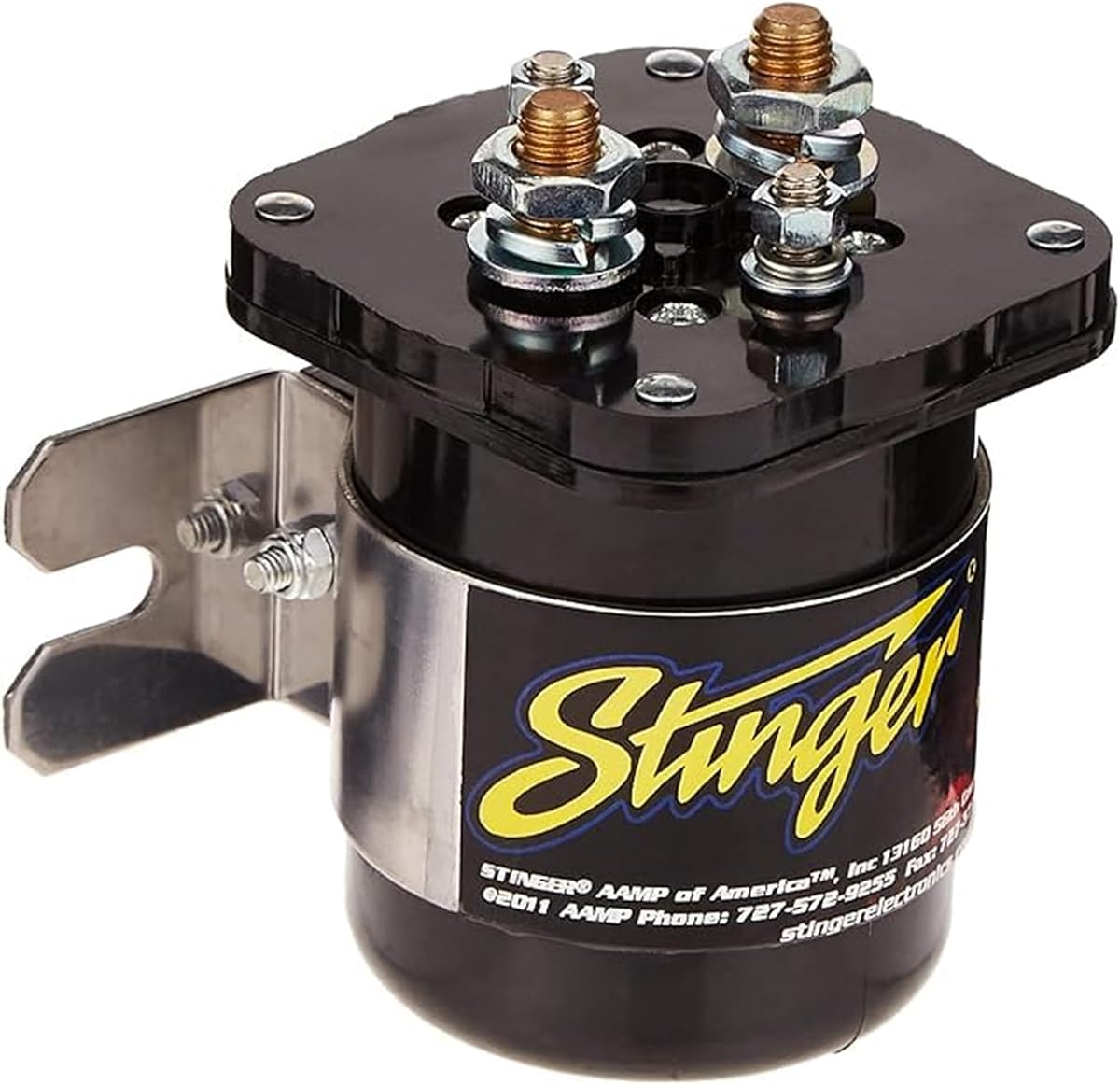
The Stinger SGP32 is a high-current dual battery isolator and relay designed for demanding electrical systems. It carries a 4.6 rating and separates itself from the more conventional 140-amp VSRs through a 200-amp continuous current rating, a 500-amp surge capability, and a phenolic plastic body designed to resist moisture damage.
We may earn a commission when you buy through this link, at no additional cost to you.
The unit is compatible with any type of vehicle alternator or charging system and can deliver power on demand for demanding accessories. Its second-battery isolation function is especially relevant to car audio, powersports, marine equipment, and off-road applications, where accessory loads can be far greater than ordinary household circuits. A stated mechanical cycle life of 100,000 supports the idea of a durable, long-lived switching component.
This is not presented as a complete dual battery wiring kit, and its high-current design may be unnecessary for a modest camper or trailer installation. The 200-amp label represents the maximum continuous capability of the relay, not a recommendation to run undersized cables or omit circuit protection. Proper installation still requires compatible conductors, terminations, grounding, and appropriate fuse placement.
The Stinger is most appropriate for installers who need more switching capacity than a standard 140-amp VSR provides, especially in high-output audio or accessory systems. Its marine-oriented phenolic construction and surge tolerance also make it attractive for performance vehicles and specialized off-road builds.
The relay can isolate a second battery while controlling power to accessories up to 200 amps continuously. This gives high-draw systems a clear path without requiring the batteries to remain permanently connected.
Phenolic construction provides moisture resistance for marine and powersports environments, while the stated 100,000-cycle life and 500-amp surge capability suit high-activity electrical installations.
We may earn a commission when you buy through this link, at no additional cost to you.
The KeyLine 140 Amp VSR is a compact automatic disconnect designed for 12V dual battery arrangements in cars, trucks, RVs, UTVs, ATVs, and marine applications. It has a 4.5 rating, a 2.6-by-2.6-by-2-inch format, and a solid-state design intended to provide efficient power distribution without the losses associated with traditional isolator diodes.
We may earn a commission when you buy through this link, at no additional cost to you.
Its voltage-sensitive control activates at 13.3 volts and disengages at 12.8 volts. This helps preserve the starting battery while allowing the auxiliary battery to charge from the vehicle's alternator. The IP65 rating adds resistance to water, dust, and vibration, making the unit suitable for off-road, marine, and daily-driving environments where environmental durability matters.
The relay includes a mounting plate and hardware but does not include installation wires. That is the most important practical distinction for buyers comparing complete kits: vehicle-specific cable length, conductor size, and terminal selection may need to be sourced separately. There is also no advertised manual reverse-charge or voltage-display function, so it is best suited to users who want automatic operation and do not need an emergency bridging feature.
Despite the missing wires, this product is a strong choice for a clean, space-conscious installation. It is particularly attractive to DIY installers who understand basic battery wiring and want a compact, weather-resistant solid-state relay rather than a relay-only solution burdened with a large display.
The solid-state relay is described as eliminating the power loss associated with conventional isolator diodes. Its automatic switching helps maintain charging efficiency while keeping the second battery isolated when appropriate.
At 2.6 by 2.6 by 2 inches, the relay can fit more easily beneath a hood, inside a camper compartment, or within a confined marine installation. The included plate and hardware simplify mounting.
We may earn a commission when you buy through this link, at no additional cost to you.
The 140A Digital Voltmeter Relay combines automatic and manual battery control with a visible voltage display and an IP68 waterproof rating. It has a 4.5 rating and is intended for cars, RVs, ATVs, UTVs, boats, 12VDC marine systems, 4WD vehicles, and caravans. Its most noticeable advantage over basic relays is the combination of monitoring and user-selectable control.
We may earn a commission when you buy through this link, at no additional cost to you.
The relay can automatically connect or disconnect the auxiliary battery according to the main battery's voltage. Both batteries can charge from the engine alternator at the same time, while the second battery provides a separate source for accessories when the engine is off. An input below 11 volts or above 17 volts automatically disconnects the circuit, helping protect the main battery from excessive discharge or unusually high voltage.
The IP68 rating is the strongest stated enclosure rating among the listed products, making the unit appealing for exposed marine, trailer, and off-road locations. However, it is explicitly not compatible with ternary lithium batteries. The supplied information also does not detail the included cable lengths, mounting hardware, or connector assortment, so those aspects should be confirmed directly with the listing before installation.
This isolator is a good fit for a 12V lead-acid system where real-time voltage information and a manual option are valuable. It is especially useful for recreational, marine, and off-road installations that need routine monitoring and may occasionally benefit from a controlled connection between battery banks.
The stated IP68 rating offers a strong barrier against water and dust. That makes the relay suitable for installations where splashing, humidity, or frequent exposure is likely, subject to correct cable glands and connections.
The digital voltmeter makes voltage visible while automatic and manual modes provide operational flexibility. The result is easier diagnostics and more deliberate control over battery-bank connections.
We may earn a commission when you buy through this link, at no additional cost to you.
The 500A Pure Copper VSR is the highest-capacity isolator in this guide, with a 4.4 rating and a construction centered on copper terminals and connectors. It is aimed primarily at RV and travel-trailer electrical systems where substantial accessory loads, long cable runs, and exposure to moisture can make conductor quality and corrosion resistance especially important.
We may earn a commission when you buy through this link, at no additional cost to you.
The relay connects the batteries while charging and disconnects them when the engine is off, providing automatic dual battery isolation. Its pure copper terminals are described as delivering better conductivity and corrosion resistance than brass alternatives, with the listing claiming 30 percent better conductivity, minimal voltage drop, and stronger rust resistance. The 500-amp rating provides a very high ceiling for continuous system demand.
That capacity may be far more than a typical car or small camper requires, so installers should compare the relay against actual alternator output, cable size, fuse ratings, and accessory demand. A higher relay rating does not correct undersized wiring. The description mentions pure copper lugs and mounting screws but does not provide a detailed list of battery cables or hardware.
For a power-hungry RV or trailer with demanding accessories, the high current rating and copper-focused construction offer a compelling package. The model is less compelling for a modest dual battery system, but it gives serious installers additional headroom and emphasizes long-term connection quality.
A 500-amp rating gives substantial capacity for demanding accessory systems. It is intended to maintain stable power for RV equipment while protecting the primary starting battery from drain.
Pure copper terminals and connectors are intended to minimize voltage drop and resist corrosion better than lower-cost brass components. Those qualities can be valuable in long runs and harsh RV environments.
We may earn a commission when you buy through this link, at no additional cost to you.
The MaySpare 140-amp Dual Battery Isolator Kit is a conventional automatic charging solution with a 4.4 rating. It uses a voltage-sensitive chip to cut in at 13.3 volts and cut out at 12.8 volts, preserving the primary battery for starting while allowing the auxiliary battery to be charged by the alternator. The kit is designed as a complete, practical installation package rather than a relay-only component.
We may earn a commission when you buy through this link, at no additional cost to you.
Its accessories are described as covering the pieces needed for a complete installation. The small housing is intended to suit many locations and is marketed for ATVs, UTVs, boats, RVs, marine vehicles, trucks, and caravans. Automatic operation simplifies everyday use, and the relay creates the familiar arrangement in which accessories can run from the second battery while the engine is off without continuously draining the primary battery.
The product information does not expressly confirm lithium compatibility, making the relay more naturally suited to conventional 12V lead-acid systems. It also lacks an advertised display, abnormal-voltage cutoff, or manual reverse-charge function, so owners who require those capabilities should consider alternatives. Actual cable length and conductor gauge should be checked against the intended installation before ordering.
MaySpare is a sensible selection for builders who want a recognized 140-amp VSR and the necessary installation pieces in one package. It is best for conventional dual battery projects in vehicles and recreation equipment where automatic operation, compact construction, and a broad range of compatible applications are the priorities.
The package is described as including the pieces needed for a complete installation, reducing the need to assemble a relay and a collection of separate cables and connectors. Vehicle-specific dimensions should still be measured.
The standard 13.3-volt cut-in and 12.8-volt cut-out thresholds provide predictable behavior across many 12V vehicle systems. The design is especially approachable for installers who want automatic isolation without extra controls.
We may earn a commission when you buy through this link, at no additional cost to you.
Choosing a dual battery isolator requires matching its electrical behavior, current capacity, environmental protection, and included components to the intended vehicle and accessory load. The following factors help narrow the field before installation.
Start by confirming the type of battery connected to each side of the system. Several products in this guide explicitly support acid-lead batteries and exclude lithium batteries, while one model is specifically described as incompatible with ternary lithium chemistry. Voltage cut-in and cut-out points are not, by themselves, proof that a relay is safe for every lithium battery management system. A relay designed for conventional lead-acid charging behavior may use thresholds and isolation logic that do not suit lithium charging requirements.
Choose a model only when its manufacturer explicitly supports the chemistry installed in the vehicle. If the project uses lithium batteries, look for a unit that specifically addresses lithium-compatible voltage profiles and battery management systems. When compatibility remains unclear, contact the seller or vehicle electrical specialist before connecting the relay.
The current rating indicates how much current the relay is designed to switch, but it is not the only consideration in a complete installation. Most products here are rated at 140 amps, the Stinger offers 200 amps continuously with surges up to 500 amps, and the 500A model targets high-output RV systems. The appropriate choice depends on the alternator output, combined accessory demand, cable gauge, connector quality, and the short-duration loads experienced during cranking.
Avoid choosing a relay simply because its headline current rating exceeds the accessory load. Every current path still needs suitable conductors, secure terminals, correct grounding, and appropriate circuit protection. For unusually high-demand systems, the higher-capacity copper-equipped model may offer useful headroom, but proper system design remains essential.
Many of the listed relays use a 13.3-volt cut-in and 12.8-volt cut-out threshold. The higher cut-in point tells the relay when the alternator has raised the primary system enough to begin charging the auxiliary battery, while the lower cut-out point determines when the batteries should be isolated again. This arrangement helps prioritize the starting battery and reduces the chance of the auxiliary bank pulling down the primary bank when the engine is stopped.
Some models add protection by disconnecting below 11 volts or above 17 volts. That behavior can be useful in a demanding electrical environment, while fixed-threshold relays offer a simpler control scheme. Compare the operating behavior with the charging system and battery type rather than assuming every 12V relay has identical responses.
Automatic operation is the central feature of most voltage-sensitive relays, but several products also provide manual control. Manual mode is valuable when a user wants to connect the banks deliberately, and two of the listed units can reverse charge so an auxiliary battery can assist a depleted primary battery. Emergency reverse charging is not a routine substitute for maintaining healthy batteries and should be used only when the user understands the consequences for battery chemistry, wiring, and electronics.
For users who mostly want dependable daily charging and separation, an automatic relay may be all that is required. Those who regularly diagnose electrical systems, carry recovery equipment, or want a deliberate emergency connection may value a digital display and manual mode more highly.
Marine, trailer, off-road, and under-hood installations can expose the relay to moisture, dust, salt, heat, and vibration. The products in this guide carry stated IP65, IP66, IP67, or IP68 ratings, with the 140A Digital Voltmeter Relay listing the highest stated enclosure rating. A higher rating provides greater confidence for exposed locations, although it does not eliminate the need for correct cable entry, strain relief, corrosion prevention, and secure mounting.
The VEVOR, Nilight, and KeyLine models are also described as shock resistant, dustproof, vibration tolerant, or weather resistant. Consider the actual installation environment rather than relying only on the IP code. A well-mounted relay with properly sealed connections is generally more useful than an impressive rating applied to an installation with loose or unprotected entries.
The contents matter because a relay alone is not a complete installation. The Nilight and MaySpare products are described as complete kits, while the VEVOR includes a broad accessory set. By contrast, the KeyLine VSR includes a mounting plate and hardware but not installation wires, and the Ampper includes a plate and four bolts without a stated wiring package. Other listings provide fewer details about their included parts.
Before purchasing, list the required cables, ring terminals, marine lugs, heat-shrink, ties, and fasteners. Check cable gauge, length, and terminal type against the vehicle's layout and load. More parts are not automatically better if the included cables are too short, too light, or inappropriate for the intended connection.
Most of the isolators are marketed for broad use in cars, trucks, RVs, campers, caravans, ATVs, UTVs, boats, trailers, marine systems, and off-road vehicles. The Stinger is more specifically oriented toward car audio, powersports, marine use, and high-current accessories, while the 500A copper unit is positioned for RV and travel-trailer systems. Installation space, starting load, alternator output, and accessory demand should guide the final choice.
A dual battery relay is intended to manage two battery systems rather than replace the need for a main battery in a single-battery vehicle. Consider whether the installation actually has a secondary battery, how accessories will be routed, and whether the relay is being used for power isolation, auxiliary charging, or both. Clear intended use reduces the chance of choosing an unnecessarily complex or undersized solution.
An integrated digital voltmeter gives users immediate feedback on battery voltage and can make troubleshooting faster. Manual controls add another layer of interaction, while fixed-voltage relays remain the simplest to operate once installed. A digital model is particularly useful for recreational vehicles, boats, and trailers where checking state of charge is a regular part of system upkeep.
Installation convenience also depends on dimensions and documentation. The KeyLine and VEVOR products are described as compact, and both include mounting hardware. Clear package contents and straightforward wiring instructions can be as important as extra features, especially for first-time dual battery builders.
Begin by identifying the primary starting battery and the auxiliary battery, then confirm that both use a chemistry supported by the relay. Disconnect power according to the vehicle manufacturer's procedure, mount the isolator in a clean, protected location, and follow the supplied instructions for terminals, grounding, and cable routing. Use appropriately rated conductors and secure connections, because the relay's current rating does not compensate for undersized wiring.
After installation, restore the primary battery first and confirm that the system is stable. Start the engine and watch the relay behavior: with a voltage-sensitive model, the auxiliary battery should connect for charging once the specified cut-in voltage is reached. Use a quality multimeter to verify charging voltage, ground performance, and the status of both batteries rather than relying only on an installed display.
For ongoing care, inspect terminals for corrosion, looseness, heat discoloration, damaged insulation, and excessive flex. Keep the enclosure dry, avoid directing pressure washers into cable entries, and periodically verify voltage before and after charging. If a battery is repeatedly depleted, check accessory loads, alternator output, cable condition, and battery health rather than immediately assuming the isolator has failed.
A dual battery isolator manages two 12V battery systems connected to one charging source. A voltage-sensitive unit connects them when charging voltage reaches the specified cut-in point and separates them when voltage falls to the cut-out point. This helps preserve the starting battery while allowing an auxiliary battery to support accessories when the engine is off.
That depends on the system design. The Stinger product is specifically described as providing a reliable way to power accessories and includes second-battery isolation, but a typical compact VSR primarily manages charging and separation rather than acting as a heavy-duty parallel starting switch. If dual-battery starting is required, use appropriately rated starting cables, contactors, and control hardware designed for that purpose.
Not automatically. The Ampper, Nilight, two 140-amp smart relays, and the 140A Digital Voltmeter Relay are explicitly limited regarding lithium compatibility, while some other listings do not state support. A lead-acid relay's cut-in and cut-out voltages may not match a lithium battery's charging needs, so compatibility should be confirmed directly with the manufacturer before installation.
The rating describes the maximum current the relay is designed to switch under its specified conditions. A 140-amp model is suitable for many conventional dual battery installations, while the 500-amp copper-equipped model offers more headroom for heavy RV and trailer accessory systems. The relay rating must still be supported by the alternator, cables, terminals, grounding, and fuse protection.
It depends on the product. The Nilight and MaySpare products are described as complete kits, and the VEVOR includes a broad accessory set. The KeyLine VSR includes a mounting plate and hardware but does not include installation wires, while the Ampper includes a plate and four bolts. Buyers should verify cable gauge, length, and terminal type for their specific vehicle.
Models with manual control let the user connect or disconnect the battery banks deliberately, while automatic VSRs make the decision according to charging voltage. Two of the listed smart relays also support reverse charging for emergency assistance to a depleted starting battery. Manual and reverse functions should be used carefully and are not a replacement for regular battery maintenance.
Choose a location that is protected from excessive heat, moving parts, sharp edges, standing water, and direct pressure-washer spray while remaining accessible for inspection. Marine and off-road installations should pay particular attention to corrosion, vibration, and sealed cable entries. Secure the mounting hardware and route heavy cables so tension cannot pull terminals loose.
Measure the primary and auxiliary battery voltages with the engine off and again while the engine is running. Compare the readings with the relay's specified cut-in and cut-out behavior, then check the alternator output and all cable connections. If voltages remain abnormal, inspect battery condition, alternator performance, grounds, fuses, and cable sizing before condemning the relay.
The Nilight 140A Dual Battery Setup is the leading all-around choice because it combines a well-rated 140-amp relay with an extensive installation package and IP66 protection. The Ampper 140A Voltage Relay offers a simpler budget-oriented option for conventional lead-acid installations, while the Stinger SGP32 provides the strongest premium performance profile with 200-amp continuous capacity, 500-amp surge handling, and marine-oriented construction.
For most vehicle, RV, trailer, and marine projects, prioritize correct battery-chemistry compatibility, sufficient current capacity, sound cable and terminal design, and an ingress rating that suits the installation. Models with a digital voltmeter and manual mode are useful when monitoring and emergency control matter, while a higher-current copper-equipped design becomes more relevant as accessory demand increases.
Ratings, technical specifications, package contents, and prices can change, so buyers should confirm the current listing before ordering. Review the relay's voltage thresholds, mounting dimensions, included accessories, and warranty information, then match those details to the vehicle and the loads that the auxiliary battery will actually support.