
PRGR HS 130-A
4.2Editor score
No app required
Measures club speed without ball
Stores 500 previous swings
Runs on AAA batteries
A golf launch monitor and swing analyzer turns each practice swing into actionable feedback, helping golfers understand ball speed, launch direction, carry distance, spin, and other performance indicators. The right device should match your practice environment, available space, skill level, and preferred coaching method while delivering information you can trust.
We compared 10 portable and indoor-capable options based on their stated measurement technologies, available metrics, app compatibility, training modes, storage, display features, power requirements, and shooting-location flexibility. The list covers radar-focused speed trainers, camera-assisted analyzers, GPS bundles, simulator systems, and connected monitors for range, backyard, or indoor-net practice.
Each review explains the strongest reasons to choose a particular model, along with limitations such as platform restrictions, subscription features, required clearance, or a narrower metric set. Ratings and product details reflect the supplied information, while prices and availability can change, so readers should confirm current listings before purchasing.
4.2Editor score

4.2Editor score

5.0Editor score
As an Amazon Associate we earn from qualifying purchases.
The table below compares all 10 monitors by their core measurement approach, practical features, connected-device support, and best-fit use case.



The Rapsodo Golf Launch Monitor combines Doppler radar with a dual-camera system to collect swing and ball-flight information, giving it a notably broad analytical scope. Its listed rating is 3.8, but the product’s stated 15-metric coverage and video-oriented features make it a compelling option for golfers who want more than a single speed reading. It can be used at a range, in a backyard, or around an indoor practice net.
We may earn a commission when you buy through this link, at no additional cost to you.
The monitor tracks such details as spin rate, spin axis, carry distance, club speed, club path, launch angle, and other swing characteristics. That combination makes it useful for diagnosing why a shot travels as it does rather than merely recording how far it went. Slow-motion contact views add a visual layer, while multiple camera angles can help golfers compare positions and movements across the swing.
The principal trade-off is access to premium functionality. The included 45-day premium trial opens simulated courses, third-party app integration, target ranges, impact vision, combined training features, and speed training. Later use of these digital tools may require a membership, so buyers focused solely on hardware measurements can get more from the device while golfers interested in ongoing simulator content should examine the subscription terms carefully.
This is the strongest choice in the group for golfers who want granular data, video inspection, and a broad mixture of practice modes. It may not be the simplest option for a beginner or the most suitable selection for someone who wants a completely subscription-free device. Even so, the extensive measurement and analysis platform gives it considerable value for deliberate, data-driven improvement.
With 15 key metrics and both radar and camera inputs, the system is built to show relationships among speed, launch, spin, and club movement. That breadth helps golfers move beyond isolated distance goals and identify which part of the swing may be influencing the result.
Dual cameras and slow-motion ball-and-club contact views let golfers compare the movement they felt with what the equipment recorded. This visual feedback is especially useful when learning to recognize changes in club path, contact position, and launch behavior.
We may earn a commission when you buy through this link, at no additional cost to you.
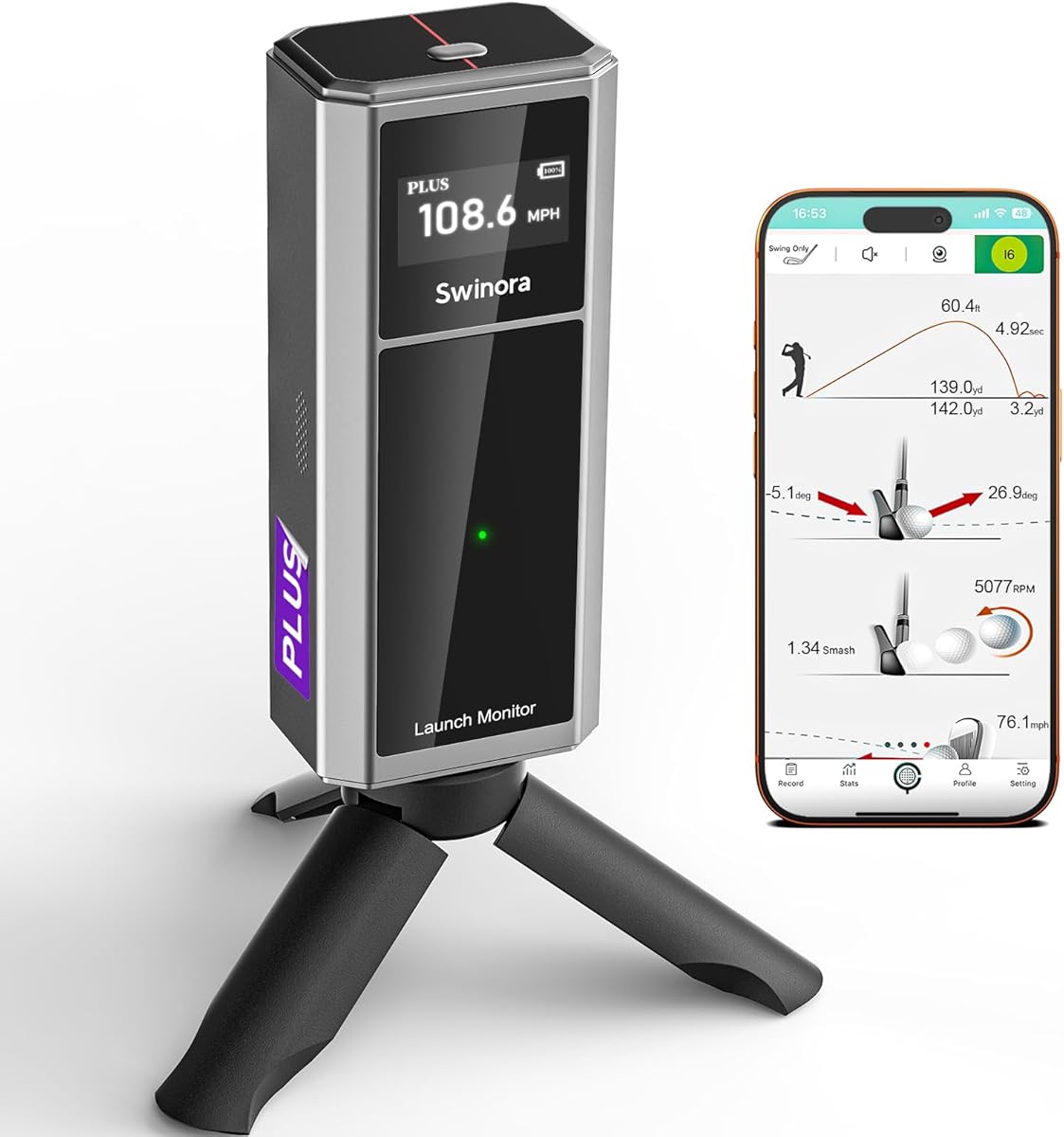
This portable golf launch monitor and swing analyzer stands out because its stated app features are available without an annual subscription. It records 13 metrics and adds temperature, humidity, and barometric-pressure sensing, making it a practical all-in-one system for practice at a range, outside, or inside a suitably sized hitting area. Its supplied rating is 4.1.
We may earn a commission when you buy through this link, at no additional cost to you.
The device tracks attack angle, launch angle, spin rate, ball speed, club speed, and additional swing metrics to create a more complete performance picture. Fixed practice views from 45-degree and 90-degree perspectives help users examine swing position, while the trajectory display provides another way to interpret the result. Real-time voice feedback can reduce the need to look away during a practice swing.
There are important boundaries. It does not measure horizontal clubface angle or swing path, so golfers seeking a complete face-and-path diagnosis may need another category of equipment. Indoor operation also requires at least 15 feet of total space: the device must sit exactly five feet behind the ball, with approximately 10 feet available for tracking ball flight. Those requirements should be checked before the monitor is installed in a garage or small net bay.
Despite those limits, this is one of the most attractive options for a golfer who values broad metrics, environmental compensation, and freedom from recurring app costs. Its calibration controls, OLED display, metal body, and multi-angle review features also make it versatile for regular practice. It is particularly well suited to golfers who want meaningful launch and speed information without paying a recurring fee for access to the analysis tools.
Temperature, humidity, and barometric-pressure modules automatically adjust shot information for prevailing conditions. This is helpful because a session conducted in a hot, humid environment may not produce an identical result to one held in cool, dry air, and the system accounts for those changes before presenting the data.
The distance-compensation function can be adjusted from 80% to 120% for each club. Once calibrated against typical carry distances, it gives golfers a more meaningful baseline for judging changes in performance and building repeatable club gaps.
We may earn a commission when you buy through this link, at no additional cost to you.
The Voice Caddie SC300i combines a six-parameter launch monitor with GPS overview tools, a large display, voice output, and a power bundle. Its most distinctive feature is immediate spoken feedback, which can help golfers stay focused on the swing instead of repeatedly checking a screen. It supports indoor and outdoor practice and has a supplied rating of 3.6.
We may earn a commission when you buy through this link, at no additional cost to you.
Using Doppler radar, the unit measures distance, smash factor, launch angle, apex, and swing speed. The stated accuracy is plus or minus 3% for ball speed, plus or minus three yards for carry distance in target mode, and plus or minus 5% in practice mode. The 5.3-inch LCD presents the measurements, while voice output makes results accessible from farther away on the practice mat.
Connection to the MySwingCaddie app for iOS and Android adds real-time shot data, club statistics, and performance analysis. Adjustable loft angles let golfers simulate different club conditions for focused indoor work, although six parameters are fewer than the broader data sets offered by several higher-ranked options. Buyers who need spin, dispersion, or detailed face-and-path measurements may find the SC300i less comprehensive.
This monitor is best for golfers who prefer spoken coaching and a physical screen rather than an app-first experience. Its combination of portable Doppler measurement, adjustable practice conditions, and audible output is practical for range and indoor sessions. Those seeking more advanced simulation or a deeper metric list should compare its feature set with more extensive systems before deciding.
After each shot, spoken results reduce the need to repeatedly glance down at the display. This can be especially helpful when practicing technical changes because the golfer receives immediate information while staying in a more natural setup position.
Adjustable loft angles allow practice sessions to simulate different club conditions. Golfers can create more varied tasks without changing the actual swing, making the system useful for comparing technique and consistency under different simulated conditions.
We may earn a commission when you buy through this link, at no additional cost to you.
The GOLFBUDDY Shot Mate delivers a focused set of measurements through Doppler radar, including club speed, ball speed, smash factor, and carry distance. Its 4.3 rating is the second highest in this comparison, and the practical feature list—practice and target modes, a full-color display, and a rechargeable battery—makes it an appealing general-purpose training tool.
We may earn a commission when you buy through this link, at no additional cost to you.
Real-time performance feedback gives golfers immediate information about distance control and swing efficiency. Practice mode supports repetition work, while target mode adds an accuracy-oriented element to a session. The bright TFT LCD automatically adjusts for changing lighting, helping users read the screen outdoors or in an indoor hitting area without relying entirely on a phone.
The main limitation is scope. Although the device covers four essential swing measurements, it does not provide the deeper launch-angle, spin, dispersion, or video analysis found among more expensive or more specialized competitors. It also lacks a stated subscription requirement, which helps keep ongoing ownership uncomplicated, but buyers should confirm that the core functions they need remain available through the included experience.
For golfers who want dependable-looking speed, smash, and carry data without a complicated setup, the Shot Mate is an excellent choice. Its 1,000-shot storage automatically retains the last 10 swings for quick review, while the extended tracking range reaches 320 yards. It is particularly suited to repetitive range work, indoor target practice, and golfers who value readable feedback over elaborate digital coaching.
The ability to save as many as 1,000 shots makes it possible to compare more than a single session. Automatic retention of the last 10 swings also gives golfers an efficient way to spot changes in speed, smash factor, or carry distance without searching through a long history.
Practice mode is suited to building consistency through repeated swings, while target mode adds a precision-oriented task. Alternating between the two can make a session more structured and help golfers connect swing feedback with the objective they are working toward.
We may earn a commission when you buy through this link, at no additional cost to you.
The Rapsodo Mobile Launch Monitor is designed around an iPhone or iPad and turns compatible Apple devices into a portable shot-analysis system. Its 4.2 rating reflects a solid overall proposition for golfers who already use Apple hardware and want to practice at a driving range, backyard, or indoor net. It records ball speed, club speed, launch angle, carry distance, and shot shape.
We may earn a commission when you buy through this link, at no additional cost to you.
Video replay is the defining benefit. Each swing can be reviewed with an on-screen tracer showing the ball’s path, allowing golfers to connect numerical results with the movement they produced. That makes it easier to spot issues and decide what to work on during the same session rather than waiting for a later lesson or review.
The iOS-only requirement is the clearest restriction. Android users cannot rely on this model, and even compatible Apple users should note that simulator courses and game modes are unlocked through premium access. The free application provides the core practice experience, but golfers interested in the complete virtual content should understand which features are included permanently.
This is a strong choice for an Apple-centered golfer who values portability and video-assisted learning more than a large built-in screen or an extensive collection of physical measurements. Its lightweight design is convenient for travel and casual practice. The mobile-first approach is effective for quick, focused sessions where reviewing the swing is the central goal.
The tracer connects the visible flight of the ball with the measured launch and speed values. Seeing that relationship after every swing can make a technical change easier to understand, particularly for golfers who are still learning how swing mechanics translate into ball behavior.
Because the system depends on a portable Apple device, it can move easily between a range, backyard, or indoor net. That flexibility makes it practical for golfers who want useful feedback without committing to a permanently installed simulator setup.
We may earn a commission when you buy through this link, at no additional cost to you.
The PRGR HS 130-A focuses on the measurements that matter most for speed training while avoiding app and connectivity requirements. It uses Doppler radar to measure club-head speed, ball speed, smash factor, total distance, and carry distance. The device has a supplied rating of 4.2 and can operate at the range, in a garage, or in a gym.
We may earn a commission when you buy through this link, at no additional cost to you.
Its most useful specialty is measuring club-head speed without hitting a ball. That allows golfers to work on speed independently of strike quality, which can be valuable when they are rebuilding a swing, increasing racket speed, or following a structured training plan. When a ball is used, the remaining measurements provide context for how efficiently the club is interacting with it.
The trade-off is simplicity without modern connected features. There is no Wi-Fi, Bluetooth, app, or stated automatic video analysis. It stores 500 past swings in memory, which supports basic progress tracking, but golfers wanting dispersion charts, shot shapes, annotated video, or virtual courses will need a more connected system. AAA batteries also make this a familiar and travel-friendly option rather than a device that depends on proprietary charging.
The PRGR is best for golfers who want dependable speed-oriented feedback with minimal setup. It is especially useful for solo swing-speed work and for travelers who want a small unit that slips into a golf bag. Its combination of no-ball club-speed measurement, simple operation, and broad multi-sport capability makes it a focused training instrument rather than a complete simulator.
Measuring club-head speed without a ball separates swing speed from ball-strike consistency. A golfer can use that information to isolate one training objective, then return to ball-based work with a clearer understanding of how much speed the swing is producing.
Running directly on AAA batteries and avoiding Wi-Fi or Bluetooth means there is no account, phone, or software update to manage. The result is a more frictionless routine, especially for players who prefer to concentrate on the swing and review basic numbers.
We may earn a commission when you buy through this link, at no additional cost to you.
The Garmin Approach R10 offers an attractive balance of portable measurement, automatic video, and app-based analysis. It can be used at home, indoors, or at the driving range, and its supplied rating is 4.2. With a compatible smartphone and the Garmin Golf app, it tracks club-head speed, ball speed, swing tempo, ball spin, launch angle, and other useful indicators.
We may earn a commission when you buy through this link, at no additional cost to you.
Automatic video recording is one of the system’s strongest features. Clips include the relevant swing metrics, allowing golfers to review technique and numerical performance together. Training mode tracks statistics by club and presents a shot-dispersion chart based on estimated ball flight, making it easier to see whether a swing is producing a repeatable pattern.
The experience depends on a compatible smartphone, and the full virtual-round catalog requires an active subscription. That can add a recurring cost for golfers who mainly want the physical monitor. Some readings, including dispersion and estimated flight, should also be interpreted in the context of the monitor’s stated accuracy rather than treated as laboratory-level certainty.
For most golfers, the Approach R10 is the most balanced connected choice in the list. It works across indoor and outdoor environments, has a stated battery life of up to 10 hours, and comes with a phone mount for convenient viewing. It is an excellent recommendation for golfers who want automatic video and club-level trends without moving into a full simulator platform.
Training mode separates performance by club, making it easier to identify which part of the game needs attention. Combined with the dispersion chart, this gives golfers a practical way to compare consistency instead of relying only on an average carry distance.
Recorded clips include the data for each swing, so a golfer can review the movement and the measurements together. This is particularly helpful at home, where immediate feedback can guide the next set of shots without requiring a coach or playing partner.
We may earn a commission when you buy through this link, at no additional cost to you.
TheStack Radar has the highest supplied rating in the comparison at 4.6 and centers its purpose around speed training, especially for wedges. It measures swing speed and ball speed, then calculates estimated carry distance and smash factor. Its compact format and direct connection to TheStack App make it a focused companion for golfers who want structured speed work rather than a broad simulator.
We may earn a commission when you buy through this link, at no additional cost to you.
The wedge-training app creates game-like, skill-specific sessions intended to help golfers dial in distances. Because training speeds transmit automatically to the phone, the feedback loop is efficient: hit, review, and adjust without manually entering each number. A one-month trial of Stack Wedge Mode is included, while bundled access to Stack Putting adds guided putting practice and tendency insights.
Platform compatibility needs care. TheStack App supports Apple devices running iOS 15.0 or later and Android devices for speed training, but the wedging experience is not yet available on Android. The included putting feature is also listed as iOS only. Golfers who rely on Android should therefore focus on the core speed function and confirm which app features match their device.
This is the top pick for golfers focused on speed, wedge gapping, and structured practice. Although it does not provide the same breadth of launch analysis as a full camera-and-radar system, its specialized training tools make it an excellent choice for players seeking a clear, repeatable speed objective. The association with 2022 US Open Champion Matt Fitzpatrick also lends credibility to its range-training use case.
The Stack Wedging platform turns speed into a structured practice objective through skill-specific sessions. That focus can help golfers build confidence in the distances they can repeat, rather than treating every wedge swing as an isolated measurement.
Measured training speeds are sent directly to the phone through Bluetooth. This reduces recordkeeping and lets golfers move through a session with less interruption, which can be useful when practicing a focused speed target under real practice conditions.
We may earn a commission when you buy through this link, at no additional cost to you.
The Voice Caddie SC4 PRO is the most simulation-oriented monitor in the list, combining eight measured parameters with a 3D driving range, E6 Connect access, GPS overview, a 5.3-inch display, and voice output. Its supplied rating is 5.0, making it an attractive premium pick for golfers who want a device to handle both measurement and virtual practice.
We may earn a commission when you buy through this link, at no additional cost to you.
Its ProMetrics engine is presented as tracking the swing from movement through impact and ball flight, with real-time ball and club-head data. The 3D Driving Range and E6 Connect experiences extend that core measurement into a more game-like home environment. This makes the system attractive for golfers who want to work on target selection, simulated course play, and structured range challenges rather than simply collecting numbers.
The VoiceCaddie S app adds statistical analysis, distance calibration, and swing-speed radar capabilities. Practice/Target Mode supports accuracy work, while Speed Training/Swing Speed Mode creates a more focused alternative to full simulation. The complexity and larger display are trade-offs for anyone who mainly wants a pocketable speed trainer, but they are sensible advantages for a permanent home setup.
The SC4 PRO is the best recommendation for golfers building a connected home-practice ecosystem. Indoor and outdoor support means the system can extend beyond a net, while the included simulator content and multiple operating modes make each session more varied. For a buyer who wants comprehensive measurement alongside virtual play, it offers the most complete package among these choices.
A 3D driving range and E6 Connect access transform each shot into a virtual experience. The added context can make practice more engaging while giving the underlying launch data a practical purpose within a game-like environment.
Practice, Target, Speed Training, and Swing Speed modes serve different objectives. Rotating among them helps a golfer alternate between accuracy, distance control, and raw speed without treating every session as an unstructured stream of shots.
We may earn a commission when you buy through this link, at no additional cost to you.
The FlightScope Mevo uses 3D Doppler radar to provide real-time golf data indoors or outdoors, with direct spin measurement among its most valuable features. It measures eight full-swing parameters, including carry distance, spin rate, club speed, ball speed, vertical launch, and smash factor. The package includes a protective hard case, and the supplied rating is 3.9.
We may earn a commission when you buy through this link, at no additional cost to you.
The FS Golf app supports customizable views of data, video, and trajectories. Automatic clipping creates clips of the entire swing with corresponding measurements, while selectable pre- and post-trigger durations give users control over how much of each movement is retained. Text-to-speech is available for immediate spoken results, which can reduce screen dependency during a session.
The application also includes skill challenges based on current PGA and LPGA tour averages. These provide concrete comparative targets for speed, distance control, and other parameters. The primary limitation is dependence on a compatible phone or tablet, which introduces an extra screen into the setup and may be less convenient than a monitor with a large integrated display.
The Mevo is a good choice for golfers who specifically want direct spin feedback and a substantial set of shot metrics in a portable radar system. It offers enough structure for deliberate practice while remaining usable at a range or around an indoor net. Golfers who prioritize spin, video, and trajectory analysis will find the feature set particularly relevant.
Spin helps explain why two shots with similar speed and launch can behave differently. Direct measurement makes it easier to connect changes in spin with distance control, trajectory, and the way a player manages speed through impact.
PGA and LPGA averages offer comparative goals for speed and distance control. Working against a tour reference can add structure, although golfers should treat it as a learning target rather than a direct prediction of competitive scoring ability.
We may earn a commission when you buy through this link, at no additional cost to you.
The right choice depends on the measurements you want, your practice environment, the space available, and whether app-based video and simulation will improve your routine.
Doppler radar, cameras, and multi-sensor systems each provide different information. Doppler radar is well suited to ball speed, club speed, smash factor, carry distance, and some launch measurements. Camera-assisted systems can add visual context, club-path information, and a clearer view of ball contact. A three-dimensional radar system may offer a particularly broad set of launch and spin readings. Choose based on the questions you want the device to answer rather than on the number of headline metrics alone.
In short: match the sensing technology to your priority, whether that is speed, spin, launch direction, impact video, or a combination of measurements.
A larger metric list is not automatically more useful. Speed-focused golfers may need only club speed, ball speed, smash factor, and carry distance. Better players may want launch angle, spin, dispersion, and a shape indicator. Wedge-focused users might prioritize calculated carry and structured distance work, while simulator buyers may care most about shot tracking and virtual-game compatibility.
In short: choose a monitor with enough relevant measurements to guide your next practice session, not merely the highest total on the specification list.
Indoor radar tracking requires more room than many shoppers expect. One of the products in this list requires 15 feet of total space, including placement behind the ball and room for the ball’s flight. Other systems may also need a clear path and stable positioning. Check the manufacturer’s alignment instructions before purchasing, and measure the intended bay rather than estimating from the size of the net.
In short: verify the full tracking depth, device placement, and obstacle clearance before bringing a monitor into a garage, basement, or indoor net.
Some monitors operate entirely on their own, while others require a phone, tablet, or specific operating system. The Rapsodo MLM is limited to iPhone and iPad, TheStack Radar offers different app functions across iOS and Android, and the Mevo uses a customizable phone or tablet interface. Some premium courses and games also require an active subscription. A compatible device is only part of the check; account creation and ongoing service access may also matter.
In short: confirm operating-system compatibility, app availability, included features, and subscription requirements before buying.
A launch monitor and a golf simulator can overlap, but they serve different purposes. Speed-first systems are compact, fast to deploy, and ideal for repetitive range work. Simulation-oriented products add virtual courses, challenges, game modes, or target exercises. A broader analytical system may provide automatic video and dispersion charts. Decide whether you want a measurement tool, a training platform, or a connected combination of both.
In short: pay for the training experience you will actually use, whether that means more metrics, automatic video, structured practice, or virtual play.
A device used at the range must be easy to carry, while an indoor monitor may stay in one position. Consider size, weight, battery life, charging method, and setup time. The Garmin Approach R10 and GOLFBUDDY Shot Mate provide stated long battery runtimes, whereas the PRGR uses readily available AAA batteries. A larger screen can improve readability but reduce the appeal of a compact grab-and-go setup.
In short: favor the power and portability combination that suits your normal location, and confirm how long the device needs to charge before a session.
Immediate feedback is more useful when it is easy to interpret. Voice output, trajectory displays, multi-angle video, automatic clipping, and readable screens can all improve the review process. Storage also matters: some devices retain only a small number of recent swings, while others save 500 or 1,000 shots. Look for the ability to compare clubs, inspect dispersion, and review enough history to identify a real trend rather than a temporary fluctuation.
In short: choose feedback that fits your learning style and storage that is sufficient to reveal meaningful patterns over time.
Begin by reading the alignment instructions for your specific model, then position it exactly as directed. Outdoor radar devices generally need a stable, unobstructed line to the ball, while indoor units may require a prescribed distance behind the ball and additional space for tracking. Use the recommended ball, confirm the selected club, and check that the device has adequate power before taking practice swings.
Warm up with a few gradual shots rather than treating the first reading as your baseline. Record the same clubs in a consistent order, pay attention to the display or spoken feedback, and compare meaningful groups of shots rather than isolated results. If a swing is mishit or poorly tracked, repeat it after confirming that the device has identified the correct club and remains properly aligned.
For longer-term care, keep the device away from excessive moisture and direct impact, clean the sensor or camera area with a soft dry cloth, and protect it during transport. Update any required app software, preserve calibration settings, and store the unit in a stable location away from extreme heat. Review the included case or bag attachment options before moving the monitor between the range, garage, and home.
It depends on the model. Most radar launch monitors need a real ball to calculate ball speed, smash factor, carry distance, launch, or spin accurately. The PRGR HS 130-A is a notable exception because it can measure club-head speed with or without a ball. Always follow the product instructions, because attempting unsupported measurements can produce misleading readings.
Yes, but the device needs enough clearance to capture the ball correctly. Indoor radar tracking may require a prescribed distance behind the ball and additional room for ball flight. The 13-Metric Portable Analyzer specifically calls for at least 15 feet of total space. Measure the practice area, remove obstacles, and follow the manufacturer’s positioning instructions before relying on indoor results.
Not for every model. The PRGR operates without Wi-Fi, Bluetooth, or an app, while the Rapsodo MLM and FlightScope Mevo are built around compatible mobile devices. Apps generally add historical analysis, video, challenges, or simulator content, but they also introduce compatibility and subscription considerations. Choose a system whose required devices and service terms match your habits.
No. Customer ratings reflect the combined experience of owners and can include factors such as setup, software, support, and expectations. Accuracy depends on the technology, metric, mode, environment, and proper alignment. Review the stated tolerances for the measurements you care about and make sure your practice setup meets the manufacturer’s requirements.
First check whether the device is correctly aligned and using the intended club and mode. Environmental effects, the ball being struck from different turf conditions, and indoor-versus-outdoor differences can also affect the comparison. Some products offer distance calibration or compensation controls. Use a controlled calibration procedure rather than adjusting the device informally between every shot.
Those metrics can be useful, but they are not the only useful feedback. A simpler monitor reporting club speed, ball speed, smash factor, and carry distance may provide enough guidance for early consistency work. As your practice becomes more specific, additional data such as launch, spin, dispersion, and video can help explain changes that distance alone cannot show.
Many of the listed models support indoor use, but simulation depth varies. Basic radar monitors may provide launch data, while others add a 3D driving range, E6 Connect, target modes, games, or virtual courses. Verify the required screen, software, phone, tablet, subscription, and room dimensions before treating a hardware monitor as a complete home simulator.
A dedicated speed trainer can be the simplest option when the main objective is club-head speed, while broader monitors help connect speed to ball speed, smash factor, launch, and distance. The PRGR supports no-ball speed work, TheStack Radar adds wedge-specific app training, and the Garmin Approach R10 combines speed with video and dispersion analysis. Consider which feedback best fits your training plan.
The GOLFBUDDY Shot Mate is a strong all-around budget-oriented choice with four practical measurements, dual training modes, generous storage, and a 4.3 rating. The Garmin Approach R10 is the most balanced connected option for golfers who want automatic video and club-level analysis, while the Voice Caddie SC4 PRO takes the premium home-simulation route with eight parameters, a 3D range, and E6 Connect access.
Your priorities should determine the final selection. Choose a no-app speed tool for simple swing work, an iPhone-based system for portable video review, a radar monitor with direct spin for launch analysis, or a simulator-oriented package for extended home practice. Always check device compatibility, indoor clearance, metric coverage, and ongoing subscription terms before ordering.
Product ratings, listings, and prices can change over time, so confirm the current manufacturer information and retailer details before purchasing. Comparing the present listing with the stated capabilities and considering where you will actually practice will help you select a launch monitor that supports a consistent and useful training routine.