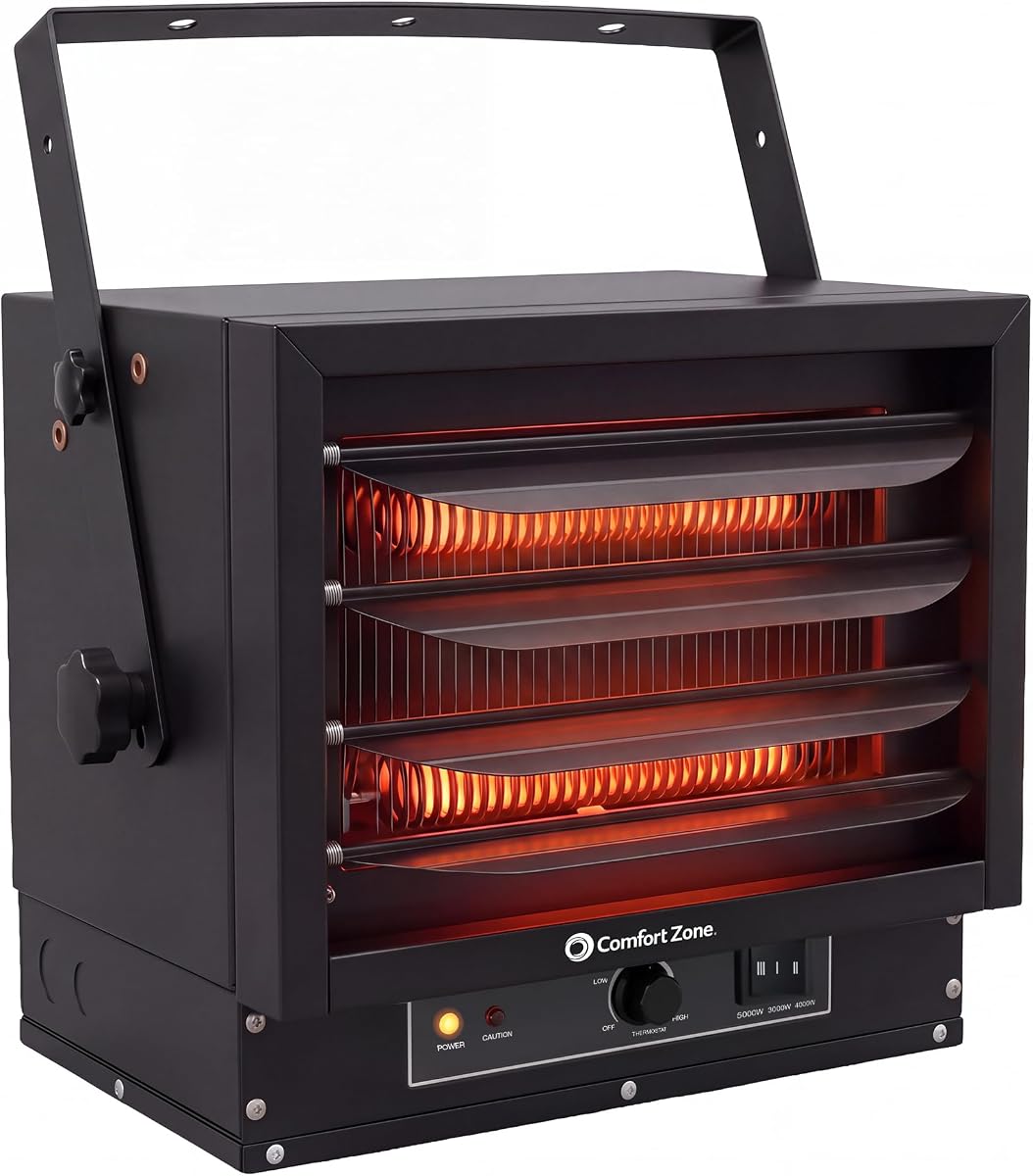
Comfort Zone CZ220BK Garage Heater
4.4Editor score
5000 watt heating capacity
Adjustable louvers and angle
Overheat and thermal protection
Discover the best 240 Volt Electric Heater options for garages and workshops, with expert comparisons of power, mounting, controls, safety, and coverage.
A 240 volt electric heater is a practical way to add powerful, consistent warmth to a garage, workshop, warehouse, or other hard-to-heat space. The best models combine strong fan-forced airflow with durable construction, flexible mounting, useful temperature controls, and dependable overheat protection.
This guide compares ten 240 volt electric heaters across heating capacity, coverage, installation method, thermostat options, remote operation, airflow direction, safety features, and intended installation area. It includes ceiling-mounted, wall-mounted, and portable-style commercial heaters, so readers can compare practical trade-offs rather than looking only at wattage.
Each recommendation highlights the product's strongest use case, important specifications, and honest limitations. Ratings reflect the supplied customer feedback, while product availability and pricing can change over time. Always verify electrical requirements, mounting clearances, and local codes before purchasing or installing a unit.
4.4Editor score

4.4Editor score
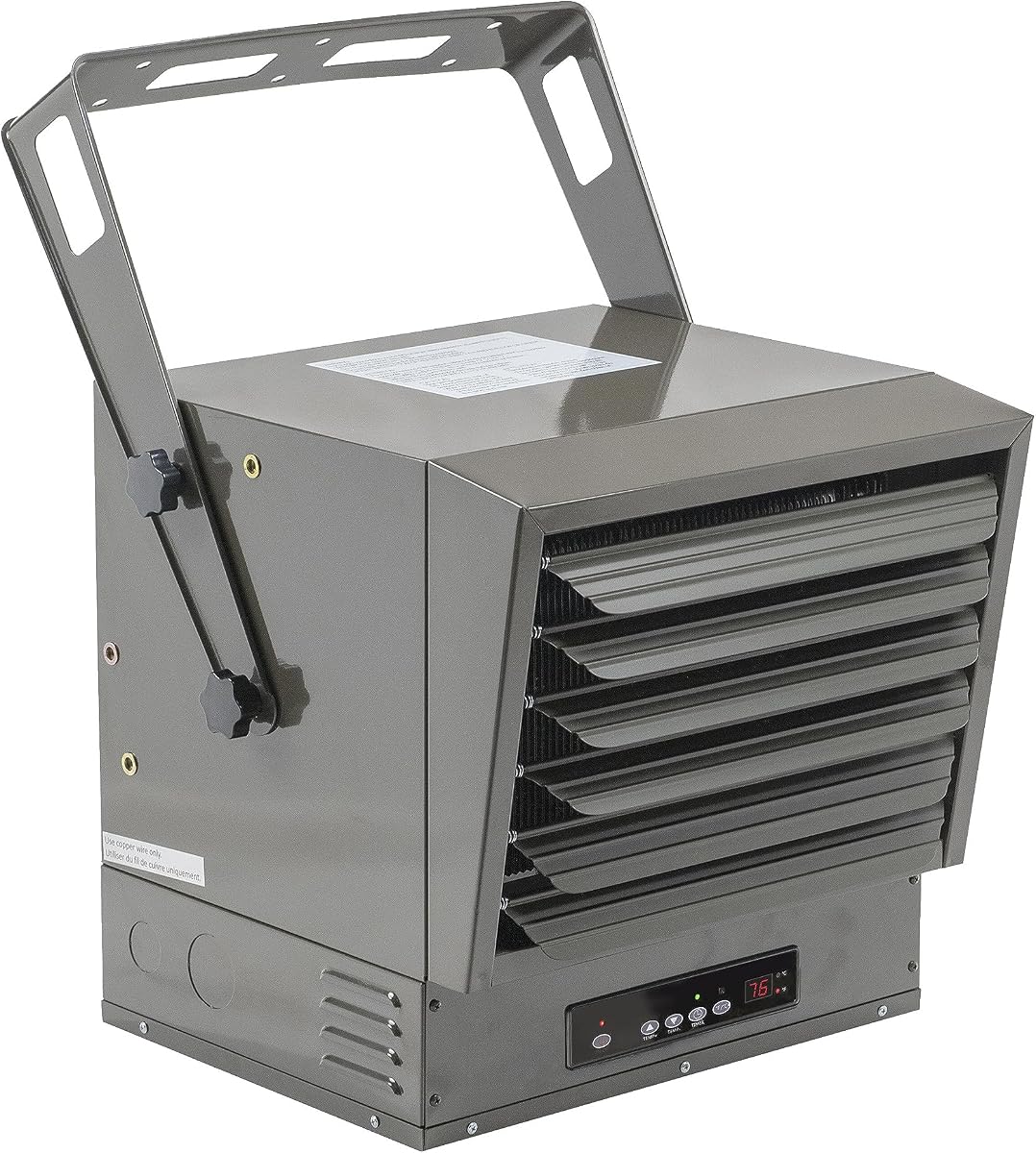
3.8Editor score
This side-by-side comparison covers ten 240 volt heaters for garages, workshops, warehouses, and related spaces, emphasizing heating output, installation style, controls, airflow management, and safety features.


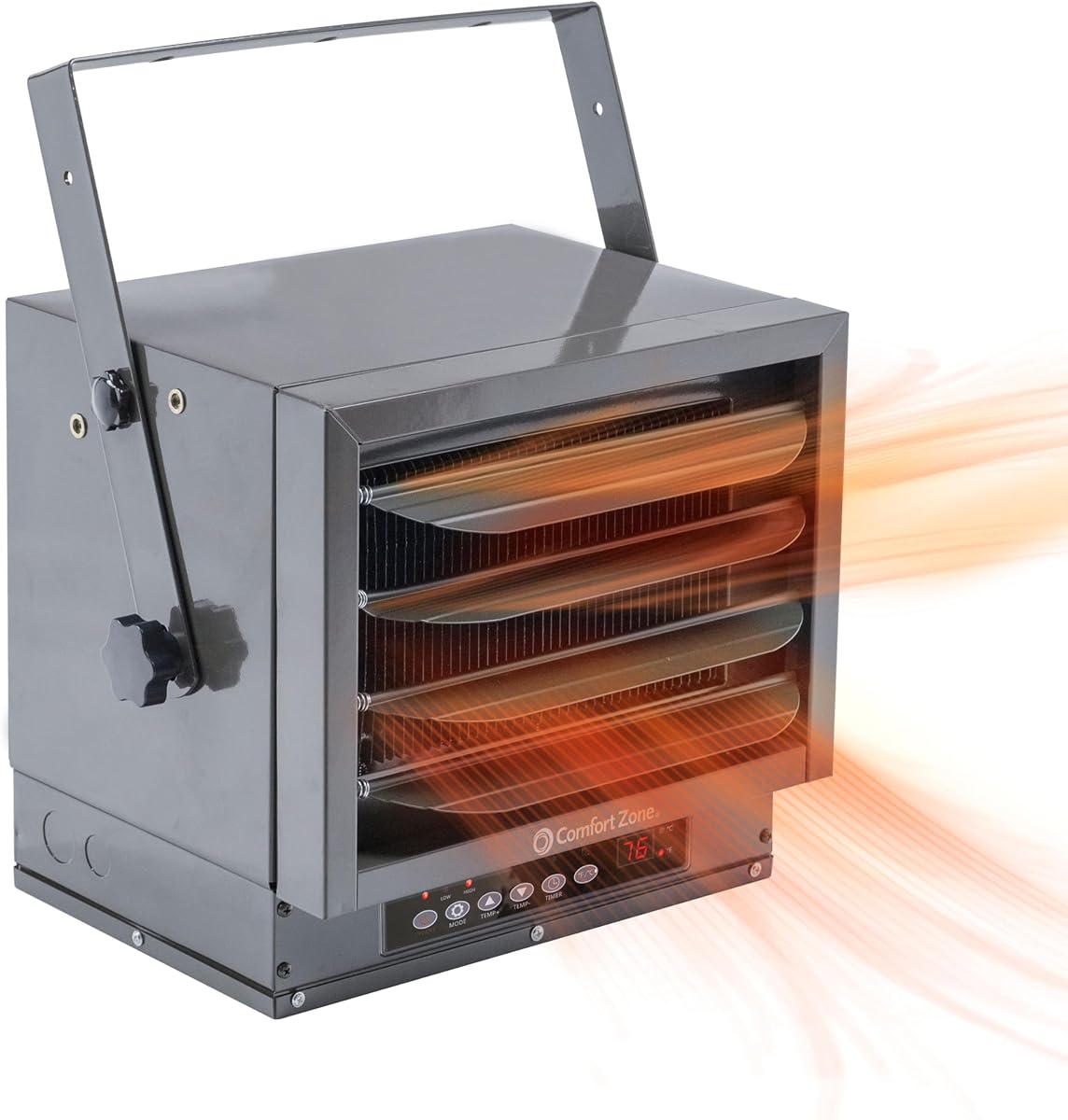
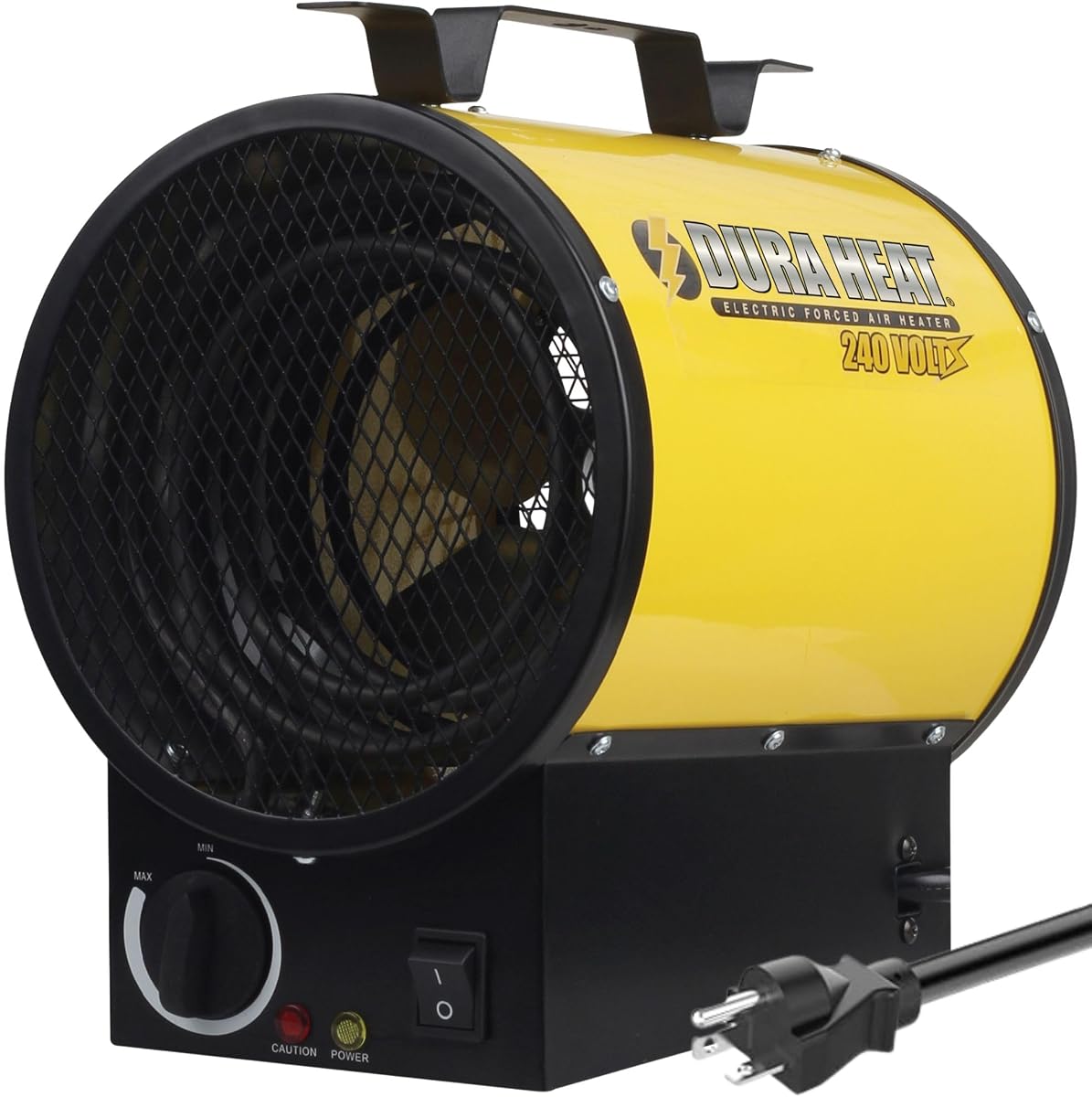


This Comfort Zone ceiling-mounted heater combines 5,000 watts of fan-forced heating with a compact, overhead installation. Its 4.4 rating reflects generally favorable customer feedback, while the three heat settings, adjustable louvers, and dual-knob thermostat make it versatile for garages, shops, warehouses, and storage areas.
We may earn a commission when you buy through this link, at no additional cost to you.
The main benefit is efficient use of space. Mounting the unit overhead keeps workbenches, vehicles, and floor storage unobstructed. Heavy-gauge steel is appropriate for areas with temperature fluctuations, and the fan-forced design helps move warm air beyond the immediate mounting point. Adjustable louvers and mounting angle offer control over where the heated air travels.
Its trade-offs are primarily installation and control convenience. A hard-wired connection should be handled by a qualified professional, and the dual-knob interface is simpler than a digital thermostat with remote operation. Those limitations are acceptable when straightforward temperature adjustment, rugged construction, and a relatively balanced feature set are priorities.
This is a strong general recommendation for homeowners with a garage or workshop who want substantial heat without occupying floor space. It is especially fitting for users who do not need remote operation and appreciate the durability of an ETL-listed commercial-style unit.
Ceiling installation keeps valuable garage floor space open for vehicles, tools, and workstations. It is especially useful in busy shops where a freestanding heater would interfere with movement or storage.
Louvers and an adjustable mounting angle help direct airflow toward work areas. The fan-forced arrangement supports more even distribution than a non-circulating heat source.
We may earn a commission when you buy through this link, at no additional cost to you.
The Comfort Zone CZ230ERBK is a 7,500-watt, fan-forced ceiling heater designed for large garages and workshops. Its 4.4 rating and broad feature set make it an attractive option for buyers who want remote operation, digital temperature control, and a timer in an overhead commercial-style unit.
We may earn a commission when you buy through this link, at no additional cost to you.
Heating coverage is stated at up to 1,250 square feet, making the heater better suited to larger areas than many 5,000-watt alternatives. Adjustable louvers and a variable mounting angle help focus airflow where it is needed, while heavy-gauge steel suits temperature-fluctuating and poorly insulated environments.
The digital thermostat and remote control are the clearest advantages over simpler knob-operated heaters. A 12-hour timer adds scheduling convenience, and a built-in sensor shuts the unit down if overheating is detected. These features add complexity and require a suitable hardwired installation, so buyers should assess electrical readiness before choosing it.
Choose this model for a large garage or workshop where remote convenience and broad coverage matter. It is a compelling middle ground between lower-output ceiling units and the 10,000-watt premium model, particularly when a timer and remote are priorities.
A digital thermostat lets users set a target temperature, while the remote changes settings without approaching the mounted unit. This is helpful in workshops where the heater is installed high or beyond easy reach.
The stated coverage of up to 1,250 square feet makes this a stronger consideration for spacious garages. Actual results depend on insulation, ceiling height, airflow, and how often doors remain open.
We may earn a commission when you buy through this link, at no additional cost to you.
The Comfort Zone CZ220BK delivers 5,000 watts of fan-forced heat from a hardwired ceiling-mounted enclosure. Its 4.4 rating indicates solid customer satisfaction, and the straightforward thermostat controls make it a practical choice for a garage, workshop, warehouse, or storage area.
We may earn a commission when you buy through this link, at no additional cost to you.
Its heavy-gauge steel body is designed to tolerate the temperature swings associated with poorly insulated work areas. Adjustable louvers and a variable mounting angle make it possible to direct warmth toward a workbench, storage zone, or general room. Overheat protection and a thermal cut-out switch provide two layers of operational protection.
This heater does not offer the remote control, digital thermostat, or timer found on more advanced models. Its installation also demands a proper 240-volt hardwired connection, which can add complexity for owners without suitable electrical infrastructure.
Despite those limitations, the CZ220BK is a persuasive budget-oriented choice for a straightforward garage-heating requirement. Select it when basic temperature control, overhead placement, and durable construction matter more than wireless operation and programmable scheduling.
Heavy-gauge steel gives the unit a commercial-style feel suited to workshops and storage areas. The enclosure is intended to withstand demanding environments and temperature fluctuations.
Adjustable louvers and mounting angle let users target a specific zone. This is useful when only part of a garage needs active warmth or when equipment sits below the airflow path.
We may earn a commission when you buy through this link, at no additional cost to you.
The DR. INFRARED DR-988 combines 5,600 watts of heating with an unusually flexible mounting approach. It can operate as a portable floor unit or be attached to a wall or ceiling, earning a place for users who may change the layout of a garage, workshop, warehouse, or construction area.
We may earn a commission when you buy through this link, at no additional cost to you.
Its thermostat covers 37 to 113 degrees Fahrenheit, and the fan switch offers ON and AUTO modes. Continuous operation promotes air circulation, while automatic mode is intended to maintain the selected temperature. The included six-foot cord ends in a NEMA 6-30P plug designed for a dedicated NEMA 6-30R, 250-volt, 30-amp outlet.
That outlet requirement is the main barrier for many households. It is not compatible with a conventional household receptacle and should not be adapted with an unsuitable extension or adapter. On the positive side, the all-metal housing, steel safety grille, and aluminum fan blades are designed for demanding environments, while UL and C-UL listing adds certification value.
The DR-988 is best for users who value mobility and mounting flexibility more than remote controls or timer-based operation. Buyers with the required dedicated circuit will appreciate its ability to move between spaces or shift from portable use to a mounted configuration.
Unlike a permanently mounted commercial unit, the DR-988 can be positioned on the floor when access or temporary heating is required. Built-in cord storage helps keep the workspace organized during transport.
The included NEMA 6-30P plug simplifies connection to a correctly installed dedicated receptacle. It is a more specialized setup than a standard 14-50 plug or a hardwired ceiling unit.
We may earn a commission when you buy through this link, at no additional cost to you.
The InoKraft 7500W Electric Garage Heater has a 4.6 rating, the highest listed rating among these ten products. It combines 7,500 watts of fan-forced heating, a digital thermostat, remote operation, three operating approaches, and flexible wall or ceiling mounting.
We may earn a commission when you buy through this link, at no additional cost to you.
High and low settings provide straightforward output choices, while ECO mode automatically adjusts heating based on ambient temperature and can shut off power when it is no longer needed. The digital thermostat adjusts from 40 to 99 degrees Fahrenheit, and a one-to-24-hour timer extends scheduling flexibility beyond many competing units.
Its included eight-foot cord and NEMA 14-50P plug make the electrical interface familiar to many garage owners, although professional installation is still recommended. The stated heating coverage of up to 750 square feet is lower than the 1,250-square-foot claims of some 7,500-watt competitors, and actual performance depends on the room's construction.
This is an excellent choice for buyers who want sophisticated controls without a hardwired installation. The combination of remote adjustment, ECO behavior, timer options, and a relatively accessible plug makes it particularly appealing for a home garage or workshop.
The digital thermostat provides a clearly defined target range, while ECO mode responds to ambient conditions. These features can reduce unnecessary operation when a garage is already warm enough.
Five installation angle adjustments and flexible louvers help direct warmth where needed. Wall or ceiling placement preserves floor space and supports a more organized garage.
We may earn a commission when you buy through this link, at no additional cost to you.
The Comfort Zone CZ230ER is a 7,500-watt hardwired ceiling heater with a 4.4 rating and a stated coverage area of up to 1,250 square feet. It is aimed at larger garages and workshops that benefit from overhead installation, remote controls, and a digital thermostat.
We may earn a commission when you buy through this link, at no additional cost to you.
Its remote allows temperature changes from a distance, while the 12-hour timer supports scheduled operation. Adjustable louvers and a variable mounting angle provide directional control, and the fan-forced design helps distribute warmth throughout the space. Heavy-gauge steel is suited to commercial-style or poorly insulated environments.
The trade-off is installation complexity. Unlike the InoKraft's plug-in approach, this unit requires a hardwired 240-volt connection, which may involve new circuit work. Its high output and broad coverage can also be more than a small workshop needs, particularly when the space is well insulated.
Choose the CZ230ER when the room is large, overhead placement is available, and remote temperature adjustment is worth the electrical work. It is a well-rounded option for users who need more reach than a smaller 5,000-watt model.
The 1,250-square-foot coverage claim makes this model suitable for larger garages and workshops. Doors, ceiling height, insulation, and airflow will still influence how quickly and evenly the space warms.
Combining a digital thermostat, remote, and 12-hour timer gives users several ways to manage operation. The remote is particularly helpful when the overhead unit is inconvenient to reach.
We may earn a commission when you buy through this link, at no additional cost to you.
The Dura Heat EUH4000 is a 240-volt garage space heater rated at 3,750 watts and 12,800 BTU. It is listed for areas up to 500 square feet, making it more modest in scope than the 7,500- and 10,000-watt alternatives in this guide.
We may earn a commission when you buy through this link, at no additional cost to you.
Its 20-amp electrical specification is one of the clearer points of comparison. Buyers should ensure that the outlet, breaker, wiring, and heater are compatible and installed according to electrical codes. The compact focus may appeal to owners of smaller garages who do not need a large commercial heater.
This product's 3.4 rating is the lowest among the listed models, and the supplied information gives less detail about thermostat range, mounting options, safety systems, and airflow adjustment. That limits how fully its long-term convenience can be evaluated compared with the more extensively documented competitors.
The EUH4000 is most reasonable for a smaller area where 3,750 watts and up to 500 square feet align with the space. It may be less suitable for buyers seeking remote controls, extensive certification details, adjustable louvers, or a high-output heater for a large workshop.
A 3,750-watt heater can be a sensible match for a compact garage or modest workshop. Matching output to room size can make operation more comfortable than oversizing a heater for a confined area.
The listed 20-amp draw should be checked against the planned circuit and outlet. A qualified electrician can confirm that the installation meets local requirements.
We may earn a commission when you buy through this link, at no additional cost to you.
The TEMPWARE 7500W Hardwired Electric Garage Heater offers remote temperature control, two heat settings, and a 25,590-BTU output. Its 4.4 rating reflects positive customer feedback, while the stated coverage of up to 1,250 square feet positions it as a large-space option.
We may earn a commission when you buy through this link, at no additional cost to you.
Low and high settings provide 6,250 and 7,500 watts, giving users a straightforward way to match output to conditions. A digital thermostat spans 45 to 95 degrees Fahrenheit, while a programmable timer can run the unit for one to 12 hours. Adjustable louvers and mounting angle help direct airflow across the intended area.
As a hardwired model, it needs grounding and a properly sized current-protection circuit breaker installed according to the National Electrical Code and local rules. A qualified electrician is recommended. The remote also does not include batteries, and the power cord is not included, so those details should be considered before installation.
The TEMPWARE is a good fit for owners who want precise digital control and scheduling in a large garage. It is particularly attractive for users who do not need a plug-in cord but appreciate remote operation and selectable output.
The 6,250-watt low setting and 7,500-watt high setting allow operation to match different heating demands. This flexibility is useful as ambient temperatures change through the day.
The 45-to-95-degree thermostat offers a more specific target than a simple knob. A programmable timer adds another layer of control over operating duration.
We may earn a commission when you buy through this link, at no additional cost to you.
The CSC152TW is a complete wall-mounted electric heater with a built-in thermostat, offering a quieter and more compact alternative to the high-output garage models. It has a 4.4 rating and is listed for bathrooms, bedrooms, offices, hotels, nursing homes, and apartment buildings.
We may earn a commission when you buy through this link, at no additional cost to you.
Its stated airflow is 10 feet per second with a noise level of 30 decibels, making it suitable for occupied indoor rooms where fan noise and visual bulk matter. A manual thermostat automatically starts or stops heating as room temperature changes, providing uncomplicated temperature regulation.
Unlike the industrial heaters elsewhere in this guide, it does not offer remote operation, a timer, adjustable louvers, or a stated high-wattage output. It is also not positioned for garage-scale heating. Installation should follow electrical requirements, and a professional electrician is an option for anyone without appropriate wiring experience.
Choose the CSC152TW for indoor spaces that need quiet, wall-mounted warmth rather than a workshop requiring powerful directional airflow. It is a focused residential or light-commercial heater with a more understated installation than a fan-forced shop model.
A listed 30-decibel operating level makes the heater more appropriate for bedrooms, offices, and other occupied rooms. Lower audible output can improve comfort during continuous use.
The built-in manual thermostat starts and stops the heater as the room reaches its selected temperature. This simple cycling system avoids the need for a separate controller.
We may earn a commission when you buy through this link, at no additional cost to you.
The Comfort Zone CZ260ER is the highest-output model in the guide at 10,000 watts. Designed for industrial-style garage and workshop use, it combines a digital thermostat, full-function remote, 12-hour timer, wide airflow distribution, and a hardwired 240-volt connection.
We may earn a commission when you buy through this link, at no additional cost to you.
Fully sheathed heating elements add an important layer of protection, while the enclosed motor is designed to shield internal components from dust and debris. Adjustable directed airflow vents allow the operator to influence where warm air travels, and an adjustable mounting bracket helps position the ceiling unit effectively.
Its 3.8 rating is lower than those of the other products, and the substantial electrical demand means the heater should be matched to a properly sized circuit and installed by a qualified professional. Buyers should also avoid installing 10,000 watts of capacity in a small room unless their heat distribution goals justify it.
The CZ260ER makes sense for large, drafty, or poorly insulated spaces where maximizing heat output and maintaining a rugged overhead installation are the top priorities. It is the premium choice here for buyers who prioritize capacity, remote functionality, and protected industrial components.
At 10,000 watts, this model offers the highest nominal capacity in the roundup. That makes it a candidate for large garages, warehouses, and workshops where lower-output units may struggle to maintain usable temperatures.
Fully sheathed elements and an enclosed motor are useful features in dusty or demanding work environments. They help protect internal parts while supporting consistent operation.
We may earn a commission when you buy through this link, at no additional cost to you.
Choosing a 240 volt electric heater requires matching heating capacity, installation requirements, controls, airflow, and safety provisions to the space. A larger heater is not automatically the better choice, especially when insulation, room size, and electrical service are poorly matched.
Wattage indicates the heater's maximum electrical heating capacity, while BTU describes heat output in another common unit. Products in this guide range from 3,750 to 10,000 watts, with several 7,500-watt options. Larger outputs can heat expansive or poorly insulated areas more effectively, but they also demand more electrical capacity and can overwhelm a small, well-insulated room. Always use room dimensions, insulation, ceiling height, and expected door openings to make a realistic comparison rather than choosing by wattage alone.
Ceiling mounting keeps the floor clear and allows warm air to move downward through the room, making it a strong fit for busy garages. Wall mounting offers similar space savings with easier access for some users. Portable-style units provide flexibility but can occupy floor space, trip hazards, or move away from the area where heat is needed. Review the mounting bracket, angle adjustment, required clearances, and whether the model can be relocated before making a final choice.
A 240 volt heater can require a dedicated circuit, a specialized plug, or a hardwired connection. The DR. INFRARED DR-988 uses a NEMA 6-30P plug and dedicated 250-volt, 30-amp receptacle, the InoKraft includes a NEMA 14-50P plug, and several Comfort Zone models are hardwired. These interfaces are not interchangeable. A qualified electrician should assess the breaker, wire gauge, grounding, outlet, and local code requirements before any connection is made.
Dual knobs are simple and durable, but they do not show a precise set temperature. Digital thermostats provide clearer temperature selection, while remotes allow changes from a distance. A 12-hour or 24-hour timer can automatically stop the heater after a set duration or support daily scheduling. For workshops and garages, remote and timer functions are especially useful because mounted units can be high, distant, or inconvenient to reach during cold-weather work.
Fan-forced heaters move heated air beyond the heating element, and adjustable louvers help determine where that air travels. A variable mounting angle allows the unit to be aimed toward a workbench, vehicle, or storage area. In tall garages or multi-use workshops, directional control can be as important as raw wattage. Look for both adjustable louvers and angle positioning if your heating needs vary by time of day or activity.
Overheat sensors, thermal cut-outs, automatic shutoff, overload protection, and indicator lights all help identify when a heater is operating or has reached an unsafe condition. The DR-988 is UL and C-UL listed, while several Comfort Zone products carry ETL listing or compliance, and the TEMPWARE is ETL certified. These certifications do not replace proper installation, clearance, and electrical work. Review the manual, maintain recommended distances from combustible materials, and never bypass built-in safety controls.
Garage and workshop heaters are commonly built with heavy-gauge steel, metal safety grilles, and protected motors because commercial spaces can be dusty, damp, or exposed to temperature swings. Indoor wall heaters may use quieter components suited to occupied rooms but offer less output. Match the construction to the environment rather than treating a quiet residential unit as an industrial solution. Also consider whether the heater is rated for indoor use and how dust, moisture, or stored combustible materials affect the installation location.
Advertised coverage can reach 500, 750, or 1,250 square feet among the products reviewed, but the figures do not guarantee identical results. Ceiling height, insulation quality, door openings, room layout, and thermostat settings all affect performance. A well-insulated space may reach a comfortable temperature faster, while a drafty garage can lose heat quickly. Treat the coverage figure as a starting point and choose a heater that can maintain useful warmth under realistic conditions.
Before installation, identify the heater's required voltage, amperage, plug type, circuit capacity, mounting method, and permitted orientation. Use the supplied manual to confirm clearances from ceilings, walls, vehicles, tools, and combustible materials. Any hardwired installation or circuit modification should be performed by a qualified electrician who can verify proper breaker sizing, grounding, wire gauge, and local code compliance.
Operate the heater within its listed voltage and amperage requirements. Set the thermostat or heat setting to a comfortable level, position adjustable louvers toward the area that needs warmth, and avoid placing the unit where its intake or discharge is obstructed. Allow adequate circulation around the heater, and do not use it in wet, damp, or hazardous locations unless the product is explicitly rated for those conditions.
During maintenance, disconnect power and allow the unit to cool before cleaning. Remove dust and debris from vents and fan openings, inspect the cord or hardwired connections, and confirm that mounting hardware and louvers remain secure. Replace damaged components through the manufacturer or an authorized service provider. Do not open, modify, or bypass the heater's thermostat, overheat sensor, safety grille, or electrical protection features.
Only use a heater that is rated for the intended space and installation conditions. Look for relevant safety certification, overheat protection, proper grounding, and manufacturer-approved clearances from combustible materials. A home garage also needs a correctly rated electrical circuit, so consult a qualified electrician when the outlet or wiring requirements are not clear.
Yes, when the unit is properly rated and installed according to its manual and local electrical codes. Some models listed here are commercial-style garage heaters, while the CSC152TW is intended for indoor rooms such as bedrooms and offices. The voltage alone does not determine whether a heater is appropriate; placement, wiring, ventilation, and clearance all matter.
The right wattage depends on the garage's size, insulation, ceiling height, and heat loss. The products reviewed cover different needs, from approximately 3,750 to 10,000 watts, with several models stating coverage up to 750 or 1,250 square feet. A highly insulated small garage may not need maximum output, while a large drafty workshop may benefit from more.
An electrician is strongly recommended for hardwired models, and it is also wise for dedicated high-current receptacles or new circuit work. Plug-in units can be easier to connect, but the plug must match the outlet exactly. Never use an adapter that changes the plug type, and do not overload an existing circuit.
They are different high-current receptacle and plug configurations used for 240-volt equipment. The InoKraft uses a NEMA 14-50P plug, while the DR. INFRARED DR-988 uses a NEMA 6-30P plug and specifies a dedicated 250-volt, 30-amp NEMA 6-30R outlet. They are not interchangeable, and the correct circuit must meet the heater's requirements.
Only if the model is specifically designed and listed for ceiling mounting. The Comfort Zone ceiling units and the InoKraft provide overhead mounting options, while the DR. INFRARED DR-988 also supports wall or ceiling placement. Follow the required mounting angle, structural support, and clearance instructions to avoid unsafe installation.
Two 7,500-watt models in this guide state coverage of up to 1,250 square feet, while the InoKraft states up to 750 square feet. These figures are not guarantees because insulation, room dimensions, ceiling height, door openings, and airflow affect performance. Consider the entire room rather than treating square footage as a strict limit.
Often, yes. Remote operation allows temperature and schedule changes without approaching a wall- or ceiling-mounted unit, and a timer can reduce unnecessary operation. Features vary, so compare the thermostat range, timer length, heat settings, and included remote batteries before choosing.
The Comfort Zone 5000W ceiling heater offers the most balanced general recommendation, combining overhead placement, three heat settings, adjustable airflow, durable steel construction, and overheat protection. The CZ220BK provides a similar core design for buyers prioritizing straightforward operation, while the Comfort Zone CZ260ER represents the premium high-output option.
For large spaces, the CZ230ERBK, CZ230ER, and TEMPWARE models provide 7,500 watts of fan-forced heat with remote operation and larger stated coverage. The InoKraft stands out for its digital controls, ECO mode, flexible timer, and NEMA 14-50P plug. The DR-988 offers portable or mounted versatility, the Dura Heat fits a smaller garage, and the CSC152TW is intended for quieter indoor spaces.
Prioritize the space's size, insulation, electrical service, mounting plan, and control preferences before comparing final models. Verify current product details, pricing, availability, clearances, and circuit requirements at the time of purchase, and consult a qualified electrician whenever installation involves hardwiring or a new high-current circuit.