
Anker soundcore 2
4.5Editor score
Twelve-watt portable output
IPX7 waterproof protection
Twenty-four-hour battery life
Explore the best Bluetooth Speakers for Classical Music, comparing sound quality, room-filling power, connectivity, portability, and design for every listener.
Classical music exposes every weakness in a wireless speaker, from limited treble extension to uneven bass and a soundstage that sounds artificially compressed. The right Bluetooth speaker should instead present strings, piano, brass, and voices with clarity, controlled dynamics, and enough tonal balance for long, attentive listening.
We compared these ten speakers using the supplied specifications, focusing on driver configuration, acoustic tuning, stereo capability, room-filling output, wireless range, wired inputs, app-based EQ, portability, and practical features such as battery life and water resistance. The list covers compact systems, powered bookshelf speakers, home speakers, and portable models.
Each review explains where a speaker is strongest, where compromises appear, and whom it is best suited for. The shortlists highlight the strongest all-around option, the most practical budget model, and a premium choice, while the full ranking covers indoor listening, larger rooms, outdoor use, and multi-speaker setups. Prices and availability can change.
4.5Editor score

4.7Editor score

4.1Editor score
This side-by-side comparison highlights each speaker's acoustic configuration, connectivity, power features, and best-use scenario, making it easier to identify the model that matches your room, listening habits, and preferred level of portability.




The Marshall Emberton III combines a portable body with a soundstage that feels unusually expansive for a wireless speaker. Its 4.7 rating reflects a strong overall package, but the defining attraction is the true stereophonic presentation. Classical recordings can spread across the listening area rather than appearing to collapse into a single point, which helps orchestral sections and chamber ensembles remain distinct.
We may earn a commission when you buy through this link, at no additional cost to you.
Marshall's Dynamic Loudness adjusts the tonal balance as playback volume changes, keeping music intelligible at lower settings while preserving impact when the speaker is turned up. The result is particularly useful for long classical sessions, where a fixed tuning could become overly aggressive or lose detail. A built-in microphone adds hands-free calling, while more than 32 hours of portable playtime makes the Emberton III easy to move between a desk, patio, bedroom, or travel setup.
Its portable format also sets clear limits. The Emberton III is not designed to fill a large living room with the effortless output of a powered home system, and the supplied details do not list analog or digital wired inputs for a lossless connection. The IP67 rating protects it from dust and water, but that resilience does not make it appropriate for humid environments where prolonged moisture exposure could still be a concern.
This is the strongest recommendation for listeners who want one speaker to cover both attentive and casual classical listening. It suits bedrooms, studies, kitchens, offices, and medium-sized rooms particularly well. Choose the Emberton III when spatial presentation, attractive design, portability, and battery life matter more than maximum volume or wired hi-fi connectivity.
True stereophonic sound is the Emberton III's most meaningful advantage for classical music. Spatially dispersed playback lets listeners distinguish orchestral layers more easily, while the speaker's stated tonal adjustments help maintain clarity without forcing the same balance at every volume.
The stated playtime of more than 32 hours makes the speaker practical for vacations, long study sessions, and all-day listening. Its dust and water resistance also gives it more flexibility than a conventional indoor Bluetooth speaker.
We may earn a commission when you buy through this link, at no additional cost to you.
The Klipsch The One Plus is a traditional 2.1 tabletop system with a clear advantage over small portable speakers: separate full-range drivers and a larger high-excursion woofer. Its 4.1 rating places it below the leaders in the supplied data, but the physical configuration suggests why it can serve as a more substantial home system for classical recordings.
We may earn a commission when you buy through this link, at no additional cost to you.
Two 2.25-inch full-range drivers handle the main stereo image, while the 4.5-inch woofer provides the low-end foundation. The biamplified system is professionally tuned and described as offering clear performance and strong bass. For a string quartet, solo piano, chamber works, and smaller orchestral recordings, the dedicated left and right drivers can create a more convincing separation than a single compact enclosure.
The One Plus also offers meaningful control through the Klipsch Connect App, including EQ adjustments and saved presets. That matters for classical listeners because symphonic recordings, solo works, and spoken-word releases can benefit from different tonal settings. Its Bluetooth 5.3 connection supports a stated range of up to 40 feet, while USB-C playback provides a wired alternative. The real wood veneer and tactile controls add a refined furniture-like presence.
This premium model is best suited to a study, living room, office, or dedicated listening shelf where it can remain powered. It is not presented as a portable battery-powered speaker, and its larger cabinet requires a stable surface. For listeners seeking a substantial stereo presentation with app control and classic design, The One Plus offers a more specialized alternative to a compact all-in-one.
The dual full-range drivers give each side of the stereo image its own transducer, while the larger woofer handles bass independently. This architecture is especially useful for classical works in which the position of violins, woodwinds, and percussion matters.
App-based EQ and saved presets give The One Plus more tonal flexibility than a basic portable speaker. Listeners can retain settings for solo, chamber, orchestral, or spoken-word material instead of relying on one fixed profile.
We may earn a commission when you buy through this link, at no additional cost to you.
The Anker soundcore 2 delivers the broad feature set expected from a portable speaker at a comparatively accessible level of investment. Its 4.5 rating indicates solid customer reception, and the combination of 12 watts of output, dual neodymium drivers, and a digital signal processor makes it a capable option for smaller rooms and everyday classical listening.
We may earn a commission when you buy through this link, at no additional cost to you.
Its BassUp technology and spiral bass port emphasize low-end impact, which can make orchestral recordings feel energetic and full. While classical listeners may prefer a more neutral presentation, the included DSP is intended to control distortion as volume changes. The battery is rated for 24 hours, and IPX7 protection allows the speaker to handle splashes, waves, and water vapor during camping, beach trips, or outdoor gatherings.
The main trade-off is that the soundcore 2 is optimized as a lively portable product rather than a neutral studio monitor. The supplied information emphasizes stronger bass and fewer tonal controls, so it may not be the ideal choice for listeners seeking fine EQ adjustments or a wide desktop soundstage. Wireless stereo pairing is supported, although adding a second compatible speaker adds another purchase and placement task.
The soundcore 2 is an excellent starting point for students, casual listeners, and anyone who wants dependable Bluetooth playback without spending on a large home system. It works well in a bedroom, kitchen, dorm, office, or covered outdoor area. For quiet string quartets or smaller works, moderate listening levels should reveal the speaker's clarity without requiring home-theater-level power.
The combination of portable dimensions, simple controls, and 24-hour stated playtime makes the soundcore 2 easy to adopt as a primary casual listening speaker. It also travels comfortably for lessons, readings, and quiet travel.
IPX7 protection is more useful than basic splash resistance when a speaker may encounter rain, waves, or water vapor. That makes the soundcore 2 viable for patios, campsites, and beach environments when operated within the manufacturer's guidance.
We may earn a commission when you buy through this link, at no additional cost to you.
The Marshall Acton III is designed as a dedicated home speaker, and its room-filling signature sound makes it well suited to listeners who play classical music in a living room, dining area, or larger study. Its 4.7 rating matches the highest rating in the supplied group, indicating particularly strong customer satisfaction.
We may earn a commission when you buy through this link, at no additional cost to you.
Marshall states that Acton III has a wider soundstage than its predecessor, with an immersive presentation intended to fill a room. That is an advantage for full orchestral works because instrumental sections can feel more open and expansive. Pair-and-play operation keeps the setup uncomplicated, while Bluetooth 5.2 and the 3.5 mm input support both wireless and wired sources.
The main limitation is that the available specifications do not describe detailed EQ controls, wireless multi-speaker pairing, or a built-in battery. It is therefore best treated as a stylish home unit rather than a portable or highly configurable system. The stated PVC-free build containing 70% recycled plastic may also matter to environmentally conscious buyers.
Acton III is a strong choice for a person who wants a single home speaker to handle both quiet chamber recordings and full-scale orchestral albums. Its distinctive design can serve as a focal point in a living space, while the straightforward connection process keeps daily listening uncomplicated. Buyers seeking finer control or battery-powered flexibility should look elsewhere.
A stated wider soundstage gives Acton III an advantage when reproducing the spatial scale of symphonies and concertos. The room-filling approach can make broad dynamics feel more immersive than a small desktop speaker.
The stripped-back Marshall design is intended to be noticed, not hidden. It suits listeners who want their audio equipment to complement furniture and living-room decor rather than resemble a technical studio component.
We may earn a commission when you buy through this link, at no additional cost to you.
The Harman Kardon Onyx Studio 9 stands apart through self-tuning technology that calibrates the speaker to its surroundings when powered on. This can be especially useful for classical listeners who move a speaker between a desk, nightstand, kitchen, and living room, because each placement may affect perceived bass and clarity.
We may earn a commission when you buy through this link, at no additional cost to you.
Its 4.6 rating reflects strong customer reception, while the built-in rechargeable battery provides up to eight hours of portable playback. The speaker can connect with two mobile devices simultaneously, making it convenient to alternate between a personal playlist and shared playback. The Harman Kardon One app adds EQ customization and control over compatible speakers, while wireless pairing allows two units to create a wider stereo image.
Compared with the longer battery life of the Emberton III and soundcore 2, eight hours is more modest. The USB charging port can also charge a connected mobile device, which is useful during extended listening but adds another consideration when planning travel. Its self-tuning behavior may not satisfy listeners who want to establish a fixed manual EQ profile, although the app provides separate controls.
Onyx Studio 9 is an excellent middle ground between a home speaker and a portable one. It is particularly attractive for listeners who value flexibility, automatic placement optimization, and simple switching between devices. Choose it for medium-sized rooms, study spaces, or moving indoor listening, and consider a two-speaker setup when the recorded ensemble deserves a broader presentation.
Automatic calibration gives the speaker a practical response to one of the most common problems in home listening: the same unit sounding different on a desk, shelf, or media unit. The feature helps the speaker adapt as it moves around the home.
Pairing two Onyx Studio 9 units wirelessly is the most attractive route to a wider, more detailed soundstage. For listeners who regularly play symphonies or concertos, that additional separation can matter more than extra battery capacity.
We may earn a commission when you buy through this link, at no additional cost to you.
The Klipsch The Three Plus is the larger and more powerful sibling to The One Plus. It is aimed at listeners who want the same heritage-inspired design and biamplified architecture but need more low-frequency capability and enough output for a larger listening space. Its 4.2 rating supports its position as a capable but less universally rated premium system.
We may earn a commission when you buy through this link, at no additional cost to you.
Dual 2.25-inch full-range drivers sit alongside a larger 5.25-inch high-excursion woofer. The arrangement is designed to fill larger spaces with bold sound, which is useful for powerful orchestral climaxes and full-bodied piano recordings. Professional tuning and a biamplified 2.1 design provide the basis for clear reproduction with strong bass, while real wood veneer and tactile controls give the cabinet an upscale appearance.
The Three Plus offers more unusual connectivity than most Bluetooth speakers. Included Phono/RCA inputs allow a turntable to be connected, appealing to listeners who enjoy physical records alongside digital releases. Broadcast Mode can wirelessly connect more than ten individual units, creating a broad multi-speaker environment. Bluetooth 5.3, app-based EQ, and USB-C playback round out the feature set.
Its substantial cabinet and lack of a listed battery make The Three Plus a stationary home speaker. It is a good choice for a living room, conservatory, large office, or dedicated music area where it can remain connected. Classical listeners with vinyl collections will appreciate the turntable support, while those needing portability should look toward a compact speaker instead.
The larger woofer and design intended for bigger spaces give The Three Plus an advantage when reproducing demanding orchestral passages. It is better suited to a room-filling role than a small bedside or travel speaker.
Built-in Phono/RCA inputs are particularly relevant for classical listeners who own records. Connecting a turntable creates a direct bridge between physical recordings and the system's Bluetooth, app, and USB-C options.
We may earn a commission when you buy through this link, at no additional cost to you.
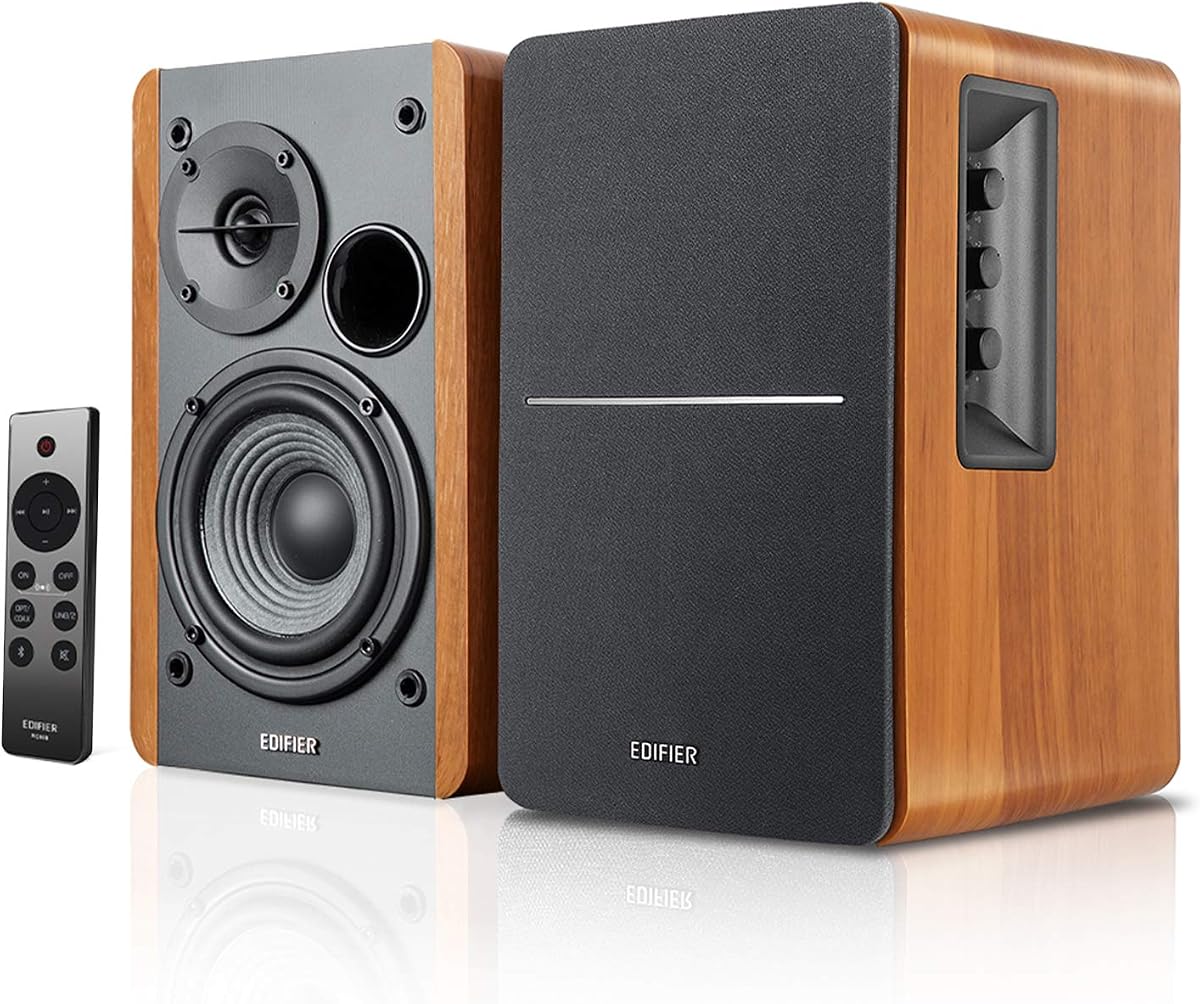
The Edifier R1280DBs is a two-piece powered bookshelf system that combines wireless convenience with the connectivity expected from a serious home-audio setup. Its 4.6 rating is among the strongest in the group, and the combination of 42 watts of continuous power, optical and coaxial digital inputs, and a subwoofer output gives it unusual flexibility for classical listeners.
We may earn a commission when you buy through this link, at no additional cost to you.
Each speaker includes a 13 mm silk dome tweeter and a 4-inch subwoofer unit, while Soundfield Spatializer is included for a wider listening effect. The active speaker provides side-panel bass and treble controls alongside volume, making quick tonal changes easy without navigating an app. The supplied specifications describe the system as producing 42 watts of continuous undistorted power.
Bluetooth 5.0 is only one of several connection methods. Optical and coaxial inputs can provide a lossless connection from a television or computer, while the subwoofer output includes automatic detection and a built-in crossover. This makes the system useful beyond music and gives owners a potential path to deeper bass without changing the main speakers.
The R1280DBs is best for a living room, study, office, or dedicated computer setup where two bookshelf speakers can be placed on either side of the listener. It requires more space and setup than a portable speaker, and the supplied details do not list a battery. Even so, its combination of digital inputs, physical controls, and stereo separation makes it one of the most versatile picks here.
Optical and coaxial inputs provide a lossless route from compatible computers and televisions. For classical listeners with a digital library, this can be preferable to relying exclusively on Bluetooth compression.
Side-panel bass and treble controls make it easy to respond to different rooms or recordings. The included wireless remote adds convenient access to volume, mute, and input selection.
We may earn a commission when you buy through this link, at no additional cost to you.
The Edifier MR3 is the most explicitly monitoring-oriented speaker in this roundup. Its 4.5 rating reflects a favorable reception, while Hi-Res Audio certification and a stated flat response from 52 Hz to 40 kHz make it appealing to classical listeners who value accuracy, detail, and transparent reproduction.
We may earn a commission when you buy through this link, at no additional cost to you.
Each powered speaker produces 18 watts RMS for a combined 36 watts, using a 3.5-inch mid-low driver and a 1-inch tweeter. The stated peak output is 92.5 dB, and the MDF cabinet is designed to reduce distortion. These specifications make the MR3 suitable for detailed listening, music creation, video editing, and everyday playback.
Connectivity is comprehensive for a powered monitor. Balanced TRS, RCA, and AUX inputs cover several professional and consumer sources, while Bluetooth adds multi-point support for switching between devices. A headphone output provides another way to engage with the signal. Music, Monitor, and Custom modes give users distinct starting points, and the EDIFIER ConneX app supports deeper EQ adjustments.
The MR3 is an excellent option for listeners who want a more analytical presentation than a typical lifestyle speaker provides. Its flat tuning may not feel as immediately lush or dramatic as some alternatives, but that restraint can reveal recording detail, balance, and dynamics. It is best suited to a desktop, compact studio, office, or study where accurate reproduction is the priority.
A flat, hi-res-oriented response is valuable when classical recordings differ in venue, ensemble, and production. The MR3 is designed to present that variation with detail rather than imposing a strongly lifestyle-focused bass signature.
Music, Monitor, and Custom modes make the speaker adaptable to casual listening, more critical work, or personalized preferences. In-depth app EQ provides additional control when the default profile needs adjustment.
We may earn a commission when you buy through this link, at no additional cost to you.
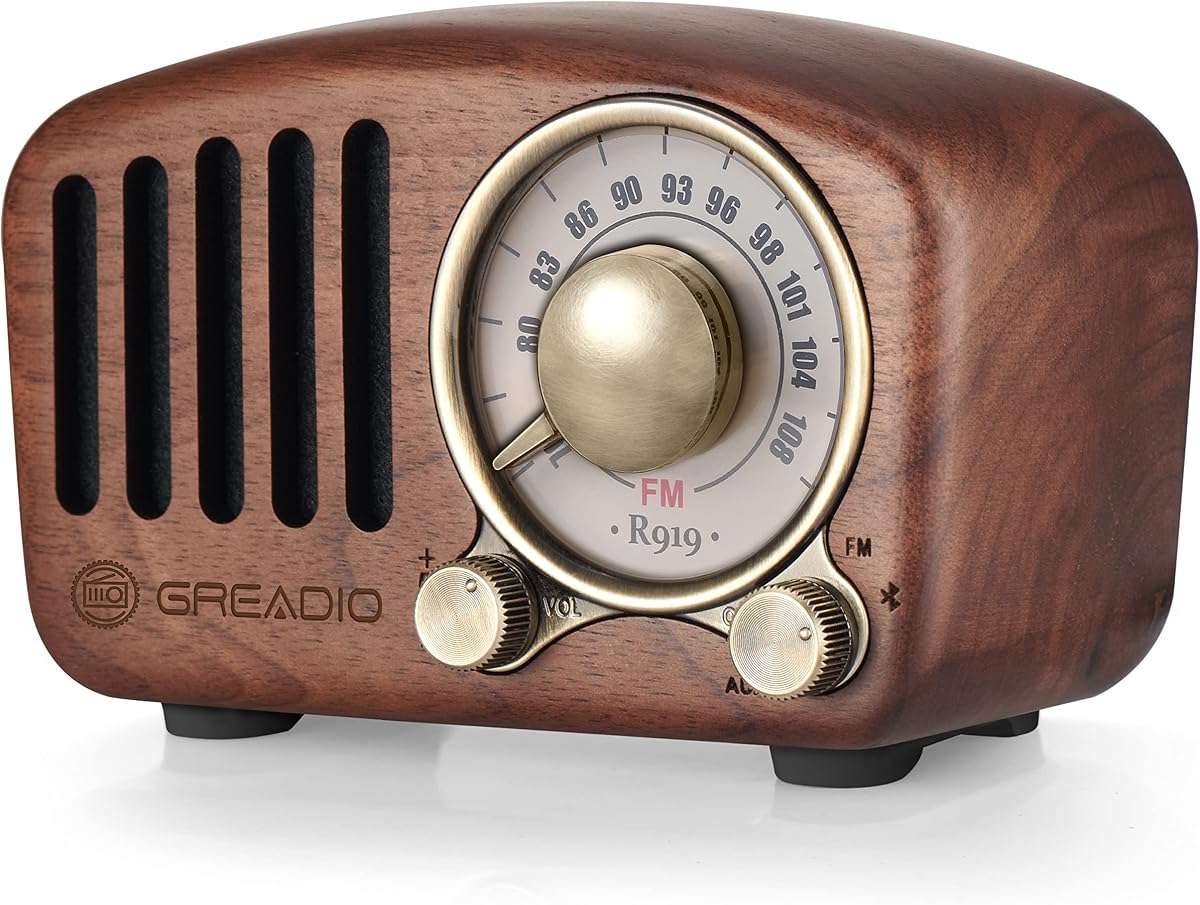
The Greadio Retro Bluetooth Speaker combines a walnut-look cabinet and radio-inspired styling with modern wireless playback. Its 4.6 rating is strong despite a specification list focused more on appearance and convenience than detailed driver information. It appeals especially to listeners who want classical music in a setting that feels more like a warm living-room object than a technical audio system.
We may earn a commission when you buy through this link, at no additional cost to you.
Bluetooth 5.0 supports connection with compatible devices, while the built-in FM radio function offers an alternative to streaming. A front-facing bass enhancement system and five-watt amplifier produce the stated stereo-rich presentation. The enclosure measures only 4.4 by 2.7 by 2 inches, making it easy to move between a desk, kitchen, garden, or bedside table.
A rechargeable 1,100 mAh battery provides up to nine hours of playtime, giving the speaker more flexibility than a purely mains-powered mini system. The trade-off is modest amplification and limited published information about frequency response, driver detail, and wireless range. It is not designed as a high-output system for a large hall or for critical work where reference accuracy is essential.
The Greadio Retro is ideal for background classical, chamber recordings, opera at moderate volume, and listeners who value aesthetics. It also works well as a gift for someone drawn to vintage equipment. Choose it for a cozy room, study, or portable indoor-and-outdoor setup rather than as the primary speaker for a spacious listening environment.
The walnut finish and radio-inspired proportions give the speaker a character that suits a bookshelf, bedside cabinet, or study. It offers a more decorative alternative to the black and technical appearance common among powered monitors.
Its compact dimensions and nine-hour stated battery make the speaker easy to carry between indoor and outdoor locations. The included FM function can also provide a non-streaming source when appropriate programming is available.
We may earn a commission when you buy through this link, at no additional cost to you.
The generic 20W Bluetooth Speaker is designed primarily for parties and portable entertainment, but its wireless connectivity and claimed output can also handle casual classical playback. Its 4.5 rating indicates solid customer reception, while the combination of Bluetooth 5.3, TWS pairing, and stated battery life distinguishes it from very basic compact speakers.
We may earn a commission when you buy through this link, at no additional cost to you.
Two drivers deliver balanced, low-distortion audio according to the supplied product information, and pairing two units creates a wider stereo experience. The stated Bluetooth range reaches up to 100 feet, offering considerable freedom from the source device. An AUX jack provides an additional wired input, although the cable is not included, and a built-in microphone supports hands-free calls.
This is not a traditional audiophile speaker, and the specification set contains no frequency-response data, driver measurements, codec details, or meaningful fine-tuning options. Multicolor lights and party positioning may be distractions during a quiet string quartet, while the IPX5 rating is intended to protect against splashes rather than full submersion. Actual battery life varies with volume, lighting, and content.
The speaker is most appropriate for informal gatherings, outdoor dinners, and listeners who want classical music playing in the background. It can also serve as a temporary option for travel or a second-room system. Buyers who care about fine tonal detail, stable stereo imaging, or critical accuracy should instead consider the Edifier models, Klipsch systems, or Marshall home speakers.
A stated range of up to 100 feet allows the speaker to sit farther from a phone or computer than many portable alternatives. That makes it useful for patios, decks, and outdoor meal settings.
TWS pairing is the most relevant feature for classical listeners because a second speaker can widen the presentation. The visual light effects can be disabled, which is helpful during quieter repertoire and longer sessions.
We may earn a commission when you buy through this link, at no additional cost to you.
The right speaker depends on whether you prioritize neutral detail, spacious separation, high volume, portability, or seamless switching between digital sources. These factors help narrow the field without assuming that one design suits every room and listener.
Classical music contains quiet passages, subtle harmonics, brass crescendos, and the transient detail of bows, mallets, and piano hammers. A speaker with a balanced response and controlled distortion can preserve those differences more faithfully than a model that chiefly emphasizes bass. The Edifier MR3 is the most explicitly accuracy-focused model because it carries Hi-Res Audio certification and offers flat-response monitoring modes, while the Klipsch systems emphasize professionally tuned 2.1 performance. Listeners should consider whether they prefer analytical transparency or a warmer, more dramatic presentation.
The ability to distinguish an orchestral section from another depends partly on speaker placement and partly on the system's architecture. Dedicated left and right drivers, such as those in the Edifier R1280DBs and Klipsch systems, can provide more convincing separation than a compact single enclosure. The Marshall Emberton III also emphasizes a multi-directional, spatial presentation. Two-speaker pairing options on the Harman Kardon, Anker, and generic 20W model can expand the soundstage, although they require a second compatible unit and careful placement.
A bedroom or study does not require the same power as a living room used for full orchestral recordings. The Marshall Acton III and Klipsch The Three Plus are designed to fill spaces, while The One Plus provides a substantial tabletop system for smaller or medium rooms. Compact products such as the Emberton III, soundcore 2, Greadio, and generic speaker trade some scale for portability. Matching output to the room prevents excessive volume, distortion, and fatigue while ensuring quiet passages remain audible.
Battery life and portability often matter more for listeners who move between rooms or take music outside. The Emberton III offers more than 32 hours of stated playtime, the soundcore 2 and generic 20W speaker are rated for up to 24 hours, the Onyx Studio 9 provides up to eight hours, and the Greadio model lists up to nine hours. The Klipsch, Acton III, and Edifier bookshelf systems appear designed for stationary use. Check the stated testing conditions because actual runtime varies with volume and features.
Classical recordings vary considerably, and EQ can help accommodate different ensembles, rooms, and personal preferences. The Klipsch Connect App offers adjustable EQ and saved presets, while the Harman Kardon One app supports customization across compatible speakers. The Edifier MR3 provides three modes plus personalized EQ through EDIFIER ConneX, and the R1280DBs places bass and treble controls directly on the active speaker. App control is useful but not automatically better than physical controls; some listeners value immediate access more than stored profiles.
Bluetooth is convenient, but some listeners may want a wired path for a computer, television, turntable, or digital audio source. The Edifier R1280DBs includes optical and coaxial inputs, the MR3 supports balanced TRS, RCA, and AUX, and both Klipsch systems include USB-C playback. The Three Plus adds Phono/RCA inputs for a turntable. The generic speaker includes an AUX jack, while the Acton III offers a 3.5 mm input. Verify which connector matches your source before choosing.
Water-resistance ratings describe different levels of exposure and should not be treated as interchangeable. The Emberton III carries an IP67 rating for dust and water protection, the soundcore 2 has IPX7 protection, and the generic speaker uses IPX5 for splash resistance. The Marshall Acton III and the bookshelf-style systems are better suited to protected indoor environments. A robust outdoor speaker can be useful for picnics and patios, but classical listening may still require careful placement away from direct weather and excessive sun.
A single Bluetooth speaker rarely recreates the scale of a full orchestra, so wireless pairing can be a worthwhile upgrade. The Harman Kardon Onyx Studio 9 can pair two units for a wider and more detailed soundstage, while the Klipsch The Three Plus supports Broadcast Mode across more than ten units. The Anker soundcore 2 and generic 20W speaker also support two-speaker pairing. Check the required placement, shared playback behavior, and whether the combined system is easier to operate than adding a conventional wired speaker.
Begin by positioning the speaker at approximately ear height on a stable, vibration-free surface. For a compact model, the front should face the listening position. For a two-piece bookshelf system, place the speakers to form a broad triangle with the listener, and use manufacturer-approved stands or isolation pads if vibration is noticeable. Allow room around vents and controls, and keep portable speakers away from direct sunlight, excessive heat, and moisture beyond their stated rating.
Pair the speaker with the desired phone, tablet, computer, or streaming device and begin at a moderate volume. For a stereo pair, follow the manufacturer's synchronization sequence and confirm that both units are playing the same source. If the speaker supports EQ, app control, or multiple listening modes, start with a neutral preset and make small changes rather than applying several tonal corrections at once. Wired inputs should be selected manually when the source offers a more stable or lossless connection.
For long sessions, periodically check the battery level and recharge before beginning an extended recital. Keep charging ports clean and dry, avoid charging a wet speaker, and follow the instructions for the specific ingress rating. Dust should be removed gently from vents and controls, while cabinets can be wiped with a soft dry or lightly damp cloth. When the speaker is not in use, disconnect unusual power sources and store it in a dry, ventilated location with the enclosure protected from impact.
Yes, modern Bluetooth speakers can provide enjoyable classical playback, particularly in bedrooms, studies, offices, and medium-sized living rooms. The most important qualities are balanced tonal response, low distortion, adequate volume, and reliable stereo separation. A larger tabletop or bookshelf system generally offers more scale than a compact portable model, while Bluetooth compression and room acoustics can also affect the result.
The Marshall Acton III and Klipsch The Three Plus are the strongest candidates here because both are designed for room-filling sound. The Three Plus adds a larger woofer, turntable inputs, and multi-speaker broadcast capabilities, while the Acton III emphasizes a wide soundstage and simple operation. Placement, room furnishings, and the recording's dynamics will influence results.
A single speaker can be satisfying, particularly with models that create a wide image or support virtual spatial processing. Dedicated stereo speakers or two matched wireless units generally improve left-right separation and instrument placement. They are especially useful for chamber music, opera, and orchestral works, although room size and listening distance also influence how much stereo expansion is needed.
It can be, particularly on busy Wi-Fi networks, at maximum wireless range, or with older Bluetooth versions. The supplied information does not list codec support for most models, so buyers should check current product details. When available, wired digital inputs such as optical, coaxial, balanced TRS, USB-C, or RCA can provide a more direct connection.
The Harman Kardon Onyx Studio 9 is explicitly designed for portable home use and includes a rechargeable battery, self-tuning calibration, and multi-device Bluetooth. The Emberton III is even more travel-friendly because of its compact enclosure and stated battery life of more than 32 hours. The soundcore 2 and generic 20W speaker are also portable, although their positioning emphasizes outdoor and party use.
Choose a portable model if you want music at the bedside, outdoors, or while moving around the home. Choose a stationary system if the priority is a large soundstage, higher output, multiple wired inputs, or a permanent connection to a computer or turntable. Portable speakers trade away some room-filling power, while stationary systems need a suitable surface and power source.
The Klipsch The Three Plus includes Phono/RCA inputs specifically for turntable connection. The Klipsch The One Plus and several other systems offer wired playback options, so buyers with a turntable should confirm the correct phono line-level connection and compatibility before purchasing. Bluetooth is generally used to send audio back from the turntable rather than as the primary turntable input.
Begin with careful placement, moderate volume, and an appropriate EQ preset if one is available. Keep the speaker at a similar height to the ear, angle it toward the listening position, and avoid placing it directly beside reflective surfaces or inside a cabinet. A second compatible speaker can broaden the image, while a larger home system may be preferable for the highest level of dynamic scale.
The Marshall Emberton III is the most versatile recommendation, combining a spacious portable presentation, flexible volume behavior, and exceptional stated battery life. The Anker soundcore 2 offers the most approachable budget package, while the Klipsch The One Plus delivers a more substantial two-channel architecture with larger drivers, app-based EQ, and premium styling.
Listeners seeking high output and a wide home soundstage should also consider the Marshall Acton III or the larger Klipsch The Three Plus. The Edifier R1280DBs and MR3 are compelling when accurate reproduction, flexible wired connections, and detailed control matter, while the Onyx Studio 9 is ideal for moving around the home. Prioritize the right balance of tonal character, stereo separation, output, portability, and inputs for your particular room.
Finally, confirm the current specifications, compatibility, and price directly with the retailer before purchasing. Product designs, firmware, app features, availability, and prices can change, and those changes may affect which model is the strongest fit for your classical library and listening space.

