
NOCO GENIUS2D 2A
4.6Editor score
Temperature-adjusted charging control
Direct-mount onboard installation
Deep-discharge recovery modes
Compare the best 12V Battery Maintainer Trickle Charger options for cars, motorcycles, boats, RVs, and stored vehicles using charging, safety, and compatibility
A 12V battery maintainer trickle charger helps counter the gradual voltage loss that occurs when a vehicle battery sits unused. The best unit provides controlled charging, monitors the battery, and avoids excessive current so stored vehicles remain ready without unnecessary intervention.
This guide compares ten charging and maintenance solutions using battery compatibility, charging stages, current output, recovery features, safety protections, installation options, and intended vehicle use. It covers compact maintainers as well as more powerful chargers for larger lead-acid, AGM, gel, marine, and lithium batteries.
Each pick highlights a distinct reason to consider it, from automatic desulfation and temperature compensation to quick-disconnect harnesses and multi-voltage support. Ratings and specifications reflect the supplied product information, while current prices and availability can change without notice.
4.6Editor score

4.8Editor score

4.6Editor score
The table below compares all ten maintainers and chargers by core electrical output, supported battery types, notable functions, and practical installation or use considerations. It is designed to help readers narrow the field before reading the detailed reviews.




The Battery Tender Junior 12V combines a 750mA charging output with a well-defined four-step program covering initialization, bulk charging, absorption, and float mode. Its 4.8 rating is the highest among the products in this guide, making it a strong choice for readers who want a focused maintainer rather than a general-purpose high-output charger. It is particularly well suited to motorcycles, ATVs, and other 12V powersports stored for extended periods.
We may earn a commission when you buy through this link, at no additional cost to you.
The core strength is its smart charging behavior. Rather than sending a fixed trickle current indefinitely, the unit completes a controlled charge and then switches to float mode to maintain an appropriate voltage. If battery voltage falls too far under load, adaptive charging resumes full output. That approach makes the device easier to leave connected without relying on a basic, unmanaged trickle stream. Compatibility with flooded, AGM, and gel-cell batteries adds flexibility for owners with mixed fleets.
The included fused-ring terminal harness and alligator clips make the Junior practical for batteries in awkward locations. Spark-proof circuitry and automatic reversed-hook-up detection provide useful safeguards during setup. Its compact 3.3-by-1.3-by-2.4-inch charger body is also easy to store. The trade-offs are equally straightforward: 750mA is modest, the unit focuses on 12V applications, and temperature compensation is not stated in the supplied specifications.
This is a particularly convincing choice for powersport owners who want an established maintenance routine without purchasing a more powerful workshop charger. Those maintaining a deeply discharged automotive battery or seeking active recovery at a faster rate may prefer one of the higher-current options. Within its intended role, however, the Battery Tender Junior offers precise charging, useful indicators, strong compatibility, and the highest rating in this comparison.
The four-stage sequence gives the battery a structured initial charge before the Junior transitions into float maintenance. That staged approach is more purposeful than continuously applying a small, fixed amount of current.
A fused-ring terminal harness can remain attached for convenient access, while the alligator clips accommodate temporary connections. Spark-proof circuitry and reversed-hook-up detection reduce setup risk.
We may earn a commission when you buy through this link, at no additional cost to you.
The NOCO GENIUS2D is an onboard 12V charger and maintainer that pairs a 2A output with a substantial recovery feature set. Its 4.6 rating reflects a balanced set of features, particularly the integrated thermal sensor, precision pulse charging, and support for batteries that have fallen to very low voltage. It is a strong option for owners who want their storage-maintenance setup installed once and left in place.
We may earn a commission when you buy through this link, at no additional cost to you.
Temperature compensation is the defining feature. The sensor dynamically adjusts charging according to ambient conditions, helping reduce the risk of overcharging in hot weather and undercharging in cold weather. That control is especially valuable for vehicles stored in garages, sheds, or outdoor spaces where seasonal temperature swings are common. The charger also monitors the battery continuously and can remain connected indefinitely without the constant supervision associated with a basic trickle charger.
Recovery capabilities broaden its value. The GENIUS2D can charge batteries from as low as 1 volt, and Force Mode allows manual charging of batteries down to zero volts. Precision pulse charging is also designed to address sulfation and acid stratification. These are meaningful advantages for neglected batteries, although no charger can reverse every physical defect such as leakage or damaged cells.
The direct-mount bracket and included hardware allow for a permanent under-the-hood installation. That makes the GENIUS2D convenient for seasonal vehicles because the connection does not need to be repeated whenever the battery is stored. Its limitation is chemistry: the stated support centers on 12V lead-acid batteries, including AGM, gel, SLA, VRLA, flooded, marine, and RV types. For lithium owners, the ECO-WORTHY model offers broader chemistry support.
The integrated sensor changes charging behavior as ambient temperature changes. This is a meaningful advantage when a vehicle is stored somewhere without consistent temperature control.
The snap-fit bracket and truss-head screws support a durable, permanent installation near the battery. Once connected, the charger can maintain the battery with less repeated setup.
We may earn a commission when you buy through this link, at no additional cost to you.
The MOTOPOWER MP00205B delivers 1A of nominal charging output in a compact maintenance-focused design. It combines an automatic charger, maintainer, trickle charger, and desulfator, earning a 4.6 rating while offering several protections for unattended use. It is a compelling option for owners who want compact equipment and straightforward automatic operation.
We may earn a commission when you buy through this link, at no additional cost to you.
Pulse charging technology is applied at appropriate stages to help optimize battery performance. Once charged, the unit stops charging and maintains the battery at 13.6V indefinitely. A zero-output standby mode prevents unnecessary consumption when the charger is not connected, while the fire-resistant case is designed for convenient storage. The LED indicator provides a visible indication of charging status.
The connection system is another advantage. Cables extend as far as 8.5 feet, and SAE quick-release options include a fused 7.5A ring-terminal harness and insulated alligator clamps. Spark-free technology supports safer lead connections, while the fuse helps protect against short circuits or overload. The charger also carries CE, RoHS, UL, and CEC certifications, giving buyers several explicit standards to consider.
The main limitation is its narrow operating scope. It is designed for 12V lead-acid batteries, including flooded and sealed maintenance-free AGM and gel cells, and it does not claim lithium compatibility or automatic 6V detection. Buyers who want more current, multi-voltage charging, or onboard mounting may need a larger unit. For its core storage-maintenance role, however, the MP00205B is compact, protected, and admirably automatic.
Pulse charging is applied automatically at suitable stages without requiring manual intervention. The charger then shifts into a 13.6V maintenance state after completing its programmed charge.
The small enclosure is easy to store between uses, while long cables and SAE quick-release fittings help reach batteries in different vehicle configurations.
We may earn a commission when you buy through this link, at no additional cost to you.
The Schumacher SC1355 is a 1.5A charger and maintainer that automatically handles both 6V and 12V batteries. Its 4.5 rating reflects a useful combination of broad voltage support, three battery chemistries, desulfation, and protected hookups. It works with standard, AGM, and deep-cycle batteries, making it a flexible middle ground for several kinds of stored vehicles.
We may earn a commission when you buy through this link, at no additional cost to you.
The multi-stage charging algorithm manages the initial charge before smart trickle charging takes over for long-term maintenance. Advanced desulfation is intended to improve battery condition and performance, making the SC1355 more capable than a strictly fixed-current maintainer. Reverse hook-up protection adds another layer of safety for workshop or garage use where cables may be connected in a hurry.
The package includes quick-connect battery clamps and ring connectors, so users can choose between temporary and semi-permanent attachment methods. The unit also suits motorcycles, ATVs, cars, trucks, SUVs, and boats. Automatic voltage detection removes the need to manually choose between 6V and 12V, which is useful for mixed collections of older and newer vehicles.
Its limitation is output speed. A 1.5A charger is better suited to maintenance and modest recovery than to rapidly reviving a large, deeply discharged battery. It also does not include the onboard mounting system found with the NOCO GENIUS2D. Even so, the SC1355 offers broad chemistry and voltage support, straightforward operation, and protected connections in a compact general-purpose package.
Automatic voltage detection allows the SC1355 to serve both 6V and 12V installations. This simplifies maintenance for owners of older vehicles, motorcycles, or mixed fleets.
Charging, maintaining, and reconditioning functions are combined with desulfation and multi-stage algorithms. It is a versatile choice for seasonal or infrequently used vehicles.
We may earn a commission when you buy through this link, at no additional cost to you.
The MOTOPOWER MP00205A combines 800mA charging, automatic desulfation, and 24-hour timer control in an all-weather maintenance package. Its 4.5 rating makes it a solid option for flooded, AGM, and gel-cell batteries used in motorcycles, cars, and other 12V applications. The automatic operation is designed for owners who want dependable maintenance without frequent supervision.
We may earn a commission when you buy through this link, at no additional cost to you.
During the charging cycle, the charger can bring the battery to 14.4V, then transition to a 13.6V maintenance level intended to limit gassing during long-term use. Its 24-hour timer terminates the active charge and enters maintenance when voltage rises above the stated threshold. That sequence adds structure to the charging process and is a clear step beyond an unmanaged trickle output.
Safety features include overcharge, short-circuit, and reverse-polarity protection. The device also uses spark-free lead connection technology and has a zero-output standby mode, avoiding battery drain when it is not connected. Automatic desulfation detection and pulse-current technology are included to optimize performance without manual intervention.
The limitations are its 800mA output and fixed 12V design. It cannot offer the faster recovery of the Schumacher SC1280 or the ECO-WORTHY 5A charger, and it does not claim 6V compatibility. The MP00205A does not include permanent mounting hardware, so reconnecting it for each storage period may be necessary. For readers who want automatic desulfation, explicit timer protection, and simple operation, it remains a well-rounded maintainer.
The unit separates a higher charging phase from 13.6V float maintenance. A 24-hour timer further defines the active charging period before it moves into maintenance mode.
Overcharge, short-circuit, and reverse-polarity protection help guard both the battery and charger. Spark-free connections further improve confidence during setup.
We may earn a commission when you buy through this link, at no additional cost to you.
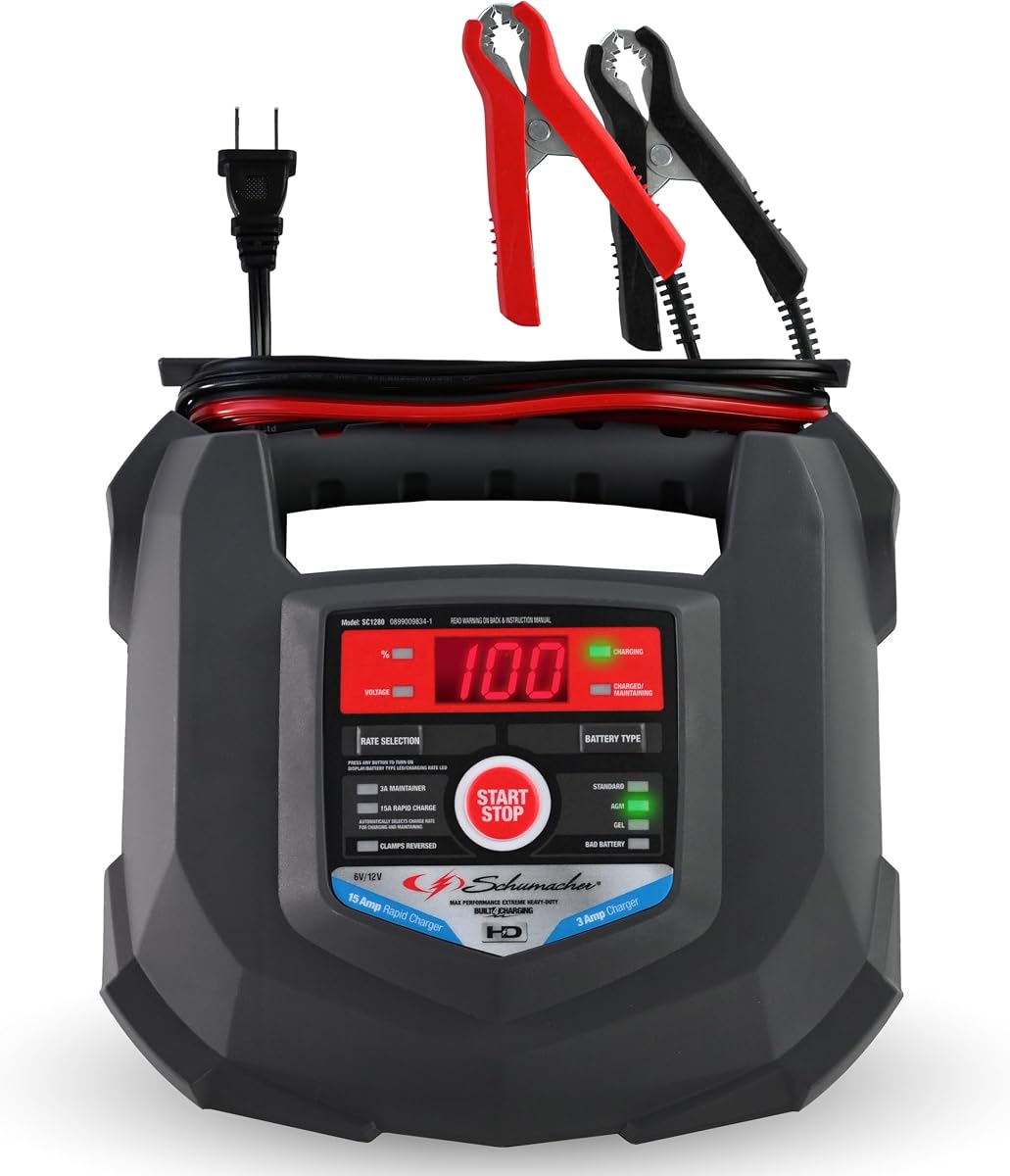
The Schumacher SC1280 stands apart with a 15A charging output and a four-in-one design covering charging, maintenance, testing, and restoration. Its 4.6 rating makes it a strong choice for owners who need meaningful recovery capacity as well as long-term upkeep. The unit automatically detects 6V and 12V systems and supports standard, AGM, gel, and deep-cycle batteries.
We may earn a commission when you buy through this link, at no additional cost to you.
Microprocessor control manages the process through multi-stage charging algorithms and advanced desulfation. Smart trickle charging handles maintenance after the initial recovery work, so the device can serve both a depleted battery and a battery that is simply being kept ready. The relatively high current makes it more useful than a compact maintainer when a vehicle has sat for months or the battery has lost substantial charge.
Its intended applications include cars, motorcycles, ATVs, trucks, SUVs, and boats. That range reflects the unit's stronger charging output and multi-stage design. Built-in testing adds a different kind of utility, allowing the charger to provide more than energy delivery. The AC-powered format also makes it a typical garage or workshop device rather than a portable power-bank-style product.
The key trade-off is that 15A is more capacity than many owners need for routine storage. A smaller 750mA to 2A maintainer may be more proportionate for a motorcycle or lightly used car. The supplied package also lists the charger and user manual without detailing a full set of connection leads. For a user who values faster recovery, testing, and flexible battery support, however, the SC1280 offers the highest current among these picks.
A 15A output provides substantially more charging capability than the compact maintainers in this list. It is better suited to restoring a battery that has experienced a meaningful discharge.
The SC1280 adds battery testing and reconditioning to charging and maintenance. This makes it a broader diagnostic and recovery tool for a garage.
We may earn a commission when you buy through this link, at no additional cost to you.
The MOTOPOWER MP00205A 2-Pack is designed for readers who need to maintain two 12V batteries at once. Each charger provides 800mA and includes the same automatic pulse-based desulfation, standby efficiency, and multi-level safety protections as the single-unit version. The 4.5 rating makes this a practical choice for households with multiple motorcycles, cars, or seasonal vehicles.
We may earn a commission when you buy through this link, at no additional cost to you.
Both chargers support flooded, AGM, and gel-cell batteries. Their SAE quick-release system offers a choice of fused ring terminals or insulated alligator clips, making it possible to keep a permanent connection on the battery and attach the charger when needed. The stated capacity reaches 30Ah for motorcycle batteries and 80Ah for car batteries, though actual results depend on battery condition and capacity.
The four-level protection system covers overcharge, short circuits, and reverse polarity. A 24-hour timer helps define the initial charging period before the charger shifts into 13.6V maintenance mode. The zero-output standby design avoids energy use while disconnected, and the pulse current is intended to optimize performance during charging and long-term upkeep.
The package format introduces practical trade-offs. Two separate chargers require access to two outlets, and each remains limited to 800mA. The product information also notes that severe sulfation, leakage, or cell defects may require battery replacement rather than further charging. For users who regularly maintain two batteries, the convenience of a matched pair can outweigh the limitations of operating each unit independently.
The two-pack supports simultaneous maintenance of separate batteries without forcing one charger to alternate between them. Each vehicle can use its own quick-release connection setup.
Fused ring terminals can remain attached to the battery for convenient access. The SAE quick-release connection allows the charger to be attached and removed without repeatedly handling the leads.
We may earn a commission when you buy through this link, at no additional cost to you.
The Battery Tender Plus combines a 1.25A output with adaptive smart charging and a four-step program, earning a 4.7 rating. It is a versatile maintenance option for automotive batteries, motorcycles, ATVs, and lawn mowers. The device is designed to adapt to the battery rather than deliver a constant, unmanaged trickle stream.
We may earn a commission when you buy through this link, at no additional cost to you.
Its two-color LED indicator communicates charge state, including when voltage drops too far under load. At that point, the charger resumes full output power. This feedback makes it easier for an owner to understand what the unit is doing without watching a separate meter. The adaptive program and float-maintenance approach also make it convenient to leave connected during longer storage periods.
A quick-disconnect harness improves usability, especially when the battery is difficult to access. Fused ring-terminal and alligator-clip accessory cables provide installation flexibility. The ten-year manufacturer warranty and lifetime customer support are unusually substantial support commitments in this category, adding confidence for buyers who intend the charger to remain connected during extended storage.
The main constraints are chemistry, voltage, and current. It is a 12V lead-acid maintainer with a 1.25A maximum output, and the supplied details do not mention temperature compensation or multi-voltage detection. It therefore offers less recovery speed than the SC1280 and fewer advanced diagnostics. Even so, the combination of adaptive charging, clear status feedback, flexible connections, and long warranty support makes the Plus a particularly balanced pick.
The charger monitors battery voltage and can return to full output after a significant under-load drop. That behavior makes it more responsive than a simple fixed trickle device.
The quick-disconnect harness reduces the inconvenience of reaching a battery in a crowded engine bay or storage area. Ring-terminal and alligator-clip options support different connection preferences.
We may earn a commission when you buy through this link, at no additional cost to you.
The ECO-WORTHY 12V 5A stands out for supporting both conventional lead-acid batteries and 12V LiFePO4 chemistry. Its 4.5 rating reflects a versatile package with automatic charging and maintenance, 5A output, and compatibility across cars, motorcycles, lawn equipment, boats, personal watercraft, and classic vehicles. It is the broadest chemistry match among the ten products listed.
We may earn a commission when you buy through this link, at no additional cost to you.
The unit operates on a universal 100-240V AC input and provides a 12V, 5A output. Its intelligent detection is designed to identify low voltage, vulcanization, and loss of capacity, prompting the user to repair and charge a compromised battery. Automatic maintenance means the device can transition beyond initial charging without requiring a separate maintenance unit.
Connection choices include battery clips, O-ring terminal cables, and an SAE connector with a 10A fuse. Those options cover temporary setups, fixed installations, and quick-release arrangements. The stated 5A output also gives it more recovery capability than the compact maintainers, while still sitting below the SC1280's 15A.
Its limitations are equally relevant. It is restricted to 12V systems and does not claim automatic 6V detection. Temperature compensation is not stated, and owners must be certain that the battery is compatible with its charging method. Connecting a charger to the wrong chemistry or voltage can be damaging. For readers who need LiFePO4 support alongside lead-acid maintenance and want more current than a typical storage maintainer, this model is a strong match.
Compatibility with 12V lead-acid and LiFePO4 batteries makes this one of the more versatile choices. Users should still confirm the exact battery type before selecting a charging program.
Battery clips, O-ring terminals, and a fused SAE connector support different vehicle layouts. These options allow a temporary connection or a more permanent storage installation.
We may earn a commission when you buy through this link, at no additional cost to you.
The Schumacher SC1300 is a 1.5A charger and maintainer that offers a straightforward combination of charging, maintenance, and reconditioning. Its 4.6 rating reflects dependable core features: automatic handling of 6V and 12V systems, support for standard, AGM, and gel batteries, and reverse-polarity protection. It suits cars, motorcycles, ATVs, trucks, SUVs, and marine batteries.
We may earn a commission when you buy through this link, at no additional cost to you.
Smart trickle charging maintains the battery over time without overcharging, while advanced desulfation is intended to improve performance and extend battery life. The three-in-one design makes it useful both for bringing a battery back toward a usable state and for maintaining it during storage. It is less technically elaborate than the SC1280 because it omits the built-in testing function, but it focuses on the core needs of many owners.
Installation is straightforward. The supplied details mention a 15-inch power cord and 17-inch ring leads, and the unit is designed to be mounted alongside the vehicle battery. A Schumacher mounting bracket is sold separately, which allows permanent positioning but adds a separate item to obtain. Reverse-polarity protection helps reduce the consequences of an incorrect hookup.
The SC1300's 1.5A output is modest compared with the 5A and 15A chargers in the guide. It is therefore better treated as a maintainer with moderate recovery ability than as a rapid battery revival device. Its strengths are 6V and 12V flexibility, protected connections, reconditioning capability, and the option for near-battery installation. For a broad range of conventional lead-acid vehicles, it remains a practical and easy-to-understand choice.
The unit is designed to mount in the engine compartment for convenient storage-maintenance access. The required Schumacher bracket is sold separately.
Smart trickle charging handles long-term upkeep, while desulfation mode supports battery performance. Reverse-polarity protection adds safety during initial setup.
We may earn a commission when you buy through this link, at no additional cost to you.
The right charger depends on battery voltage, chemistry, capacity, vehicle type, and how much recovery capability you need. Comparing those requirements before buying prevents an underpowered unit, incompatible chemistry, or unnecessary complexity from undermining the maintenance setup.
Confirm the battery voltage before choosing a maintainer. Most automotive, motorcycle, marine, and powersport batteries in this category are 12V, but several products also support 6V systems. Chemistry matters just as much: many units are intended for flooded, AGM, gel, SLA, or other lead-acid batteries, while the ECO-WORTHY 12V 5A also supports 12V LiFePO4. Never assume a charger is suitable solely because it fits the physical battery compartment.
Charging output determines how quickly a depleted battery can take in energy and how comfortably the charger can handle a large battery bank. Compact maintainers provide 750mA to 1.25A, which is generally suited to smaller powersport batteries and routine upkeep. A 2A unit offers a modest increase, while 5A and 15A models offer more recovery capacity for larger or deeply discharged batteries. Current alone does not determine suitability, but it should reflect the battery's capacity and the amount of recovery expected.
A quality maintainer should move through controlled stages rather than applying a fixed trickle indefinitely. Look for initialization, bulk, absorption, and float behavior, along with automatic transitions based on battery voltage. Float maintenance holds the battery at an appropriate level after the initial charge, while a restart under load can respond when the battery voltage falls. This behavior is especially valuable for vehicles exposed to temperature changes or intermittent accessory use.
Lead-acid batteries can develop sulfation and acid stratification during prolonged storage or repeated partial discharge. Automatic pulse-based desulfation and reconditioning modes may improve charging performance in some batteries. These features are not substitutes for replacing a physically damaged cell, leaking battery, or severely deteriorated unit. Products such as the MOTOPOWER models, Schumacher SC1355, SC1280, and SC1300 include desulfation functions with varying degrees of specificity.
Look for reverse-polarity, overcharge, short-circuit, and spark-free connection protection. Timer-controlled charging can add another layer of oversight by ending the active charging phase and moving into maintenance. Some products also use standby mode to avoid unnecessary energy consumption. Safety features matter most when a charger will remain connected around a vehicle, particularly in hot weather or during long storage periods.
Storage conditions affect battery chemistry and charging behavior. The NOCO GENIUS2D distinguishes itself with an integrated thermal sensor that adjusts charging as ambient temperature changes. Other products do not state equivalent temperature compensation, so users should consider their garage or storage environment carefully. A charger intended for outdoor use or unheated storage should ideally offer explicit temperature compensation and weather-resistant construction.
Connection style affects how often a maintainer must be attached and removed. Ring terminals support a permanent setup, alligator clips suit temporary use, and SAE quick-release connectors balance both approaches. The NOCO GENIUS2D includes a direct-mount bracket, while the Schumacher SC1300 can be mounted near the battery with a separate bracket. For hard-to-reach batteries, sufficient cable length and a convenient quick-disconnect system are valuable.
A motorcycle, classic car, boat, RV, and modern vehicle may use the same 12V label while having different capacity and usage requirements. Maintenance-only units often suit smaller powersports, whereas larger automotive batteries benefit from more current and stronger recovery functions. Marine, deep-cycle, and RV applications require explicit battery-type compatibility. Always verify that the maintainer supports the vehicle's battery rather than relying on the nominal system voltage alone.
Begin by identifying the battery voltage and chemistry, then read the charger's instructions and verify that the vehicle or equipment is switched off. Inspect the battery for leakage, swelling, corrosion, damaged terminals, or other visible defects. Clean the terminal area if needed and confirm that the charger supports the battery type before attaching leads.
Connect the charger's positive lead to the positive battery terminal and its negative lead to the negative terminal. Use the correct ring terminals, alligator clips, or quick-release harness, and avoid pinching cables under a hood or around moving components. Reverse-polarity protection does not make incorrect hookups appropriate. Plug the charger into a suitable grounded outlet after checking the connection.
Allow the charger to complete its programmed charging stages and monitor the status light or display. Once it reaches float or maintenance mode, confirm that the indicated state is stable. Keep the unit connected as directed for long-term storage, inspect connections periodically, and disconnect it before servicing the electrical system. Replace the battery rather than continuing to charge it if it leaks, swells, smells unusual, or has damaged cells.
Products designed for long-term maintenance can often remain connected because they switch to a controlled float state after charging. The NOCO GENIUS2D specifically states that continuous monitoring allows safe indefinite connection. Even so, buyers should follow the instructions for their specific charger and inspect the battery and connections periodically, especially in extreme heat.
A traditional trickle charger applies a small, relatively constant current, while a smart maintainer monitors the battery and changes its output through programmed charging stages. Most products in this guide use multi-stage charging and float maintenance rather than unmanaged trickle current. That distinction generally makes a modern maintainer more appropriate for long-term storage.
The Battery Tender Junior 12V and Battery Tender Plus 12V are especially practical for motorcycles because they use controlled charging and float maintenance and include ring-terminal harnesses. Smaller 750mA to 1.25A outputs are generally more proportionate to typical powersport batteries. Always confirm the charger's supported battery chemistry and follow the vehicle manufacturer's guidance.
Only use a charger specifically approved for the battery's chemistry and voltage. Among these products, the ECO-WORTHY 12V 5A explicitly supports 12V LiFePO4 as well as lead-acid batteries. Most other units are designed for 12V lead-acid, AGM, or gel batteries and should not be assumed compatible with lithium chemistry.
Recovery depends on the charger's output and the physical condition of the battery. The NOCO GENIUS2D can charge from 1 volt and offers Force Mode for batteries down to zero volts, while higher-current units can replenish energy more quickly. No charger can restore a leaking, swollen, shorted, or defective battery, so replacement may still be necessary.
Temperature compensation is valuable when a battery is stored in conditions that vary substantially between summer and winter. The NOCO GENIUS2D includes an integrated thermal sensor that adjusts charging for ambient temperature. In mild, stable indoor conditions, the other maintainers may still meet routine storage needs, but owners should consider ventilation and heat when choosing where to connect them.
The correct procedure depends on the charger and vehicle. For permanently mounted units, switching the charger off before starting may prevent brief voltage fluctuations or electrical-system conflicts, while removable quick-disconnect leads should always be detached before driving. Follow the manufacturer instructions and avoid leaving a charger connected if the vehicle's electrical system uses a different charging method.
Use the supplied leads with enough length to reach the battery without stretching them sharply. Ring terminals support permanent installation, SAE quick-release connectors permit convenient removal, and alligator clips are useful for temporary setups. Keep connections clear of moving parts, hot exhaust components, sharp edges, and battery vents.
The Battery Tender Junior 12V leads the guide with a 4.8 rating, compact design, four-stage program, and broad lead-acid compatibility. The NOCO GENIUS2D offers the most advanced onboard proposition through temperature compensation, direct mounting, and deep-discharge recovery, while the MOTOPOWER MP00205B provides a compact automatic option with pulse charging and extensive safety certifications.
Prioritize the factors that match your actual battery and storage situation. Select a compact maintainer for smaller powersports, a higher-current charger for a large or deeply discharged automotive battery, a fixed-mount model for permanent installation, and a chemistry-compatible unit when LiFePO4 is involved. Look for controlled float behavior, clear status feedback, protected connections, and a quick-disconnect arrangement that suits the battery's location.
Before buying, verify the current rating, supported voltage and chemistry, included cables, mounting hardware, warranty, and installation requirements. Ratings can offer a useful indication of customer response, but they do not replace checking specifications. Current prices and product availability may change, so compare the latest listing details before making a final purchase.


