
WIMIDING 4G Cellular 2K Trail Camera
4.8Editor score
Removable SIM flexibility
48MP photo capture
32GB memory card included
Works without cellular service
Our 4G Trail Cameras under 200 guide compares ten cellular trail cameras on night vision, solar power, detection speed, app control, and coverage options.
A 4G trail camera brings dependable wildlife monitoring and remote property coverage to locations without Wi-Fi or convenient access to mains power. The right model combines fast motion detection, clear day and night imagery, solar charging, reliable cellular service, and an app that makes remote viewing genuinely convenient.
We compared ten cameras on the features that materially affect field use, including trigger speed, night-vision range, lens coverage, power options, storage methods, network support, weather resistance, and recurring cellular-service requirements. The list includes premium-featured models, budget-friendly options, flexible SIM choices, and one important non-cellular comparison camera.
Each pick highlights a different use case, from panoramic wildlife viewing to livestock monitoring and fully independent local recording. Ratings, features, and availability can change over time, so shoppers should confirm current specifications, cellular coverage, subscription terms, and accessories before making a final purchase.
4.8Editor score

4.8Editor score
3.0Editor score
The comparison below highlights the major differences in connectivity, imaging, power, detection, and field usability, including the one non-cellular model included for practical comparison.


This 4G LTE Cellular Trail Camera is a feature-rich option for hunters, wildlife observers, and property owners who want remote access without a Wi-Fi connection. Its 4.3 rating reflects a broadly capable package, while the combination of 2.5K live viewing, a 360-degree feed, solar power, and app-based control makes it especially interesting for users who want to monitor a broad area from a phone.
We may earn a commission when you buy through this link, at no additional cost to you.
The camera supports HD and SD recording modes, allowing users to balance clarity against cellular-data consumption. A SIM card is pre-inserted, and complimentary data is provided for an initial trial, making setup less complicated than sourcing and activating a card independently. Motion-triggered notifications arrive through the app, while a 0.2-second reaction helps preserve short-lived wildlife activity. The six infrared LEDs and selectable full-color or infrared night vision support monitoring after dark.
A high-efficiency solar panel reduces battery-service frequency, and the weather-resistant construction is designed for extended outdoor placement. The most advanced feature is AI-powered species and behavior recognition, but that capability requires a paid subscription. The memory card is also not included. These are important ownership costs to consider, and the AI description should not be mistaken for a standard feature available without any service commitment.
This is a strong recommendation for a buyer who values panoramic control, flexible live viewing, and a broad software feature set. It may be less attractive for someone seeking the simplest possible camera or one with no subscription-based extras. Review the cellular plan, supported services, and storage requirements before installation, especially if the camera will monitor an active hunting area or remote property.
The 360-degree live feed gives the camera more flexibility than a fixed-lens model. You can inspect a wider hunting lane or property perimeter without relying on a precise directional aim, while HD and SD modes help control the amount of cellular traffic generated by live viewing and transferred recordings.
Six infrared LEDs and separate night-vision options make the camera suitable for nocturnal activity. The full-color mode is useful around dawn and dusk, while infrared recording is better suited to complete darkness where visible light could disturb animals.
We may earn a commission when you buy through this link, at no additional cost to you.
The TKENPRO 4G LTE Cellular Trail Cameras combines a 4.8 rating with extensive remote-control features, making it one of the strongest all-around choices in this guide. The camera supports 2K HD live streaming, a panoramic field of view, 355 degrees of pan, 120 degrees of tilt, and 4x digital zoom. That combination is particularly useful when one camera must cover a broad trail, clearing, or farm boundary.
We may earn a commission when you buy through this link, at no additional cost to you.
Its PIR motion sensor can trigger in 0.2 seconds, reducing the chance that a fast-moving deer or person will cross the detection zone before recording begins. The built-in microphone and speaker also enable real-time two-way audio, adding a practical layer beyond ordinary photo alerts. For nighttime observation, low-light infrared technology is advertised to cover up to 85 feet, while a five-watt solar panel supports long-term off-grid operation.
The trade-off is the built-in, non-removable SIM. It automatically searches for a strong 4G network and is intended for use within the United States, but it cannot be replaced with a user-supplied carrier card. Each camera also needs its own data plan. Its IP65 rating and stated operating range of approximately -20°C to 50°C make it suitable for demanding farms, forests, and remote cabins where weather protection and dependable power are priorities.
This camera is best for buyers who want broad visual coverage, responsive triggering, two-way communication, and effective solar operation in one unit. It is less suitable for cross-region use or for anyone who needs complete SIM freedom. The strong rating and balanced feature set make it a particularly attractive option for serious remote monitoring.
The 355-degree pan and 120-degree tilt create much more flexibility than a standard fixed view. Digital zoom adds further detail when you need to inspect a distant animal, and the 2K stream provides enough detail for meaningful remote observation.
A five-watt panel and IP65 enclosure reduce the need for regular visits. The camera can continue operating without mains electricity or Wi-Fi, although users must maintain cellular service and choose a suitable plan for each unit.
We may earn a commission when you buy through this link, at no additional cost to you.
This Solar Trail Camera earns a 4.9 rating, making it one of the most well-regarded products in the roundup. It is designed for users who want a straightforward 4G LTE trail camera with fast motion response, solar charging, and flexible recording storage. Support for Verizon, T-Mobile, and AT&T networks adds useful network versatility, although the included prepaid SIM still needs an appropriate plan after its trial period.
We may earn a commission when you buy through this link, at no additional cost to you.
The camera's PIR sensor has an adjustable detection setup and a 0.2-second trigger speed. Photos and videos can be saved to a memory card as large as 128GB, allowing local recording without a continuous cloud subscription, or users can use the included cloud-storage trial. The app sends timely activity alerts and supports phone playback and downloading. A four-watt solar panel is intended to reduce battery changes, with the manufacturer noting that suitable sunlight can support operation for up to 365 days.
AI recognition and seven-day activity prediction are additional tools for users who want help identifying species and anticipating busy periods. Species identification requires a cloud-storage subscription, so the advanced analysis is not a no-cost feature. The memory card is not included, and IP66 weather resistance is reassuring but does not mean the camera should be submerged or left unsealed in severe conditions.
This model is a good balance for wildlife watchers who value a strong rating, broad carrier compatibility, solar power, and local storage. It suits people who want dependable app alerts but can live without the panoramic movement offered by higher-end models. Confirm the cellular terms and cloud requirements before deploying it at a remote location.
Supporting memory cards up to 128GB is valuable for hunters who want a local archive. Cloud storage remains optional during the trial, so users can decide how their recordings should be retained based on their monitoring needs.
The app's ability to analyze environmental data and estimate activity peaks can help focus scouting efforts. Treat these predictions as guidance rather than certainty, since animal movement changes with weather, season, and human activity.
We may earn a commission when you buy through this link, at no additional cost to you.
The SEHMUA Trail Camera is a versatile cellular option for deer scouting, farm monitoring, and backyard observation. Its 4.2 rating reflects a solid balance of capabilities, with 2K live footage, remote setup, a fast 0.2-second trigger, and a 120-degree field of view. The Ucon app supports live viewing, settings changes, and sharing footage with other people, which makes it convenient for families or monitoring teams.
We may earn a commission when you buy through this link, at no additional cost to you.
The camera supports major cellular networks and includes a prepaid SIM with an initial unlimited-data trial. That arrangement simplifies activation, but the card is fixed inside the camera and limited to local United States use. Each unit needs its own data plan. A 7800mAh rechargeable battery and four-watt solar panel support off-grid operation, while IP66 weather resistance helps the camera cope with changing outdoor conditions.
Night recording relies on 850nm low-light infrared illumination with a stated range of up to 82 feet. The AI engine can identify species and predict activity, but cloud storage is required for species identification. Footage can also be stored on a memory card up to 128GB, with a cloud trial available for users who prefer remote access. The memory card itself is not included.
This camera is recommended for buyers who want 2K live viewing and a broad field of view without moving to a premium panoramic model. Its limitations are the locked SIM and subscription-dependent AI. For hunters and property watchers who prefer a familiar app and flexible storage, the SEHMUA remains a practical option.
Live footage and recorded clips can be viewed through the Ucon app, and sharing functions make the camera useful when several people need situational awareness. Remote setting changes reduce the need to physically visit the camera for routine adjustments.
The 850nm infrared system and 120-degree lens are well suited to nocturnal trails and open property edges. At night, the 82-foot range provides useful coverage without the need for a visible flood light that could disturb wildlife.
We may earn a commission when you buy through this link, at no additional cost to you.
The SPYPOINT Flex-M Twin focuses on making cellular trail-camera ownership uncomplicated. Its 3.9 rating is lower than those of several competing models, but the product offers a clear user-friendly app, automatic cross-carrier connection, on-camera setup controls, and a free transmission allowance. It is a strong option for buyers who prioritize simplicity over panoramic movement or very high-resolution specifications.
We may earn a commission when you buy through this link, at no additional cost to you.
The camera can transmit photos through the SPYPOINT app without Wi-Fi, and the service includes a free monthly photo allowance before paid transmission options are needed. It automatically identifies and uses a suitable cellular network, removing the need to research or select a carrier manually. Photo, video, time-lapse, and Time-Lapse+ modes cover different monitoring situations, while Constant Capture is designed to send and capture images simultaneously.
A key limitation is that the compatible solar panel is sold separately. Users who want a self-sufficient off-grid installation need to budget for that accessory, and those who prefer a complete kit may favor a model that includes a panel and battery. The app also offers personalized maps, weather information, remote settings, firmware updates, and BUCK TRACKER AI for species filtering.
This camera is best for hunters or property watchers who want dependable cellular photo transmission without juggling carrier selection. It is also appealing to those who want flexible time-lapse workflows and do not need a high-resolution live-video model. The included functionality and free photo plan help offset the lower rating, while solar-panel compatibility allows a complete off-grid setup.
The Flex-M continuously monitors network performance and uses cross-carrier coverage automatically. This is especially helpful for users placing the camera in unfamiliar territory where available networks may vary by location.
Time-Lapse is useful for monitoring a location at regular intervals, while Time-Lapse+ combines interval images with detection-triggered shots. That gives users a way to study movement patterns while still recording activity connected to the camera's sensor.
We may earn a commission when you buy through this link, at no additional cost to you.
The Misstech 4G LTE Cellular Trail Camera is built for wildlife, livestock, and remote-property monitoring, with a particularly fast 0.1-second motion trigger. Its 4.3 rating and broad feature set make it appealing when quick reactions are important. The camera captures full-HD photos and videos and offers 2K live streaming through a cellular connection and smartphone app.
We may earn a commission when you buy through this link, at no additional cost to you.
One of its most distinctive features is the built-in two-inch color display. Users without cellular service or an active subscription can review photos and videos directly at the camera, avoiding the need to remove the memory card and carry it to another device. In the app, standard-definition previews can be streamed to reduce cellular-data use, while full-HD versions can be downloaded when greater detail is needed.
Night recording uses 940nm no-glow infrared LEDs and an F1.6 aperture. The design also includes multi-user access for families, ranch workers, or research teams, along with interactive map pins that help locate the camera across large pastures or wooded acreage. A four-watt solar panel supports continuous operation, and the camera can operate without a subscription for local viewing.
This model is an excellent choice for livestock operators and wildlife observers who prioritize response speed and on-site review. Its main connectivity limitation is that fully user-provided SIM cards are not supported. After the trial period, an active cellular plan is needed for live feeds and alerts. For users who prioritize offline playback and fast detection, that limitation is easier to justify.
The 0.1-second trigger is among the quickest in this guide and helps capture animals moving through a detection zone. Push notifications make that speed useful beyond recording, allowing livestock owners and property monitors to react sooner.
Standard-definition previews help users check recent activity without consuming as much cellular data as a continuous high-resolution stream. The built-in display also provides a practical local fallback when remote access is unnecessary.
We may earn a commission when you buy through this link, at no additional cost to you.
The WIMIDING Trail Camera 4G Cellular stands out for flexibility: it can operate with the included SIM, accept a user-supplied SIM, or function as a conventional trail camera without cellular service. Its 4.8 rating makes it one of the most attractive options in the guide, especially for buyers who want cellular capability without being locked into a mandatory provider.
We may earn a commission when you buy through this link, at no additional cost to you.
The camera records 48MP photos and 2K video through a 120-degree lens. Its 850nm low-glow infrared system has a stated range of up to 65 feet, and a 0.4-second trigger speed provides quick detection. Motion alerts and map-pin location are available through the TrailCam Go app, while a two-inch color LCD allows convenient on-site review. A 32GB memory card and eight AA batteries are included for easier immediate setup.
The most important advantage is operational independence. If there is no signal, a subscription becomes undesirable, or the SIM needs changing, the camera can continue recording locally. The removable SIM avoids geographic and service-provider limitations associated with fixed cards. Its trade-offs are a slower trigger than the fastest models in the roundup and a shorter advertised night-vision distance.
This is a strong recommendation for backyard monitoring, wildlife watching, and anyone who wants a cellular camera that can become a standalone trail camera when needed. The included memory card and batteries reduce initial setup friction. Format the card in the camera before first use, and confirm the app and network behavior in the intended coverage area.
A removable SIM gives users more carrier choice than models with a permanently installed card. More importantly, the camera retains its core recording function without cellular service, allowing local wildlife monitoring to continue when a remote connection is unavailable.
The included 32GB card and eight AA batteries help reduce the number of items required before setup. The built-in display allows quick checks in the field, and IP66 construction helps protect the unit during outdoor use.
We may earn a commission when you buy through this link, at no additional cost to you.
The SEHMUA Trail Camera 2 Packs provides a complete two-camera approach to cellular monitoring. Its 5.0 rating is the highest listed in the roundup, and the package is especially appealing for buyers who want to cover a trail and a secondary property location, monitor two approaches, or maintain overlapping fields of view. Each camera supports 2K live streaming and a 0.2-second motion trigger.
We may earn a commission when you buy through this link, at no additional cost to you.
Both units use low-glow 850nm infrared illumination with a stated range of up to 82 feet, and each has a 120-degree field of view. The 7800mAh rechargeable batteries and four-watt solar panels are designed to support long-term outdoor monitoring. IP66 weather resistance adds protection against rain, dust, and changing seasonal conditions.
Connectivity requires a prepaid cellular SIM in each camera, and the two units cannot share a single data subscription. Users receive trial data for first use and then need to maintain service through the app. Photos and videos can be stored on memory cards up to 128GB or in cloud storage, but the memory cards are not included. Cloud storage and some AI functions require a subscription after the trial.
This package is a strong fit for hunters, farmers, and homeowners who want two points of coverage instead of one. The perfect rating is encouraging, though the subscription structure and included accessories should be reviewed carefully. It is best for users prepared to manage separate service for both cameras and a storage plan that matches their monitoring activity.
A two-camera package can cover separate approaches or overlapping areas without relying on a single wide-angle view. That flexibility is useful when a trail bends through dense vegetation or a property has several vulnerable access points.
The cameras use the same general app-based workflow, which makes managing two locations convenient. Each unit still requires its own data plan, so buyers should include both in ongoing operating costs and avoid assuming that a subscription can be shared.
We may earn a commission when you buy through this link, at no additional cost to you.
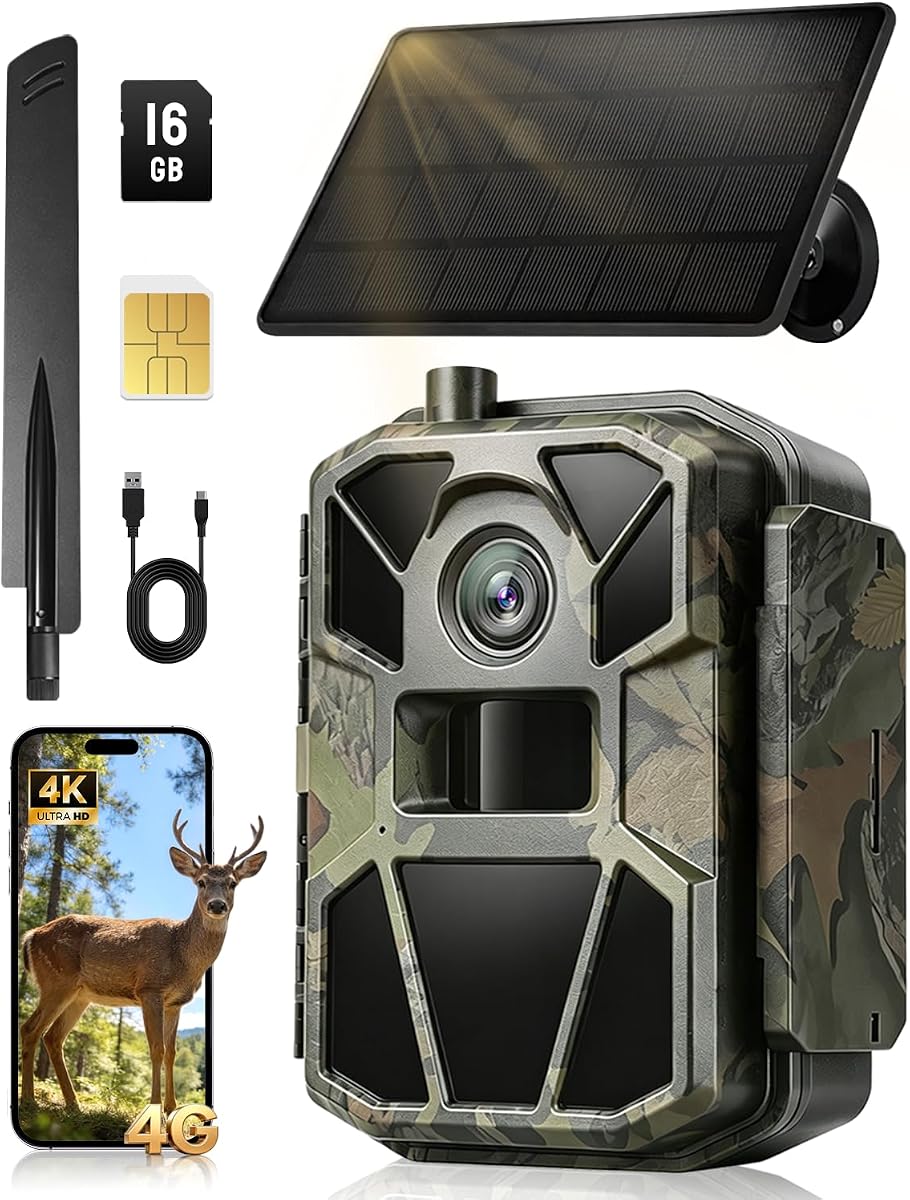
The 64MP 4K 4G LTE Camera is the feature-heavy premium selection in this guide. It offers 64MP still images, 4K video, an extremely fast 0.1-second trigger, and up to 98 feet of no-glow infrared coverage. Those specifications make it attractive to buyers who want detailed imagery of distant animals, subtle property activity, or a large monitoring area.
We may earn a commission when you buy through this link, at no additional cost to you.
Automatic network switching is designed to improve connectivity in woods, fields, and other locations where one carrier may perform better than another. A large 12000mAh rechargeable battery and included solar panel reduce battery maintenance, while IP66 protection supports year-round outdoor use. The app can display photos, adjust selected settings, check GPS location, and manage the camera remotely. A SIM and 16GB memory card are included.
The camera's 3.0 rating is the lowest in the roundup, so buyers should interpret it as a warning to review recent customer feedback rather than ignore the model. Some convenient functions are also separated from the free service. Remote photo transmission is covered by the included period of photo data, but live viewing and video transfer or downloading require optional paid app services.
This model is recommended for users who prioritize resolution, fast triggering, long-range night vision, and flexible carrier selection. It is less appropriate for buyers seeking a simple, predictable service with every advanced feature included. Confirm the current service packages and app experience before buying, especially if 4K transfer and continuous live viewing are central to your intended use.
The 64MP photos and 4K video options are useful when fine detail matters, such as identifying markings on distant wildlife or reviewing a small object near a property boundary. Higher resolution files also require adequate storage and may take longer to transfer over cellular networks.
Automatic network switching is valuable in wooded areas where cellular reception can vary across a short distance. The GPS feature also helps users locate and return to a camera mounted on a large tract of land.
We may earn a commission when you buy through this link, at no additional cost to you.
The WOSPORTS Trail Camera is not a 4G model, but it is included as a practical baseline for readers who want excellent field recording without cellular service. Its 4.3 rating is respectable, and the camera records photos at adjustable resolutions up to 64MP alongside 4K or lower-resolution video. The 0.2-second trigger and 120-degree detection angle suit trails, farms, and backyard monitoring.
We may earn a commission when you buy through this link, at no additional cost to you.
Thirty-two 940nm infrared LEDs create a no-glow night-vision system designed to avoid the visible red light that can disturb some wildlife. A two-inch color LCD lets users preview recordings directly without removing the memory card. A 16GB card is included, and support extends to larger cards, while a password and straightforward menu system help protect and organize footage.
The absence of cellular and Wi-Fi connectivity is the defining trade-off. There are no live feeds, push notifications, or remote app access, and users must physically visit the camera to review or retrieve important files. Eight AA batteries are supported but not included, while compatible lithium batteries and solar panels are optional accessories. This model therefore favors dependable local capture over immediate connectivity.
This camera is recommended for buyers who want high-resolution evidence without a recurring service, especially in areas with weak cellular coverage. It also serves as a straightforward local backup for a cellular installation. Those who need immediate remote alerts should choose a 4G model, but hunters focused on image quality and field reliability may find this non-cellular option especially useful.
The camera provides 64MP photos and 4K video without requiring a cellular subscription. That makes it attractive for users who prefer predictable ownership and are willing to retrieve recordings during a scheduled trail check.
The 940nm infrared array avoids the visible glow associated with some night-vision systems. This can help wildlife behave more naturally while still illuminating the camera's 120-degree detection area in darkness.
We may earn a commission when you buy through this link, at no additional cost to you.
The best cellular trail camera depends on signal reliability, wildlife behavior, power access, recording resolution, and how quickly you need information. Evaluate these factors together rather than treating resolution or trigger speed as the only measures of quality.
A cellular trail camera is only useful when it can obtain a dependable signal. Check whether the model uses a built-in prepaid SIM, a removable SIM, or automatic cross-carrier selection. Built-in cards can simplify activation but may restrict service choices or regional use. Removable SIMs provide greater carrier flexibility, while an automatic network system is helpful when coverage varies between one carrier and another across the property.
For hunters traveling between states, local-only SIM restrictions can be a decisive issue. Farms and remote homesteads may benefit from automatic network switching because trees, terrain, and distance from towers can weaken connectivity. Always verify current coverage at the intended installation site and understand whether each camera needs a separate plan.
Trigger speed indicates how quickly the camera can begin recording after its PIR sensor detects movement. Speeds around 0.1 to 0.2 seconds are well suited to fast-moving deer and other wildlife. A slower trigger can still be useful for less active subjects, but it increases the chance of missing the first moments of an encounter. An adjustable sensor also allows users to balance sensitivity, false alerts, and battery or data use.
A wider detection angle can cover a larger trail or property edge, although it may also record more irrelevant activity. Match the lens and detection pattern to the actual location rather than choosing the widest possible specification. A camera aimed across a busy path may need sensitivity adjustments that would be unnecessary in a quiet woodland corridor.
Resolution should be judged by practical use rather than a single maximum number. High-resolution stills help with animal identification and distant movement, while 2K video provides a good balance for live viewing and everyday playback. 4K files can reveal more detail, but they consume more storage, take longer to transfer, and may require optional service features on some cellular cameras.
Consider whether you need high-resolution video or mainly need clear photos and timely alerts. A memory card or included card is important for local backups, while cloud storage may be more convenient for remote organization. Check file sizes, available storage limits, and whether advanced features are tied to a cloud subscription.
Infrared night vision lets a camera record in darkness without using a bright visible light that could change animal behavior. Low-glow or no-glow systems use infrared illumination that is less noticeable to wildlife and people. Stated ranges can help compare cameras, but actual clarity also depends on the lens, sensor, subject distance, and amount of ambient light.
Consider the width of the night scene as well as the maximum range. A stated range of 65 feet does not mean the entire area will be equally clear. Cameras advertising 82 to 98 feet are better suited to broader nighttime coverage. Test the camera at its intended mounting height and angle when possible, particularly if identifying details at distance is important.
Remote trail cameras are much easier to maintain when they can recharge continuously. A built-in solar panel is a major advantage, but panel size, battery capacity, sunlight exposure, and the number of daily recordings all affect real-world endurance. A four-watt panel may be sufficient in many open locations, while five watts offers additional margin. Models sold without a panel may still support compatible accessories.
Consider whether the supplied battery is rechargeable and whether replacement cells are available. Low temperatures can reduce battery performance, while shaded tree sites may produce less charging than open fields. Do not treat a stated multi-season duration as a guarantee; it depends heavily on weather, activity level, panel orientation, and transmission volume.
The companion app determines how much time you spend managing the camera. Useful features include push alerts, live viewing, remote settings, GPS maps, firmware updates, AI species identification, activity predictions, and multi-user sharing. A clear interface and on-camera setup controls can make a substantial difference, particularly when the camera is located far from a road or vehicle.
Free allowances, paid transmission plans, cloud storage, live video, and AI recognition may be separated. Some models include a meaningful trial, while others provide only a limited amount of initial data. Review the recurring service structure for every camera in a multi-camera package, because a shared subscription may not be available.
An IP66 rating indicates protection against dust and powerful water jets, making it a useful baseline for cameras mounted in rain, snow, or dusty environments. It does not mean the camera is waterproof under every condition. Seals, cable ports, lens surfaces, and battery compartments should remain properly closed and undamaged.
A sturdy mounting strap and secure tree attachment matter as much as the enclosure. Strong winds, branches, and animals can pull a camera off its mount. Avoid exposed positions where limbs can strike the housing, and use a protective cover only if it does not obstruct the lens, sensor, solar panel, or radio signal.
A camera that continues recording without cellular service offers valuable insurance. Local memory-card storage protects your footage from an unreliable signal, and a removable SIM lets you change carriers or use a different service. Models with non-removable prepaid SIMs generally simplify activation but provide less control over coverage and regional restrictions.
If you want a genuinely independent trail camera, the WOSPORTS model in this guide records locally and does not offer cellular viewing. Several other choices can still function as conventional recorders when a SIM is removed. Local-only operation is especially useful for image collection, evidence gathering, and areas with no practical cellular reception.
Begin by confirming cellular coverage at the intended location, formatting the memory card in the camera when required, and charging any rechargeable battery before installation. Activate the camera and its cellular service, connect it to the app, and test both a live view and a motion-triggered recording. This process also verifies that the SIM is recognized, the antenna has a clear path, and the selected storage method is working.
Mount the camera securely at a sensible height with the lens directed toward the main trail, gate, field edge, or property access point. Tighten the strap, aim the solar panel toward open sky, and confirm that the camera is not blocked by vegetation. After mounting, watch the live feed and wait for a short test recording, adjusting the motion sensitivity or angle if the area produces too many irrelevant triggers.
For maintenance, wipe the lens and solar panel after rain, mud, or pollen accumulation, and inspect the strap, seals, and battery compartment during regular visits. Keep app permissions and firmware current, monitor data or transmission allowances, and back up important recordings. If performance declines, check signal strength, card capacity, battery charge, and card formatting before replacing the camera.
Yes. These cameras use a cellular LTE connection rather than Wi-Fi, making them suitable for remote fields, forests, farms, cabins, and other off-grid locations. They still need adequate cellular signal and an appropriate data or transmission plan for remote viewing and alerts. Local recording may continue when the signal is weak, depending on the model and storage configuration.
That depends on the camera. The WIMIDING model in this guide supports a removable SIM and can also operate without cellular service, while several competitors use a built-in prepaid SIM. Built-in cards may be limited to particular regions and cannot be replaced. Check the product instructions and current service terms before purchasing for travel or use outside the United States.
Not always. Resolution is only one part of image quality, and lens quality, sensor performance, lighting, focus, motion, and camera placement can have an equally large effect. A 2K camera with good optics and proper positioning may produce more useful results than a higher-resolution model that records distant subjects through poor light or at the wrong angle.
Usage varies with stream quality, motion, connection speed, and how long the feed remains open. Continuous high-resolution viewing generally uses more data than receiving still alerts or viewing short previews. Many apps provide lower-resolution previews to reduce consumption, while HD downloads and advanced AI services may require additional service or storage.
They can, but performance depends on sunlight, temperature, battery chemistry, and the camera's power draw. Snow cover can reduce charging, and cold temperatures may temporarily reduce battery performance. A larger panel and high-capacity rechargeable battery can provide more margin, but no solar camera is completely maintenance-free in every climate.
No. Several models in this guide support local memory-card recording, and one can also function as a conventional trail camera without a cellular plan. Cloud storage is useful for remote organization, but it may be needed for species identification and other AI features. Buyers should compare local storage, cloud retention, and subscription requirements before choosing.
The useful range depends on the animal size, field angle, ambient light, and desired level of detail. Cameras with roughly 65 to 98 feet of stated range cover different scenarios, but a maximum range does not mean the entire area will be equally sharp. A closer, more precisely aimed camera often produces better identification shots than a distant camera set to its maximum range.
Several cellular trail cameras in this guide require a separate subscription for each unit, even when they are managed through the same app. Check the service policy for multi-camera households, farms, or packages before installing additional units. Local recording can remain available for some models, but remote alerts and live viewing may still require active service for every camera.
The TKENPRO 4G LTE Camera is the strongest balanced choice because it combines a 4.8 rating with 2K streaming, full panoramic control, two-way audio, fast detection, night vision, and solar power. The WIMIDING 4G 2K Camera is the best budget-oriented option for buyers who value removable SIM flexibility, local fallback operation, high-resolution photos, and included accessories.
The 4G LTE 2.5K Camera stands out for feature-rich remote monitoring, while the 64MP 4K model offers the most demanding image specifications and automatic network switching. Before choosing, prioritize reliable signal at the exact installation site, the recurring cellular structure, local storage support, solar suitability, and the trigger and night-vision performance needed for the intended wildlife or property.
Specifications, customer ratings, service terms, and availability can change, and the value of each camera depends on where it will be used. Check current features, cellular plans, included accessories, and subscription requirements at the time of purchase. Those details are more important than headline specifications alone when selecting a trail camera that needs to work reliably for months without frequent attention.