Speediance Gym Monster 3
5.0Editor score
220-pound digital resistance
One-pound adjustment increments
Nineteen cable positions
Hands-free voice controls
Explore the best AI Powered Smart Home Gym Systems, comparing smart coaching, resistance, tracking, space savings, workouts, and ownership for different goals
AI Powered Smart Home Gym Systems combine connected equipment, adaptive resistance, motion tracking, and guided programs to make home training more interactive and personalized. A strong system should reduce guesswork, support consistent form, offer enough exercise variety, and fit naturally into the space and routine of the people using it.
We compared the ten systems in this guide across their core hardware, resistance capabilities, AI features, workout selection, performance measurement, display experience, installation needs, and portability. The list covers full-size strength stations, wall-mounted cable trainers, compact all-in-one machines, a portable cable gym, and an AI-adaptive treadmill for runners.
Each numbered review explains the strongest benefits and the practical compromises of its featured product, helping you identify which system best fits your training goals, available space, and preferred workout style. Product features and availability can change, so confirm the current specifications and commercial terms before purchasing.
5.0Editor score

4.1Editor score

3.7Editor score
The following comparison highlights the major differences among all ten featured systems, including their equipment format, resistance range, smart features, training versatility, and space requirements. It is designed to make the differences clear before you examine individual reviews in greater detail.


The AEKE K1 is a feature-rich smart fitness mirror with a 4.1 rating, and it stands out for combining strength, cardio, flexibility, motion analysis, and entertainment in one relatively compact machine. Its defining strength is the Intelligent Motion Analysis Engine, which can examine movement through 17-point skeletal tracking, track repetitions and sets, and turn the data into performance reports rather than leaving the AI role limited to choosing workouts.
We may earn a commission when you buy through this link, at no additional cost to you.
Five resistance modes and a digital servo motor allow the resistance to adapt as a session progresses, while the extensive library includes more than 350 movements and over 200 professional courses. The 43-inch 4K touch screen and 2.1-channel surround sound make it particularly engaging for interactive classes, motion-sensing games, and full-body routines. The system also provides detailed metrics for calories, exertion balance, and movement completion, giving users a clear picture of training behavior over time.
The most significant advantage over many large smart gyms is the absence of a recurring subscription. The supplied information states that access to workouts, classes, AI coaching, and updates is included for life, which can make ownership more straightforward for people who want guided training without an ongoing membership. The trade-offs are that the K1 remains a substantial upfront investment, uses powered resistance rather than conventional barbell plates, and is not designed to replace every specialized piece of equipment in a traditional strength facility.
Its auto-folding footprint of approximately 0.3 square meters is also a major practical benefit. The K1 is best for a home, apartment, or shared workout area where a visitor wants a polished screen, broad course selection, and intelligent form feedback but has limited room for bulky gym equipment. For those priorities, it is the strongest all-around recommendation in this guide, with the caveat that buyers should verify the included accessories, available resistance range, installation requirements, and warranty terms for their particular location.
Seventeen-point skeletal tracking gives the K1 a more detailed view of body movement than a simple repetition counter. Its reports can help identify completion patterns, exertion balance, and areas where consistency may need to improve, giving AI coaching a practical role in everyday training.
The large 4K touch screen, surround sound, motion-sensing games, and broad course library turn the system into an entertainment-capable fitness station. This makes it particularly attractive for households that want exercise to feel engaging rather than purely mechanical.
We may earn a commission when you buy through this link, at no additional cost to you.
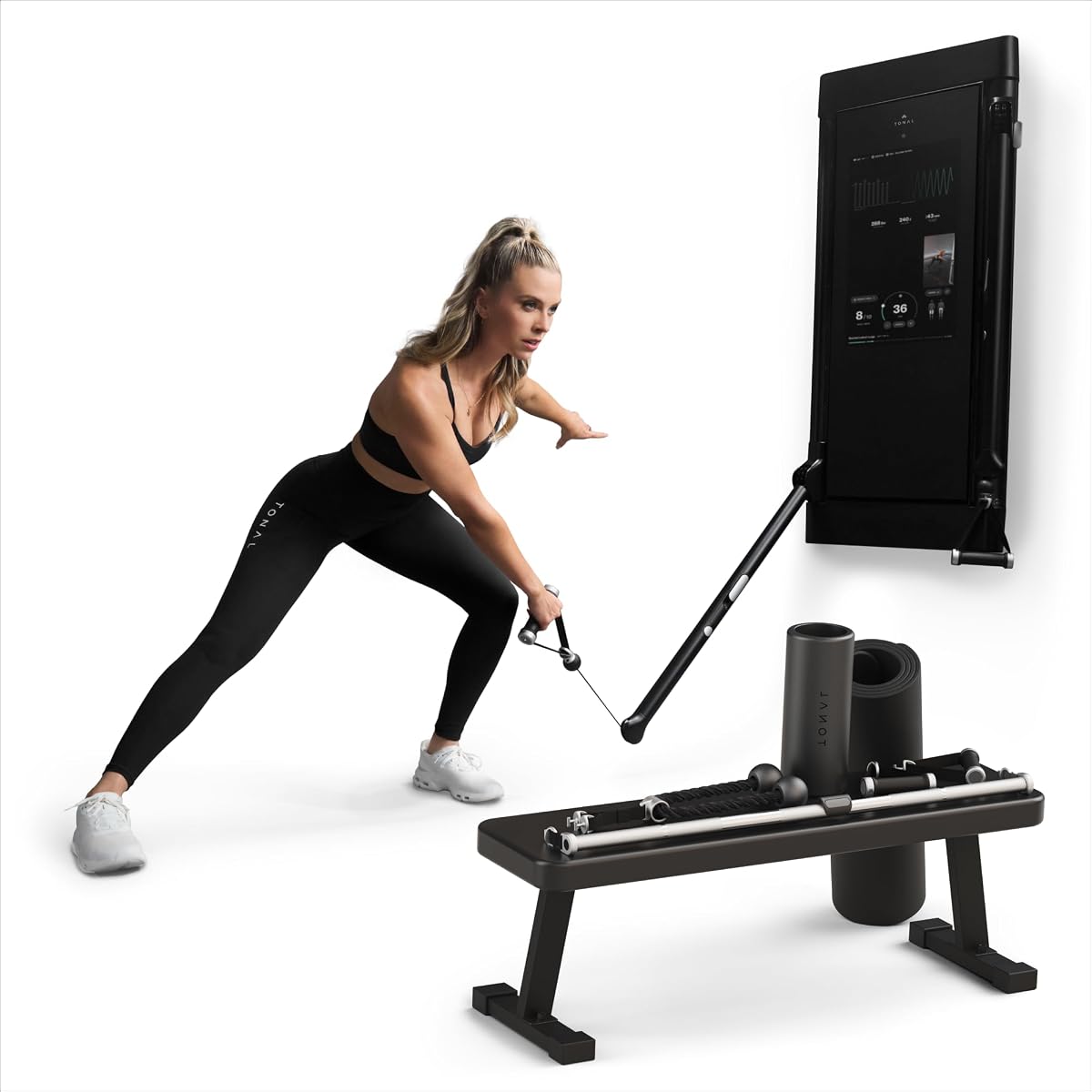
Tonal 2 is a wall-mounted smart cable machine that emphasizes adaptive strength training, precise progression, and a library that extends far beyond conventional resistance exercises. It carries a 4.1 rating and is designed for people who want the adaptability of digital resistance without giving up the familiar movement patterns of cable training.
We may earn a commission when you buy through this link, at no additional cost to you.
Its AI system adjusts resistance in real time according to performance. Instead of manually changing the load before every set, the user can work against a system that sets an appropriate starting weight and increases it in controlled increments as strength develops. Tonal also tracks repetitions, sets, milestones, strength, power, and total volume lifted, then turns those measurements into personalized weekly targets and insights.
The training library includes thousands of expert-designed workouts across 15 modalities, including strength, cardio, yoga, mobility, and Aero HIIT. That variety makes Tonal useful for household training, periodized goals, and users who alternate between demanding resistance work and lower-impact sessions. The wall-mounted design also addresses a common problem with large home gyms: nearly all of the equipment remains suspended, preserving an open floor area.
The trade-off is installation. The product requires a compatible wall and a space survey followed by professional delivery and installation, which adds steps that a freestanding system does not require. It is also primarily a cable-based station rather than a rack built around barbells and plates. Tonal 2 is best for homeowners with suitable mounting space who prioritize adaptive resistance, professionally guided programs, and detailed performance data in a compact footprint.
The ability to adjust resistance during a set can make progressive overload more approachable, especially for users who are uncertain about how quickly to increase load. The system handles weight changes while preserving a cable-machine training experience.
Fifteen modalities make it possible to alternate strength, cardio, yoga, mobility, and high-intensity interval work. A varied library can help reduce boredom and support a more sustainable weekly routine.
We may earn a commission when you buy through this link, at no additional cost to you.
The AEKE S1 Pro is a 220-pound digital-resistance cable system built around AI coaching, real-time motion tracking, and individualized training programs. With a 4.1 rating, it presents a strong technical proposition for users who want their home equipment to respond to performance rather than function only as an adjustable weight source.
We may earn a commission when you buy through this link, at no additional cost to you.
Advanced sensors track body mechanics and provide feedback intended to improve form and help optimize movement. The supplied description says the platform learns from performance and evolves as the user's fitness changes, which is the core promise of an AI-driven fitness system. The motorized resistance engine also supports different training demands, from controlled muscle building to more explosive power work, while allowing resistance to change quickly and accurately.
Beyond resistance, the S1 Pro is positioned as a complete training platform with hundreds of exercises, professional-grade modes, and a space-conscious design. The absence of recurring membership fees is another meaningful advantage for people who want ongoing access to coaching without a separate subscription. Its minimalist appearance and integrated technology may also appeal to buyers who want a smart home fitness device that feels more like modern furniture than a conventional weight rack.
Its compromises are less about core functionality and more about expectations. A digital cable machine does not reproduce every barbell movement, plate-loading exercise, or specialized machine found in a commercial gym. Detailed information about display size, included attachments, exact exercise count, and the current breadth of AI features should be confirmed before purchase. The S1 Pro is best for a buyer focused on adaptive coaching, motion intelligence, and a broad collection of digitally resisted full-body workouts.
Rather than treating AI as a simple workout selector, the S1 Pro uses performance and movement data to shape recommendations. This approach is most useful for users who value ongoing adjustment and clear coaching prompts.
A motor-driven system provides accurate, immediate load changes across a broad cable workout format. It supports users who want to train different muscle groups and goals without managing a rack of individual plates.
We may earn a commission when you buy through this link, at no additional cost to you.
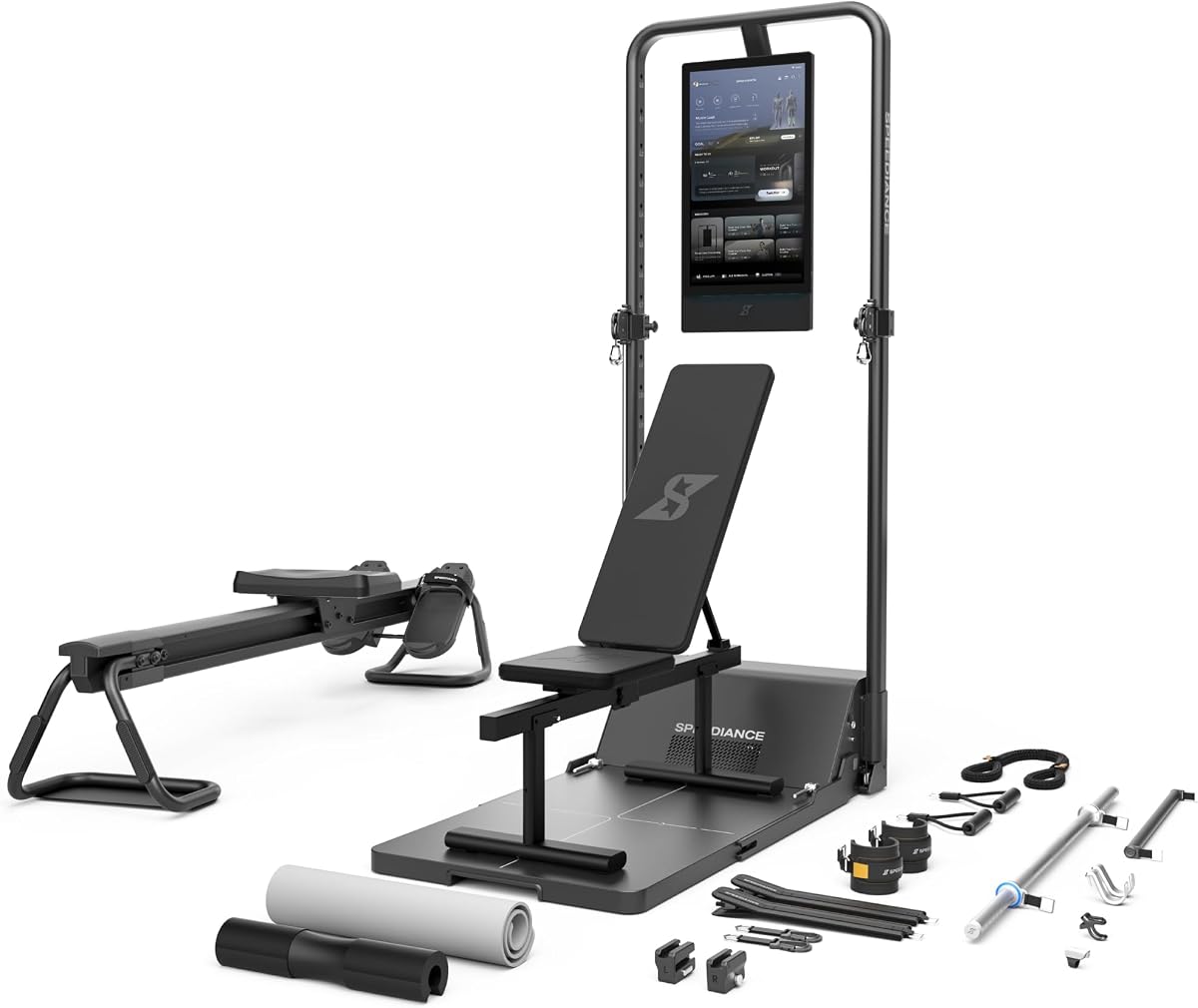
Speediance Gym Monster 3 is an all-in-one digital gym that combines strength, cardio, Pilates, mobility, and functional training. Its 5.0 rating is the highest among the featured products, and the system is especially appealing to buyers who want precise load control and versatile cable positions without manually adding or removing plates.
We may earn a commission when you buy through this link, at no additional cost to you.
The machine delivers up to 220 pounds of digitally controlled resistance with one-pound adjustments. That granularity can be useful for progressive training, isolating small differences between exercises, and accommodating multiple family members with different strength levels. Four resistance modes offer different ways to challenge the user, while 19 cable positions make it possible to perform squats, presses, rows, pulls, and other functional patterns from different angles.
Its AI-powered coaching is intended to support the journey from assessment through planning, workout guidance, and progress tracking. Hands-free voice control allows settings to be changed without interrupting a set. The supplied information notes that selected AI features may arrive through future over-the-air updates, so buyers should understand that the full feature set can evolve. A 23.8-inch HD display, 20-watt 2.1-channel stereo system, and ambient lighting add entertainment and visibility.
The main compromise is space. Although it avoids drilling and wall mounting, the system occupies less than 10.8 square feet, which is still meaningful in a smaller room. It also remains a cable-centered strength platform, and users seeking traditional barbell movements may need separate equipment. Gym Monster 3 is best for people who prioritize fine resistance control, flexible cable geometry, modern presentation, and a freestanding all-in-one format.
Precise digital changes make it easier to progress gradually, share a machine among users, and respond to different exercise demands. The result is more flexible programming than many resistance systems with coarse manual increments.
Nineteen cable positions allow users to alter pulling and pushing angles. That versatility supports functional training and can make a single machine feel more varied across a weekly program.
We may earn a commission when you buy through this link, at no additional cost to you.
Speediance Gym Monster 2 combines a power cage, Smith machine, squat rack, bench rack, cable machine, and pulley system in one foldable home gym. Its 4.2 rating makes it one of the stronger-rated systems in the guide, and it is the best fit among these products for buyers who want a broad collection of strength-machine functions rather than a purely cable-based station.
We may earn a commission when you buy through this link, at no additional cost to you.
Dual 800W permanent magnet synchronous motors produce up to 220 pounds of smooth digital resistance. The AI coaching system tracks performance in real time and recommends weight adjustments after each set, giving the automation a direct role in progressive overload. Its multifunctional bench and pulley arrangement supports exercises for the chest, back, legs, and core, while the rack components expand the range of familiar barbell-supported movements.
The defining advantage is space efficiency. The supplied specifications state that the unit folds to 0.25 square meters, or approximately 2.69 square feet, making it unusually compact for a system that includes a cage, squat rack, and bench rack. Its long-term support package includes two years of protection for the main unit, one year of accessory replacement coverage, continuous software updates, and an expanding workout library.
That versatility introduces practical trade-offs. A machine that performs more jobs may have a more involved setup and may require more care to use safely than a simple wall-mounted cable system. Buyers should verify the folded dimensions, operating clearance, attachment storage, and room required for safe use. Gym Monster 2 is best for a buyer who values traditional strength-training landmarks, fast digital adjustments, and an exceptionally small stored footprint.
The integrated cage, Smith configuration, squat support, bench, and pulleys cover more training patterns than a single cable tower. It is a practical choice for users transitioning from a commercial gym or seeking a broad strength setup at home.
Real-time performance tracking informs post-set weight recommendations. The feature reduces repetitive manual adjustments and helps users follow a more consistent progression.
We may earn a commission when you buy through this link, at no additional cost to you.
OxeFit XS1 Peak is the most unconventional system in this guide because it combines resistance training with rowing, canoe, kayak, paddleboard, surf swim, ski cross, and digitally controlled Pilates. Its 2.9 rating is the lowest listed here, but the product's breadth of training modes may still make it a compelling option for buyers who want much more than a conventional cable workout.
We may earn a commission when you buy through this link, at no additional cost to you.
Its OxeAI system uses precision analytics to adapt workout protocols to the user's progress. Performance feedback includes power, velocity, load, and balance, allowing users to examine both the quantity and quality of each movement. The trainer-led classes and guided programs add another layer beyond the machine's physical exercise modes, while the durable, sleek design is intended to function as a central home fitness station.
The major consideration is the membership model. The supplied information says OxeFit membership begins after account setup, generally before installation, with a 12-month initial commitment and separate monthly or yearly billing. That differs materially from systems advertising lifetime access or no recurring membership. Buyers should review the activation process, required commitment, current benefits, and cancellation terms carefully rather than assuming that every AI feature is included permanently with the hardware.
The XS1 Peak is best for a motivated buyer who values variety, detailed biomechanical metrics, and an ambitious all-in-one training experience. Its drawbacks are the lowest listed rating, the ongoing membership requirement, and the likely need to plan around installation and floor space. The broad feature set is impressive, but the commercial arrangement should be weighed alongside it.
The range of simulated sports gives the XS1 Peak a different purpose from standard resistance stations. Users can vary sessions by activity type rather than relying only on different attachments and loading patterns.
Tracking power, velocity, load, and balance can reveal more than whether a set was completed. These measures can help users understand movement output and identify areas that need attention.
We may earn a commission when you buy through this link, at no additional cost to you.
The original Speediance Gym Monster is a multifunctional strength system with a 4.2 rating and a notably large content library. It offers up to 220 pounds of adjustable resistance, more than 700 supported movements, and over 300 classes, making it particularly compelling for users who want variety from a single home machine.
We may earn a commission when you buy through this link, at no additional cost to you.
Dual direct-drive engines allow precise weight changes, while the built-in touch screen combines the digital weight system with visual training programs. Free Lifting and partner modes expand the ways the machine can be used, and the dynamic resistance modes offer different sensations and training patterns. The system is designed to support cardio and strength work together, which is useful for users who want a complete session without switching between unrelated products.
Its Ski Mode is a distinctive addition, using two ski handles and ten height settings to create a dynamic cardio experience. This adds a movement style that fixed-cable equipment cannot easily duplicate and can make strength sessions more varied. The touchscreen also gives users a central place for guided programming and direct resistance control.
The primary drawback is that the supplied information provides less detail about the sophistication of its AI coaching and motion tracking than competing products. Buyers should ask what data the system records, how it uses that data, and what features are available immediately versus through future updates. It is also a freestanding machine and therefore demands more floor area than a wall-mounted trainer. The original Gym Monster is best for users who prioritize content volume, precise digital weights, and engaging cardio variety.
More than 700 movements and 300 classes can make it easier to maintain novelty. The broad selection supports different muscle groups, training styles, and household preferences within one platform.
Two handles and ten height settings create a dedicated ski-style movement option. It provides a fast way to add cardiovascular intensity without leaving the system or repeating a conventional strength exercise.
We may earn a commission when you buy through this link, at no additional cost to you.
Echelon Strength Pro is a wall-mounted cable trainer built with commercial-grade positioning, independent resistance up to 132 pounds per arm, and a 24-inch HD touch screen. It is a strong option for buyers who want a durable, connected strength station without dedicating floor space to a large freestanding gym.
We may earn a commission when you buy through this link, at no additional cost to you.
Digital resistance can be adjusted quickly using built-in bar and grip controls. Five modes—Normal, Concentric, Eccentric, Progressive, and Isokinetic—allow the feel and progression of a set to change according to the training objective. This variety is one of the system's most compelling technical features, especially for users interested in controlled eccentrics, progressive loading, and specialized movement patterns rather than basic cable exercises alone.
The display supports instructor-led strength, HIIT, yoga, mobility, and recovery workouts. Wi-Fi connectivity provides access to guided programs, movement libraries, and real-time workout tracking. Four interchangeable attachments broaden the exercise range and support traditional lifts, rotational work, and floor-based movements. The system also includes four heavy-duty concrete anchors intended to provide stable wall installation.
The installation requirement is decisive. A properly anchored system must be positioned on a suitable wall, with enough clearance for movement and cable travel, so buyers should confirm structural conditions and installation requirements before ordering. The supplied information also provides no numerical customer rating for this product, making direct rating comparisons less informative. Echelon Strength Pro is best for a technically minded buyer with suitable mounting space who values multiple resistance modes and independent arm strength.
Up to 132 pounds for each arm provides substantial loading for unilateral and bilateral training. It is a meaningful advantage over compact portable cable systems with much lower maximum resistance.
Concentric, eccentric, progressive, and isokinetic options let users vary the resistance curve. This adds programming depth for people who want more than linear increases in load.
We may earn a commission when you buy through this link, at no additional cost to you.
MAXPRO is a portable smart cable gym for travelers, apartment dwellers, and anyone who wants resistance training without a permanent machine. It has a 3.7 rating and offers a different proposition from the large digital gyms in this guide: lightweight construction, broad adjustable resistance, app-connected sensors, and the ability to train almost anywhere with suitable anchoring.
We may earn a commission when you buy through this link, at no additional cost to you.
The MAXPRO Sport Orange SmartConnect uses Bluetooth and onboard sensors with the MAXPRO app to track workouts, monitor progress, and provide coaching data. Users can join coach-led strength, HIIT, suspension, and general strength sessions or build their own routines. The system supports strength, cardio, suspension, plyometric, and functional training, which gives a small amount of equipment a broad range of uses.
Resistance markings are clear and adjustable from 5 to 300 pounds with a simple dial. The included package contains a three-piece quick-connect long bar, two workout handles, ankle and wrist straps, door-mount brackets, and a USB charger. At less than nine pounds, the system folds into a compact package that can be carried between locations, making it especially useful for travel, temporary hotel rooms, or shared homes.
The compromises are important. MAXPRO is not a rack, bench, or full exercise station, and cable exercises require safe attachment to a suitable anchor. The door brackets may not be appropriate for every door or frame, so installation conditions should be checked. Its 3.7 rating also trails the leading systems in this list, although the rating should be considered alongside its exceptional portability. MAXPRO is best for people who value flexibility of location more than a comprehensive, stationary gym.
The five-to-300-pound resistance range is unusually capable for a portable cable system. Users can perform demanding strength work while still packing the equipment into a small carryable bundle.
Bluetooth sensors work with the app to record workouts, monitor progress, and surface coaching information. This preserves useful digital feedback even when the hardware itself is moved frequently.
We may earn a commission when you buy through this link, at no additional cost to you.
Fitkol AI is an AI-adaptive treadmill built for runners who want the machine to manage pace and incline automatically. It carries a 4.7 rating, making it one of the highest-rated selections here, and its defining feature is the SportMind AI system, which monitors heart rate and modifies the workout without requiring repeated manual adjustments.
We may earn a commission when you buy through this link, at no additional cost to you.
Speeds range from 0.6 to 9.6 miles per hour, while incline adjusts from zero to 10 percent. The system uses heart-rate data to keep the user in a targeted training zone, making micro-adjustments when the user can handle more intensity and easing back when recovery is appropriate. That creates a guided running session centered on biometric feedback rather than a fixed program that follows the same settings from start to finish.
Its brushless motor is rated at up to five horsepower, the stated user capacity is 440 pounds, and the running deck measures 20 by 54 inches. Shock absorption is intended to reduce impact on joints, while compatibility with an Apple Watch or Fitkol wristband supports accurate heart-rate input. The product also states that its AI membership is included for life without monthly fees, an important distinction among connected fitness equipment.
The obvious limitation is category scope. Unlike the cable and strength systems in this guide, the Fitkol does not provide resistance training, and its value depends on having enough floor space for the deck and safe running clearance. The brand and service explanation notes that the treadmill is listed under Azomabox, while FITKOL handles product development, manufacturing, quality control, warranty, and after-sales support under the same trademark owner. It is best for cardio-focused households that want an AI running coach rather than an all-in-one weight machine.
Real-time heart-rate monitoring allows the AI to change speed and incline during a session. This is particularly useful for interval training, recovery runs, and cardiovascular work where the right intensity changes over time.
The stated absence of a recurring AI membership makes the system's software features more straightforward to evaluate. Buyers should still verify the current terms directly before ordering.
We may earn a commission when you buy through this link, at no additional cost to you.
The right AI Powered Smart Home Gym System depends on how you train, how much room you have, and how much automation you actually want. Resistance, tracking accuracy, content quality, ownership terms, and installation are more meaningful differentiators than the word AI alone.
Start by identifying the movements you want to perform. Cable machines are versatile for rows, presses, pulls, squats, and functional work; multifunction strength stations add racks, benches, and squat supports; portable systems prioritize location flexibility; and treadmills focus on cardio. A broad marketing description does not guarantee that every station in the library matches a specific training program, so review the available modes, attachments, and exercise types before buying.
Choose a format aligned with your routine rather than the one with the longest feature list. Strength-focused users should prioritize loading range and exercise geometry, while runners should prioritize belt area, speed range, incline control, and motor performance.
Digital resistance is most useful when it is smooth, repeatable, and easy to change. Maximum load matters for advanced strength work, but increments, starting resistance, and control placement are equally important for beginners and shared households. Systems offering one-pound adjustments or clearly marked resistance can make progression and switching between family members easier. Confirm whether resistance is expressed as total system capacity or capacity per arm or cable.
Prioritize the lowest increment you can comfortably use and the range that supports your current and future goals. A system that becomes difficult to adjust or cannot provide enough load may be frustrating despite its smart features.
AI can range from simple workout recommendation to motion analysis, automatic load changes, and biometric control. Determine whether the system tracks repetitions, form, power, velocity, heart rate, or other metrics, and whether those insights genuinely change the next workout. Data collection is only valuable when it leads to useful guidance.
Do not assume every product uses AI in the same way. Some systems automate resistance, some analyze movement, and others adapt treadmill speed and incline. Choose the type of automation that directly supports your training goal.
A large movement count can sound impressive, but the quality and variety of the programs matter more. Look for strength, cardio, mobility, yoga, recovery, and interval formats appropriate to your experience level. Trainer-led classes may be more engaging than demonstrations, while motion-sensing games can help with consistency or family use. Confirm whether new content arrives through updates and whether the listed library is available immediately.
Choose enough variety to prevent boredom without paying for content you will never use. A focused library with clear plans may serve a specific goal better than a huge collection organized around unrelated activities.
Smart gyms range from portable bundles that fit in a closet to wall-mounted systems and large freestanding stations. Check both operating and stored dimensions, required ceiling clearance, cable travel, safe exercise zones, and whether drilling is permitted. A compact folded footprint does not eliminate the space needed while the machine is being used.
Wall-mounted systems can preserve floor space but require a compatible structure and careful placement. Freestanding models are easier to relocate but may dominate a room. Measure the intended training area before deciding, and read all installation requirements.
Ownership costs can extend well beyond the hardware. Some systems advertise lifetime access, others provide core functionality without a subscription, and others require a committed membership for coaching or adaptive features. Check activation timing, billing frequency, initial commitment, included content, and what happens if you stop paying. Future software features should not be treated as guaranteed if their availability depends on later updates.
Compare the complete ownership package rather than focusing only on the purchase. A system with lifetime access may offer better long-term predictability, while a membership model may be worthwhile if its ongoing coaching and content are substantial.
The display should be readable from your normal exercise position, responsive when adjusting settings, and large enough for the routines you intend to follow. Tracking quality matters just as much: useful systems count repetitions, identify sets, monitor performance, and present understandable summaries. Heart-rate support, wearable compatibility, and offline behavior can influence whether the equipment remains useful during different training situations.
Prioritize clear data over a crowded dashboard. Metrics should help you make decisions about load, pace, form, or recovery rather than merely displaying more numbers. Check whether tracking works automatically or depends on a particular device.
For high-frequency use, stability, motor quality, anchor strength, warranty coverage, and accessible support are important. Digital motors should run smoothly, moving parts should be protected, and attachments should feel secure. Look for clear assembly instructions, maintenance guidance, replacement-part availability, and a warranty that covers the main unit and important components. Reviews can also reveal recurring support or firmware concerns.
Treat safety as part of the purchase decision, not an afterthought. Use the equipment as instructed, inspect attachments regularly, maintain adequate clearance, and confirm that a product is appropriate for your experience and physical condition. A strong warranty adds confidence, but safe setup remains the buyer's responsibility.
Begin by reading the setup instructions, confirming the required floor or wall clearance, and completing any manufacturer-recommended calibration or account setup. Create a user profile with accurate training information, connect any heart-rate device, and select a conservative starting program. The first few sessions should focus on learning the controls, cable paths, attachments, and correct movement range before trying maximum resistance or advanced AI programs.
Allow the system to adapt gradually. Resistance recommendations and automatic treadmill changes are most useful when the initial profile and sensor data are accurate. Wear comfortable clothing, keep the space around the equipment clear, inspect moving parts and attachments before each workout, and stop if a movement causes pain or loss of control. For strength systems, begin with an appropriate load and use the prescribed handles, bars, straps, or anchors exactly as directed.
For ongoing care, clean the screen, grips, seat, running belt, and other high-contact surfaces according to the manufacturer's instructions. Keep ventilation paths open, inspect cables and anchors, and follow the prescribed lubrication or maintenance schedule for treadmills. Save workout summaries, update the system when prompted, and contact support if performance data, motor behavior, or resistance changes unexpectedly. Long-term care depends on using approved accessories and avoiding unauthorized modifications.
A genuinely AI-powered system should use data to adjust or personalize training rather than merely display a workout list. Examples include automatically changing resistance based on performance, analyzing motion, recommending load adjustments, or modifying treadmill speed and incline according to heart rate. The usefulness of the AI depends on sensor quality, the recommendations it produces, and whether those suggestions are easy to understand and follow.
Many are designed to welcome beginners because they can guide exercise selection and manage initial resistance. Features such as real-time feedback, adaptive loading, and beginner-friendly classes can make a structured program easier to follow. A new user should still begin with suitable movements, learn safe form, and avoid setting maximum difficulty or resistance on the first session.
It depends on the product. The AEKE K1 and Fitkol AI treadmill are described as including lifetime access without recurring AI subscription fees, while the OxeFit XS1 Peak requires a separate membership with an initial commitment. Other products may provide core machine functions without a subscription while charging for selected coaching or content, so check the current terms for each system.
A smart system can replace many common machine and cable exercises, but it does not reproduce every barbell, plate-loaded, rack, or specialized cardio option. It is best for people whose routine is built around cable resistance, guided bodyweight work, digital strength training, or running. Buyers who need traditional barbell movements should consider whether a smart system should supplement rather than replace conventional equipment.
The required space depends on the format and includes more than the stored footprint. Wall-mounted trainers preserve floor area but need safe mounting and cable clearance, while freestanding systems need room to exercise around the unit. MAXPRO can travel with the user, whereas the largest strength systems require a permanent workout zone. Measure both operating and storage dimensions before ordering.
Wall-mounted systems must be attached to a suitable structure using the specified anchors and installed according to the manufacturer's instructions. Drywall alone may not provide adequate support, and cable travel must be clear of doors, walls, screens, and other users. Professional installation is advisable when the instructions require it or when the user is unsure about wall suitability.
Accuracy varies with camera placement, lighting, clothing, body size, exercise type, and the sensors used by each platform. Tracking can help with repetition counts, movement completion, and general feedback, but it should not be treated as a medical diagnosis or perfect substitute for a qualified trainer. Users should stop any movement that feels unstable or painful, especially when using automatic resistance or treadmill adjustments.
Confirm maximum resistance, adjustment increments, supported exercises, display size, tracking features, installation requirements, warranty, and subscription terms. Also verify room dimensions and included accessories, since some bundles vary. Current specifications and software availability can change, so the manufacturer's latest listing and support documentation should guide the final decision.
The AEKE K1 is the strongest overall choice for a buyer seeking detailed motion analysis, a large entertainment display, extensive training content, and lifetime AI access. The Speediance Gym Monster 3 stands out for precise one-pound resistance changes, flexible cable positioning, and freestanding convenience, while MAXPRO is the practical portable option for strength and suspension training away from a permanent home gym.
Your priorities should determine the remainder of the list. Tonal 2 suits adaptive cable training and a wall-mounted approach; the AEKE S1 Pro emphasizes personalized AI coaching; Gym Monster 2 combines multiple rack functions with compact storage; OxeFit XS1 Peak prioritizes multi-sport variety; the original Speediance offers extensive content; Echelon Strength Pro provides multiple resistance modes; and Fitkol focuses on AI-driven running. Consider space, movement preferences, resistance, content, and commercial terms before choosing.
Features, software, bundles, and commercial conditions can change, so check the current product listing before buying. Review included accessories, installation requirements, warranty coverage, and membership details at the time of purchase, and compare the system with your actual workout schedule rather than the total number of advertised features.