
HiLetgo ESP8266 ESP-01 3-Pack
4.2Editor score
Compact ESP8266 WiFi modules
Three-pack for project flexibility
Access point and station modes
Compatible with Arduino
Explore Arduino WiFi Module options for IoT, automation, sensors, and connected projects, comparing compatibility, wireless features, and ease of use.
An Arduino WiFi Module can transform a basic microcontroller project into a connected device capable of exchanging data, joining a local network, or accepting wireless commands. The right module depends on your experience, available GPIO pins, voltage tolerance, radio protocol, programming workflow, and the complexity of the project you intend to build.
This guide compares ten Arduino-compatible WiFi modules and development boards, including the Arduino UNO R4 WiFi, Nano ESP32, ESP32 boards, ESP8266 modules, and NodeMCU-style platforms. We examined the stated processor capabilities, wireless support, flash memory, programming connections, operating modes, expandability, and practical differences between bare modules and complete boards.
Each review explains what makes the product distinctive, where it fits best, and which trade-offs buyers should consider. The list includes options for beginners, compact electronics, sensor networks, home automation, and more demanding connected projects. Product availability and pricing can change, so confirm the current listing and technical details before purchasing.
4.2Editor score

4.7Editor score

4.7Editor score
The table below compares all ten selections by wireless capability, processor class, memory or connectivity details, programming method, and Arduino compatibility, helping distinguish integrated boards from standalone radio modules.



The Arduino UNO R4 WiFi is a complete development platform rather than a bare radio accessory, and its 4.7 rating reflects a strong combination of processing power, connectivity, and convenience. It combines a Renesas RA4M1 ARM Cortex-M4 microcontroller with an ESP32-S3 wireless chip, giving builders dedicated resources for embedded control and wireless communication within one board.
We may earn a commission when you buy through this link, at no additional cost to you.
Its feature set extends well beyond ordinary Wi-Fi. Bluetooth 5.0 supports connected peripherals, while USB-C simplifies programming and power. CAN support suits industrial, automotive, or robotic communication requirements, and the Qwiic connector makes it easier to attach I2C sensors. A 12-bit DAC and integrated operational amplifier improve analog output and signal-processing options, while the 12-by-8 LED matrix provides immediate visual feedback without another display.
The main trade-off is complexity. A bare ESP8266 can be easier to integrate into a very small circuit, while the UNO R4 WiFi includes more hardware and occupies more space. The dual-processor design also introduces more capabilities than a new maker may initially need. Even so, these features create a flexible platform that can grow from a simple status display into a sophisticated connected instrument.
This is our Editor's Choice for readers who want a capable Arduino-compatible board without assembling a separate Wi-Fi module. It suits people building remote sensors, smart controls, cloud-connected prototypes, CAN-enabled robotic systems, and projects that benefit from visible status feedback. For the broadest built-in feature set, it is a particularly persuasive choice.
Pairing the RA4M1 with the ESP32-S3 separates general embedded processing from wireless tasks. That architecture can be valuable in projects that need reliable peripherals alongside connected control, and it makes the board more versatile than a single-chip radio module.
The Qwiic connector provides a straightforward route to compatible I2C sensors and peripherals. This is especially useful for prototypes because it reduces the number of individual connections required when adding display, sensing, or expansion hardware.
We may earn a commission when you buy through this link, at no additional cost to you.
The HiLetgo three-pack of ESP8266 ESP-01 modules offers one of the most approachable ways to add Wi-Fi to an embedded project. Its 4.2 rating places it below several more highly rated products, but the rating should be considered alongside the unusual value of receiving three compact wireless modules rather than a single board.
We may earn a commission when you buy through this link, at no additional cost to you.
Each ESP8266 provides on-board processing and storage, reducing the need for a separate microcontroller when the project is dedicated to a connected device. Support for access point mode, station mode, and a combined AP-plus-STA configuration gives builders several ways to organize communication. The modules can act as network members, create a local wireless environment, or perform both functions at once.
The compact format is a major strength, but it also creates the main technical barrier. These are modules rather than self-contained development boards, so programming and connection details must be handled carefully. Their serial interface also operates on a 3.3-volt logic level, meaning they should not be connected directly to a 5-volt signal without appropriate protection. For inexperienced builders, the lack of a convenient onboard USB interface may make the setup less approachable.
The three-pack configuration makes this product a strong choice for makers who need several endpoints, such as distributed sensors, room controls, or multiple prototypes. It also works well for learning and experimenting without limiting every project to one module. Choose it when low cost, compact size, and the flexibility of three units outweigh the convenience of a ready-to-program development board.
Receiving several identical modules makes it easier to build sensor nodes or coordinated control points. Consistent hardware can also simplify the design of enclosures, firmware, and assembly procedures when a project expands beyond a single device.
AP, STA, and AP-plus-STA support covers local access-point tasks, ordinary network participation, and simultaneous roles. That flexibility is useful for projects ranging from direct device setup to communication with an existing local network.
We may earn a commission when you buy through this link, at no additional cost to you.
The ESP8266 ESP-01S with 4MB flash is a straightforward single-module option for adding network connectivity to a compact project. Its 4.4 rating indicates a generally favorable reception, and the most immediately useful detail is its 4MB of flash memory, which provides more room for firmware and files than basic 1MB ESP-01 variants.
We may earn a commission when you buy through this link, at no additional cost to you.
The listing identifies this as the latest ESP-01S form and states that it has a stronger signal than earlier versions. That makes it relevant to projects where maintaining a dependable connection matters, such as remote sensor nodes or automation endpoints. Its processor handles the wireless role, allowing a connected product to be designed without putting every function onto a separate Arduino controller.
The product remains a bare module, and that is the main limitation. It does not provide the USB-C programming convenience, voltage regulators, or exposed development conveniences found on complete boards. Users must select the Generic ESP8266 Module option in the Arduino IDE and account for the module's 3.3-volt electrical requirements. For a maker experienced with serial programming, these are manageable steps rather than fundamental obstacles.
This module is a good match for a single embedded node that needs Wi-Fi and a useful amount of flash. It can also serve as a building block in a multi-device system, although the HiLetgo and other multipacks offer more units for that purpose. Choose it when compactness and 4MB storage are priorities and you are comfortable programming a standalone module.
The 4MB flash specification gives this module more storage than common 1MB ESP-01 boards. That additional capacity can be useful when firmware grows or a project needs room for additional code and stored assets.
The stated Arduino IDE workflow uses the Generic ESP8266 Module board selection. Familiarity with that setting makes the ESP-01S approachable for users who already work within the Arduino ecosystem.
We may earn a commission when you buy through this link, at no additional cost to you.
Aitrip's five-pack of ESP8266 ESP-01 modules is aimed at builders who need several identical wireless nodes. The 4.4 rating is solid, and the package quantity makes this list particularly relevant to sensor networks, multi-room automation, and projects that benefit from consistent modules across multiple devices.
We may earn a commission when you buy through this link, at no additional cost to you.
Every module supports access point, station, and combined AP-plus-STA modes. This allows a network to include devices that join an existing infrastructure, create a local access point, or perform both roles. The listed applications include smart grids, intelligent transportation, smart furniture, handheld devices, and industrial control, illustrating how broadly the ESP8266 platform can be applied.
Voltage compatibility is the critical caveat. The modules operate from 3.0 to 3.6 volts and have a stated maximum I/O tolerance of 3.6 volts, so they must not receive five-volt logic. Connecting them directly to a five-volt Arduino output without a suitable interface or level conversion can damage the module. Their 1MB SPI flash also offers less storage than the 4MB alternatives in this guide.
Despite those constraints, the five-module quantity is valuable for distributed builds. It is a good choice when several endpoints must share the same radio design and you already understand how to power and program bare ESP-01 modules. For a single connected device with room for a larger firmware, an ESP-01S or complete development board is generally more flexible.
A set of five modules is practical when one controller must communicate with several remote sensors, relays, or indicators. Using matching modules can also streamline firmware configuration and enclosure design.
Because the listed input tolerance tops out at 3.6 volts, the modules should not be attached directly to five-volt signals. Appropriate level conversion or a compatible interface is necessary for reliable and safe operation.
We may earn a commission when you buy through this link, at no additional cost to you.
The ELEGOO three-pack of ESP-WROOM-32 development boards stands out as the most fully equipped group of conventional ESP32 boards in the list. Its 4.7 rating matches the Arduino UNO R4 WiFi, while the inclusion of three boards, broad I/O support, and a USB-C programming connection makes it highly practical for multiple connected prototypes.
We may earn a commission when you buy through this link, at no additional cost to you.
The dual-core ESP32 platform can run up to 240MHz, providing ample performance for sensor processing, automation logic, wireless communication, and connected-device tasks. It supports 2.4GHz Wi-Fi along with Bluetooth Classic and BLE, making it useful for projects that need more than network connectivity. GPIO, UART, SPI, and I2C interfaces provide direct paths to displays, sensors, motor drivers, and other modules.
Power-saving features are another important strength. Dynamic clock scaling and low-power operating modes can reduce energy use in compatible sensing, monitoring, and connected applications, which is useful for battery-oriented IoT builds. The CP2102 bridge and USB-C interface simplify programming and serial monitoring, although a USB-C cable is not included. Over-the-air update support also allows compatible firmware revisions to be deployed through Wi-Fi without reconnecting the board by USB.
This is our Best Premium pick for makers who want complete boards, generous processing capability, and a three-unit package. It is especially suitable for home automation, remote controls, wireless sensors, and multi-device prototypes. Buyers who need only one board can still benefit from its strong feature set, while those building a distributed system will have enough hardware to develop and deploy several endpoints.
The dual-core processor and broad interface selection give the ESP32 room for sensor processing, automation logic, and wireless tasks. This makes the board suitable for projects that outgrow a basic serial Wi-Fi module.
Compatible over-the-air updates can simplify revisions after a device has been deployed. Developers no longer need to reconnect every unit by USB each time they want to install a compatible firmware change.
We may earn a commission when you buy through this link, at no additional cost to you.
The Arduino Nano ESP32 offers the processing power and wireless flexibility of an ESP32-S3 in a compact development-board format. Its 4.5 rating and official Arduino positioning make it an attractive middle ground between the full-featured UNO R4 WiFi and the smaller bare ESP8266 modules considered elsewhere in this guide.
We may earn a commission when you buy through this link, at no additional cost to you.
Its dual-core Xtensa 32-bit LX7 processor can run at up to 240MHz, supporting wireless applications, smart sensors, real-time data processing, and edge machine-learning tasks. Wi-Fi and Bluetooth 5.0 cover common network and short-range communication needs. The USB-C port supports modern programming and power delivery, improving the setup experience compared with older micro-USB boards.
HID support enables a particularly interesting set of projects. The board can be used to create custom keyboards, mice, and other input peripherals, provided the relevant software and device behavior are implemented correctly. MicroPython compatibility is another advantage for developers who prefer an interactive Python workflow for rapid embedded prototyping and quick iteration.
The board is supplied without headers, which can benefit projects requiring a particularly clean layout or a custom soldering arrangement. It also means the buyer may need to perform additional assembly. The compact size and wireless capabilities make it ideal for smart-home prototypes, connected sensors, custom controls, and wearables, while the Nano footprint suits projects where a full-size board would be cumbersome.
The Nano format reduces the space required for a capable Wi-Fi and Bluetooth platform. That makes it attractive for portable controllers, compact sensor nodes, and custom enclosures where a full development board would be inconvenient.
Compatibility with MicroPython gives Python-focused developers a rapid path to experimentation, while its Arduino identity keeps it accessible within the broader Arduino ecosystem. The choice depends on the workflow and tools best suited to the project.
We may earn a commission when you buy through this link, at no additional cost to you.
This four-pack of ESP8266 ESP-01S modules is geared toward projects that need several compact wireless endpoints. The 4.4 rating supports its place among well-regarded choices, and the four-unit quantity offers enough hardware to experiment with distributed designs without committing to a much larger pack.
We may earn a commission when you buy through this link, at no additional cost to you.
The product data identifies applications including wearable electronics, wireless location-sensing devices, home automation, and sensor networks. Those uses reflect the ESP8266's practical strengths: a small footprint, wireless connectivity, and the ability to serve as a dedicated connected controller when a separate Arduino processor is not required.
A notable feature is the self-calibrated RF assembly, which is intended to support reliable radio performance. The hardware can also be reused across multiple projects, which is useful for experimentation and temporary test fixtures. However, the supplied information is less detailed than for the other ESP8266 options. It does not explicitly identify flash capacity, programming connections, or the maximum logic voltage, so those details should be confirmed before integration.
This four-pack is a sensible choice for a maker building a small home-automation network, a group of wireless sensors, or a wearable prototype. It is less convenient for immediate programming because these are standalone modules rather than ready-to-connect boards. Buyers should compare the missing technical details with the more fully specified ESP-01S alternatives if exact flash or voltage constraints are critical.
Four units are enough to construct a small multi-node system without creating an unnecessarily large inventory. The set can also support parallel experiments, classroom work, or prototypes that will later move into a distributed deployment.
The stated ability to reuse the modules makes them practical for iterative development. A radio that proves effective in one prototype can move into another design instead of remaining dedicated to a single prototype.
We may earn a commission when you buy through this link, at no additional cost to you.
The five-pack of ESP8266 ESP-01S modules combines a useful quantity with clearly stated programming information, making it attractive for coordinated IoT prototypes. Its 4.5 rating is among the stronger results in the guide, and the inclusion of 4MB flash across five matching modules gives builders both flexibility and consistency.
We may earn a commission when you buy through this link, at no additional cost to you.
The listed 115200-baud rate provides a clear reference for serial communication setup. The product data also identifies the ESP-01S as using the DOUT protocol and instructs programmers to select SPI MODE as DOUT when programming it in the Arduino IDE. Such explicit guidance reduces uncertainty compared with listings that offer only a broad compatibility claim.
The electrical limitation is equally important. These modules support 3.3 volts and should not be operated with 5V, so the design must include a suitable power arrangement and level-compatible connections. The bare-module format also means that a USB interface, regulator, and other supporting components may need to be supplied by the maker. These requirements make the product less convenient for an absolute beginner than a complete development board.
The five-module set is a strong fit for distributed sensor networks, IoT concepts, and home-automation endpoints where a compact radio is preferred. It is also useful for building a prototype and several field-test versions with the same configuration. Choose it when a larger deployment, generous per-module storage, and clearly documented programming details matter more than USB convenience.
Each of the five modules includes 4MB of flash, providing substantially more room than 1MB ESP-01 options. Matching specifications also simplify replication across a multi-device deployment.
The specified baud rate, DOUT protocol, and SPI MODE selection give builders concrete configuration points. This clarity is particularly useful when reproducing the same working setup across every module in the pack.
We may earn a commission when you buy through this link, at no additional cost to you.
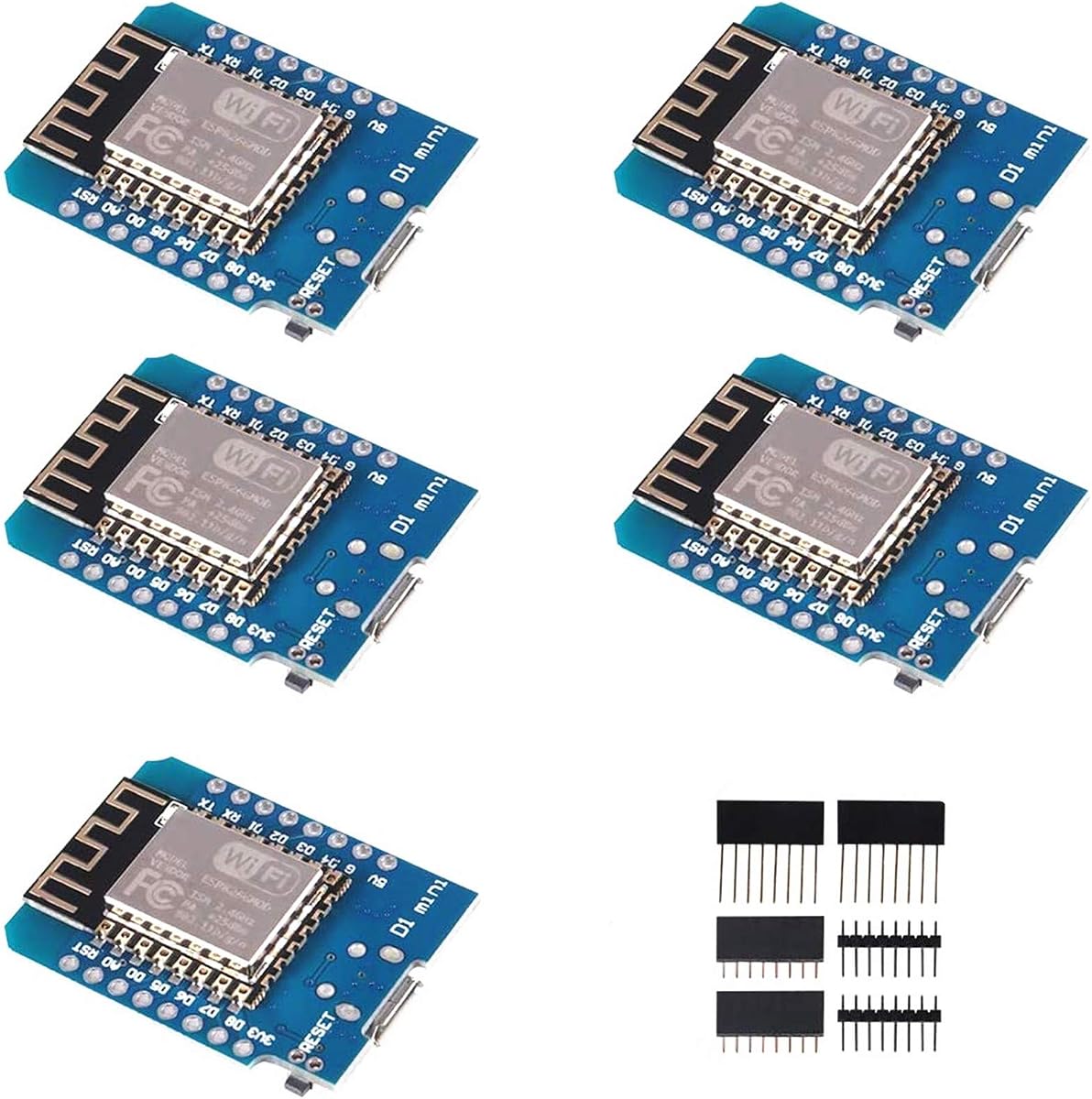
The WeMos D1 Mini five-pack provides a complete development board around the ESP8266EX, eliminating much of the setup required by bare ESP-01 modules. Its 4.5 rating and combination of five boards, familiar Arduino compatibility, and onboard power support make it one of the most approachable multi-board selections in the guide.
We may earn a commission when you buy through this link, at no additional cost to you.
Each D1 mini offers 11 digital input-output pins, with interrupt, PWM, and I2C support on the listed pins except D0. It also provides one analog input with a stated maximum of 3.2 volts. These interfaces are sufficient for LEDs, relays, sensors, displays, and other common peripherals, giving new projects considerably more room than the limited pin access of a tiny radio module.
Programming is handled through the board's micro-USB connection, while the ESP-8266EX platform and 4MB flash provide the core wireless development capabilities. The listing describes compatible operation within the Arduino IDE and references the WeMos and NodeMCU form factor. Onboard power circuitry, a 5V 1A switching supply, and a 500mA resettable fuse further simplify integration compared with an unassembled module.
The principal compromises are familiar but relevant. Micro-USB is less universal and less durable than USB-C, and the 3.2-volt analog-input ceiling needs careful attention when connecting certain sensors. Even so, this pack is ideal for beginners who want to start quickly and for makers who need five ready-to-use WiFi development boards for automation, controls, or connected sensor projects.
The D1 mini combines the ESP8266EX, flash storage, USB programming, and onboard power support on a usable board. This integration means a maker can spend less time assembling basic support hardware and more time developing the application.
Eleven digital pins with interrupt, PWM, and I2C capabilities provide a useful expansion surface for relays, sensors, indicators, and displays. The single analog input remains useful, but its stated 3.2-volt maximum should guide sensor selection.
We may earn a commission when you buy through this link, at no additional cost to you.
The ten-pack of ESP8266 ESP-01 modules is the largest collection in the guide and carries a 5.0 rating. It is a practical option for makers who need many small wireless endpoints, whether for sensor networks, classroom exercises, automation trials, or several parallel prototypes.
We may earn a commission when you buy through this link, at no additional cost to you.
The ESP8266 provides on-board processing and storage, allowing it to act as the controller for a dedicated connected product rather than merely serving as a radio accessory. AP, STA, and combined AP-plus-STA modes provide flexibility in how the modules join networks, create local access points, or handle both roles. Compatibility with Arduino platforms and LWIP in AP-plus-STA mode supports established development practices.
Its greatest advantage is quantity, but that does not change the fundamental nature of an ESP-01 module. These are bare components, not complete development boards, and the product data does not specify a USB programming connection, flash size, or detailed pin arrangement. A builder therefore needs to provide the appropriate programmer, power source, and supporting interface. That makes the ten-pack best suited to makers who already understand this module family.
The set is a strong choice for distributed installations where many consistent endpoints are required. It can also provide spare parts for iterative projects or a pool of modules for education and experimentation. For a single simple connected project, one of the development boards would be more convenient, but this pack offers maximum flexibility when the objective is to deploy numerous compact nodes.
A ten-unit package is suited to projects that need more endpoints than a smaller multipack can supply. It can support a larger sensor installation, classroom activity, or a sequence of prototypes using identical radio hardware.
Support for AP, STA, and AP-plus-STA modes gives the collection broad deployment flexibility. The modules can participate in a local network, create a local access point, or combine both functions according to the project's communication model.
We may earn a commission when you buy through this link, at no additional cost to you.
The most useful Arduino WiFi Module is the one that matches your project size, programming experience, wireless requirements, and electrical constraints. Review these factors before comparing boards, multipacks, and bare modules.
A complete development board integrates a processor, radio, programming connector, voltage regulation, and exposed pins. This makes it easier for beginners and faster for prototypes. A bare ESP8266 module is smaller and more flexible for embedded builds, but it requires careful programming, power, and signal connections. Arduino UNO R4 WiFi, Arduino Nano ESP32, ELEGOO ESP-32, and WeMos D1 Mini options are boards, while the other ESP8266 entries are modules.
All ten products support Wi-Fi, but their secondary wireless capabilities differ. The Arduino UNO R4 WiFi and Nano ESP32 include Bluetooth 5.0, while the ELEGOO ESP-32 boards include Bluetooth 4.2 with Bluetooth Classic and BLE. The ESP8266 selections focus on Wi-Fi and offer AP, STA, or combined operating modes. Choose according to whether the project requires local network access, short-range peripheral communication, or both.
Voltage compatibility is one of the most important considerations for ESP8266 modules. The Aitrip listing explicitly supports 3.0 to 3.6 volts and has a 3.6-volt maximum I/O tolerance, while the five-pack ESP-01S warns against 5V use. A five-volt output can damage a module that expects 3.3-volt logic. Check the power input, logic levels, and regulator arrangement before connecting any bare module to an Arduino or sensor.
The ESP8266 family is well suited to straightforward connected tasks, while the dual-core ESP32 and ESP32-S3 platforms provide more performance for sensor processing, automation logic, real-time data, and edge machine-learning work. The Arduino UNO R4 WiFi combines RA4M1 and ESP32-S3 processors, offering two distinct computing resources. Choose processing power based on the code, number of peripherals, response requirements, and future expansion of the project.
Flash capacity affects how much firmware and data a module can hold. Several products provide 4MB, while the Aitrip five-pack has 1MB per module. The D1 mini listing also references 4MB, although one description line mentions 1MB, so buyers should verify the final package details. More flash can be valuable for larger sketches, web assets, or more advanced projects, but it is not the only factor affecting usable space.
Multipacks can save effort when a project includes several endpoints. The guide covers three-unit, four-unit, five-unit, and ten-unit collections. This is particularly useful for sensor networks, distributed home automation, and classroom work. For a single prototype, a development board may offer more convenience than a collection of bare modules. For a planned deployment, matching hardware across several nodes can simplify firmware, enclosure, and assembly work.
USB-C boards offer a modern programming connection, while the WeMos D1 Mini uses micro-USB and bare ESP8266 modules require an external interface. The ELEGOO ESP-32 boards also support compatible over-the-air updates, allowing deployed firmware revisions without a USB reconnection. MicroPython compatibility on the Nano ESP32 provides an alternative rapid-prototyping workflow. Select the programming method that matches the tools and experience already available to you.
GPIO availability matters when connecting relays, displays, sensors, motor drivers, and other accessories. The D1 mini provides 11 digital input-output pins, while complete ESP32 boards expose GPIO, UART, SPI, and I2C. The UNO R4 WiFi adds a Qwiic connector for compatible I2C peripherals. Bare modules require more careful pin planning because their small size and limited exposed interface are central design constraints.
Begin by confirming the board or module identity, supported Arduino environment, required board selection, and electrical limits. For bare ESP8266 modules, install the appropriate ESP8266 support, select the Generic ESP8266 Module or the exact configuration stated in the product instructions, and use a level-compatible connection. Development boards such as the UNO R4 WiFi, Nano ESP32, ELEGOO ESP-32, and D1 mini provide a more direct programming path through their USB connections.
Power the hardware correctly and verify the basic sketch before adding network complexity. Confirm serial communication, pin assignments, sensor readings, and output behavior first. Then configure Wi-Fi credentials and test the intended connection mode. ESP8266 products can use AP, STA, or AP-plus-STA modes, while the ESP32-based boards provide Wi-Fi and Bluetooth capabilities. Keep credentials and network details out of shared source files when working on a project that may be published.
For deployed devices, plan for power stability, enclosure ventilation, antenna clearance, and the heat generated by continuous wireless use. Do not exceed the stated voltage or I/O limits, and avoid connecting five-volt logic directly to modules designed for 3.3 volts. Update firmware through the intended method, and use over-the-air updates only with a compatible software framework. When handling bare modules, avoid excessive force on the antenna, prevent accidental shorts between the small pads, and store unused modules in an ESD-conscious environment.
A development board combines a wireless chip with programming connectors, power support, regulators, and accessible pins. A bare ESP8266 module provides the processor and radio but requires separate programming and careful power connections. Boards are easier for beginners, while modules can be smaller and more adaptable for custom embedded designs.
They can communicate through serial signals, but voltage compatibility must be checked first. Many ESP8266 modules expect 3.3-volt logic and must not receive five-volt inputs directly. A suitable level shifter, voltage divider, or interface board may be needed, and a stable 3.3-volt power arrangement is also important.
A complete board is generally the easiest starting point because it exposes the required pins and includes a programming connection. The ELEGOO ESP-32 boards and WeMos D1 Mini are particularly approachable, while the Arduino Nano ESP32 adds modern USB-C and MicroPython support. The Arduino UNO R4 WiFi is more feature-rich but may offer more than a simple first project requires.
No. The Arduino UNO R4 WiFi and Arduino Nano ESP32 support Bluetooth 5.0, and the ELEGOO ESP-32 boards support Bluetooth 4.2 with Bluetooth Classic and BLE. The ESP8266 products in this guide focus on Wi-Fi, so they are better suited to projects that do not require Bluetooth.
AP mode makes the module act as a wireless access point, while STA mode connects it to an existing wireless network. AP-plus-STA allows both roles at the same time. These modes appear in the listed ESP8266 options and can be useful for direct device setup, ordinary network access, or projects that need local and infrastructure communication.
Choose 4MB when you expect larger firmware, more stored data, or room for future expansion. A 1MB module can still handle many focused Wi-Fi projects, but it offers less storage. If a listing contains inconsistent flash information, as with some D1 mini descriptions, confirm the package and module markings before ordering.
Compatible ESP32 projects can use over-the-air updates through a supported software framework. The ELEGOO boards in this guide explicitly list OTA functionality, allowing deployed firmware revisions through Wi-Fi. The feature still requires careful configuration and a recovery plan, so USB access should remain available during development.
The number depends on the architecture, but each physical sensor node normally needs its own connected module unless the design uses a centralized controller. Multipacks are useful for prototypes, testing, and final deployments. Allow extra units for development and replacement, but confirm that your design can power and address every module reliably.
The Arduino UNO R4 WiFi takes the Editor's Choice for its combination of dual processors, Wi-Fi, Bluetooth 5.0, USB-C, CAN, analog features, Qwiic expansion, and an onboard LED matrix. The HiLetgo ESP8266 ESP-01 three-pack is the Best Budget selection for compact multi-node learning and experimentation, while the ELEGOO ESP-32 boards earn Best Premium for their processing power, broad interfaces, USB-C programming, and OTA support.
Prioritize voltage compatibility, programming convenience, available I/O, and the exact wireless functions your project requires. Bare ESP8266 modules are attractive for size and quantity, but development boards are easier to configure and less demanding to integrate. A larger flash option gives more room for growth, while multipacks make sense only when the project genuinely needs several endpoints.
Before buying, verify the current product listing, package contents, board configuration, and technical documentation. Specifications can vary between revisions or seller bundles, and prices and availability change over time. Checking those details ensures that the selected Arduino WiFi Module matches both the project and the available accessories before work begins.