
CyberPower PR1500LCD Smart App Sinewave UPS
4.6Editor score
High 1500-watt output capacity
Relocatable multifunction LCD
Optional remote management support
Our Battery Backup for Home Theater guide compares 10 UPS systems for runtime, output quality, outlets, surge protection, displays, and home-entertainment fit.
A home theater needs more than surge protection when the lights flicker or the power goes out. A properly sized battery backup can keep essential equipment running long enough to save settings, shut down safely, or continue watching during a brief interruption. The best models combine useful capacity, clean power, readable diagnostics, and enough outlets for an entertainment setup.
We compared ten CyberPower and GOLDENMATE uninterruptible power supplies using their supplied specifications, focusing on VA and watt ratings, output type, outlet count, voltage regulation, displays, connectivity, form factor, and protection features. The list includes traditional lead-acid systems, lithium models, simulated-sinewave units, and a rack-mount option suited to more advanced installations.
Each review identifies what stands out about that model and where it may fit best, from a compact living-room setup to a larger system with multiple high-draw components. Product features and availability can change over time, and prices fluctuate, so readers should confirm current specifications and compare current costs before making a final purchase.
4.6Editor score

4.5Editor score

4.5Editor score
This side-by-side comparison highlights the major differences among all ten models, including power capacity, waveform quality, outlet configuration, monitoring features, and physical format.




The CyberPower CP1500PFCLCD is a strong all-around choice for a home theater because it combines 1500VA of capacity with true sine wave output, twelve NEMA 5-15R outlets, automatic voltage regulation, and a color LCD. Its 4.5 rating reflects a well-rounded feature set, while the PFC-oriented design makes it especially relevant to modern computers, streaming boxes, and other electronics with power supplies that may not tolerate abrupt transitions as comfortably as simpler equipment.
We may earn a commission when you buy through this link, at no additional cost to you.
The standout advantage is the combination of pure sine wave output and a 1000W continuous-power rating. This gives connected home-entertainment components a steadier form of battery power than the simulated-sinewave models represented elsewhere in the list. Six outlets provide battery backup and surge protection, while six additional outlets provide surge protection. That allows a television, receiver, streaming device, modem, and other essential components to be organized according to which ones need continued operation during an outage.
The multifunction color LCD gives users immediate information about battery and power conditions, and its ability to tilt up to 22 degrees helps make the display easier to read from different positions. Two front USB charging ports, including one Type-A and one Type-C, are convenient for phones and tablets, although they should not be mistaken for separate communications connections for the UPS. The three-year warranty includes the battery, and the product also includes a $500,000 connected equipment guarantee.
This is the most balanced recommendation in the guide for readers who want meaningful capacity, clean output, abundant outlets, and straightforward status monitoring. It may be more than a very small living-room system needs, but it provides room for a television, network equipment, game console, and other essential components. Choose it when output quality and connection flexibility matter more than minimizing physical size.
The pure sine wave output is the key differentiator. It provides a smoother, more consistent alternative to simulated-sinewave battery power, making this model a sensible match for sensitive displays, computers, receivers, and newer entertainment hardware.
The color LCD presents detailed operating information, while its adjustable viewing angle improves placement flexibility. Front USB-A and USB-C ports add convenient low-power charging without taking away any of the twelve AC outlets.
We may earn a commission when you buy through this link, at no additional cost to you.
The CyberPower CP1500AVRLCD3 offers 1500VA of capacity, a 900-watt maximum load, and a well-equipped collection of 12 NEMA 5-15R outlets. Its 4.5 rating and intelligent color display make it a practical option for a home theater containing multiple powered devices. Six outlets are backed by battery and surge protection, and six more are protected against surges without extending backup runtime.
We may earn a commission when you buy through this link, at no additional cost to you.
Automatic voltage regulation is especially useful in a home entertainment environment. It corrects minor voltage fluctuations without immediately moving the connected equipment to battery power, which can reduce unnecessary battery cycling. The simulated sine wave output is designed to safeguard workstations, networking devices, and home entertainment equipment, although buyers seeking the smoothest possible waveform may prefer a pure sine wave alternative.
The color LCD supplies detailed information about current battery and power conditions. A right-angle NEMA 5-15P plug and six-foot power cord help the unit sit neatly behind a media console, while the two front charging ports are useful for mobile devices. A three-year warranty includes the internal battery, and the listed $500,000 connected equipment guarantee adds another layer of reassurance.
This model is well matched to buyers who want high outlet count and ample capacity but do not require pure sine wave output or optional network management. It should be paired only with equipment whose combined power use remains within the 900-watt rating. For typical television, receiver, streaming, and networking combinations, its stated capacity offers useful headroom, provided the final load is calculated carefully.
The split outlet layout makes it possible to reserve all six backup-supported receptacles for components that should remain operational during an outage. The other six are useful for lower-priority accessories that still benefit from surge protection.
Automatic voltage regulation corrects small voltage variations without invoking battery mode. In a home where minor power fluctuations are common, that behavior can help avoid unnecessary battery use.
We may earn a commission when you buy through this link, at no additional cost to you.
The CyberPower EC850LCD is an 850VA UPS designed to combine backup power, surge protection, and energy-conscious outlet control. Its 4.4 rating places it behind several higher-rated models, but its twelve NEMA 5-15R outlets and ECO mode make it a practical option for a home theater where the goal is to protect essential gear without powering every peripheral during an interruption.
We may earn a commission when you buy through this link, at no additional cost to you.
Six outlets offer battery backup and surge protection, while the other six provide surge protection. Three of the surge-only outlets are controlled by ECO mode. When the connected computer is turned off or enters sleep mode, the system can shut off power to attached peripherals, reducing unnecessary energy consumption. This is useful in a media setup where a streaming device, console, or accessory may remain plugged in but idle for long periods.
The multifunction LCD gives users immediate insight into battery and power conditions. The right-angle input plug offsets the cable by 45 degrees and uses a five-foot cord, making it easier to place the UPS against a wall or inside a tighter shelf. The three-year warranty covers the battery, and the product includes a $100,000 connected equipment guarantee plus downloadable PowerPanel Personal Edition software.
This model fits best in a modest entertainment system where a television, network connection, and one or two essential devices need backup. The reduced-capacity ECO design offers a sensible compromise, but consumers should account for every connected load and avoid assuming that all twelve outlets remain powered during an outage. It is less appropriate for power-hungry amplifiers, large projectors, or extensive gaming setups.
ECO mode can remove standby power from selected peripherals after the system detects that the main computer is off or asleep. That makes it easier to limit wasted energy in a permanently connected media setup.
Although its capacity is lower than that of the 1500VA units, the EC850LCD supplies twelve NEMA outlets. The generous receptacle count can be valuable when numerous low-power entertainment accessories need surge protection.
We may earn a commission when you buy through this link, at no additional cost to you.
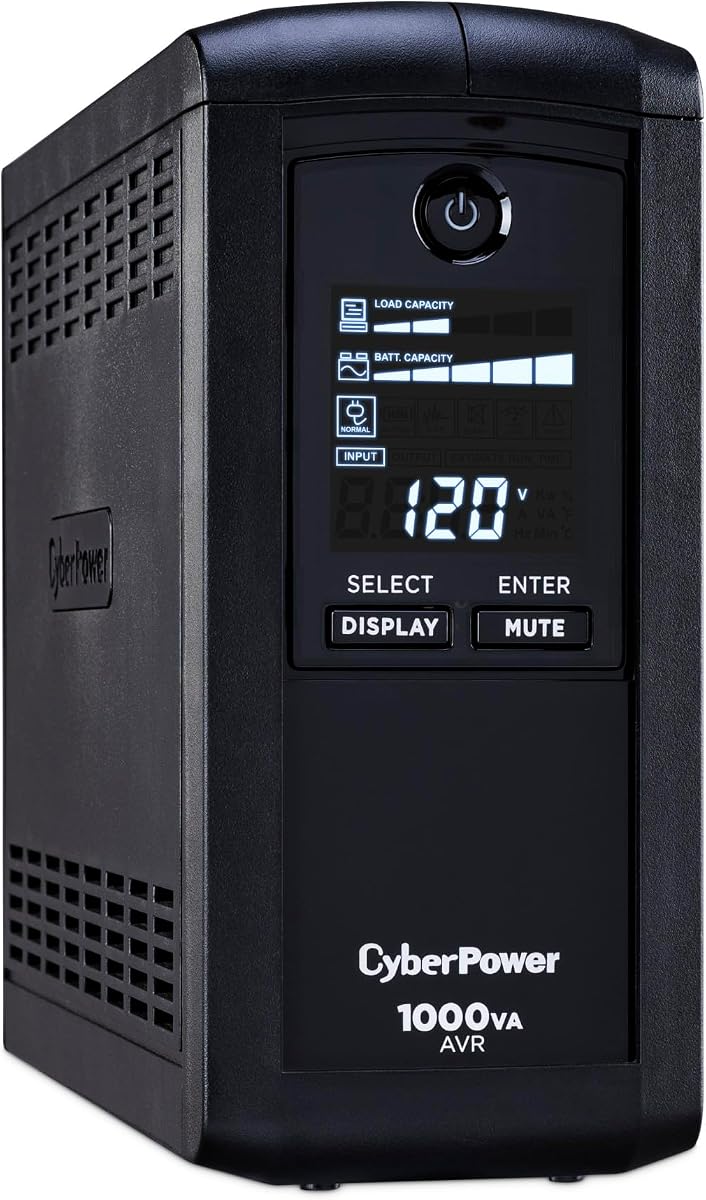
The CyberPower CP1000AVRLCD provides 1000VA and a 600-watt maximum load in a conventional UPS format. Its 4.5 rating reflects a dependable combination of intelligent status reporting, automatic voltage regulation, and nine NEMA 5-15R outlets. It is a practical middle ground for a home theater that needs more support than a compact standby unit but does not require a 1500VA system.
We may earn a commission when you buy through this link, at no additional cost to you.
Five outlets provide both battery backup and surge protection, while four are reserved for surge protection. The intelligent LCD reports estimated runtime, battery capacity, load capacity, and other operating details, making it easier to decide which devices should remain connected. Automatic voltage regulation corrects minor fluctuations without switching to battery power, which can help preserve battery capacity during ordinary voltage variations.
The simulated sine wave output is designed for workstations, network devices, and home entertainment equipment. A right-angle NEMA 5-15P plug with a six-foot cord improves positioning around furniture. The package includes downloadable PowerPanel Personal Edition software, a three-year warranty that includes the battery, and a $350,000 connected equipment guarantee.
This model makes sense for a typical setup with a television, receiver, streaming box, and network hardware. Buyers should reserve the five backup outlets for the components most likely to need uninterrupted power. It is less suitable for large-screen projectors, high-powered amplifiers, or a densely packed equipment rack where additional capacity and more backup-supported receptacles would be advantageous.
The intelligent display provides estimated runtime along with battery and load information. These readouts make it easier to manage active equipment and avoid adding devices that could exceed the unit's available backup reserve.
AVR handles minor voltage changes without moving the system into battery mode. That helps the UPS operate more efficiently while still providing backup protection when a full outage occurs.
We may earn a commission when you buy through this link, at no additional cost to you.
The CyberPower AVRG900LCD carries a 4.6 rating, the highest among the products in this guide. It combines 900VA of capacity, a 480-watt maximum load, twelve NEMA outlets, automatic voltage regulation, and data line protection. Although its output is simulated sine wave, the model offers a particularly broad combination of connection and surge-protection features for a home media installation.
We may earn a commission when you buy through this link, at no additional cost to you.
Six outlets provide battery backup and surge protection, and six additional outlets provide surge protection. Data line protection is a notable distinction for setups that include connected networking or telephone equipment, helping guard against surges traveling through those lines. The intelligent LCD provides detailed information about power and battery conditions, while AVR corrects minor voltage fluctuations without immediately using the battery.
The right-angle NEMA 5-15P input and five-foot power cord help with placement behind a television console. A three-year warranty includes the battery, and the listed connected equipment guarantee is $200,000. Downloadable PowerPanel management software is also included. Unlike several other models here, this one does not advertise front USB charging ports, so those functions are not part of its feature set.
This is a strong choice for a moderately sized home theater with many peripherals but relatively modest power requirements. The twelve-outlet arrangement is especially helpful for older or densely equipped systems where surge-only connections are needed. Keep total connected consumption below 480 watts and reserve the six protected outlets for essential devices to preserve the available runtime.
Data line protection adds a layer of defense for connected network or telephone lines. That makes the AVRG900LCD more versatile for entertainment systems with external connectivity.
Its 4.6 rating is the strongest listed score in the group, while the broad outlet count and AVR add practical value. Its lower wattage limit remains the primary consideration for high-power components.
We may earn a commission when you buy through this link, at no additional cost to you.
The CyberPower CP850AVRLCD is an 850VA, 510-watt UPS with a 4.5 rating. It targets smaller home theater configurations that still benefit from automatic voltage regulation and detailed monitoring. Its nine NEMA 5-15R outlets include five battery-backed connections and four surge-protected connections, offering a simpler layout than many of the twelve-outlet alternatives.
We may earn a commission when you buy through this link, at no additional cost to you.
The intelligent LCD reports estimated runtime, battery capacity, load capacity, and other power conditions. This is useful because available backup time changes as the connected load changes. A right-angle input plug with a six-foot cord makes the enclosure easier to position, while the simulated sine wave output is specified for workstations, networking equipment, and home entertainment systems.
AVR corrects minor voltage fluctuations without transferring to battery mode, helping the unit reserve its battery for actual interruptions. The three-year warranty covers the internal battery, and the product includes a $250,000 connected equipment guarantee along with downloadable PowerPanel Personal Edition management software.
This model is a reasonable fit for a smaller television, receiver, streaming device, and router arrangement. It is less appropriate when the setup includes a power-hungry projector or amplifier, or when many low-power accessories need surge-only receptacles. Buyers should use the backup-supported outlets only for devices that truly benefit from remaining on during an outage.
The LCD helps users understand how the present load affects available runtime. This information supports better outlet assignment and makes it easier to remove nonessential equipment when longer backup is desired.
Five battery-supported outlets are enough for many essential entertainment components. Four additional surge-protected outlets can serve accessories that should remain protected but do not need battery power.
We may earn a commission when you buy through this link, at no additional cost to you.
The CyberPower PR1500LCD is a 1500VA, 1500-watt sine wave UPS with a 4.6 rating, making it a premium option for more demanding home theaters. It combines strong output capacity with support for Active PFC and conventional power supplies, a multifunction LCD that can be relocated, and optional remote management for installations where the UPS is not easily accessible.
We may earn a commission when you buy through this link, at no additional cost to you.
Its most distinctive feature is the extendable display, which can be removed and placed elsewhere using the attached 4.5-foot cable. This is useful when the UPS sits inside a cabinet, on a lower shelf, or in another hard-to-see location. The screen provides detailed information about battery and power conditions, while AVR corrects minor voltage fluctuations without invoking the battery.
Eight NEMA 5-15R outlets provide battery backup and surge protection. The model uses a straight NEMA 5-15P input with a six-foot cord. Remote management requires an optional RMCARD205 card, so buyers who need network control must include that accessory in the final setup. A three-year warranty includes the battery, with a $375,000 connected equipment guarantee and downloadable PowerPanel Business Edition software.
This is the pick for a larger theater that needs substantial wattage and smooth sine wave output without moving to a much larger enclosure. Its lower receptacle count means careful prioritization is essential, and a home with many wall wart adapters may need additional surge protection. The optional management capability makes it especially appealing for owners who want remote visibility into a concealed installation.
The 1500-watt rating provides substantial room for a television, receiver, streaming equipment, and other essential components. Sine wave output also makes the model a strong match for sensitive modern electronics.
The removable LCD makes operating data accessible even when the main enclosure is tucked away. Optional remote management extends that visibility for advanced and concealed installations.
We may earn a commission when you buy through this link, at no additional cost to you.
The CyberPower ST900U is a 900VA, 500-watt standby UPS that combines a slim profile with twelve NEMA 5-15R outlets. Its 4.5 rating and stated support for home entertainment, computers, gaming consoles, and broadband routers make it a practical budget-oriented choice for smaller rooms and less demanding equipment.
We may earn a commission when you buy through this link, at no additional cost to you.
Six outlets provide battery backup and surge protection, and six provide surge protection. Four outlets are widely spaced, which helps with bulky plugs and crowded power strips that might not fit around conventional tightly packed receptacles. The right-angle input plug offsets the cord by 45 degrees and uses a five-foot length, helping the unit sit neatly against a wall or within a narrow shelf.
The GreenPower high-efficiency design uses a compact charger and power inverter to reduce energy consumption. As a standby UPS, it is fundamentally suited to keeping essential equipment operating during shorter power disturbances and allowing an orderly shutdown during a longer interruption. Its simulated sine wave output is intended for home office and home entertainment equipment.
This model is a sensible value for a modest setup that does not need a detailed display or pure sine wave output. It fits particularly well where outlet quantity, shelf space, and broad device compatibility matter more than advanced monitoring. Keep the connected load under 500 watts and place only essential equipment on the six battery-supported outlets to maximize runtime.
The slim enclosure is easier to accommodate in a media cabinet than many full-size UPS designs. It offers a practical way to add protection without making the home theater setup feel overly bulky.
Four widely spaced receptacles reduce the frustration of trying to fit large power plugs side by side. The remaining outlets keep the system useful for a mix of essential and surge-only devices.
We may earn a commission when you buy through this link, at no additional cost to you.
The CyberPower OR500LCDRM1U is a one-rack-unit UPS designed for department and workgroup servers, network devices, telecom equipment, and similarly compact systems. With 500VA and a 300-watt maximum load, it is the smallest-capacity model in this guide, but its rack-friendly form factor makes it relevant to home theaters with a dedicated equipment rack or compact network stack.
We may earn a commission when you buy through this link, at no additional cost to you.
Six NEMA 5-15R outlets are divided into four battery backup and surge protection receptacles and two surge-only receptacles. The multifunction LCD displays runtime in minutes, battery status, and power conditions, allowing users to monitor a setup that may be tucked into a cabinet. AVR corrects minor voltage fluctuations without switching to battery mode, while the long straight input cord offers placement flexibility.
Remote management requires the optional RMCARD205 management card, so it is not a standard connection on the base unit. The product is UL safety certified, backed by a three-year warranty that includes the batteries, and carries a $300,000 connected equipment guarantee. Its simulated sine wave output is specified for equipment without Active PFC power supplies.
This is not the right choice for a conventional large-screen home theater with substantial total power demand. It is better suited to network gear, a small streaming rack, or a controlled cluster of low-draw components. Within those limits, the rackmount format, four protected outlets, and informative display create a specialized package that the larger consumer-oriented models do not offer.
The one-rack-unit enclosure fits neatly into a standard equipment rack. That makes the model easier to organize alongside network, control, and low-power entertainment hardware without taking up a full shelf.
The LCD provides runtime, battery status, and power-condition information in a compact panel. Optional remote management can extend that visibility to installations where direct access is inconvenient.
We may earn a commission when you buy through this link, at no additional cost to you.
The GOLDENMATE 2000VA/1600W is the highest-output model in this comparison and uses a 51.2V, 9Ah lithium iron phosphate battery. Its 4.4 rating reflects a distinctive combination of pure sine wave output, line-interactive design, a 2000VA capacity, and a long service life claim exceeding 10 years and 3,000 charge cycles.
We may earn a commission when you buy through this link, at no additional cost to you.
This system is built for consumers who want a high-capacity backup with a lithium battery rather than a conventional lead-acid design. The manufacturer states that the battery is maintenance-free and does not require replacement like lead-acid models. Automatic voltage regulation addresses outages, surges, voltage drops, shocks, and high or low voltage, while the pure sine wave output is suitable for computers, workstations, network devices, and telecom equipment.
Eight NEMA 5-15P outlets provide surge protection and battery backup, with wider spacing designed to accommodate varied power cords. The intelligent LCD reports real-time battery and power status, and an integrated switch combines the main power button, mute control, and LCD on/off function. A communication port and supplied USB cable allow a connected Windows PC to initiate shutdown through Windows settings, while front Type-A and Type-C charging ports deliver a combined 10W.
Its trade-offs are size and weight. The manufacturer notes that the larger battery and heavier transformer make the enclosure larger and heavier than comparable lead-acid products. It also supports a 90–140V AC input for standard 110V household power, and generator output may not be recognized if voltage, frequency, waveform, or grounding does not meet requirements. This is a compelling premium-capacity option when long battery life and high output are priorities.
The LiFePO4 battery pack is the defining feature, with a stated lifespan beyond 10 years and more than 3,000 charge cycles. Buyers should also consider the greater initial hardware weight and the manufacturer's stated input limitations.
The 2000VA and 1600-watt ratings provide the highest stated load capacity in the group. Pairing that capacity with pure sine wave output makes the model suitable for demanding systems with modern and sensitive electronics.
We may earn a commission when you buy through this link, at no additional cost to you.
Choosing a home theater UPS requires balancing runtime, output compatibility, outlet count, physical placement, and the amount of equipment that truly needs backup. The most useful model is not automatically the one with the largest rating; it is the one that matches your loads and operating priorities without creating installation problems.
Start with the power requirements of every device that will be connected, including the television or projector, receiver, amplifier, streaming box, game console, network modem, and any USB-powered equipment sharing an adapter. A UPS's watt rating indicates the maximum continuous load it can support, while VA is a broader measure that also reflects the power factor of the load. Comparing the two numbers can reveal whether a model has enough headroom or is being pushed beyond its intended operating range.
Leave some capacity unused rather than operating continuously at the maximum. A lower-capacity UPS may also deliver a shorter runtime than a larger model supporting the same equipment, because the battery and inverter have less energy available. Use the LCD load and runtime data after installation to confirm the real behavior of the connected system.
Pure sine wave output is the smoothest option and is generally the safest match for sensitive or modern electronics. Simulated sine wave models are designed for many conventional home entertainment, networking, and computer devices, but some loads may behave less ideally when transferred to battery power. The list includes both approaches so buyers can prioritize either compatibility, capacity, physical size, or battery technology.
If the system contains modern high-performance computers, an audio receiver with a power-sensitive amplifier, or other equipment with strict power requirements, pure sine wave output deserves particular attention. For simpler displays, streaming boxes, and routers, a simulated sine wave model may provide ample protection and greater outlet flexibility.
A home theater can require more physical receptacles than expected once power strips and bulky adapters are included. Some UPS models in this guide provide twelve NEMA outlets, while others provide nine, eight, or six. Count the actual plugs rather than the number of devices, because a power strip occupies one receptacle while providing several connection points.
Also distinguish between battery-backed and surge-only outlets. Place the equipment that must remain operational or shut down cleanly on backup-supported receptacles, and use surge-only outlets for accessories that do not need to remain powered. Check outlet spacing when large transformer plugs are involved.
Runtime depends on battery capacity, inverter efficiency, the UPS load, and the age and condition of the battery. A large television or power-hungry amplifier can consume enough energy to shorten runtime quickly, while a television, network box, and modest receiver generally place a lighter load. The LCD models provide runtime or load information that can help refine the installation after connection.
Decide whether the goal is a brief uninterrupted viewing period, enough time to save work and issue shutdown commands, or simply protection from surges. Keeping nonessential devices disconnected from battery outlets improves the chance of reaching that goal. For long outages, household battery capacity has practical limits, so an automatic shutdown plan remains important.
Automatic voltage regulation corrects minor voltage fluctuations without switching to battery mode. This is useful in neighborhoods where lights dim, equipment restarts, or small voltage changes occur. Surge protection is present across the featured products to some degree, but the exact coverage and guarantee differ by model. Data line protection on the AVRG900LCD adds an extra layer for connected network or telephone lines.
Think about where surges are likely to enter. A system with long external cable runs, a nearby network connection, or a shared surge-protection path may benefit from broader protection. A three-year warranty that includes the internal battery is also an important feature because the battery is often the first component to age in a UPS.
The ST900U emphasizes a slim enclosure for shelves and media cabinets, while the OR500LCDRM1U fits into one rack unit. Standard units such as the CP1500PFCLCD and CP1500AVRLCD3 provide more substantial capacity and outlet counts. The GOLDENMATE lithium system is intentionally larger and heavier because it contains a large battery and transformer, which should be considered before installation.
Measure the intended shelf, cabinet, or rack space and leave room for the input plug, cables, airflow, and easy access to the display and controls. A right-angle input plug can simplify placement against a wall. For a concealed installation, a model with a relocatable LCD or optional remote management may be easier to monitor.
A multifunction LCD can show estimated runtime, load capacity, battery condition, and current power status. These details help distinguish normal operation from a unit that is heavily loaded or has a battery that needs attention. Color displays and adjustable panels add convenience, but they are not required for backup protection.
PC communication can support automated shutdown, which is particularly useful for home-office equipment that shares a home theater. The PR1500LCD and OR500LCDRM1U support optional remote management hardware, while the GOLDENMATE system provides a communication port and a supplied USB cable for supported Windows shutdown functions. Consider these features if the equipment is hidden or operated occasionally.
Most models in this guide use conventional UPS battery designs, while the GOLDENMATE 2000VA/1600W uses a lithium iron phosphate pack. The manufacturer states that the lithium battery exceeds 10 years of lifespan and 3,000 charge cycles, which may appeal to owners seeking a long-term battery solution. That advantage comes with a larger and heavier enclosure and should be balanced against the system's physical requirements.
Regardless of chemistry, a UPS battery is a consumable component. Warranty coverage that includes the battery is valuable, and periodic testing helps ensure the unit can deliver the runtime expected. Checking the displayed battery status and performing a planned test can reveal problems before an actual outage.
Place the UPS on a stable, dry, ventilated surface near the equipment it protects. Avoid storage areas with heat, moisture, or restricted airflow. Connect essential components directly to battery-backed outlets, while accessories that only require surge protection can use the remaining receptacles. Do not exceed the UPS's watt rating, and avoid connecting high-load appliances such as space heaters, hair dryers, or large power tools.
After wiring the home theater, test the installation by disconnecting the UPS from the wall while the equipment is operating. Confirm that the connected devices continue to function and that the display reports the expected transition to battery operation. Review the runtime and load readings, then use the appropriate monitoring or shutdown software if the model supports communication with a computer. Keep the system connected to AC power so the internal battery can maintain its charge.
Care for the unit by checking battery status, listening for alerts, and reviewing runtime estimates every few months. A planned brief test can verify that the outlets and communications function correctly without waiting for an emergency. Keep the ventilation openings clear, use the provided power cord, and do not open the enclosure. If the battery is swollen, the unit smells unusual, or it shows persistent fault indications, discontinue use and arrange qualified service.
The right size depends on the combined power draw of the television, receiver, projector, console, streaming devices, and network equipment. Add their watt requirements, compare the total with the UPS's continuous watt rating, and leave some headroom. If several high-power components share one battery, a larger capacity model will generally provide longer runtime and more room for future equipment.
Connecting the television directly is generally useful if it is the primary device you want protected and kept running. The receiver, streaming device, modem, and game console may also merit backup if they need time to shut down cleanly. Leave surge-only outlets for accessories that do not need battery runtime, because every additional load can shorten the available backup period.
Pure sine wave output is the more consistent waveform and is a strong choice for modern computers, sensitive audio equipment, and other demanding electronics. Simulated sine wave units can work well with many conventional TVs, streaming boxes, routers, and receivers. If the equipment manufacturer specifies a UPS type, follow that guidance; otherwise, pure sine wave offers the broadest compatibility.
Runtime varies with the UPS capacity and the amount of connected load. A modest television and network setup may run considerably longer than a large display, powerful amplifier, projector, and game console operating together. The LCD on most featured models can provide load and runtime estimates, which are more useful than relying on a universal runtime claim. Testing with the actual equipment gives the best indication of performance.
Yes. Leaving the UPS connected to AC power allows it to maintain the battery charge and remain ready for an interruption. Most systems also manage minor voltage changes through automatic voltage regulation. Periodic tests and battery-status checks help confirm that the installation is operating as expected.
Surge-only outlets protect connected equipment from sudden voltage spikes but do not supply power during an outage. Battery-backed outlets also provide power when normal utility electricity stops, subject to the UPS capacity and remaining runtime. For a home theater, put the most important devices on battery-backed outlets and use surge-only connections for less critical accessories.
A lithium UPS may be attractive when long battery life and reduced replacement concerns are priorities. The GOLDENMATE lithium model also offers high capacity and pure sine wave output, but its battery and transformer make the enclosure larger and heavier. A lead-acid model can still be appropriate for a smaller installation where physical dimensions, features, and current cost are the dominant considerations.
No. A UPS provides a finite amount of stored energy, and its runtime declines as the connected load increases. The goal may be to continue watching briefly, protect against surges, or provide enough time for an orderly shutdown. Very long outages eventually require manually shutting down equipment, especially if the installation includes a large display, projector, or amplifier.
The CyberPower CP1500PFCLCD is the most balanced overall recommendation because it combines 1500VA of capacity, pure sine wave output, twelve outlets, USB charging, and a detailed color display. The CyberPower PR1500LCD stands out for its 1500-watt rating, smooth output, relocatable screen, and optional remote management, while the CyberPower ST900U offers a space-conscious and outlet-rich option for smaller entertainment setups.
Prioritize actual load, outlet allocation, and waveform compatibility before considering additional features. A larger UPS is useful only when its capacity serves a real need, and a sophisticated display cannot compensate for connecting too many devices to battery-backed outlets. For sensitive or modern electronics, pure sine wave output deserves added weight; for conventional systems, a simulated-sinewave model with the right number of protected outlets may be more appropriate.
Finally, check current product specifications, availability, and prices before ordering, since both prices and product details can change. Confirm the watt limit, outlet type, input voltage, physical dimensions, and warranty terms for your chosen model, then test the installation before relying on it during an actual outage.