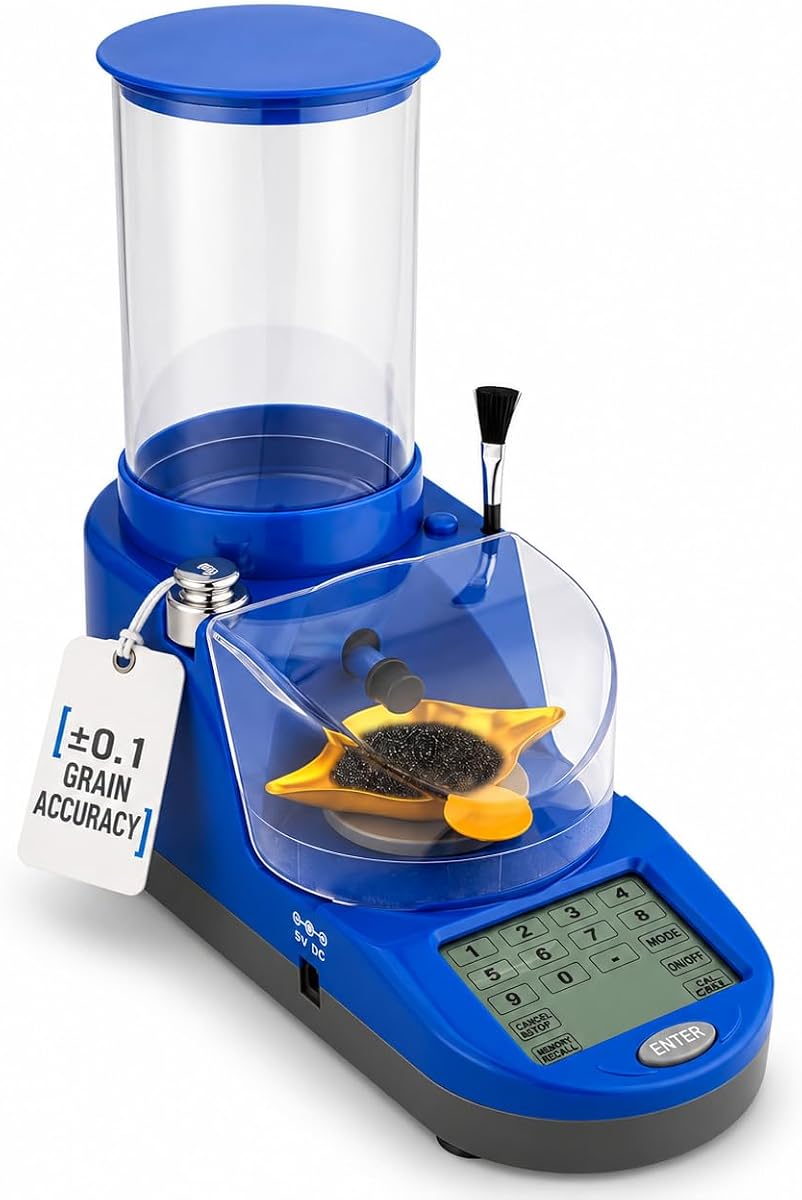
Digital Powder Scale
4.2Editor score
Automatic powder dispensing
Plus-or-minus 0.1-grain accuracy
Anti-static shielding
Our beam scale for reloading guide compares ten scales for accuracy, capacity, ease of use, stability, and features, helping you choose the right one.
A beam scale for reloading must balance fine sensitivity with repeatable readings, especially when powder charges and projectile weights are small enough for tiny inconsistencies to matter. A useful scale should settle quickly, provide an easy-to-read measurement, support routine zeroing, and offer enough capacity for the components you routinely weigh. Mechanical and digital approaches can both work well, but each suits different benches and loading styles.
The products in this guide were compared using the supplied specifications, focusing on stated accuracy, capacity, readability, damping, calibration features, included accessories, and suitability for reloading tasks. Although the list is centered on the search for a beam scale, it also includes closely related digital and precision balances because modern reloaders often compare mechanical and electronic options before deciding which operating system fits their workflow best.
Each pick highlights a distinct reason to consider it, from a purpose-built mechanical beam design to portable digital scales, laboratory balances, and an automatic dispensing system. Ratings and specifications reflect the available product information, while no hands-on testing is claimed. Product availability, features, and prices can change, so readers should confirm the current listing and compare the latest specifications before purchasing.
4.2Editor score

3.9Editor score

4.3Editor score
The comparison below places all ten scales side by side, emphasizing stated capacity, resolution, operating method, and the accessories that make them useful around a reloading bench. The selection includes a traditional beam scale, several digital precision scales, and two triple-beam laboratory balances.




The Redding Reloading Model No. 2 is the most purpose-built mechanical beam scale in this group, earning a 4.3 out of 5 for its reloading-focused design rather than for general laboratory versatility. It is configured specifically for powder and bullet weighing, with a stated capacity of 505 grains, sensitivity to one-tenth of a grain, over-and-under graduations, and a simple two-counterpoise arrangement. That direct focus makes it a natural starting point for anyone searching specifically for a beam scale for reloading.
We may earn a commission when you buy through this link, at no additional cost to you.
Its mechanical advantages are substantial. A magnetically dampened beam is designed to settle quickly after the pans move, reducing the waiting involved in each measurement. Hardened knife edges ride in precision stainless-steel seats, a construction detail intended to preserve alignment and durability. The pour-spout pan and flat platform also serve different portions of the workflow: one supports careful powder transfer while the other accommodates bullets or other components.
The trade-offs follow directly from its mechanical design. A 505-grain maximum is sufficient for many common powder and projectile measurements, but it is modest compared with digital scales reaching 1,500 or 2,000 grains. The scale also requires more active participation from the user because there is no automatic display, auto-trickle function, or powered dispenser. Its supplied rating of 3.9 is lower than several digital options, although rating alone does not capture its relevance to reloaders who prefer a traditional beam instrument.
This is the recommendation for a reloader who values sensitivity, durable mechanical construction, and freedom from batteries or electronic calibration. It is less appropriate for someone who wants automatic dispensing, a large illuminated display, or a single scale capable of handling unusually heavy component batches. Among true beam scales, however, its clear specifications and focused design make it the strongest all-around match in this guide.
The stated tenth-grain sensitivity is the central attraction for charge adjustment. Combined with over-and-under graduations, it gives a reloader a visual indication of how far a charge or projectile weight sits above or below the target instead of relying only on a single line.
A fully mechanical system avoids battery replacement and electronic power requirements. Magnetic damping and hardened knife edges support fast settling, consistent alignment, and routine use on a reloading bench.
We may earn a commission when you buy through this link, at no additional cost to you.
The QWORK Triple Beam Mechanical Balance is a broad-capacity laboratory-style balance with a stated maximum of 2,610 grams and 0.1-gram resolution. Its 3.8 rating places it near the lower end of the group, but its mechanical format and included weight set distinguish it from compact reloading scales. It is most compelling for reloaders who also need a general-purpose balance for powder, components, or laboratory-style tasks.
We may earn a commission when you buy through this link, at no additional cost to you.
The balance uses three sliding riders to cover a broad measurement range, while magnetic damping helps the pointer settle after movement. A zero adjustment knob allows the user to compensate for systematic error before working. The package includes two 1,000-gram weights and one 500-gram weight, expanding the stated capacity beyond the base configuration, and a six-inch platform provides a practical surface for larger items.
Transport can affect the zero setting, which is an important limitation called out in the supplied information. Re-zeroing may therefore be necessary before use, and the process requires following the product's instructions. Another distinction is that 0.1-gram resolution is much less granular than the tenth-grain sensitivity of the Redding scale or the digital models' stated grain readings.
Choose the QWORK when a large mechanical capacity, no-battery operation, and a complete set of weights matter more than real-time digital precision. It is less compelling for someone whose primary goal is measuring very small reloading charges in grains. Its strongest use is as a versatile bench balance with reloading as one of several possible applications.
The triple-beam arrangement and supplied 1,000-gram and 500-gram weights expand the balance to 2,610 grams. This makes it useful for bulk components and general weighing tasks that exceed the capacity of most compact digital scales.
The zero adjustment knob is especially important after transport, when a balanced instrument may no longer read exactly zero. A quick check and adjustment establishes a dependable starting point for every weighing session.
We may earn a commission when you buy through this link, at no additional cost to you.
The MAXUS Digital Milligram Scale offers 50 grams of capacity with 0.001-gram readability, giving it a 4.4 rating and making it the finest-resolution compact digital option in this list. Although it is not a beam scale, its grain mode, small dimensions, and highly sensitive display can be useful for very small reloading components, powders, and other lightweight items.
We may earn a commission when you buy through this link, at no additional cost to you.
Six units—grams, ounces, troy ounces, pennyweights, carats, and grains—allow the scale to fit different measurement habits. Dedicated buttons provide fast access to tare, counting, unit selection, and power. It can run from batteries or through the included USB cable, making it equally suited to a fixed bench or a portable setup. The included tray, scoop, tweezers, and two 20-gram calibration weights support immediate use.
The main limitation is capacity. A 50-gram ceiling is more than adequate for many individual components, but it cannot cover bulk powder handling or larger batches. Very high readout precision should also not be confused with the actual accuracy of a particular reloading process; environmental conditions, handling, and calibration still influence results.
This scale is best for a reloader who needs exceptionally fine resolution for small components, appreciates grain conversion, and values a compact format. It is less suitable for measuring large quantities or replacing a conventional 1,500-grain bench scale. For those tasks, one of the higher-capacity digital picks is the better fit.
The 0.001-gram display is the defining feature, providing much finer numerical resolution than most reloading scales. It is particularly relevant for tiny components, powder samples, jewelry, and other lightweight materials.
Battery and USB power options make the MAXUS adaptable to different workspaces. Its compact 4.5-by-2.6-by-1.6-inch size also allows storage in a drawer or transport case when the bench is not in use.
We may earn a commission when you buy through this link, at no additional cost to you.
The RCBS Pocket Digital Scale has a 4.5 rating, the highest among the ten products, and combines a reloading-oriented 1,500-grain capacity with 0.1-grain readings. Its compact design and included accessories make it one of the most straightforward choices for a reloader who wants a digital alternative to a traditional beam instrument.
We may earn a commission when you buy through this link, at no additional cost to you.
The scale is intended to cover powder charges, bullets, and other components, which reflects the practical range of most reloading benches. A powder pan and check weight are included, and batteries are supplied, reducing the setup required before the first weighing. The stated 0.1-grain readout is suitable for checking powder drops and verifying component weights without moving to a much larger bench scale.
Digital convenience does not eliminate routine care. A reloader should still work on a stable, level surface, allow the scale to stabilize, and confirm calibration with the included check weight when readings become questionable. The listed features do not mention automatic dispensing, so it should be considered a measuring scale rather than a complete powder-measure system.
The RCBS is the best fit for someone who wants a recognized reloading brand, a portable format, and the highest listed rating in the group. It offers more capacity and convenience than a small precision scale, although it lacks the integrated dispensing and anti-drift features described for the higher-end digital powder system.
A 1,500-grain ceiling comfortably covers typical powder charges and projectile weights. That balance of range and compact size makes the scale practical for routine bench work without taking up the space of a full laboratory balance.
The supplied powder pan, check weight, and batteries address several common setup needs immediately. Keeping the check weight nearby allows the reloader to verify performance as conditions or handling routines change.
We may earn a commission when you buy through this link, at no additional cost to you.
The MB2610 Triple Beam Mechanical Balance Scale combines a 2,610-gram capacity with 0.1-gram resolution and a 4.4 rating. It is designed for analytical, school, and general weighing applications, providing a sturdy and battery-free alternative to the electronic products in the list.
We may earn a commission when you buy through this link, at no additional cost to you.
Three beams carry sliding weights of 10 grams, 500 grams, and 100 grams, allowing the user to approach a measurement from different ranges. Magnetic damping reduces pointer swing and helps the reading settle quickly. A sturdy base supports the platform, while the clear graduations are intended to make direct readings efficient. Two 1,000-gram weights and one 500-gram weight accompany the scale.
Its mechanical nature makes it less suitable for the fine-grain demands of many modern loading methods. At 0.1-gram resolution, it is better suited to general quantities and component batches than to delicate charge adjustment. It also occupies more bench space than a pocket digital scale and requires more manual interpretation.
The MB2610 is a good option for a reloader who also needs laboratory-style weighing capacity, values a stable mechanical platform, and prefers not to manage batteries. For powder charge refinement in tenths of a grain, however, a reloading-specific digital scale or the Redding beam scale will usually be a closer match.
The 2,610-gram maximum supports substantially heavier loads than compact reloading scales. It is useful for grouped components, bulk accessories, or general bench weighing in addition to individual cartridge-making tasks.
Magnetic damping minimizes pointer swing after the riders are positioned. Combined with the stated sturdy base, it creates a stable platform for direct readings without electronic stabilization.
We may earn a commission when you buy through this link, at no additional cost to you.
The TOPWEIGH Reloading Scale with Metal Powder Pan is a budget-oriented digital option with a 4.3 rating. Its defining reloading feature is a narrow metal pan intended to make powder transfer easier and reduce the sticking problem associated with some plastic pans.
We may earn a commission when you buy through this link, at no additional cost to you.
The scale reads in grains and grams with 0.1-grain display resolution, and its backlit LCD improves visibility during bench work. A tare function, automatic power saving after 180 seconds of inactivity, a powder scoop, and a 50-gram calibration weight are included. The narrow spout pan is positioned to support controlled powder placement, while the stated easy-clean design helps maintain a tidy process.
The supplied information does not state a maximum capacity, and that omission deserves attention when comparing it with the 1,500- and 2,000-grain digital models. It also lacks an automatic powder dispenser or integrated trickler, so powder management remains manual. The 0.1-grain figure is display resolution and should be considered alongside calibration quality and repeatability when judging real-world precision.
For a new reloader who wants a compact, readable scale with a useful metal pan at a modest entry point, this model is compelling. It is better viewed as a straightforward charge-checking scale than a complete high-speed dispensing system. Buyers who routinely handle large component batches may prefer a model with a clearly stated high capacity.
The narrow metal pan is intended to reduce powder clinging compared with conventional plastic surfaces. Its spout shape also supports more controlled transfer into the pan during charge checks.
Switching between grains and grams accommodates both cartridge components and general small-item weighing. The backlit screen and simple tare function make the scale approachable for a new reloading setup.
We may earn a commission when you buy through this link, at no additional cost to you.
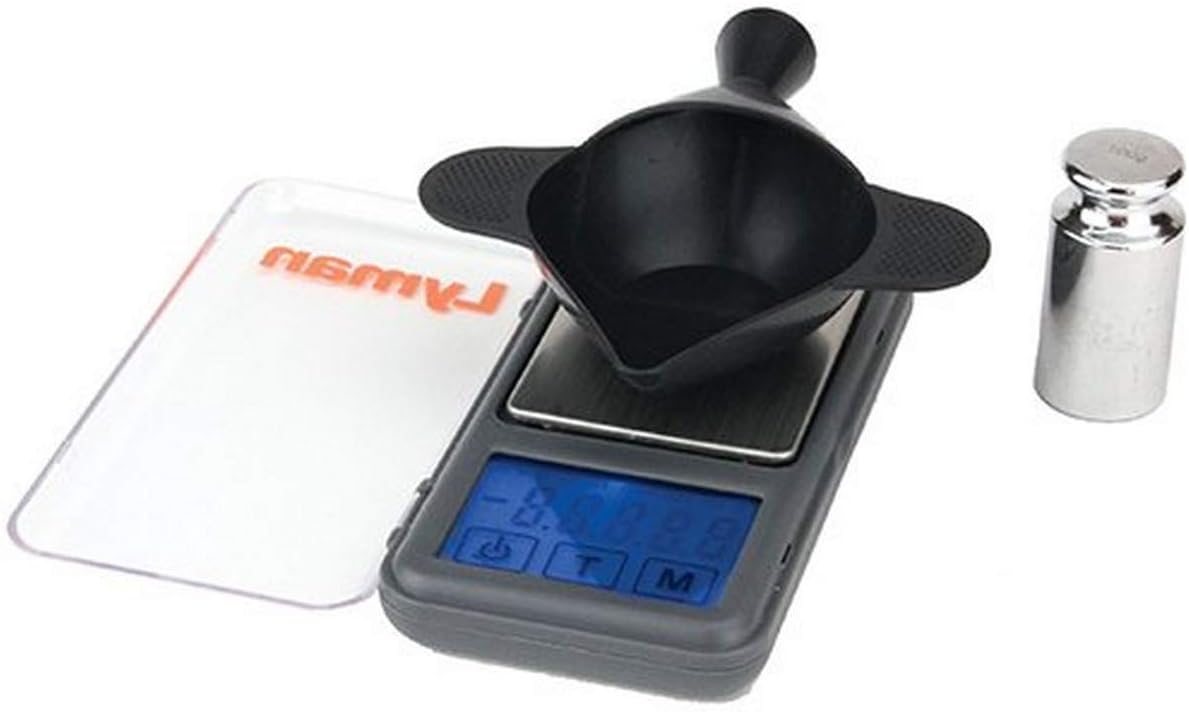
The Lyman Pocket Touch 1500 Scale Kit combines a 1,500-grain capacity with touchscreen operation and a 4.4 rating. It is designed as a ready-to-use reloading package, pairing the scale with a Powder Pal funnel pan, a handy powder scoop, a calibration weight, and two AAA batteries.
We may earn a commission when you buy through this link, at no additional cost to you.
Touchscreen controls handle power, tare, calibration, and switching between grams and grains. The illuminated display is intended to remain visible in different lighting conditions, which helps during dim workshop environments or when the scale sits beneath a press or cabinet. The 1,500-grain range is well suited to powder charges, bullets, and typical reloading components.
Compared with a simple button-based pocket scale, the interface has more controls and may require a little more care to operate. It still lacks the automatic dispensing found in the dedicated digital powder system, so the reloader's powder measure or trickler remains part of the workflow. The included funnel pan is particularly relevant to transfer control and powder organization.
The Lyman is an excellent choice for a reloader who wants a complete, approachable kit rather than a bare scale. It offers enough capacity for routine work, a visible display, and the accessories needed to begin checking charges without sourcing each item separately.
The funnel pan, powder scoop, calibration weight, and batteries create a more complete starting kit than a standalone digital scale. Each included item supports a common task in measuring, transferring, or verifying powder.
Touchscreen operation places power, tare, calibration, and unit selection in a single interface. A backlit display helps maintain readability across changing bench lighting and viewing angles.
We may earn a commission when you buy through this link, at no additional cost to you.
The Digital Powder Scale is the most automated product in this guide, with a 4.2 rating and a stated accuracy of plus or minus 0.1 grain. It measures from 0.4 to 1,500 grains and includes an automatic powder dispenser capable of dropping consistent charges at up to two grains per second.
We may earn a commission when you buy through this link, at no additional cost to you.
Its automatic repeat function is a major workflow advantage. Rather than manually trickling powder for every cartridge, the reloader can return the pan and initiate another charge, reducing repetitive work. The integrated anti-static shielding is intended to block interference from phones and computers, while the anti-drift system is designed to maintain stable readings throughout a loading session.
A compact touchscreen and backlit display support quick navigation and readable results. The scale is positioned as a complete piece of reloading equipment rather than merely a measuring accessory. Its complexity, however, may not be justified for a casual reloader who makes only a few loads or already owns a dependable manual powder measure and trickler.
This model is best for high-volume reloaders who value speed, repeat dispensing, and stability during long sessions. It stands apart from every other entry because the machine handles both measurement and powder delivery, reducing the number of separate tools required at the bench.
The automatic dispenser can drop charges at up to two grains per second and repeat the process when the pan is returned. This reduces the hand work involved in producing a succession of similar powder charges.
Anti-static shielding and anti-drift technology are intended to limit electronic interference and reading changes as the session continues. These features are particularly relevant when many cartridges are being loaded on the same bench.
We may earn a commission when you buy through this link, at no additional cost to you.
The ERS2000 Powder Scale combines a 2,000-grain capacity with one-tenth-grain resolution and an integrated powder trickler. Its 4.3 rating reflects a strong balance of measurement range, reloading-specific accessories, and a compact bench-oriented design.
We may earn a commission when you buy through this link, at no additional cost to you.
The trickler attaches to either side, making it adaptable to left- or right-handed bench layouts. This is a meaningful convenience for reloaders who do not want a separate accessory occupying space or requiring repositioning. The scale also switches between grain and gram measurements, supports powder and reloading component work, and includes an AC adapter, cleaning brush, calibration weights, and a pop-out storage tray.
Its 2,000-grain maximum is higher than most pocket digital scales, making it suitable for components beyond ordinary powder charges while still remaining focused on compact reloading use. The one-tenth-grain resolution supports careful charge adjustment, though it does not provide the automatic dispensing offered by the dedicated digital powder system.
The ERS2000 is an appealing middle ground for reloaders who want more capacity and an integrated trickler without a large automatic dispenser. It is especially useful for mixed reloading tasks where both grain and gram measurements are useful and either side of the bench may be occupied.
The removable trickler can be positioned on either side of the scale. That flexibility makes it easier to arrange the unit around a press and supports use by both left- and right-handed reloaders.
A 2,000-grain ceiling gives the ERS2000 room for larger components and varied bench tasks. It remains more compact than a full laboratory balance while covering a broader range than most pocket scales.
We may earn a commission when you buy through this link, at no additional cost to you.
The UNIWEIGH Digital Reloading Scale offers a 1,500-grain capacity with 0.1-grain resolution in a lightweight, portable format. Its 4.3 rating makes it a solid compact option, particularly for reloaders who want a scale that can move between a bench, toolbox, and range-side storage location.
We may earn a commission when you buy through this link, at no additional cost to you.
The large backlit LCD automatically adjusts brightness, improving readability in bright or dim settings. A tare function resets the scale to zero, while a dedicated calibration function supports accuracy maintenance over time. The stated high-precision sensor and 0.1-grain resolution make the scale suitable for powder, coins, and reloading components within its capacity.
A protective case is included for transport and storage, helping protect the scale when it is not being used. The supplied information does not list a powder pan, calibration weights, or an automatic dispenser, so the scale may require additional accessories for a complete powder-transfer setup.
Choose the UNIWEIGH for portability, convenient storage, and a simple digital interface. It is a strong general reloading scale, but buyers wanting a ready-to-use powder kit may prefer the Lyman or TOPWEIGH, while high-volume users may prefer automatic dispensing.
The display adjusts its backlight automatically, reducing the need for manual changes as the scale moves between areas. This is useful in workshops with variable lighting and improves general readability.
The protective case makes the scale easier to store between sessions or carry in a toolbox. It is a practical advantage for reloaders with limited bench space or multiple work locations.
We may earn a commission when you buy through this link, at no additional cost to you.
The best scale depends on whether you prioritize a traditional mechanical beam, fast electronic readings, automatic dispensing, portability, or broader laboratory capacity. Accuracy, usable resolution, stability, and repeatability should be considered together rather than treating one printed specification as a complete measure of performance.
A mechanical beam scale offers tactile, visual adjustment without batteries, while a digital scale provides a numerical display, unit conversion, tare, and often easier calibration. The Redding Model No. 2 is purpose-built around a dampened beam, whereas most alternatives use electronic load cells. Choose based on bench habits rather than assuming one method is automatically more precise.
In short, select a beam scale for mechanical simplicity and a digital scale for convenience and expanded functions.
Resolution describes the smallest displayed increment, while accuracy describes how closely a result should agree with a known standard. A tenth-grain increment is meaningful for many powder-charge checks, while 0.1-gram or 0.001-gram resolution serves different measurement tasks. Avoid equating a very fine display with guaranteed real-world accuracy, and consider whether your process actually needs that level of detail.
In short, choose resolution that matches the smallest adjustment you make rather than simply selecting the largest number printed on the box.
Capacity should cover the heaviest item you expect to place on the scale, not merely a typical powder charge. The products here range from 50 grams to 2,610 grams, and reloading-specific digital models commonly support 1,500 to 2,000 grains. A laboratory triple-beam balance is useful for bulk work, but a dedicated scale may be more convenient for individual components.
In short, verify both the maximum load and the readability at that load before committing to a model.
Stable readings save time and make small differences easier to interpret. Mechanical products use magnetic damping to limit beam or pointer swing, while digital products need time to settle after a change. Bench vibration, an uneven surface, nearby movement, and air currents can all influence a reading, so stability features work best on a solid, level workspace.
In short, favor fast damping and a stable readout, then always let the scale settle before recording a result.
A measuring scale, a scale with an integrated trickler, and an automatic dispenser serve different levels of involvement. A narrow powder pan can help control transfer, while an automatic dispenser may speed repeated production. Consider how much powder you load at once and whether you prefer manual adjustment, assisted trickling, or a return-and-repeat dispensing process.
In short, match the scale to your preferred workflow rather than buying unnecessary automation or extra accessories you will not use.
Reliable results depend on a scale being zeroed before use and checked periodically. Mechanical balances may need a zero adjustment after movement or transport, while digital scales use calibration weights or functions. The QWORK specifically notes that transportation can affect its zero setting, while several digital products include calibration weights or a calibration control.
In short, keep the supplied check weight or calibration masses nearby and verify accuracy before an important loading session.
A large, illuminated display is useful in a dim workshop, while touchscreen or dedicated controls can make tare and unit switching convenient. Mechanical scales require interpreting moving beams or a pointer, which some users enjoy and others find less immediate. Consider readability at your normal viewing angle and whether gloves, powder residue, or a crowded bench could complicate button operation.
In short, choose controls that remain easy to use in your actual workspace, not merely the most feature-filled interface.
A pocket format is valuable when bench space is limited, but a usable powder pan, scoop, funnel, check weight, batteries, and power connection can matter just as much. The Lyman kit, TOPWEIGH set, and ERS2000 package emphasize accessories, while the UNIWEIGH emphasizes protective portability. Inventory the tools already on your bench before paying for duplicates.
In short, balance portability against the accessories required for a complete, convenient measuring setup.
Begin by placing the scale on a firm, level, clean section of the reloading bench away from vibration. Remove any pan, platform, or protective component as directed by its instructions, inspect it for powder residue, and make sure the scale is not resting on a loose mat. For a digital model, install the batteries or connect the specified power source, turn it on, and allow the display to stabilize before placing anything on the pan.
Check the zero or tare condition with an empty pan. A mechanical beam scale should be balanced and sitting at its reference point; a digital scale should read zero after tare. Use the included check weight or calibration mass according to the manufacturer's directions, and recalibrate if the result is outside the expected reading. Do not attempt a calibration adjustment unless the required reference weight and instructions are available.
For powder checks, use a clean, suitable pan and transfer powder gradually to minimize spillage and static-related movement. Let the beam, pointer, or digital display settle before reading, and avoid touching the pan while the measurement is in progress. Record the result, empty the pan, and check zero again between groups. Periodically clean removable pans with methods approved for the material, and never immerse a scale that was not designed for immersion.
Neither type is automatically more accurate. A well-adjusted mechanical beam can provide repeatable results, while a properly calibrated digital scale can be faster and easier to read. The better choice depends on the stated resolution, calibration quality, leveling, stability, and the reloader's ability to use each instrument consistently.
A tenth-grain increment is useful when you want to see small differences between charges or fine-tune a target weight. Coarser readings may be adequate for general checks, while milligram scales serve very small components. Display resolution should be considered separately from verified accuracy, so keep a known check weight available.
An integrated trickler is convenient when the reloader wants controlled manual dispensing without a separate accessory. It is not essential if you already have a reliable trickler or powder measure. Automatic dispensing offers a different benefit by speeding repeated charges, which may matter more for high-volume production.
Check zero and calibration at the beginning of a session, especially if the scale has been moved or exposed to significant temperature changes. Periodic checks with a known weight help identify drift before it affects a batch. Follow the manufacturer's instructions for calibration weights, adjustment procedures, and acceptable tolerance.
Many digital reloading scales can handle powder charges, bullets, primers, and other small components within their stated capacity. Mechanical models with dedicated pans can also weigh different component types, but users must select the appropriate platform and confirm the capacity. A level platform is especially important when weighing cylindrical bullets.
A triple-beam balance is useful when you need high capacity, general-purpose weighing, or a battery-free instrument. It may be less convenient for fine powder adjustment because its resolution is commonly stated in tenths of a gram. Dedicated reloading scales provide more relevant capacity, units, pans, and workflow features.
A level, vibration-resistant surface is essential. The scale should also be allowed to settle after movement, and the pan or platform should remain untouched while the reading is taken. Clean pans, careful powder transfer, and avoiding strong air movement or interference can further improve consistency.
It may be useful for extremely small components or sample measurements, but it is not automatically better for routine cartridge reloading. A scale with 0.1-grain readability and sufficient capacity is generally more relevant to powder and projectile checks. The finest display is valuable only when the entire measurement process is accurate and repeatable.
The Redding Model No. 2 is the leading choice for anyone who specifically wants a traditional, purpose-built beam scale, offering tenth-grain sensitivity, magnetic damping, and a durable mechanical system. The RCBS Pocket Digital stands out with the highest listed rating and a practical 1,500-grain capacity, while the budget-friendly TOPWEIGH provides a narrow metal powder pan, 0.1-grain resolution, and straightforward dual-unit controls.
Prioritize the workflow you will actually use. Choose the Lyman for a complete touchscreen kit, the ERS2000 for an integrated trickler and larger capacity, or the dedicated automatic dispensing system for higher-volume work. Double-beam and laboratory balances make more sense when high capacity and general weighing take priority over fine-grain convenience.
Before purchasing, confirm the current specifications, included accessories, calibration method, and available capacity on the product listing. Prices, ratings, and product details can change, and the most suitable beam scale for reloading ultimately depends on your accuracy requirements, bench space, and preferred powder-handling process.