
N newline Conference Speaker
4.3Editor score
Five-meter voice pickup range
Bluetooth 5.1 and USB-C
Twelve-hour talk time
AI noise and echo reduction
Discover the best Bluetooth speakerphone home office options by comparing microphone coverage, noise reduction, connectivity, portability, and call quality.
A Bluetooth speakerphone for a home office does more than add convenient call audio. It can improve voice pickup, reduce distracting background noise, support full-duplex conversations, and make a small workspace feel more suitable for virtual meetings. The right model depends on room size, device compatibility, portability, and how consistently you make calls.
This guide compares ten speakerphones selected for home-office use, considering their microphone arrays, noise-control technology, speaker performance, connection options, battery life, portability, and platform support. It covers wired-only designs, flexible USB and Bluetooth models, and portable conference phones intended for professionals who move between desks, offices, and meeting rooms.
Each selection is evaluated from the supplied product specifications rather than personal testing. The ranking highlights distinct strengths: broad room pickup, useful wireless freedom, strong team-platform integration, compact travel design, and practical noise reduction. Product ratings and availability can change over time, so readers should verify current listings and compatibility before purchasing.
4.3Editor score

4.7Editor score

4.6Editor score
The comparison below places all ten models side by side, focusing on room coverage, connectivity, battery life, portability, and the noise-control features that matter most in a home-office environment.



The Jabra Speak 510 (2025 Edition) combines a 4.7 rating with the sort of simple, flexible design most home-office users need. It supports both Bluetooth and USB, making it suitable for a laptop, smartphone, desk phone, or softphone setup. Its portable form also makes it practical for people who alternate between a home desk and another workspace.
We may earn a commission when you buy through this link, at no additional cost to you.
The strongest argument for this model is the breadth of its connection options. Bluetooth removes cable clutter when you want a clean desktop, while USB provides a direct path to a computer for stable conferencing. Jabra also states that the speakerphone works with online meeting platforms and can handle streaming music, giving it more usefulness than a strictly single-purpose call device.
Its trade-offs are modest. The supplied information does not quote a precise battery duration, so anyone who needs all-day wireless operation should confirm current specifications. It also offers fewer advanced voice features than models that explicitly advertise AI noise cancellation or large beamforming arrays. For a user whose priority is dependable setup and device flexibility rather than highly specialized processing, those omissions are reasonable.
This is the strongest general recommendation for a home office because it balances portability, straightforward operation, and broad connectivity. It suits solo professionals, small teams, and travelers who want one speakerphone to work across computers and phones. Choose it when an easy setup, strong listed rating, and freedom of connection outweigh the desire for a much larger microphone array.
Bluetooth lets you take calls without routing a cable across the workspace, while USB remains useful when you want a straightforward computer connection. That versatility makes the Speak 510 adaptable to changing desk arrangements.
The portable construction suits users who need conference audio away from a permanent office. Its ability to connect with a desk phone, mobile phone, or softphone expands its use beyond laptop-based meetings.
We may earn a commission when you buy through this link, at no additional cost to you.
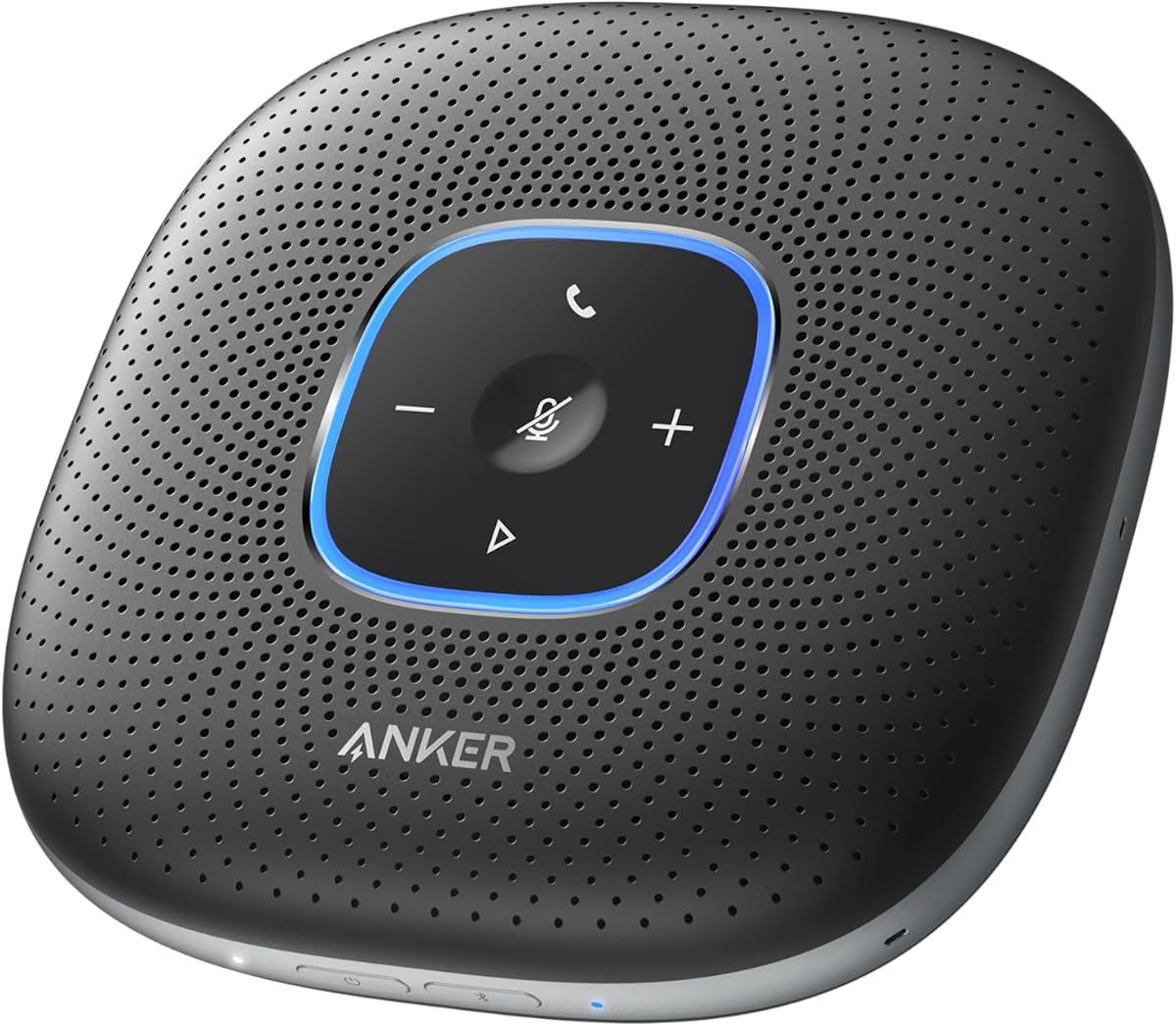
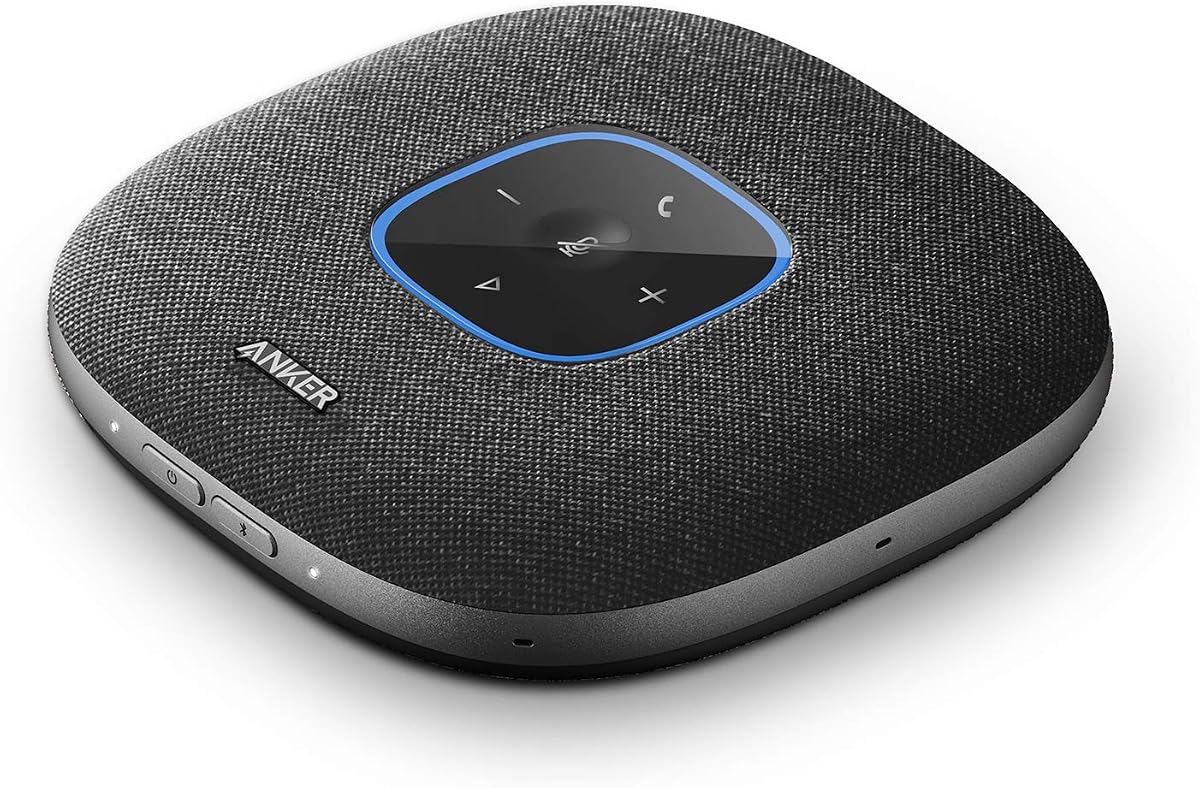
The original Anker PowerConf is a well-rounded home-office speakerphone with six microphones arranged for 360-degree pickup. It carries a 4.4 rating and combines Bluetooth operation with a driver-free USB-C computer connection. Its Voice Radar 3.0 system is designed to reduce noise, cancel echo, and detect multiple speakers, addressing common problems in shared or imperfect home workspaces.
We may earn a commission when you buy through this link, at no additional cost to you.
A major strength is its built-in 5,200mAh battery, which Anker states supports up to 24 hours of calls. PowerIQ technology also allows the unit to charge compatible devices, a useful secondary function when outlets are scarce. Automatic voice balancing adjusts for differences in speaking volume and distance from the speakerphone, helping participants sound more consistent.
The main limitation is that six microphones do not guarantee superior performance in every room. Very large spaces may still require careful placement, and buyers who want highly detailed environmental controls should compare the stated features with newer models that emphasize beamforming or advanced AI cancellation. Even so, the PowerConf offers a credible feature set for daily calls and small meetings.
This model is a sensible recommendation for someone who values long battery life and flexible connectivity without requiring a premium specialist device. Its Zoom certification and compatibility with popular conferencing platforms make it especially approachable for remote workers. Place it centrally, keep the USB-C or Bluetooth link stable, and it can become the audio centerpiece of a compact home-office meeting routine.
The six-microphone 360-degree arrangement is designed to capture participants from different directions. That makes the device useful when people are spread across a desk, small dining table, or compact meeting area.
The stated 24-hour battery makes the PowerConf attractive for users who hold frequent calls and want to avoid keeping the unit tethered to a desk. The charging function adds convenience when mobile devices also need power.
We may earn a commission when you buy through this link, at no additional cost to you.
The Anker PowerConf S330 is built for people who want a dependable computer speakerphone without pairing routines or battery management. Its 4.4 rating reflects a broadly capable device, and the included USB-C-to-USB-A adapter makes it easier to use with computers that require the older connector.
We may earn a commission when you buy through this link, at no additional cost to you.
Four high-sensitivity microphones provide 360-degree voice pickup within a stated three-meter range. That is more than adequate for a compact home office and many small workspaces. The custom DSP-based voice enhancement is intended to reduce background noise, while the 1.75-inch driver and passive bass radiators give the speaker enough body for music as well as speech.
Its wired-only nature is the defining trade-off. The S330 is best for a fixed desk where reliability and quick setup matter more than the ability to carry calls into another room. It also lacks the long battery specification highlighted by several neighboring models, so remote or mobile use is not its central strength.
For a dedicated office computer, the S330 may be the most uncomplicated option in this roundup. Connect it, choose the speakerphone in the conferencing application, and begin the call. It is particularly attractive for workers who dislike Bluetooth pairing, want stable audio, or plan to keep the same setup every day.
A wired connection avoids pairing interruptions and gives a permanent workstation a focused conference device. The included adapter broadens compatibility with common desktop and laptop ports.
Smart voice enhancement targets background distractions, while the larger driver and passive radiators provide a more satisfying sound profile than a tiny laptop speaker. That balance works for both meetings and music.
We may earn a commission when you buy through this link, at no additional cost to you.
The Anker PowerConf S3 is a well-equipped option for users who want wireless freedom, computer connectivity, and detailed microphone coverage. Its six-microphone array supports 360-degree voice pickup, while the customized DSP algorithm performs real-time voice optimization and background-noise reduction. The result is designed to keep remote participants from hearing inconsistent or distant voices.
We may earn a commission when you buy through this link, at no additional cost to you.
Bluetooth 5 and USB-C make it appropriate for both phones and laptops. Anker states that it works with popular online-conferencing platforms, and its app control gives users a central place for device settings. The 24-hour call-time claim also puts it among the strongest choices for mobile schedules, while double-talk processing helps when conversation overlaps.
The benefits come with trade-offs. App control is convenient but adds a configuration layer that some users will not need. Six microphones provide solid room coverage, although the Lenovo and Yealink options claim larger pickup ranges. If you routinely conduct meetings in a large space, compare those stated coverage figures before deciding.
The S3 is a strong middle ground for a home office that needs to handle both scheduled calls and occasional team meetings. It is especially useful for people who move their working setup regularly because battery power and two connection methods reduce dependence on a fixed cable. Choose it when voice consistency, portability, and familiar conferencing compatibility are priorities.
Automatic volume balancing compensates for differences in loudness and distance from the device. That can make collaboration feel more natural when one participant sits farther away.
Bluetooth serves mobile use, while USB-C serves a computer. The switch between those methods allows the same speakerphone to support a desk, meeting room, or traveling workspace.
We may earn a commission when you buy through this link, at no additional cost to you.
The Yealink SP92 stands out with a rich set of features for small meeting rooms and home offices. Its 4.1 rating is the lowest among the ten products, but the specification sheet is impressive: an omnidirectional microphone, a 50mm speaker, AI noise cancellation, full-duplex operation, echo cancellation, and a stated pickup radius of up to four meters.
We may earn a commission when you buy through this link, at no additional cost to you.
Microsoft Teams certification is a meaningful advantage for organizations standardized on that platform. Yealink also states compatibility with Zoom, Google Meet, Cisco Webex, and other unified-communications environments across Windows, macOS, and Android. The device provides Bluetooth 5.3, USB-C with an adapter, and an optional BT51C dongle, giving it a flexible connection strategy.
The 20-hour battery supports extended call schedules, and the stated two-and-a-half-hour recharge time makes the unit manageable for regular use. It also weighs only 276 grams and includes a carrying case. Against these strengths, the lower rating may reflect unknown long-term experience or listing variability, and users who need only one connection type may consider it unnecessarily elaborate.
The SP92 is a compelling budget-oriented choice for small teams that want team-platform certification and more voice-processing features than a basic wired speakerphone offers. It is especially useful when the home office also serves as a temporary meeting room. Just confirm that your preferred platform, computer, and optional accessories align with your workflow.
The four-meter radius and omnidirectional microphone give the SP92 room coverage beyond a typical single-person desk. It is intended for groups of roughly four to eight people.
Yealink says the AI system can filter more than 1,000 types of noise, including keyboard taps and air-conditioning hum. This focus is highly relevant in shared homes and busy workspaces.
We may earn a commission when you buy through this link, at no additional cost to you.
The Lenovo Speakerphone 6000 is the most technically expansive model in this guide, led by eight beamforming microphones and a stated pickup range of up to five meters. Its 4.5 rating is also among the strongest. The microphones use AI noise cancellation to prioritize voices, making this speakerphone a natural fit for a larger home office or hybrid meeting area.
We may earn a commission when you buy through this link, at no additional cost to you.
Its 50mm speaker and full-duplex operation support natural simultaneous listening and speaking. The dedicated Microsoft Teams button and USB certification make it particularly convenient for Teams users, while USB-C or USB-A wired connections support plug-and-play operation. Bluetooth 5.3 supports simultaneous connections to two devices, and the unit can remember up to eight paired devices.
Lenovo rates it for 12 hours of talk time, which should cover many workdays of scheduled calls. IP54 dust and splash resistance adds durability for shared environments, and the included carrying case improves portability. The broad feature set may feel excessive for one-person calls, while buyers using other platforms should confirm that their preferred software handles the controls as expected.
This model is the strongest choice here for a home office that regularly becomes a small conference room. Its microphone array and longer stated pickup range create margin when participants sit far from the unit. Choose it when room coverage, durability, and multi-device flexibility matter more than a minimal footprint or strictly wired operation.
Eight microphones can focus on speech from different positions while suppressing ambient distractions. That helps when a home desk doubles as a meeting area for several colleagues.
Keeping two Bluetooth devices connected can simplify transitions between a phone and computer. Wired USB remains the most direct option for Teams-oriented enterprise use.
We may earn a commission when you buy through this link, at no additional cost to you.
The Jabra Speak 510 MS is a focused conference speaker for softphone and mobile-phone calls, with a 4.6 rating that places it near the top of this group. It supports both Bluetooth and USB and can connect to a PC, tablet, or smartphone, covering the most common endpoints in a home-office environment.
We may earn a commission when you buy through this link, at no additional cost to you.
HD Voice is the standout audio feature, supporting clearer conversation quality while keeping the device's purpose straightforward. Its battery lasts for up to 15 hours of talk time and offers four days of standby, which is adequate for many working days between charges. The supplied compatibility information specifically mentions Windows Microsoft Lync and Microsoft Office Communicator.
The main question is whether those older platform references reflect the user's actual needs. Modern conferencing software may still work through standard Bluetooth or USB audio, but users operating within managed business environments should verify current support. The 15-hour battery rating is also shorter than the 20- and 24-hour figures offered by several competitors.
For professionals whose calls center on softphones, mobile devices, or a straightforward mix of Bluetooth and USB, the Speak 510 MS remains a practical choice. It delivers strong listed customer feedback, recognizable conferencing features, and broad device support without an elaborate specification list. It is best viewed as a focused, established work speakerphone rather than a feature-maximizing model.
Softphone and mobile-phone support reflects the device's roots in professional calling. USB offers a dependable wired route, while Bluetooth makes temporary placement changes easier.
HD Voice support gives the Speak 510 MS a clear purpose for one-to-one conversations, interviews, and compact team discussions where intelligible speech matters most.
We may earn a commission when you buy through this link, at no additional cost to you.
The Jabra Speak 710 UC delivers a more premium conference experience with immersive sound, HD Voice, and an omnidirectional microphone. Its 4.6 rating reflects strong user satisfaction, while certification for Zoom and Google Meet makes it an appealing choice for the two most prominent meeting platforms in many home-office workflows.
We may earn a commission when you buy through this link, at no additional cost to you.
Jabra states that the speaker supports in-room coverage for up to six people. That capacity suits a compact meeting area without trying to cover a large boardroom. Plug-and-play connectivity through USB or Bluetooth reduces setup friction, and the included Link 370 adapter provides the necessary USB connection path.
The portable design weighs 195.4 grams and includes a protective travel pouch, so users can easily move the speaker between a home desk, office, or hotel workspace. Its limitations are that the listed information gives fewer battery specifics than many competing models, and six-person coverage falls short of options explicitly designed for larger groups.
This is the premium recommendation for professionals who value sound quality, recognized certification, and straightforward portability. It is particularly well suited to solo professionals, small teams, and traveling workers who want a dedicated conference device for Zoom or Google Meet. Choose it when polished audio and quick deployment outweigh a desire for advanced AI controls or very large room pickup.
The emphasis on immersive sound gives the Speak 710 UC a premium feel for music, presentations, and voice calls. Omnidirectional pickup helps participants speak naturally from around the room.
The low weight, compact format, and included pouch make it straightforward to pack the speaker with a laptop. Setup remains simple when the user moves to an unfamiliar room.
We may earn a commission when you buy through this link, at no additional cost to you.
The YAMAHA YVC-330 is an advanced conference phone with a 4.6 rating and a feature set aimed at polished meeting audio. SoundCap technology combines far-field noise reduction, self-silence, three unidirectional microphones, and human voice activity detection to emphasize speech and reduce distracting sounds from outside the useful pickup zone.
We may earn a commission when you buy through this link, at no additional cost to you.
Its connection options are notably broad. USB 3.0, NFC, and Bluetooth let the device fit different room and device arrangements, while the included six-foot USB cable supports a direct laptop connection without an adapter. YAMAHA states compatibility with Zoom, Google Meet, Skype, and other conference tools, making it broadly relevant across communication platforms.
The illuminated controls are a thoughtful touch: blue indicates talk mode and red indicates mute, reducing uncertainty during meetings. It is designed for groups of five to eight people. Its position as the most expensive selection in the supplied list makes it a deliberate purchase rather than a budget choice, and NFC may add less value than USB or Bluetooth for most users.
The YVC-330 is a premium recommendation for users who want refined voice detection, automatic microphone control, and flexible connectivity. It fits a home office that also hosts small group meetings, especially when participants appreciate clear mute feedback and minimal interruption. Buyers should verify that its higher-tier feature set addresses a real need rather than paying for unused capabilities.
Far-field reduction and voice activity detection help the microphones distinguish useful speech from background sound. The result is a more controlled conference experience in shared rooms.
Blue and red illuminated states make the speakerphone's operating condition visible across a table. That small detail can prevent accidental interruptions during sensitive calls.
We may earn a commission when you buy through this link, at no additional cost to you.
The N newline Conference Speaker combines two omnidirectional microphones with a stated five-meter pickup range, giving it unusually generous room coverage for its simpler two-microphone design. Its 4.3 rating is respectable, and the AI algorithm's real-time noise reduction and echo elimination target the acoustic problems most likely to disrupt a home-office call.
We may earn a commission when you buy through this link, at no additional cost to you.
Bluetooth 5.1 and USB-C give users both wireless and wired paths, while double-talk support is designed to keep both sides intelligible when speakers overlap. The supplied information also mentions a high-power speaker and sound-cavity design intended to produce fuller music playback. A 12-hour battery covers many individual call days, although it is shorter than the endurance offered by several alternatives.
Its 300-gram weight and stated dimensions make it practical to carry, and the mesh-wrapped appearance suits a professional desktop. The lower rating compared with the leading products suggests it may not offer the same track record or refinement. Buyers should also treat the five-meter range as a placement target rather than a guarantee of equally clear speech from every position in a large room.
The N newline is a value-oriented recommendation for users who want a wide pickup area, modern connection methods, and effective double-talk handling in a portable format. It works particularly well for small-to-medium meetings and mixed home-office use. Place it centrally and keep background noise under control to gain the most from its stated processing features.
The omnidirectional pair and stated 16-foot pickup distance let participants move around a small-to-medium space. Central placement remains important for consistent volume.
Double-talk processing is intended to preserve speech when both ends talk at once. This makes the device useful for collaborative conversations rather than only formal one-speaker-at-a-time calls.
We may earn a commission when you buy through this link, at no additional cost to you.
The best home-office speakerphone is the one that captures your intended participants clearly, connects to your devices without friction, and suits the physical limitations of your workspace. Evaluate these factors before narrowing the field.
Microphone pickup is more important than raw speaker output when clarity depends on where people sit. A single-person desk can work with a modest array, but a dining table used for meetings benefits from six or eight microphones and an omnidirectional or beamforming pattern. Stated ranges help with initial placement, although real performance depends on room acoustics, furniture, and competing ambient sound. A speaker placed centrally will generally serve a group better than one tucked near the primary user.
Home offices often contain keyboard noise, household sounds, video fans, and reflective surfaces. Real-time noise reduction, far-field filtering, voice activity detection, and automatic level balancing can improve intelligibility by emphasizing speech. Echo cancellation is equally important because a speakerphone microphone can otherwise pick up the playback it is producing. The products here describe these features in different ways, so buyers should look for solutions tailored to speech rather than assuming every noise-control label performs identically.
Bluetooth provides a clean wireless desk and makes portable use easier, while USB can offer a more stable computer connection with fewer pairing variables. Some models include adapters for computers with USB-A ports, while others are optimized for USB-C. Platform certification can add confidence for enterprise users, but standard audio connections are usually more flexible for mixed environments. Check the exact port on your computer, the meetings you run, and whether your organization restricts uncertified USB devices.
Full-duplex operation allows both sides to hear and speak at the same time, which better resembles a natural conversation. Double-talk features take this further by attempting to preserve overlapping speech. They are particularly valuable in collaborative meetings, interviews, and home offices where interruptions or rapid exchanges are common. Basic models may still work effectively, but they are less likely to provide the same processing focus as devices that explicitly advertise these functions.
Battery endurance determines whether a device can remain wireless throughout a workday. Stated figures in this guide range from 12 to 24 hours of talk time, though exact conditions can vary. A long battery is useful for people who travel between rooms or use the speakerphone for both calls and music. Wired-only designs avoid charging entirely and often provide the simplest fixed-desk experience. Always consider recharge time and whether the device can charge a phone when a battery is built in.
A home-office speakerphone may also need to serve a shared office, hotel room, or temporary meeting area. Lightweight construction, a compact footprint, and an included carrying case simplify transport. Durability features such as IP54 dust and splash resistance can be useful in shared workspaces, although they do not make every device waterproof. Choose portability when travel is routine and prioritize fixed placement, room coverage, or larger controls when the device stays at home.
A conference speakerphone should render speech clearly, but many users also stream music between meetings. Larger drivers and passive radiators can provide more body and bass than a computer's built-in speakers. Voice-focused processing still matters most: the output should remain intelligible without sounding overly compressed or artificial. If you work alone and rarely play audio through the device, microphone quality should take priority over a larger speaker.
Setup should not require specialist technical knowledge. Plug-and-play USB, familiar Bluetooth pairing, illuminated mute states, and dedicated meeting controls all reduce daily friction. App control can be helpful for adjusting settings but is unnecessary for basic calls. Dedicated Teams buttons suit organizations standardized on that platform, whereas cross-platform users may prefer a more neutral interface. Consider how often you adjust controls and whether a physical button is easier to identify under pressure.
Start by placing the speakerphone in the center of the area where participants will sit, rather than directly in front of one person. Connect it to the computer with USB for a direct meeting-audio link, or pair it with the computer or phone over Bluetooth. Charge the device fully before its first long call, then update any associated app and confirm that the correct speaker and microphone are selected in the conferencing software.
For the best results, keep the unit within its stated pickup range and avoid placing it beside a fan, window, television, or other sound source. Speak at a natural volume rather than leaning toward the microphone. Use the physical mute control before sensitive comments or background conversations, and verify the illuminated or displayed status. When moving between offices, carry the device in its case and recheck the operating system's selected audio input and output after reconnecting.
Clean the exterior with a soft, dry or lightly dampened cloth and keep liquids away from openings and charging ports. Do not use abrasive cleaners, and avoid charging a wet device. Review the manufacturer's guidance for battery care and software updates. Periodically test a short call after firmware or application changes so that connectivity and microphone behavior remain predictable.
A dedicated speakerphone is usually better for calls because it places microphones farther from the computer fan and other distractions while providing full-room pickup. It also lets other people speak naturally without passing around headphones. A good headset may still be preferable for frequent private calls, focused interviews, or noisy open-plan work.
Most models in this guide use standard computer audio and can work with multiple online meeting platforms. Jabra Speak 710 UC is specifically certified for Zoom and Google Meet, while the Yealink SP92 is certified for Microsoft Teams and states compatibility with other leading platforms. Check the manufacturer's current platform list and your organization's device policies before buying.
USB is usually the simplest and most consistent option for a permanent computer desk because it avoids pairing issues. Bluetooth is more convenient when you want a cleaner setup, use a phone, or move the speaker between rooms. Several models support both, allowing you to use the most practical connection for each meeting.
A compact desk often works with a shorter-range unit, while a table used by several people benefits from the four- to five-meter ranges claimed by some models. Range is only one factor: placement, room reflections, and background noise also affect clarity. Center the device and keep it away from household sound sources.
Yes, and they can still be worthwhile for a home office. A dedicated device often produces clearer speech than a computer microphone, offers physical mute control, and can handle occasional group meetings without another setup. For solo calls, prioritize simplicity and device compatibility over the largest microphone array.
Noise reduction suppresses unwanted background sounds such as keyboards, fans, or household activity. Echo cancellation prevents the speakerphone microphone from picking up audio played through its own speaker, which would otherwise create an echo for remote participants. Effective calls benefit from both functions.
The right endurance depends on whether the device is portable or stays on a desk. Models here state talk times from 12 to 24 hours, while wired-only options avoid the issue entirely. Frequent travelers should favor longer stated call time, and fixed-desk users may prioritize stable wired performance instead.
Only if your organization uses Microsoft Teams as a standard platform or restricts USB peripherals. Certification can provide stronger assurance about controls and platform behavior. Users who regularly switch among Teams, Zoom, Google Meet, and other tools may prefer broader compatibility and simple audio-device switching.
The Jabra Speak 510 (2025 Edition) is the best all-around recommendation because it combines a strong 4.7 rating with flexible USB and Bluetooth connectivity, broad device support, and a portable format. The N newline stands out as the best budget-oriented option for buyers seeking a generous five-meter pickup range and modern connections, while the Jabra Speak 710 UC is the premium choice for polished portable audio and certification for Zoom and Google Meet.
Before buying, prioritize the room you actually use. Match microphone range to the number and location of participants, confirm that USB or Bluetooth suits your computer, and decide whether long battery life matters more than a permanently wired setup. For smaller workspaces, the Jabra Speak 510 or N newline is likely sufficient; larger hybrid meeting rooms may benefit from the Lenovo Speakerphone 6000 or Yealink SP92.
Ratings, stock, and product details can change, and current listings may also be updated after this guide was prepared. Check the latest specifications, platform compatibility, included accessories, and current price before making a final purchase. That final verification helps ensure the speakerphone integrates cleanly with your devices and remains useful for the way you work.