Nitecore NU25 MCT UL
4.7Editor score
400-lumen ultralight output
Warm, neutral, cool colors
45-hour maximum runtime
Our best caving headlamp guide compares 10 rechargeable, waterproof options for brightness, beam control, comfort, battery life, and safety.
A caving headlamp must balance bright illumination, controlled beam patterns, long runtime, secure fit, and dependable resistance to moisture and dust. Underground, a lamp that works perfectly on an open trail may still be too large, short on runtime, or difficult to operate while negotiating ropes, passages, and uneven terrain.
We compared 10 headlamps using the specifications and feature details supplied for each model. The list covers maximum output, beam distance, lighting modes, charging options, water resistance, weight, removable-battery flexibility, mounting versatility, and comfort for extended underground exploration.
Each review identifies the strongest reasons to consider a particular lamp along with its trade-offs. The top selections range from a lightweight value model to a high-output premium option, while the full guide explains what to prioritize. Product prices and availability can change, so check current listings before buying.
4.7Editor score

4.6Editor score

4.5Editor score
The following comparison highlights each lamp's output, beam reach, protection rating, and most important functional advantage. It provides a quick way to distinguish focused cave expedition tools, compact ultralights, removable work lights, and feature-rich all-around headlamps.


The Fenix HM60R V2.0 combines 1600 lumens of maximum output with a 185-yard beam distance, earning it a 4.6 rating and the Editor's Choice position. Its spotlight, floodlight, red-light, and flash options cover nearly every common cave-lighting task without forcing the user to carry several different lamps.
We may earn a commission when you buy through this link, at no additional cost to you.
Lightweight operation is one of its strongest qualities. At 6.1 ounces, the HM60R V2.0 is light enough for long underground routes, while the IP68 rating and impact resistance up to two meters provide reassuring protection in wet, dusty, and confined environments. The four spotlight levels and three floodlight levels make it easy to balance brightness and battery use.
Its main limitation is that the 1600-lumen maximum trails the 2700- and 3000-lumen options in this list, although that difference matters less when the beam is used efficiently. The long 292-hour low-mode runtime, 2.5-hour USB-C recharge, glove-friendly top switch, and side brightness control more than compensate for the lower ceiling.
This is the strongest all-around recommendation for cavers who want a capable expedition lamp without an oversized or overcomplicated design. It is especially suitable for parties that need spot, flood, signaling, and emergency functions in one package, as well as anyone who values long runtime and dependable IP68 protection over having the highest possible output.
The four spotlight levels help reveal distant passage details, while the three floodlight levels illuminate floors, walls, and larger chambers. Red-light settings and flash mode preserve dark adaptation or improve signaling when a brighter beam would be disruptive.
USB-C fast charging, a hidden waterproof port, and up to 292 hours on low support extended trips. The 6.1-ounce weight and impact-resistant construction also reduce the burden of carrying a lamp through technical passages.
We may earn a commission when you buy through this link, at no additional cost to you.
The Fenix HM71R delivers up to 2700 lumens and a 251-yard beam distance, giving it the output needed for large chambers, deep route finding, and demanding underground conditions. Its 4.5 rating reflects a powerful, adaptable design, with a 500-lumen floodlight and a detachable right-angle body.
We may earn a commission when you buy through this link, at no additional cost to you.
The most unusual feature is the quick-release mounting system. Removing the lamp from its headband converts it into a right-angle flashlight that can be clipped to a pocket, stood upright, or attached to a magnetic surface. That flexibility is useful when hands are needed for ropes, equipment, or passage work.
The HM71R includes a reflective, breathable wide headband and is rated IP68, with stated extreme-temperature tolerance from -31 to 113 degrees Fahrenheit. Its stated low-mode runtime is 48 hours, which is less generous than the HM60R V2.0's maximum runtime, and the full-size high-output configuration is bulkier than compact ultralights.
Cavers who need serious reach and output should give this model priority, especially when the ability to reposition the light matters. It is a premium choice for technical exploration, large passage systems, and lead cavers who want a powerful spot-and-flood headlamp that can become a right-angle task light.
The quick-release clip lets the light move from the headband to a pocket, metal surface, or freestanding position. This makes the HM71R useful when fine motor control or both hands are required during rope work and equipment handling.
A 2700-lumen spotlight with a 251-yard reach handles large spaces and distant route features. The 500-lumen floodlight adds broad coverage for chamber navigation, camp tasks, and close inspection.
We may earn a commission when you buy through this link, at no additional cost to you.
The Coast XPH30R has a 4.7 rating, the highest among the featured models, and pairs that strong reception with 1200 lumens of turbo output. Its twist-focus system changes the beam between shorter-range flood illumination and a concentrated long-range beam without leaving halos or hot spots.
We may earn a commission when you buy through this link, at no additional cost to you.
The detachable design broadens its usefulness. Removing the body from the head strap and bracket creates a handheld flashlight with a magnetic base, allowing it to be placed on metal surfaces or held independently. This makes the XPH30R useful for inspecting a passage, working on gear, or lighting an area outside the headlamp's usual orientation.
The specified outputs are 1200 lumens in turbo, 500 in high, 160 in medium, and 46 in low. Stated runtimes range from 6.75 hours on high to 28 hours on low. Its IP54 rating provides water resistance and one-meter drop protection, but it does not offer the same full-submersion protection as the IP67 and IP68 models in this guide.
The XPH30R is a good choice for cavers who value one-hand beam adjustment and compact physical size more than absolute maximum output or the highest ingress-protection rating. Its 4.37-ounce weight, detachable magnetic body, and four output levels make it particularly adaptable for route-finding and equipment tasks.
The twist-focus optic lets the user move between broad nearby coverage and a tighter distance beam. That transition is valuable when a passage opens suddenly, a junction appears, or distant formations need closer inspection.
The removable body and magnetic base let the light work as a conventional handheld flashlight. Cavers can illuminate ropes, equipment, passage walls, and task areas without repeatedly removing the entire head assembly.
We may earn a commission when you buy through this link, at no additional cost to you.
The Blukar Rechargeable Headlamp has a 4.6 rating and emphasizes flexibility rather than extreme output specifications. Its main white light, side white light, all-white-light mode, flashing mode, and red main-light mode provide several ways to illuminate close tasks, see around obstacles, and remain visible to companions.
We may earn a commission when you buy through this link, at no additional cost to you.
A rotating main-lens zoom changes the light between flood and spotlight behavior, while the lamp head tilts through 90 degrees. The elastic headband is breathable, non-slip, adjustable for different head sizes, and can also be secured to a helmet, making it a practical entry point for recreational or beginning cave exploration.
The integrated non-removable battery simplifies charging through the included USB cable and fully charges in about five hours. The IPX6 rating and sealed battery compartment provide water and shock protection, although the integrated pack cannot be swapped in the field. Compared with expedition-focused models, fewer published cave-specific details are provided.
This headlamp suits cavers who want lots of accessible modes and a low-cost way to add lighting to a helmet. It is best for short outings and moderate conditions where portability, easy charging, and multiple white-light patterns matter more than maximum lumen output or spare-battery flexibility.
Five modes cover forward illumination, side-area lighting, a combined pattern, flashing, and red output. Rotating the lens adds another layer of control by changing the beam's focus without requiring a separate tool.
A 90-degree adjustment keeps the beam aimed where the wearer is looking, while the adjustable elastic band provides a secure fit. The headstrap can also be attached to a helmet for activities where a standalone band may slip.
We may earn a commission when you buy through this link, at no additional cost to you.
The Coast XPH34R combines 2700 lumens of maximum output with a 295-meter beam distance and a stated maximum runtime of 120 hours. Its 4.6 rating reflects a capable high-output design, while Pure Beam Twist Focus allows the user to transition between a broad flood beam and a concentrated spot.
We may earn a commission when you buy through this link, at no additional cost to you.
Its rechargeable-dual-power system adds valuable trip resilience. Depending on the included battery configuration, the lamp can use a ZITHION rechargeable battery or compatible alkaline batteries, reducing the risk of being stranded if one power source is unavailable. The detachable body and magnetic tailcap also allow use as a handheld flashlight.
The aluminum housing is described as dust-resistant and storm-resistant, and the product carries an IP54 rating with one-meter drop protection. That protection is robust for ordinary outdoor use, though it is less comprehensive than the IP67 or IP68 ratings offered by several other selections. Its physical size is also greater than that of ultralight models.
Cavers who require long-distance reach, substantial maximum output, and flexible battery options should consider the XPH34R seriously. It is particularly compelling for large cave systems and longer expeditions where a powerful spot beam, long total runtime, or backup alkaline power could be more valuable than minimum weight.
The ability to use compatible alkaline batteries adds a layer of redundancy beyond the rechargeable configuration. That flexibility can be valuable on extended trips, subject to safe battery handling and proper use of the manufacturer.
Pure Beam Twist Focus provides smooth movement between edge-to-edge flood coverage and a sharper distance spot. The 295-meter maximum reach helps when navigating large spaces or identifying distant route features.
We may earn a commission when you buy through this link, at no additional cost to you.
The Coast WPH20R is built around versatility, offering 2000 lumens, six light modes, and both spot and flood beams. Its 4.5 rating suggests a solid overall reception, while the ability to operate as a headlamp, clip light, or magnetic work light makes it adaptable to changing cave tasks.
We may earn a commission when you buy through this link, at no additional cost to you.
IP67 protection is one of its most important features for underground use. It is rated for full submersion up to one meter and for protection against dust and debris, giving it stronger ingress protection than the IP54 and IPX6 models in this list. USB-C recharging adds convenient power management for regular trips.
The pocket and hat clips provide alternatives to wearing the main headband, and the magnetic work-light configuration can free the user's hands. A lockout feature helps prevent accidental activation during transport or storage. The supplied information does not provide a detailed maximum-runtime figure, so users should consider that when planning a long expedition.
The WPH20R is a strong fit for cavers who want one lighting platform that can move between head, hat, pocket, and magnetic placements. It is especially useful for technical tasks, camp activities, and situations where a conventional headlamp position may interfere with helmets, packs, or other equipment.
The pocket clip, hat clip, and magnetic work-light setup make the lamp easy to reposition. A cave explorer can use it on the head for travel, clip it to gear, or place it on a suitable metal surface during equipment work.
The IP67 rating protects against dust, debris, and full submersion up to one meter. That makes the WPH20R a reassuring option for wet passages, drip zones, and environments where fine grit is common.
We may earn a commission when you buy through this link, at no additional cost to you.
The BLACK DIAMOND Icon 700 provides 700 lumens, IP67 waterproof protection, and a 4.4 rating. Its feature set is deliberately expedition-oriented, with full-strength and dimmed illumination, strobe, red night-vision, and lockout functions for route finding, campsite work, and emergencies.
We may earn a commission when you buy through this link, at no additional cost to you.
Its battery system is one of the model's most useful qualities. Four AA batteries are included, and the lamp can also use a separately sold Rechargeable Icon Battery. That creates a familiar and potentially flexible power platform, although users choosing rechargeable operation need to account for the additional accessory.
The rugged housing and secure headband are designed for demanding environments, and the IP67 rating supports use in rain, snow, and wet alpine conditions. The trade-off is output: 700 lumens is lower than the 1200-, 1600-, 2000-, 2700-, and 3000-lumen maximums offered by several competitors, though sustained use depends more on mode selection and runtime.
The Icon 700 is best suited to cavers who prioritize rugged construction, established battery options, and red-light control over maximum brightness. It is a credible expedition choice for long routes and backup use, particularly for teams that value familiar AA cells and a locking function during transport.
Four included AA batteries make the power system easy to understand and replenish. The optional Rechargeable Icon Battery adds a reusable path for users who prefer not to rely on disposable cells.
Red night-vision output helps preserve dark adaptation, while strobe and dim modes cover signaling and close work. Lockout reduces the chance of a light switching on unexpectedly inside a pack.
We may earn a commission when you buy through this link, at no additional cost to you.
The BLACK DIAMOND Storm 500-R produces up to 500 lumens and carries a 4.4 rating. It is a straightforward rechargeable headlamp for cavers who prioritize low weight, a comfortable fit, and adaptable lighting over high-output performance or a detachable battery system.
We may earn a commission when you buy through this link, at no additional cost to you.
Its integrated 2400 mAh lithium-ion battery charges through micro-USB, eliminating disposable batteries and reducing the need to carry spare cells. Full-strength, dimming, strobe, and red night-vision modes cover general movement, close tasks, signaling, and lower-light situations without requiring another lamp.
The compact, low-profile housing and adjustable headband are designed to remain stable during active outdoor pursuits. This makes the Storm 500-R useful for general caving trips, but the 500-lumen ceiling may be less persuasive for explorers who routinely cross large chambers or need to identify distant features.
The older micro-USB connection is the main practical drawback compared with modern USB-C models, since it requires the appropriate cable. Despite that limitation, the Storm 500-R is a good pick for weight-conscious users who want a rechargeable, dimmable, red-light-equipped lamp with a secure everyday fit.
The integrated battery eliminates disposable cells and reduces pack volume. A 2400 mAh capacity supports the lamp's full, dim, strobe, and red-light functions, while micro-USB keeps the design straightforward.
The low-profile housing reduces bulk, and the adjustable headband provides a secure fit. That combination is useful on longer routes where a large lamp can become tiring or catch on clothing and equipment.
We may earn a commission when you buy through this link, at no additional cost to you.
The OLIGHT Perun 3 has the highest stated maximum output in the group at 3000 lumens, along with a 4.6 rating and an IP68 waterproof and dustproof rating. It is built for cavers who want exceptional brightness combined with a detachable right-angle configuration and several low-light options.
We may earn a commission when you buy through this link, at no additional cost to you.
Its proximity sensor is a distinctive safety-oriented feature. When the headlamp detects an object immediately after turbo mode is selected, it automatically reduces output power. This can help avoid an unexpectedly intense beam at close range and is especially relevant in narrow passages where walls or formations may be close to the wearer.
The lamp includes red light with two brightness levels and a flashing mode for signaling, while large metal side buttons are designed for straightforward operation. The body detaches from the headband, and the headband uses a stainless-steel mount, breathable construction, and an anti-sweat rubber strip. Maximum runtime is stated at 20 days, although actual output and runtime vary by mode.
The Perun 3 is a compelling choice for high-output cave exploration, particularly for users who appreciate automatic brightness adjustment and a detachable right-angle form. Its size and feature density may be more than a casual user needs, but serious cavers gain substantial illumination and thoughtful proximity protection.
The proximity sensor reduces turbo output when it detects an object before or within 0.5 seconds of activation. This helps maintain a more practical beam in confined passages and around nearby cave features.
A 3000-lumen maximum, 20-day stated runtime, and IP68 rating cover demanding illumination and wet conditions. Detaching the body turns the headlamp into a right-angle flashlight for pockets, surfaces, and close task work.
We may earn a commission when you buy through this link, at no additional cost to you.
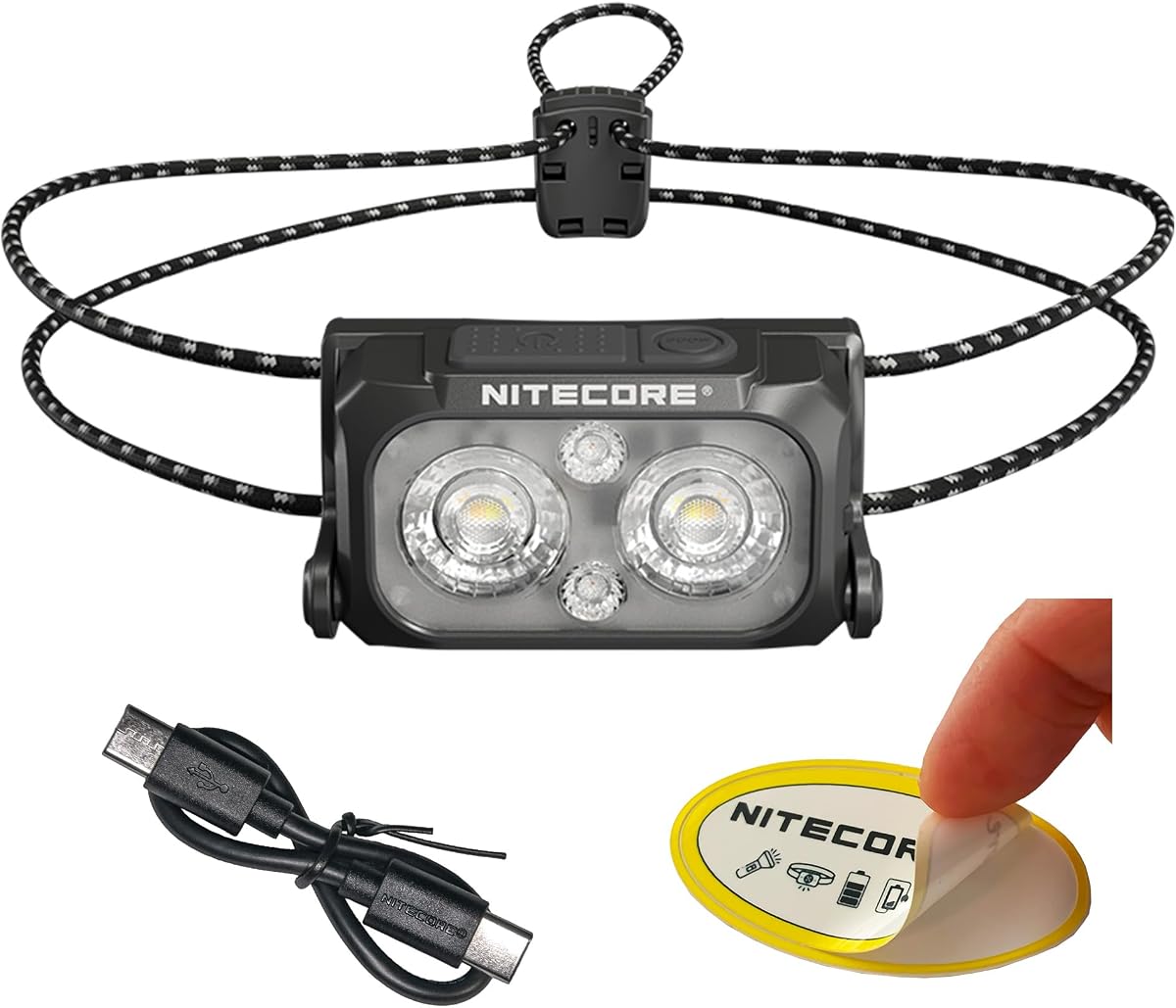
The Nitecore NU25 MCT UL weighs just 1.65 ounces and has a 4.7 rating, making it an exceptional choice when every gram matters. Its 400-lumen maximum and 144-yard beam distance are more restrained than the output of larger models, but the low weight and 45-hour maximum runtime suit long, mobility-focused trips.
We may earn a commission when you buy through this link, at no additional cost to you.
Multi-color temperature control distinguishes it from many compact headlamps. Users can switch among warm, natural, and cool white output, allowing the beam to suit close inspection, general visibility, or enhanced outdoor contrast. SOS, beacon, and an auxiliary red light with three outputs add emergency and signaling functions.
USB-C recharging takes just over an hour, and a power-status indicator helps prevent an unexpected loss of light. The durable PC housing carries an IP66 rating and one-meter impact resistance. That provides strong water and dust protection, although it remains below the IP67 and IP68 ingress ratings of several alternatives.
The NU25 MCT UL is the pick for cavers who need a compact, rechargeable light that will not become tiring during long walks, crawls, and climbs. It is less suited to huge chambers or distant route finding than 2000- to 3000-lumen models, but its color control, runtime, and low weight create a compelling specialist package.
Warm light is easier on the eyes and useful in rain or fog, neutral white supports natural close-range visibility, and cool white can improve outdoor contrast. This control is unusually useful in a lightweight format.
At 1.65 ounces, the lamp is easy to forget during long approaches. USB-C charging, a status indicator, and up to 45 hours of runtime reduce the logistical burden of maintaining a small but capable light.
We may earn a commission when you buy through this link, at no additional cost to you.
Choosing a caving headlamp involves balancing illumination, protection, endurance, and fit. The right choice depends on passage size, trip length, team equipment, and whether priority is placed on distance reach, close-range detail, or minimal carried weight.
Maximum lumens provide a useful indication of potential brightness, but beam reach and beam shape are equally important underground. A high-output flood beam illuminates nearby walls and passages, while a focused spot reaches farther down a tunnel or across a large chamber. The Fenix HM71R and Coast XPH34R reach 2700 lumens, the OLIGHT Perun 3 reaches 3000, and the Fenix HM60R V2.0 delivers 1600 with a 185-yard beam distance. The Nitecore NU25 MCT UL produces 400 lumens with a 144-yard reach, making it better suited to close-range exploration than very large chambers. Output should be reserved for navigation and situations that genuinely require it, since sustained high settings consume more energy and can reduce useful visibility when shining into nearby reflective surfaces.
A cave route often requires several kinds of illumination. Flood lighting reveals floor texture, nearby formations, and the shape of a passage, while spot lighting identifies distant turns, breaks in the floor, and larger chamber features. Some headlamps provide a smooth transition between both, as seen in the Coast XPH30R and XPH34R with their twist-focus systems. The Fenix HM60R V2.0 separates spotlight and floodlight into dedicated selections and adds red light and flash. Red illumination can help preserve night adaptation, and flashing modes provide visible signaling. A caving group may also benefit from a headlamp that detaches and stands or magnetically attaches to equipment, reducing the need to aim the beam by turning the wearer's head.
Caves are commonly damp, dusty, and physically demanding, so ingress protection should be considered alongside brightness. The Fenix HM60R V2.0, Fenix HM71R, and OLIGHT Perun 3 carry IP68 ratings, while the Coast WPH20R and BLACK DIAMOND Icon 700 have IP67 ratings. The Nitecore NU25 MCT UL is rated IP66, the Blukar model is IPX6, and the Coast XPH30R and XPH34R are IP54. These standards are not interchangeable: higher numbers within the same IP system generally indicate stronger protection against solids and water. Impact resistance is also useful, ranging from one-meter protection on several Coast and Nitecore models to impact resistance up to two meters on the HM60R V2.0. Ratings reduce risk but do not make a lamp indestructible.
Runtime is determined by output and mode, so maximum figures should be treated as limits rather than all-day expectations. The Fenix HM60R V2.0 offers up to 292 hours on low, the Nitecore NU25 MCT UL reaches 45 hours, and the Coast XPH34R lists 120 hours. USB-C is the most convenient common charging standard in this group, appearing on the HM60R V2.0, HM71R, Coast XPH30R, Coast WPH34R, Coast WPH20R, and Nitecore NU25 MCT UL. Micro-USB on the BLACK DIAMOND Storm 500-R requires a compatible cable, while the BLACK DIAMOND Icon 700 accepts four AA batteries and can use a separate rechargeable battery. The Coast XPH34R offers rechargeable-dual-power flexibility, while the Blukar and several Fenix models use integrated batteries.
A headlamp that performs well in a specification list can still become uncomfortable during a long approach, crawl, or climb. Weight matters, but strap construction, adjustment range, and stability are equally important. The Fenix HM71R uses a reflective, breathable wide headband, and the OLIGHT Perun 3 adds a stainless-steel mount, breathable construction, and an anti-sweat strip. The Blukar model has an adjustable, breathable elastic band and can be secured to a helmet. The BLACK DIAMOND Storm 500-R emphasizes a low-profile design and secure adjustable band. Head size, helmet compatibility, layers, and wet conditions all affect fit, so the best choice is one that remains stable without shifting when the wearer looks upward or moves through tight spaces.
Caving trips often involve carrying ropes, helmets, clothing layers, food, water, and other safety equipment, so every gram of headlamp weight can matter. The Nitecore NU25 MCT UL is the lightest featured option at 1.65 ounces. The Coast XPH30R weighs 4.37 ounces, the Fenix HM60R V2.0 weighs 6.1 ounces, and higher-output models may feel bulkier. Lightweight does not automatically mean better, because a tiny housing may offer fewer controls or lower output, while a larger model may provide stronger construction, easier operation, and more versatile mounting. Consider the entire kit rather than the lamp alone, especially for expedition parties carrying substantial shared equipment.
Cave controls are often used with cold, wet, muddy, or gloved hands, making simple switches and clear mode selection important. The Fenix HM60R V2.0 uses a glove-friendly top switch for selecting spotlight or floodlight and a side switch for brightness. The OLIGHT Perun 3 features large metal side buttons, and the Coast WPH20R includes lockout to prevent accidental activation. The Blukar headlamp uses one-touch selection across five modes, while the Fenix HM71R separates spot and flood functions. Look for a layout that can be understood without removing the lamp, and test it in advance under gloves or with wet fingers so a mode change does not unexpectedly brighten the beam.
A detachable lamp can become more than a wearable light. The Coast XPH30R and XPH34R detach into handheld flashlights with magnetic bases, and the Fenix HM71R converts into a right-angle flashlight for pocket, surface, or magnetic placement. The Coast WPH20R can operate as a headlamp, clip light, or magnetic work light. The OLIGHT Perun 3 also detaches into a right-angle flashlight. These arrangements are valuable when inspecting equipment, illuminating the ceiling during a belay, lighting a passage floor, or freeing both hands. They are especially convenient for a group because one person can continue wearing the main light while another uses a detached unit as a task lamp.
Before entering a cave, charge the lamp fully and confirm that the battery, charging port, and housing are dry and in good condition. Learn every mode before departure, including how to change beam type, activate red light, and operate lockout. A quick hands-on check with gloves is useful because cave lighting may be adjusted in cold, damp, or muddy conditions.
Use a lower illumination level for routine travel whenever the passage permits it. Save brighter output for wide chambers, route-finding, and tasks requiring greater reach, and use red light when preserving night adaptation matters. Aim the beam toward the floor or one side of the passage rather than directly into other cavers' eyes, and keep the lens clean so moisture and mud do not reduce the beam.
After the trip, switch the lamp off, disconnect any charging cable, and wipe away dirt and moisture. Let the headband dry before storage, and keep the charging port clear of debris. Store the lamp in a cool, dry place according to the manufacturer's instructions, recharge it before a long trip, and periodically check the battery and physical seals for wear or damage.
The right output depends on the cave, but many explorers prefer at least 500 lumens for ordinary passages and 1,000 lumens or more for large chambers. More light is not always better because high output consumes more power and can create glare on close walls. A model with dedicated flood and spot modes is usually more useful than a single very bright beam.
An IP67- or IP68-rated lamp provides stronger protection against water and dust than lower-rated alternatives, making it a sensible choice for damp or muddy caves. No rating makes a lamp immune to damage, however. The housing, lens, switches, and charging port should still be protected, and damaged equipment should not be taken underground.
Red light can be useful because it tends to preserve dark adaptation better than white light, helping with map reading, route finding, and low-light observation. Several featured models include red modes, while others provide signaling flashes. Red is usually a supplementary mode rather than a replacement for the brighter white beam needed on technical terrain.
No. Bright output is valuable in large spaces, but beam control, runtime, comfort, and waterproofing can be more important during long trips. A high-output lamp used continuously may consume power faster, while a focused and flood combination can make lower output surprisingly effective. Choose the brightest mode when the environment calls for it rather than leaving it on continuously.
One capable model can cover navigation, close inspection, signaling, camp tasks, and emergency lighting when it offers a broad range of modes. A detachable right-angle or magnetic configuration adds even more flexibility. For prolonged expeditions, some cavers still prefer a second compact light or backup power, so they can continue if the primary lamp fails.
Use a spotlight for distant turns, route features, and large chambers because it concentrates light farther down the passage. Use a floodlight for nearby walls, floor detail, rope work, and close inspection. Models such as the Coast XPH30R and XPH34R allow smooth transitions, while the Fenix models provide dedicated spotlight and floodlight selections.
A full charge before departure is the safest habit, particularly for long or remote routes. Rechargeable models can lose part of their capacity over time, and a final top-up at home is easier than managing a low battery underground. Carry a suitable cable and verify the port type, as the list includes both USB-C and micro-USB models.
A stable, adjustable, breathable headband is essential, particularly when wearing a helmet or moving through confined spaces. Low weight also reduces fatigue, while large glove-friendly switches and lockout improve control. The most comfortable choice is one that stays secure without pressing excessively on the forehead during long approaches and technical sections.
The Fenix HM60R V2.0 is the most balanced overall choice, combining 1600 lumens, long runtime, IP68 protection, glove-friendly controls, and dedicated spot, flood, red, and flash modes. The Fenix HM71R is the premium upgrade for cavers who need 2700 lumens, longer reach, and a detachable right-angle body, while the Nitecore NU25 MCT UL is the standout lightweight and budget-oriented option.
For most cave trips, prioritize the beam pattern, ingress protection, comfortable fit, and realistic runtime rather than maximum lumen output alone. High-output models suit large chambers, while ultralight models suit long approaches. Detachable bodies, red light, magnetic bases, dual-power options, and lockout can add value where the route and tasks justify them.
Features, ratings, prices, and availability can change, so verify the current product listing before purchase. Check the latest specifications, included accessories, charging requirements, and warranty terms, and choose the headlamp that best matches the expected cave conditions and duration of your trip.