
Focal 300ICLCR5
5.0Editor score
Three-way overhead speaker design
Dual five-inch woofers
Built-in acoustic back-box
This guide compares the best ceiling speakers for Dolby Atmos, covering sound quality, dispersion, installation, channel flexibility, and overall value.
Ceiling speakers can transform a Dolby Atmos home theater by placing sound overhead, reducing the visible equipment around the room, and creating a more continuous listening experience. The best models balance focused directional output with enough off-axis dispersion to cover main seating and secondary listening areas.
The products in this guide were compared using their published specifications, driver configurations, ratings, installation details, and stated Dolby Atmos or home-theater applications. The list includes conventional in-ceiling speakers, a specialized overhead three-way model, a height speaker pair, and a multi-speaker system for larger installations.
Each review explains the speaker's strongest contribution, practical trade-offs, and ideal room placement. Ratings reflect the supplied customer feedback rather than personal testing, while retail pricing and availability can change, so readers should verify current product details and installation requirements before purchasing.
5.0Editor score

4.8Editor score

4.7Editor score
This side-by-side overview compares driver layouts, dispersion, installation considerations, and home-theater positioning across ten ceiling or height-speaker options designed for immersive audio systems.




The Micca M-8C is a two-way in-ceiling speaker rated 4.7 stars, with an eight-inch poly woofer and a pivoting one-inch silk dome tweeter. Its most useful Dolby Atmos feature is the adjustable tweeter, which lets an installer direct the high frequencies toward the main listening area rather than relying entirely on the ceiling's natural reflections.
We may earn a commission when you buy through this link, at no additional cost to you.
The speaker's 40Hz-to-20kHz frequency response, 8-ohm impedance, and 100-watt power handling make it suitable for overhead effects in a conventional home-theater system. A 6dB crossover network supports a coherent transition between the woofer and tweeter, while the large poly woofer provides more substantial low-frequency output than a small ceiling speaker would ordinarily offer.
Installation is designed to remain straightforward. Built-in mounting tabs secure the speaker to drywall or wood panels without separate brackets or boxes, and the rimed grille protrudes only slightly from the ceiling. Paintable white finishes let the grille blend into the surrounding surface. The absence of an integrated back box may make it less consistent in acoustically unpredictable ceiling cavities, and it is sold individually.
This is a strong choice for buyers building a Dolby Atmos room one speaker at a time, particularly when placement flexibility and full-range capability matter more than a factory-sealed enclosure. It can also serve as a main or surround ceiling speaker, although using multiple units will require matching models and careful amplifier-channel planning.
The pivoting tweeter gives installers a direct way to shape overhead coverage. Aiming it toward the seating area can improve clarity for effects such as rain, aircraft, and moving dialogue without requiring complicated electronic correction.
The eight-inch woofer and response down to 40Hz distinguish this model from compact in-ceiling speakers. That capability makes it useful for more than occasional overhead effects when the amplifier and room layout are appropriate.
We may earn a commission when you buy through this link, at no additional cost to you.
The Klipsch CDT-5800-C II is a single in-ceiling speaker with a 4.7-star rating. Its Controlled Dispersion Technology and horn-loaded design focus the sound in a controlled direction, making it relevant to home theater installations where overhead speakers need to reach a defined seating area without flooding adjacent rooms.
We may earn a commission when you buy through this link, at no additional cost to you.
Treble and midbass attenuation switches provide useful tonal controls. These can help an installer reconcile ceiling placement with a room's reflections, nearby walls, or the output characteristics of the main speakers. Because the listed product includes these adjustment options, it offers more placement flexibility than a basic fixed-output ceiling speaker.
The available product information is concise, so buyers should verify the exact driver layout, physical dimensions, and mounting requirements on the retailer listing. It is offered as one white speaker rather than a pair, which means a balanced left-and-right overhead system requires two units. The controlled-dispersion approach is especially relevant when speakers are mounted close to walls or positioned in a room with an irregular seating arrangement.
The CDT-5800-C II is a practical choice for a dedicated theater where precise overhead coverage is the priority. It may also serve as a surround or outdoor in-ceiling speaker, as indicated by the full product title, but its specific environmental suitability should be confirmed against the manufacturer's installation guidance before exposure to outdoor conditions.
Controlled Dispersion Technology is the defining feature for immersive cinema use. It gives the installer a way to concentrate sound where it is needed while reducing unwanted spill into adjacent spaces.
Separate treble and midbass attenuation switches can help resolve common ceiling-speaker challenges. They are especially useful when a ceiling speaker must work alongside separate main and surround speakers that have different tonal signatures.
We may earn a commission when you buy through this link, at no additional cost to you.
This matched pair of Klipsch CDT-5800-C II speakers is rated 4.7 stars and provides a more direct route to a balanced overhead channel than purchasing two individual units. Each speaker combines an eight-inch Cerametallic woofer with a one-inch titanium tweeter and Controlled Dispersion Technology.
We may earn a commission when you buy through this link, at no additional cost to you.
The driver's size supports a home-theater role in which effects need more body than a small ceiling speaker can provide. Titanium tweeters are intended to reproduce high-frequency detail, while controlled dispersion helps keep the ceiling sound focused on the audience. The included SlimTrim magnetic grille keeps the profile low and gives the ceiling a finished appearance.
As a two-speaker set, the package is convenient for a front overhead or front height configuration. Buyers creating a larger four-speaker Atmos layout will need to purchase another matched pair. The product information does not provide full cutout and depth figures, so the physical requirements should be confirmed before cutting the ceiling, particularly in rooms with joists, ducts, or wiring.
This pair is a strong middle-ground choice for a two-channel overhead installation because it combines a convenient package with a larger woofer and adjustable acoustic behavior. Its main advantage over a single-speaker purchase is the reduced need to source a second matching unit separately.
Buying a pair simplifies left-right channel matching and provides a complete two-speaker overhead package. This is especially convenient for first-time Atmos installers who want a focused front-height effect without assembling a larger system.
The eight-inch Cerametallic woofer and titanium tweeter provide a more full-bodied starting point than a small point-source ceiling speaker. Their larger scale can help overhead effects feel connected to the front soundstage.
We may earn a commission when you buy through this link, at no additional cost to you.
The Klipsch R-1650-C four-pack is a complete set of compact in-ceiling speakers rated 4.6 stars. With four matching units, it is well suited to the common four-speaker overhead pattern used in larger Dolby Atmos configurations, including front and rear height positions.
We may earn a commission when you buy through this link, at no additional cost to you.
Each speaker uses a six-point-five-inch polymer-cone woofer paired coaxially with a one-inch polymer-dome tweeter. The large motor structure is designed for high sensitivity, while the coaxial tweeter distributes clear high frequencies over a broad area. That wide coverage can help all listeners hear consistent height effects from different positions in the room.
The mounting system is designed for straightforward installation, and the paintable aluminum grille adds rust protection in moisture-prone spaces such as bathrooms, kitchens, and saunas. Each unit has a 9.5-inch overall diameter and requires an 8.3-inch cutout. Buyers should still check the unspecified mounting depth and local ceiling structure before cutting.
This four-pack is most compelling when a room plan calls for four overhead positions and the buyer wants a matched set. It is less suitable for a modest two-speaker configuration because the package includes more speakers than that layout needs. Its compact dimensions, however, make it easier to accommodate than many larger designs.
A four-speaker package simplifies the creation of front and rear height channels. Matching drivers across all positions can improve the sense of a unified overhead sound field when the amplifier processes the channels correctly.
The 8.3-inch cutout, compact 9.5-inch diameter, and easy-install mounting system make the speakers practical for residential ceilings. The aluminum grille can be painted to coordinate with the ceiling rather than remaining visually prominent.
We may earn a commission when you buy through this link, at no additional cost to you.
The Klipsch CDT-5650-C II carries a 4.8-star rating, the highest among the listed conventional ceiling options. Its one-inch titanium tweeter and Controlled Dispersion Technology make it a persuasive choice for overhead placement, where directing energy toward the audience is essential.
We may earn a commission when you buy through this link, at no additional cost to you.
The broader CDT platform also incorporates treble and midbass attenuation switches, allowing installers to adapt output to the room. These controls are valuable because ceiling reflections can make the same speaker sound different from a bookshelf speaker placed near ear level. A controlled tweeter and adjustable tonal balance help the overhead channel integrate more closely with the rest of the theater.
This listing includes one white speaker, so buyers need two for a conventional stereo overhead pair and four for a front-and-rear four-speaker arrangement. The supplied product information does not include cutout or mounting-depth measurements, making physical verification particularly important. Its stated suitability for integrated whole-house audio systems also indicates broader placement flexibility beyond a dedicated theater.
The CDT-5650-C II earns the Editor's Choice position because it combines a strong rating, focused dispersion, a detailed tweeter, and useful controls. It is a particularly good match for installers who want more placement control than a basic fixed-dispersion ceiling speaker provides.
Treble and midbass attenuation can address audible differences between overhead and ear-level speakers. Those controls make it easier to integrate the CDT-5650-C II with a front stage designed around separate stand-mounted or floorstanding models.
The one-inch titanium tweeter supports articulate high-frequency effects. Combined with controlled dispersion, it provides a practical method for delivering overhead detail without relying exclusively on diffuse ceiling reflections.
We may earn a commission when you buy through this link, at no additional cost to you.
The Yamaha NS-IC800 pair includes two eight-inch two-way in-ceiling speakers and carries a 4.7-star rating. Its relatively high maximum input power of 140 watts gives the receiver or amplifier considerable operating headroom, while the 50-watt nominal rating provides a clearer guide to normal drive levels.
We may earn a commission when you buy through this link, at no additional cost to you.
The two-way configuration is designed to cover both low and high frequencies from a single ceiling location. Yamaha lists a maximum frequency response of 28kHz, 8-ohm impedance, a 3.50kHz crossover point, and a dome driver type. Those specifications make the pair suitable for overhead channels in rooms where a broader, less narrowly focused sound field is desired.
The speaker has a 10.9-inch diameter and a listed depth of 4.3 inches. Because the grille is white, it should blend naturally with many standard ceilings, although painting may still be desirable for customization. No adjustable tweeter or back enclosure is identified in the supplied information, so installers may have less directional control than with the Klipsch CDT models.
The matched pair is a sensible choice for buyers who want a straightforward two-speaker overhead installation from an established home-audio brand. It may also work well as a pair of front or rear height speakers, provided placement and room acoustics suit a wider dispersion pattern.
The 140-watt maximum and 50-watt nominal ratings give installers considerable flexibility. This is helpful in a home theater where the same amplifier handles several channels and transient movie effects require headroom.
An eight-inch woofer and dome tweeter cover a broad range in a conventional two-way format. The pair is well suited to overhead use when the goal is room-filling sound rather than narrowly focused output.
We may earn a commission when you buy through this link, at no additional cost to you.
The Focal 300ICLCR5 is a dedicated three-way overhead home-theater speaker with a perfect 5-star rating. Unlike a conventional in-ceiling model simply repurposed for Atmos, its specialized design allows operation as a left, right, or center channel, giving installers several ways to distribute height effects.
We may earn a commission when you buy through this link, at no additional cost to you.
Its driver array is substantial: two five-inch flax-fiber woofers handle bass, a four-inch flax-fiber midrange reproduces the central portion of the spectrum, and a one-inch aluminum-magnesium tweeter delivers high-frequency detail. Dividing the work among three dedicated drivers allows each section to operate within a more appropriate range than a compressed two-way design.
A built-in back box is one of the model's most important technical distinctions. It helps deliver more balanced sound regardless of the surrounding installation and protects the drivers from dust and dirt. That enclosure can also make the speaker's behavior more predictable when it is installed in a ceiling cavity rather than in a wall.
The 300ICLCR5 is the premium choice for a serious dedicated theater where the ceiling is treated as a distinct soundstage. Because it is sold as one speaker, a front overhead pair requires two units. Buyers should confirm cutout dimensions and placement clearances, but the specialized architecture makes this model particularly compelling for high-end Atmos objectives.
The ability to serve as a left, right, or center overhead channel shows that the speaker was designed around immersive cinema rather than general in-ceiling use. That specialization gives installers flexibility when room geometry limits conventional speaker positions.
The built-in enclosure helps protect the internal components and improves consistency between installations. It is a meaningful advantage in a home theater where a different acoustic environment behind each ceiling panel could otherwise affect performance.
We may earn a commission when you buy through this link, at no additional cost to you.
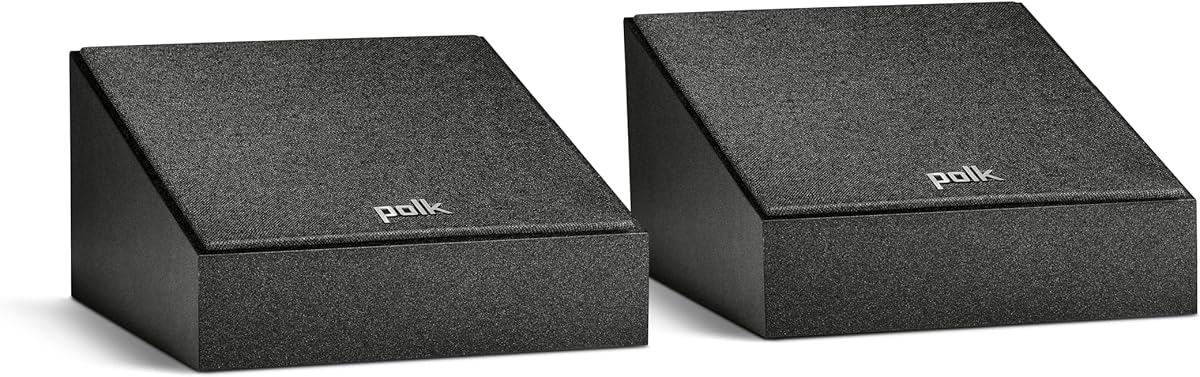
The Polk Audio Monitor XT90 pair provides height effects without requiring holes in the ceiling. Rated 4.6 stars, these compact speakers use a four-inch Dynamically Balanced woofer to add dimensional effects to movies, music, and games when paired with a compatible receiver.
We may earn a commission when you buy through this link, at no additional cost to you.
The supplied information identifies Dolby Atmos, DTS:X, and DTS Virtual:X support. It also states that the speakers can act as a ceiling channel when connected to an AV receiver with a minimum seven-channel configuration. Compatibility with four-ohm and eight-ohm amplifiers and receivers gives the pair broad system-building flexibility.
Placement is a major advantage. The speakers can sit on top of compatible Polk bookshelf or floorstanding models, or they can be wall-mounted using built-in keyhole slots. The Midnight Black finish is designed to blend with modern décor, though unlike a recessed ceiling speaker it remains visible in the room.
This pair is ideal for renters, apartment dwellers, or anyone who cannot cut into a ceiling. It can also serve as a temporary or flexible upgrade path for a home theater. The main trade-off is visual prominence and potentially less elevated placement than a true in-ceiling model.
The XT90 pair creates overhead effects while remaining completely independent of ceiling construction. It is a practical solution for finished homes, rentals, and rooms where recessed installation is undesirable.
Built-in keyhole slots and top-of-speaker placement give users several ways to position the height channels. That flexibility allows the pair to be introduced gradually or integrated with a broader Polk theater system.
We may earn a commission when you buy through this link, at no additional cost to you.
The Polk Audio 70-RT is a three-way in-ceiling speaker with a 4.7-star rating. Its seven-inch subwoofer, two-and-a-half-inch midrange driver, and 0.75-inch dome tweeter divide the frequency range across three dedicated drivers, helping the speaker combine substantial output with broad coverage.
We may earn a commission when you buy through this link, at no additional cost to you.
Polk lists a total frequency response from 34Hz to 27,000Hz and highlights its patented Power Port technology for bass performance. In a Dolby Atmos setup, that low-frequency capability can help overhead effects feel grounded and substantial. The multi-driver arrangement also offsets reflective ceiling surfaces more effectively than a compact two-way design, according to the supplied description.
Installation uses a precision flange, optional pre-construction brackets, and a patented rotating-cam system intended to create a secure, vibration-free fit. The wafer-thin sheer grille is designed to disappear into the ceiling and can be painted to match the decor. A large driver array demands accurate cutout measurements and adequate cavity depth, so installers should inspect the ceiling structure before proceeding.
The 70-RT is a strong choice for a dedicated theater that wants a substantial ceiling speaker with broad coverage. It can also work as a main ceiling speaker in a multipurpose room. Its size and deep enclosure are the principal compromises, but the three-way design provides a more specialized alternative to smaller two-way models.
The seven-inch subwoofer and response down to 34Hz give the 70-RT considerably more low-frequency substance than typical compact in-ceiling speakers. That can make overhead effects feel more physical and integrated with the rest of a theater system.
The paintable wafer-thin grille is intended to blend into the ceiling after finishing. This allows the substantial three-way hardware to remain installed without visually dominating a carefully decorated media room.
We may earn a commission when you buy through this link, at no additional cost to you.
The Acoustic Audio by Goldwood CS-IC83 system includes five matching eight-inch three-way in-ceiling speakers and carries a 4.7-star rating. A five-speaker package can serve a large room that needs multiple overhead and surround positions without requiring separate purchases of every unit.
We may earn a commission when you buy through this link, at no additional cost to you.
Each speaker uses a high-rigidity poly-cone woofer, a Poly Mica midrange, and a 13mm soft-dome tweeter. The stated frequency response is 40Hz to 20kHz at 95dB and 8 ohms, while passive three-way crossovers distribute the frequency bands. The wide-dispersion design is appropriate for rooms where multiple seats should hear the overhead and surround effects.
The pressure-lock mounting system clamps to drywall, and the specified round cutout is 9.45 inches with a mounting depth of 3.78 inches. Overall speaker diameter is 10.83 inches. Removable grilles and durable ABS housings can be painted to match the decor, while spring-loaded raw-wire connections simplify hookup to a compatible receiver or amplifier.
The system is a convenient way to build a substantial home-theater speaker layout. The listed amplifier range is 10 to 350 watts per channel, and CL3-rated in-wall wire is called for. The fixed five-speaker quantity may not match every room, but the package is efficient for buyers who need a balanced group of ceiling channels.
Five matched units provide a straightforward path to a room with several ceiling channels. The quantity can serve a planned theater arrangement without assembling separate main, surround, and overhead speaker sets.
Wide dispersion and 95dB sensitivity support consistent output across listening positions. Those characteristics are particularly useful when a room has a wide sofa, multiple rows, or speakers placed closer to the ceiling than to the main seating area.
We may earn a commission when you buy through this link, at no additional cost to you.
The right ceiling speaker depends on room geometry, channel count, acceptable visual presence, and the degree of directional control required. Reviewing these factors before installation helps prevent incompatible speaker placement and unnecessary remodeling.
Two-way speakers use a woofer and tweeter, making them a common and relatively straightforward choice for overhead effects. Three-way models add a dedicated midrange driver, allowing the tweeter and large woofer to operate in a narrower frequency range. This can improve clarity, control, and bass performance, but it also requires more physical space behind the ceiling.
Choose a two-way model for compact installations and a three-way model when output, clarity, or dedicated overhead performance are priorities. Match the architecture to the size of the room rather than assuming that more drivers always produce better results.
An Atmos ceiling speaker should deliver clear overhead cues to the audience. A pivoting or horn-loaded tweeter can focus high frequencies toward the seats, while a conventional wide-dispersion design may provide more consistent coverage across a large or irregular seating area. Controlled Dispersion Technology is particularly relevant when nearby rooms must remain isolated from spillover.
Look for a model whose coverage pattern suits the ceiling height and seat position. Directional control is useful in dedicated theaters, while broader dispersion can be beneficial in a family room with wide seating or more than one listening area.
A minimal two-speaker height layout may suit a compact theater, while four overhead speakers can improve front-to-rear coverage in a larger room. A five-speaker bundle can streamline a more extensive installation, and dedicated models may support left, right, or center overhead roles. The receiver must provide the corresponding speaker channels and processing controls.
Count the intended overhead positions before selecting a package. Buying an individual model can make it easier to match existing speakers, while a matched set reduces channel-matching concerns and simplifies a room-wide installation.
Check both the maximum and nominal power ratings, along with impedance. The listed products include examples from 50-watt nominal Yamaha models to a 140-watt maximum rating, while the Acoustic Audio package specifies a 10-to-350-watt per-channel range. These figures should be evaluated alongside receiver output and the number of connected channels.
Impedance affects amplifier loading, and the listed designs generally use eight-ohm configurations except for the Polk Monitor XT90, which is stated as compatible with four- and eight-ohm receivers. Use a receiver or amplifier capable of safely driving the selected load and verify multi-channel power requirements.
A visually simple grille does not guarantee easy installation. Ceiling speakers require a correctly sized cutout, sufficient mounting depth, and clearance from joists, ducts, pipes, wiring, and structural supports. Published dimensions vary substantially, from the Micca M-8C's 9.4-inch cutout and 3.5-inch depth to the CS-IC83's 9.45-inch cutout and 3.78-inch depth.
Measure the available cavity and consult the current manufacturer drawing before cutting. If depth is limited, prioritize a compact two-way model. If a large three-way design fits, verify that the grille and flange can sit flush against the finished ceiling.
The area behind the ceiling can affect consistency, particularly when joists create irregular cavities. A model with an integrated back box, such as the Focal 300ICLCR5, offers a more controlled acoustic environment and protects the drivers from dust and dirt. Models without an enclosure may be lighter and easier to fit but should be evaluated carefully in exposed cavities.
Choose an enclosed design when predictable performance and installation consistency matter most. For open-backed models, inspect the cavity, reduce accidental airflow paths where practical, and ensure the mounting is stable and free from vibration.
Ceiling speakers often sound different from speakers positioned near ear level because ceiling and wall surfaces create reflections. Adjustable treble, midbass, or tweeter controls can help a ceiling speaker blend with the main front stage. The Klipsch CDT models offer attenuation switches, while the Micca uses a pivoting tweeter for directional placement rather than tonal switching.
If the system combines speakers from different brands, look for flexible controls and an AV receiver with room correction. These features cannot solve poor placement, but they can improve the match between overhead channels and the primary speakers.
A recessed in-ceiling speaker is visually discreet and can place the acoustic source above the listener, but it requires construction work and careful planning. A height speaker can sit on top of a front speaker or be wall-mounted, making it easier to add to an existing theater. The Polk Monitor XT90 demonstrates the latter approach with keyhole mounting slots and compatibility with a minimum seven-channel receiver.
Choose recessed speakers for a permanent, polished installation and height speakers for flexibility, shorter-term upgrades, or rooms where drilling is not appropriate. Either approach still benefits from deliberate placement and compatible processing.
Plan the full channel layout before cutting any ceiling openings. Identify the receiver's Dolby Atmos capabilities, map the primary seating, and assign speakers to the appropriate height, surround, front, or center channels. Place overhead speakers slightly in front of and above the audience when possible, while maintaining symmetry and avoiding placement directly over seating that would make dialogue seem detached from the screen.
Match every ceiling speaker to the receiver's impedance and channel configuration. Run the correct gauge of in-wall cable, keep speaker wires away from power wiring where code requires separation, and test each pair before the grilles are installed. Label the cables clearly, use the supplied cutout template, and secure the mounting clamps according to the manufacturer's instructions.
After installation, power on the receiver at a low level and check every channel for silence, distortion, and correct left-right assignment. Run the receiver's automatic room correction if one is available, then listen to familiar films and music while adjusting height levels, crossover settings, and any attenuation controls. Once satisfied, paint the grilles if desired and clean the housings with a dry or lightly damp cloth without allowing moisture into the openings.
A compatible receiver and correct channel configuration are essential, but ceiling speakers do not have to carry a Dolby Atmos logo to work. A well-positioned two-way in-ceiling model can provide effective height effects. Dedicated three-way or more specialized designs can offer finer control, but the overall system calibration and speaker placement are just as important as the model designation.
A basic room may use two overhead speakers, often placed above the front stage or main seating area. Larger rooms commonly use four to create front and rear height coverage. The number should reflect room size, ceiling geometry, seat count, and the processing channels available on the receiver, rather than a single universal requirement.
Yes, ordinary in-ceiling speakers can serve as overhead channels when they are physically suitable and the receiver provides the required processing. Models with pivoting tweeters or controlled dispersion can be especially practical because they help direct sound toward the audience. Installation quality, crossover settings, and room calibration remain important.
Matching can simplify tonal integration and channel consistency, especially when ceiling speakers also serve as main or surround speakers. It is not always mandatory because receivers can correct level and frequency-response differences, and dedicated overhead effects do not need to be acoustically identical. Controlled attenuation or adjustable tweeters can make mixed systems easier to balance.
Height speakers are easier to add to a finished room and avoid ceiling construction. In-ceiling speakers generally provide a more integrated appearance and can be positioned more directly above the audience. The better choice depends on installation access, visual preferences, room shape, and whether the system needs dedicated overhead speakers or flexible front-height channels.
Check the manufacturer's cutout diameter, overall diameter, and mounting depth before cutting. Also inspect the area behind the ceiling for joists, pipes, ducts, and wiring. These dimensions differ among the reviewed products, so the model should be selected after the available space has been measured rather than afterward.
Many of the listed grilles are designed to be paintable, including the Micca, Klipsch R-1650-C, Polk 70-RT, and Acoustic Audio models. Use a compatible paint method and avoid allowing paint to enter driver openings. Allow the finish to dry fully before installation or grille replacement.
They must be compatible with the receiver's speaker impedance and its available output channels. Dolby Atmos processing also depends on the number and placement of connected speakers, so a receiver with enough channels and correct menu configuration is necessary. The Polk Monitor XT90 specifically calls for a minimum seven-channel receiver when used as a ceiling channel.
The Focal 300ICLCR5 stands out as the premium option because its dedicated three-way design, flexible overhead channel roles, and integrated back box are purpose-built for immersive cinema. The Klipsch CDT-5650-C II offers the highest listed rating and strong directional control, while the Micca M-8C provides a practical budget path with a large woofer and pivoting tweeter.
For other installations, prioritize the number of channels needed, the room's seating geometry, and the space behind the ceiling. A four-pack or five-speaker system simplifies larger layouts, while a dedicated three-way model can offer more refined output. Height speakers such as the Polk Monitor XT90 are valuable when recessed installation is not possible.
Before purchasing, verify the current manufacturer specifications, receiver compatibility, cutout dimensions, and required mounting depth. Retail pricing and availability can change, and on-site acoustics may ultimately determine which placement works best, so leave enough time for calibration and adjustment after installation.

