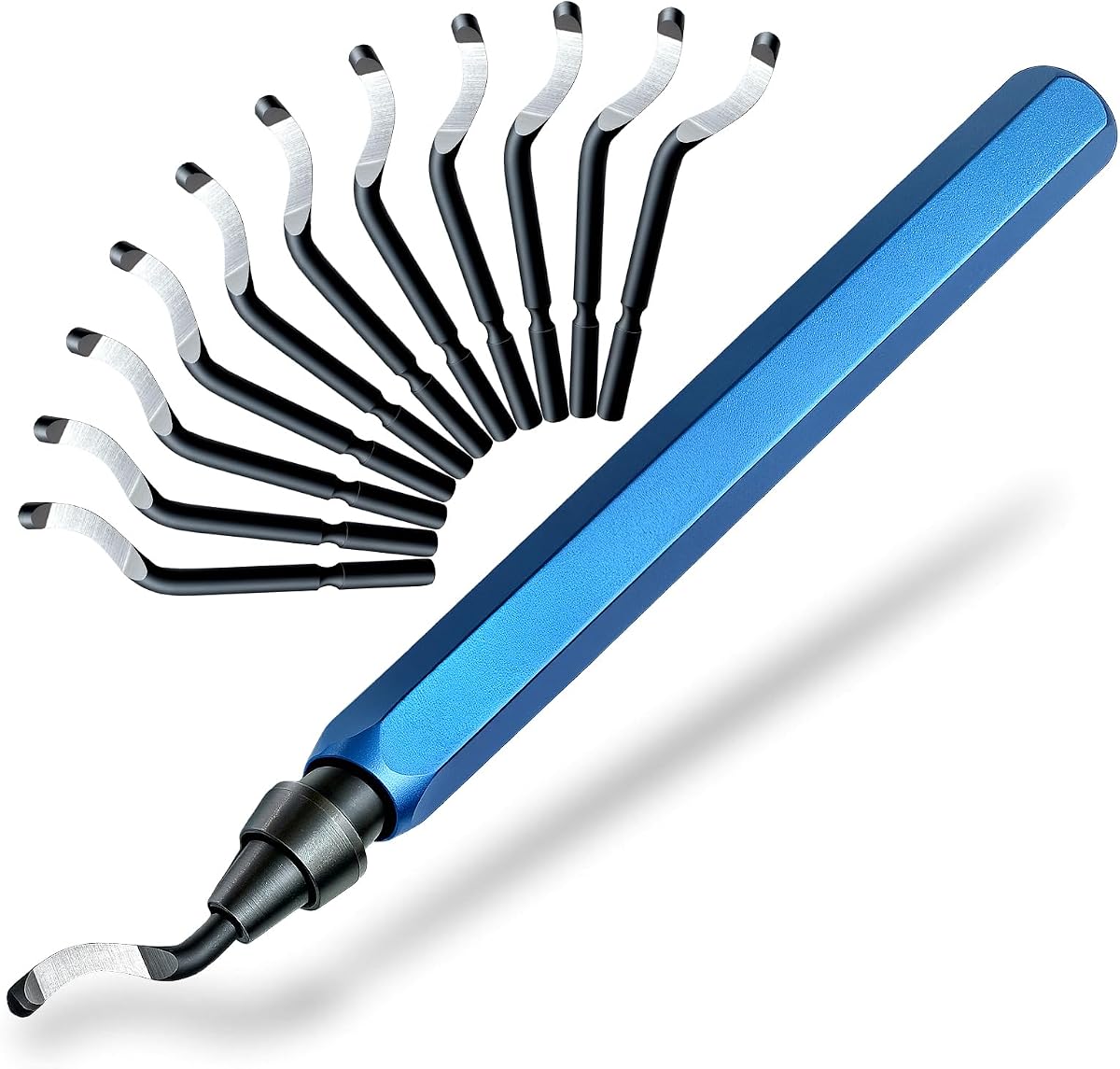
13-Piece HSS Deburring Tool
4.7Editor score
Twelve M2 HSS replacement blades
Non-slip aluminum handle
Tool-free spring-loaded blade changes
Discover the best deburring tool for 3D printing, with ten expert picks compared for blade quality, handling, versatility, durability, and print finishing.
A deburring tool for 3D printing removes the rough edges, support marks, and small imperfections left by extrusion and resin printing. A useful model combines a sharp replaceable blade with a rotating or swiveling head, a secure grip, and a design that lets the cutting edge follow curved and irregular surfaces without damaging delicate parts.
This guide compares ten manual deburring tools based on their stated blade materials, handle construction, replacement blade count, working mechanisms, and compatibility with printed parts, resin, plastic, PVC, and metals. It covers focused single-handle kits as well as broader finishing sets that add files, pliers, cutters, or countersink reamers.
Each review explains the product's strongest features, practical trade-offs, and ideal user. The five-piece set offers the most complete finishing package, while the AFA Tooling models stand out for premium blade specifications and refined aluminum handles. Product availability and seller conditions can change, so readers should verify current listings before purchasing.
4.7Editor score

4.8Editor score

4.3Editor score
The comparison below organizes all ten options by blade configuration, handle type, included accessories, and principal materials. The list includes compact aluminum deburring tools, red ergonomic models, mixed-blade kits, and a comprehensive finishing set for makers who want more than edge cleanup.




This AFA Tooling deburring tool combines a CNC-machined anodized aluminum handle with eleven M2 high-speed steel blades, making it a focused choice for smoothing 3D-printed edges and finishing other materials. Its 4.7 rating reflects a favorable balance of blade durability, handling, and practical construction.
We may earn a commission when you buy through this link, at no additional cost to you.
The blades are tempered to HRC 62–64 and are described as retaining a sharp cutting edge considerably longer than standard carbon steel when working with stainless steel, aluminum, and harder metals. A spring-loaded retention system allows a dull blade to be replaced without reaching for additional tools, while the aluminum body provides a more substantial feel than a light plastic handle.
The primary trade-off is focus: this is a deburring tool rather than a full post-processing system. It does not include files, pliers, cutters, or reamers, so users removing extensive support structures may still need separate tools. The absence of a listed storage case for the spare blades is another minor inconvenience when working away from a bench.
It is best suited to makers who regularly handle both printed parts and light metal fabrication. For quick cleanup of PLA, PETG, ABS, or resin edges, it offers a controlled cutting action and a durable grip. Among straightforward aluminum-handle options, it is a strong, well-rounded recommendation.
The M2 HSS blades are the defining feature, with stated HRC 62–64 hardness and improved edge retention compared with carbon steel. That makes the tool useful when one accessory must handle both plastic prints and tougher metal edges.
The aluminum handle and compact blade housing support careful, incremental passes. This is helpful around seams, corners, and support intersections where excessive force could damage a thin printed wall.
We may earn a commission when you buy through this link, at no additional cost to you.
This 12-blade manual deburring tool is designed for 3D prints, resin, PVC, copper, and other workshop materials. Its 4.5 rating places it among the stronger general-purpose options here, especially for users who want rapid blade changes and a cutter that can rotate through different orientations.
We may earn a commission when you buy through this link, at no additional cost to you.
The rotating head is intended to follow curved, contoured, and irregular edges, which is useful when a printed part includes hollow sections, circular openings, or nonuniform surfaces. The spring-loaded mechanism keeps the blade secure while allowing it to be removed in seconds. A full-metal handle supplies firm tactile feedback and stability during repeated passes.
The specifications identify the blades as HSS and describe them as wear-resistant, but they do not provide the same detailed hardness or alloy treatment found in the premium AFA Tooling descriptions. A dedicated storage case is also not listed. Those details may matter to workshop users who want organized spare storage or tightly specified cutting materials.
This tool is a practical choice for hobbyists and general makers who need to clean resin, plastic, PVC, and metal components with one accessory. It is especially helpful for users who expect the blade to dull during mixed-material work and want numerous replacements immediately available.
The 360-degree rotating head changes the cutting angle as the tool moves. This is valuable on curved walls, drilled openings, and complex printed forms where a fixed blade would need frequent repositioning.
With twelve HSS blades and tool-free changes, a user can keep working without searching for a separate blade. The approach is convenient for long finishing sessions involving multiple materials or several printed parts.
We may earn a commission when you buy through this link, at no additional cost to you.
This 13-piece kit includes one aluminum handle and twelve M2 HSS blades, creating a straightforward core kit for 3D-print cleanup and general trimming. Its 4.7 rating makes it one of the strongest-rated options in the group, while its compact construction suits both workshop drawers and portable use.
We may earn a commission when you buy through this link, at no additional cost to you.
The non-slip aluminum handle offers a steady grip, and the spring-loaded release allows blades to be changed in seconds without extra tools. The swiveling head is described as razor-sharp and designed to remove burrs while producing a smooth, professional finish across resin models, copper, PVC, and various metals.
Its limitations are mostly about scope rather than core performance. There are no diamond files, pliers, countersink reamers, or support-removal tools in the stated configuration, and no storage case is identified. Users with extensive support trees will still need to remove supports before using the blade on the finished surface.
This is the best budget-oriented choice for someone who wants a reliable deburring handle, a generous supply of replacement M2 HSS blades, and simple operation. It is compact enough for a pocket or small toolbox yet substantial enough for routine work on printed parts, pipes, and metal components.
The handle and twelve replacement blades cover the essential deburring workflow without adding unrelated accessories. That focus makes the kit easier to organize and quicker to deploy at a workbench.
A non-slip aluminum surface provides control while the cutter is guided around a part. The balance is useful when stabilizing a delicate printed feature with one hand while guiding the tool with the other.
We may earn a commission when you buy through this link, at no additional cost to you.
This 11-blade HSS deburring tool is aimed at 3D printing, metal fabrication, resin work, and pipe finishing. Its 4.6 rating reflects a versatile design, while the ergonomic anodized aluminum handle distinguishes it from simple plastic-bodied cutters.
We may earn a commission when you buy through this link, at no additional cost to you.
Its stated applications extend beyond standard edge deburring to reaming and chamfering, making it useful for tasks around holes and freshly prepared edges. The handle is described as comfortable and durable, which is advantageous during longer sessions or when several different components are being processed.
The product data does not specify the exact blade alloy beyond HSS, nor does it describe a storage case or included files and secondary tools. As a result, buyers seeking tightly documented metallurgy or an all-in-one finishing package may find other choices more transparent. The broad task list is helpful, though the most detailed instructions should be checked with the listing.
It suits makers who want one hand tool for common post-printing jobs, PVC or copper pipe cleanup, and light metal work. The combination of an aluminum grip and replaceable HSS blades makes it a practical middle ground between compact hobby tools and larger workshop kits.
The listed ability to deburr, ream, and chamfer makes this tool useful around printed holes and machined edges. That broader range is valuable when a project needs both edge cleanup and light opening refinement.
The ergonomic handle and anodized aluminum body are intended to support steady control. They are especially helpful for repetitive trimming of resin, plastic, or metal pieces.
We may earn a commission when you buy through this link, at no additional cost to you.
This AFA Tooling model combines eleven M2 HSS blades with a 148-millimeter CNC-machined anodized aluminum handle, earning the highest rating in the comparison at 4.8. It is engineered for both 3D-print finishing and general metal, plastic, and pipe work.
We may earn a commission when you buy through this link, at no additional cost to you.
The blades are tempered to HRC 62–64 and described as maintaining a sharp edge considerably longer than carbon steel. The handle's 12-millimeter hexagonal shape is intended to prevent rolling and provide a stable, non-slip hold. A high-precision internal swivel allows the blade to follow contours, while the spring-loaded collar supports rapid replacements.
The product listing specifically identifies use on PLA, PETG, ABS, and resin prints, including brims, rafts, and support artifacts. Its balanced aluminum construction is designed to permit delicate pressure without gouging. The main trade-off is that the machined handle gives it more substance than lightweight plastic alternatives, which may matter for users who prefer minimal tool weight.
This is the most balanced choice for serious 3D printing and mixed-material work. It combines detailed blade specifications, refined handling, replacement storage, and broad applications without turning into a large multi-tool kit. It is the top editor's choice for controlled print finishing.
The balanced handle and fine swivel action support light, controlled passes around thin walls, corners, and support marks. This is particularly useful when a printed model is visually finished rather than merely made functional.
M2 HSS blades, HRC 62–64 hardness, CNC aluminum, and an anodized finish create a more refined tool than a basic plastic-handled cutter. The specifications remain understandable and relevant to frequent users.
A dedicated case for the ten spare blades keeps replacements organized. That detail is useful for mobile repair work or shared benches where loose small components could otherwise be misplaced.
We may earn a commission when you buy through this link, at no additional cost to you.
This red-handled AFA Tooling model provides eleven M2 HSS blades, a 5.4-inch CNC-machined anodized aluminum handle, and a 4.7 rating. Its thick knurled grip gives it a workshop-oriented character suited to detailed deburring and steadier control.
We may earn a commission when you buy through this link, at no additional cost to you.
The blades are tempered to HRC 62–64 and designed for wear resistance across stainless steel, copper, brass, aluminum, PVC, and other hard materials. A high-precision internal swivel helps the cutter track curves, holes, and edges, while a spring-loaded collar enables rapid blade changes. The textured grip reduces reliance on a smooth, slippery hold.
Its slightly heavier feel is a trade-off for makers who prefer a very light handheld tool. It also remains an edge-finishing instrument rather than a full support-removal kit, so needle-nose pliers or cutters may still be needed for complex trees. For users already managing metal pipe or machined parts, though, that narrow focus is appropriate.
The tool is a strong choice for users who want secure handling and precise pressure on prints, holes, and metal edges. It is particularly appropriate for workshop environments where a substantial grip and organized spare blade storage are more useful than minimal weight.
The knurled surface gives the fingers a textured purchase, which can improve accuracy around small printed features. The thicker handle also provides a stable counterpoint to the rotating blade.
With suitable M2 HSS blades and a swivel head, the tool can move from PLA and resin to copper, brass, PVC, and aluminum. That range makes it a practical shared accessory for mixed maker spaces.
We may earn a commission when you buy through this link, at no additional cost to you.
This 19-piece kit is the broadest post-processing option in the guide, combining a deburring handle, eleven M2 HSS cutters, five diamond files, needle-nose pliers, and flush cutters. Its 4.3 rating is the lowest among the ten products, but the package itself is more extensive than any alternative listed.
We may earn a commission when you buy through this link, at no additional cost to you.
The listing says the set was developed through multiple rounds of real-world testing and refinement. Its 5.12-inch knurled aluminum grip is designed to spread pressure and reduce hand fatigue, while a spring-loaded locking ring provides quick blade changes. The eleven blades include two geometries for curved and flat surfaces and rotate through 360 degrees.
The diamond files add value where a cutting blade cannot comfortably reach, while the pliers and cutters help remove skirts, rafts, and support structures. The trade-off is that a multi-piece package is inherently bulkier and more complex than a single-handle tool. Its lower rating also suggests it may not appeal to buyers seeking the simplest possible solution.
It is best for makers who want an entire finishing station in one purchase, especially resin users cleaning complex supports and then refining surfaces. Choose it when accessibility and file coverage matter more than a minimal footprint. It earns the premium award for overall post-processing capability rather than for a single specialized feature.
Needle-nose pliers reach confined spaces, while flush cutters snip support structures and excess filament. This reduces the need to buy separate tools before the deburring stage even begins.
Five diamond files offer different grits and shapes for areas the blade cannot reach. They are intended for controlled abrasion on resin, plastic, metal, and printed surfaces.
Separate blade geometries for curved and flat surfaces give the user more than one approach to edge cleanup. The 360-degree head helps these cutters follow contours around finished parts.
We may earn a commission when you buy through this link, at no additional cost to you.
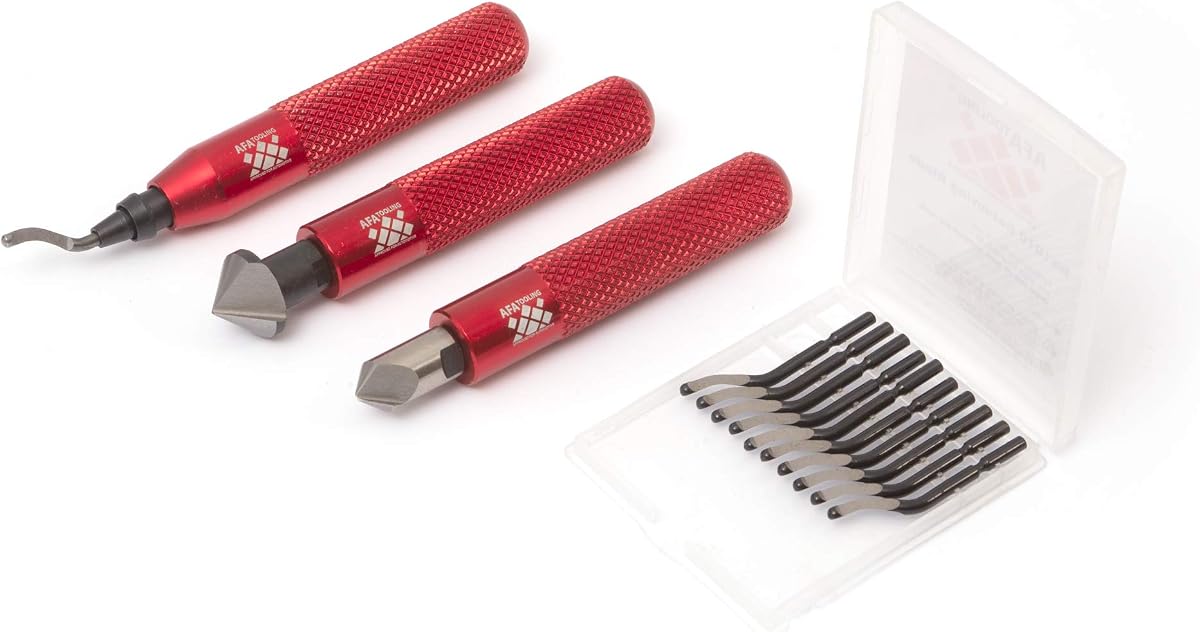
This AFA Tooling set pairs a red CNC handle and eleven HSS deburring blades with two countersink hand reamers. Its 4.7 rating and expanded accessory selection make it especially useful for makers who need to finish both edges and circular openings.
We may earn a commission when you buy through this link, at no additional cost to you.
The swivel head is designed to remove burrs from uneven surfaces, while the two 90-degree HRC 62–64 reamers are intended for countersinking and enlarging openings in wood, plastic, and metal. A knurled aluminum handle supports controlled pressure, and the set includes a protective case for spare blades.
This is a more specialized package than a basic print-finishing tool. Users who only need to smooth rough edges may find the reamers unnecessary, and the extra components require careful storage. In return, the set reduces the need to source separate countersink tools when a printed or machined part requires a clean opening.
It is an excellent fit for fabricators, machinists, and advanced 3D printing hobbyists whose projects involve holes, gears, pipes, or freshly cut parts. For general print cleanup alone, a simpler blade kit may be easier to manage, but for combined edge and hole finishing this set is highly capable.
Two different-sized angled reamers extend the set beyond general deburring. They support controlled countersinking and opening enlargement when a printed part needs to accept a fastener or fit into another component.
The textured aluminum grip gives the user a stable connection to both the deburring head and the reamers. A protective case helps keep the spare blades organized during bench work.
We may earn a commission when you buy through this link, at no additional cost to you.
The ruthex Deburring Tool combines eleven HSS blades with a rotating tip and a metal handle that incorporates spare-blade storage. Its 4.3 rating is shared with the comprehensive 19-piece kit, but this model focuses more narrowly on portable edge removal.
We may earn a commission when you buy through this link, at no additional cost to you.
The built-in compartment holds two extra blades, allowing quick replacement without searching through a toolbox. The quick-release mechanism requires no additional tools, and the included blades are suitable for left- and right-handed use. A 360-degree rotating tip is designed to approach holes, straight edges, and hard surfaces from different orientations.
Material compatibility is broad, covering resin, plastic, PVC, copper, aluminum, stainless steel, wood, and 3D-printed parts. The main limitation is that only two spare blades fit inside the handle, and the package does not include files, pliers, or reamers. Users needing extensive support removal must plan for separate accessories.
This is a convenient option for mobile repair work, shared toolboxes, and makers who switch frequently between printed components and workshop materials. The metal box adds organized storage, while the handle compartment solves the most immediate inconvenience of losing a small replacement blade.
Built-in storage for two replacement blades means a worn cutter can be changed without leaving the task. This is particularly useful on a workbench where tiny metal parts are easy to misplace.
The rotating tip helps users work around holes and straight edges without constantly turning the entire handle. The 360-degree movement supports smoother access to a printed part's geometry.
We may earn a commission when you buy through this link, at no additional cost to you.
This 16-blade AFA Tooling set is the most varied blade collection in the comparison, with three distinct blade types for general edges, hard metals, and small holes. Its 4.7 rating makes it attractive to advanced makers who regularly move between printed components and demanding workshop materials.
We may earn a commission when you buy through this link, at no additional cost to you.
Six BS1010 M2 HSS blades are listed for steel, brass, and aluminum. Five BS1018 M35 cobalt HSS blades target stainless steel and hard metals, while five BK3010 M2 HSS blades suit holes down to 1.5 millimeters. The blades use HRC 62–64 or 65–65–67 hardness ranges and are described as triple quenched and tempered.
The trade-off is that three blade geometries require more attention to organization than a standard interchangeable set. The handle is also described as thick and heavy-duty, which may be less appealing for prolonged precision work on lightweight prints. Even so, the ability to select a blade for the task is a major advantage for metalworking.
This set is best for users who want a single deburring platform for plastics, prints, copper, PVC, aluminum, brass, stainless steel, and auto or gear components. For routine resin cleanup, it offers more capability than required, but for a mixed workshop it provides exceptional material flexibility.
General-purpose, cobalt, and small-hole blades allow the user to match the cutter to the workpiece. That specificity is valuable for metal projects where a single blade geometry may not be ideal for every edge.
M35 cobalt HSS blades and stated HRC 65–67 hardness identify this set as a serious choice for stainless steel and hard metals. The conventional M2 blades still cover printed materials and common metals.
The 0.72-inch aluminum body and knurled grip are designed to resist slipping and reduce hand fatigue during metalwork. Its substantial size is intentional, although it may feel less nimble than a slimmer deburring handle.
We may earn a commission when you buy through this link, at no additional cost to you.
The right deburring tool depends on the material being finished, the geometry of the part, and the other post-processing tools already in your workshop. Blade quality, handle control, replacement availability, and included accessories should be evaluated together rather than treating blade count as the only measure of capability.
For PLA, PETG, ABS, and many resin parts, a sharp HSS blade is generally sufficient, while mixed-material users may benefit from more specialized options. Choose based on the hardest material you expect to trim, not merely the 3D prints in your immediate workflow.
Look for a smooth 360-degree mechanism when a project contains complex geometry. A simpler rotating tip may still work, but controlled swivel action generally provides more natural movement around printed curves and irregular surfaces.
Choose a knurled aluminum handle for detailed work or extended metal finishing. A slimmer design may feel more portable, while a thicker handle can provide stability and reduce fatigue. Comfort should be balanced against the weight you are willing to carry.
Consider the materials you use and how often the blade will dull. Occasional plastic work may need only a few replacements, while repeated resin, PVC, or metal finishing can justify a larger set. Choose storage that fits your workspace and travel habits.
If your prints have intricate support structures, choose a broader finishing kit or budget separately for cutters and pliers. If your work is already free of supports and needs only edge cleanup, a focused deburring tool will be easier to carry and use.
Match the tool to the finish you want rather than assuming one model suits every polymer. For visual pieces, a fine control handle and additional files may be more useful than a large replacement count. For functional parts, quick removal of rough edges is usually the priority.
Prioritize the system you will actually maintain. Large kits need deliberate organization, while a focused tool with a few easily stored spares may be more convenient for occasional use. Check the included components carefully before deciding which layout fits your workflow.
Begin by fully curing and cleaning the printed part according to the material's requirements, then remove supports with appropriate cutters or pliers. Clamp the workpiece securely or support it with one hand and use light pressure. Place the rotating blade against the rough edge and move the tool along the contour in a controlled, continuous pass.
Avoid forcing the cutter into a sudden change of direction, especially on thin printed walls. Use the tool's swivel action to follow curves, and work from rougher areas toward cleaner sections. Stop if the blade begins to drag or catch, then inspect the edge and replace the blade before continuing to reduce the chance of gouging the part.
After use, remove loose debris from the handle and blade housing with a soft brush or dry cloth. Keep the cutting edge dry and protected from moisture. Store replacement blades in their case or the handle compartment, and clean the tool before putting it away to prevent resin, PVC, or metal particles from settling around the mechanism.
A manual tool with a sharp rotating blade is effective for cleaning the outer edges of a fully supported and cleaned resin part. For models with deep support marks, a kit that includes needle-nose pliers, flush cutters, and diamond files is more practical. The cutting tool should be used after supports are removed so it does not merely scrape across leftover attachment points.
Yes. Several products in this guide specifically list PLA, PETG, ABS, and resin among their applications. The technique remains the same: use light, controlled passes with a sharp blade. A thicker or more delicate print may benefit from less pressure and more frequent inspection of the cutting edge.
A swivel blade changes its cutting orientation as the tool follows a curve, hole, or uneven edge. This can make the cutting action more natural and reduce the need to reposition the entire handle. It is especially helpful on printed geometry with circles, hollow sections, or irregular contours.
The included sets range from eleven to sixteen blades, and the number of pieces is only one part of the comparison. M2 HSS blades are common, while mixed sets may include cobalt blades for hard metals and smaller blades for narrow holes. Frequent metalworkers may value blade variety, while plastic-focused users may prioritize a comfortable handle and quick replacement mechanism.
Yes, provided the tool's blade material and hardness are suitable for the harder workpiece. The HSS tools listed here are described for applications including aluminum, copper, brass, stainless steel, PVC, resin, and common 3D printing polymers. Avoid forcing a blade through a hard metal edge, and replace it if it begins to drag or lose its clean cut.
They are not always necessary, but they are useful for smoothing areas a blade cannot comfortably reach and for refining resin or plastic surfaces after edge cleanup. The 19-piece kit includes five files with different shapes and grits. If your work involves detailed surface preparation rather than only edge removal, those tools can materially improve the finishing workflow.
Use several light passes instead of applying strong downward pressure, and make sure the workpiece is stable. Keep the blade moving in the direction of the contour and use the swivel mechanism to negotiate curves. Stop when the blade catches, and inspect or replace it before making another pass.
It is unnecessary for general edge cleanup but valuable when a printed hole must be enlarged or shaped to accept a fastener. The AFA Tooling set with two countersink hand reamers is designed for this more specialized work in wood, plastic, and metal. Most makers can skip it unless hole preparation is part of their project.
The AFA Tooling 11-Blade CNC model is the leading all-around recommendation because it combines detailed M2 HSS blade specifications, a refined aluminum handle, smooth swivel action, and organized storage. The 13-piece HSS kit is the strongest core-value option, while the 19-piece finishing package is ideal for makers who also need files, pliers, and cutters.
Prioritize the work you actually perform. Light plastic and resin finishing may be handled well by a focused, lightweight kit, while mixed workshop use benefits from HSS or cobalt options and a substantial grip. If holes require countersinking, if support structures are complex, or if portable storage matters, those needs should guide the choice more strongly than blade count alone.
Ratings, included accessories, and product conditions can change over time, so verify the current listing and manufacturer information before ordering. Check that the blades, handle, storage system, and supporting tools in the selected package still match the features covered in this guide.