
UEi EM201SPKIT Static Pressure Test Kit
4.7Editor score
Complete static-pressure testing kit
Includes digital differential manometer
Clear large LCD display
Portable service-vehicle design
Compare the best digital manometers for HVAC, gas, and pressure testing, reviewing accuracy, ports, units, displays, and field features before buying today.
Digital manometers make pressure troubleshooting faster and more precise by replacing analog gauges with clear numerical readings, selectable units, and dual-port testing. A useful model should suit the pressure range, offer dependable accuracy, and remain easy to read in cramped mechanical rooms, dark equipment areas, and other demanding field environments.
We compared the ten featured products by examining their stated pressure ranges, accuracy, supported units, port arrangements, data-recording functions, displays, power systems, and included accessories. The guide covers general-purpose HVAC and gas testers, compact low-range instruments, and professional kits designed for service technicians who regularly perform static-pressure and differential-pressure measurements.
Each review explains the features that distinguish its featured manometer while noting any practical limitations stated in the product information. Ratings and specifications reflect the supplied marketplace data, and available features can vary by model. Product prices and availability change frequently, so readers should confirm current listings and included accessories before making a purchase.
4.7Editor score

4.6Editor score

4.4Editor score
The comparison below highlights the different pressure ranges, port configurations, unit selections, recording features, and accessory packages offered by these ten digital manometers.




The Klein Tools ET180 combines a focused low-pressure range with features that make it especially practical for HVAC troubleshooting. Its stated rating is 4.6, and its strongest appeal is the combination of static and differential measurement, a large illuminated display, eleven units, and a magnetic back. Those traits make it straightforward to use in equipment rooms where speed and readability matter.
We may earn a commission when you buy through this link, at no additional cost to you.
The ET180 measures from negative 60 to positive 60 inches of water column with a stated full-scale accuracy of plus or minus 1.5 percent. It supports inches of water, bar, ounces per square inch, psi, millibar, kilopascals, inches of mercury, millimeters of mercury, kilograms per square centimeter, feet of water, and centimeters of water. This selection covers common HVAC, air, and gas service tasks without requiring manual conversions.
Its dual ports can support differential measurements, while the display can show minimum, maximum, and average values. A hold button freezes the current reading, and auto power-off helps conserve battery life. The magnetic back is a meaningful field advantage over a purely handheld design because it leaves both hands available when positioning tubing or adjusting equipment. The kit includes the manometer, two meters of one-eighth-inch silicone tubing, three AAA batteries, a storage pouch, and instructions.
The main limitation is its lower-pressure focus. It is best suited to static and differential pressure work around HVAC systems, air handling, and gas applications within the stated range, rather than higher-pressure mechanical testing. Buyers who need a wider pressure range, temperature measurement, or more unit options may prefer another model. For technicians seeking a well-balanced, field-oriented instrument, the ET180 remains an especially strong overall choice.
Overall, the ET180 combines the most useful aspects of a professional digital manometer without becoming unnecessarily complicated. Its clear display, magnetic mounting, broad low-pressure unit selection, and complete accessory package make it convenient for routine diagnostics and more involved pressure checks alike.
The ET180 concentrates on the functions technicians repeatedly need: dual-port testing, hold, minimum, maximum, average, backlighting, and hands-free placement. The strong magnetic back can be especially helpful when monitoring a reading while both hands remain near the connected lines.
Eleven supported units cover common HVAC, air, and gas pressure work. The large backlit screen remains the main reading source, while quick toggling lets technicians compare measurements without performing conversions on a separate calculator.
We may earn a commission when you buy through this link, at no additional cost to you.
The EHDIS Dual-Port Manometer is a general-purpose air and gas pressure meter with an emphasis on measurement versatility. It carries a 4.4 rating and supports single-pipe pressure as well as differential pressure between two lines. Its twelve unit choices, twin inputs, fast response, and recording functions give it a broad profile for ventilation, air-conditioning, gas, boiler, and calibration work.
We may earn a commission when you buy through this link, at no additional cost to you.
The stated pressure range is plus or minus 2.999 psi, with accuracy of plus or minus 0.3 percent of full-scale output at 25 degrees Celsius. Repeatability is listed at plus or minus 0.2 percent, with a maximum of plus or minus 0.5 percent full scale, while linearity and hysteresis are also specified. Measurements can be shown in kPa, psi, kgf/cm2, ounces per square inch, bar, mbar, inches of mercury, millimeters of mercury, inches of water, feet of water, centimeters of water, and pascals.
Data hold, maximum and minimum recording, data saving, and a temperature function broaden the instrument beyond a simple instantaneous gauge. The supplied description also notes a 0.5-second response time, which can be useful when pressure changes quickly. Its 32-bit microcontroller and 24-bit analog-to-digital converter are stated as part of the sensing and measurement architecture, while the twin input probes support differential gas-pressure testing.
Some aspects require attention before purchase. The marketplace information is partly awkwardly translated, so technicians may want to confirm the display layout, temperature unit behavior, data-saving workflow, and probe details in the current listing and manual. A magnetic mount is not stated, and the two hoses or probes may need to be positioned manually. Even so, the combination of range, unit flexibility, and data functions makes this a compelling option for routine service work.
This EHDIS model is best for users who want more than basic pressure readings and routinely work across differing measurement systems. Its recording and temperature-related functions can reduce the need for separate tools, while the dual-port arrangement handles both single-source and differential pressure tasks.
Hold, maximum, minimum, and saving functions make the EHDIS useful for watching a system settle or comparing readings over time. These tools can be more valuable than a basic instantaneous display during diagnostics involving intermittent pressure changes.
The same instrument can measure the pressure of one pipe or calculate the difference between two pipes. That flexibility suits gas valves, domestic boilers, ventilation systems, exhaust checks, and other balancing or troubleshooting tasks.
We may earn a commission when you buy through this link, at no additional cost to you.
The PT465 Dual-Port Manometer offers a versatile combination of pressure, differential-pressure, and temperature measurement. Its 4.4 rating reflects a generally well-received general-purpose instrument, while the stated applications cover ventilation, air conditioning, gas systems, laboratories, blowers, clean rooms, boilers, and gas appliances. It is particularly relevant to technicians who want temperature information without carrying a separate thermometer.
We may earn a commission when you buy through this link, at no additional cost to you.
Its measuring range is plus or minus 20.68 kPa, equivalent to plus or minus 2.999 psi. Accuracy is specified at plus or minus 0.3 percent of full-scale output at 25 degrees Celsius, and the response time is listed as 0.5 seconds. The display is described as 4.45 by 4.95 centimeters with an LCD backlight, providing a readable central interface in dim service environments.
The stated operating temperature is negative 40 to 80 degrees Celsius, with a 0 to 50 degrees Celsius operating range for the instrument. Over-range and under-range indicators communicate measurement limits, while error codes can help flag invalid conditions. A storage function retains data during testing, and a differential display mode supports comparison work. The low-battery reminder helps users replace power before interrupted diagnostics.
Its enclosure is made from ABS material described as resistant to impact and high temperatures, which suits mobile service use. The lack of a stated magnetic back or hands-free feature is a drawback when a technician needs to monitor a stable reading while working with both hands. Users should also recognize that the temperature measurement and storage functions are supplements to pressure testing rather than substitutes for specialized environmental instruments.
The PT465 is a good general-purpose choice for routine HVAC, boiler, gas-appliance, laboratory, and maintenance work. It earns attention through its balanced feature set, particularly the combination of dual-port testing, temperature measurement, storage, and clear error indicators.
Measuring temperature at the same time as pressure can reveal relationships that a pressure-only meter would miss. This is useful during combustion, airflow, and equipment-condition checks where both values help frame the diagnosis.
Over-range, under-range, and low-battery indicators make the instrument easier to use consistently. They help distinguish an actual measured condition from a setup or power problem that could otherwise lead to a mistaken conclusion.
We may earn a commission when you buy through this link, at no additional cost to you.
The UEi EM201SPKIT is the most complete dedicated static-pressure package in this group. It includes the EM201B digital differential manometer along with pressure-testing accessories, earning a 4.7 rating, the highest listed score among the ten products. Its strength is not an expansive specification list but the convenience of receiving a coherent service kit rather than assembling a meter, hoses, and fittings separately.
We may earn a commission when you buy through this link, at no additional cost to you.
The large clear LCD provides a straightforward way to view pressure data in varying working environments. The differential manometer is designed for HVAC testing and service procedures involving static pressure in air handlers, ductwork, and related equipment. That focused positioning makes the kit attractive to technicians who regularly balance ducts, investigate airflow restrictions, or verify static-pressure performance across multiple pieces of equipment.
Its compact and lightweight construction is another meaningful advantage for service professionals. The meter and accessories can be carried in a tool bag or transported in a service vehicle without requiring separate storage arrangements for every component. A complete kit also reduces setup friction by placing the manometer and supporting pressure-testing equipment together from the start.
The supplied information does not list detailed numerical specifications for this kit, such as exact ranges, unit options, or the full contents and specifications of each accessory. Buyers who require those details should review the current package listing and manufacturer documentation carefully. A complete kit can also be more than a technician needs for occasional low-pressure checks. Those factors do not diminish its suitability for a professional static-pressure workflow.
For HVAC service teams seeking a cohesive, portable test package, the EM201SPKIT is a premium pick. It reduces accessory gathering, puts the core instrument and supporting tools together, and offers the highest rating in the comparison while maintaining a clear focus on real-world static-pressure measurement.
The included manometer and pressure-testing accessories make this more useful than a meter alone for static-pressure workflows. Technicians can organize the kit in one place and carry it directly to the job without assembling separate hoses and fittings first.
Compact, lightweight construction supports storage in service vehicles and tool bags. The large display and dedicated differential instrument align with common field tasks involving ductwork, air handlers, and related static-pressure checks.
We may earn a commission when you buy through this link, at no additional cost to you.
The POROMETISTO DMT01 combines a plus-or-minus five PSI range with a strong set of baseline and tracking controls. Its 4.4 rating and 0.5-second response time position it as a capable general-purpose tester. The most distinctive feature is its one-key manual zero reset, which helps establish a clean baseline before a new measurement.
We may earn a commission when you buy through this link, at no additional cost to you.
Accuracy is stated at up to plus or minus 0.3 percent of full scale, with repeatability and linearity also highlighted in the product information. Twelve pressure units are supported, including PSI, kPa, mbar, inches of water, millimeters of mercury, kilograms per square centimeter, and bar. MAX, MIN, and AVG modes allow users to follow peak, lowest, and average values during a test.
Data hold freezes the current reading, while relative-time display helps users understand how long a test has been running. The LCD is backlit for low-light work, and the auto power-off interval can be adjusted from 5 to 60 minutes. A low-battery indicator is included, and the zero reset gives technicians a direct way to correct offsets before changing hoses or moving to a different system.
The stated applications include HVAC, automotive maintenance, and boiler-pressure testing. The package contains the DMT01, two hoses, a user manual, three 1.5-volt AAA alkaline batteries, a packing box, and a cloth bag. POROMETISTO also states that it will provide a one-year free replacement service for product-quality issues, which offers some reassurance even though the brand is less established in this roundup than UEi or Klein Tools.
The DMT01 is a strong choice for users who want manual baseline control and detailed live tracking. It is not automatically the best option for every pressure range, but its five PSI span, flexible recording modes, and complete basic kit make it versatile for a wide range of field checks.
The one-key zero reset establishes a baseline before testing. This is particularly useful after connecting different hoses, moving between equipment, or working where ambient drift could otherwise affect the displayed value.
Maximum, minimum, average, hold, and relative-time functions turn the display into a small diagnostic recorder. They can show whether a reading is stable, drifting, or changing in response to adjustments made during the test.
We may earn a commission when you buy through this link, at no additional cost to you.
The ZIBOO ET1013 is a compact, budget-oriented digital manometer for low-range pressure work. It has a 4.4 rating and covers plus or minus two psi with a stated resolution of 0.001 psi. Its slim body, backlit LCD, and straightforward controls make it appealing for technicians who need a portable meter for HVAC, pneumatic controls, gas appliances, laboratory work, and related checks.
We may earn a commission when you buy through this link, at no additional cost to you.
The instrument measures both gauge and differential pressure and offers eleven selectable units. A dedicated hold button freezes the displayed value, and MIN, MAX, and AVG recording mode tracks changing readings. Its zero function permits quick offset correction, which is important when changing test arrangements or beginning a new baseline.
At 5.79 by 2.16 by 1.26 inches, the ET1013 is designed for one-handed use. The stated control placement leaves the other hand available for adjustments, while the backlit display improves visibility in dark workspaces. Automatic shutdown after 20 minutes of inactivity helps conserve power and avoids leaving the meter on unnecessarily in a service vehicle.
Its main boundary is the plus-or-minus two PSI range. It is well suited to low-pressure differential work but not to higher-pressure mechanical tests. Compared with the PT520, for example, it does not state a substantial storage capacity, nor does it offer the same broad negative-pressure span. Error codes for out-of-range readings and a low-battery warning improve reliability during everyday use.
The ET1013 is a sensible value-oriented choice when a technician needs a readable, portable, low-range meter with standard recording features. It provides the essential tools—dual-port testing, hold, zero, maximum, minimum, average, unit selection, and backlighting—without requiring a larger professional kit.
The slim 5.79-inch form and one-handed control layout make the ET1013 easy to carry and operate. It can remain in a compact tool pouch or service bag while still offering a full-size backlit display for field readings.
A 0.001 psi resolution is useful when the expected pressure difference is small. Combined with differential measurement, hold, and zeroing, it supports finer comparisons across gas appliances, pneumatic controls, and HVAC systems.
We may earn a commission when you buy through this link, at no additional cost to you.
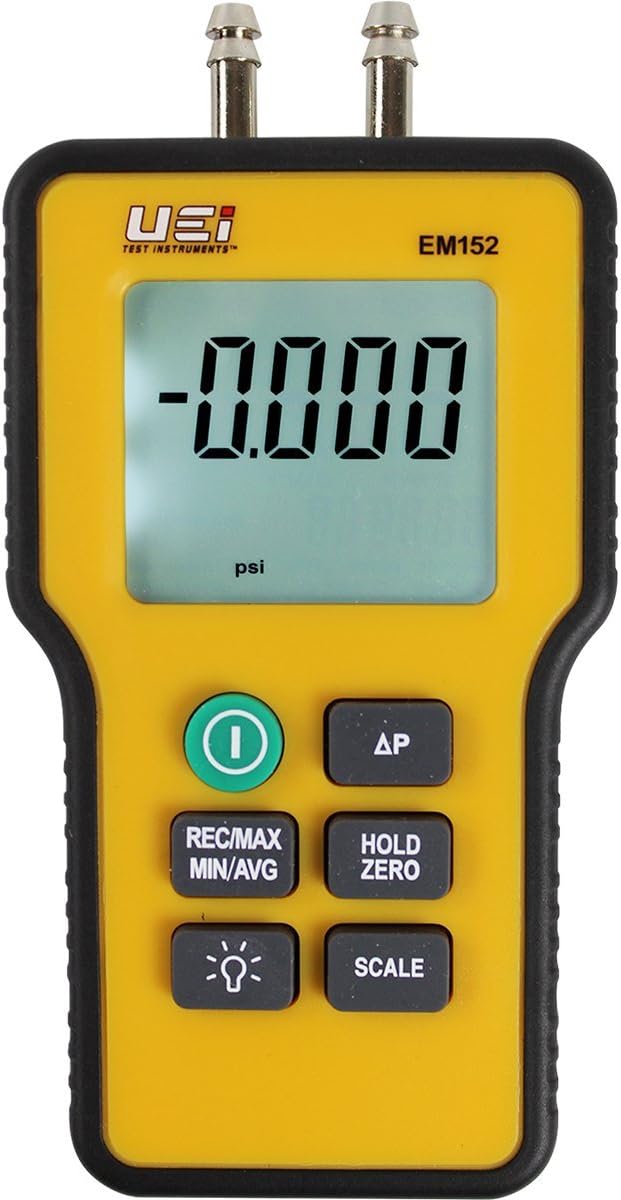
The UEi EM152 is built for technicians who require a professional differential-pressure instrument with strong stated accuracy and field-oriented features. Its 4.4 rating reflects a well-regarded specialist tool, while the 0.3 percent full-scale accuracy specification and NIST-traceable calibration make it especially relevant for exacting HVAC and gas service work.
We may earn a commission when you buy through this link, at no additional cost to you.
The meter covers a 60-inch water-column range and measures positive, negative, and differential pressure from two inputs. It can also be used with one port vented to read a single source. Stated uses include HVAC static pressure, draft, gas supply, manifold, and burner-pressure checks on natural gas and LP systems, giving it a broad but focused field profile.
Eleven units are available through the SCALE button, and auto-ranging automatically selects the appropriate resolution. The user can record maximum, minimum, and average values, hold a reading, and zero the sensors to cancel ambient drift. A large high-contrast backlit LCD is designed for dark mechanical rooms and crawl spaces where smaller screens can be difficult to read.
The built-in magnet in the protective rubber boot provides genuine hands-free utility. Two 18-inch silicone hoses are included, and a one-year limited warranty is stated. The meter runs on one standard 9V battery and includes auto power-off. The nine-volt battery is less common than AAA cells, but it can simplify field replacement planning because technicians can keep a spare in the service kit.
The EM152 is an excellent choice for professional pressure diagnostics where precision, readability, and hands-free operation matter. Its range is narrower than instruments designed around PSI or kPa, but that focus is appropriate for many static, draft, manifold, and burner measurements encountered in everyday HVAC service.
The stated 0.3 percent full-scale accuracy and NIST-traceable calibration give the EM152 a strong foundation for professional measurements. The result is especially useful when a small differential reading must be distinguished from a system fault.
Automatic resolution selection keeps the instrument from requiring manual range changes. Users can switch units while the meter manages resolution, making it easier to move between static, draft, and gas-supply diagnostics.
We may earn a commission when you buy through this link, at no additional cost to you.
The LUTIFIX PT520 stands out for its broad pressure span, seven measurement adapters, and integrated data storage. Its 4.1 rating is lower than those of the other featured products, but the stated features make it a distinctive option for users who work with varied hose sizes, negative pressure, or a need to review stored readings after a test.
We may earn a commission when you buy through this link, at no additional cost to you.
The measuring range is negative 100 to positive 200 kPa, and accuracy is stated at plus or minus 0.25 percent of full scale. That span covers vacuum testing and positive-pressure applications. The product information specifically identifies intake-manifold negative-pressure checks, brake-booster pressure testing, and other negative-pressure work as use cases.
Ten units can be selected, including hectopascals, Torr, mbar, inches of mercury, millimeters of mercury, inches of water, millimeters of water, psi, kPa, and kilograms per square centimeter. Seven adapters accommodate different hose dimensions, including outer diameters of 4 to 12 millimeters, 20 millimeters, 16 millimeters, 9 millimeters, 8 millimeters, 6 millimeters, and 8 to 20 millimeters.
The PT520 can record up to 29 data sets, lock the display, zero the readings, and display maximum and minimum values after recording. Its high-resolution LCD includes both backlighting and a flashlight, improving access in dark or obstructed spaces. LUTIFIX also states a three-year parts replacement promise for damage caused by non-human factors, along with a stated customer-support response target.
The PT520 is most compelling for users who value adapters and storage over the highest marketplace rating. Adapter selection must be matched carefully to the hose or port being tested, and the included claims should be reviewed in the current listing. Within that context, it is a well-equipped meter for mixed positive and negative-pressure diagnostics.
Seven adapters make it easier to connect the meter to different hose or port dimensions. This is a meaningful advantage for technicians who work across multiple equipment types and do not want to rely on a single connection size.
Recording up to 29 data sets allows readings to be revisited after the test. Combined with data locking, zeroing, and maximum and minimum views, the PT520 supports a more methodical diagnostic workflow.
We may earn a commission when you buy through this link, at no additional cost to you.
The Dual-Port HVAC Manometer is a high-capacity general-purpose instrument for pressure, temperature, and recorded-data work. Its 4.3 rating and broad stated application list make it relevant to technicians, installers, and maintenance personnel working across HVAC, refrigeration, manufacturing, mining, petrochemical, laboratory, and medical-environment tasks.
We may earn a commission when you buy through this link, at no additional cost to you.
The device has two top ports. A single channel measures pressure relative to current atmospheric pressure, while the dual channel simultaneously measures the difference between the two ports. The stated pressure reading is supported by temperature measurement, and the maximum and minimum modes help users watch changes during a test. Its ABS construction is described as resistant to falling and durable for regular handling.
Twelve pressure units are offered, including millimeters of mercury, inches of mercury, feet of water, centimeters of water, inches of water, pascals, kilopascals, millibars, bar, psi, kilograms per square centimeter, and ounces per square inch. The 4.45 by 4.95 centimeter high-definition display uses an LCD backlight, making numerical readings easier to see in dark work areas.
Its standout feature is the ability to store 100 groups of data, allowing users to review and compare readings later. A 15-minute inactivity shutdown helps conserve power, and a low-battery reminder provides advance warning. The required power source is a 6F22 9V, 250mAh battery, which is not included for transport reasons and must be obtained separately.
This model is best for users who value storage and dual-channel flexibility over a highly specific measurement range. Its generic name and less detailed pressure specification make careful listing review important, but the stated 100-group memory, temperature function, and broad unit selection create a useful package for frequent testing and documentation.
One hundred stored data groups exceed the logging capacity stated for most of the other models. That capacity is useful for long service visits, repeated test points, and comparing readings across a system before finalizing a repair or adjustment.
The user can move from a quick atmospheric-reference reading to simultaneous differential measurement without changing instruments. This makes the meter adaptable to single-line checks and two-port comparisons across a wide range of industrial applications.
We may earn a commission when you buy through this link, at no additional cost to you.
The Basic Dual-Port Manometer is a straightforward field gauge for low-pressure HVAC and gas tasks. It has a 4.4 rating and includes the essential functions most users need: gauge and differential measurement, eleven selectable units, high resolution, data hold, zeroing, and MAX, MIN, and AVG recording.
We may earn a commission when you buy through this link, at no additional cost to you.
The pressure range is plus or minus two psi, with gauge readings displayed at 0.001 psi resolution. This is a useful range for comparing low-pressure differences and checking appliances or pneumatic controls. Dual ports support differential readings, while the gauge mode provides a simpler single-source measurement for routine diagnostics.
The instrument is compact at 5.79 by 2.16 by 1.26 inches and designed for one-handed operation. Its large LCD is backlit for dark environments, and automatic shutdown after 20 minutes helps preserve battery life. The straightforward button layout and familiar recording controls reduce the learning curve for technicians who use several different pressure meters.
Compared with the ZIBOO ET1013, which shares a similar range, resolution, unit count, and body size, this model is described as a basic option. Temperature measurement and substantial data storage are not stated. The product information focuses on core diagnostic functions rather than a specialized accessory package, so buyers should verify exactly what is included with the current listing.
The Basic Dual-Port Manometer is a sensible choice for anyone who wants the essential functions of a portable digital gauge without a large memory system or temperature function. It suits HVAC, pneumatic controls, gas-appliance service, laboratory checks, medical-equipment work, and computer-peripheral testing as described by the manufacturer.
Hold, zero, and MAX, MIN, and AVG modes provide the core tools for a disciplined pressure check. The interface remains approachable, which helps users focus on the test rather than navigating a complicated menu.
The slim housing is easy to hold while the other hand manages tubing or controls. A backlit screen preserves readability in low-light locations, and automatic shutdown reduces the chance that the meter will remain powered throughout an inactive work period.
We may earn a commission when you buy through this link, at no additional cost to you.
The right digital manometer depends on the pressures you need to test, the type of equipment you service, and the recording or convenience features that will improve your workflow.
Begin with the lowest pressure difference you may need to detect and the highest pressure the connected system can produce. Low-range instruments around plus or minus two psi offer 0.001 psi resolution, while the Klein ET180 and UEi EM152 center on a 60-inch water-column range. Broader kPa models such as the LUTIFIX PT520 can handle negative pressure and larger positive readings. Match the range to the application rather than choosing only the broadest span, since excessive range can reduce the usefulness of fine readings.
Stated accuracy is a key differentiator in this category. Accuracy claims range from plus or minus 0.25 percent full scale for the PT520 to plus or minus 1.5 percent for the Klein ET180, with several models listed at plus or minus 0.3 percent. Consider how the full-scale percentage relates to the expected measurement, and look for zeroing or calibration controls that help remove offsets before a test. A traceable calibration statement is also useful for professional work where documentation matters.
Dual ports allow a manometer to measure the difference between two pressure sources, which is essential for many balancing, draft, static-pressure, and gas-supply diagnostics. Some models can also operate in single-source mode. If your work only involves checking one line, a simpler gauge may suffice, but dual-port instruments offer much greater flexibility for an HVAC or gas technician who handles several types of systems.
The featured meters support between ten and twelve pressure units, including common choices such as psi, bar, mbar, kPa, pascals, inches or millimeters of water, and inches or millimeters of mercury. More units are helpful when specifications, appliance documentation, or regional service procedures use different measurement systems. Automatic or one-key switching also reduces conversion errors, particularly when comparing a live reading with a manufacturer’s target value.
Hold, maximum, minimum, average, zeroing, data logging, and storage can all improve the quality of a pressure test. Hold freezes a transient value, while maximum and minimum reveal peaks that an instantaneous display may miss. Average supports repeatability checks, and stored records allow readings to be compared after a test. Choose the level of logging your workflow needs: a simple hold is sufficient for a quick check, while larger memory is valuable for lengthy surveys and documented commissioning work.
A large, high-contrast, backlit screen is important in mechanical rooms, crawlspaces, and equipment cabinets where lighting is poor. One-handed operation is also valuable when the other hand is holding tubing or making an adjustment. Compare display size, button placement, unit-switching logic, and whether the unit is responsive enough for a technician wearing gloves. Digital manometers are functional tools, so clarity and workflow often matter more than decorative features.
Power requirements affect service continuity. Most of the featured products use AAA batteries, while the UEi EM152 and the high-capacity dual-port model use a 9V battery. Check whether batteries are included, and consider carrying a spare. For hands-free use, a strong magnetic back is valuable. The UEi EM201SPKIT instead prioritizes a complete accessory package and portable kit storage for static-pressure work.
The included hoses, probes, adapters, and fittings can determine whether a meter is ready for immediate use. The UEi EM201SPKIT is a complete static-pressure package, the PT520 includes seven adapters, and several other models include two hoses or input lines. Match the kit to your connections and procedures. A lower-cost basic meter may be sufficient for occasional checks, while a dedicated kit can save setup time for a technician who performs pressure testing every day.
Begin by inspecting the meter, tubing, adapters, and battery compartment before connecting anything. Confirm that the sensor ports are clear, the battery is correctly installed, and the display responds normally. Read the model’s instructions, especially for zeroing, port configuration, and pressure limits. Before taking a reading, verify that the chosen unit and range match the equipment specification and allow the instrument to stabilize in the surrounding environment.
For differential measurement, connect the two hoses to the intended ports while the system is in a safe, known state. Open or vent one port as directed by the manufacturer when a single-source reference is required. Use the zero function only in the manner specified in the manual so that ambient pressure is not subtracted from a meaningful differential. Start with a low-pressure test if appropriate, watch the display for stability, and record minimum, maximum, and average values when the system changes during the process.
After the job, disconnect hoses according to the equipment procedure and avoid using compressed air to blow debris into the ports. Wipe the exterior and tubing with a suitable cleaner, but do not immerse the instrument. Remove batteries for long-term storage, especially if leakage is possible, and store the meter in its pouch or case away from excessive heat and impact. Periodically compare its readings with a trusted reference, replace aging batteries, and have calibration or zero accuracy checked if results become inconsistent.
Gauge pressure measures pressure relative to the surrounding atmosphere, while differential pressure compares two points. A differential manometer is therefore useful for tasks such as checking static pressure across an air handler, balancing airflow, measuring draft, or comparing gas-supply lines. Confirm that the selected ports and operating mode match the intended measurement.
The UEi EM201SPKIT is specifically presented as a complete static-pressure test kit with a digital differential manometer and supporting accessories. The UEi EM152 and Klein ET180 are also strong choices for individual low-pressure differential measurements. The right option depends on whether you prioritize a complete kit, accuracy, unit selection, or hands-free operation.
Temperature can be useful when pressure changes are related to heating, combustion, refrigeration, or airflow conditions. The PT465 and the high-capacity dual-port model state that they measure temperature alongside pressure. For isolated gas-pressure or pneumatic-control checks, a pressure-only meter may provide a simpler workflow and be sufficient for the task.
Most technicians use a small core set, but the best unit is the one that matches the equipment specification and local service documentation. Ten to twelve selectable units offer flexibility across HVAC, gas, and laboratory work. Quick unit switching is especially useful when comparing a live reading directly with a target expressed in a different system.
Zeroing establishes the instrument’s baseline at the beginning of a test and can correct small offsets caused by sensor drift, ambient pressure, or connection changes. The DMT01, ET1013, EM152, PT520, and Basic Dual-Port Manometer all state zero functions. Follow the manual’s procedure so the zeroing operation is applied correctly to the measurement mode in use.
Hold freezes the current display so it can be read or recorded. Maximum and minimum retain the highest and lowest values encountered during a test, while average summarizes the readings over the measurement period. These modes are especially helpful when a system fluctuates and an instantaneous reading would not reveal the full behavior.
Many featured models are designed for both categories because both require static, differential, gauge, and gas-appliance pressure checks. The most important requirements are the correct pressure range, resolution, unit compatibility, and suitable ports. A complete accessory package or dedicated kit can add convenience if you routinely service one of these sectors.
It is generally better to remove batteries during long-term storage unless the manufacturer specifically recommends otherwise. This reduces the risk of leakage or battery damage, particularly in warm storage areas. Keep the instrument in its supplied pouch or a protected case, and install a fresh or appropriately conditioned battery before the next job.
The UEi EM201SPKIT stands out as the best premium choice for technicians who want a complete static-pressure package, while the Klein Tools ET180 offers the strongest all-around balance of dual-port capability, selectable units, backlighting, recording, and magnetic hands-free operation. The ZIBOO ET1013 delivers the most approachable budget-oriented package for low-pressure work.
Prioritize the pressure range, accuracy, port configuration, and unit system that match your actual work before considering convenience features. Record functions, temperature measurement, storage capacity, adapters, and magnetic mounting can then be prioritized according to your workflow. For professional service, traceable calibration and a stable zero are particularly important, while occasional users may benefit more from a compact, simple meter.
Finally, verify the current listing because prices, availability, package contents, and marketplace details can change. Confirm the technical range, included hoses or accessories, battery requirements, warranty terms, and any model-specific operating instructions before purchasing. That final check ensures the selected digital manometer is genuinely suited to the pressure tests you expect to perform.