
WOOKLEA End Fed Antenna
4.8Editor score
Broad 1–30MHz frequency coverage
Supports nine listed HF bands
Portable 1:64 balun design
Discover the best End Fed Half Wave Antenna options, comparing bandwidth, power handling, balun design, portability, and installation needs.
An end-fed half-wave antenna offers amateur radio operators a compact, lightweight way to transmit and receive across multiple HF bands without a complex antenna farm. A good model should offer dependable impedance matching, manageable wire requirements, adequate power handling, and construction suited to portable, home, or emergency deployments.
We compared all ten antennas in the supplied range by examining supported frequencies, matching-network design, power limits, included wire, connector type, mounting flexibility, weather resistance, and the practical information needed to judge each product. The list includes dedicated-band radiators, tunable multiband systems, balun-based kits, and complete antennas.
Each review shows which operating style the product best supports, while the comparison table makes the main technical differences easier to see. Product ratings and specifications reflect the available listing information, and prices change over time, so readers should confirm current details and availability before purchasing.
4.8Editor score

4.7Editor score

The comparison below highlights antenna architecture, frequency coverage, power capacity, wire requirements, and deployment characteristics. It is designed to make clear which products are complete multi-band systems, which are single-band radiators, and which are balun-centered kits best suited to operators who already understand wire cutting and tuning.

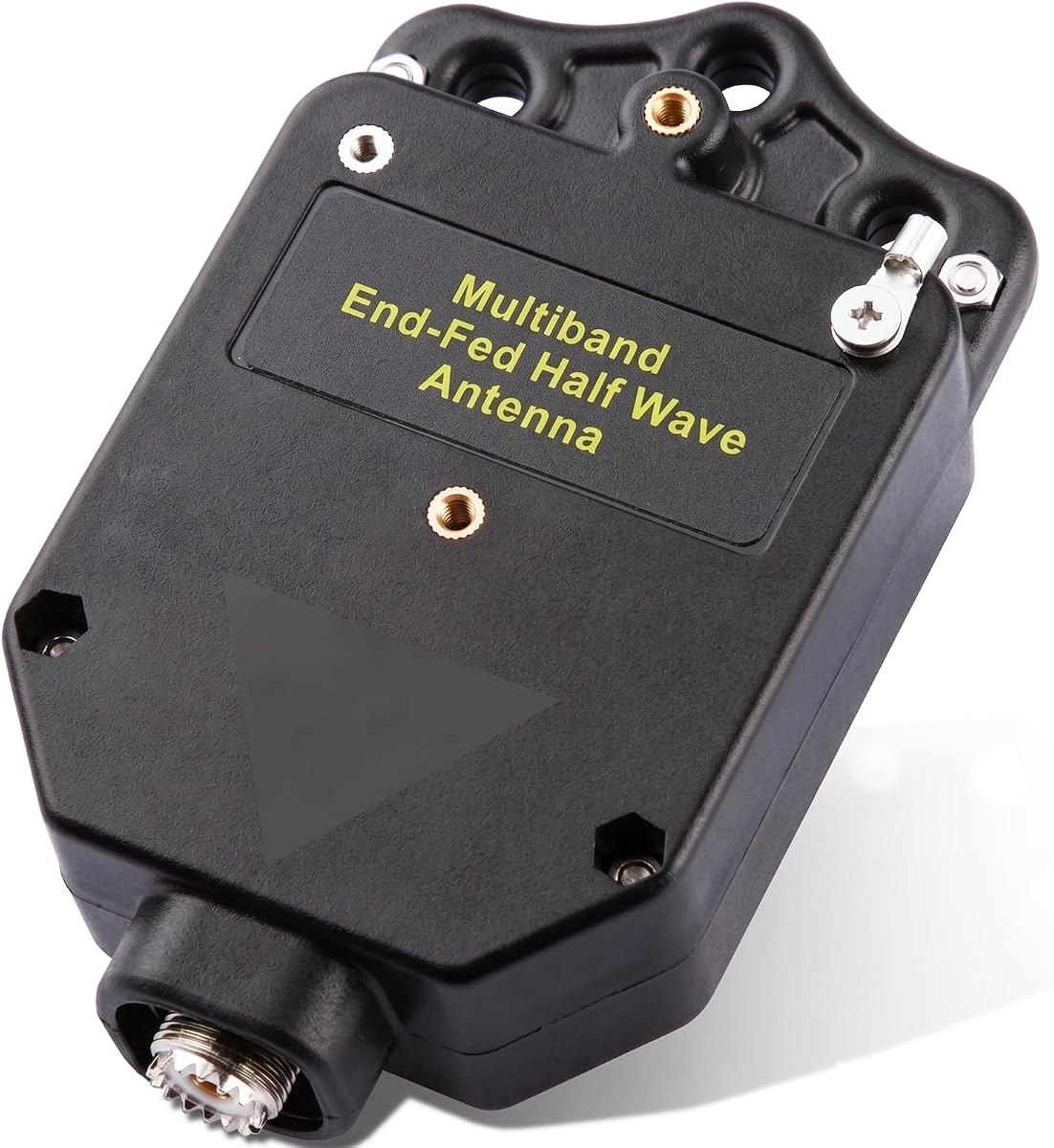


The JYR4010-150W stands out as a balanced option for operators who want meaningful multiband capability without the wire length and installation complexity of a full 80-meter system. Its 4.7 rating reflects generally favorable customer feedback, while the listed design covers the 40, 20, 15, and 10-meter bands. Those are four of the most useful HF bands for portable, SOTA, POTA, and everyday home-station operation.
We may earn a commission when you buy through this link, at no additional cost to you.
The integrated 1:64 impedance transformer is the product's defining feature. It is intended to provide stable operation across the supported bands without constant tuning in most installations, with SSB operation listed up to 150 watts and CW or FT8 up to 100 watts. The enclosure incorporates a large ferrite core, a waterproof M-J connector, UV-resistant materials, and what the manufacturer describes as a natural-convection cooling arrangement.
There are practical limitations. The 150-watt SSB figure should not be confused with a continuous 150-watt rating across every mode, and real-world impedance can change with nearby objects, wire placement, and the radio's system impedance. The listed guidance recommends approximately 10 feet of clearance from general obstacles and 16 feet from metal surfaces, which may be difficult in a compact campsite or restrictive urban property.
This is a strong choice for a new operator who wants a ready-made four-band wire antenna, especially one who will use SSB and common digital modes. It is also attractive for campers and portable users because the single-wire design is easy to suspend from a tree, pole, roof, or mast. For operators who only need one dedicated band, a simpler radiator may be easier to optimize.
Covering 40, 20, 15, and 10 meters gives this antenna a useful balance between band selection, wire length, and deployment time. The matching network is designed to reduce the need for an external tuner, although an analyzer remains useful during initial installation.
The wire can be mounted horizontally, vertically, or diagonally, making it easier to adapt to different supports. Its relatively compact central assembly and straightforward single-ended layout suit field use, rooftop installations, and temporary camping stations.
We may earn a commission when you buy through this link, at no additional cost to you.
The WOOKLEA antenna is the value-oriented choice in this group, combining a 1:64 balun with support for an unusually broad list of HF bands. Its 4.8 rating is the highest numerical rating among the listed products. The design operates from 1 to 30MHz and is presented as compatible with the 80, 60, 40, 30, 20, 16, 12, 10, and 6-meter bands.
We may earn a commission when you buy through this link, at no additional cost to you.
Power specifications are generous for a portable product. The listing states SSB below 150 watts, CW below 120 watts, and FM, AM, FT4, and FT8 below 80 watts. A standard interface and 1:64 matching ratio simplify connection to compatible HF equipment, while the ABS housing is intended to provide durability without the weight of a larger fixed installation.
The main caveat is that the antenna requires the operator to provide wire. Approximately 65.6 feet of 2.5-square-millimeter wire is called for in the four-band arrangement, while the eight-band configuration calls for roughly 132.5 feet. That distinction changes the product's total footprint considerably. It should also be cut for the intended frequencies and fine-tuned, so this is not a completely hands-off antenna.
Choose the WOOKLEA when portability, broad mode support, and value matter more than having every component factory assembled. It is well suited to emergency kits, portable operations, and operators who already know how to measure wire length and check resonance. Those wanting a finished, fully specified installation may prefer a model that includes its radiator.
The stated 1–30MHz range and nine-band support make the system useful for more than conventional contest bands. That flexibility is valuable for shortwave listening, emergency communication, and operators whose available wire length changes according to the operating location.
The central matching unit is compact and intended for rapid deployment, while a single-wire element reduces the number of supports and cables required. Operators should still plan the full wire length carefully because folding or sharply routing the radiator can alter its electrical behavior.
We may earn a commission when you buy through this link, at no additional cost to you.
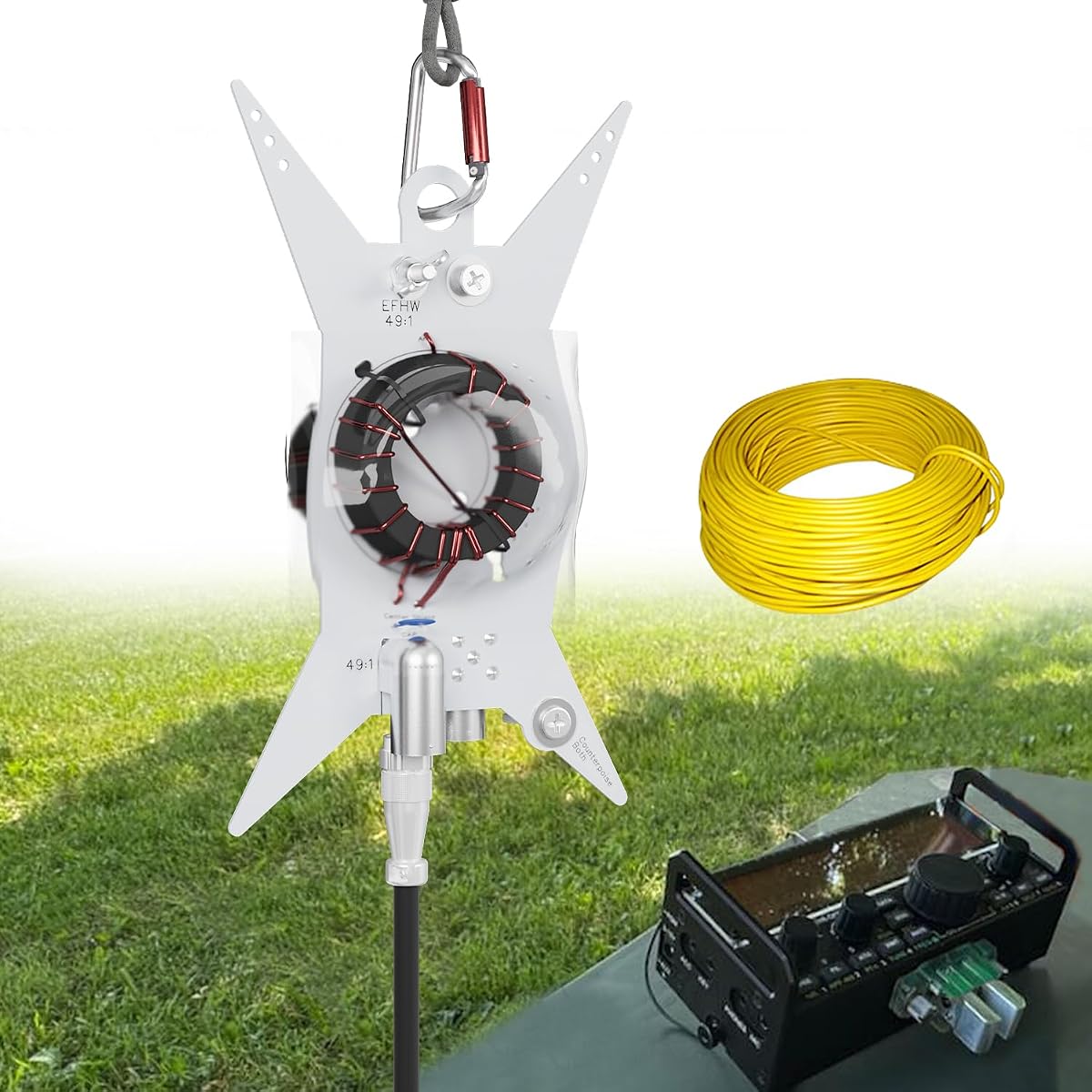
This dual-ratio antenna is built for operators who want one matching unit to handle both resonant half-wave wires and less predictable random-wire installations. The 49:1 side is intended for an end-fed resonant antenna, while the 9:1 side can be used with an end-fed random wire and a tuner. That flexibility makes the product appealing to experienced portable operators.
We may earn a commission when you buy through this link, at no additional cost to you.
Its 4.6 rating indicates generally positive feedback, and the stated compatibility with major radio brands broadens its practical appeal. The antenna can be mounted horizontally, vertically, or diagonally, and its windproof, rainproof construction is suitable for outdoor field use. The product description also notes that wires are included, reducing one preparation step for buyers.
The trade-off is that no ratio can make every installation automatically resonant. A random-wire system remains sensitive to component placement, nearby objects, feed-line routing, and the chosen frequency. The 9:1 configuration may also require an external tuner, while the 49:1 side needs an appropriately cut resonant wire. Operators should therefore treat the included hardware as a flexible foundation rather than a guarantee of low SWR everywhere.
This antenna is best for an operator who understands end-fed matching and wants one compact unit for several deployment styles. It is less suitable for someone seeking a fully specified, no-tuning antenna with predetermined wire lengths. Its value lies in adaptability rather than minimal setup effort.
Having 49:1 and 9:1 options in one enclosure lets the user change how a wire is matched rather than carrying separate baluns. The appropriate side depends on whether the wire is a deliberate resonant design or a practical random-wire compromise.
The system is particularly appropriate for POTA, SOTA, camping, and portable work where a perfect antenna site may not be available. Its ability to accept different mounting angles helps operators adapt the antenna to trees, masts, and temporary supports.
We may earn a commission when you buy through this link, at no additional cost to you.
The JYR8010-150W is the most comprehensive factory-specified option here, providing eight natural-resonance bands from 80 through 10 meters. Its stated operating span is 3.5 to 29.7MHz, and the included radiator is 130 feet long. The 4.6 rating suggests broadly positive experiences, particularly among operators who value a complete, premeasured installation.
We may earn a commission when you buy through this link, at no additional cost to you.
The antenna uses cold-drawn, multistrand 2.5-square-millimeter copper wire, a 64:1 balun, and an SO-239 connector. The listing states that SWR remains at or below 2 across the supported bands, with SSB and CW power up to 150 watts. Maximum power for FT8, FM, AM, and FSK is listed as 100 watts, providing useful mode-specific guidance.
Its main disadvantage is scale. A 130-foot radiator and 20-meter installation rope require more space, careful support, and careful routing than a four-band system. The recommendation to remain three meters from buildings and the ground is sensible, but not every campsite or balcony will allow that separation. The word “no tuning” describes the intended factory configuration, not immunity to environmental changes.
This model is best for a home station with enough land, an open rooftop, or an experienced portable operator who can accommodate the long wire. It offers a wider selection of harmonics than the shorter four-band alternatives and avoids the need to source a separately specified radiator. Those who want only 20 or 40 meters will get less value from the additional wire.
The package includes a 130-foot multistrand copper radiator and a 20-meter rope, reducing the need to plan additional components. This makes the antenna more approachable for buyers who want a defined wire length rather than a generic balun kit.
The stated 150-watt ceiling for SSB and CW is suitable for many modern HF transceivers. Lower limits for digital and other modes encourage sensible operation and help users distinguish the antenna's maximum capability from a recommended continuous level.
We may earn a commission when you buy through this link, at no additional cost to you.
This upgraded balun is designed for operators who want control over radiator length and operating layout. It covers 1–30MHz and can be configured for either four-band or eight-band service. The product description gives suggested lengths of 65.6 feet for four bands and 133.9 feet for eight bands, with trimming encouraged after installation.
We may earn a commission when you buy through this link, at no additional cost to you.
The listed power handling reaches 150 watts SSB and 120 watts CW, while FT8 and FT4 are limited to 60 watts. A dedicated ground terminal is a notable addition: the manufacturer says it can accept a one- to two-meter single-strand wire to help suppress electromagnetic interference without requiring an earth-buried ground system. That is a useful distinction for portable setups where buried grounding is impractical.
The high-strength ABS enclosure is intended to resist impact and outdoor wear, and the 1:64 matching ratio is designed to reduce path loss. As with the other wire antennas, actual performance depends on placement. The product recommends keeping the wire at least three meters from general obstacles and five meters from metallic objects, and non-metallic support rope is advised to avoid disturbing the antenna system.
This is a good middle ground for an experienced operator who wants a high-ratio balun, mode-specific guidance, and an optional ground terminal without committing to one factory-cut wire length. It is less convenient for beginners than a complete antenna, but it offers useful flexibility once the operator understands cutting, tuning, and system grounding.
The same central unit can serve two common wire configurations, depending on the operator's space and desired bands. This is helpful for users who may move between a compact portable setup and a longer home-station installation.
The dedicated ground terminal provides a practical way to control common-mode noise and electrostatic concerns. A short counterpoise can improve the installation, but it is not a substitute for correct antenna placement or a properly arranged feed line.
We may earn a commission when you buy through this link, at no additional cost to you.
This 1:64 balun-based antenna offers a straightforward route to a portable multiband wire system. The listed 1–30MHz range supports the 80, 60, 40, 30, 20, 16, 12, 10, and 6-meter bands, while the product can be configured for a four-band or eight-band wire arrangement. Its 4.6 rating indicates generally favorable customer feedback.
We may earn a commission when you buy through this link, at no additional cost to you.
The antenna is specified for SSB below 150 watts, CW below 120 watts, and FM, AM, FT4, and FT8 below 80 watts. Its ABS shell is described as durable and weather resistant, supporting use in outdoor installations and emergency-response settings. The small matching unit can also be carried easily, which is valuable when setup must be fast.
The buyer must supply approximately 2.5-square-millimeter wire and determine the appropriate length. Suggested dimensions are about 65.6 feet for the four-band setup and 132.5 feet for the eight-band version. An antenna analyzer is recommended for fine-tuning the frequency point, making this more involved than installing a ready-made radiator.
Choose this product if you want a simple, durable balun package and already have the tools to prepare wire. It is well suited to portable stations and experimental deployments where the operator wants to adapt the antenna to local conditions. A buyer seeking the shortest path to operation should instead select a model with an included, factory-length radiator.
The matching enclosure is compact, and the overall system needs only one wire and one principal support. That makes it practical for emergency communication kits and temporary operations where equipment must move quickly.
The listing clearly distinguishes SSB, CW, and digital or amplitude-mode limits. Following those distinctions can protect the matching component and keeps the antenna's published capacity meaningful.
We may earn a commission when you buy through this link, at no additional cost to you.
The Radiowavz END FED Half Wave Antenna is a focused 40-meter radiator rather than a general-purpose multiband system. It is built around 26-gauge, 19-strand copper-clad steel with a poly-coated finish, an SO-239 connector, and a stated 200-watt power-handling figure. Its 3.4 rating is the lowest among the rated products, so buyers should weigh its specialized simplicity carefully.
We may earn a commission when you buy through this link, at no additional cost to you.
The design can be suspended horizontally, vertically, or on a slope, giving it the flexibility expected from a portable end-fed wire. Tuning is best performed with an antenna analyzer attached to the far end of the coaxial cable. That process allows the operator to adjust the radiator where it is installed rather than relying entirely on a factory estimate.
The product is intended for its native 40-meter band and is not recommended for operation outside that band without a tuner. This limitation is not necessarily a disadvantage: an operator who primarily works 40 meters may prefer a simple dedicated radiator over a longer, more complex multiband wire. It can also be easier to optimize because only one fundamental band must be considered.
This antenna is best for 40-meter-focused home or portable operation where simplicity matters. It is less attractive for users seeking immediate access to 20, 15, or 10 meters. Before purchasing, ensure your radio and operating plans align with the dedicated band, and be prepared to perform the recommended installation tuning.
A dedicated radiator avoids the compromises created by a shared multiband wire. For operators who spend nearly all their time on 40 meters, the focused design can make installation and adjustment easier to understand.
The recommendation to use an analyzer at the end of the coaxial cable accounts for the environmental changes that affect a wire antenna. It provides a more accurate adjustment than cutting the wire solely from a generic band calculation.
We may earn a commission when you buy through this link, at no additional cost to you.
The Radiowavz EFH20 is a dedicated end-fed half-wave antenna for 20 meters. Unlike the other Radiowavz listing in this roundup, which includes detailed construction, power, connector, and tuning information, the EFH20 listing provides only the model name and identifies it as a 20-meter end-fed half-wave antenna. That limited information calls for careful expectation setting.
We may earn a commission when you buy through this link, at no additional cost to you.
The model's simple purpose is easy to understand. A dedicated 20-meter radiator can be attractive to an operator who values low complexity, has limited installation space, or prefers to concentrate on one highly active HF band. The EFH20 name also gives buyers a straightforward way to identify the intended band, which helps prevent accidental use with an incompatible wire length.
Because the supplied listing does not state power handling, connector details, radiator length, or included components, these should be verified with the manufacturer or retailer before purchase. No customer rating is available in the supplied data, so this model should not be compared on rating strength with the other nine products. Its single-band nature also means it will not offer the operating flexibility of the multiband antennas.
The EFH20 is best considered by an informed 20-meter operator who can confirm the remaining specifications and is comfortable installing and tuning a conventional wire antenna. It is less suitable for a first-time buyer who needs documented power limits and detailed installation guidance. Those requirements are better met by the complete multiband systems in this guide.
A dedicated band antenna can simplify both setup and signal expectations for operators who primarily work 20 meters. It avoids the longer radiator and multiple resonance points required for broad multiband coverage.
The sparse product information makes it especially important to confirm power limits, connector type, radiator dimensions, and included accessories. Those details affect compatibility and should not be assumed from similar EFHW products.
We may earn a commission when you buy through this link, at no additional cost to you.
This JYR4010 model provides a four-band package with a 70-foot radiator, a 64:1 balun, a 20-meter rope, and a storage bag. It is designed around the 40, 20, 15, and 10-meter bands, with a stated 7–28MHz operating range and a claim of SWR at or below 2 on each supported band.
We may earn a commission when you buy through this link, at no additional cost to you.
The antenna uses cold-drawn multistrand copper wire measuring 2.5 square millimeters and an SO-239 connector. SSB and CW power are listed up to 150 watts, while FT8, FM, AM, and FSK are limited to 100 watts. The product description notes that it can be mounted vertically or horizontally and discusses the different propagation characteristics associated with each orientation.
The manufacturer's erection guidance says the system should remain more than three meters from the ground and be positioned as high and openly as possible. It also acknowledges that the installation environment may require a slight adjustment for lowest SWR. Grounding at the balun or the end of the coaxial cable is recommended to reduce electrostatic discharge risk, with appropriate safety precautions during installation.
This is a complete and portable option for 40-, 20-, 15-, and 10-meter operation. It is especially useful for SOTA, POTA, camping, or emergency use because the storage bag, rope, wire, and balun are packaged together. Since no numerical customer rating is available, buyers should place greater emphasis on the documented specifications and their own installation requirements.
The included radiator, rope, balun, and storage bag remove the need to assemble a comparable system from separate parts. That convenience is especially helpful for operators who need to move an antenna between home and field locations.
The 40, 20, 15, and 10-meter selection covers major HF operating interests without requiring the full 130-foot footprint of an 80-meter configuration. This makes the model a practical compromise for many portable stations.
We may earn a commission when you buy through this link, at no additional cost to you.
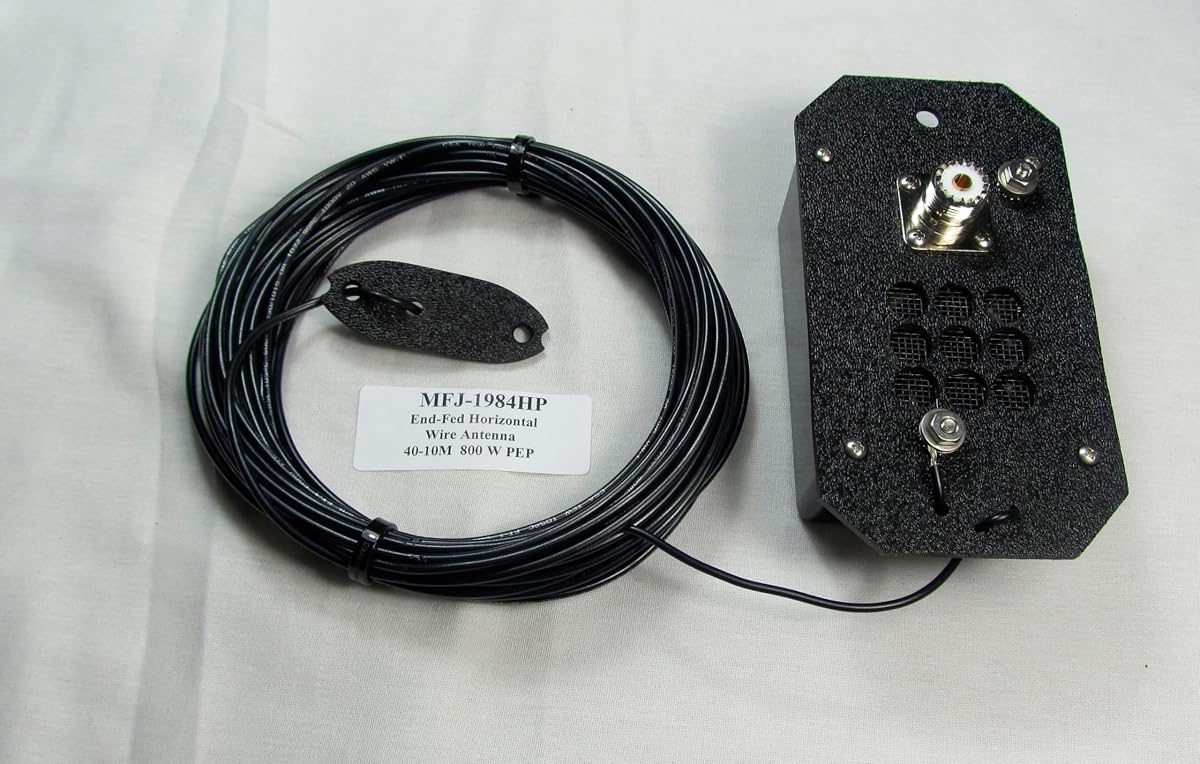
The MFJ-1984HP occupies the premium end of this selection with an 800-watt PEP rating, broad 40–10-meter HF coverage, and a weather-resistant matching network. It is designed for operators who need considerably more power headroom than the typical portable 100- to 150-watt antenna can provide, while still preferring the simplicity of a single wire.
We may earn a commission when you buy through this link, at no additional cost to you.
Its matching transformer transforms the antenna feed to 50 ohms across the HF range without traps, stubs, or resonators. The design eliminates the need for a long counterpoise, radials, or a separate feed-line arrangement, reducing installation complexity. Only one high center or end support is needed, allowing rapid deployment at home, while traveling, or during emergency use.
The physical design emphasizes longevity. Stainless hardware and UV-resistant materials are used throughout, the radiator is insulated, and the end insulator is designed to slide through foliage without catching. These details are particularly relevant to an outdoor horizontal wire antenna that may remain exposed to wind, sunlight, and vegetation.
This is the strongest premium option for high-power fixed stations, club installations, and experienced operators who need broad HF coverage with minimal supporting infrastructure. The 800-watt PEP figure is a maximum capability, not a recommendation to operate every radio at maximum output continuously. Actual results still depend on matching, installation, feed-line arrangement, and local conditions, but the documented specifications distinguish it as a higher-capacity system.
The 800-watt PEP specification gives high-power transmitters substantially more headroom than portable 100- to 150-watt systems. That makes the antenna more relevant to fixed stations, contests, and emergency communications infrastructure.
No counterpoise, radials, or resonator network is required, and one well-positioned support can be sufficient. These features reduce installation time and make the antenna easier to deploy in temporary locations.
We may earn a commission when you buy through this link, at no additional cost to you.
Choosing an end-fed half-wave antenna involves balancing band coverage, wire length, matching method, transmitter power, and installation space. The following factors help narrow the field before considering the fine differences between individual models.
Start with the bands you actually use rather than selecting solely by the broadest printed range. A four-band system centered on 40, 20, 15, and 10 meters is easier to deploy than an 80-meter configuration, while a dedicated 20- or 40-meter antenna can be simpler for a specialist. Also distinguish a stated frequency span from the specific bands on which the antenna is designed to resonate. The JYR8010-150W covers eight natural-resonance bands, whereas several balun kits operate across a wide range only when the wire is cut and tuned appropriately.
A high-impedance end-fed wire commonly uses a transformer such as 49:1, 64:1, or 1:64 to transform the feed to a radio-friendly impedance. A dual 49:1 and 9:1 unit adds flexibility because it can support resonant wires and tuner-assisted random-wire arrangements. A lower-ratio 9:1 side generally needs more reliance on an external tuner. Consider whether you prefer a turnkey matched system or a flexible unit that you can configure according to location.
Match the antenna to the maximum output of your radio and operating mode. Several portable designs list SSB up to 150 watts, with lower limits for CW, FT8, FT4, FM, and AM. The Radiowavz 40-meter model states 200-watt handling, while the MFJ-1984HP is rated at 800 watts PEP. A higher rating provides headroom for a powerful station, but it does not guarantee low SWR in every installation or excuse operation beyond the manufacturer's guidance.
The radiator is often the antenna's largest and most important component. Four-band systems may use roughly 65 to 70 feet of wire, while eight-band layouts can require around 130 feet. Longer wires can reach additional low-frequency bands but demand more space, stronger supports, and careful routing. A dedicated-band antenna usually has a shorter and more manageable footprint. Review whether the wire is included, because balun-only packages require the buyer to source suitable 2.5-square-millimeter wire.
End-fed antennas are highly sensitive to nearby objects and metal. Product guidance generally recommends approximately three meters of clearance from buildings, the ground, and general obstacles, with about five meters from metallic objects. Tree supports, rooftops, masts, and open fences can work, but close routing around structures may alter resonance. Non-metallic rope is preferable for the end support, and the feed line should be arranged so it does not create avoidable common-mode effects.
Even a no-tuning antenna can benefit from an initial SWR check. Installation environment, nearby objects, and feed-line routing affect the impedance seen by the radio. Some listings explicitly recommend trimming the wire and using an antenna analyzer, while dedicated models are tuned with the analyzer attached to the end of the coaxial cable. If you already own an analyzer, a wider customization option becomes more attractive. If not, a complete model with a factory-defined radiator may be simpler.
Portable operators should consider the entire package, not just the balun. The JYR4010 Four-Band includes wire, rope, and a storage bag, while the JYR8010-150W includes a 130-foot radiator and installation rope. Other products primarily provide the matching unit and require separately sourced wire. Check the connector, such as SO-239 on specified JYR models, and make sure it matches the radio or feed-line adapter arrangement. A compact package can still become bulky once the full radiator is extended.
An outdoor antenna needs protection from moisture, ultraviolet exposure, wind, and mechanical strain. ABS housings, insulated radiators, sealed connectors, UV-resistant parts, and stainless hardware all improve durability. Some balun-centered products also provide a ground terminal for a short counterpoise or electrostatic protection. Grounding can reduce noise and voltage on the feed line, but it does not replace sound antenna placement. Follow the manufacturer's installation instructions and use appropriate precautions around electrical potential.
Begin by identifying the target bands and choosing the appropriate radiator length. If the product includes a factory-designed wire, use it as supplied for its intended configuration. If the antenna is a balun kit, cut the specified 2.5-square-millimeter wire for the four-band or eight-band arrangement. Avoid sharp bends, kinks, and conductive clips, because changes in the wire can move the antenna's resonant point.
Install the matching unit at the supported end of the radiator and connect the radio using the appropriate interface or adapter. Mount the wire as high and openly as practical, keeping the stated clearance from buildings, the ground, metal objects, and other obstacles. Use non-metallic support rope where possible. After the installation is secure, check SWR across each intended band and trim or adjust only according to the manufacturer's guidance.
Inspect the antenna periodically, especially after storms or prolonged exposure to wind. Check the enclosure, connector, wire, insulator, rope, and support for damage, corrosion, abrasion, or strain. Keep the feed line and ground connections secure, and disconnect or power down the radio before changing wires. Never work near overhead power lines, and follow local electrical and climbing safety rules when installing the antenna.
It depends on the model, wire length, band, and installation. A properly designed 49:1 or 64:1 system may produce acceptable SWR on its intended bands without a tuner, while a random-wire antenna commonly needs one. Even no-tuning designs should be checked with an SWR meter or analyzer because nearby objects and support routing can change the antenna's impedance. A tuner never corrects a poor installation, so placement should be optimized first.
No. A longer radiator may add lower bands and harmonics, but it also requires more space, stronger supports, and more careful installation. For portable work, a 65- to 70-foot four-band wire can be much more practical than a 130-foot eight-band radiator. Select the wire length based on the bands you need, available space, and the installation method rather than treating length as the only measure of performance.
Yes, provided the wire is supported safely and cannot fall onto people, vehicles, or power lines. Use an appropriate non-metallic line or a support that does not create a conductive path. Check local rules regarding trees, property boundaries, and amateur-radio structures. Leave enough separation from branches and other conductors, and inspect the support regularly because growth and weather can change the geometry of the installation.
A 64:1 impedance transformer helps match the very high impedance of an end-fed half-wave wire to the approximately 50-ohm input expected by most modern transceivers. It does not create additional bands by itself. The radiator's length, surrounding environment, and its relationship to the selected bands determine whether the antenna resonates properly, and the matching system must also be selected for the intended feed arrangement.
Use no more than the antenna's stated limit for your specific mode. Some products allow SSB up to 150 watts but list lower limits for CW, FT8, FM, or AM, while the MFJ-1984HP is specified at 800 watts PEP. These figures are maximum capabilities, not a recommendation for prolonged operation. Starting with lower power while checking SWR is prudent, particularly if the installation is new or the wire has been trimmed.
Many end-fed half-wave antennas do not require a long counterpoise because the high-impedance matching system transforms the feed differently from a conventional end-fed wire. A ground terminal or short counterpoise may still help with electrostatic protection, common-mode noise, or feed-line routing. Follow the product instructions, keep the feed line controlled, and do not assume that a ground wire can compensate for poor antenna placement.
An analyzer is strongly recommended for custom-wire and dedicated-band installations, and it is useful for checking any new system. It can reveal whether the installed wire resonates where expected and help guide small adjustments. Products described as requiring no tuning still benefit from verification because the surrounding environment changes the electrical characteristics. Measuring at the radio end also helps detect problems in the feed line and connectors.
The best orientation depends on the operating environment and desired radiation pattern. A vertical antenna tends to produce a more omnidirectional pattern and can be useful for local and general contacts. A horizontal installation can produce different directional characteristics and may offer advantages for certain long-distance paths. In both cases, height, unobstructed surroundings, and nearby metal usually influence results more than the nominal orientation alone.
The WOOKLEA portable multiband antenna is a compelling budget choice because of its broad 1–30MHz specification, strong customer rating, and compact 1:64 balun, although the wire must be supplied and tuned. The JYR4010-150W Four-Band is the most balanced recommendation, combining a high rating, four popular bands, substantial power handling, and flexible deployment in one package.
The JYR8010-150W Eight-Band is ideal when maximum specified HF coverage matters, while the dual 49:1 and 9:1 antenna provides the most adaptable matching approach for experienced operators. Dedicated-band Radiowavz designs can be simpler for specialists, and the MFJ-1984HP stands apart for high-power capability and premium construction. Prioritize band coverage, wire length, installation space, and antenna analyzer access before choosing.
Finally, confirm the current product details, included components, power limits, connector type, and retailer information before purchasing. Pricing and availability change, and antenna performance depends heavily on the actual site. A well-chosen end-fed half-wave antenna can provide a remarkably simple station, but only when the wire, matching system, and installation are treated as one complete antenna system.