
VEVOR 100W Foldable Solar Panel
5.0Editor score
Compact 100W portable design
24% monocrystalline cell efficiency
Multiple direct-charging ports
Broad power-station connector set
IP65 outdoor protection
Discover the best foldable monocrystalline solar panels, comparing efficiency, capacity, portability, weather resistance, charging options, and compatibility.
Foldable monocrystalline solar panels combine efficient photovoltaic cells with a portable briefcase-style design, making them useful for camping, RV travel, hiking, emergency preparedness, and charging compatible power stations. The right model balances rated output, physical weight, connector options, weather protection, and the charging demands of your equipment.
This guide compares ten foldable monocrystalline solar panels ranging from 100W to 500W. We examined stated cell efficiency, portability, kickstand options, included cables, direct-charging ports, environmental ratings, power-station compatibility, and practical limitations such as input caps, shading, and weather-related guidance.
Each review identifies the strongest use case for the panel and explains the compromises worth considering before purchase. The three leading picks represent a compact budget option, a well-rounded choice for direct and station charging, and a premium bifacial model. Product prices and availability change frequently, so verify current offers before buying.
5.0Editor score

4.5Editor score

4.4Editor score
The comparison below highlights each panel's rated capacity, cell efficiency, portability, weather resistance, and connection options. It is designed to show which models best fit smaller portable power stations, larger battery systems, direct device charging, or travel-focused use.



The Renogy 200W Portable Solar Panel is a balanced all-around choice for travelers who want meaningful charging capacity without moving a bulky four-panel array. Its 4.5 rating reflects a favorable combination of 25% N-Type cell efficiency, a lightweight 13.89-pound design, and useful charging flexibility. The folding dimensions are listed as 23.72 by 22.99 by 1.97 inches, making it closer to a large backpack than a conventional briefcase. That portability, combined with a 200W nameplate rating, is especially attractive for campsites, RV travel, and compact power stations.
We may earn a commission when you buy through this link, at no additional cost to you.
Its standout feature is the combination of panel output and direct device charging. The junction area includes USB-C Power Delivery up to 45W and two USB-A ports, allowing phones, tablets, GPS units, cameras, and some laptops to be charged without routing energy through a portable power station. MC4 output remains the primary method for replenishing compatible power stations, and the listed compatibility includes Jackery Explorer 1000 v2, EcoFlow DELTA 3, DELTA 3 Max, RIVER 3 Max, and Anker SOLIX S2000. The built-in kickstands provide four positions at 40, 50, and 60-degree angles, while reinforced grommets provide additional mounting options.
The most important trade-off is that the four-in-one adapter is not included. Buyers using a power station with a non-MC4 input should verify the connector and purchase the appropriate adapter separately rather than assuming the listed compatibility applies out of the box. The 45W USB-C output is useful for many electronics, but demanding laptops may draw more power than it can provide. Also, rated wattage represents ideal laboratory conditions, so actual charging speed will vary with sunlight, panel orientation, temperature, cable loss, and the power station's own input limit.
This is the recommendation for most buyers seeking a capable but manageable portable panel. It is particularly well suited to campers who want both direct USB charging and station charging, as well as RV users who appreciate the relatively low weight and multiple positioning options. The certifications listed for the product—including UL 61730 and claimed CE, RoHS, FCC, CA65, PSE, and ISO 9001 coverage—add confidence for buyers who prioritize documented safety and compliance. Overall, its efficiency, portability, and connection options make it the strongest general-purpose pick in this roundup.
The 200W rating provides more useful recovery capacity than a small phone-charging panel while remaining manageable at 13.89 pounds. Its magnetic briefcase-style closure also makes it easier to place on an RV surface, tent, or vehicle than a rigid fixed panel.
MC4 output supports compatible power stations, while USB-C PD and dual USB-A ports provide a convenient fallback for essential devices. That combination reduces dependence on wall outlets when campsite conditions are poor or power reserves become low.
We may earn a commission when you buy through this link, at no additional cost to you.
The ZOUPW 200W Portable Solar Panel is a connector-focused option for buyers who own a power station with a less common DC input. Its 4.5 rating pairs a 23.5% monocrystalline cell efficiency rating with a useful built-in USB controller and an unusually broad included cable. Rather than requiring a separate adapter for many common stations, the supplied 10-foot five-in-one lead includes XT60, Anderson, DC7909, DC8020, and DC5521 connections. That makes the panel a strong candidate for a mixed collection of portable batteries.
We may earn a commission when you buy through this link, at no additional cost to you.
The panel also supports direct charging through USB-A QC 3.0 and USB-C PD up to 60W. This is a meaningful convenience during outages or remote trips, particularly for communications equipment, navigation devices, cameras, tablets, and phones. Its four adjustable kickstands allow the user to tilt the folded briefcase toward the sun, and the manufacturer claims this positioning can produce 25–30% more energy than laying the panel flat. ETFE lamination provides heat resistance, corrosion protection, and an IP67 waterproof rating for the panel surface, while the junction box remains water-resistant rather than submersible.
Its principal weakness is weight. At 18.96 pounds, it is substantially heavier than the 200W Renogy option and less convenient for hikers who need to minimize every ounce. Buyers should also distinguish the panel's IP67 rating from complete submersion of the junction box. Listed station compatibility includes Jackery Explorer 1000 v2, 1500, 2000 Pro, and Plus models, Bluetti Elite 30 V2 and 100 V2, EcoFlow Delta and River products, and Anker Solix C1000, C1000 Gen2, and C2000 Gen2. Exact input limits and connector requirements should still be confirmed.
Choose the ZOUPW model when connector breadth and direct USB-C charging matter more than minimum carried weight. It is well suited to power-station owners who want one panel to work across several battery brands and to travelers who regularly need to keep small electronics running. The 12-month warranty and 30-day money-back guarantee also add some purchase reassurance, although buyers should review the current terms before ordering. Overall, it offers strong flexibility and useful charging features, though it is not the lightest option at this power level.
The included five-in-one lead is the key reason to consider this model. It covers several widely used DC inputs and can reduce the frustration of discovering that a power station requires an adapter you do not have while already away from home.
The integrated USB-C PD port supports up to 60W, while USB-A QC 3.0 covers many smaller devices. These ports provide a practical way to maintain critical electronics even when portable battery capacity is limited.
We may earn a commission when you buy through this link, at no additional cost to you.
The VEVOR 100W Foldable Solar Panel is the budget-minded selection in this guide and stands out with a 5.0 customer rating. It uses 16BB PERC monocrystalline cells with a stated conversion efficiency of at least 24%, combining a respectable efficiency figure with a capacity that is easier to carry than a 200W, 300W, or 400W model. The folding construction is designed for storage in a vehicle, at a campsite, or in a hiking kit, making it suitable for users who need reliable supplementary charging rather than a full-size portable power system.
We may earn a commission when you buy through this link, at no additional cost to you.
Direct-charging options are unusually broad for a 100W panel. It includes one standard USB-A port, one USB-A port with QC 3.0, one Type-C port, and one DC port. There is also a built-in MC4 cable, a three-in-one MC4 connector cable providing XT60, Anderson, and DC5521 options, and a 10-in-1 DC adapter set. These accessories make the panel more versatile for small electronics and a broad range of power stations despite its lower solar rating. The stated operating range is 14°F to 149°F, covering common camping and travel environments.
The first limitation is straightforward: 100W cannot replenish a large battery as quickly as a 300W or 500W panel. Actual output also depends on how many folding sections receive direct sunlight and whether the chosen power station accepts the full available input. Its IP65 rating provides dust and water protection, but it is one step below the IP67 ratings assigned to several other products here. That distinction matters for prolonged exposure, so the panel should still be protected during heavy rain, deep puddles, or other severe conditions rather than treated as fully waterproof equipment.
This is the pick for travelers who want a lighter panel, frequent access to direct USB charging, and broad adapter coverage without moving to a much larger and heavier model. It may be especially useful for phones, GPS units, cameras, tablets, or maintaining a smaller battery bank. Those who need to run demanding appliances or rapidly recharge a large power station should consider a higher-output option. For the stated purpose of compact, budget-conscious portable solar charging, however, the VEVOR 100W combines efficiency, flexibility, and an excellent listed rating.
A 100W panel is best treated as a versatile supplementary source for phones, navigation gear, cameras, tablets, and modest battery banks. Its value comes from portability and convenience rather than rapid recovery of very large power stations.
The included 10-in-1 DC adapter set and three-in-one MC4 lead offer more connection flexibility than many competitors. It is a useful feature for owners who have encountered mismatched DC inputs on otherwise compatible portable batteries.
We may earn a commission when you buy through this link, at no additional cost to you.
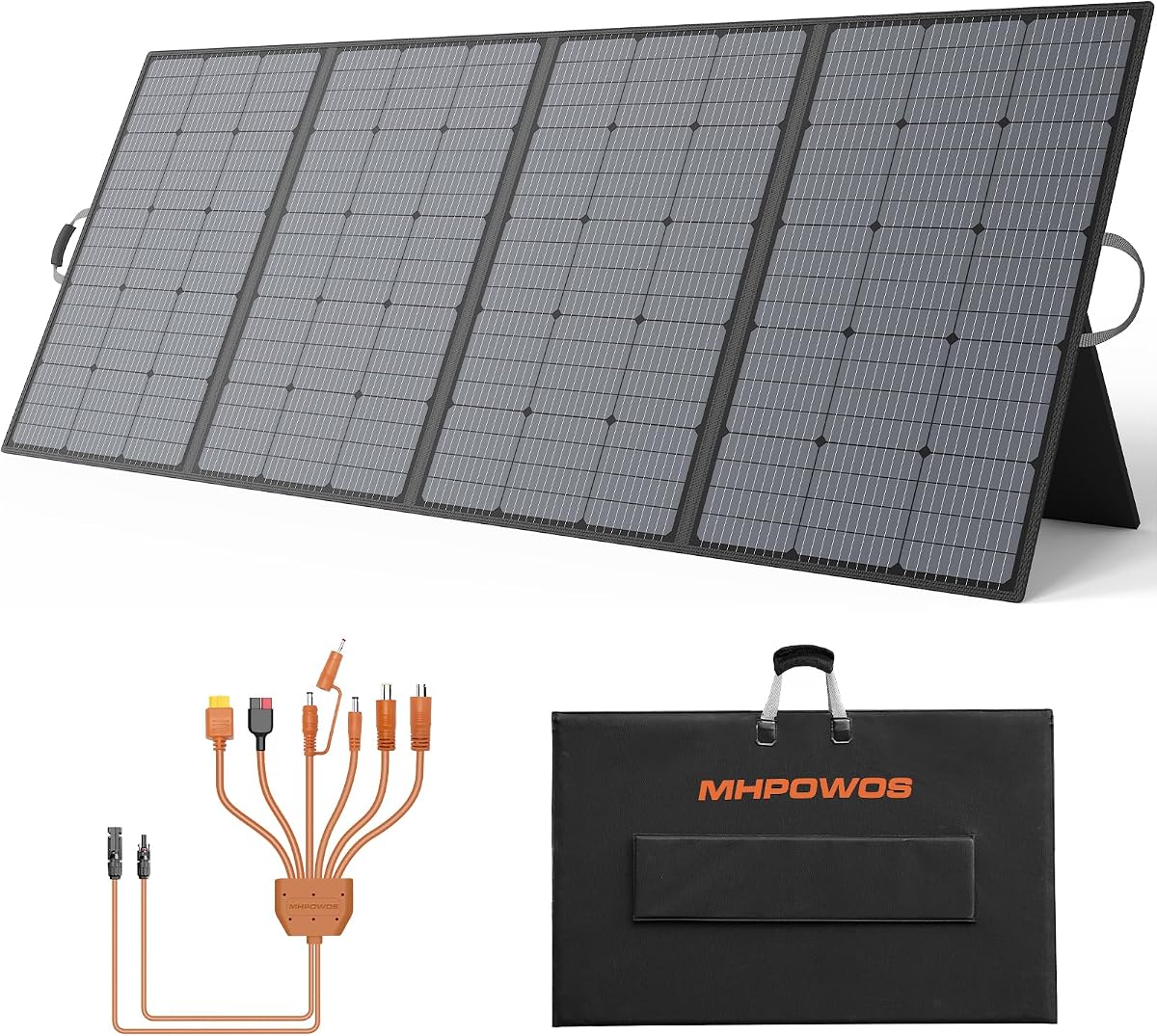
The MHPOWOS 400W Portable Solar Panel is built for buyers who need more charging capacity than a compact two-section model can provide. Its 4.1 rating is lower than those of several nearby selections, but the 400W output, 23.5% A-grade monocrystalline cell efficiency, and broad connector selection create a clear value proposition for RV and camping setups. Its multifold structure breaks the panel into manageable sections while giving users a much larger collection surface when unfolded.
We may earn a commission when you buy through this link, at no additional cost to you.
The connection package is particularly comprehensive. The supplied solar connector covers Anderson, XT60, DC7909, DC5521, DC8020, DC5525, and DC35135 formats, making the panel compatible with many popular portable power stations without relying on a single proprietary input. Four incorporated kickstands allow the unfolded panel to rest on a flat surface, and the adjustable supports help maintain a favorable angle toward the sun. A zippered accessory pouch helps keep the lead and small components together, while the stated IP67 rating covers both dust and water resistance for the panel.
Buyers must pay close attention to the power station's maximum solar input. The manufacturer explicitly notes that even under ideal sunlight, the station cannot accept more than its specified input limit. A power station capped at 200W, for example, will not turn a 400W panel into a 400W charging source. The panel's lower 4.1 rating may also reflect buyer expectations or experiences not captured in the technical specifications, so checking current customer feedback is advisable before purchase.
The MHPOWOS 400W is most suitable for RV travelers, campers, and off-grid users who prioritize energy recovery over a small packed size. It is a solid choice when your portable power station has a generous solar input limit and you need one connector-rich panel to serve multiple battery systems. It is less attractive for walkers or anyone carrying equipment over distance, because a 400W multifold array is inherently more cumbersome. Within that high-capacity use case, the strong output and connector coverage make it a practical option.
A 400W rating can substantially reduce waiting time compared with a 100W or 200W panel when sunlight and power-station input limits are favorable. It is best suited to replenishing large stations that are used for appliances, tools, or extended off-grid periods.
The panel cannot force a battery to accept more power than its solar controller allows. Confirm the station's maximum solar input, connector type, and any required activation settings before ordering to avoid disappointment.
We may earn a commission when you buy through this link, at no additional cost to you.
The PECRON 500W Portable Solar Panel is the highest-capacity model included here, aimed at RV users, larger power stations, and off-grid households that need to recover substantial energy. It uses monocrystalline silicon cells with a stated 25.1% conversion rate and supplies 500W of maximum rated power. At 22.5 pounds, it is impressively light for a four-panel array, although the number should be considered alongside the amount of surface area it occupies when unfolded.
We may earn a commission when you buy through this link, at no additional cost to you.
The four-panel folding design includes an integrated thick carry handle and adjustable kickstands. Those stands can tilt the panel vertically to 90 degrees, which is particularly useful during winter mornings, summer noon periods, or other times when low-angle sunlight can be captured more effectively. The stated operating range extends from -10°C to 70°C, and the IP67 rating is intended to resist dust, splashes, and light rain. The clean panel surface and adjustable angle are designed to improve daily energy collection rather than relying solely on rated cell efficiency.
Connection simplicity is the principal compromise. The package includes an MC4 extension cable and an MC4-to-XT60 adapter, so MC4 is the central output. Owners using another DC format may need an additional appropriate adapter. No customer rating is supplied for this product, so the numeric rating field remains unassigned rather than implying a measured score. Users should also inspect current customer feedback for information about real-world output, folding durability, and connector fit.
The PECRON is a strong candidate for people with large power stations or RV electrical systems that can use a substantial solar input. It may be less suitable for ordinary backpacking, small battery banks, or buyers who prioritize direct USB charging, because no USB outputs are listed. The balance of 500W output, 25.1% cell efficiency, and a stated 22.5-pound weight is nevertheless compelling for stationary camping and vehicle-based use. For buyers who need maximum energy recovery and can accommodate a four-panel deployment area, it is one of the strongest choices in this guide.
The 500W rating is aimed at portable stations capable of accepting substantial solar input. It can shorten recovery periods compared with smaller panels when the battery is large, conditions are favorable, and the station does not impose a lower input cap.
The kickstands can support a vertical 90-degree orientation, which helps maintain useful exposure when the sun is low. This is particularly relevant during winter mornings and summer noon, when a fixed flat position may not capture the strongest available light.
We may earn a commission when you buy through this link, at no additional cost to you.
The VEVOR 300W Foldable Monocrystalline Solar Panel offers a middle ground between easy-to-carry 100W and 200W models and larger 400W or 500W systems. Its 4.2 rating reflects a generally capable package with 22–23% cell efficiency, a 300W rated output, and an IP67-rated surface. The foldable construction is aimed at camping, RV travel, hiking, fishing, and emergency use, while the tempered glass and ETFE layers are intended to withstand outdoor conditions.
We may earn a commission when you buy through this link, at no additional cost to you.
For power-station compatibility, VEVOR supplies a built-in MC4 cable, a four-in-one MC4 connector cable with XT60, Anderson, DC5521, and DC5525 options, and a 10-in-1 DC adapter set. That is ample coverage for many mainstream portable batteries. Unlike several lower-capacity panels in the roundup, however, this model does not list USB-A or USB-C direct-charging outputs. Users who need to charge a phone directly from the panel should plan to use a portable power station or another adapter instead.
The stated operating range is -4°F to 149°F, equivalent to -20°C to 65°C, giving it a broad range for normal outdoor use. Its IP67 rating is stronger than the VEVOR 100W's IP65 designation. Nevertheless, as with all panels in this category, heavy or prolonged rain should be avoided even when a product carries a high ingress rating. The 300W panel also needs a power station that can accept a suitable input level, and folding panels can lose meaningful output if only some sections receive direct sunlight.
This VEVOR model is a good fit for campers and RV travelers who want more recovery capacity than a 200W panel without carrying a 400W or 500W system. It is especially attractive for users whose power stations use MC4, XT60, Anderson, or common DC5521-style connections. Those prioritizing direct phone charging, the lightest possible carrying weight, or bifacial generation should look elsewhere. For high-capacity charging with a durable surface and broad adapter coverage, it remains a well-balanced option.
The 300W rating sits in a practical range for medium and large portable stations. It offers stronger potential input than compact panels while remaining easier to deploy and carry than the largest four-panel systems.
The combination of tempered glass, an ETFE surface, and IP67 protection supports use in camping, RV, and exposed outdoor environments. Positioning remains important, however, because partial shading or unfavorable angles can reduce actual charging performance.
We may earn a commission when you buy through this link, at no additional cost to you.
The VEVOR 200W Foldable Solar Panel is differentiated by its integrated 30A PWM controller and alligator-clip connection. Its 4.0 rating is the lowest among the rated products in this roundup, but the technical package targets a clear audience: RV owners, campers, and users who want to connect the panel directly to a battery without relying on a proprietary portable-power-station input. The 23% monocrystalline cell efficiency and 200W output offer a reasonable balance of capacity and portability.
We may earn a commission when you buy through this link, at no additional cost to you.
The built-in MC4 cable and included alligator clips make the electrical connection approach more familiar to traditional solar users. The PWM controller regulates charging current, while the framed construction is intended to preserve structural strength during folding and transport. The stated IP67 rating and operating range of 14°F to 149°F are suitable for a broad range of outdoor conditions. Four folding sections should still be positioned carefully because one shaded section can affect the panel's total output.
A PWM controller is less efficient than the more sophisticated maximum power point tracking used by some modern solar electronics. It may still be appropriate for the intended battery setup, but it should be considered when prioritizing energy yield. This model also lacks direct USB-A or USB-C charging ports, so it is less convenient for travelers who want to top up a phone without a power station. The 4.0 rating reinforces the importance of checking recent buyer feedback, particularly regarding output consistency and included wiring.
Buy this VEVOR 200W if direct battery connection, an integrated controller, and alligator clips are more important than direct USB charging. It may suit an RV storage battery or a portable battery system designed around MC4-style solar input. It is less compelling for compact backpacking or owners of power stations that require specialized high-voltage inputs. Within its battery-charging focus, the panel provides a straightforward 200W monocrystalline option with durable outdoor construction.
The integrated controller and alligator clips reduce the number of separate components required for a basic battery connection. This can make setup more approachable for users familiar with conventional RV or off-grid solar wiring.
A PWM controller can be a sensible match for certain battery systems, although it may not deliver the same energy yield as more advanced tracking electronics. Comparing controller type is important when maximizing output from a 200W panel.
We may earn a commission when you buy through this link, at no additional cost to you.
The Renogy 300W Portable Solar Panel combines a relatively high 300W rating with 25% N-Type cell efficiency and a weight of 18.74 pounds. Its 4.2 rating makes it one of the stronger choices for RV users who need substantial output but do not want to carry the largest panel in the group. The stated 960Wh daily output is explicitly sunlight-dependent, so it should be treated as a best-case energy estimate rather than a guaranteed daily harvest.
We may earn a commission when you buy through this link, at no additional cost to you.
One of the most attractive features is the parallel wiring designed to reduce the effect of partial shading. If a tree, cloud, or RV obstruction covers part of the panel, the interconnected design is intended to prevent that isolated shadow from diminishing overall efficiency as severely as it could on a basic series arrangement. The IP67 waterproof construction includes hail-resistant ETFE coating, and the stated temperature range extends from -40°F to 185°F. IP68 connectors are included for use with many portable power stations and batteries.
Setup is designed to take about a minute: unfold the panel, extend the rust-proof kickstands, and position it toward the sun. No tools are required, which is useful at campsites and during emergency deployment. The trade-offs are that this model does not list USB-A or USB-C direct-charging outputs, and its 300W capacity means it is less convenient to carry than the Renogy 200W or VEVOR 100W. Buyers should also verify their power station's solar input and voltage limits before use.
This panel is recommended for RV travel, camping, and emergency backup where higher charging capacity and resilience to partial shade are priorities. It is also a logical choice for buyers already comfortable with Renogy's ecosystem of portable power equipment. The three-year output and material and workmanship warranty adds useful coverage compared with shorter warranty periods. For someone who values efficiency, straightforward deployment, and shading resilience more than direct USB outputs, the Renogy 300W is a strong high-capacity option.
A 25% N-Type cell rating and 300W maximum output provide strong energy-recovery potential while keeping the listed weight below 19 pounds. This combination suits users who need more power than a 200W model but value portability more than a 400W or 500W system.
Parallel wiring helps limit the effect of shadows affecting only part of the array. No folding panel is immune to obstruction, but a shade-conscious design can preserve more usable output around trees, clouds, and RV structures.
We may earn a commission when you buy through this link, at no additional cost to you.
The E-POWO 400W Portable Solar Panel is a high-output choice for users who recharge large portable power stations or RV battery systems. Its 4.2 rating reflects a solid combination of 23.5% monocrystalline efficiency, ETFE coating, an IP67 rating, and a broad connector cable. At 15.57 kilograms, it is one of the heavier options here, and its folded dimensions of 37.76 by 24.96 by 1.3 inches reinforce the need to consider transport volume alongside carrying weight.
We may earn a commission when you buy through this link, at no additional cost to you.
Three built-in kickstands provide 40, 50, and 60-degree angles, allowing the panel to be adjusted as sunlight changes. The product description also highlights reinforced grommets for RV or tent mounting and a briefcase-style folded appearance. Its seven-in-one cable supports Anderson, XT60, DC7909, DC5521, DC8020, DC5525, and DC35135 connections, which gives it broad compatibility with many portable power stations.
The panel's advanced ETFE lamination is designed to improve dust resistance and weather protection, while the waterproof Oxford fabric casing and fiberglass structure add mechanical strength, corrosion resistance, and thermal stability. Even so, the manufacturer notes that cloud cover and obstacles may reduce charging efficiency. As with other 400W models, the receiving power station's maximum solar input may limit the rate of energy acceptance. There are also no listed direct USB ports, so small-device charging is less convenient.
The E-POWO is best for stationary camping, RV living, and other applications where the vehicle can accommodate a substantial panel. It may also serve users who want one high-output panel and a wide range of connection options. It is not the most attractive choice for backpacking or anyone with strict weight and volume limits. An 18-month warranty and stated customer-support responsiveness provide additional reassurance, but buyers should still confirm their battery system's electrical requirements. For high-capacity outdoor charging with flexible positioning, it is a capable option.
The 40, 50, and 60-degree kickstand positions let the user adapt the panel as the sun moves. Adjusting the angle can improve exposure during changing conditions and reduce the need to leave the panel in a suboptimal fixed position.
Reinforced grommets, a protective briefcase-style shell, and a wide range of connectors suit RV and van setups. The substantial size and weight remain the trade-off for people who must carry the panel away from a vehicle.
We may earn a commission when you buy through this link, at no additional cost to you.
The MHPOWOS 400W Bifacial Portable Solar Panel is the premium selection because it adds dual-sided solar capture to an already capable 400W design. Its 4.4 rating is among the strongest in the group, while the bifacial construction is claimed to generate up to 20% more energy than a single-sided panel. That advantage depends on light reaching the rear surface, so it should not be treated as automatic additional output in every campsite or RV placement.
We may earn a commission when you buy through this link, at no additional cost to you.
The panel uses N-Type 16BB monocrystalline cells and has a stated 25% conversion efficiency. It weighs 19.7 pounds, which is relatively restrained for a 400W foldable panel, and folds to 22.4 by 38.3 by 2.8 inches. Three reinforced brackets support a 30–60-degree adjustment, while a rubber handle simplifies transport. Its 25% efficiency and bifacial architecture make it appealing for buyers who want maximum energy capture from a limited deployment area and can position the rear face toward reflected light.
Environmental protection is another strength. The stated IP68 rating exceeds the IP67 ratings of most competitors, and the weather-resistant ETFE coating is paired with an anti-corrosive aluminum frame. The manufacturer still advises avoiding prolonged heavy rain. The seven-in-one cable includes DC7909, DC8020, XT60, DC5521, DC5525, DC35135, and Anderson connectors, giving it broad compatibility with portable generators and power stations. It cannot store electricity itself, and no direct USB ports are listed.
This model is recommended for serious RV, van-life, camping, and emergency applications where high output and bifacial potential justify a more specialized panel. It is also attractive for users with large power stations capable of accepting a 400W input. Those expecting straightforward direct phone charging or wanting the lightest possible 400W option should compare alternatives. Overall, the combination of 25% cells, dual-sided capture, 19.7-pound weight, and IP68 protection gives it the most distinctive feature set in this roundup.
Bifacial cells can collect light from the rear as well as the front, making reflected ground light useful rather than wasted. The claimed gain is environment-dependent, so the panel should be placed where the back can receive diffuse or reflected sunlight.
The ETFE surface, anti-corrosive aluminum frame, and IP68 rating provide strong environmental protection. At 19.7 pounds, the panel also offers a favorable balance for its 400W class, although its folded length remains substantial.
We may earn a commission when you buy through this link, at no additional cost to you.
The best foldable monocrystalline solar panel for one traveler may be too heavy, too small, or too connector-specific for another. Consider charging demand, portability, cell construction, weather protection, included adapters, and the limitations of the receiving power station before making a final choice.
Rated wattage indicates the panel's maximum electrical output under specified test conditions, not the amount of energy it will produce in every outdoor situation. A 100W panel is best for essential electronics and smaller batteries, while 200W and 300W models suit mainstream portable stations. A 400W or 500W panel is more appropriate for large batteries, sustained RV use, and faster recovery when the power station accepts a high solar input. Actual charging speed also depends on sunlight intensity, panel angle, temperature, cable resistance, and whether every folding section is illuminated.
Monocrystalline cells generally provide a favorable balance of efficiency, durability, and temperature performance compared with many lower-tier alternatives. The products here claim efficiencies from 22–23% through 25.1%, with the Renogy and PECRON models leading the stated range. Higher cell efficiency can produce more usable power from the same physical area, but it is only one part of total performance. Glass or ETFE coatings, bypass or parallel wiring, quality connections, and correct positioning can meaningfully affect actual output. Treat the efficiency figure as a useful comparison point rather than a guarantee of daily energy production.
A panel that is excellent in theory can be impractical if it cannot be carried to the campsite or stored in the available vehicle space. The Renogy 200W is the lightest listed option at 13.89 pounds and folds to a backpack-like size, while the 300W models occupy more space and weigh around 18 to 19 pounds. The 400W and 500W products are substantially heavier, although their higher output may justify that burden for vehicle-based travel. Compare both weight and folded dimensions, and account for the space taken by kickstands, cables, and the unfolded deployment area.
MC4 is the most common output format among these panels, but portable batteries may use XT60, Anderson, DC7909, DC8020, DC5521, DC5525, or DC35135 connections. The ZOUPW, MHPOWOS 400W, and E-POWO models include especially broad multi-connector cables. Some VEVOR packages include multiple adapter leads, while the Renogy 200W requires a separate four-in-one adapter for certain non-MC4 connections. Compatibility also depends on electrical characteristics, not just connector shape. Confirm the station's input voltage, current, solar mode, and maximum input wattage before connecting a panel.
USB-A and USB-C outputs can make a panel much more useful when no power station is available. The VEVOR 100W includes standard USB-A, USB-A QC 3.0, Type-C, and DC ports. The Renogy 200W offers USB-C PD up to 45W and two USB-A ports, while the ZOUPW 200W provides USB-C PD up to 60W and USB-A QC 3.0. Direct charging is convenient for phones, tablets, GPS units, and cameras, but output limits matter. A panel's solar rating does not guarantee that its USB port can sustain the full charging rate of a high-demand laptop.
Outdoor panels encounter rain, dust, wind, temperature changes, and repeated folding. IP65 indicates protection against dust and water jets, while IP67 adds temporary immersion protection for qualifying components, and IP68 provides a higher level of dust and water protection. Ratings may apply to the solar module rather than every cable, connector, controller, or junction box. Most models also use ETFE or glass surfaces for scratch resistance, UV protection, and durability. Even high-rated panels should be positioned to avoid pooling water and prolonged heavy rain, and connectors should remain dry whenever possible.
A panel's angle can have a major effect on energy production. Kickstands at 40, 50, 60, 65, or 90 degrees provide flexibility as the sun moves. Reinforced grommets offer additional mounting points for RV surfaces or tents, while three brackets and adjustable supports are available on the bifacial model. Partial shading remains a concern for all folding panels because trees, clouds, and vehicle structures can interrupt the circuit. Renogy's 300W model specifically emphasizes parallel wiring to reduce the effect of isolated shadows, but every buyer should select a clear, sunlit site and avoid placing the panel beneath trees or obstructions.
Warranty coverage can provide useful protection against manufacturing defects, although the length and service terms vary across this category. ZOUPW states a 12-month warranty and 30-day money-back guarantee, E-POWO states an 18-month warranty, and MHPOWOS states 18 months for the bifacial model. Renogy's 300W includes three years of output and material and workmanship coverage. Warranty length should be compared with build quality, connector coverage, expected use, and available customer feedback. Checking current reviews is particularly valuable for products with few or no listed ratings, as real-world observations can clarify setup, output, and durability.
Before deployment, read the power station's solar-input instructions and identify the correct connector. Unfold the panel in an open area with clear access to sunlight, remove any protective film, and connect the cable before positioning the panel if the manual requires that sequence. Unfold all sections and avoid leaving one folded over another during charging, because shading can reduce output. Use the kickstands to establish a stable angle, and secure the panel with grommets or approved mounting points when wind is expected.
Check the power station for signs of solar input and verify that the displayed wattage is reasonable for the conditions. A panel may produce less than its rated maximum in clouds, high heat, partial shade, or late-afternoon light. Let the battery and panel stabilize after connection, and allow the power station to identify the solar input. Do not connect panels beyond a station's rated input, and do not assume that a connector physically fitting means the electrical specifications are compatible. Unplug the panel before changing cables or folding it away.
Care for the surface with a soft, clean cloth and mild water if the manufacturer permits it. Avoid abrasive pads, harsh chemicals, and placing sharp objects against the laminated cells. Keep connectors dry and free of dirt, and never immerse a junction box unless its documentation explicitly allows it. After each trip, fold the panel along its intended seams, secure loose cables in the supplied pouch, and store the unit in a dry, ventilated location. Inspect for loose frames, damaged grommets, pinched leads, or cracked surfaces before the next deployment.
Yes, when the panel's output connector, voltage, and current are compatible with the power station's solar input. Most models use MC4 as the base connection, with included or optional adapters for XT60, Anderson, DC7909, and other formats. Check the power station's maximum solar input because it may accept less than the panel's rated wattage. The panel also requires suitable sunlight and an unobstructed angle to approach its rated output.
A bifacial panel can be worthwhile when its rear surface receives useful reflected or diffuse light. The claimed advantage in this category is up to 20% more energy than a single-sided panel, but real gains vary with ground color, spacing, elevation, and placement. If the back is blocked or facing an unhelpful surface, much of that potential is lost. For a premium installation with careful positioning, bifacial technology is distinctive and potentially productive.
The power station may have a lower maximum solar input than 400W, or its input current may limit the accepted power. Clouds, shade, panel angle, high temperatures, and cable losses can reduce production further. Check the station's specifications and solar mode, and compare observed input with the panel's nameplate rating under ideal conditions. A faster controller within the panel cannot override a hard input limit in the battery.
Some models can. The VEVOR 100W includes USB-A, USB-A QC 3.0, and Type-C ports, while the Renogy 200W and ZOUPW 200W offer USB-C PD and USB-A outputs. The stated USB-C limits are 45W for Renogy and 60W for ZOUPW, which may be adequate for many phones, tablets, and some laptops. High-demand notebooks may still overload the port or require a separate power bank or station.
IP67 indicates strong protection against dust and temporary water immersion for the components covered by the rating. A panel's junction box, cables, controller, or connectors may have different limitations, and prolonged heavy rain is not recommended for many models. The surface may tolerate splashes and rain, but keeping electrical connections dry and following the manufacturer's instructions remains the safest approach.
Place every active section in direct sunlight and use the included kickstands to point the panel toward the sun. Adjust the angle as conditions change, and never leave a folded or obstructed section covering part of the collection surface. For bifacial models, position the rear face where reflected light can reach it. Clean the surface before deployment and avoid placing the panel beneath trees, chimneys, or vehicle structures that create moving shadows.
Usually, yes, provided the connector and electrical specifications are compatible and the power station accepts solar input at that level. A smaller panel will simply charge more slowly than its nameplate capacity might suggest when connected to a much larger battery. You may also need to activate the station's solar input mode. The reverse is more restrictive: a panel larger than the station's input rating may be accepted physically but will not charge the battery faster.
Disconnect all cables, fold the panel only along its designed sections, and inspect the surface and frame for damage. Store the lead in the supplied pouch or a separate container so it cannot rub against the cells. Keep the panel dry and away from prolonged direct sunlight, sharp tools, and heavy objects. A quick inspection before each use can identify loose grommets, damaged insulation, or connector problems before they interrupt charging.
The VEVOR 100W is the most approachable compact option, combining a 5.0 rating, 24% cell efficiency, multiple direct-charging ports, and a broad adapter set. The Renogy 200W is the strongest all-around recommendation for most travelers because it combines 25% N-Type efficiency, a light 13.89-pound package, direct USB-C charging, flexible kickstands, and broad power-station support. For buyers who want the most specialized feature set, the MHPOWOS 400W Bifacial panel offers dual-sided capture, 25% cells, IP68 protection, and a broad connector cable.
Prioritize the receiving system before choosing the panel. Confirm connector format, solar input voltage and current, maximum input wattage, and whether direct USB charging matters. Then balance rated output against folded size, carried weight, sunlight exposure, and connector needs. Larger panels are not automatically better for every trip: a 100W model may be ideal for essential electronics, while a 300W, 400W, or 500W panel makes more sense when charging a substantial power station.
Ratings, product specifications, promotions, and availability can change, so compare the current listing and recent customer feedback before ordering. Check that all included accessories match your power station, review any maximum input limitations, and keep weather guidance in mind. With those checks completed, the right foldable monocrystalline solar panel becomes a practical and dependable part of a camping, RV, travel, or emergency-preparedness kit.