
Uniden SDS150
4.2Editor score
Software-defined radio architecture
True I/Q signal processing
Built-in GPS and smartphone link
Handheld police scanner guide comparing ten models for digital reception, programming, GPS, weather alerts, portability, battery options, and field use.
A useful handheld police scanner should make local radio traffic easy to find, organize, and follow without forcing constant manual adjustment. The right model depends heavily on whether your area uses conventional analog channels, modern digital protocols, or mixed trunked systems, as well as on portability, programming convenience, alerts, and battery needs.
This guide compares ten Uniden, Whistler, and BAOFENG handheld models using their published specifications, listed features, and customer ratings. It covers dedicated receive-only scanners alongside two amateur radios that have limited conventional scanning, clearly identifying where each product is and is not appropriate for monitoring public-safety traffic.
Each review explains the strongest capabilities, practical limitations, and most suitable user, helping you avoid buying an incompatible radio system. Ratings and availability can change over time, and product prices fluctuate, so compare the current specifications and listing details before making a final purchase decision.
4.2Editor score

4.4Editor score

4.0Editor score
The table below compares all ten products by radio type, supported systems, core scanning features, and portability. Dedicated digital scanners offer the most complete public-safety monitoring, while analog units are simpler and the two included amateur radios are primarily transceivers rather than police scanners.
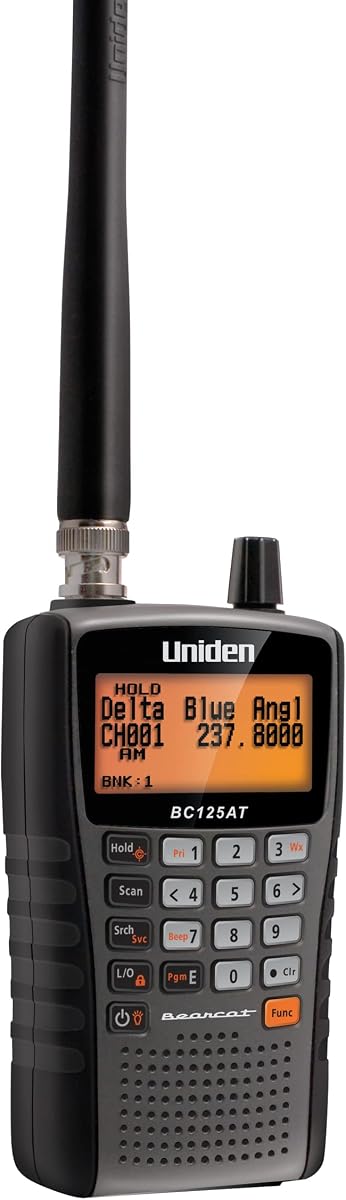


The Uniden Bearcat BC125AT is a straightforward analog handheld scanner with a 4.0 customer rating. Its 500 channels, Close Call RF capture, and 10-bank organization make it a practical choice for listeners who want to explore conventional police, fire, emergency, aviation, marine, railroad, and other services without navigating a complex digital radio.
We may earn a commission when you buy through this link, at no additional cost to you.
Its strongest appeal is accessibility. The scanner divides channels into 10 banks, supports alpha tags, and includes preset search bands for popular services. Close Call can tune to nearby transmitters even when a channel has not already been stored, while Do Not Disturb mode prevents that feature from interrupting an active transmission. The orange backlight also improves visibility in low-light conditions.
The important limitation is that this is exclusively an analog scanner. It cannot monitor Project 25, DMR, NXDN, or digital trunked systems, which means it may miss much of the public-safety activity used in larger cities. It is also a receive-only device without two-way communication. Those restrictions make the BC125AT suitable for conventional traffic, but not for comprehensive modern monitoring.
Choose this model if you live in an area with conventional systems, want a simple introduction to scanning, or need a lightweight radio for local aviation and other analog services. If your local agencies use modern digital formats, choose a DMR, NXDN, or Project 25-capable scanner instead. Within the analog handheld category, the BC125AT offers useful discovery features and straightforward organization.
Close Call RF capture automatically tunes to nearby signals, helping users find active conventional frequencies without first programming every channel. Do Not Disturb mode allows that background function to remain enabled without interrupting an active conversation.
Ten memory banks, alpha-tagged channel names, and preset service bands make the BC125AT approachable. Its 500-channel capacity is generous for a basic analog handheld, although it is far smaller than the dynamically allocated memory offered by several digital alternatives.
We may earn a commission when you buy through this link, at no additional cost to you.
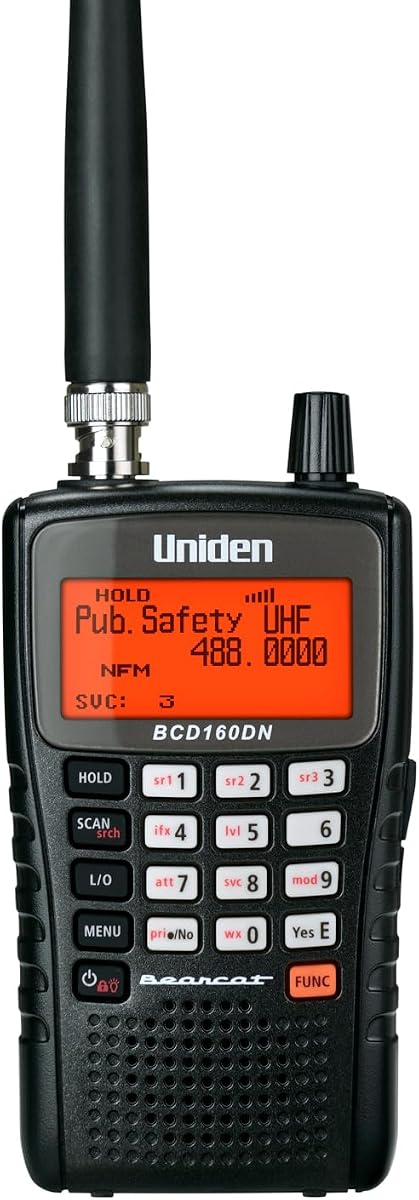
The Uniden BCD160DN is a compact digital handheld with a 3.2 customer rating. It supports DMR and NXDN, includes 1,000 memory channels, and provides rapid DCS and CTCSS detection. That makes it a relatively focused digital option for users whose local monitoring needs are covered by those two protocols rather than Project 25 or digital trunking.
We may earn a commission when you buy through this link, at no additional cost to you.
The radio arrives preloaded with DMR and NXDN information, so users can begin with the supported systems without building every profile from scratch. Rapid system and channel tagging, narrow-band reception, custom search, and free PC software add useful discovery and management tools. It also accepts two rechargeable AA Ni-MH batteries or two alkaline batteries, and the included USB cable charges the rechargeable cells in the unit.
The central drawback is compatibility. The product information explicitly states that trunking and APCO P25 are not supported. A listener in an area dominated by P25 Phase I or Phase II, trunked digital systems, or other digital formats may find that the radio cannot follow the transmissions it is intended to monitor. Its 3.2 rating also suggests more mixed customer experiences than the higher-rated scanners in this list.
Buy the BCD160DN when you specifically want a small, battery-powered scanner for DMR or NXDN, need preloaded digital data, and do not require P25 decoding. For broader public-safety use, a Uniden model with P25 and trunking support is the safer choice. Its strengths are clear, but protocol coverage must match the systems used around you.
DMR and NXDN decoding make this radio more than a conventional scanner. However, the absence of P25 and trunking support sharply limits where it can follow modern public-safety networks, so users should verify local radio formats before purchasing.
The scanner uses two AA batteries, allowing users to choose alkaline cells or rechargeable Ni-MH batteries. Its included USB cable charges compatible rechargeable batteries while they remain installed and the radio is switched off.
We may earn a commission when you buy through this link, at no additional cost to you.
The Uniden SDS100 is a True I/Q digital handheld with a 4.4 customer rating, the highest listed rating among the dedicated scanners in this guide. It is designed to improve decoding in weak-signal and simulcast areas, two situations where less advanced digital receivers can miss traffic, freeze, or display unstable information.
We may earn a commission when you buy through this link, at no additional cost to you.
Its True I/Q receiver captures the complete signal waveform in three dimensions, supporting improved digital error correction and signal recovery. The large color display can be customized by field, and the HomePatrol database covers known radio systems in the United States and Canada. Uniden updates the main database weekly, while Sentinel software provides access to updates and additional management tools.
Location-based scanning is another major benefit. Users can enter a ZIP or postal code or GPS coordinates, and the scanner can select relevant systems. Connecting an external GPS receiver, which is not included, enables automatic system selection and reselection while traveling. The scanner also has a built-in battery charger for convenient USB charging.
This is an excellent choice for users who regularly encounter weak signals, simulcast interference, or many digital systems and want a capable handheld without moving to a larger mobile radio. It balances sophisticated reception with an approachable location-based setup. Buyers should be comfortable maintaining profiles and accepting the additional cost associated with a specialized True I/Q scanner.
Capturing the full signal waveform supports better error correction and recovery when conditions are poor. The SDS100 is particularly relevant to users who experience digital fades, simulcast overlap, or unreliable decoding with simpler scanners.
Entering a location and letting the scanner identify nearby systems reduces initial programming work. An external GPS receiver adds automatic reselection while traveling, although that accessory is not part of the package.
We may earn a commission when you buy through this link, at no additional cost to you.
The Uniden BCD325P2 is a feature-rich trunked handheld with a 4.1 rating. Its Advanced Dynamic Memory System can scan and search 25,000 channels, giving it ample room for large regional systems. It also supports APCO Project 25 Phase II, making it a more relevant option for many current public-safety networks than an analog-only unit.
We may earn a commission when you buy through this link, at no additional cost to you.
Close Call RF capture helps users notice nearby signals, while 100 Quick-Key System Access buttons provide direct access to frequently monitored systems. DCS and CTCSS Rapid Decode identifies sub audible tones quickly, and System and Channel Number Tagging speeds access to specific entries. S.A.M.E. weather alerts can provide severe-weather information for the user's particular area.
The main setup consideration is that modern trunked scanning is more involved than conventional frequency entry. GPS connectivity improves the experience, but the GPS receiver is optional and not included. Users also need to select the correct systems and keep their programming current. Battery life varies with usage, temperature, and battery capacity, so field planning remains important.
The BCD325P2 is a strong fit for listeners who need broad trunked-system coverage, P25 Phase II capability, and a large memory bank in a compact handheld. Choose it over a simpler scanner if you monitor many systems or travel between regions. It is less attractive for someone wanting completely automatic location setup without any configuration work.
The dynamic memory system allocates capacity as needed and can handle 25,000 channels. That makes the scanner suitable for large systems and users who maintain numerous service groups without relying on fixed, rigid banks.
The 100-key Quick-Key System Access feature gives users one-touch control over frequently used systems. This is valuable in active monitoring situations where navigating several menu layers would be unnecessarily slow.
We may earn a commission when you buy through this link, at no additional cost to you.
The Uniden Bearcat SR30C is a compact conventional scanner with a 4.0 rating and a 500-channel memory. It gives users access to more than 32,000 frequencies through preset searches across police, fire, emergency, weather, marine, racing, aircraft, ham, railroad, and CB bands. That makes it a useful entry point for conventional listening and service discovery.
We may earn a commission when you buy through this link, at no additional cost to you.
Close Call RF capture finds nearby active signals, Priority Scan gives designated channels extra attention, and the Delay function helps avoid missing replies during two-way conversations. PC programming supports organized configuration, while Memory Backup helps retain frequencies if the scanner loses power. Keypad entry, an earphone jack, key lock, battery warning, and battery save round out the practical controls.
Its biggest limitation is also its most important compatibility issue: it cannot receive digital communications such as Project 25, DMR, or NXDN. Areas with digital trunking may offer little useful public-safety activity on this scanner. It also lacks the location-aware programming and broader digital protocols found in the more advanced Uniden handhelds.
Choose the SR30C if your goal is affordable conventional scanning, aviation and weather discovery, or an easy-to-carry introduction to radio monitoring. It is less suitable if you need to follow a modern public-safety network. For users who know their area remains analog, the compact design and preset banks provide an effective package.
Ten preset banks place common conventional services within easy reach. Users can begin exploring immediately and then organize favorites into the scanner's programmable memory without starting from a blank list.
The scanner can run from two alkaline batteries, two rechargeable Ni-MH batteries, or USB power. The included USB cable supports both external power and in-unit charging for compatible rechargeable cells.
We may earn a commission when you buy through this link, at no additional cost to you.
The Uniden BCD436HP is a HomePatrol-style digital handheld with a 4.2 rating. It combines traditional handheld controls with automatic programming: after entering a ZIP code, TrunkTracker V uses a radio-system database and selection methods to identify nearby systems in the United States and Canada. That makes it substantially easier to begin than a manually programmed trunking scanner.
We may earn a commission when you buy through this link, at no additional cost to you.
The scanner covers public safety, police, fire, EMS, ambulance, aircraft, military, and weather traffic, with a stated scan speed of 85 channels per second. Its extra-large display presents more information at once, while GPS connectivity, Radio System Analysis, Discover Mode, and Close Call RF capture add discovery tools. A built-in battery charger supports USB charging.
Instant Replay is especially useful for reviewing as much as 240 seconds, or four minutes, of recent traffic. Custom alerts can be tied to channel or unit IDs, Close Call hits, emergency transmissions, and tone-outs. Each alert can use one of nine tone patterns, 15 volume settings, seven colors, and three flash patterns, making it possible to distinguish important events in noisy environments.
The BCD436HP is a compelling choice for users who want digital trunking without a demanding initial setup. It is less specialized than the SDS100 or SDS150 for difficult RF environments, and nearby systems can occasionally still benefit from manual profile adjustments. Nevertheless, its combination of automatic setup, replay, alerts, and close-call discovery makes it one of the most approachable advanced scanners here.
Entering a ZIP code can populate relevant nearby systems automatically, reducing the need to research every control channel and talk group. This is a major convenience for listeners who are new to trunked public-safety radio.
Instant Replay preserves the most recent four minutes of transmissions. That buffer can help users recover details from a fast exchange or check a call that was obscured by another transmission.
We may earn a commission when you buy through this link, at no additional cost to you.
The Uniden SDS150 is the most advanced scanner in the supplied lineup, with a 4.2 rating. It introduces software-defined radio technology, a True I/Q receiver, built-in GPS, an updated control layout, a digital display, improved filtering, and enhanced sensitivity. The design specifically targets weak-signal and simulcast environments where accurate decoding can be difficult.
We may earn a commission when you buy through this link, at no additional cost to you.
The built-in GPS receiver is a notable convenience because it removes the need for a separate external GPS accessory during travel. Bluetooth connectivity through the U/Aware smartphone app extends the product's practical feature set, while optimized power management is intended to support extended field operation. A supplied charge cradle also provides a dedicated charging solution, with an extra slot for another battery.
Durability is another advantage. JIS 4 and IPX4 water resistance makes the scanner better suited to daily field work and poor weather than a basic handheld. The stated control redesign and digital display are intended to make a sophisticated radio more intuitive, although users of advanced trunking systems should still expect some configuration work.
This is the strongest choice for enthusiasts who want leading-edge signal handling, integrated positioning, rugged construction, and smart connectivity. The charge cradle's extra battery slot requires a separately sold battery, and the premium cost may exceed what a casual listener needs. For serious users working in difficult coverage areas, however, the SDS150 offers the most advanced feature set in this comparison.
The scanner's software-defined radio approach provides a modern foundation for reception and filtering. Paired with True I/Q processing, it is designed to improve signal recovery and performance in weak or overlapping simulcast areas.
Integrated GPS, optimized battery management, water resistance, and a dedicated charging cradle support mobile use. The extra cradle charging position accommodates a separately purchased battery for longer shifts away from a power source.
We may earn a commission when you buy through this link, at no additional cost to you.
The Whistler WS1040 is a programmable digital handheld with a 4.1 rating. It supports P25 Phase I, trunking, multiple radio systems, weather alerts, and PC programming. That combination places it between basic conventional scanners and the more specialized Uniden digital models, making it a relevant option for users who follow modern but not every possible radio format.
We may earn a commission when you buy through this link, at no additional cost to you.
Menu-driven programming includes context-sensitive help that explains settings as users work through the interface. Free Form Memory Organization allocates memory dynamically instead of forcing every system into rigid, predefined banks. Scan Lists can be arranged according to the user's preferences, helping separate priority agencies, talk groups, and other groups of interest.
Digital AGC is designed to compensate for low audio levels often encountered on digital systems. The Skywarn Storm Spotter function provides quick access to storm-spotter frequencies, while LED and audio alerts help surface important activity. A PC interface allows more extensive programming and management, and the product includes troubleshooting guidance for cases where Windows does not initially recognize the USB connection.
The WS1040 is best suited to listeners who want P25 Phase I and trunking, appreciate contextual programming help, and want a flexible memory structure. It does not list P25 Phase II support, so users in Phase II-heavy areas should not assume compatibility. The PC programming requirement also makes it less convenient than location-based HomePatrol-style models.
Context-sensitive text appears within menu items to explain what choices are available. This lowers the learning curve for users configuring talk groups, scan lists, and other digital functions.
Free Form Memory Organization dynamically allocates capacity and supports multiple scan lists. Users can prioritize selected systems without wasting fixed memory regions that other scanners might reserve regardless of actual use.
We may earn a commission when you buy through this link, at no additional cost to you.
The BAOFENG BF-F8HP PRO is a tri-band amateur radio with a 4.3 rating, not a dedicated police scanner. It can receive conventional analog frequencies, scan named zones, and monitor airband AM, NOAA weather, and broadcast FM, but it cannot decode DMR, digital trunked systems, or modern police networks. It belongs in this list as a portable conventional scanning option rather than a public-safety scanner.
We may earn a commission when you buy through this link, at no additional cost to you.
Its 1,000 memories, 10 named zones, clear English menus, and full keypad make organization more approachable than many traditional radios. Users can create zones for home, travel, clubs, events, simplex, and receive channels, temporarily skip a busy channel without changing the saved scan list, and view a two-channel display with Dual Watch.
The radio is also a two-way amateur transceiver, but transmission requires valid amateur authorization in the United States and must remain within the user's privileges. Airband, NOAA, and broadcast reception are receive-only. BTECH CPS or supported CHIRP-next software can handle larger programming tasks, though the PC03 cable is sold separately and is required for firmware updates.
Location sharing can exchange position information with another compatible BF-F8HP PRO on the same channel, but it does not provide APRS, mapping, continuous tracking, or an emergency-location service. Choose this model for amateur-radio communication and conventional zone scanning. Do not choose it as a primary police scanner unless all relevant local traffic is conventional analog and you understand the device's other functions.
Ten named zones let conventional frequencies be grouped by activity or location. Skipping a temporary channel does not alter the underlying scan list, making it easier to manage busy local activity.
Airband AM, NOAA weather, and broadcast FM are reception features rather than transmit bands. The radio cannot decode DMR or trunked systems, so it should not be expected to follow modern digital public-safety traffic.
We may earn a commission when you buy through this link, at no additional cost to you.
The BAOFENG K5PLUS is a compact tri-band amateur radio with a 4.5 rating, the highest customer rating in the supplied data. It is not a dedicated police scanner, and it cannot decode the digital formats used by many current public-safety agencies. Its relevance to this category comes from conventional receive and scan-list functions rather than specialized police-radio monitoring.
We may earn a commission when you buy through this link, at no additional cost to you.
It supports tri-band amateur transmission on UHF, VHF, and 1.25-meter bands, while reception includes VHF, UHF, FM, Airband, 1.25-meter, 1-meter, and NOAA frequencies. Adjustable output provides 10W, 7W, and 4W levels, giving the user more control over transmission requirements. A long high-gain antenna and external speaker microphone are included for the listed package.
One-Key Frequency Copy makes it easier to copy frequencies and CTCSS or DCS tones from compatible radios. CHIRP programming supports channel names, frequencies, tones, power levels, and batch editing, which is useful when building or maintaining a large conventional list. The supplied 2500mAh battery recharges through the included USB-C cable.
Choose the K5PLUS for amateur-radio communication and conventional monitoring with a simple, highly rated handheld. It is not suitable for following Project 25, DMR, NXDN, or digital trunked police systems, and transmitting on amateur frequencies requires appropriate authorization. For actual police-scanner use, choose one of the dedicated Uniden or Whistler models instead.
One-Key Frequency Copy reduces the manual effort involved in transferring frequencies and tone codes from compatible radios. This makes the radio easier to use when building conventional channels on the move.
CHIRP support allows batch editing of frequencies, names, tones, and power levels. This is more useful for hobby and amateur-radio users than listeners who need a public-safety scanner database.
We may earn a commission when you buy through this link, at no additional cost to you.
The most important choice is protocol compatibility, followed by programming method, reception technology, alerts, battery design, and portability. Verify the radio formats used in your area and distinguish dedicated receive-only scanners from two-way amateur radios before comparing features.
A scanner is useful only if it can decode the systems used by the agencies and services you want to hear. Conventional analog frequencies are the simplest format, but many public-safety agencies now use DMR, NXDN, APCO Project 25, or digital trunking. A model that cannot decode the local format may display activity yet fail to produce intelligible audio. Pay close attention to the difference between DMR, NXDN, P25 Phase I, and P25 Phase II rather than treating the word digital as a complete specification.
Conventional scanners follow individual frequencies, while trunked scanners follow control data that directs the receiver toward active talk groups. Some products support only conventional channels, some support selected digital protocols, and the most capable units combine broad trunking support with advanced decoding. Consider whether your listening list consists of simple local channels or large regional networks. A large channel count is useful, but it does not compensate for a missing protocol or trunking support.
Programming ranges from manual frequency entry to ZIP-code-based automatic setup and full database management. Automatic location programming is fastest for general public-safety listening, while manual and PC-based methods offer more control for experienced users who maintain custom systems. Consider the Uniden HomePatrol database, Sentinel software, free Uniden software, or the Whistler PC interface. Also note that some radios require an extra cable for computer programming or firmware updates.
Weak signals, fading, and simulcast overlap can disrupt even a compatible scanner. True I/Q and software-defined reception are designed to improve digital error correction and signal recovery in challenging radio environments. The Uniden SDS100 and SDS150 are especially relevant where ordinary digital scanners struggle. If you live near tall buildings, terrain obstructions, or heavily overlapping systems, receiver architecture may matter more than additional cosmetic features.
Location-based scanning helps the radio identify relevant systems and avoid wasting time on distant traffic. Some models accept a ZIP or postal code, some support GPS coordinates, and others include GPS hardware. External GPS support can automatically reselect systems as you travel, while built-in GPS reduces setup. Remember that an optional GPS receiver is not included with every model, so check the package contents rather than assuming every GPS-capable radio includes the accessory.
Useful alerts can identify specific unit or channel IDs, emergency transmissions, Close Call hits, and tone-outs. The BCD436HP adds multiple tones, volume levels, colors, and flash patterns, which helps distinguish different events. S.A.M.E. weather alerts can target severe conditions for a particular area. The most valuable alert design is one that remains noticeable in a noisy room without becoming irritating during ordinary monitoring.
A scanner can offer 500, 1,000, 25,000, or a much larger dynamically allocated memory pool. Larger capacity is valuable for extensive regional listening, but it does not make a radio easier to carry. Look at display size, keypad layout, weight, weather resistance, and grip as well as memory. The SDS100 and SDS150 emphasize field-oriented construction, while the SR30C and BC125AT favor simplicity and a compact footprint.
Battery type affects convenience, field runtime, and replacement cost. Some scanners use standard AA cells, while others use proprietary rechargeable packs charged in a cradle. The SDS100 has a built-in USB charger, and the BCD160DN can charge compatible AA Ni-MH cells in the radio. The SDS150 includes a cradle with an extra charging position, but the additional battery is sold separately. Review actual power needs rather than assuming a scanner can operate indefinitely.
Begin by identifying the radio systems in your area and matching them to the scanner's supported formats. For automatic models, enter your ZIP or postal code and allow the location-based setup to complete. For manually programmed units, use a reliable local system reference to enter the correct frequencies, talk groups, tones, and system details. Review the manufacturer instructions and software guidance before saving a large profile.
Organize saved channels into banks, scan lists, favorites, or zones that reflect how you listen. Assign meaningful names, mark priority systems, and set an appropriate alert pattern for urgent categories. Test Close Call, replay, and weather-alert functions in a safe setting before relying on them in an emergency. When using GPS, confirm that the location is accurate and that nearby systems have been selected as intended.
Protect the radio from moisture, extreme heat, impact, and long-term battery drainage. Use the intended charger and compatible battery cells, and avoid leaving a radio charging unattended for extended periods or in a hot vehicle. Clean the casing and controls with a soft, slightly damp cloth, keep ports free of debris, and update firmware through the manufacturer's supported software when updates become available.
No. A scanner must support the radio format used by the department, and some departments use encrypted or otherwise restricted traffic that a general-purpose scanner cannot decode. Local system compatibility is the most important factor to verify. Location-based databases can simplify discovery, but users should still confirm the specific protocol and any applicable access restrictions.
Not necessarily. A digital scanner is essential where local agencies use DMR, NXDN, P25, or digital trunking, but it may be unnecessary in an area served entirely by conventional analog systems. A simpler analog model can be easier to program and sufficient for aviation, weather, marine, and other conventional services. Compatibility should come before feature count.
No. The dedicated Uniden and Whistler scanners listed here are receive-only and cannot transmit. The BAOFENG BF-F8HP PRO and K5PLUS are amateur transceivers, but transmitting on amateur frequencies requires valid amateur authorization and compliance with local rules. They are not police radios and do not provide police two-way communication.
The scanner may be monitoring a format it cannot decode, or it may be struggling with weak signal, simulcast overlap, or a mismatched system profile. Confirm that the selected protocol is supported, update the system database, and improve the profile if necessary. In difficult RF conditions, a True I/Q or software-defined scanner may perform better than a conventional digital model.
GPS is not required for basic listening, but it is useful for travel because it can automatically select systems associated with the current location. Some scanners have built-in GPS, while others require a separate receiver that may not be included. Check the product package carefully if location-aware operation is important to you.
A scanner is designed primarily to receive programmed radio traffic, often including many channels and talk groups on one device. An amateur radio is a two-way transceiver intended for licensed amateur communication and generally provides a smaller set of conventional channels. The BF-F8HP PRO and K5PLUS also support receive-only bands and conventional scanning, but they remain ham radios rather than dedicated police scanners.
Update the radio database and software, create a profile for the area you expect to visit, and confirm that location-based selection or GPS works correctly. Charge the battery fully and carry an approved spare power source if permitted. Familiarize yourself with channel controls, alerts, and recording rules before monitoring in a new area.
They are useful aids, not substitutes for accurate programming. Close Call can find nearby active signals but may not decode every system correctly, while location setup depends on accurate database information and compatible profiles. Use both as discovery tools, then review the selected systems and adjust the programming when needed.
The Uniden SDS150 stands out as the most advanced model with software-defined reception, True I/Q processing, integrated GPS, and rugged construction, while the SDS100 offers proven True I/Q performance and location-based scanning at a different tier. For a conventional and budget-conscious introduction, the SR30C provides an approachable 500-channel radio with helpful service presets and Close Call discovery.
Prioritize local protocol compatibility first, then choose the programming method that matches your experience. True I/Q technology matters most in weak or simulcast-heavy areas, automatic location setup is ideal for beginners, and large dynamic memory benefits users with extensive regional systems. Exclude the two BAOFENG transceivers unless you want amateur-radio operation alongside conventional reception.
Before purchasing, verify the current protocol support, package contents, battery requirements, and listing details. Ratings can change with additional customer feedback, and prices fluctuate over time, so compare the latest product information and current cost rather than relying on this guide alone.