
Portable Solar Generator with Panel
4.8Editor score
Includes foldable 40W panel
Compact 280Wh battery
Dual pure sine wave outlets
This guide compares the best lithium portable solar power stations, examining capacity, output, solar charging, portability, UPS support, and use cases.
Lithium portable solar power stations combine rechargeable battery storage, AC and USB outlets, and solar charging in a self-contained package for travel, outages, and off-grid work. A capable unit can run essential electronics, recharge phones and cameras, or keep selected household appliances operating when grid power becomes unavailable.
We compared these ten systems using their published battery capacity, continuous and surge output, charging options, portability, UPS capability, and included accessories. The guide covers compact models for camping, higher-capacity units for home backup, and complete solar-generator bundles designed for independent recharging.
Each review identifies the strongest use case and the compromises worth considering, while the comparison table offers a quick view of major specifications. Customer ratings and technical details may change, and prices also vary over time, so readers should confirm current listings and compatibility before purchasing.
4.8Editor score
4.7Editor score

4.8Editor score
The table below compares all ten stations by energy capacity, output, solar capability, and major practical features, making it easier to match a power station to camping, RV, mobile-work, or emergency-backup needs.




The Jackery Explorer 300 is a compact 292Wh portable power station built for hikers, campers, and travelers who need more than a conventional power bank. Its 4.6 rating reflects a strong balance of portability, output, and charging flexibility, while the 7.5-pound weight makes it more manageable than many sub-1kWh alternatives.
We may earn a commission when you buy through this link, at no additional cost to you.
Its most useful feature is the varied output selection. Two AC outlets, two USB-A ports, a 100W USB-C Power Delivery port, and a 120W car port can serve laptops, cameras, drones, lights, and a CPAP device. Rated output is 300W with a 600W surge allowance, and LiFePO4 chemistry supports more than 4,000 charge cycles before the battery reaches 70% capacity.
Solar recharging is another strength. Jackery states that a compatible 100W panel can bring the unit to 80% in about 2.8 hours, while a 40W panel takes around 7.5 hours. The trade-off is that no solar panel is included, so buyers wanting a complete renewable-energy kit must add one separately.
This is a sensible choice for light-duty mobile power rather than full home backup. It suits someone who wants to charge several devices away from an outlet, run a small appliance, or maintain critical equipment during a short interruption. For a larger battery and included panel, the Jackery Solar Generator 1000 v2 is the more complete alternative.
The Explorer 300 is particularly useful for electronics that benefit from steady AC power or fast USB-C charging. It can also serve as a portable CPAP battery, provided the device's requirements and the available runtime are checked before travel.
LiFePO4 cells make this unit more appropriate for regular camping and emergency use than a one-time novelty battery. The published cycle life also reduces concern about replacing a small internal battery after relatively short periods of use.
We may earn a commission when you buy through this link, at no additional cost to you.
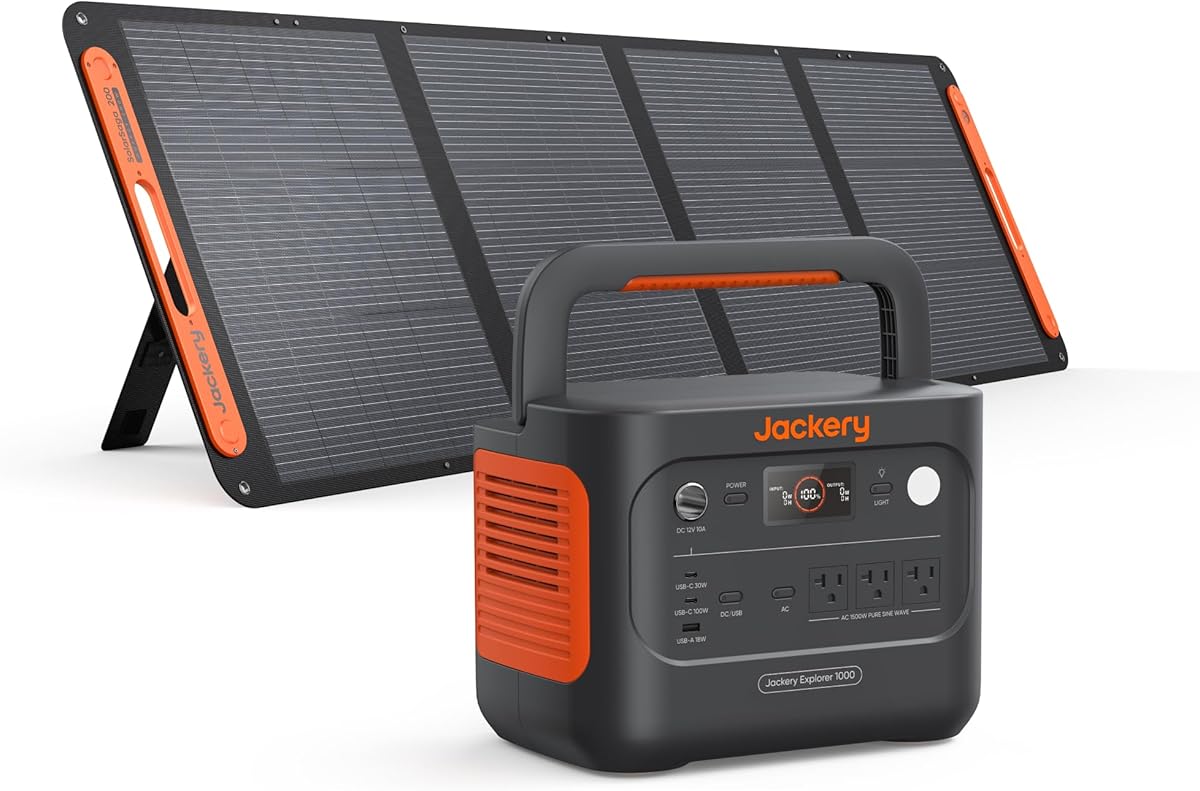
The Jackery Solar Generator 1000 v2 is a balanced 1,070Wh system for buyers who want substantial output and a compatible solar panel in one package. Its 4.5 rating and 1,500W continuous AC capacity put it in a versatile middle tier, suitable for camping, road trips, and selected household loads.
We may earn a commission when you buy through this link, at no additional cost to you.
The bundle includes the Explorer 1000 v2 power station, a 200W foldable solar panel, an AC charging cable, a user manual, and five years of coverage. The station offers two USB-C ports, one USB-A port, a DC car port, three pure sine wave AC outlets, and LED lighting. Pure sine wave output is particularly appropriate for sensitive electronics and motor-driven equipment.
Charging is flexible. The power station can reach 80% in about six hours with the included 200W panel. Wall charging normally completes in 1.7 hours, while an optional emergency mode enabled in the Jackery app can complete a full charge in one hour. The distinction matters because buyers who rely on the fastest mode must enable it before each emergency charge.
The 23.8-pound weight and larger housing make it less attractive for long hikes than the Explorer 300. It is better for family camping, tailgating, remote work, and outages where multiple appliances must operate. Buyers choosing it for the first time should use the default charging mode for routine recharging and reserve emergency charging for genuine time-sensitive situations.
Including a 200W panel removes the need to research a compatible solar controller or panel separately. The folding panel is more practical for trips where every bit of pack space matters, although the station itself remains too heavy for ultralight hiking.
The app adds overnight quiet charging, energy-efficiency control, and emergency charging. These options are useful because the fastest charging mode is not always the best choice for long-term battery health or for use around sleeping campers.
We may earn a commission when you buy through this link, at no additional cost to you.
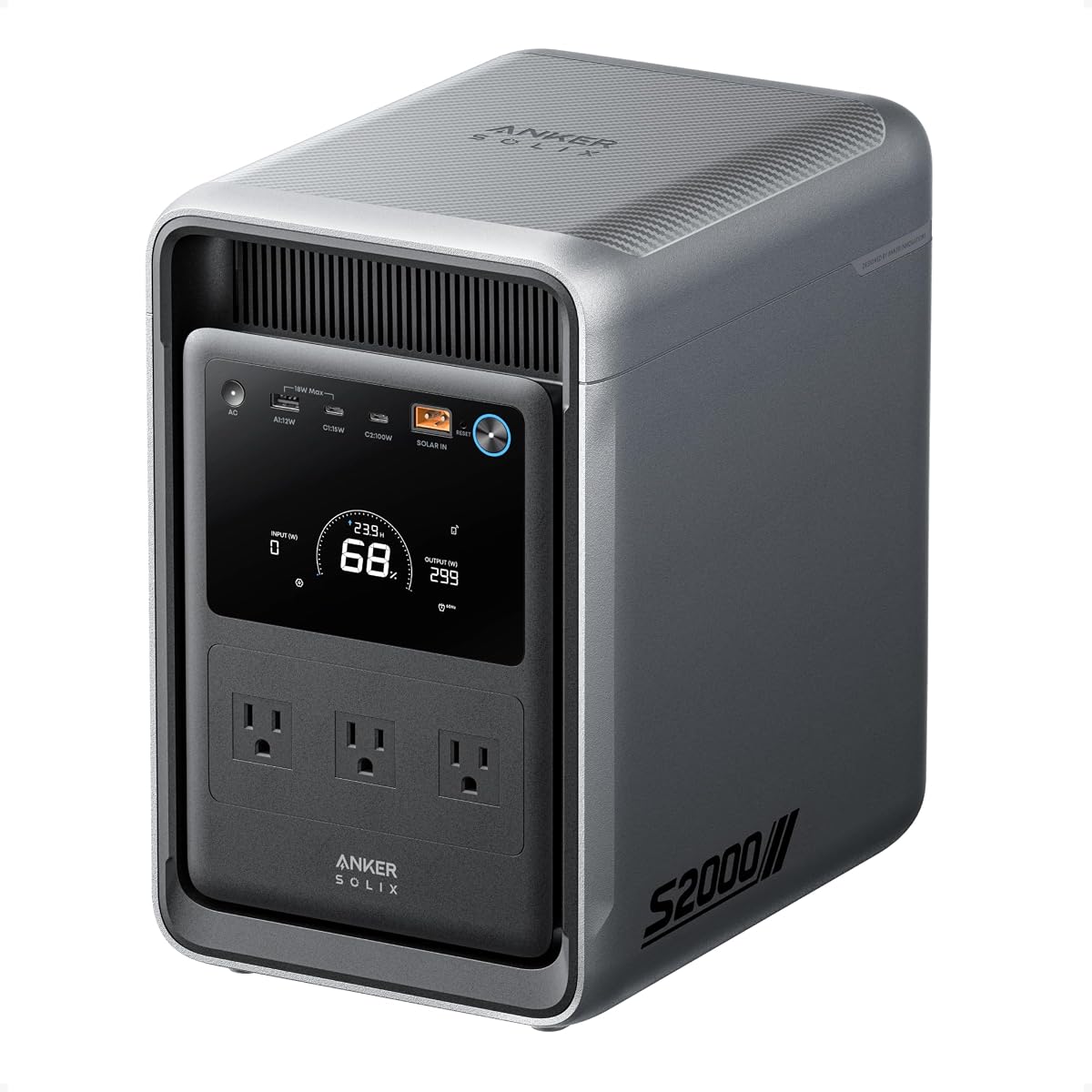
The Anker SOLIX S2000 is one of the strongest choices here for readers who need meaningful battery capacity without moving into a much larger 3kWh system. It combines 2,010Wh of storage, 1,500W continuous output, and a 4.7 rating in a package measuring 8.2 by 11.1 by 12.7 inches.
We may earn a commission when you buy through this link, at no additional cost to you.
Efficiency is a central selling point. Anker specifies a 6W idle draw and claims the station can keep a refrigerator running for up to 35 hours, although actual runtime naturally changes with refrigerator type, ambient temperature, and usage. The 314Ah LFP battery is rated for 10,000 cycles and a 15-year lifespan, making it a long-term option for frequent backup use.
The S2000 supports wall charging, solar, a generator, an alternator charger, a car outlet, and simultaneous AC-plus-solar charging. Solar input can reach 400W. Its 10ms switchover helps preserve operation of sensitive equipment, while front and rear outlet groups reduce cable clutter in home-office or RV installations.
The main drawback is the absence of a 12V DC port, which may inconvenience users with legacy automotive accessories. At 35.7 pounds, it also requires deliberate transport planning. Even so, it is a compelling option for refrigerators, routers, lighting, and other essentials when a medium-capacity station is the right compromise.
A 2,010Wh battery gives the S2000 more endurance than compact camping stations without reaching the bulk of the BLUETTI Elite 300. That middle position makes it useful for extended outages, tailgating events, and mobile projects that involve several powered devices.
Six charging methods allow the station to recover through whichever source is available. A compatible solar array is useful for sustained off-grid work, while AC, car, generator, and alternator options make emergency replenishment more practical.
We may earn a commission when you buy through this link, at no additional cost to you.
The BROWEY 1600W stands apart with a solar panel integrated into its housing, offering a more self-contained alternative to conventional power-station-and-panel bundles. It carries a 4.8 rating, 1,024Wh capacity, 1,600W continuous pure sine wave output, and 3,200W peak surge capacity.
We may earn a commission when you buy through this link, at no additional cost to you.
The built-in panel and MPPT controller are particularly convenient for campers and RV travelers who want solar recharging without unfolding and positioning a separate panel. The unit can also charge connected devices while collecting sunlight and can accept other compatible solar panels when faster charging is needed.
Eight ports cover AC, DC, and 100W USB-C Power Delivery. The stated 1,600W output is enough for refrigerators, CPAP machines, tools, and other portable loads, while the LiFePO4 battery is described as lasting more than ten years and retaining 80% capacity after 3,000 cycles. A battery management system adds protection against overvoltage, overheating, and short circuits.
Recharging is flexible: the included AC adapter and 100W USB-C input can replenish the battery to 80% in about three hours, while car charging and 40W solar charging are also supported. The built-in panel is convenient but may not match the charging speed of a larger unfolded panel. This model is strongest for buyers who value portability and integrated solar over maximum solar-input speed.
Integrating the panel removes one setup task and makes the station easier to deploy from a vehicle. It is especially useful for maintaining phones, lights, and small appliances during camping trips where a full-size portable solar array would be inconvenient.
Pure sine wave output is a meaningful feature for computers, medical equipment, and other electronics that may be sensitive to unstable waveforms. Actual suitability still depends on each device's power requirements and the manufacturer's guidance.
We may earn a commission when you buy through this link, at no additional cost to you.
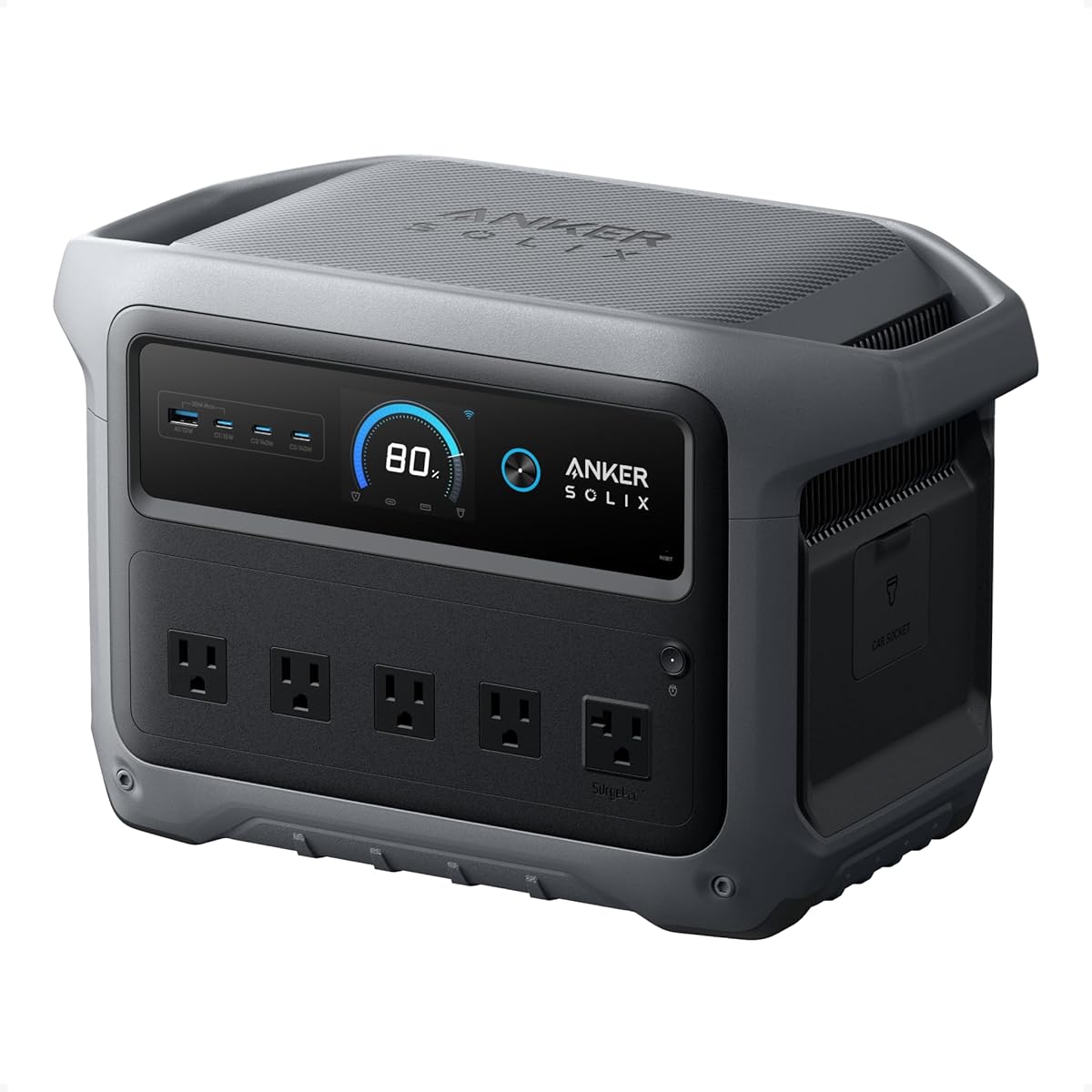
The Anker SOLIX C1000 emphasizes fast replenishment in a relatively compact 1,056Wh format. Its 4.7 rating and unusually broad port count make it appealing for RVs, camping, and outages where several device types need to operate or recharge simultaneously.
We may earn a commission when you buy through this link, at no additional cost to you.
Anker states that the unit reaches 80% capacity in 43 minutes with UltraFast recharging and can complete a full wall charge in under an hour. The fastest setting must be activated through the Anker app, and a smartphone is required. Published operating-temperature guidance for this charging mode is 68 to 122 degrees Fahrenheit, which matters in cold or extremely hot environments.
The SurgePad system delivers 2,400W of output across 11 ports, while the LFP battery is rated for 3,000 cycles over a ten-year lifespan. Solar charging can reach 600W and reportedly restore the battery in 1.8 hours under suitable conditions. Real solar performance varies with panel orientation, weather, shading, and temperature.
This station is a good middle choice for users who want quick recovery and abundant connections. It is not automatically the strongest option for extended outages, because its 1,056Wh capacity is considerably smaller than a 2kWh or 3kWh unit. Its advantages are speed, compactness, and the number of ports, all of which suit mobile users who replenish often.
Rapid wall charging is valuable when a station is stored at home and must be ready before a trip. It also reduces the downtime between uses, making the C1000 convenient for users who move between an RV, campsite, and residence.
The 600W solar input offers a meaningful step up for portable arrays. Compatible panels and favorable sunlight remain important, and the headline charging time should be treated as a best-case figure rather than an everyday guarantee.
We may earn a commission when you buy through this link, at no additional cost to you.
The BLUETTI Elite 300 is the largest-capacity station in this guide, combining 3,014Wh of energy storage with 2,400W continuous output. Its 4.7 rating reflects a feature set aimed at RV travel, extended outages, and users who need more than a weekend-camping battery can provide.
We may earn a commission when you buy through this link, at no additional cost to you.
RV compatibility is unusually thorough. A TT-30 outlet and 12V 30A DC output can serve compatible RV appliances such as 12V refrigerators, water pumps, and diesel heaters. The unit can also run household essentials including refrigerators, routers, lights, televisions, and CPAP machines, with 4,800W surge capacity for resistive loads.
A 10ms UPS function supports computers, routers, and home-office equipment during brief grid interruptions. App controls allow users to monitor consumption, manage outputs, and adjust settings. Recharging is available through AC, solar panels, or a car charger, with a stated 0-to-80% recharge time of as little as 78 minutes under the applicable setup.
The tradeoff is size, weight, and cost relative to smaller units. A 3kWh battery is not automatically a whole-home generator, and actual runtime depends on load size. Even so, the Elite 300 is the most compelling option here for RV owners, remote workers, and households wanting meaningful reserve capacity for essential equipment.
The TT-30 socket and high-current DC output make this system more practical for mobile living than a station offering only standard household AC outlets. Buyers should still verify their RV's connector and electrical requirements before purchase.
A 3,014Wh battery can sustain several appropriate loads for longer than the 1kWh models in the guide. It is still important to estimate runtime using each appliance's actual draw rather than relying on a single headline-hour figure.
We may earn a commission when you buy through this link, at no additional cost to you.
The BLUETTI Elite 30 V2 is a lightweight entry-level station aimed at camping, road trips, and short household emergencies. It weighs 9.4 pounds, stores 288Wh, and holds a 4.4 rating that reflects a capable compact package with a few compromises.
We may earn a commission when you buy through this link, at no additional cost to you.
Its standout feature is output relative to size. Rated continuous output is 600W, while Power Lifting Mode raises the available figure to 1,500W for compatible resistive loads. That can accommodate lights, speakers, laptops, a CPAP machine, and small kitchen appliances, but users should observe manufacturer limits and avoid assuming every heat-producing device is suitable.
Efficiency features include UltraCell technology, improved cooling, and a stated 50% reduction in power consumption. The unit's idle draw is listed at 4.5W, DC draw at 5W, and AC draw at 8W. Wall charging can reach 80% in 45 minutes and a full charge in 70 minutes, while solar, car, and other charging options add flexibility.
The 10ms UPS is useful for keeping a router, laptop, or CPAP device running during short outages. However, 288Wh remains a modest amount of stored energy, so it is best treated as a portable supplement rather than a prolonged household backup. The Elite 30 V2 is a sensible choice for travelers who prioritize size, output, and charging speed.
The 600W continuous rating is more useful than capacity alone for short, high-power tasks. It lets the station handle demanding small appliances while remaining small enough for a normal daypack or vehicle camping setup.
Fast UPS transfer and modest idle consumption make the station appropriate for maintaining communication, internet, and medical equipment. Battery capacity, however, limits how long those devices can run without a recharge.
We may earn a commission when you buy through this link, at no additional cost to you.
The Anker SOLIX C1000 Gen 2 combines 1,024Wh of capacity, 2,000W continuous output, and ten-device support in a relatively compact system. Its 4.7 rating makes it one of the most balanced options for RV travel, remote work, emergency preparation, and off-grid living.
We may earn a commission when you buy through this link, at no additional cost to you.
Wall recharging is the defining feature. Anker states that the upgraded HyperFlash technology can fully recharge the unit at 1,600W in 49 minutes when enabled through the app. Its 10-port selection can keep numerous phones, laptops, lights, and other devices running at the same time, while 3,000W peak output provides additional starting headroom.
The LFP battery is rated to retain at least 80% capacity after 4,000 cycles, supporting a long service life for frequent use. Solar input can reach 600W at up to 60V, with a claimed 1.8-hour recharge under ideal conditions. As with every solar charging figure, weather, panel angle, shading, and system losses affect the result.
A 10ms UPS transition helps keep critical devices running, and TOU mode in the app can manage consumption for remote monitoring. The unit is reported as 14% smaller and 11% lighter than similar models. Buyers should still compare its physical weight and dimensions with their own storage and lifting needs before committing.
The rapid charging claim is valuable for households that keep a station on standby and need it ready before a storm or trip. The app-based activation should be accounted for rather than assuming the fastest mode always runs automatically.
Ten simultaneous devices make this station useful for group camping and remote workspaces where several people need charging. The 2,000W output also gives it more headroom for small appliances than conventional 1,000W-class units.
We may earn a commission when you buy through this link, at no additional cost to you.
The BLUETTI AC180 offers an appealing balance of 1,152Wh capacity and 1,800W continuous output. Its 4.6 rating reflects a flexible station for camping, off-grid work, and backup use, with rapid wall and solar charging among its leading characteristics.
We may earn a commission when you buy through this link, at no additional cost to you.
At 1,440W AC input, the battery can be fully charged in about one hour. A 500W solar input can recharge it in roughly 2.8 to 3.3 hours under suitable conditions, while combining AC and solar can reduce the total time to around one hour. Eight outlets give users a choice of connection types for essential devices.
Output is 1,800W, and the BLUETTI app can activate a 2,700W power-lifting mode for compatible higher-demand loads. A 20ms UPS function allows the unit to support essential equipment during outages. That switch time is still fast for many applications, although models in this guide with 10ms transfer may be better suited to highly sensitive equipment.
The AC180 is a good compromise for people who need more output than a small camping unit but want to avoid a 2kWh or 3kWh system. It includes an AC cable, car cable, solar charging cable, manual, and a five-year warranty. Users should confirm appliance startup demand and electrical requirements before using the lifting mode.
The one-hour wall recharge makes the station practical for users who need it frequently rather than storing it untouched for months. Rapid replenishment also supports emergency preparation because the reserve can be restored quickly after a test.
The 1,800W continuous rating creates more flexibility for tools, appliances, and a portable work setup. The app-activated lifting mode should be used only with compatible equipment and within the product's documented constraints.
We may earn a commission when you buy through this link, at no additional cost to you.
The ZeroKor 300W Solar Kit is an accessible bundle containing a 300W power station, a 40W foldable solar panel, and a separate 100W portable power pack. Its 4.8 rating is strong, although users should understand that the package is aimed primarily at phones, tablets, laptops, cameras, lights, and other small camping loads.
We may earn a commission when you buy through this link, at no additional cost to you.
The main station stores 280Wh and has two 110V pure sine wave AC outlets rated up to 300W. It also includes a DC output, three USB-A ports, one additional USB port with Quick Charge support, and an SOS flashlight with a reading mode. The secondary 100W unit has its own AC outlets, DC connection, USB ports, USB-C port, and flashlight.
The 40W folding panel adds a basic renewable charging path, while the included battery management system provides short-circuit, over-current, over-voltage, and overload protection. Low noise and no combustion make the system suitable for indoor use, tents, and sleeping-in-vehicle arrangements where a fuel-burning generator would be undesirable.
This is not a solution for high-draw coffee makers, hair dryers, water pumps, air compressors, or other appliances that may exceed its limits. Its strengths are value, included accessories, and straightforward camping power. Buyers needing longer runtime or stronger household backup should move to a 1kWh-class model.
The additional 100W power pack provides a convenient way to keep smaller devices charged while the larger station operates appliances. It can also serve as a separate reserve in a vehicle, tent, or second camping area.
The 40W folding panel is easy to deploy and can maintain the main station over time, although it is modest compared with the higher-wattage panels supplied or supported by the larger models in the guide.
We may earn a commission when you buy through this link, at no additional cost to you.
Selecting a lithium portable solar power station requires balancing stored energy, output, recharge speed, weight, and intended use. The most expensive model is not automatically the best choice, and the lightest unit is not necessarily the most useful during an outage.
Capacity is measured in watt-hours and indicates how much energy the battery can store. A station around 280Wh to 300Wh is appropriate for phones, laptops, lights, and small appliances. Models near 1,000Wh provide more useful runtime for camping gear, tools, and selected household equipment, while 2,010Wh to 3,014Wh units suit longer outages and RV use. Runtime also depends on appliance wattage, conversion losses, temperature, and battery condition.
Choose enough capacity for the loads you expect to run, not merely the largest number on the specification sheet. A high-output station with a small battery can power demanding appliances briefly but may deplete quickly.
Continuous output describes the power a station can sustain, while surge or peak output covers brief startup demands. Pumps, compressors, kettles, and refrigerators can require more power momentarily than their running draw. Buyers should check both the running requirement and startup behavior of every important appliance, along with surge limitations and the manufacturer's guidance on lifting modes.
Choose a continuous rating comfortably above your expected load and a peak rating that comfortably covers startup surges. Do not treat a temporary power-lifting mode as a substitute for correctly rated continuous output.
Solar-charging speed depends on the station's maximum solar input, the panel's rated wattage, voltage, connector, sunlight, orientation, temperature, and shading. Some bundles include a compatible foldable panel, while others require one to be purchased separately. A higher input limit can be valuable when multiple panels are planned, but adding more panels only helps if the station and charge controller support it.
For a complete setup, compare the included panel with the station's input rating. For the fastest recovery, prioritize a high-quality compatible panel and place it where it receives unobstructed direct sunlight.
USB-A, USB-C Power Delivery, 12V DC, car sockets, and AC outlets support different equipment. Modern USB-C ports are especially useful for laptops, tablets, and phones that accept high-wattage charging. Pure sine wave AC output is generally preferable for sensitive electronics, while TT-30 and high-current DC connections may be important for RV systems.
Choose based on connector compatibility and the number of simultaneous devices, not only the total port count. Check voltage, amperage, and supported charging protocols for every device that matters.
Fast AC charging is valuable for emergency preparation and repeated use, while solar charging is important for prolonged off-grid operation. Car charging provides a convenient emergency option in vehicles. Some stations also accept alternator chargers, generators, or simultaneous AC-plus-solar input. Published one-hour charging modes may require app activation or specific temperature conditions, so those instructions should be understood before relying on the headline figure.
Prioritize the recharge method that matches your normal use. A wall-fast model with a separate panel may suit campers differently from a bundle with slower but more portable solar hardware.
UPS mode can keep a computer, router, or medical device operating when grid power fails. Models advertising 10ms transfer are especially appealing for sensitive electronics, while a 20ms system may still be suitable for many loads. UPS performance depends on the supported outlets and the station's configuration, so buyers should check whether networking, controls, or high-draw outlets are included.
Choose a short switchover time if uninterrupted operation is important. Test the complete setup before relying on it during a real emergency, and confirm that the connected equipment accepts the station's supported UPS mode.
All ten selections use lithium-based battery systems, with many featuring LiFePO4 chemistry. Published cycle ratings range from 3,000 cycles to 10,000 cycles, and the associated lifespan figures often assume particular depth-of-discharge and usage conditions. Cycle count is only one consideration; heat, prolonged storage at full charge, deep discharges, and charging practices also affect battery aging.
Favor stations with documented battery-management systems, clear warranty coverage, and realistic cycle specifications. Store the unit appropriately and follow the manufacturer's charging guidance to preserve usable capacity.
Weight matters more for hiking than for home backup. Compact units below 10 pounds are easier to carry, while a 23.8-pound or 35.7-pound station may be reasonable in a vehicle but burdensome on foot. Also consider the folding handle, housing dimensions, cable storage, and whether the package includes a panel, car cable, AC adapter, or solar cable. A complete bundle can be more useful than a lower-cost bare station.
Choose the lightest system that still handles your intended loads, then verify the included accessories. Extra panels, specialized RV cables, and high-current adapters can add convenience but may also increase cost and storage needs.
Before first use, read the included manual, inspect the power station and cables, and confirm that the output, connectors, and voltage match the devices you intend to power. Charge the unit through a wall outlet before a trip, install the relevant app if it offers charging controls, and test each output with a low-risk device. For UPS use, connect the equipment and simulate an outage before relying on the function during an actual emergency.
During use, keep the battery and ventilation openings unobstructed, avoid exposing the unit to rain or excessive heat, and do not exceed its continuous output rating. Use pure sine wave AC for sensitive electronics and follow specific manufacturer restrictions for refrigerators, pumps, medical devices, and appliances with compressors. If a load repeatedly causes shutdown, disconnect it rather than repeatedly forcing a restart.
To maintain the battery, use the unit within the manufacturer's temperature guidance, avoid leaving it fully depleted for long periods, and follow the recommended storage-charge level for extended inactivity. Inspect connectors for dirt or damage, keep solar panels clear of shade and debris, and periodically verify the capacity with familiar devices. Recycle or dispose of the station through an appropriate lithium-battery facility when its service life ends.
For charging phones, cameras, lights, and small USB devices, a station around 280Wh to 300Wh is generally sufficient. A 1,000Wh-class unit is better for laptops, car refrigerators, CPAP machines, and several devices over a longer trip. Choose based on both the watts required by each appliance and the total watt-hours needed for the desired runtime.
Many models can run a refrigerator if the station's continuous output exceeds the appliance's running requirement and startup surge. The stated 35-hour refrigerator runtime for the Anker SOLIX S2000 is a best-case example that depends on the refrigerator model, temperature, and usage. Confirm the fridge's label and power draw before relying on any published runtime.
A built-in panel is convenient because it requires less setup and is always available, making the BROWEY 1600W appealing for travel. A separate panel can often be positioned more effectively for direct sunlight and may charge faster when its wattage is higher. The best choice depends on available space, sunlight, and the station's solar-input limit.
Charging time varies with panel wattage, sunlight, angle, temperature, and system losses. The products in this guide publish solar charging times ranging from around 1.8 hours with compatible 600W input to several hours with smaller panels. Treat these as favorable-condition estimates and verify connector, voltage, and power requirements before connecting a panel.
UPS mode is designed to transfer power rapidly when grid electricity fails, helping computers, routers, and other sensitive devices continue operating. General emergency backup may start after a delay or require a button press. Stations advertising 10ms or 20ms switchover are especially useful for low-interruption applications, but buyers should confirm which outlets and functions are supported.
It can replace a gas generator for many electronic, communication, lighting, and small-appliance uses because it operates quietly without combustion. It is not a direct replacement for every generator, especially when sustained high output, extended runtime, or large resistive loads are required. Comparing continuous watts, surge watts, and stored watt-hours clarifies whether the battery can meet the need.
LiFePO4 stations avoid the combustion fumes associated with fuel-burning generators and can be used in many indoor and vehicle-camping situations when operated according to the manual. They still require ventilation, protection from heat and water, and care not to overload or damage the battery. A gas generator should never be operated in an enclosed area.
Divide the power station's usable watt-hour capacity by the combined average wattage of the devices you plan to run, then allow a margin for conversion losses and battery aging. A 1,000Wh station running a 100W continuous load has a theoretical ten-hour runtime before losses, so actual runtime will be shorter. Starting surges also matter even though they may consume relatively little total energy.
The ZeroKor 300W Solar Kit stands out as the approachable entry point, combining a foldable panel and two compact power stations. The Anker SOLIX S2000 is the most well-rounded option for meaningful home backup, while the BROWEY 1600W offers an attractive premium design with integrated solar and high continuous output. Each serves a different mix of portability, convenience, and reserve capacity.
Prioritize the specifications that affect your actual use: stored watt-hours for runtime, continuous output for operating loads, and surge capacity for startup. USB-C power, pure sine wave AC, fast UPS transfer, RV connections, and the right recharge method can be more valuable than a larger headline capacity. Verify the dimensions, weight, and included accessories before finalizing a choice.
Customer ratings, software behavior, and technical specifications can evolve, while prices and promotions change frequently. Buyers should compare the current Amazon listing, warranty terms, and compatibility details at the time of purchase, and should size the system with a little extra reserve for conversion losses and changing energy needs.