
Motion Sensor Light Bulbs for Outdoor Indoor
4.3Editor score
800 lumens daylight output
PIR detection up to 13 feet
Dual sensor automatic operation
Our expert guide compares the best low wattage motion sensor light bulbs for brightness, detection range, energy efficiency, color, and easy installation.
Low wattage motion sensor light bulbs combine automatic activation with energy-conscious LED technology, making them useful for porches, driveways, stairwells, garages, basements, and other areas where hands-free lighting is convenient. A good bulb should detect movement reliably, activate only when needed, fit a compatible fixture, and provide enough brightness for navigation or added security.
We compared these ten products by sensor technology, detection range, activation behavior, light output, color temperature, base compatibility, installation restrictions, and intended applications. The list includes PIR and radar motion sensors, plus one automatic dusk-to-dawn bulb that does not detect movement. Ratings reflect the supplied customer feedback, while feature details come directly from the listed product information.
Each review explains the strongest reasons to consider that bulb, along with installation trade-offs and practical limitations. The top selections highlight standout combinations of output, sensing capability, and convenience. Product availability, ratings, and pricing can change, so readers should verify current listing details before purchasing.
4.3Editor score

4.3Editor score

4.2Editor score
The comparison below places all ten bulbs side by side, focusing on wattage, output, sensor type, detection reach, and notable operating characteristics rather than price alone.


This 9W A19 motion sensor bulb combines a 4.3 rating with an 800-lumen output that is equivalent to a 60-watt traditional bulb. Its 5000K daylight color makes it a practical fit for porches, garages, basements, and exterior entry points where crisp visibility matters. The integrated PIR sensor and photocell provide a straightforward combination of movement detection and automatic dark activation.
We may earn a commission when you buy through this link, at no additional cost to you.
The bulb detects movement at roughly 10 to 13 feet, with a stated detection height of about 6.8 to 8 feet. It illuminates when movement is registered and turns off approximately 30 seconds after the area is left. The photocell keeps it inactive in bright conditions and enables sensing in darkness, while the listed LED beads are rated for up to 25,000 hours. Installation is simple because it uses a standard E26 base.
There are meaningful placement restrictions. The sensing portion at the top cannot be covered by a fixture, shade, or other object, and the bulb should point downward or horizontally rather than be installed too high. It should not be placed inside a glass or metal cover. These limitations reduce its flexibility in decorative fixtures, but they are common to many exposed PIR motion bulbs.
This is a strong choice for shoppers seeking a relatively low-wattage option with useful brightness and automatic nighttime activation. It suits uncovered fixtures near entrances, steps, and storage areas. Buyers should measure their intended detection zone and confirm that the fixture leaves the sensor exposed. For those who can accommodate the installation rules, it offers a capable and economical upgrade over a constantly lit bulb.
The photocell prevents daytime activation, while the PIR sensor handles movement within its stated 10-to-13-foot range. This makes the bulb especially useful in locations where lights are frequently left on or where finding a switch is inconvenient.
At 9 watts and 800 lumens, the bulb delivers meaningful visibility without using the power of the traditional 60-watt equivalent it replaces. The 5000K daylight output is particularly effective for outdoor steps, garage approaches, and other safety-oriented applications.
We may earn a commission when you buy through this link, at no additional cost to you.
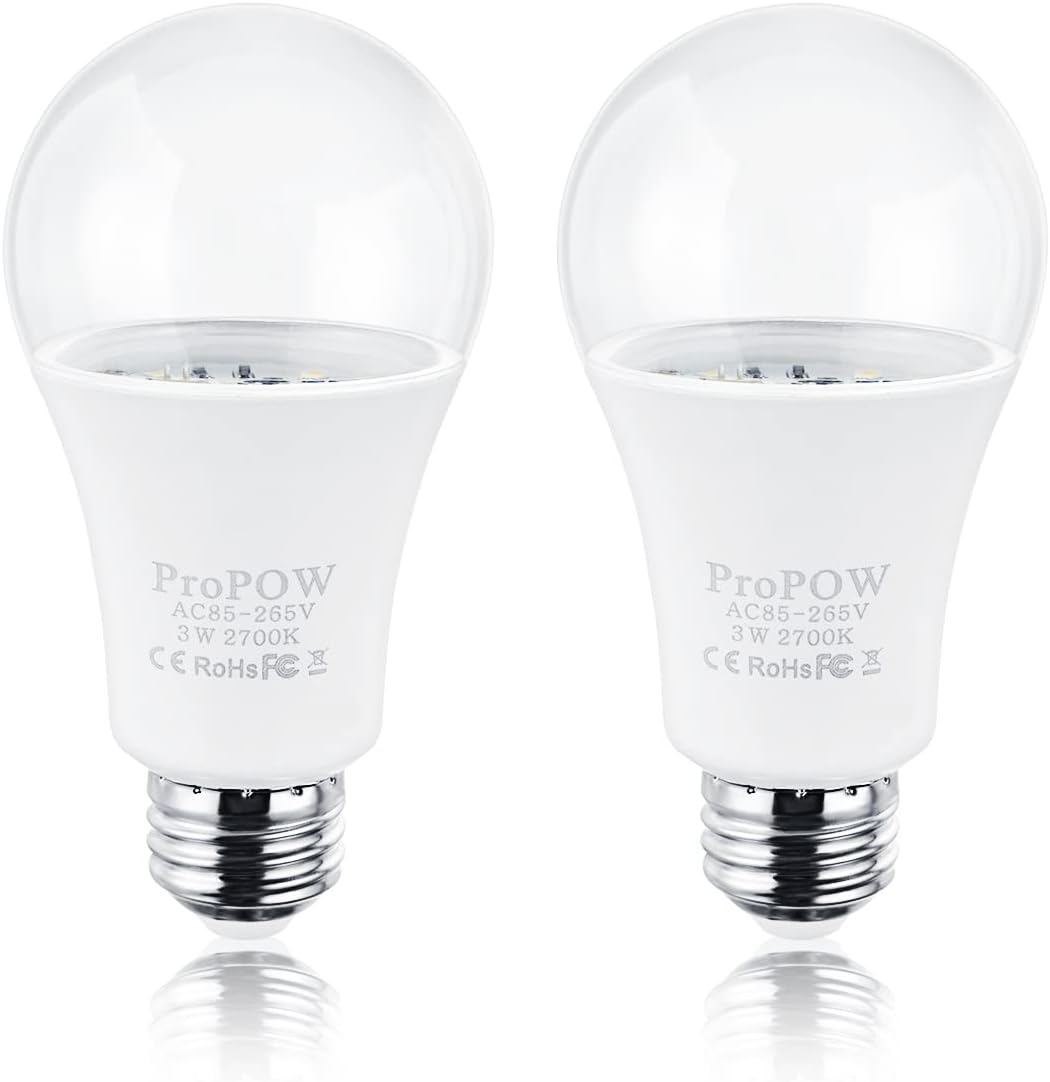
This bulb earns a 4.6 rating, the highest listed among the ten products, and stands out for its exceptionally low 3-watt consumption. It produces 300 lumens of soft white light at 2700K, creating a gentler atmosphere than the daylight-output options. It is designed for continuous automatic illumination from dusk until dawn rather than movement-triggered operation.
We may earn a commission when you buy through this link, at no additional cost to you.
A built-in photocell switches the bulb on below approximately 15 lux and off above approximately 40 lux. That makes it suitable for porches, hallways, patios, driveways, garages, and yards where the goal is dependable overnight illumination without operating a wall switch. The clear-cover A19 design fits standard E26 medium screw sockets, and a two-bulb pack allows one bulb per fixture.
The central limitation is obvious: this is not a motion sensor bulb. Its 300-lumen output is suitable for ambient or supplementary lighting, but it may not be sufficient as the only source of light in a large, dark entrance or heavily traveled outdoor area. It is also non-dimmable, so users cannot adjust output with a compatible dimmer.
Homeowners looking for the absolute lowest energy use should shortlist this option, particularly for decorative or secondary fixtures. It is also a better fit for someone who prefers continuous nighttime visibility over brief movement-triggered bursts. For primary security lighting or paths requiring stronger illumination, a motion-activated model would be more capable.
A 3-watt draw makes this the most energy-conscious bulb in the guide. Its automatic dusk-to-dawn operation is ideal for fixtures that benefit from overnight ambient light without the complexity of an app, hub, or manual scheduling.
The 2700K soft-white output is gentler than the 5000K and 6000K alternatives, making these bulbs more appropriate for patios, hallways, and welcoming entry areas. Their 300 lumens are best treated as ambient illumination rather than a substitute for a high-output floodlight.
We may earn a commission when you buy through this link, at no additional cost to you.
This 12W radar motion sensor bulb carries a 4.3 rating and pairs a 1100-lumen daylight output with one of the broadest detection systems in the group. It provides a 360-degree viewing angle and an approximately 16-to-32-foot detection diameter, making it well suited to open porches, driveways, garages, stair areas, and exterior approaches.
We may earn a commission when you buy through this link, at no additional cost to you.
The radar sensor uses Doppler-based movement detection rather than the heat-based sensing used by many competing bulbs. According to the product information, it can detect movement through acrylic, glass, and other non-metallic materials, which can be useful when the bulb is mounted near a window or inside a protected location. A photosensitive sensor disables motion activation in bright conditions and permits it in darkness below approximately 15 lux.
Installation requires care. The bulb should face downward and should not be placed where other lighting constantly shines on the sensor. On its first daytime activation, it performs a brief program self-check and turns off after about two seconds. Radar sensitivity may also register moving plants or other objects, an advantage for broad security coverage but a possible source of unwanted activation in exposed areas.
This is the most versatile choice for a buyer who prioritizes long-range, wide-angle motion detection. Its 1100 lumens also offer stronger visibility than most lower-output models in the roundup. Choose it for a broad outdoor area where a wide radar field is valuable, but verify downward placement and avoid positioning it where nearby lights interfere with the light sensor.
The 360-degree detection angle and 32-foot maximum reach give this bulb an advantage over many exposed PIR sensors with narrower fields. That makes it especially useful near long driveways, wide porches, garage entrances, and stairs where approaching movement may originate outside a narrow cone.
The 1100-lumen daylight output offers clear visibility, while the built-in photocell keeps motion sensing inactive when ambient light is strong. This balances useful security illumination with the reduced operating time associated with a bulb that remains on continuously.
We may earn a commission when you buy through this link, at no additional cost to you.
This SINCELIGHT M1A-series bulb has a 4.1 rating and distinguishes itself with five selectable color temperatures ranging from 2700K to 6000K. A user can rotate the base to choose warm, neutral, or cool light without replacing the bulb or adding extra controls. It uses an E26 base and is positioned as a convenient retrofit for standard fixtures.
We may earn a commission when you buy through this link, at no additional cost to you.
The dual-sensor design combines a PIR infrared motion sensor with a light sensor. It activates in darkness when it detects human or animal activity and remains off when ambient light is sufficient. Continued activity resets the timing, and the bulb turns off 60 seconds after activity stops. Its construction includes an aluminum radiator and a high-thermal-conductivity PBT cover, with a stated lifespan of up to 15,000 hours.
Compared with many competing bulbs, its 60-second timeout is relatively long. That keeps the light on longer after someone leaves, reducing abrupt darkness but increasing runtime. The bulb also depends on heat-signature movement, so radar is a better choice when detection must extend through non-metallic barriers or capture movement unrelated to body heat.
This product is ideal for buyers who want one versatile bulb family to suit different rooms and moods. Warm light can serve a porch or hallway, while higher CCT settings can brighten a garage or stairwell. It works well where a modest PIR field is sufficient and where adjustable color is more valuable than maximum detection distance.
Five CCT settings—2700K, 3000K, 4000K, 5000K, and 6000K—allow the same bulb to adapt to different spaces. This is useful in homes where a single outdoor fixture may need warm welcoming light at night and brighter visibility for storage or maintenance tasks.
The photocell and PIR sensor work together so the bulb activates only in darkness when movement is detected. A continuous-activity reset also prevents the light from switching off while someone remains active in the detection area.
We may earn a commission when you buy through this link, at no additional cost to you.
The GE LED+ A21 motion sensor bulb combines a 4.2 rating with the convenience of a recognizable lighting brand and a straightforward setup. It screws into a fixture with an E26 medium base, needs no app or hub, and begins operating automatically when motion is detected at night. Its warm-white output is designed to support home security without the harsher appearance of daylight white.
We may earn a commission when you buy through this link, at no additional cost to you.
The advanced motion sensor offers a 90-degree viewing angle and a stated detection distance of up to 24 feet. The bulb consumes 11 watts while providing output equivalent to a 75-watt traditional bulb. It is damp-rated for humid conditions, and its automatic shutoff after periods without motion helps reduce unnecessary energy use. The package includes two A21 bulbs and a quick-start guide.
One important operational feature is the selectable always-on mode. Turning the wall switch off and on within three seconds activates the mode, confirmed by a flash; holding the switch off longer than three seconds reactivates motion sensing. It also stays lit for five minutes after the last detected movement, a longer delay than most of the 30- and 60-second options in this guide.
This bulb is best for homeowners who value established branding, simple controls, and a generous five-minute hold time. Check the fixture size carefully because the A21 form factor is larger than an A19. It is also intended for non-enclosed fixtures. Those constraints aside, it is a polished and practical premium choice for covered outdoor approaches or other compatible locations.
The switch-controlled always-on function is valuable when a homeowner wants normal manual lighting occasionally while retaining motion activation at other times. Reactivating sensor mode is straightforward once the timing sequence is understood.
The five-minute delay after the final detected movement is longer than the common 30-second setting. That can reduce abrupt darkness while someone walks through an area or retrieves items, though it also keeps the bulb illuminated longer.
We may earn a commission when you buy through this link, at no additional cost to you.
This Torkase motion sensor bulb has a 4.2 rating and delivers 1100 lumens, equivalent to a 100-watt traditional bulb. It combines a PIR sensor with dusk-to-dawn activation, making it a higher-output option for staircases, front doors, garages, porches, closets, balconies, storage rooms, and other locations that benefit from automatic nighttime illumination.
We may earn a commission when you buy through this link, at no additional cost to you.
The sensor detects movement at approximately 8 to 16 feet and only operates when ambient light falls below 15 lux. It turns off after 30 to 45 seconds without movement. The stated LED lifespan is up to 20,000 hours, and the product information describes up to 85% energy savings relative to a traditional bulb, supporting the category's low-consumption appeal.
Fixture compatibility is the decisive trade-off. The bulb needs an open, downward-facing fixture with the PIR sensor exposed. It will not work properly in fully enclosed or recessed fixtures, upside-down installations, or behind a shade or cover. Users should also avoid switching it with touch, voice, infrared, or light-control switches, as those controls can interfere with normal operation.
Choose this bulb when brightness matters as much as automation and the available fixture is open. Its output should provide ample visibility on stairs or in an entryway, while the PIR system ensures the light is not active all night. Buyers willing to satisfy the exposed-sensor requirement gain a capable bulb with a useful balance of output and reach.
The 1100-lumen output is among the strongest in the group and makes this bulb suitable for places where light must reveal obstacles, steps, or an approaching person. The 30-to-45-second delay is long enough to support movement through an entry area without remaining on for a full minute.
Before purchasing, open the intended fixture and verify that the bulb's sensing section can remain visible and face downward. An attractive enclosed shade may prevent proper operation, making this model less versatile than a conventional non-sensor LED.
We may earn a commission when you buy through this link, at no additional cost to you.
This four-pack has a 4.3 rating and provides 1000 lumens of crisp 6000K daylight from a 13.5-watt LED. It targets properties that need motion-activated coverage in several areas at once, such as porches, garages, stairs, basements, yards, gardens, corridors, bathrooms, and storage rooms. Its standard E26 base allows straightforward replacement of compatible bulbs.
We may earn a commission when you buy through this link, at no additional cost to you.
The PIR infrared sensor detects people or animals at approximately 16 to 26 feet in darkness. A built-in photoelectric sensor enters detection mode below 10 lux and prevents the bulb from illuminating brightly during daylight. The timeout is about 30 seconds after the area is left, but continued movement resets the countdown, so the light remains on while activity continues.
The custom semi-transparent cover is described as shockproof and designed for high light transmission and uniform diffusion. That construction supports the bulb's crisp output, although its 6000K color is more clinical than the warm or neutral choices. At 13.5 watts, it also uses more power than the 3W, 9W, 10W, and 12W models in the roundup.
This product makes sense for buyers who want a coordinated four-bulb installation or want spares for future fixtures. Its approximately 26-foot reach is particularly useful for yards, larger driveways, and garage approaches, while the four-pack reduces the need to source matching sensor bulbs separately. It is less suitable for users seeking warm residential ambience or the lowest possible power draw.
Four matching bulbs make it easier to illuminate a porch, garage, basement, and exterior path without mixing sensor models. The pack also provides practical replacement stock for high-traffic locations where bulbs are installed or removed frequently.
A 16-to-26-foot detection range covers more distance than many exposed PIR bulbs in this list. The 30-second reset responds to continued movement, helping avoid premature shutoff while someone is still present.
We may earn a commission when you buy through this link, at no additional cost to you.
This 12W four-pack has a 4.0 rating and offers a convenient way to upgrade several standard E26 fixtures to automatic motion lighting. It produces 100-watt-equivalent output and needs no app, hub, rewiring, or additional accessory. The listed applications include porches, garages, pathways, driveways, patios, gardens, balconies, and entryways.
We may earn a commission when you buy through this link, at no additional cost to you.
Its PIR sensor activates at approximately 13 to 20 feet when motion is detected, then turns off after 30 seconds. A light sensor allows operation only in darkness below 15 lux. The direct screw-in design means most users can replace an existing bulb and gain automatic lighting without changing the fixture.
The listing presents some inconsistent color information. The product title refers to 5000K daylight, while the feature description identifies the bulbs as 3000K soft white. Buyers should check the package or current listing details to confirm the actual color temperature. The 4.0 rating is also the lowest numerical customer rating in the group, so expectations should be balanced.
This pack is attractive for its simple installation and useful combination of brightness, low wattage, and four-bulb convenience. It may be especially suitable for a home with multiple exterior fixtures. However, confirm the color temperature and ensure the sensor area can remain unobstructed before ordering.
Because these bulbs use standard E26 sockets, users can convert several compatible fixtures without rewiring or smart-home equipment. This makes the four-pack useful for coordinated indoor and outdoor upgrades.
The title describes 5000K daylight light, but the feature details state 3000K soft white. Because the two choices create noticeably different atmospheres, buyers should verify the current package information before selecting the bulb for a specific room or exterior design.
We may earn a commission when you buy through this link, at no additional cost to you.
This LUXON BR25 radar bulb earns a 4.5 rating and offers 6000K cool-white light from a 15-watt LED. Its microwave-based radar sensor is presented as more sensitive than PIR and capable of detecting movement even when a subject's body temperature is close to the surrounding temperature. The stated operating range is 13 to 26 feet.
We may earn a commission when you buy through this link, at no additional cost to you.
The bulb automatically activates in darkness and turns off approximately 30 seconds after motion ceases. Its photocell threshold is listed at under six lux for activation and above six lux for deactivation. A lifespan of up to 20,000 hours adds to its suitability for frequently used exterior fixtures, while the E26 base supports straightforward replacement.
Radar's reach also creates potential sensitivity to moving objects beyond people and animals. The product information specifically notes that moving plants, branches, a fan, or movement behind a door, wall, or window can trigger it. This can be beneficial for broad security awareness but may cause unwanted lighting in exposed or busy surroundings.
Choose this bulb when reliable detection and wide placement options matter more than the lowest wattage. It is well suited to exterior approaches and areas where a conventional PIR sensor may miss the subject. Users prone to false triggers should install it thoughtfully and consider the direction of nearby vegetation or moving objects.
The radar sensor can recognize movement even when body temperature is similar to ambient conditions. It can also detect movement through non-metallic barriers, giving it placement flexibility that exposed PIR bulbs cannot match.
Because radar can pick up moving branches, plants, fans, and other activity, mounting location matters. Position the bulb where useful movement will trigger it while routine environmental movement is less likely to create repeated illumination.
We may earn a commission when you buy through this link, at no additional cost to you.
The Bluex three-pack provides the highest stated lumen output in this guide at 1300 lumens, using 15 watts per bulb. Its 5000K daylight color is intended for entryways, garages, yards, and indoor spaces where clear visibility is the priority. The A21 form factor uses an E26 medium base and installs in a conventional compatible fixture.
We may earn a commission when you buy through this link, at no additional cost to you.
The integrated motion sensor detects movement up to approximately 24 feet and uses a wide detection angle. Once movement is detected at night, the bulb illuminates automatically and shuts off when activity stops. Installation requires no app, hub, or Wi-Fi connection, making it a straightforward option for users who want sensor lighting without a smart-home ecosystem.
The supplied product information does not include a numerical customer rating, so there is no established rating figure to compare with the other products. It also contains a color inconsistency: the title lists 5000K daylight while the parenthetical description references 4000K cool white. Buyers should confirm the color temperature on the current package. As an A21 bulb, it may also be too large for compact A19 fixtures.
This product is best considered by buyers who prioritize strong output and a three-bulb installation over having an established numerical rating. Its listed moisture resistance makes it suitable for porches, driveways, garages, basements, and other exposed locations when the fixture provides suitable protection. Verify bulb dimensions, color temperature, and fixture compatibility before ordering.
At 1300 lumens per bulb, this set provides the strongest stated output in the comparison. That brightness can improve visibility around garages, wide entryways, and exterior paths when the motion sensor activates.
The automatic motion and nighttime behavior works without an app, hub, or Wi-Fi connection. Users only need a compatible powered fixture and an always-energized wall switch for the bulb to provide hands-free illumination.
We may earn a commission when you buy through this link, at no additional cost to you.
Choosing a low wattage motion sensor bulb involves balancing light output, detection method, fixture constraints, and operating behavior. The following factors help narrow the options according to the space, coverage requirements, and level of automation needed.
Light output is measured in lumens and indicates how much visible illumination a bulb produces. The options in this guide range from 300 lumens for soft ambient light to 1300 lumens for bright security-oriented coverage. A small porch, closet, hallway, or stair landing may look adequately lit with a lower-output bulb, while a driveway, garage entrance, or broad exterior area generally benefits from 1000 lumens or more. Color also affects perceived brightness: 5000K and 6000K light often looks crisper, whereas 2700K and 3000K creates a warmer atmosphere.
Choose a bulb whose output matches the size of the area and the amount of visibility required. Do not equate wattage with brightness alone, because LED efficiency determines how much light a given wattage produces.
PIR sensors detect infrared energy associated with movement by people or animals. They generally provide a directional field and work well when heat is a useful identifying characteristic. Radar sensors use microwave Doppler detection and can offer wider coverage, greater sensitivity, and detection through some non-metallic materials. Radar may also respond to moving branches, fans, and other objects, so its increased reach comes with a need for thoughtful placement.
Choose PIR for a contained approach or location where only people and animals should trigger the light. Choose radar for broad coverage, challenging temperatures, or situations where the subject may not register clearly to an infrared sensor.
Detection reach varies significantly. The Torkase bulb covers approximately 8 to 16 feet, the first-ranked 9W bulb reaches 10 to 13 feet, and several radar or long-range PIR products extend to 24, 26, or 32 feet. Detection angle matters as much as raw distance. A long range is not useful if the sensor cannot see the approach, while a broad radar field may illuminate areas that do not need it.
Measure the intended area from the planned bulb location and consider entrances, blind corners, stairs, and vehicles. Select the smallest suitable range when nearby foot traffic could cause excessive activation.
A photocell determines when darkness-based operation is permitted. Most motion bulbs remain inactive during daylight and enable their sensor after ambient light crosses a specified threshold. Thresholds differ among products, ranging from under six lux to under 18 lux, so a bulb may activate earlier in twilight than another. The second-ranked bulb differs because it switches on at dusk and remains lit until dawn without detecting motion.
Check the threshold when evening behavior matters, especially for very dark entryways or gardens. Also ensure nearby fixtures do not keep illuminating the sensor, because competing light can interfere with reliable darkness detection.
An E26 medium screw base is common, but the overall bulb shape still matters. A19 bulbs tend to fit many standard fixtures, while A21 bulbs are larger and may require additional clearance. The GE LED+ and Bluex products use the A21 format, and the LUXON uses a BR25 reflector shape. Enclosed shades, narrow lanterns, recessed housings, and compact fittings can prevent the bulb from seating properly.
Compare the product dimensions with the fixture's rated bulb shape and maximum wattage. Even though these are LED bulbs, using the correct shape avoids pressure on the socket and leaves the sensor in the intended position.
Many PIR bulbs require the top sensor to remain exposed. A shade, glass cover, metal cover, recessed housing, or upward-facing orientation can block the sensing area. Radar bulbs also generally need downward placement to make full use of their detection pattern. Fixtures with integrated touch, voice, infrared, or light controls may interfere with a sensor bulb's normal operation.
Install the bulb in an open, downward-facing fixture whenever the manufacturer requires it. If the existing fixture is enclosed, choose a purpose-designed fixture for the sensor bulb rather than forcing an installation that cannot function as intended.
Timeout controls determine how long the light remains on after movement stops. Most of the listed bulbs use a 30-second delay, while the SINCELIGHT option uses 60 seconds and the GE LED+ remains on for five minutes. A longer timeout can prevent premature darkness but increases operating time. Some bulbs also offer an always-on mode controlled through the wall switch, which can be useful when conventional lighting is occasionally needed.
Choose a timeout based on normal movement patterns. Thirty seconds suits quick passage through an entry, while a longer delay is better for tasks that involve setting down items or moving slowly around a staircase.
Pack size affects convenience. Two-bulb packs suit a porch and garage, while four-packs are useful for completing a larger installation or keeping matching replacements. Three-bulb packs can cover a main entrance, side path, and garage. Color temperature should match the intended atmosphere: warm 2700K or 3000K is generally more welcoming, while 4000K, 5000K, and 6000K provide a crisper security or task-lighting appearance.
Plan fixture count before choosing a pack, and verify color details carefully because two listings present conflicting temperature information. Confirming the actual specification prevents surprises after installation.
Begin by switching off power at the breaker and confirming that the socket is compatible with the bulb's E26 base and physical size. Remove the existing bulb, install the sensor bulb by hand without over-tightening, and restore power. For a dark-area test, allow the fixture to settle under ambient light conditions, then walk through the sensor field from different directions. A daytime startup self-check on certain models is normal and should not be mistaken for a fault.
Adjust the installation angle and height rather than forcing a sensor bulb into a covered fixture. Keep the sensing section exposed, point it toward the expected approach, and avoid nearby lights that could interfere with the photocell. Test both movement activation and timeout behavior. If the bulb remains on, check whether another light is illuminating the sensor, whether the wall switch controls incompatible touch or voice features, and whether the fixture allows the required downward orientation.
For care, clean the outer cover and sensor area with a dry or lightly damp cloth after the bulb has cooled and power has been disconnected. Do not spray liquid into the fixture or touch electrical components while energized. Replace the bulb if the lens becomes dirty, cracked, or obstructed. Also recheck the fit periodically because vibration, weather, and fixture movement can gradually change the sensor angle.
They can, provided the lumen output and detection range match the area. Bulbs around 1000 to 1300 lumens are better suited to garage entrances, driveways, and larger approaches, while lower-output models work well for steps, porches, and ambient guidance. Placement also matters because the sensor must remain uncovered and oriented toward the area it is meant to monitor.
PIR sensors detect infrared movement associated with people and animals and usually create a directional detection area. Radar sensors use microwave Doppler detection, often covering a wider field and detecting movement through some non-metallic materials. Radar may also react to moving plants, fans, or other objects, so neither type is automatically superior in every installation.
Many of the listed bulbs cannot operate properly when their sensor is covered. Models such as the first-ranked 9W bulb and the Torkase bulb specifically require an exposed sensing area, and radar products generally require downward installation. Check the fixture type and product guidance before buying, especially if the intended location has a glass, metal, recessed, or fully enclosed cover.
The first activation of some radar models performs a short self-check and turns off after roughly two seconds. A bulb that remains on can also be affected by another light source reaching the photocell, an incompatible wall switch, or a blocked or poorly aimed sensor. Confirm that the fixture permits a downward orientation and that the wall switch remains energized when automatic operation is desired.
Not all models are dimmable, so compatibility should be verified before installation. The 3W dusk-to-dawn bulb in particular is explicitly listed as non-dimmable. Even when a bulb supports dimming, its motion sensor and automatic on-off behavior may make traditional dimmer use impractical, and incompatible controls can cause flickering or improper operation.
The timeout depends on the model. Most products in this guide turn off about 30 seconds after the area is cleared, the SINCELIGHT bulb waits 60 seconds, and the GE LED+ remains illuminated for five minutes. Continued movement usually resets the countdown. Longer delays improve convenience but keep the light on longer than a short timeout.
No, because the sensor and bulb share the same fixture, so one bulb illuminates only the area where it is installed. However, radar models with wide detection fields may cover a larger exterior region around a single fixture. For multiple rooms or distant points, separate bulbs or a wired outdoor lighting system are more practical.
The motion-activated options in this guide are designed to work automatically after installation and do not require an app, hub, or Wi-Fi network. The included light and motion sensors handle daytime blocking and movement activation directly. This makes them suitable for users who want simple local control rather than a connected smart-lighting system.
The first-ranked 9W bulb stands out as a balanced budget choice with 800 lumens, dual sensing, and a standard E26 base. The GE LED+ A21 pair is the premium selection because of its established branding, 24-foot detection, always-on option, and long five-minute hold time. Between them, the 12W radar bulb is the editor's choice for shoppers who value wide coverage and an ample 1100-lumen output.
Before selecting any model, prioritize fixture compatibility, detection direction, light output, and the desired timeout. A very low-wattage bulb may be ideal for soft ambient guidance, while a larger area usually benefits from 1000 lumens or more. PIR is well suited to targeted human and animal detection, whereas radar offers broader reach but can respond to other moving objects. Exposed-sensor and downward-facing installation requirements deserve careful attention.
Ratings, product details, and pricing can change over time, so readers should review the current listing before making a final purchase. Confirm the bulb size, color temperature, sensor restrictions, and pack contents, and ensure the fixture can support the intended installation. With those checks completed, the right low wattage motion sensor bulb can deliver convenient automatic lighting with less unnecessary energy use.