
WD Red Plus 4TB
4.2Editor score
CMR recording for RAID
5400 RPM operating speed
128 MB drive cache
Optimized for continuous use
NAS drives give home servers a dependable foundation for family photos, media libraries, backups, surveillance recordings, and important documents. The right drive must suit your NAS chassis, tolerate sustained workloads, provide dependable RAID performance, and offer enough capacity for files that continue to grow.
This guide compares ten NAS-focused enclosures and internal hard drives based on the supplied specifications, including bay count, networking, application support, recording technology, cache, workload ratings, and intended use. It covers entry-level personal systems, advanced creator platforms, four-bay family servers, and enterprise-grade storage.
Each selection reveals which buyers it serves best, from first-time NAS owners to demanding multi-user setups. Product availability, bundle contents, compatibility, and pricing can change, so readers should verify the latest listing details and confirm that every required drive is included before purchasing.
4.2Editor score

4.6Editor score

4.6Editor score
As an Amazon Associate we earn from qualifying purchases.
The table below compares the ten featured NAS enclosures and internal hard drives by type, core hardware, storage design, and key capabilities.



The UGREEN NAS DH2300 is an approachable two-bay enclosure for people who want private family storage without the complexity of a full server platform. It carries a 4.5 rating in the supplied data and stands out for its simple setup, cross-device backup support, and AI-assisted organization of photos. It is designed primarily for personal files, phone backups, entertainment media, and scattered documents that need one accessible home.
We may earn a commission when you buy through this link, at no additional cost to you.
Its 1GbE Ethernet interface, high-performance processor, and 4GB of onboard memory are sufficient for the intended everyday workload. The listed transfer rate reaches up to 125MB/s, making it practical for routine backups and media access across a home network. Automatic backups can work with Windows, iOS, Android, and macOS devices, while AI recognition helps sort images by faces, locations, text, and objects.
The important limitation is its simplicity. It does not support Docker, virtual machines, or SAN Manager, and Plex cannot be run through Docker as it can on more advanced UGREEN systems. Wi-Fi is also unavailable without an external USB adapter, although the included wired connection is generally the more reliable approach. These restrictions make the DH2300 less attractive to enthusiasts who want to run containers or virtualized services.
This is a sensible choice for a first NAS, a couple's photo archive, or a household seeking straightforward private storage. Buyers should select two compatible drives separately, choose the RAID arrangement that matches their redundancy priorities, and use Ethernet for dependable performance. For simple backups and family media without advanced applications, it delivers an unusually approachable package.
Keeping data on locally installed drives gives the household a centralized location that remains accessible through phones, tablets, computers, and browsers. Layered features include two-factor authentication, permissions, encrypted transfers, and RAID modes, although access outside the home still depends on a sound network and remote-access configuration.
Automatic device backups reduce the chance that a new phone replacement will erase a camera roll. AI tagging, similar-image detection, and duplicate cleanup make the enclosure more useful for a growing family archive rather than a simple shared file folder.
We may earn a commission when you buy through this link, at no additional cost to you.
The UGREEN NAS DXP2800 is the strongest all-around recommendation for advanced home users who want more than automatic backups. Its supplied rating is 4.6, and the combination of an Intel N100 quad-core processor, 8GB of DDR5 memory, and 2.5GbE networking gives it room for media libraries, Docker containers, virtual machines, and remote work files in a compact two-bay design.
We may earn a commission when you buy through this link, at no additional cost to you.
Two M.2 NVMe slots provide another layer of flexibility. Compatible flash storage can accelerate selected workloads or expand the usable storage pool, while the two hard-drive bays can hold larger-capacity hard disks for archives. AI photo management recognizes people, objects, scenes, and locations, which helps organize large collections of RAW images, family pictures, and 4K video.
Compatible network cameras can turn the system into a local surveillance hub. Face recognition, people detection, and pet detection make recorded events easier to review without relying on a separate camera ecosystem for every task. Docker and virtual-machine support also open the door to Plex-compatible media applications and other self-hosted workflows, although the user must install and configure those services.
This model makes the most sense for creators, remote workers, and technically confident households that want advanced applications from only two bays. Buyers should account for the separate cost of HDDs and SSDs, ensure their router and client devices support 2.5GbE, and confirm application compatibility before committing to a specific containerized service.
The 2.5GbE connection offers a meaningful improvement over basic gigabit networking when copying large RAW files, edited video, or full backup sets. Performance still depends on the router, client hardware, storage configuration, and size of individual transfers, so a compatible client and switched network path remain important.
Docker and virtual-machine support distinguish this enclosure from simpler personal NAS units. The dual M.2 slots can complement hard-drive storage with high-speed flash space, making the system suitable for creators who regularly work with active media libraries and demanding multi-user access.
We may earn a commission when you buy through this link, at no additional cost to you.
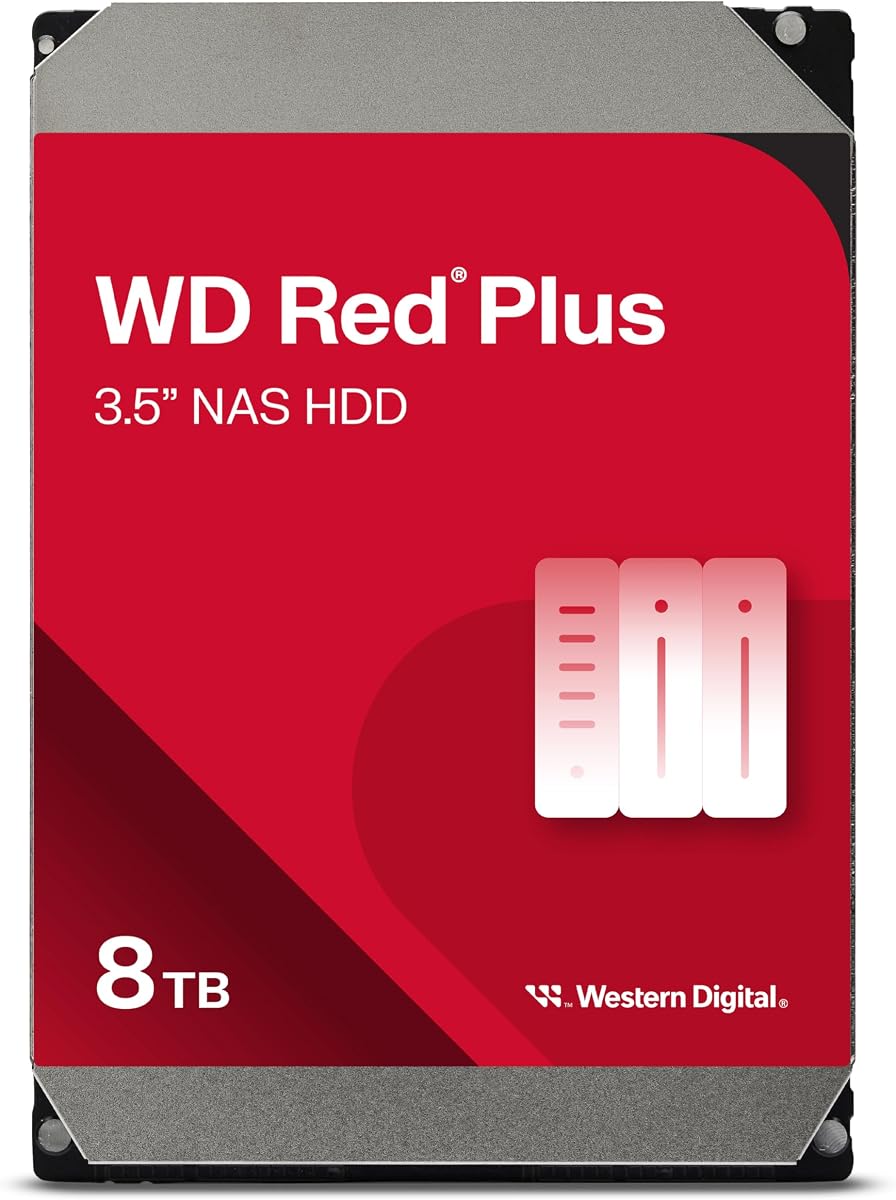
The WD Red Plus 8TB is a purpose-built internal hard drive for NAS systems, making it a practical foundation for a multi-bay home server. It has a supplied rating of 4.2 and combines 8TB of capacity with CMR recording, 5640 RPM operation, SATA 6 Gb/s, and 256 MB of cache. Those traits suit users maintaining media archives, business files, backups, and shared family storage.
We may earn a commission when you buy through this link, at no additional cost to you.
NASware firmware helps the drive integrate with compatible arrays, while its workload rating of up to 180TB per year is suitable for sustained activity. The specifications mention use in small and medium business NAS systems operating around the clock, making it a better NAS-focused choice than a generic desktop drive for anyone who expects regular simultaneous access.
As with every hard drive, failure remains possible, so RAID should not be treated as a substitute for backups. CMR recording is especially useful in RAID because it avoids the write-penalty limitations associated with SMR drives when multiple drives perform concurrent tasks. Buyers must still check the NAS compatibility list, bay dimensions, and supported capacity before ordering.
This is an attractive capacity option for users who want room to preserve media and documents without continually moving files elsewhere. It works particularly well in a two- or four-bay NAS where continuous operation and predictable RAID behavior matter. For a first home server with expanding archives, it provides a more specialized and dependable foundation than a general-purpose desktop disk.
Conventional magnetic recording is well suited to RAID workloads because each drive writes consistently without the severe sustained-write penalty found in SMR designs. That consistency can matter when rebuildings, backups, and user activity overlap.
Eight terabytes provides useful headroom for a family media collection, project archives, and rotating backups. With two compatible drives, a home user can mirror important files for redundancy, while a four-bay enclosure offers greater capacity and additional rebuild options.
We may earn a commission when you buy through this link, at no additional cost to you.
The WD Red Plus 4TB offers a balanced entry point for home-server builders who need specialized NAS behavior without moving immediately to the largest available capacity. Its supplied rating is 4.2, and the drive combines a 4TB capacity with 5400 RPM operation, SATA 6 Gb/s, CMR recording, and 128 MB of cache. It is built for RAID-optimized NAS systems with up to eight bays.
We may earn a commission when you buy through this link, at no additional cost to you.
Its defining strength is clear specialization. NAS-aware firmware, continuous-operation design, and CMR recording make it more appropriate for a home server than a general-purpose desktop hard drive, particularly when the drive will contribute to a mirrored or larger RAID array. The lower spindle speed can also translate into modest power and noise characteristics that suit a household environment.
The trade-off is capacity. Four terabytes is enough for many first-time NAS projects, but high-resolution video, camera footage, and multiple backup generations can consume that space quickly. If the NAS platform permits a larger drive later, that is another reason to choose an enclosure with unused bays or expandability. The drive does not solve the need for an independent off-server backup.
For families storing documents, a moderate photo collection, and selected media, this drive is a sensible balance. It also works well as a matched pair in a two-bay enclosure, where redundancy and straightforward expansion are usually more important than having the largest possible capacity in a single slot.
Two matched CMR drives can form a simple protected array in a compatible two-bay NAS. Matching models and capacities simplifies management and reduces the chance of unexpected space or performance differences between volumes.
The 5400 RPM platform is aimed at continuous NAS use without the emphasis on maximum rotational speed found in performance-oriented drives. Actual acoustic and thermal results vary, so a home server still benefits from proper airflow and a placement that avoids direct vibration.
We may earn a commission when you buy through this link, at no additional cost to you.
The UGREEN DXP4800 Plus is a high-performance four-bay NAS designed for families, creators, and small teams that need room to grow. Its supplied rating is 4.6, while its 10GbE networking and support for Docker and virtual machines place it above entry-level home-storage appliances. It is well suited to shared archives, active media, collaboration, and private cloud-style access.
We may earn a commission when you buy through this link, at no additional cost to you.
A 10GbE port can move a 1GB file in less than a second under favorable conditions, although real performance depends on the client, router, drive configuration, and file size. The enclosure can reach 144TB of stated raw capacity when populated with compatible drives. Automatic backups, flexible RAID options, remote access, and detailed permissions support a household that wants control without managing individual external disks.
AI photo features recognize faces, scenes, objects, and locations, while duplicate removal helps keep large libraries tidy. Users can access the NAS from Windows, macOS, Android, iOS, browsers, and compatible smart TVs. The system also works with drives from several major manufacturers, although the current compatibility list should be checked before purchasing.
This model is ideal for a family whose storage needs have outgrown two bays or for a creative team that handles frequent large transfers. It is more complex than a basic file server, so buyers should be comfortable learning RAID, permissions, and application management. In return, they gain speed, expansion room, and a capable platform for self-hosted workflows.
The 10GbE interface is the major differentiator for large file operations. Users editing high-resolution footage or running frequent backups benefit from a client and switch that also support 10GbE, since the NAS alone cannot overcome a slower network path.
Four drive bays make it easier to begin with the capacity you need and add storage later. Compatible third-party HDDs and SSDs keep the platform flexible, while RAID choices let the owner balance usable space against redundancy.
We may earn a commission when you buy through this link, at no additional cost to you.
The UGREEN NAS DH4300 Plus is an entry-level four-bay NAS that focuses on home media, family photos, private storage, and easy backups. Its supplied rating is 4.2, and the combination of a four-bay layout, 2.5GbE networking, 8GB of LPDDR4X memory, and 4K HDMI output gives it more flexibility than a basic two-bay personal enclosure.
We may earn a commission when you buy through this link, at no additional cost to you.
Phone photo and video backup can run automatically, while AI albums use semantic search and recognition of people, objects, pets, and similar images. Duplicate removal keeps collections manageable. NFC-assisted connection, illustrated instructions, and support for Windows, macOS, Android, iOS, browsers, and smart TVs make it approachable for households moving away from scattered cloud accounts.
Unlike the DH2300, this model supports Docker, which opens the door to compatible containerized applications, including Plex when configured through Docker. It does not support virtual machines, however, so buyers who want both container and virtualized environments should choose a DXP-series enclosure instead. Wi-Fi is not built in, and a wired Ethernet connection remains the recommended path.
The DH4300 Plus fits a family that wants more storage bays and stronger everyday performance than the entry-level two-bay model without moving into the full DXP feature set. It is particularly useful for phone backups, shared media, and a growing photo archive. Storage disks are separate, so compatible drives must be selected before setup.
Real-time mobile backup helps keep camera rolls from disappearing when a device is replaced or reset. AI organization then makes the archive easier to browse, with people, places, objects, and visual similarity used to locate a specific memory.
Docker support expands the system beyond basic file sharing, while HDMI output can serve a compatible television or display. It remains less extensible than a virtual-machine-capable DXP system, but it offers a useful middle ground for home media and selected self-hosted applications.
We may earn a commission when you buy through this link, at no additional cost to you.
The UGREEN NAS DXP4800 GT is the most technically advanced model in this guide, targeting creators, technology enthusiasts, and office teams that need sustained performance. Its supplied rating is 4.6, and the AMD Ryzen Embedded R2514 with four cores, eight threads, and speeds up to 3.70GHz is paired with 8GB of expandable DDR4 memory and dual 10GbE ports.
We may earn a commission when you buy through this link, at no additional cost to you.
The hardware supports backups, media processing, Docker apps, virtual machines, SAN Manager, and multi-user workloads. Dual 10GbE networking can use Link Aggregation on compatible equipment for a theoretical aggregate rate of 20Gbps, or roughly 2.5GB/s. Four SATA bays, two U.2 NVMe-capable bays, and two M.2 slots create several paths for high-speed and high-capacity storage.
Surveillance Center supports compatible ONVIF or RTSP cameras, live multi-view, PTZ control, event detection, recording, and timeline playback. Local footage storage provides centralized review without depending on a separate cloud subscription for compatible camera functions. A built-in SD card slot, USB-A and USB-C 10Gbps ports, USB 2.0, and 4K HDMI make direct media import and peripheral connections convenient.
Local account mode, TLS/SSL, RSA, AES, SHA-512, flexible permissions, Security Manager, and RAID support reinforce the emphasis on private data. The preinstalled memory is non-ECC, so ECC error correction requires a compatible upgrade. This is a strong choice for intensive workflows, but buyers should ensure their network hardware and technical skills match the platform's capabilities.
Two 10GbE ports provide more flexibility than a single connection. With compatible switching and aggregation, multiple users can benefit from parallel throughput, while a single connection still supports rapid local media workflows when the client hardware permits.
The surveillance interface and direct media imports address two common home-server jobs. Compatible cameras can record locally, and creators can move camera files through the SD slot or 10Gbps USB connections without routing every transfer through a desktop computer first.
We may earn a commission when you buy through this link, at no additional cost to you.
The Seagate BarraCuda 8TB is a versatile internal desktop hard drive with enough capacity and speed for personal archives, game libraries, media, and secondary storage. Its supplied rating is 4.5, and the listed sustained outer-diameter transfer rate of 190MB/s makes it responsive for large file copies on a suitable computer or storage system.
We may earn a commission when you buy through this link, at no additional cost to you.
The stated applications include music, video, photo editing, and PC gaming, giving it broad appeal outside the NAS category. It can also serve as additional storage in a compatible home server when the platform's compatibility list permits it. That flexibility is useful for users building a mixed system that handles both desktop data and occasional server duties.
The key caution is that the BarraCuda line is described as a general internal hard drive rather than a dedicated NAS model. It does not list NAS-specific firmware, multi-bay workload ratings, or a formal NAS warranty in the supplied specifications. For an always-on array with heavy concurrent access, a NAS-specific drive is generally the safer specialization.
This drive makes the most sense for secondary libraries, scratch media, or a lightly used server enclosure that explicitly supports it. It can also serve as a personal archive outside the NAS. Users should avoid treating it as automatically equivalent to a high-workload enterprise drive, and they should maintain separate backups for data that cannot be replaced.
A sustained transfer rate of 190MB/s suits large media libraries and desktop projects. Network performance will be lower over most home connections, but the drive can still keep local applications supplied with data efficiently when the rest of the system is properly configured.
Because the BarraCuda is aimed at a wide range of SATA applications, it can serve as a secondary archive or a lightly used server volume. Users with intensive multi-bay arrays should favor a dedicated NAS drive with documented workload and multi-bay support.
We may earn a commission when you buy through this link, at no additional cost to you.
The Seagate IronWolf Pro 24TB is built for high-capacity, continuously used NAS storage. Its supplied rating is 4.4, and the drive combines a substantial 24TB capacity with CMR recording, 7200 RPM operation, 512 MB of cache, and a workload rating of up to 550TB per year. It is aimed at demanding multi-bay environments rather than occasional desktop storage.
We may earn a commission when you buy through this link, at no additional cost to you.
AgileArray firmware uses features such as dual-plane balancing, time-limited error recovery, and rotational vibration sensors to support RAID performance. IronWolf Health Management provides prevention, intervention, and recovery recommendations. A five-year limited warranty and complimentary three-year Rescue Data Recovery Services add support around one of the most failure-prone components in any storage system.
The density and spindle speed may create more heat, vibration, and acoustic output than a slower drive. Adequate NAS airflow, compatible bay support, and an appropriate drive-size limit are essential. Although RAID can help maintain availability when one drive fails, it does not protect against deletion, corruption, ransomware, or damage to an entire array.
This is an excellent choice for media archivists, small offices, and advanced households that want significant capacity with documented NAS optimization. It is especially relevant where every additional terabyte reduces the number of slots needed, but its workload profile is overkill for a lightly used two-bay personal server.
CMR provides consistent write behavior across the full drive, making the 24TB model better suited to RAID than an SMR alternative of similar capacity. That consistency supports rebuilds and sustained workloads where drive performance must remain predictable.
IronWolf Health Management and the included rescue service can help owners respond to developing drive issues. These tools complement, rather than replace, a sensible monitoring routine and a separate copy of irreplaceable data.
We may earn a commission when you buy through this link, at no additional cost to you.
The Synology DiskStation DS224+ is a complete two-bay NAS package centered on the DSM operating system. The supplied data lists a Celeron J4125 four-core processor with speeds up to 2.7GHz, 6GB of non-ECC DDR4 memory, 36TB of storage from two 18TB SATA hard drives, and two 1GbE network ports. No numerical rating was supplied for this listing.
We may earn a commission when you buy through this link, at no additional cost to you.
Its greatest convenience is that the storage is already included, removing the need to choose matching hard drives before a beginner can begin. Integrated security features support centralized access, while DSM provides a unified environment for managing files, photos, surveillance video, sharing, and backups. The platform is particularly attractive to buyers who prefer an established managed ecosystem.
The two 1GbE ports are the main performance constraint for large transfers. They can still serve routine file access and many backup workloads effectively, but a multi-gigabit enclosure offers a better path for creators moving large video files. The listed operational power usage can be as low as 15 watts, making it suitable for a home environment where the NAS remains available around the clock.
The DS224+ is a strong choice for households seeking a straightforward, complete package rather than assembling a custom system. Buyers should confirm the exact current bundle, included drive configuration, account availability, and DSM feature requirements before ordering. As with every NAS, it still needs an independent backup plan for data that cannot be recreated.
DSM centralizes storage management, sharing, indexing, photo features, and surveillance functions in one interface. The managed approach can make the system approachable for first-time NAS users and easier to administer across several client platforms.
Two 18TB hard drives are listed as part of the configuration, which removes the initial drive-selection step. It is a practical advantage for users who want a ready-to-configure appliance, though current bundle details should be confirmed before purchase.
We may earn a commission when you buy through this link, at no additional cost to you.
Choosing a NAS drive or enclosure starts with how the system will be used, then narrows through capacity, recording method, networking, expansion, application requirements, and protection needs.
A NAS enclosure is the system that combines a processor, networking, operating software, bays, and a management interface. An internal hard drive is only one component placed inside it. Beginners who want a functioning server should consider a complete enclosure, while existing NAS owners need to match replacement drives to the chassis, interface, bay format, and manufacturer compatibility list.
Start by measuring current data and estimating annual growth in photos, videos, backups, and archives. Include the overhead of retaining multiple backup versions, and remember that RAID reduces usable capacity because some space supports parity or mirroring. The listed maximum capacities describe platform limits under compatible configurations, not the amount every user will immediately be able to use.
CMR drives are generally preferable in multi-bay RAID because their write behavior remains consistent across the disk. This helps during rebuilds and when several users write at once. The WD Red Plus models and Seagate IronWolf Pro in this guide are specified as CMR, while desktop-oriented capacities should be checked carefully before being added to an active array.
A lightly used archive has different requirements from a busy office array processing continuous backups and camera recordings. The WD Red Plus 8TB supports up to a 180TB yearly workload, while the IronWolf Pro 24TB supports up to 550TB per year. Higher workload ratings are valuable when drives remain active and handle sustained multi-user access.
The fast drive inside a server cannot exceed a slow client or network path. The DH2300 and DS224+ use 1GbE, the DXP2800 and DH4300 Plus use 2.5GbE, and the DXP4800 Plus and DXP4800 GT use 10GbE options. For large media transfers, the client computer, switch, router, cabling, and protocol support must all be compatible.
Basic file sharing, photo backup, and RAID management do not require the same hardware as containers and virtual machines. The DH2300 does not support Docker or virtual machines, the DH4300 Plus supports Docker but not virtual machines, and the DXP series supports both. Plex can run through Docker on the supported models, but it requires manual setup.
RAID can keep a system available after a drive failure, but it does not protect against accidental deletion, ransomware, filesystem damage, or loss of the entire device. Maintain another copy on an external drive, remote system, or separate home location. A three-part backup plan provides meaningful protection for files that cannot be recreated.
Check drive dimensions, SATA interface, maximum capacity, memory type, and the NAS manufacturer's compatibility list. For enclosures, confirm whether storage drives are included and whether expansion requires specific M.2, U.2, or SATA devices. Also verify physical shipping restrictions, warranty terms, and support resources for the exact model and bundle.
Begin by reading the NAS manual, verifying drive compatibility, and preparing a clean, well-ventilated location. Install the drives according to the enclosure's procedures, connect Ethernet, and power on the system before creating storage volumes. Use matching drives of the same capacity when adding a drive to an existing RAID set, and confirm every volume setting before the NAS begins copying or synchronizing data.
Protect the NAS with a consistent backup schedule and periodically verify that backup files can be opened. Keep the operating system and applications updated, monitor drive health, and investigate unusual warnings rather than ignoring them. RAID should be configured to match the user's need for availability, usable capacity, and rebuild time, while a separate copy should be stored somewhere outside the main enclosure.
Maintain airflow around the bays, keep the unit away from direct heat and vibration, and use reliable surge protection and an orderly shutdown procedure. Review the compatibility list again before changing drives, and avoid moving the server during an active RAID rebuild. When expanding capacity, follow the manufacturer's procedure for adding or replacing drives to avoid an unintended volume change.
NAS drives are generally better for continuous use in multi-bay systems because they are designed with NAS firmware, workload expectations, vibration handling, and multi-drive operation in mind. A desktop drive can work in some lightly used servers, but it may be less appropriate for intensive arrays. Always verify the NAS manufacturer's compatibility list before installation.
That depends on the product listing. The UGREEN models in this guide are diskless and require compatible HDDs or SSDs to be purchased separately. The Synology DS224+ listing includes two 18TB hard drives, according to the supplied information. Buyers should verify the current package contents because bundles and configurations can change.
A 2.5GbE NAS can transfer data much faster over a compatible local network, especially when working with large media files. The client device, switch, router, and cabling must also support the faster connection. For basic document access and modest backups, 1GbE may be sufficient, while creators often benefit from 2.5GbE or faster.
Physical SATA compatibility does not guarantee that every NAS supports the drive's capacity, format, or hardware profile. Check each enclosure's supported drive size, bay type, interface, and compatibility list. Different operating systems may also require different partitioning or file-system preparation, so use the manufacturer's import or initialization guidance.
No. RAID can maintain availability after certain drive failures, but it does not reliably protect against accidental deletion, ransomware, corruption, or the loss of the entire NAS. Keep at least one independent copy on another system or storage location. Periodic restore testing is the best way to confirm that those backup copies are usable.
CMR is generally the safer choice for RAID and multi-user storage because it offers more consistent sustained-write behavior. SMR can be useful for inexpensive secondary storage, but it is less suitable for rebuilds and concurrent workloads. Among the featured NAS-focused models, the WD Red Plus drives and IronWolf Pro are specified as CMR.
The requirement depends on how many people use the system, how frequently videos are recorded, and how many backup versions you retain. Start with current data, add expected annual growth, and leave space for additional versions and RAID overhead. A four-bay enclosure also offers more flexibility than a two-bay model when a family archive continues to expand.
Not if the system will only provide file sharing, backups, photos, and media access. Docker and virtual machines become useful when you want to run compatible self-hosted services or isolated environments. The DH2300 supports neither, the DH4300 Plus supports Docker only, and the DXP models support both, so the requirement should guide the purchase.
The UGREEN DXP2800 is the most versatile general recommendation, combining 2.5GbE networking, 8GB of memory, NVMe expansion, and support for Docker and virtual machines. The DXP4800 Plus serves growing families with four bays and 10GbE, while the DXP4800 GT takes performance further for creators and teams that need dual 10GbE, expandable memory, and advanced application support.
For straightforward private storage, the DH2300 provides an easy two-bay starting point. The DH4300 Plus is more appropriate when a family needs four bays, phone backups, and Docker. Existing NAS owners can focus on the WD Red Plus and IronWolf Pro models, while the DS224+ appeals to buyers who want a managed, storage-inclusive package and the Synology ecosystem.
Before purchasing, check the current listing, exact bundle contents, drive compatibility, and current market conditions. Product configurations and prices change, so the final choice should reflect both your present workload and the amount of room your files will need later. Above all, choose a NAS that can grow and maintain backups outside the server itself.