
Ulefone Armor X12 Pro
4.0Editor score
Compact 5.45-inch display
4860mAh battery
MIL-STD-810H protection
Rugged phones for construction workers must tolerate dust, rain, drops, vibration, and long shifts away from reliable charging options. The strongest choices combine certified physical protection with large batteries, readable screens, glove-friendly controls, accurate positioning, and useful onboard lighting for early starts, emergencies, and poorly lit interiors.
This guide compares ten rugged phones on the features that matter most at a construction site. We examined ingress protection and military-standard claims, battery capacity, charging support, screen visibility, processing and memory, camera systems, network compatibility, weight, expansion options, and practical tools such as glove mode, compasses, FM radio, and integrated lamps.
Each review identifies the strongest reason to consider a model, along with trade-offs involving weight, screen size, connectivity, or software generation. The Armor X16 Pro leads the list for its balanced construction-site feature set, while alternatives serve priorities such as compact handling, high-end cameras, 5G, or maximum battery endurance. Prices and availability change frequently.
4.0Editor score

4.3Editor score

4.2Editor score
As an Amazon Associate we earn from qualifying purchases.
The table below compares all ten rugged phones across their most decision-relevant characteristics, including protection ratings, battery class, display size, connectivity, and worksite-oriented functions. It is designed to make trade-offs between compactness, endurance, network support, and specialized equipment easy to identify.




The Ulefone Armor X16 Pro 5G earns a 4.3 rating and stands out as the most balanced option in this guide. It combines dual 5G, a 10,360mAh battery, a 120Hz display, serious physical protection, and several tools that are directly relevant to construction work. It is not the lightest or most powerful model here, but its features support daily site use rather than a single specialized purpose.
We may earn a commission when you buy through this link, at no additional cost to you.
Its MediaTek Dimensity 6300 chipset, 8GB physical RAM with up to 8GB virtual memory, and 256GB storage provide a capable platform for navigation, messaging, job applications, site documents, and everyday camera use. A 120Hz FHD+ display reaches 910 nits, which is especially valuable when plans, inspection notes, and navigation routes must be read in direct sunlight. The 6.56-inch size offers a useful balance between visibility and portability.
Durability is a major strength. IP68 and IP69K certification covers water, dust, and high-pressure water exposure, while the stated drop resistance reaches two meters. The 133-lumen flashlight can illuminate dark rooms or provide a basic work light, and glove mode should make the touchscreen more practical when dusty or gloved hands are involved. The main compromises are the device's size and the stated inability to work with AT&T or Cricket.
Choose the Armor X16 Pro 5G for workers who want modern connectivity without sacrificing battery life or site-ready durability. It is a strong all-purpose choice for superintendents, field technicians, contractors, and anyone who regularly moves between outdoor jobsites. Verify the phone's exact carrier compatibility and charging requirements before purchasing, but for general construction use it is the most complete recommendation in this roundup.
The 910-nit display is one of the brightest screens in this group, improving visibility in sunlight and on exposed sites. Glove mode adds a practical layer of usability when the alternative is removing work gloves to answer a call or open a blueprint.
A 10,360mAh battery, 33W charging, and reverse charging make the phone useful beyond a standard workday. Its independent flashlight is not a replacement for certified site lighting, but it adds practical illumination when workers enter dark buildings, utility areas, or emergency locations.
We may earn a commission when you buy through this link, at no additional cost to you.
The Ulefone RugKing 5 Pro carries a 4.1 rating and prioritizes endurance, illumination, and rugged protection. Its 20,000mAh battery is one of the largest capacities in the list, while the 976-lumen lighting system can function as a torch, headlamp, or work light. It is aimed at workers who spend extended periods away from dependable charging points.
We may earn a commission when you buy through this link, at no additional cost to you.
The phone runs Android 16 with an octa-core processor, 8GB physical RAM plus 8GB virtual memory, and 256GB storage. It also supports microSD expansion up to 2TB. Its FHD+ 6.78-inch display reaches 910 nits and uses Corning Gorilla Glass, providing a readable and reasonably durable surface for plans, messages, and navigation.
Its Water-Lock mode is especially relevant during rain or heavy washdown conditions because it helps keep maps and critical information visible while reducing accidental touches. The 64MP main camera and 20MP infrared night camera add value for documentation and low-light inspection. IP68, IP69K, and MIL-STD-810H protection reinforce the phone's suitability for demanding work environments.
The decisive disadvantage is weight. At 629 grams, the RugKing 5 Pro is substantially heavier than ordinary smartphones and even many rugged competitors. Workers who value battery capacity above pocket comfort should consider it; those who carry a phone all day or work in environments where weight affects safety may prefer a slimmer model. AT&T and Cricket compatibility is also excluded.
Few competitors combine a large battery with such a bright built-in light. The 1,202-LED array is particularly useful for early-morning arrivals, nighttime inspections, roadside breakdowns, and spaces where bringing a separate torch would be inconvenient.
Water-Lock mode is a thoughtful construction-site feature. It helps preserve access to maps and work information during heavy rain while limiting unintended screen activation, although users should still follow the manufacturer's guidance around wet charging and sealed ports.
We may earn a commission when you buy through this link, at no additional cost to you.
The Ulefone Armor X12 Pro has a 4.0 rating and offers the most compact construction-focused design in the guide. Its 5.45-inch screen makes it easier to operate one-handed or inside a pocket with work gloves, while IP68, IP69K, and MIL-STD-810H protection cover the major hazards encountered on outdoor sites.
We may earn a commission when you buy through this link, at no additional cost to you.
The phone combines a MediaTek Helio G36 octa-core processor with 8GB RAM, including 4GB virtual memory, and 64GB internal storage. A microSD card can add up to 256GB. Its 4,860mAh battery is specified for up to 264 hours of standby, 20 hours of talk time, and eight hours of video, which is more appropriate for standard shifts than extended off-grid operation.
Construction-oriented tools include glove mode, an outdoor toolbox, a compass, NFC, OTG, and support for GPS, GLONASS, Galileo, and BeiDou. The three-card slot can accommodate multiple SIM lines and a memory card, which is useful for separating work and personal communication. Android 16 also provides a current permission system and privacy-oriented interface.
This is the pick for workers who prioritize portability, simple daily reliability, and a smaller handset over 5G, high-resolution cameras, or an enormous battery. The small HD+ screen is less suitable for detailed blueprint review than larger alternatives, and 64GB may fill quickly when storing many site photos or videos. Even so, it delivers a remarkably useful set of essentials at a restrained size.
A 5.45-inch display is uncommon in the rugged-phone category and gives the Armor X12 Pro a clear advantage for workers who dislike large handsets. It is easier to grip securely with dusty hands and less likely to feel cumbersome when clipped to a tool belt or carried in a pocket.
Support for four major satellite systems strengthens the phone's position as a field device. The compass, outdoor tools, glove mode, and OTG functions add useful options for orientation, site utilities, and connecting compatible accessories.
We may earn a commission when you buy through this link, at no additional cost to you.
The Blackview Rugged Phone has a 3.9 rating and is a straightforward 4G work phone with a 10,000mAh battery, 6.56-inch display, and strong physical protection. It offers a broad set of site functions and compatibility with numerous GSM carriers, but it does not include 5G and its screen is dimmer than several alternatives.
We may earn a commission when you buy through this link, at no additional cost to you.
Its 12GB memory configuration consists of 4GB physical RAM and virtual expansion, paired with 128GB storage and support for microSD cards up to 2TB. The 90Hz 720 by 1612 display provides smooth scrolling and adequate space for plans, messages, and navigation. A 16MP rear camera and 8MP front camera cover routine site documentation and video calls.
The rugged construction lists a two-meter drop claim, 30-minute water protection, and dust protection. DokeOS 4.2 adds outdoor tools, call recording, exercise tracking, real-time subtitles, and an EasyShare transfer application. GPS, dual-band Wi-Fi, NFC, OTG, and fingerprint unlock broaden its everyday usefulness, while the 10,000mAh battery is specified for up to 20 days of standby.
This is a sensible option for crews that need 4G service, broad GSM support, and useful battery capacity without moving to a 5G handset. It is not compatible with CDMA networks or the listed major CDMA carriers, including AT&T, Cricket, Verizon, Straight Talk, and U.S. Cellular. Confirm the exact carrier and SIM format before ordering.
The combination of 128GB internal storage and expansion up to 2TB is useful for teams that retain photos, voice notes, and training materials locally. The EasyShare tool may also reduce friction when moving information between compatible devices.
The extensive GSM carrier list is a meaningful strength for a work phone. Because compatibility is more complicated than simply being unlocked, workers should still verify their provider, location, and SIM requirements before deployment.
We may earn a commission when you buy through this link, at no additional cost to you.
The 8849 Tank 2 Pro has a 3.9 rating and is the most specialized entry in the roundup. It combines a 23,800mAh battery, 120W charging, a built-in projector, a 1,200-lumen camping light, and a high-resolution camera system. Those extras make it appealing to field leaders, contractors, and outdoor technical professionals who work away from offices.
We may earn a commission when you buy through this link, at no additional cost to you.
The MediaTek Helio G99 octa-core processor is paired with 12GB physical RAM and 12GB adjustable memory, plus 512GB internal storage. Expansion up to 1TB provides room for project documents and media. Its 6.79-inch FHD+ display runs at 120Hz and reaches 580 nits, providing a smooth, reasonably bright display for maps, presentations, and communication.
The 100-lumen projector with 120Hz refresh and manual focus can show movies, presentations, plans, or training material without a separate projector. The 1,200-lumen light offers three brightness levels, SOS mode, and an explosion-flash pattern. A 100MP main camera, 64MP night-vision camera, 32MP selfie camera, and 8MP telephoto camera further separate it from basic work phones.
Its trade-offs are size and weight. At 688 grams, it is among the heaviest phones listed, and the large battery contributes to that burden. IP68 protection supports water and dust resistance, but the model does not carry the same IP69K and MIL-STD-810H language emphasized by several competitors. It is best for users who actively value the projector, lamp, battery, and camera system.
Few phones can replace a small projector and portable lighting system. The Tank 2 Pro is especially relevant for tradespeople who show plans, deliver remote training, inspect dark areas, or need a dependable emergency beacon away from vehicles and buildings.
Charging a 23,800mAh battery would normally create downtime concerns, so 120W charging is particularly relevant. The stated ability to reach 90% in roughly 90 minutes makes the large capacity more practical, provided the compatible charger and power source are available.
We may earn a commission when you buy through this link, at no additional cost to you.
The Blackview Fort 2 holds a 4.1 rating and breaks away from the stereotype of bulky rugged phones. At 10.7 millimeters thick and 245.3 grams, it is one of the slimmer and lighter models here, making it attractive to construction workers who still want IP68, IP69K, and MIL-STD-810H-tested protection.
We may earn a commission when you buy through this link, at no additional cost to you.
It runs Android 16 with DokeOS 5.0, an octa-core G81 processor, 8GB physical RAM, and 128GB storage. Up to 16GB of virtual memory and 2TB microSD expansion provide additional flexibility. The 6.56-inch 90Hz display has a high 89.7% screen-to-body ratio, although its 450-nit brightness is lower than many competing rugged devices.
A 16MP AI rear camera and 13MP front camera handle documentation and communication. GPS, dual-band Wi-Fi, NFC, face unlock, and an Intelligent PA add conventional smartphone conveniences. Gemini AI support can assist with everyday tasks, while DokeOS tools include deep power saving, a system manager, game mode, and notebook functions.
The best reasons to select the Fort 2 are portability, modern software, and credible physical protection. It is less suitable for crews requiring 5G or a brighter outdoor display, and its CDMA carrier restrictions should be checked carefully. Subject to those limitations, it is a strong option for workers who need durability without a massive handset.
The 10.7mm profile and 245.3-gram weight materially improve one-handed use. This makes the Fort 2 easier to carry on long shifts while retaining sealed protection against water, dust, and everyday impact.
Android 16, DokeOS 5.0, Gemini AI, and a stated three-year manufacturer warranty create a modern ownership proposition. Users should still review warranty exclusions and understand that virtual memory does not physically add processing memory.
We may earn a commission when you buy through this link, at no additional cost to you.
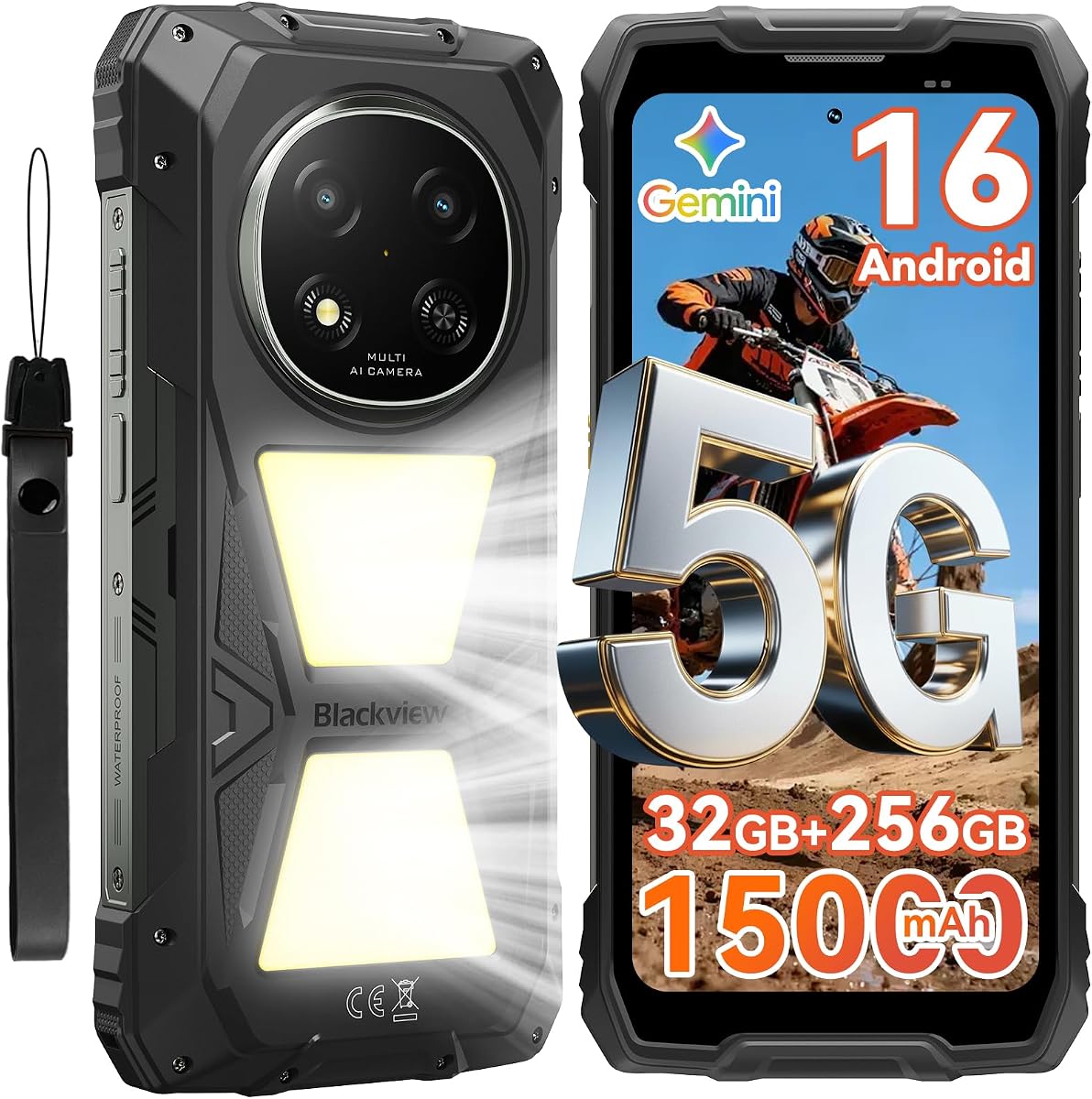
The Blackview Rock 2 Pro 5G has a 4.0 rating and targets workers who want modern 5G performance, long battery life, and extensive site protection. Its 15,000mAh battery, dual 400-lumen camping lights, 2.4K 120Hz display, and glove mode make it a credible all-round field device.
We may earn a commission when you buy through this link, at no additional cost to you.
The listed hardware includes a MediaTek UMS9620 5G chipset and an octa-core T8100 processor, with 8GB physical RAM, 24GB virtual memory, and 256GB storage expandable to 2TB. Android 16 and DokeOS add privacy controls, personalization, and Gemini AI features. The camera system combines a 16MP rear camera and 13MP front camera for routine documentation.
IP68 and IP69K protection, a stated 1.5-meter drop-resistant design, and dust sealing support use on construction sites and in harsh outdoor work. The 400-lumen lighting system offers standard lighting, SOS, and quick-flashing modes. The large battery is specified for up to 57 days of standby and 56.5 hours of continuous calls, although real results depend on settings and usage.
The main drawback is weight at 558 grams. Its 450-nit display may also be less readable than brighter options in intense sun. The phone is well suited to workers on supported 5G networks who prioritize endurance, gloves, and built-in lighting; buyers should confirm carrier bands and assess whether the weight is acceptable for a full shift.
5G is commonly paired with greater power demands, but this model pairs it with a 15,000mAh battery and 33W charging. That combination suits workers who need fast mobile data while remaining away from charging points for extended periods.
Two 400-lumen lights are useful for dark work areas, early starts, and emergency signaling. Glove mode improves the chance of operating the touchscreen with work gloves, making the large display more useful in the conditions where ruggedness matters most.
We may earn a commission when you buy through this link, at no additional cost to you.
The Ulefone Armor X12 carries a 3.8 rating and serves as a compact, entry-level alternative to the Armor X12 Pro. It preserves the same broad construction-oriented foundation: a 5.45-inch display, 4,860mAh battery, IP68 and IP69K protection, MIL-STD-810H standards, glove mode, outdoor tools, and a three-card slot.
We may earn a commission when you buy through this link, at no additional cost to you.
It runs Android 13 Go with an octa-core processor, 3GB physical RAM plus 3GB virtual memory, and 32GB internal storage. A 256GB microSD card is supported, which helps compensate for limited built-in storage. The Sony IMX214-based 13MP main camera and 8MP selfie camera provide basic photo and communication capabilities.
The phone's 4,860mAh battery is specified for up to 264 hours of standby, 20 hours of talk time, and eight hours of video. That is suitable for conventional daily use, though it is less convincing for remote assignments. NFC, Bluetooth, face recognition, GPS, GLONASS, Galileo, BeiDou, a compass, and headset-free FM radio add practical field functions.
This model is best for crews seeking a smaller, simpler phone with robust physical protection and few frills. The older operating system and limited storage are meaningful drawbacks, particularly for app-heavy workflows and heavy media capture. Workers should also assess app compatibility because Android Go devices can have different resource constraints from standard Android models.
The 5.45-inch display is the Armor X12's defining practical advantage over larger models. It can be secured with one hand, used while wearing gloves, and carried without the bulk associated with high-capacity battery phones.
Despite its lower tier, the phone retains meaningful water, dust, and impact standards. That makes it a sensible option when the priority is a durable communications and navigation device rather than advanced cameras, 5G, or an exceptionally bright panel.
We may earn a commission when you buy through this link, at no additional cost to you.
The Ulefone Armor 33 has a 4.2 rating and is the premium endurance option in this guide. Its 25,500mAh battery, 66W charging, 10W reverse charging, bright 1,100-lumen light, 118dB speaker, and extensive camera system make it the most richly equipped Ulefone model considered here.
We may earn a commission when you buy through this link, at no additional cost to you.
The MediaTek Helio G100 is joined by 12GB physical RAM and 12GB extended memory, with 512GB storage expandable to 2TB. Its 6.95-inch FHD+ display operates at 120Hz, reaches 700 nits, and uses Corning Gorilla Glass 5. Android 15 supplies the operating system, while the physical camera key allows faster access to the camera for documenting site conditions.
The rear cameras include a 50MP main lens, 50MP ultrawide, and 64MP infrared night-vision camera, joined by a 32MP front camera. The integrated warning light can provide emergency alerts, the Infinite Halo system offers different lighting modes, and the 118dB speaker can make the phone audible in noisy environments. IP68, IP69K, and MIL-STD-810H protection reinforce its rugged positioning.
The largest compromise is physical. At 765 grams and measuring 185.5 by 85.5 by 34 millimeters, the Armor 33 is extremely large and heavy. It is also a 4G device, and AT&T and Cricket are excluded. Choose it when maximum battery life, a bright display, loud audio, night vision, and accessory expansion are more important than one-handed comfort or 5G.
The 25,500mAh battery sets a clear endurance advantage in this group, while 66W charging helps reduce downtime. Reverse charging can also supply emergency power to earbuds or another device, a useful capability on remote assignments.
The combination of a 1,100-lumen lamp, warning light, 118dB speaker, and night-vision camera supports several difficult conditions. It can illuminate a work area, attract attention in an emergency, cut through ambient noise, or photograph details where visible light is limited.
The uSmart expansion connector supports compatible Ulefone endoscopes, magnifiers, a microscope, and a night-vision camera. These accessories broaden the phone's value for inspection, maintenance, and troubleshooting beyond ordinary communication.
We may earn a commission when you buy through this link, at no additional cost to you.
This Blackview Fort 2 listing shares the core design of the earlier Fort 2 entry and holds the same 4.1 rating. It is a lightweight, current-generation 4G handset for workers who want a slim profile, modern Android software, and certified physical protection without the extreme bulk found in many high-capacity models.
We may earn a commission when you buy through this link, at no additional cost to you.
Its 10.7mm thickness and 245.3-gram weight make it easy to carry and operate one-handed. The 6.56-inch HD+ panel has a 90Hz refresh rate, 89.7% screen-to-body ratio, and 450-nit maximum brightness. That resolution is sufficient for routine work information, although it offers less detail than higher-resolution alternatives.
Inside, an octa-core G81 processor, 8GB physical RAM, up to 16GB virtual RAM, and 128GB storage provide Android 16 performance. Storage can expand by 2TB. DokeOS 5.0 adds a deep power-saving mode, System Manager 2.0, Game Mode 2.0, and Notebook 3.0. Gemini AI is integrated for general assistance, while NFC, GPS, face unlock, and dual-band Wi-Fi support daily tasks.
IP68 and IP69K ratings and MIL-STD-810H testing cover dust, water, and everyday impact risks, making the phone credible for construction and warehouse work. It does not provide 5G, and its listed GSM-only compatibility excludes several major CDMA carriers. Buyers who prioritize mobility, current software, and protection will find the trade-offs reasonable.
The principal advantage is how little bulk accompanies the rugged design. Workers can carry the Fort 2 throughout a shift without the wrist or pocket burden of models weighing more than half a kilogram, while still benefiting from sealed construction.
Android 16, DokeOS 5.0, and Gemini AI bring familiar modern features rather than a restricted experience. The notebook and system tools can support checklists, notes, and device maintenance, although dedicated project-management software may require testing on a specific worksite network.
We may earn a commission when you buy through this link, at no additional cost to you.
Choosing a rugged worksite phone requires balancing physical protection against weight, display readability, battery endurance, network compatibility, and the specific tools used during a shift. The most expensive specification is not always the most useful, and a phone that cannot connect to the crew's carrier or feels uncomfortable all day may be a poor investment.
Look for clearly stated IP68, IP69K, and MIL-STD-810H protection rather than vague terms such as waterproof or military grade. IP68 addresses immersion under defined conditions, IP69K concerns high-pressure, high-temperature water jets, and MIL-STD-810H describes testing across multiple environmental stresses. These ratings are not interchangeable, and the manufacturer should define the tested conditions. A phone can tolerate a dusty site while still being vulnerable to a high-pressure wash, so workers should understand both the rating and their employer's procedures.
Choose the highest relevant certification, but also confirm the ports are closed and the phone is not being charged while wet. In short, use recognized ratings as evidence of protection while treating every device as a tool that still needs sensible care.
Battery capacity is especially important where charging is limited or work shifts are long. Phones in this guide range from 4,860mAh to 25,500mAh. Larger capacity can provide better endurance, but it often increases weight and may not match the charging speed you need. Consider 33W, 66W, or 120W charging options and whether the required charger and suitable power outlet will be available on site. Reverse charging and OTG can add flexibility for accessories or emergency power.
For daily indoor crews, a midrange battery may be sufficient. Remote crews, long highway projects, and workers without dependable charging should prioritize endurance. Match charging speed and battery capacity to your actual shift, not just the largest headline number.
A construction phone must remain readable in sunlight, dust, and shadow. Brightness ratings, anti-glare properties, refresh rate, resolution, and size all influence usability. A 6.56-inch 90Hz panel may be more useful than a larger but dim screen, while a 5.45-inch display can be easier to operate one-handed. Glove mode is particularly valuable because many workers should not remove gloves to unlock a phone, handle drawings, or confirm a delivery.
Prioritize a screen that balances brightness, size, and resolution, then confirm glove compatibility. A larger display helps with plans, while a compact screen improves secure handling. The best choice depends on whether the device is mainly a communication tool or a portable reference terminal.
Unlocked does not automatically mean compatible with every carrier. Several models support 4G GSM bands but exclude CDMA networks, and others explicitly do not support AT&T, Cricket, or certain other carriers. 5G models may still rely on 4G outside compatible markets or carriers. Check the full frequency list, regional bands, SIM format, and your employer's service before purchasing. Devices with multiple SIM options can separate work lines, personal communication, or a data-only plan.
Network compatibility is non-negotiable on a job where dispatch, safety alerts, and time tracking depend on service. Verify the exact carrier rather than relying on the unlocked label, and avoid assuming that imported international models will connect reliably to every local network.
Rugged phones range from about 245 grams to 765 grams in this roundup. A heavier handset may feel more substantial and can house a larger battery, but prolonged one-handed use, pocket carry, and ladder work can make it tiring or unsafe. Gloves can also make a large device harder to grip. Compact models around five inches are easier to control, while slim 4G phones offer a middle ground without enormous battery capacity.
Do not overlook weight after comparing specifications. If the device will remain in your pocket throughout a long shift, compare its bulk and center of gravity. A slightly smaller phone with adequate endurance is often more practical than the heaviest model.
Integrated lights can illuminate dark rooms, stairwells, equipment areas, and roadside emergencies. Look for measured lumen output, multiple brightness levels, SOS modes, and warning flashes. Night-vision cameras are useful when visible light is insufficient, while a high-resolution main camera helps document progress and defects. Other useful tools include a compass, glove mode, outdoor toolbox, FM radio, OTG, customizable keys, and multiple card slots.
Choose tools that match your work rather than paying for features you will never use. A supervisor who frequently presents plans may value a projector, while a technician entering dark mechanical spaces may prioritize a lamp and night vision. Confirm which accessories are included and whether expansion hardware is proprietary.
Construction work can generate many photos, videos, voice notes, and documents. Compare physical RAM, internal storage, virtual memory, and microSD support. Virtual memory can assist with multitasking but does not replace physical memory, and expandable storage does not always make every app directly compatible with removable media. Processing power and Android generation also influence navigation, communication, security controls, and app longevity.
For typical field use, prioritize dependable navigation, messaging, and document access over benchmark-style claims. Ensure that required company applications and security tools support the selected Android version. Workers storing extensive media locally should choose ample physical storage or verify that their organization permits external-card storage.
Begin by configuring the phone before entering the field. Install required work and safety applications, update the operating system, activate the selected carrier's SIM, calibrate location services, set an emergency contact, and test the glove mode and custom keys with the gloves normally worn on site. Confirm that NFC, OTG, flashlight, compass, FM radio, and reverse charging functions work as expected. Taking ten minutes for setup prevents a problem from becoming a delay during an active shift.
Protect the seals and charging process. Keep port covers firmly closed in dusty or wet conditions, and never charge a wet phone unless the manufacturer explicitly permits it. Rinse off grit with fresh water when the manufacturer recommends doing so, dry the device thoroughly, and avoid using compressed air that could force particles into openings. Use a case or belt clip that does not obstruct buttons, microphones, speakers, or the flashlight. Even a certified rugged phone benefits from controlled handling.
Treat the display and camera lenses with the same care as expensive optical equipment. Use a screen protector that still allows glove input, clean the lens with a soft cloth, and keep the phone away from chemicals or abrasive dust when possible. Periodically inspect the casing, port covers, battery behavior, storage level, and charging performance. Keeping the software current, backing up work records, and following the manufacturer's replacement guidance helps preserve both device reliability and warranty coverage.
Yes, but their protection depends on the certified ratings and proper care. Models with IP68, IP69K, and MIL-STD-810H claims are designed to handle combinations of dust, water, impact, humidity, and temperature stress better than ordinary phones. They still require closed port covers, careful charging, and sensible handling. Employers should also follow site rules and avoid treating a rugged phone as waterproof under every possible condition.
Glove mode is the most important feature, and several models include it, including the Armor X12 Pro, Rock 2 Pro 5G, and Blackview Rugged Phone. Screen size and weight also affect control. The Armor X12 Pro's compact 5.45-inch display may be easier to hold securely, while larger models can still be useful when the priority is reading plans. Test the touchscreen with the actual gloves before committing.
Not always. 4G is sufficient for calls, messaging, maps, and many ordinary business applications, while 5G can improve transfers and latency where coverage is strong. The Armor X16 Pro and Rock 2 Pro 5G provide 5G, but most other models in this guide use 4G. First confirm that your carrier operates 5G at the work location; otherwise, battery life, protection, and ergonomics may matter more than the fastest available network generation.
The required capacity depends on navigation, camera use, screen time, network conditions, and access to charging. A 4,860mAh battery is reasonable for many standard indoor shifts, while 10,000mAh to 15,000mAh provides more margin. Models above 20,000mAh suit remote work but are significantly heavier. Consider charger availability, charging speed, reverse charging, and the length of time the phone must operate without power.
It may, but you should verify the exact network rather than relying on the word unlocked. Several models support only GSM 4G and are incompatible with major CDMA carriers. The listed devices also have model-specific exclusions involving AT&T, Cricket, Verizon, and other providers. Compare the supported frequency bands, SIM type, and carrier with the manufacturer or provider before deploying the phone.
They are helpful for navigating, checking a small area, signaling, or illuminating immediate surroundings, but they should not be treated as a substitute for certified site lighting. The Tank 2 Pro and Armor 33 offer particularly bright lamps, while the Armor X16 Pro and RugKing 5 Pro provide dedicated or versatile lighting. For electrical, confined-space, or hazardous-area work, use approved lighting and follow safety protocols.
Not necessarily. Greater weight often accompanies a larger battery, stronger lamp, projector, or additional hardware, but it can become tiring during long shifts and may be harder to operate one-handed with gloves. The Fort 2 is notably light at 245.3 grams, while the Armor 33 reaches 765 grams. Choose the lightest model that still meets your battery, protection, and feature requirements.
Yes, depending on the model and your storage plan. Most include at least 64GB or 128GB of internal storage, while several support microSD expansion as large as 1TB or 2TB. Virtual RAM should not be confused with physical storage, and some apps cannot write directly to a removable card. Check your organization's data policies, back up critical records, and avoid relying on a single device as the only copy of inspection documents.
The Ulefone Armor X16 Pro 5G is the strongest all-around recommendation because it combines dual 5G, a 10,360mAh battery, a bright 120Hz display, certified protection, glove mode, and a dedicated flashlight without becoming as bulky as the largest models. The Armor X12 Pro is the practical compact option, while the Armor 33 represents the premium extreme with maximum battery capacity, powerful lighting, extensive cameras, and loud audio.
Prioritize the constraints of your actual workday. Check carrier compatibility first, then decide whether weight, screen size, battery endurance, 5G, night vision, or integrated lighting matters most. Protection ratings matter, but so do sealed port covers, careful charging, and realistic expectations. For most crews, a balanced model is easier to carry all day than the most feature-heavy handset, while field specialists may justify the added bulk.
Before ordering, compare the current listing details, supported bands, included accessories, and warranty terms. Pricing, carrier bundles, storage configurations, and availability can change, so the current product page should remain the final source for purchasing decisions. Whatever model fits the job, use the phone as a reliable tool rather than a substitute for approved safety equipment or professional site procedures.