
Outdoor 360° Omni-Directional HDTV Antenna
4.9Editor score
Built-in VHF and UHF amplifier
Weather-resistant outdoor construction
Includes 32.8-foot coaxial cable
Flexible rooftop and RV mounting
Explore the best RV antenna for local channels, comparing indoor and outdoor models for reception range, weather resistance, mounting, and easy setup.
An RV antenna for local channels can make the difference between dependable television on the road and constant channel searching. The right model must balance reception strength, portability, mounting flexibility, and resistance to the weather conditions encountered outside a campsite or near an RV park.
This guide compares ten indoor, outdoor, roof-mounted, and magnetic antennas using their stated reception features, signal amplification, broadcast-band support, included cables, compatibility, and RV-specific design. It also distinguishes portable indoor models from antennas intended to remain mounted while the vehicle is moving.
Each review explains where a product is most practical, along with limitations that may matter in remote areas. Ratings provide an additional reference, but advertised range is not a guarantee because broadcast towers, terrain, obstructions, and weather ultimately determine which channels can be received. Prices and availability can change.
4.9Editor score

5.0Editor score

3.8Editor score
The comparison below highlights the strongest options for different travel styles, from compact indoor antennas to weather-resistant outdoor models. The most useful choice depends on local tower coverage, the RV's construction, mounting preferences, and whether the antenna must function while the vehicle moves.


The 2026 Digital TV Antenna combines a 4.7 rating with several features that make it practical for an RV. Its centerpiece is an upgraded smart signal booster that automatically switches between long- and short-range modes, reducing the need for manual amplifier adjustments when conditions change. The advertised 6000-plus-mile range is a maximum claim rather than a promise of identical reception everywhere.
We may earn a commission when you buy through this link, at no additional cost to you.
A major advantage for RV use is the included 40-foot coaxial cable. It offers enough length to place the antenna near a window, on an exterior surface, or elsewhere with a clearer view of broadcast towers while keeping the television inside. The housing is described as waterproof and suitable for RV, camping, yacht, basement, garage, and outdoor installations, while the 360-degree omnidirectional design avoids the need to aim a directional element.
The product supports VHF and UHF reception, works with smart TVs and older televisions, and includes interference filtering intended to provide steadier images. Its tool-free installation is straightforward, although the instructions appropriately recommend rescanning whenever the antenna is repositioned. Signal performance will still depend on tower distance, terrain, obstructions, and other electronic interference, so the dramatic range figure should not be treated as a guaranteed outcome.
This is a strong choice for RV owners who want one antenna that can move between indoor and outdoor positions. It is especially useful when a long cable is needed to find a better signal location. Choose it over a permanently mounted roof antenna when flexibility and easy relocation are more important than a fixed installation.
The 40-foot cable gives an RV owner room to experiment with window, wall, tabletop, and exterior positions. Because the antenna is omnidirectional, placement can focus on reducing obstructions rather than carefully aiming a narrow beam.
The automatic range adjustment simplifies operation in changing reception conditions. Signal filtering and dual-band reception may improve stability, although rescanning remains necessary after substantial movement.
We may earn a commission when you buy through this link, at no additional cost to you.
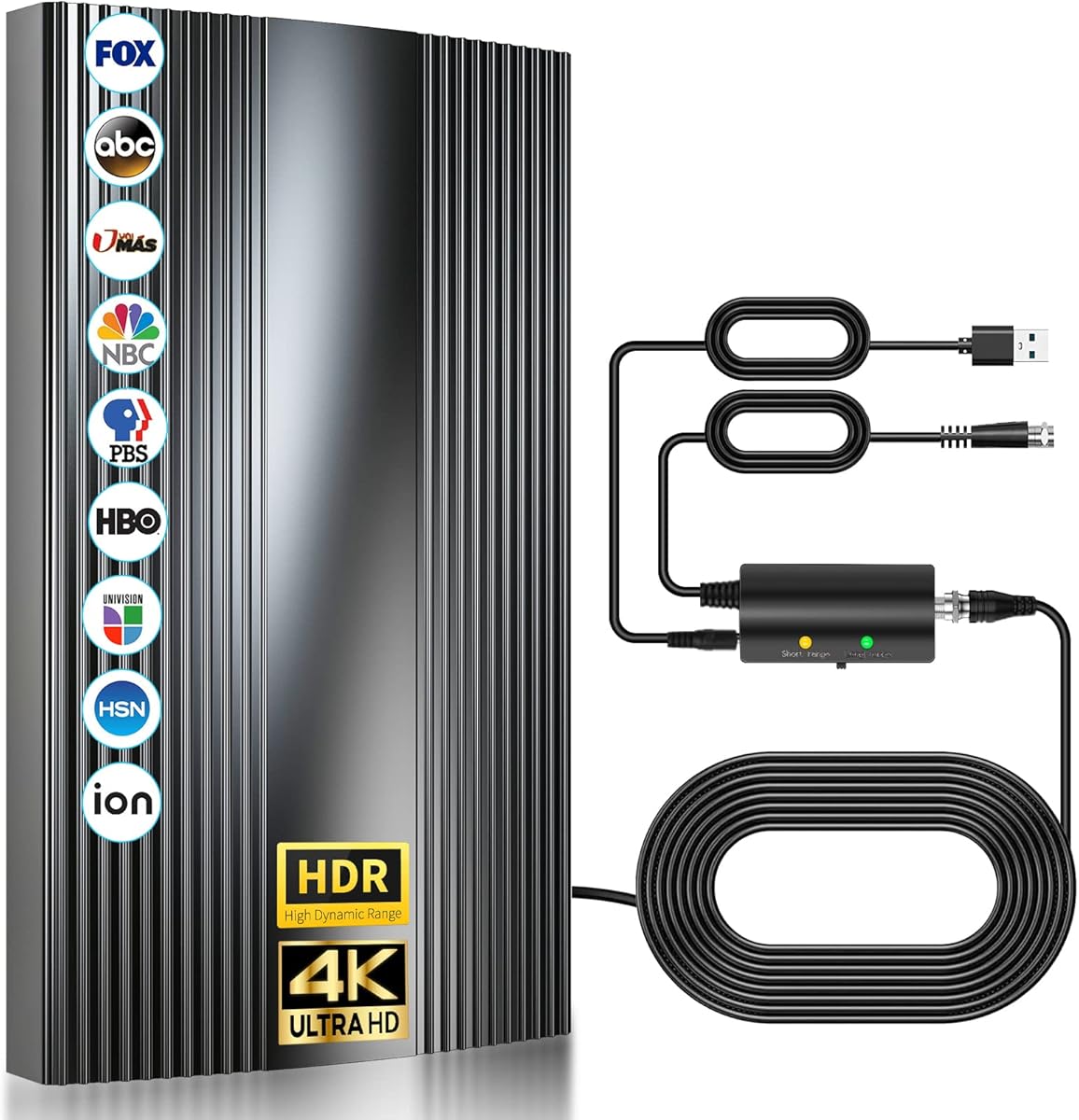
The Smart 6000+Miles antenna is the strongest all-around choice in this guide, combining a 5.0 rating with features suited to both parked and traveling RVs. A switch-controlled amplifier booster provides separate short- and long-range settings, with the short mode intended for locations within 38 miles and the long mode for greater distances. That user-controlled design is more informative than relying on one universal amplification setting.
We may earn a commission when you buy through this link, at no additional cost to you.
The included 38-foot coaxial cable uses a solid copper center conductor, dielectric insulation, and three aluminum shielding layers according to the product information. The stated shielding is intended to reduce interference and signal loss, while the long cable provides meaningful placement flexibility inside and around an RV. The compact, lightweight antenna can sit on a table or cabinet, hang near a window, or be attached to a vehicle roof.
Its universal compatibility is useful for a mixed setup: it works with modern smart televisions and older sets, provided the television has a standard antenna input or is paired with a compatible tuner. The weatherproof treatment extends from the shell seams to the circuit board, and a ventilation design is intended to limit condensation. On the other hand, the product data does not specify a roof-mounting bracket, so permanent exterior installation may require separate hardware.
This antenna suits travelers who want meaningful control over signal amplification and the freedom to move the unit between indoor and outdoor locations. It is a particularly sensible choice for RVs that spend time in both urban and rural areas, where tower distance can change quickly. For owners wanting a ready-made roof installation, a model that includes mounting hardware may be easier to deploy.
Selecting a 38-mile short mode or a longer-distance mode can prevent the amplifier from operating in a way that is poorly matched to local conditions. This makes troubleshooting more systematic when stations disappear after parking in a new area.
The 38-foot cable is long enough to move the antenna away from electronics, metal cabinets, and other obstructions. It can reach an exterior position while the television and converter remain comfortably inside the RV.
We may earn a commission when you buy through this link, at no additional cost to you.
This compact indoor antenna is a convenient choice for RV owners who want to move television reception around without permanent hardware. Its 4.7 rating reflects a generally strong reception proposition, while a magnetic base lets it attach directly to a compatible metal surface such as a television stand, window frame, or RV wall. A 16.5-foot cable expands the available placement area without creating an oversized installation.
We may earn a commission when you buy through this link, at no additional cost to you.
The antenna uses 360-degree VHF and UHF reception, so it does not need to be aimed toward a tower. A switchable dual-mode amplifier is controlled with yellow and green modes, and the listing says the design can support 4K, HD, and HDR broadcasts. It connects to the ANT IN input of a television with a built-in ATSC or ATSC 3.0 tuner; an older television without a tuner requires a digital converter box.
The principal limitation is its indoor orientation. Although the magnetic base may attach to an RV wall, the instructions advise bringing the antenna indoors before rain. The shorter cable also means that reaching an exterior mounting point would be less convenient than with the 38- or 40-foot models in this list. It is better suited to trying a series of safe positions around a window or entertainment area than to permanent roof use.
This is a practical choice for a smaller camper, travel trailer, or SUV-style RV where simple, tool-free placement matters more than fixed installation. It also works well for people who travel often and want an antenna that can be packed away quickly. Travelers needing all-weather exterior reception should choose a purpose-built outdoor model instead.
The magnetic mount makes repositioning fast: the antenna can move from a window frame to an RV wall as signal conditions change. It also helps keep the small unit from occupying limited counter space.
Direct ATSC and ATSC 3.0 support covers many modern HDTVs. For an older set without an integrated tuner, a separate digital converter is still required.
We may earn a commission when you buy through this link, at no additional cost to you.
The Outdoor RV TV Antenna is the most explicitly vehicle-oriented product in this guide. It is designed for permanent roof mounting on a camper or motorhome, with a supplied base and four screws for a more secure elevated position. Its 3.9 rating is lower than those of several indoor alternatives, but the installation design directly addresses a common RV problem: getting a usable broadcast signal while the vehicle is moving.
We may earn a commission when you buy through this link, at no additional cost to you.
A 360-degree omnidirectional configuration removes the need to rotate the antenna as the RV changes direction. The weather-resistant, UV-stabilized housing is intended to withstand outdoor exposure, while the elevated mounting point helps the antenna clear nearby obstacles. The product is also advertised for trucks, boats, and caravans, giving it more flexibility than a conventional indoor flat-panel antenna.
Connection uses a standard 75-ohm Antenna In or RF In connection, so compatibility with common RV televisions and tuners should be straightforward. The product information recommends checking local channel coverage before buying, placing the antenna in a high position, and rescanning after movement. Enclosed or heavily obstructed areas can still limit reception, and the description does not specify the length of the included coaxial cable.
This antenna makes the most sense for an RV owner who plans to keep the same unit mounted while traveling and wants a stable, elevated installation. It requires drilling or otherwise securing the included base and should be checked for roof compatibility before installation. Travelers seeking a no-drill solution should consider one of the magnetic or indoor models instead.
Roof placement can reduce interference from walls, appliances, cabinetry, and nearby vehicles. The included four-screw base also provides a more permanent solution than a temporary magnetic mount.
The mobile-use design keeps reception operational as the RV moves, provided the area has usable over-the-air coverage. A channel rescan may still be necessary when entering a new broadcast area.
We may earn a commission when you buy through this link, at no additional cost to you.
The Indoor Smart TV Antenna is a methodical option for RV travelers who want clear instructions for selecting amplification settings. Its 4.1 rating reflects a useful feature set, including separate short-range and long-range modes. The manufacturer defines short range as suitable within 35 miles, while long range covers distances from 35 to 250 miles. This gives users an understandable starting point when entering unfamiliar territory.
We may earn a commission when you buy through this link, at no additional cost to you.
A smart IC chip is intended to improve gain and filter cellular and FM interference. The antenna supports UHF and high-VHF signals and can deliver 4K, UHD, and 1080p broadcasts when the originating station and local signal permit. It includes a 16.5-foot cable, manual, and amplifier, while installation simply requires connecting to the television's ANT IN port and initiating a channel scan.
The primary technical limitation involves low-VHF channels. The product information specifically notes that some stations on channels 2 through 6 may require a separate low-VHF-compatible antenna. In addition, the amplifier cannot create a signal that is not available, so the long-range mode may not improve reception in a deeply obstructed location. Placement away from metal objects, thick walls, routers, and microwaves is still important.
This model is most appropriate for an RV used primarily for local broadcast viewing in areas where most desired stations are carried on UHF or high-VHF. It is less suitable for travelers who need guaranteed access to every low-VHF affiliate. The included short cable and indoor design also make it better for temporary placement than permanent rooftop reception.
Using the appropriate range mode can produce more consistent behavior than leaving an amplifier on its strongest setting regardless of location. The instructions make this adjustment easy to revisit when the RV changes position.
Some stations on channels 2 through 6 may not be received by this model. Travelers who regularly watch a low-VHF affiliate should verify its broadcast band before relying on this antenna alone.
We may earn a commission when you buy through this link, at no additional cost to you.
The JoyfulPaws 33-Foot Round Antenna combines a restrained circular design with a cable long enough to improve placement options around an RV. Its 4.2 rating sits near the middle of the group, but the product is specifically described as suitable for living rooms, bedrooms, RVs, and outdoor use. That makes it more versatile than a purely desktop-oriented indoor antenna.
We may earn a commission when you buy through this link, at no additional cost to you.
The smart IC chip is intended to optimize signal transmission and reduce interference, while the round body provides 360-degree reception. The included 33-foot coaxial cable gives users a practical way to find a stronger position without moving the television. The antenna supports HD, 1080p, 4K, and 8K HDR broadcasts, although the available resolution is determined by the station, television, and local signal.
Compatibility is broad, with support for smart TVs and older televisions that include a tuner or are connected to a digital converter box. The product data recommends consulting online channel-coverage resources before purchase and placing the unit near a window or higher in the room. A television without an integrated tuner cannot receive signals directly and must be paired with a converter.
This is a good middle-ground choice for RV owners who want more placement freedom than a short indoor cable provides but do not want to drill into the roof. Its 4.2 rating and advertised 2,200-plus-mile range should be interpreted carefully, because the actual channel list will depend on local broadcast infrastructure. It is best suited to owners who understand that position and rescanning are central to OTA reception.
The 33-foot cable provides enough reach to move the antenna toward a window or an exterior RV surface. Its circular form is intended to receive signals from every direction without manual aiming.
The antenna can serve a modern HDTV or an older television equipped with a tuner. A tuner-free set requires an external digital converter before local broadcasts become available.
We may earn a commission when you buy through this link, at no additional cost to you.
The Outdoor Omni-Directional HDTV Antenna is the premium choice in this roundup, earning a 4.9 rating and presenting a focused outdoor feature set. Its 360-degree omnidirectional design captures VHF and UHF signals from every direction, while a built-in amplifier is intended to strengthen and stabilize reception. This combination is particularly relevant when an RV is parked beneath trees, beside buildings, or in a suburban area away from the strongest tower line.
We may earn a commission when you buy through this link, at no additional cost to you.
The housing is built to withstand rain, snow, wind, and heat, making it suitable for roof, attic, RV, camper, or trailer installation. Lightweight construction and a 32.8-foot premium coaxial cable provide flexibility in selecting the best position. The long cable allows the antenna to sit outside while the television remains inside, and the product can be mounted on walls, poles, rooftops, or near windows.
The antenna is described as ready for 4K, UHD, and 1080p reception, though those labels apply only when a broadcaster transmits a compatible feed and the local signal is sufficient. Its rating is excellent, but the listing does not state a specific maximum range, which may be an advantage for buyers who prefer a more measured product description. The data also does not make clear whether a permanent roof-mount bracket is included.
This is the best fit for an RV owner willing to place an antenna outdoors and value a dedicated amplifier, broad broadcast-band support, and a weather-focused design. It can be positioned on an existing roof rack, wall, or pole to gain a clearer view of towers. Before drilling, however, verify the RV's roof material, mounting requirements, and the location of any clearance or access constraints.
A built-in amplifier and VHF/UHF design combine useful features for permanent exterior placement. The weather-resistant housing is intended to remain exposed through changing seasonal conditions.
The 32.8-foot cable reaches from an exterior mounting point to an interior television, while the lightweight body can be used on poles, walls, rooftops, and RV structures. This creates several options for improving line-of-sight access to broadcast towers.
We may earn a commission when you buy through this link, at no additional cost to you.
The HIDB Indoor Digital Antenna is a compact, uncomplicated option for RVs with limited interior space. Its 3.8 rating places it near the lower end of the group, yet the slim design and light weight make it easy to carry, conceal, and reposition. It is intended for indoor use and provides a straightforward alternative for travelers who only need local channels in populated areas with strong coverage.
We may earn a commission when you buy through this link, at no additional cost to you.
The housing uses dual PC soft material rather than ordinary PVC and is described as flame retardant, moisture resistant, and protected against lightning. Its omnidirectional reception means the antenna does not have to be pointed toward a transmitter. It can sit on a TV stand or table, which is convenient inside a motorhome, although the included cable length is not specified in the supplied information.
The product is designed to connect to a television's antenna input and receive local HD broadcasts. Best results are obtained by mounting it high and near a window facing broadcast towers, with local channel maps consulted before installation. As with every OTA antenna, the available lineup depends on terrain, distance, weather, and obstructions, and the manufacturer recommends rescanning after moving the unit.
This antenna is best for a compact RV, a traveler with light equipment requirements, or someone who wants a low-profile indoor unit. It is less appropriate for remote locations where stronger amplification and a long exterior cable would be valuable. Buyers should also confirm their television includes a compatible tuner or plan to use a converter box.
The slim, lightweight body takes up very little space and can be hidden beside a television or placed on a compact shelf. Its portable form is useful for changing campsites or storing it easily between trips.
The flame-retardant dual PC housing offers moisture resistance for indoor use. A higher and more window-facing placement can improve access to incoming broadcast signals without a permanent installation.
We may earn a commission when you buy through this link, at no additional cost to you.
The 2026 6000+ Mile Digital Antenna pairs a 4.7 rating with a long cable and flexible placement options. Its 38-foot premium cable allows an RV owner to move the antenna toward a clearer window, place it on an exterior surface, or position it above obstructions. The compact unit is suitable for walls, windows, tabletops, cabinets, garages, offices, RVs, and camping locations.
We may earn a commission when you buy through this link, at no additional cost to you.
A smart IC chip and clear filter technology are intended to receive a broad range of signals while minimizing interference. The antenna supports 4K and 1080p picture formats, HDR content, and common broadcast networks. Its housing is described as eco-friendly and waterproof, allowing indoor or outdoor use, though separate secure mounting hardware may be needed outside.
The installation process is uncomplicated: connect the cable to the CABLE-ANT IN input, position the antenna, and initiate a TV channel scan. The listing advises using a window as the preferred location and moving the antenna if few or no stations appear. A signal booster cannot replace a clear broadcast signal, so the advertised 6000-plus-mile range should be understood as a broad performance claim rather than a guaranteed distance.
This model is well suited to RV owners who want one flexible antenna without committing to a roof-mounted unit. It is especially attractive when the television is fixed and the signal source needs to be placed elsewhere. Those needing secure permanent mounting may prefer a product that explicitly includes a roof base and screws.
The 38-foot lead can reach a window, exterior wall, or higher surface while remaining connected to an interior television. This gives users more opportunities to find a stronger signal than a short indoor cable permits.
The intelligent chip and filter technology aim to reduce unwanted interference while preserving available OTA signals. Support for HD, 4K, 1080p, and HDR is useful across current smart televisions, subject to broadcaster and signal conditions.
We may earn a commission when you buy through this link, at no additional cost to you.
The Compact Magnetic RV Antenna is the budget pick, combining a low purchase price with a genuinely travel-friendly design. Its 3.8 rating is tied for the lowest among the reviewed products, but the 10-foot cable, compact housing, and tool-free magnetic mount make it easy to carry and deploy. It is designed for local HD channels and can serve smart or older televisions with a suitable tuner.
We may earn a commission when you buy through this link, at no additional cost to you.
The magnetic base attaches to metal surfaces such as a television stand, window frame, or compatible RV fixture. A compact scratch-resistant metal shell helps it blend into a limited interior, and the included 10-foot cable allows some flexibility without creating a large installation. The antenna operates without USB power, reducing cable clutter and making it convenient for spontaneous setup.
The product advertises 360-degree VHF and UHF reception, automatic amplification of weak signals, filtering of electromagnetic interference, and support for 4K and 1080p content. Its stated coverage extends up to 120 miles, but local terrain, weather, and tower distance will have a major influence on the actual channel list. A channel rescan should follow every significant relocation.
This is the most practical choice for a budget-conscious traveler, a small RV, or a secondary television that needs only basic local coverage. It is less suitable for an exterior or rooftop installation, and the short cable limits how far it can be separated from the TV. Users seeking a permanently mounted antenna should look for a model with a dedicated roof bracket.
The base adheres to a compatible metal surface without screws or permanent modifications. This is ideal for renters, quick-stop travelers, and anyone who prefers not to alter the RV interior.
The antenna needs no USB power, and its short cable keeps the setup uncluttered. These features simplify packing, although they also limit placement flexibility compared with the longer-cable models.
We may earn a commission when you buy through this link, at no additional cost to you.
Choosing an RV antenna requires balancing local broadcast coverage, physical placement, travel habits, and the type of television equipment already installed. The most heavily advertised range figure is only one part of the decision; antenna design, cable length, band support, and mounting method often have a more direct effect on everyday use.
Choose an antenna only after confirming that the required stations broadcast in the relevant area. A powerful amplifier cannot create a signal that the transmitter does not deliver.
Choose permanent roof hardware for driving use, and choose a magnetic or indoor antenna for parked viewing and minimal installation.
Use short range near strong transmitters and long range farther away, following the manufacturer's guidance. Treat the amplifier as a supplement to good placement.
Confirm both broadcast-band support and the television's tuner. A television with ATSC or ATSC 3.0 can usually connect directly, while an older tuner-free set needs a converter.
Choose a longer cable when the television is fixed or when an outdoor position may help. Choose a shorter cable only when compact storage and minimal clutter are priorities.
Use rated outdoor hardware for exterior mounting and verify the attachment method before installation. Keep temporary indoor antennas away from rain and moisture.
Verify the tuner and connection before purchasing, and budget for a converter only if the existing television cannot receive digital broadcasts directly.
Prioritize a realistic design and clear placement advice over headline range figures. Higher channel counts and stable images matter more than maximum resolution on a signal that is not present.
Begin by confirming that the television has an ATSC tuner and determining which channels are available in the area. Connect the antenna through the included coaxial cable to the Antenna In, RF In, or CABLE-ANT IN port. If the television lacks a tuner, connect the antenna to a digital converter box and then connect the box to the television using the appropriate video and audio cables.
Place the antenna as high as possible and near a window, preferably in a direction that reduces obstruction by walls, metal appliances, trees, and neighboring vehicles. For a temporary indoor setup, attach the magnetic base to a stable metal surface. For exterior use, secure the antenna with an appropriate weather-resistant mount, preserve cable strain relief, and avoid creating a path where rainwater can run toward the connection.
Run a full channel scan after the initial placement and whenever the antenna is moved or the RV enters a materially different area. If reception is weak, change the amplifier range mode, move the antenna higher, rotate the RV to a different parking position, or try a window with a clearer view. Clean dust and debris from indoor surfaces carefully, inspect exterior fittings for looseness or corrosion, and pack portable antennas in their cases during travel.
It can, provided the television receives a strong enough over-the-air signal and the antenna is securely mounted. A fixed, elevated, omnidirectional antenna is generally more appropriate for driving than a lightweight indoor unit. Coverage maps and a channel rescan in each new area remain important, and moving reception can still be interrupted by terrain, tunnels, trees, and tall buildings.
No. A strong, unobstructed signal may work with a simpler indoor antenna, while weak rural or obstructed signals can benefit from a low-noise amplifier and careful placement. Amplification cannot create broadcast coverage, and excessive gain in a strong-signal area can sometimes make reception less stable. Selecting a short or long mode that matches local conditions is generally more useful than simply seeking the strongest possible booster.
Consult the dtv.gov/maps broadcast locator or another reputable television reception map using the RV's home area and intended travel destinations. The maps can show station availability, channel numbers, and transmitter locations. Coverage is not always guaranteed because terrain, buildings, trees, antenna height, and equipment placement can change the result, so testing and rescanning remain necessary.
Yes, especially when the RV is parked and the antenna can be moved to a window or higher location. A magnetic model is particularly convenient for trying different positions without permanent hardware. Indoor performance is usually weaker than an elevated outdoor installation in obstructed or remote locations, and a short cable limits how far the antenna can be separated from the television.
The RV may have entered an area with different broadcast coverage, or obstacles may now block the transmitter. The signal amplifier may also be set for the wrong distance, and the television may still be using a channel list created in the previous location. Move the antenna, select the appropriate range mode, and run a fresh channel scan after entering the new area.
No. The antenna carries the signal broadcast by each station, so the available resolution depends on the station's transmission. A compatible television can display 4K, 1080p, HD, or other formats when the received signal supports them. An antenna may improve stability and reduce interference, but it cannot create higher-resolution content than the broadcaster provides.
An older television with a compatible digital tuner may work directly with the antenna. A television without an ATSC tuner cannot receive the antenna's digital broadcasts and requires a digital converter box between the antenna and the set. Check for an Antenna In, RF In, or CABLE-ANT IN port and confirm tuner compatibility before installation.
A longer cable provides more placement options, which can be valuable when the best signal is near a window or outside the RV. However, cable quality and shielding matter, and an excessively long run of low-quality cable can introduce loss. Use the supplied cable, avoid sharp bends and strain, and connect it securely to minimize avoidable signal degradation.
The Smart 6000+Miles antenna is the most versatile overall selection, offering switchable range modes, a 38-foot cable, indoor and outdoor placement, and the highest customer rating in the group. The Outdoor Omni-Directional HDTV Antenna is the premium pick for owners who want a dedicated exterior unit with a built-in amplifier, while the Compact Magnetic RV Antenna stands out as the budget-friendly portable option.
The roof-mount model is the clearest choice for a permanent installation designed to operate while traveling, and the 40-foot flexible antenna is useful when the television stays fixed and the antenna needs to move around the RV. Before purchasing, verify local channel coverage, identify the broadcast bands used by essential stations, and confirm television or converter compatibility.
Finally, compare the current price, cable length, mounting method, and amplifier controls at the time of purchase. Retail prices and promotions can change, but the most important factors remain realistic signal availability, secure placement, and a design that suits whether the RV is parked or on the road.