
Baofeng UV-5R Upgrade AR-5RM Two Pack
4.8Editor score
Dual amateur band transmission
NOAA emergency reception
USB-C and base charging
Our guide compares 10 ham radio for backpacking options across range, battery life, weather alerts, portability, programming, and emergency features for hikers.
Ham radio for backpacking can provide dependable communication where cellular coverage ends, but the best radio must balance reach, battery life, size, weather resistance, and ease of use. A trail-friendly transceiver should be simple to operate, comfortable to carry, and capable of receiving useful local or regional information without relying on a network.
We compared these ten radios using their published specifications, listed functions, supported bands, charging methods, memory capacity, emergency features, and physical design. The guide includes conventional handheld transceivers, a compact QRP radio, a programmable tri-band model, and a dual-mode DMR radio.
Each review explains who the radio is best suited for, what makes it useful outdoors, and where its compromises may matter. The top picks represent the strongest combinations of capability and practicality, although availability, licensing rules, accessory needs, and prices can change over time.
4.8Editor score

4.4Editor score

4.5Editor score
The table below compares the ten radios by their most important backpacking characteristics, including supported amateur bands, output or operating class, power management, emergency reception, and programmability. It is a quick orientation tool, while the detailed reviews explain the practical trade-offs of each model.


The Baofeng UV-5RM combines a conventional dual-band handheld format with enough features to serve as a capable backpacking radio. Its 4.6 rating reflects a broadly favorable product profile, while the listed specifications suggest particular strength for hikers who want more than basic voice communication. It receives across several ranges and transmits on the 144–148 MHz and 420–450 MHz amateur bands.
We may earn a commission when you buy through this link, at no additional cost to you.
The 1.77-inch color display provides a clear way to review frequency and channel information, while 999 memory channels offer ample room for local repeaters, simplex channels, and travel plans. CHIRP compatibility makes computer-based frequency management practical. For users who do not want to perform that setup at the trailhead, the one-touch frequency-copy function can duplicate settings directly from a compatible radio.
Its 2500mAh rechargeable battery is supported by a USB-C cable and desktop charging base, allowing charging from a wall outlet, power bank, laptop, car adapter, or other USB source. That flexibility is valuable on long routes where wall outlets may be unavailable. A speaker microphone supports hands-free communication in camps, on group hikes, or around noisy outdoor work areas.
The main limitation is that the package includes a single radio, so a second compatible unit would be needed for a complete point-to-point trail setup. First-time users must also understand which channels are appropriate under their local licensing authority. For a solo hiker adding radio to an emergency kit, or a group member wanting a feature-rich conventional handheld, this is one of the strongest general-purpose options in the list.
With 999 memory channels, a 1.77-inch color display, and CHIRP support, the UV-5RM can accommodate a larger regional channel list than many entry-level handhelds. That makes it useful for travelers who move between home, club, and expedition frequencies without rebuilding the radio each time.
USB-C and base charging provide convenient options for camps, vehicles, and trailheads. A suitable power bank can also help extend operating time between opportunities to use a wall outlet.
We may earn a commission when you buy through this link, at no additional cost to you.
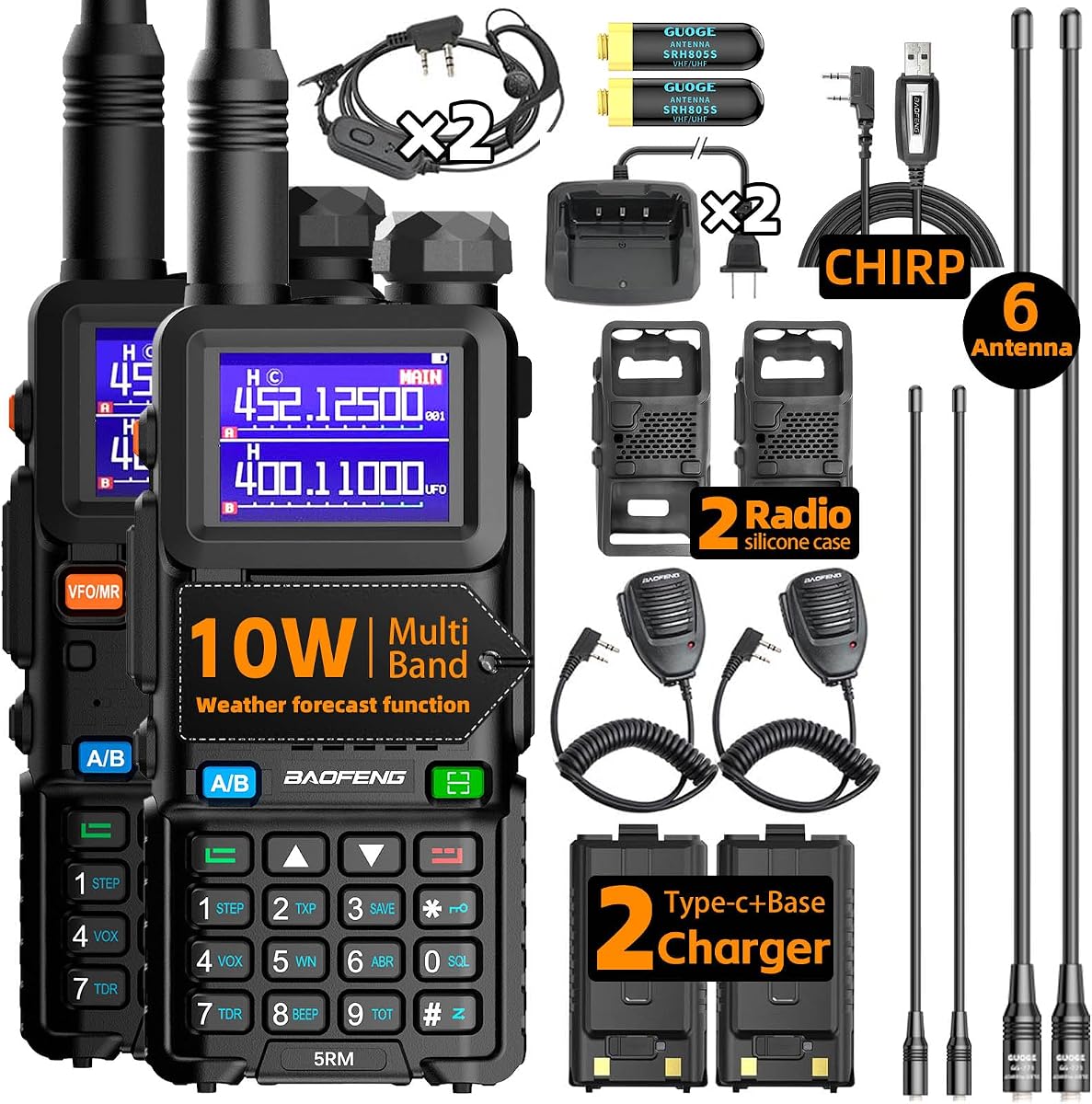
The Baofeng AR-5RM two-pack is a straightforward choice for hikers traveling with a partner or small group. Its 4.5 rating and two-radio configuration make it easy to see why the product ranks highly among conventional backpacking handhelds. Each radio supports the same 144–148 MHz and 420–450 MHz transmitting ranges while offering broad reception beyond the amateur bands.
We may earn a commission when you buy through this link, at no additional cost to you.
The package is notably complete, with two radios, two 2500mAh batteries, USB-C cables, desktop base chargers, speaker microphones, earpieces, belts, hand straps, a programming cable, and a manual. That assortment reduces the need to assemble a full communications kit separately. Both radios also support CHIRP programming, while frequency copying offers a quicker setup option for compatible devices.
A 1.77-inch color screen and up to 999 stored channels make the radios practical for organizing local repeaters and simplex frequencies. NOAA reception supplies forecasts and emergency weather alerts, adding useful context when conditions deteriorate. The speaker microphones are especially helpful for group travel because they allow hands-free operation while walking or tending camp tasks.
Its main drawback is the number of accessories to organize, and the radio is not a substitute for understanding local channels and operating rules. It also has more features than a user may need for simple campsite communication. Nevertheless, a two-pack is more coherent for a hiking group than a single-radio bundle, making this a practical choice when every member needs an identical unit.
Two matching radios, spare batteries, charging cables, desktop chargers, earpieces, and speaker microphones are included. That makes the package easier to distribute among a hiking pair than a basic handheld with several separate accessories.
The NOAA weather receiver can deliver forecasts and emergency alerts about severe events. It is a useful addition when the group needs local information, particularly in areas where cellular warnings may be unavailable.
We may earn a commission when you buy through this link, at no additional cost to you.
The Baofeng UV-32 is the most navigation-oriented handheld in this guide, combining 10-watt high-power operation with a built-in GPS function. Its 4.4 rating reflects a strong feature set, and the two-pack format is appropriate for hikers who want location information and conventional communications in the same equipment. It also includes a prominent 18.89-inch high-gain antenna.
We may earn a commission when you buy through this link, at no additional cost to you.
Three power settings—high, medium, and low—allow a user to balance reach against battery consumption. The radio also supports AM reception, FM reception, a stopwatch, an LED flashlight, DTMF, VOX, an alarm, a 2500mAh battery, and NOAA weather forecasts. Those details make it useful as a multipurpose trail tool rather than only a voice transceiver.
Frequency settings can be copied using the side keys or written through an app, giving users more than one way to prepare channels. The GPS adds a distinct layer of situational awareness, although the supplied information does not describe continuous tracking, mapping, or emergency location service. A backpacker should therefore treat GPS as an additional feature rather than a replacement for a dedicated navigation device.
The 18.89-inch antenna is the clearest backpacking compromise because it can make the radio less pocket-friendly and more likely to snag while moving through vegetation. The many settings may also demand a short learning session. Even so, the combination of GPS, selectable power, flexible programming, weather reception, and two complete radios makes this an excellent choice for prepared groups.
The built-in GPS can provide location information during a hike, complementing voice communication between group members. It is most useful as a situational-awareness tool rather than a full mapping or tracking platform.
High, medium, and low settings let operators adapt output to terrain and remaining battery. The lower levels can reduce consumption when maximum range is not necessary.
We may earn a commission when you buy through this link, at no additional cost to you.
The Malahit trusdx is a different proposition from the familiar handheld transceivers in this roundup. This compact, low-power radio supports the 80, 60, 40, 30, and 20 meter bands and serves as an advanced multi-band platform. Its 4.5 rating makes it worthy of consideration for backpackers who value operating across high-frequency bands in a relatively small package.
We may earn a commission when you buy through this link, at no additional cost to you.
The unit is supplied already assembled in an army-green three-dimensional printed case with raised lettering. Its mainboard is listed as version 1.2 and its radio-frequency board as version 1.0. The bootloader is installed and the firmware is programmed before shipping, which reduces the setup required by a buyer comfortable with the advanced configuration process.
Two firmware choices are described. The official version is programmed without a spectrum display, while the beta version includes a spectrum display and slightly fewer other menu functions. That distinction is meaningful for operators who want visual awareness of nearby signals. The case and assembly make it more refined as a portable radio, but the buyer must still understand the instructions to program a call sign.
The battery case is explicitly excluded, and the listed power jack measures 3.5 by 1.35 millimeters. This radio is therefore a specialist choice rather than a ready-to-use answer for every hiker. It is best for licensed users seeking compact HF and multi-mode operation who can select a compatible power solution and complete call-sign programming before departure.
The 80, 60, 40, 30, and 20 meter band coverage gives this compact radio access to long-distance propagation that typical VHF and UHF handhelds do not offer. It is especially interesting for hikers interested in beyond-line-of-sight communication.
The beta firmware provides a spectrum display, helping users see signal activity around a selected frequency. The trade-off is that the beta menu contains fewer other functions than the official version.
We may earn a commission when you buy through this link, at no additional cost to you.
The Baofeng BF-F8HP PRO is designed for amateur operators who want organized control rather than a bare-bones handheld. Its 4.3 rating and emphasis on clear English menus make it approachable, while 1,000 memories and ten named zones support users who maintain separate lists for home, travel, clubs, events, simplex, and receive channels.
We may earn a commission when you buy through this link, at no additional cost to you.
The radio provides a two-channel view that can show names and frequencies, Dual Watch, Single Watch, and approximate signal strength in dBm. Users can choose which zones scan together and temporarily skip a busy channel without changing the saved scan list. This makes the radio especially useful for travelers who need to move between different networks with minimal menu work.
Common adjustments can be made from the keypad, while larger programming tasks are handled through BTECH CPS or supported CHIRP-next with a separately sold PC03. Firmware updates require BTECH CPS, the PC03, and the matching instructions. The model also supports direct radio-to-radio location sharing with another compatible BF-F8HP PRO on the same channel.
That sharing function has clear boundaries: it generally does not pass through repeaters and does not provide APRS, maps, continuous tracking, or emergency location service. Valid amateur authorization is required to transmit, while airband AM, NOAA, and broadcast FM are receive-only. For a backpacker who values memory organization and a full keypad, it is a capable, modern handheld.
Ten named zones and 1,000 memories make it practical to maintain different channel sets for different trips. Scan-zone selection adds control over how the radio moves through that stored information.
Two compatible radios can exchange location information over the same channel. This is convenient for a group, but it should not be confused with continuous tracking, mapping, APRS, or an emergency location service.
We may earn a commission when you buy through this link, at no additional cost to you.
The black Baofeng UV-5R remains one of the most recognizable entry-level dual-band handhelds. Its 4.5 rating reflects its established appeal, and the listed feature set covers the fundamentals a backpacker needs: dual-frequency display, dual standby, selectable power, an LED flashlight, emergency alert, and programming through a computer.
We may earn a commission when you buy through this link, at no additional cost to you.
It transmits within 144–148 MHz and 420–450 MHz, keeping its amateur-band focus straightforward. Storage for 128 channels is less generous than the 999- and 1,000-channel models in this guide, but it remains sufficient for a compact regional channel list. The radio also supports 50 CTCSS and 104 DCS tones, a keypad lock, VOX, voice companding, tone searching, and selectable tri-color background light.
High and low transmit-power settings help users manage range and battery use. A large LCD keeps the channel and frequency information visible, while the flashlight is a practical addition for nighttime trail tasks. CHIRP support and manual programming offer flexibility for users willing to configure the radio before a trip.
The 128-channel limit and older specification place it behind newer models in memory, charging, and function count. It is also a single-radio package. For a new operator who wants a familiar, uncomplicated handheld rather than a dense feature set, however, the UV-5R remains a practical choice with a strong rating and long-standing user familiarity.
The large LCD, keypad lock, selectable background colors, and straightforward frequency controls keep the radio approachable. These details are useful when the user is wearing gloves or working in a dark campsite.
The emergency alert and LED flashlight add value beyond ordinary voice communication. The selectable transmit power also helps balance reach against operating time.
We may earn a commission when you buy through this link, at no additional cost to you.
The Baofeng K5PLUS packs a high-power radio, extensive memory, weather reception, and flexible charging into a conventional handheld format. Its 4.5 rating makes it a credible option for a backpacker who wants a capable radio without moving into digital or full-featured GPS equipment.
We may earn a commission when you buy through this link, at no additional cost to you.
The radio supports up to 999 channels, 10-watt high power, CTCSS and DCS, TOT, VOX, DTMF, an alarm, an LED flashlight, a stopwatch, airband reception, FM reception, and NOAA weather reception. Frequency copying can be activated with the BAND button, reducing the need for computer programming when setting up with another compatible radio.
A high-gain antenna measuring up to 15.35 inches is included. It is designed to improve signal strength and extend communication distance, but it is also the main handling compromise. A flexible antenna may be more packable than a rigid one, yet it still projects well beyond the radio body and should not be forcefully bent or folded.
Charging is flexible, with a US desktop charger and USB-C cable allowing use with wall outlets, vehicles, laptops, and power banks. The package includes only one radio, so groups will need additional matching units. For a solo operator or an individual adding a capable handheld to an emergency kit, the K5PLUS provides a strong balance of range, features, and charging convenience.
Ten-watt output can improve practical reach, while one-click frequency copying helps compatible radios share settings without a computer. The result is a radio that can move into service quickly at a trailhead.
Both a desktop charger and USB-C cable are supplied. That lets users top up the battery from a power bank or vehicle during a long trip instead of relying exclusively on wall power.
We may earn a commission when you buy through this link, at no additional cost to you.
The Baofeng DM-32 is the guide’s most technically advanced handheld, supporting both DMR digital mode and conventional analog voice. Its 4.3 rating reflects a broad feature set aimed at users who need more than standard simplex communication. It is a single-radio package, but it may be especially valuable to hikers participating in an established digital network.
We may earn a commission when you buy through this link, at no additional cost to you.
The radio offers 10-watt maximum output with medium and low settings, a 2.0-inch screen, a full keypad, and support for as many as 4,000 channels. TDMA dual-time-slot capability is listed, along with programmable side keys. Digital features include text messaging, call recording, remote monitoring, and ARC4, AES128, and AES256 encryption options.
Built-in GPS and APRS add location reporting capabilities, while FM, AM, and NOAA reception support weather information and broader monitoring. A Type-C connection handles charging, frequency writing, and firmware updates. These qualities make the radio suitable for organized teams, event communication, and users comfortable managing a more sophisticated interface.
Digital range and interoperability depend on compatible infrastructure and fellow radios, so the most advanced specifications are not automatically useful in every backcountry location. APRS and mapping also require compatible receiving equipment and suitable software. For a hiker who works with digital groups, the DM-32 is highly capable; for a beginner who only needs a simple handheld for local analog contacts, it may be excessive.
DMR and analog support make the DM-32 useful around teams that may use different systems. This interoperability is valuable where both digital repeaters and conventional simplex channels are in play.
GPS and APRS can support position reporting when the required receiving setup and mapping tools are available. The radio is therefore best suited to users already participating in location-aware communication networks.
We may earn a commission when you buy through this link, at no additional cost to you.
The Baofeng AR-5RM two-pack stands out with the highest listed rating in the guide at 4.8. It combines two upgraded UV-5R-style handhelds with 999-channel memory, 2500mAh rechargeable batteries, NOAA reception, and flexible charging. For a hiking pair, this provides a ready foundation for conventional voice communication and emergency information.
We may earn a commission when you buy through this link, at no additional cost to you.
The radios transmit on 144–148 MHz and 420–450 MHz and receive over several ranges from 108 MHz through 520 MHz. Aviation frequencies are receive-only, with manual AM input that cannot be written during programming. Other features include CTCSS and DCS codes, an LED flashlight, time-out timer, VOX, DTMF, an alarm, and a 1.77-inch color display.
CHIRP support is available, and the instructions specifically direct users to search for the 5RM model. A quick frequency-copy function simplifies matching channels with another compatible radio. Both USB charging and desktop base charging are supported, allowing the set to be replenished from a wall outlet, vehicle, or other suitable USB source.
The two-radio format is more useful for backpacking than a single unit when both ends of a group need equipment. However, the programming workflow and local amateur rules still require attention, and the aviation functions do not add transmit capability on aviation frequencies. Its strong rating, complete pairing, and practical feature balance make it an excellent general-purpose two-person choice.
A matching two-pack removes the need to source a second equivalent handheld. Users can prepare both radios, confirm their shared channels, and assign one to each member of a hiking pair.
The weather receiver adds forecast and emergency-alert access, while USB and base charging support different power sources. These are especially helpful during multi-day routes away from dependable electrical outlets.
We may earn a commission when you buy through this link, at no additional cost to you.
The Baofeng BF-F8HP is an established 8-watt dual-band handheld built around a ruggedized shell and a full accessory kit. Its 4.5 rating is strong for a model whose emphasis is straightforward operation, durable construction, and easy access to common controls.
We may earn a commission when you buy through this link, at no additional cost to you.
Three transmit-power settings—8 watts, 4 watts, and 1 watt—allow the user to adjust output for terrain, battery condition, and communication distance. The listed frequency range is 136–174 MHz for VHF and 400–520 MHz for UHF, with both broad and narrowband modes selectable. A V-85 high-gain antenna is included.
The kit contains the radio, a 2100mAh battery, antenna, CH-5 desktop charger, 110-volt adapter, earpiece kit, wrist strap, belt clip, and user manual. A PC03 FTDI programming cable is recommended for easier computer programming, but the listed package does not include it.
The radio is a single unit, and its memory and feature set are less expansive than those of newer models in the guide. Nevertheless, the durable shell, multiple power levels, complete hardware kit, and 4.5 rating make it a solid choice for a backpacker who wants a traditional handheld with broad receiving flexibility and straightforward charging.
The hardened radio shell and complete kit provide a practical foundation for regular trail use. A wrist strap, belt clip, and earpiece kit also support carrying and hands-free operation.
Operators can choose 8-watt, 4-watt, or 1-watt output depending on local conditions. This provides useful flexibility for conserving battery on shorter or less obstructed routes.
We may earn a commission when you buy through this link, at no additional cost to you.
A useful backpacking radio should match your operating experience, route conditions, group size, and emergency plan. The most important factors are legal authorization, appropriate band coverage, practical power management, usable controls, charging logistics, and a form factor you can comfortably carry.
In the United States, transmitting on amateur frequencies generally requires a valid amateur radio license, and operators must remain within the privileges associated with their license class. Receiving-only functions may also be subject to local rules, especially when using aviation, broadcast, or other non-amateur bands. A prospective buyer should identify the intended operating region and channels before purchasing, then confirm current requirements with the relevant licensing authority. Possession of a capable handheld does not automatically make every listed feature legal to transmit on.
Choose only a radio you can configure and operate within your authorization, and keep programming software current. For most backpackers, the practical starting point is a conventional dual-band handheld with familiar simplex and repeater functions.
VHF and UHF amateur bands are the core of most handheld communication, covering 144–148 MHz and 420–450 MHz in the relevant United States amateur allocations. The products in this guide vary in how much additional reception they offer, with some supporting aviation AM, broadcast FM, and broader ranges. Coverage is only one side of the equation: the local repeater network, terrain, antenna height, and compatible equipment on the receiving end determine real-world usefulness.
Match the radio to the networks your group will use. A basic dual-band handheld is usually sufficient for hiking and camping, while a tri-band or HF-capable radio makes more sense for users pursuing longer-distance paths or specialized operating.
Radio capability must be balanced against the length of the trip. Listed battery capacities range from 2100mAh to 2500mAh, but actual runtime depends on transmit power, signal conditions, display use, accessory connections, and battery condition. Models with high, medium, and low power settings provide the most control. Lower output can extend operating time and reduce the need to carry a large battery bank.
Estimate runtime conservatively, carry a way to recharge, and test the radio before the trip. A radio that cannot make it through the expected outing is not a reliable emergency tool, regardless of its feature list.
USB-C charging is especially convenient for backpackers because it reduces the number of proprietary cable formats that must be carried. Desktop base chargers are useful at home and in a vehicle, while a compatible power bank can provide a practical means of recharging away from an outlet. The BF-F8HP uses a dedicated CH-5 charging system, and the Malahit trusdx does not include a battery case, so both require more deliberate power planning.
Decide whether the radio will be charged primarily at camp, in a vehicle, or from a packable battery. Confirm the connector, voltage, and battery requirements before relying on a particular charging arrangement.
The most capable radio is not necessarily the most comfortable to carry. Full-size handhelds are simpler to operate, while their controls and displays may be easier to read. Conversely, long high-gain antennas can improve signal performance but make a radio less pocket-friendly and more vulnerable to snagging. The UV-32 includes an 18.89-inch antenna, and the K5PLUS lists one up to 15.35 inches. The Malahit trusdx is compact but requires more advanced setup and a separate power solution.
Try the radio with its intended pack and antenna position. The best backpacking setup is one you will actually carry, operate, and maintain.
A color display, dual-channel view, named zones, and a full keypad can improve navigation, but they also add bulk and complexity. The UV-5R uses a large LCD with selectable backlight levels, while the BF-F8HP PRO emphasizes clear English menus and organized zones. The Malahit offers a spectrum display in beta firmware, which is useful for more technical operation. Controls should remain legible when the radio is stored in a pocket or operated in poor weather.
Choose complexity that matches your experience. Simplicity can be a safety advantage under stress, while advanced controls can be worthwhile for users who regularly manage multiple networks.
CHIRP is an important consideration for users who want to maintain larger channel lists across multiple radios. Direct frequency copying can make matching two compatible devices easier, but it is not a substitute for understanding the channel plan or checking that a copied channel is appropriate. Computer programming usually requires a supported cable, compatible software, and familiarity with the model. The BF-F8HP PRO also supports BTECH CPS and CHIRP-next, while firmware updates require BTECH CPS and a separately sold PC03.
Prepare and verify frequencies before leaving for the trail. Keep a simple paper or offline list of primary and fallback channels where appropriate.
NOAA reception, flashlight functions, alarms, and GPS can improve awareness during an emergency, but they should complement rather than replace a dedicated plan. The DM-32 includes GPS, APRS, and remote monitoring for users with compatible teams and receiving equipment. The UV-32 offers GPS and an 18.89-inch antenna but does not present itself as a mapping or continuous-tracking device. The BF-F8HP PRO can exchange location with a compatible peer radio, though it lacks APRS and emergency location service.
Verify that the relevant feature works with your actual group. Carry maps, navigation tools, first-aid supplies, and an emergency communication plan regardless of the radio's capabilities.
Before the trip, read the radio's manual, confirm your amateur authorization, and program the required channels. A more capable radio is not a better radio if the operator cannot access its settings under pressure. Download the appropriate programming software, install the correct driver, save a backup of the channel list, and test transmission with a partner on the planned frequencies. Bring the supplied or recommended programming cable only if users need to change settings away from a computer.
On the trail, set the radio to the lowest power that provides reliable communication and keep the antenna extended and unobstructed. Terrain, forest cover, water, and elevation can make a large difference in VHF and UHF propagation. Agree on primary channels, secondary channels, call signs, check-in times, and a procedure for missed contacts. Use the flashlight and emergency alert features as appropriate, but do not rely on NOAA reception as the only source of weather information.
To protect the radio, keep it accessible but shielded from prolonged moisture and extreme heat. Use the supplied belt clip or a suitable radio pouch, and avoid leaving it loose in a bottom compartment where it can be crushed. Clean the contacts and connector with appropriate care, inspect the antenna and battery case, and recharge according to the manufacturer's guidance. After a long trip, review battery condition, channel programming, and accessory completeness before storing or reusing the equipment.
In the United States, a valid amateur radio license is generally required to transmit on amateur frequencies. Receiving-only reception may have different rules depending on the bands and equipment involved, so operators should check current local regulations. License privileges also determine which frequencies and power levels may legally be used. Possessing a capable radio does not replace the need to follow applicable operating rules.
A conventional handheld with a compact body, selectable power levels, and USB-C charging is generally the simplest practical choice. The Baofeng UV-5R Black and K5PLUS are traditional handheld options, but antenna length and programming requirements can affect their convenience. A solo hiker should prioritize battery endurance, familiar controls, and a durable antenna over features that are unlikely to be used.
Two radios are necessary when two people need to communicate directly with one another. A single radio is more useful for listening to local traffic, receiving NOAA alerts, or contacting a staffed repeater or emergency network. The AR-5RM and UV-32 two-packs are convenient because they provide matching units, although additional accessories and programming may still be needed for a complete group setup.
Range varies dramatically with terrain, antenna height, frequency, power, interference, and what is available at the receiving end. A higher-powered handheld may help in open areas, while forests and mountains can block line-of-sight paths. The listed transmit powers should not be treated as guaranteed distances because real results depend on the entire communication path. Local repeaters, high placement, and compatible equipment can extend practical coverage.
Not for basic voice communication, but location features can be valuable for groups using compatible equipment. The UV-32 includes GPS, while the DM-32 adds APRS and supports more extensive digital functions. These features still require planning, appropriate receiving equipment, and software. A radio with GPS should not replace a dedicated map, compass, or offline navigation tool.
NOAA reception is an added source of weather information, not a complete substitute for planning. Reception quality varies by location, and a capable receiver cannot prevent exposure to every hazard. Check forecasts before departure, monitor changing conditions, carry appropriate clothing and shelter, and maintain an evacuation plan for severe weather or other emergencies.
Yes. Programming before departure lets you verify channels, tones, names, and dual-watch settings without consuming a trail day. CHIRP is supported by several models, while the BF-F8HP PRO can also use BTECH CPS and supported CHIRP-next software. Save a backup of the radio's memory and carry a simple list of essential frequencies in case the primary radio fails.
Analog radios use conventional continuous voice communication, while DMR radios use digital voice and can support features such as text messaging, recording, encryption, and efficient use of paired time slots. The DM-32 supports both modes and can interoperate with conventional radios, but digital contacts still require compatible equipment and appropriate networks. Analog-only handhelds remain broadly useful for local simplex and repeater communication.
The Baofeng AR-5RM two-pack is the most balanced choice for a hiking pair, offering matching radios, high ratings, NOAA reception, flexible charging, and straightforward conventional operation. The UV-32 stands out for backpackers who value built-in GPS, multiple power levels, and a high-gain antenna. For a more advanced and compact HF-oriented option, the Malahit trusdx provides five-band capability, but it demands greater programming knowledge and separate power planning.
Prioritize the functions that match your actual trip rather than the longest feature list. A simple dual-band handheld with good battery management is usually better for local hiking than a complex digital radio, while groups using APRS or established DMR systems can justify more advanced equipment. Confirm compatibility, licensing, charging method, antenna handling, and group channel plans before the trip.
Finally, check current availability, package contents, radio accessories, and prices when purchasing, since they can change over time. Test every radio and programming cable before leaving, recharge the batteries, and document your primary communications plan. A well-prepared setup is far more valuable in the backcountry than a specification that has never been verified in the field.