
10Pcs T5577 Writable RFID Cards
5.0Editor score
Ten writable T5577 cards
Compatible with 125kHz systems
Supports repeated erase and writing
Explore the best blank rewritable RFID cards, comparing frequency, chip type, compatibility, rewritability, printing, and uses for access and DIY projects.
Blank rewritable RFID cards offer a flexible way to create custom credentials, visitor passes, inventory labels, and interactive NFC records. A useful card must match the reader’s frequency, support the required format, and provide enough memory or programming flexibility for its intended job.
We compared all ten products by operating frequency, chip type, rewritability, card construction, compatibility, intended applications, and printing considerations. The list includes low-frequency T5577 cards, 13.56MHz MIFARE-compatible cards, and an NTAG Ultralight EV1 option, with one fixed-UID comparison entry clearly identified.
Each review explains what the card is best suited for, along with its practical limitations. The top selections cover small-scale testing, high-volume access credentials, and reusable 13.56MHz projects. Availability and pricing can change, so confirm the current listing and reader compatibility before purchasing.
5.0Editor score

4.5Editor score

4.6Editor score
This side-by-side comparison highlights the most important differences in frequency, chip technology, writable capacity, physical format, and typical use. It also makes clear which cards are truly rewritable and which require programming before they can function.




The LEXI 20pcs Rewritable UID Smart Card is a 13.56MHz PVC card designed around MIFARE Classic 1K-style access control and custom data applications. It carries a 4.2 rating, but its strongest qualities are practical ones: the cards can be read, written, copied, and reprogrammed, with the supplier specifying more than 100,000 rewrite cycles.
We may earn a commission when you buy through this link, at no additional cost to you.
The cards are fully compatible with MIFARE Classic 1K and use a four-byte UID. Memory is organized into 16 sectors of four blocks, while the stated reading range is approximately 0–10 centimeters, or 0–4 inches, with a compatible reader. The changeable identifier makes these cards more useful for controlled credential creation than ordinary fixed-number proximity cards, provided the operator owns or is authorized to manage the system.
There are important boundaries. This is not a universal blank card: it operates at 13.56MHz, not 125kHz, and a compatible writer or copier is needed. Changing a UID can also be constrained by the access system’s security architecture, and the supplied information does not establish compatibility with every MIFARE lock or reader. Those factors make prior equipment checks essential.
This is a good fit for administrators creating reusable access credentials, technicians developing 13.56MHz projects, or users who want a manageable set of twenty writable cards. It is less suitable for someone who needs 125kHz hotel-key compatibility or expects the cards to work immediately in a reader without programming. For authorized 13.56MHz work, the combination of MIFARE compatibility, rewritability, and a twenty-card quantity makes it a versatile choice.
Because the identifier and card data can be reprogrammed, these cards support recurring credential changes without replacing the physical card each time. That is especially useful for controlled visitor systems, internal prototypes, and environments where each badge needs a different programmed record.
The stated 0–10 centimeter reading range applies only with suitable 13.56MHz equipment. Check the reader protocol, access-control platform, writing software, and any sector-level security requirements before ordering a full batch.
We may earn a commission when you buy through this link, at no additional cost to you.
The 30 Pack NTAG Ultralight EV1 NFC Cards is aimed at users who want to place small, editable data records on standard-size cards. It operates at 13.56MHz, includes 48 bytes of user-rewritable memory, and has a 4.1 rating. Its strongest use is lightweight NFC data storage rather than a large access-control credential.
We may earn a commission when you buy through this link, at no additional cost to you.
The cards use a manufacturer-programmed seven-byte UID, support up to 100,000 write cycles, and include a stated ten-year data-retention period. Security options include a page-lock read-only mode, a 32-bit one-time-programmable area, configurable password protection, access-attempt limits, anti-tamper counters, lock bits, and an ECC originality signature. The maximum reading distance is listed as 100 millimeters with matched readers.
The significant setup consideration is that EV1 cards are factory-locked. The supplied information provides specific NFC Tools Advanced Write commands for unlocking, after which the cards can be formatted and programmed. That makes them more involved than a fully ready-to-write T5577 card. The small 48-byte memory also limits what can be stored, while ordinary household inkjet printing is not supported.
This option suits event organizers, temporary visitor programs, campus access, loyalty-card prototypes, and personal NFC projects where a short link or compact record is enough. It can also work with compatible UV, retransfer, direct-to-card thermal, and all-in-one lamination printers. Users who need larger sectors, a changeable UID, or full MIFARE Classic memory should look elsewhere.
Password protection, one-time-programmable memory, lock bits, and tamper counters make the EV1 format useful when a card needs a basic editable record with configurable restrictions. These features operate within a much smaller memory structure than MIFARE Classic.
The matte white PVC surface supports thermal sublimation and compatible professional printing processes. It is not designed for direct ordinary household inkjet printing, which helps maintain the contrast and finish expected on visitor or event cards.
We may earn a commission when you buy through this link, at no additional cost to you.
The YARONGTECH-125khz writable rewrite blank white RFID cards are a balanced option for 125kHz access-control and identification work. The pack contains 20 cards with original T5577 chips, and the product has a 4.5 rating. Their defining feature is the ability to write a new identifier in 125kHz ID or H ID WG formats.
We may earn a commission when you buy through this link, at no additional cost to you.
These cards arrive without a preprogrammed ID number, so a 125kHz RFID writer or copier is required before they can be read. Their blank white PVC body is printable with Zebra, Fargo, and Evolis card printers, allowing a physical badge design to be added after the electronic credential has been established.
The main trade-off is that these are not ready-to-use cards. A buyer without compatible programming equipment may find them unusable, even if the physical card quality and format are suitable. They also operate in the low-frequency 125kHz category, so they will not work with NFC phones or 13.56MHz systems. The need to program before use is central to their value, not a minor inconvenience.
For access administrators, hotel-key system technicians, attendance-system users, and hobbyists working with compatible 125kHz hardware, these cards offer a useful quantity and clear rewrite capability. They are a strong general-purpose selection when a project needs a traditional proximity card rather than an NFC data tag.
Twenty cards provide enough stock for testing, a small team, or repeated credential changes without moving to a bulk pack. The writable chip also makes it possible to reuse a physical card after a role, room, or access assignment changes.
Print the desired visual identification, then write the appropriate electronic ID with a supported 125kHz device. Keeping these two steps in the correct order helps prevent a mismatch between the badge design and its programmed credential.
We may earn a commission when you buy through this link, at no additional cost to you.
The 12 Pack T5577 T5567 T5557 cards provide a manageable quantity of low-frequency proximity credentials. Rated 4.5, these are credit-card-sized, 0.8mm-thick PVC cards with writable T5577 chips. They suit users who need a moderate batch for access control, attendance, ticketing, packing cards, or compatible hotel-key projects.
We may earn a commission when you buy through this link, at no additional cost to you.
The cards can be written in 125kHz ID and H ID WG formats and customized to a 26-bit Prox format. The stated capabilities also include duplication of EM4100 or TK4100 ID card keychain tags, subject to using the cards in systems the operator controls or is authorized to manage. A lanyard punch-hole marker appears on both the short and long sides.
Despite the list of related chip names in the product title, the supplied specification identifies T5577 as the included chip. Buyers should not assume that T5567 or T5557 chips are physically present unless the seller confirms that separately. Another caveat is that the cards cannot be read before an identifier has been written, making writer compatibility the decisive question.
This set is well suited to small offices, installers validating a system, or developers creating a limited set of custom 125kHz credentials. The standard CR80 size and 0.8mm thickness also make it easier to fit into ordinary badge sleeves. It is less appropriate for immediate NFC-phone use or any environment requiring 13.56MHz protocol support.
The 0.8mm CR80 format closely follows conventional credit-card dimensions. That consistency simplifies use with lanyards, badge holders, and standard visitor-card sleeves without requiring a specialized form factor.
The supported 125kHz ID, H ID WG, and customizable 26-bit Prox formats offer flexibility, but the target reader determines which format will work. Identify the reader’s expected protocol and card type before writing credentials.
We may earn a commission when you buy through this link, at no additional cost to you.
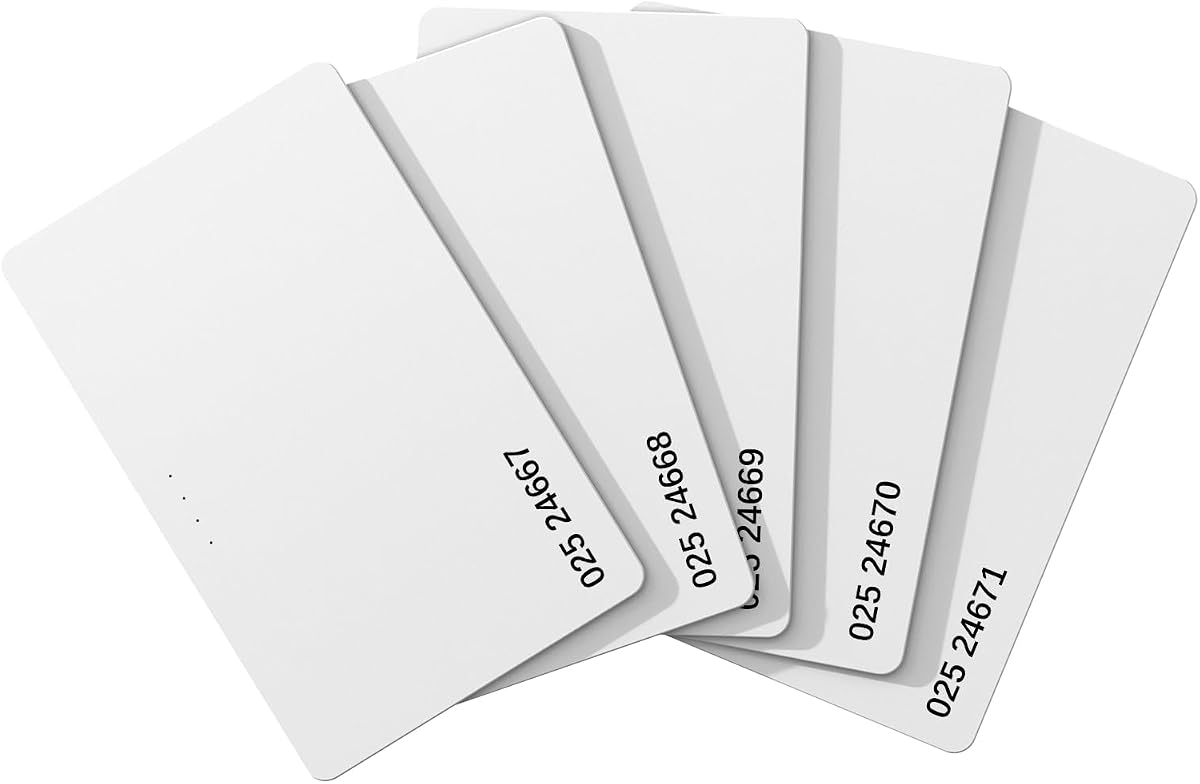
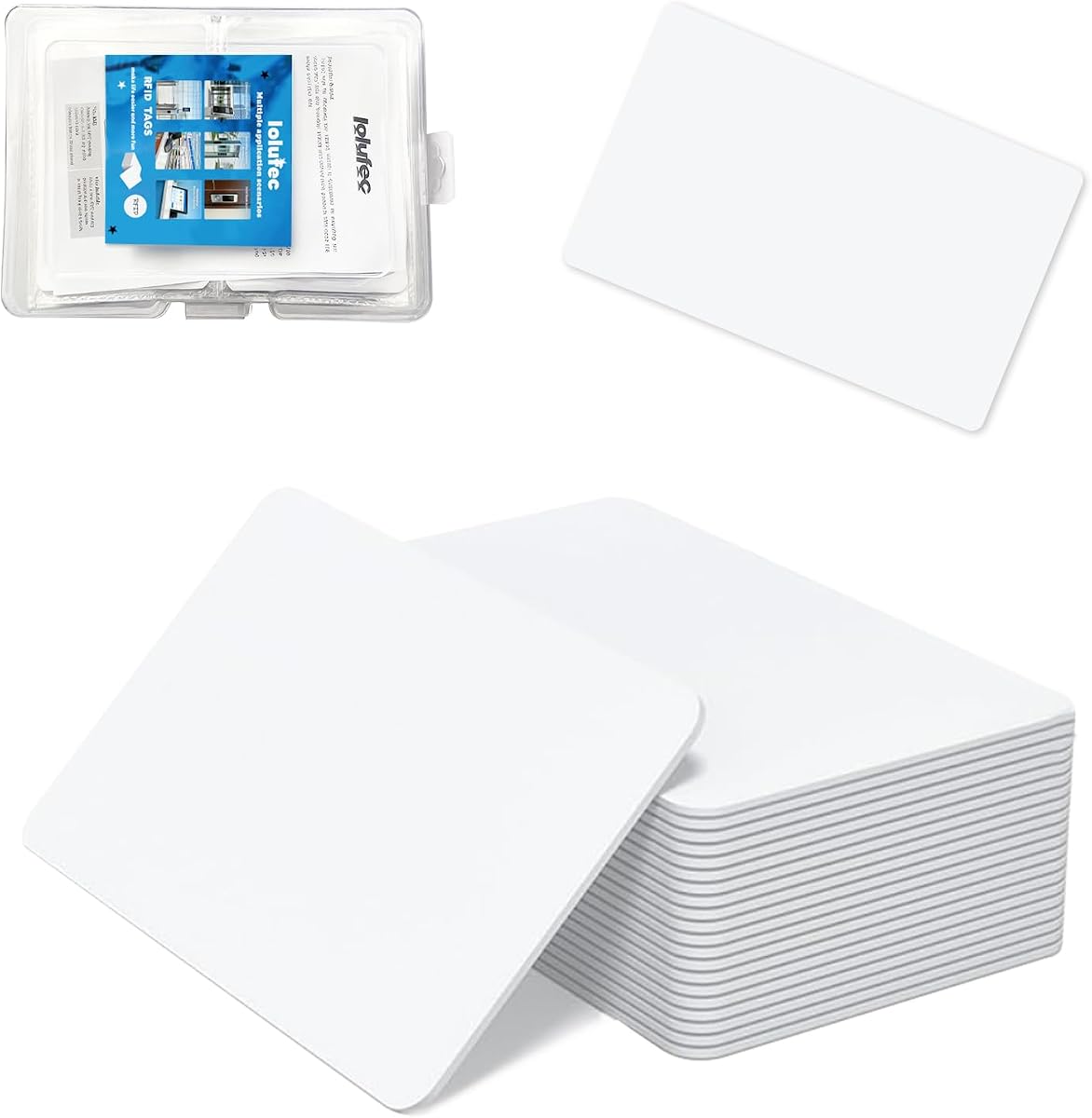
The 10Pcs T5577 Writable RFID Cards are a focused option for testing and modest-scale 125kHz projects. They have a 5.0 rating, include ten cards, and use writable T5577 chips that must be programmed before use. Their balance of compatibility guidance and a small pack makes them an accessible way to build a first working set.
We may earn a commission when you buy through this link, at no additional cost to you.
The cards are designed for 125kHz readers, writers, and access-control systems that support T5577 writable formats and common low-frequency proximity formats. The listing specifically cites compatibility with 1386, 1326, and H10301 reader formats. Each credit-card-sized card is about 1.8mm thick and made from white PVC described as waterproof and wear-resistant.
The main limitation is again the programming requirement. These are not preprogrammed credentials, so readers will not recognize them until the correct ID has been written. They are also not recommended for direct use on metal surfaces, where radio-frequency performance can be less predictable. The product is intended for 125kHz systems, not NFC phones or 13.56MHz readers.
This is our Best Budget selection for people who need a small, practical batch rather than a large inventory. It works especially well for testing reader compatibility, replacing an authorized existing 125kHz credential, or building a short set of employee, school, parking, hotel-key, or access-control records. Confirm system support before ordering, then use a compatible writer to add the required data.
Ten cards allow a technician to test several identifiers without carrying a bulk inventory. The repeated erase-and-write capability also makes the pack useful for learning, prototyping, and correcting credential assignments.
The white PVC body is described as waterproof, wear-resistant, and suitable for longer-term use. Its credit-card shape makes the cards easy to carry in wallets, holders, or badge sleeves after programming.
We may earn a commission when you buy through this link, at no additional cost to you.
The 100 Pack T5577 T5567 T5557 cards are a high-volume option for organizations that routinely issue, replace, or reprogram 125kHz credentials. They have a 4.5 rating and share the core specifications of the smaller T5577 set: writable chips, CR80 dimensions, 0.8mm thickness, and white PVC construction.
We may earn a commission when you buy through this link, at no additional cost to you.
Each blank card can be written in 125kHz ID or H ID WG formats and customized to a 26-bit Prox format. The listed use cases include hotel keys, access control, time and attendance, ticketing, and packing cards. The cards also support duplication of EM4100 or TK4100 ID card keychain tags when used within appropriately authorized systems.
The larger quantity does not change the need for compatible programming equipment. These cards cannot be read before an identifier is written, and a card printer alone will not create a functional electronic credential. Organizations should also maintain a reliable numbering and issuance process so that physical cards can be matched to programmed access records without confusion.
This pack makes sense for property managers, installers, event operators, or system administrators with a steady need for low-frequency cards. It is less attractive for a one-time test because the quantity is far greater than many experiments require. For those who already know their readers support the relevant 125kHz formats, it is a dependable bulk supply.
A hundred cards reduce the frequency of restocking compared with small packs. Rewritability further supports reuse when personnel, rooms, or access levels change, provided the platform allows the card data to be overwritten.
Assign each card a physical identifier, log its programmed electronic ID, and test it in the intended reader. This disciplined workflow is especially valuable when deploying a large batch across multiple doors or recipients.
We may earn a commission when you buy through this link, at no additional cost to you.
The JASAG 100pcs Premium Rewritable UID Smart Card is the strongest high-volume option in this 13.56MHz group. It has a 4.6 rating and provides 100 blank white PVC cards based on MIFARE Classic 1K. The cards support reading, writing, reprogramming, and more than 100,000 rewrite cycles, with a stated reading distance of 0–10 centimeters.
We may earn a commission when you buy through this link, at no additional cost to you.
Each card includes a unique encrypted identifier that can be reprogrammed, while the memory is described as 1,024 bytes organized into 16 sectors of four blocks. Compatibility with 13.56MHz RFID products and door access systems is claimed. The 100-card quantity makes this a practical choice for organizations that need a substantial reusable stock without moving to fixed-UID cards.
There is a clear technical limitation: the product cannot copy 125kHz cards. Users must also account for the security configuration of the target system, since a reader that expects a particular access model may not accept a rewritten identifier even when the card hardware is technically compatible. The product is intended for controlled credential and cloning workflows in authorized environments.
This is our Best Premium pick because it combines large-scale availability with a changeable UID and a useful amount of MIFARE-compatible memory. It suits access administrators, security technicians, and developers who need many reprogrammable 13.56MHz cards. It is less appropriate for simple NFC phone links, where NTAG is usually a better memory model, or for 125kHz hotel systems.
The combination of one hundred cards and repeated reprogramming supports organizations that manage many temporary or changing access assignments. Physical cards can remain in circulation while their identifiers are updated for different users or access levels.
The stated 16-sector, four-block, 1,024-byte organization gives developers a familiar structure for testing access control and custom data applications. Compatibility must still be validated against the exact reader, software, and authentication setup in use.
We may earn a commission when you buy through this link, at no additional cost to you.
The 80 Pcs MIFARE Classic 1K RFID Cards are an important comparison item, but they do not fully match the keyword. They are data-writable cards with a fixed, hardware-locked UID. The 4.7 rating reflects a well-specified 13.56MHz option for access control, hotel keys, employee attendance, membership, and parking applications.
We may earn a commission when you buy through this link, at no additional cost to you.
These cards use an Fudan FM11RF08 chip configured for MIFARE Classic 1K and ISO14443A protocols. Memory is divided into 16 sectors with dual A/B access keys, while Sector 0 Block 0 contains a factory-locked four-byte UID. Authentication is required before writing, and the default factory access key is FF FF FF FF FF FF.
The decisive limitation is that the UID cannot be altered. The cards are therefore not interchangeable with genuinely changeable-UID products, and they are explicitly unsuitable for UID-cloning applications. The listing also excludes compatibility with iPhone writing, HID iCLASS, Schlage, Lenel proprietary systems, ISO 14443 Type B, encrypted enterprise access networks, 125kHz equipment, Amiibo, Yoto, and Skylanders.
Even with that caveat, the cards may be valuable for organizations that want a large supply of standard MIFARE credentials without needing to change the identifier. Their uncoated PVC is compatible with UV, retransfer, direct-to-card thermal, and all-in-one lamination printers, though not ordinary household inkjet printers. Consider them only when fixed-UID behavior is acceptable.
A factory-locked UID cannot be casually rewritten, which can suit systems that bind issued identities to physical cards. This differs fundamentally from changeable-UID products and should guide the purchasing decision before any bulk order.
The product supports several common reader platforms, including ACR122U, PN532, and RC522, but also lists a substantial set of incompatible access ecosystems. Verify the exact lock, software, and communication protocol before deploying the cards.
We may earn a commission when you buy through this link, at no additional cost to you.
The 5 Pack T5577 125kHz Rewritable RFID Cards is the smallest selection here and a practical choice for evaluating a 125kHz project before committing to a larger order. The cards can be programmed, erased, and reused for access control, asset tracking, inventory labeling, personal identification, attendance, and DIY projects.
We may earn a commission when you buy through this link, at no additional cost to you.
The T5577 chip operates at 125kHz and is described as compatible with most common 125kHz reader-writers. Because each card is blank, owners can write custom information, ID numbers, or access credentials into systems they legally operate or have written authorization to program. The white appearance keeps the cards suitable for basic identification and labeling.
Unlike most products in this roundup, the supplied listing does not provide a numeric customer rating, so there is no meaningful rating to evaluate. Buyers should also avoid interpreting “compatible with most common” as universal compatibility. The exact reader must support 125kHz T5577 or the desired prox format, and an appropriate writer is needed to create the first usable record.
This five-card pack is ideal for developers, installers, and curious users who want a low-commitment way to test a reader, explore a workflow, or replace a small number of authorized credentials. It is less suitable for a busy access program, where a larger pack would reduce restocking frequency. Its main strength is controlled experimentation without excess inventory.
Five cards are enough to test different identifiers, reader positions, badge formats, or programming commands. Once the workflow is proven, the same T5577 platform is represented by larger packs in this guide.
The listing appropriately restricts use to systems and credentials the user owns or is authorized to program. Following that principle keeps experimentation within legitimate access-control and asset-management environments.
We may earn a commission when you buy through this link, at no additional cost to you.
The 12 PCS T5577 Thick Smart Cards add a more substantial physical format to the 125kHz options. These contactless proximity cards are 1.8mm thick, use white PVC, and have a 4.7 rating. The thicker profile is designed for a key-fob or clamshell-style badge that can withstand repeated handling better than a thin card.
We may earn a commission when you buy through this link, at no additional cost to you.
The cards operate at 125kHz and support 1386, 1326, and H10301 reader formats. Their writable T5577 chip can be programmed in 125kHz ID and H ID WG formats and customized to 26-bit Prox. The listing says the cards can be erased and written 100,000 times, making them suitable for new credentials and authorized backups.
Several exclusions are important. The cards cannot be added directly to locks; they must first be written by a compatible 125kHz writer or copier. They are not NFC chips and will not work with NFC phones. The supplied information also says they do not work with ONITY systems or Proxmark3 RDV4, so compatibility claims should be read as specific rather than universal.
The format is useful for people who want a durable badge for keyless entry, employee identification, attendance, or other 125kHz systems. It is a good fit for key rings, shared facilities, and repeated daily handling, provided the reader supports the proper format and the user has suitable writing equipment. It is not the right choice for NFC shortcuts, visitor links, or 13.56MHz access platforms.
The 1.8mm thickness creates a sturdier proximity-card format that is more appropriate for a key fob or frequently handled badge. It remains credit-card sized, so it can still fit many standard holders and sleeves.
The cards are not automatically accepted by a reader after purchase. Programming an identifier with a supported 125kHz writer is a necessary step, and the target system must use a compatible format rather than an excluded platform.
We may earn a commission when you buy through this link, at no additional cost to you.
The right blank rewritable RFID card depends primarily on reader frequency, chip format, memory model, and how the credential will be issued. Use the following factors to narrow the options before choosing a pack size or printing workflow.
Operating frequency is the first compatibility checkpoint. The T5577 options in this guide operate at 125kHz, while the LEXI, JASAG, MIFARE Classic, and NTAG products operate at 13.56MHz. A card that looks similar and fits in the same wallet can still be completely unreadable by the target reader. Confirm both the physical reader and the software or system specification rather than relying on the phrase “RFID card,” which covers multiple unrelated technologies.
T5577, MIFARE Classic 1K, and NTAG Ultralight EV1 serve different purposes. T5577 is intended for writable 125kHz proximity identifiers, MIFARE Classic 1K provides sector-based memory and access-control compatibility, and NTAG Ultralight EV1 offers a smaller NFC data area with its own security and factory-locking behavior. Product titles sometimes mention several related chips, so use the included-chip specification rather than assuming every named technology is present.
A changeable UID and a rewritable data area are not the same thing. The LEXI and JASAG cards advertise reprogrammable four-byte identifiers, while the 80-pack MIFARE option has a factory-locked UID that cannot be altered. The T5577 cards are writable but arrive without an ID number, so the identifier is written later. Decide whether the requirement is reusable data, a new identifier, or a fixed unique identity before purchasing.
Most low-frequency T5577 cards cannot be read before they are programmed. You need a compatible 125kHz writer or copier and software that supports the target format. The NTAG EV1 cards also require formatting and, according to the supplied instructions, an unlocking step in NFC Tools. A 13.56MHz reader may read data without writing, but that does not mean it can create or modify credentials. Make sure your toolkit matches the card’s frequency and chip.
Memory capacity depends on the application. MIFARE Classic 1K cards organize 1,024 bytes into sectors, which is useful for structured access and application data. NTAG Ultralight EV1 provides 48 bytes of user-rewritable memory, making it better for short links or compact records. Its security options include passwords, one-time-programmable memory, and tamper controls. T5577 cards are primarily credential-format devices, so their value comes from identifier compatibility rather than large storage.
Most products are blank white PVC and can accept printed identification, but the supported printer matters. The T5577 listings identify Zebra, Fargo, and Evolis compatibility, while the uncoated 13.56MHz cards support UV, retransfer, direct-to-card thermal, and all-in-one lamination processes. Ordinary household inkjet printers are not suitable for the uncoated cards discussed here. Consider whether a printed name, company logo, role, or lanyard hole is necessary before ordering.
Pack sizes range from five to 100 cards. A five- or ten-card pack is sensible for proof-of-concept testing, while 12-, 20-, and 30-card sets suit a small team, event, or controlled deployment. The 80- and 100-card options are more appropriate for offices, hotels, campuses, and installers that issue credentials regularly. Choose a quantity that reflects your program’s turnover rate rather than simply the lowest unit cost.
Blank writable cards can be used for legitimate access control, inventory, attendance, tickets, visitor authorization, and NFC projects, but a programmable card also creates security responsibilities. Program only credentials you own or are authorized to manage, maintain a record linking each physical card to its electronic ID, and revoke access when a person or role changes. This disciplined approach prevents a technically flexible card from becoming a security liability.
Begin by identifying the card’s frequency, chip type, and required identifier format. Test one card with the intended reader and programming tool before deploying the rest of the pack. For a blank T5577, write the appropriate 125kHz identifier before attempting to read it; for NTAG EV1, complete the supplied unlocking and formatting steps before writing custom data. For MIFARE cards, authenticate with the accepted key before attempting a write operation.
Print the visual identity separately from the electronic programming workflow. Use a printer compatible with the card’s surface and finish, allowing printed material to cure or laminate as required. After programming, insert the card into the actual reader or door hardware used in production, not merely the writer used to create the credential. Test reading, access, data retrieval, and overwrite behavior before distributing the cards.
Store unused cards away from excessive heat, moisture, bending, abrasion, and strong interference. Avoid placing low-frequency cards directly against metal, which can impair read performance, and do not leave programmed cards in wallets beside unrelated contactless cards if a reader is sensitive to interference. Retire a card that no longer reads reliably, securely erase or block obsolete credentials where the system permits, and keep a log linking each issued card to its owner and authorization period.
A blank card arrives without the final electronic identifier or data that the user needs. A rewritable card can be programmed again after that information is written, provided the chip and reader support the same format. Some products, such as the fixed-UID MIFARE option, are writable in data areas but cannot have their UID changed, so read the distinction carefully.
Generally, no. NFC phones and most standard NFC readers operate at 13.56MHz, whereas the T5577 cards in this guide operate at 125kHz. The 13.56MHz choices are the relevant ones for NFC-compatible devices, and even then the phone must support the required card type and writing function.
A blank T5577 does not contain a preprogrammed identifier, so the reader has nothing meaningful to recognize. A compatible 125kHz writer or copier must first write an ID in the format expected by the target system. This is expected behavior rather than necessarily a defective card.
T5577 is a writable chip used here for 125kHz proximity credentials, while MIFARE Classic 1K is a 13.56MHz standard with a sector-based memory and authentication structure. They operate at different frequencies and are programmed with different tools, so one generally cannot substitute for the other.
Yes, when the printing process is compatible with the card material. Several listings specify Zebra, Fargo, Evolis, UV, retransfer, thermal, and lamination support. The uncoated cards in this guide cannot be printed directly with ordinary household inkjet printers, so confirm the printer workflow before ordering.
Rewrite endurance varies by product. The LEXI and JASAG 13.56MHz cards and the NTAG EV1 option are stated to support 100,000 write cycles, and the thick T5577 option is also described as supporting 100,000 erases and writes. Actual lifespan can vary with storage conditions, write practices, and card quality.
They are legitimate tools for systems and credentials you own or have permission to administer. Using them to access or duplicate a third party’s card, door, vehicle, or account without authorization may violate laws, contracts, or policies. Check local regulations and your organization’s access-control requirements before programming or deploying any credential.
Choose a card that exactly matches the reader’s frequency and supported format. The five- or ten-card 125kHz T5577 packs are efficient for testing 125kHz equipment, while a single MIFARE or NTAG card is better for 13.56MHz experiments. Confirm the required writer, test one card, and only then consider a larger pack.
The Best Budget pick is the 10Pcs T5577 set for controlled 125kHz testing, while the YARONGTECH 20-card pack takes the Editor’s Choice position for its balanced quantity, printing support, and multiple writable formats. For large-scale 13.56MHz operations, the JASAG 100-card selection offers the strongest combination of changeable UID, MIFARE Classic 1K structure, and reusable inventory.
Prioritize compatibility before every other consideration. Match the frequency, chip, identifier format, memory structure, and programming method to the reader and system you actually intend to use. Choose a changeable UID only when the workflow needs it, select NTAG for compact NFC records, and use T5577 for compatible 125kHz credentials. The fixed-UID MIFARE pack remains useful for applications where the identity must remain locked, but it is not a true substitute for a changeable-UID card.
Finally, check the current listing, availability, package quantity, and seller information before purchasing, because product configurations and costs can change. Read the manufacturer’s programming instructions, test one card end to end, and document each credential before rolling it out. A careful compatibility check is the surest way to avoid a technically correct card that simply cannot work in the intended system.
