
Upgraded Bed Sensor Alarm
4.5Editor score
Floor or doorway placement
Up to 918-foot open-area range
Five volume levels
Battery and Micro USB power
Caregiver pager included
A bed alarm can give family caregivers valuable warning when an older adult leaves bed, approaches a doorway, or shows signs of nighttime wandering. The right device balances early detection, dependable alerts, comfortable placement, and simple operation, while also respecting the patient’s need for dignity and independence.
This guide compares ten bed alarms and floor-alert systems using their stated specifications, including sensor type, wireless range, notification methods, power options, placement, and caregiver controls. It covers products suited to home care, hospitals, nursing facilities, and rehabilitation settings, with special attention to dementia-related wandering risks.
Each pick highlights a different approach, from pressure-sensitive mattress pads to under-bed motion sensors and weight-sensing floor mats. Ratings reflect the supplied customer feedback, while features and limitations are based on the product information. Availability, configurations, and prices can change, so confirm current details before purchasing.
4.5Editor score
4.8Editor score
4.6Editor score
As an Amazon Associate we earn from qualifying purchases.
The comparison below organizes all ten systems by sensing method, placement, wireless reach, alert options, and practical caregiver features, making it easier to identify the most appropriate device for a particular bedroom and care routine.
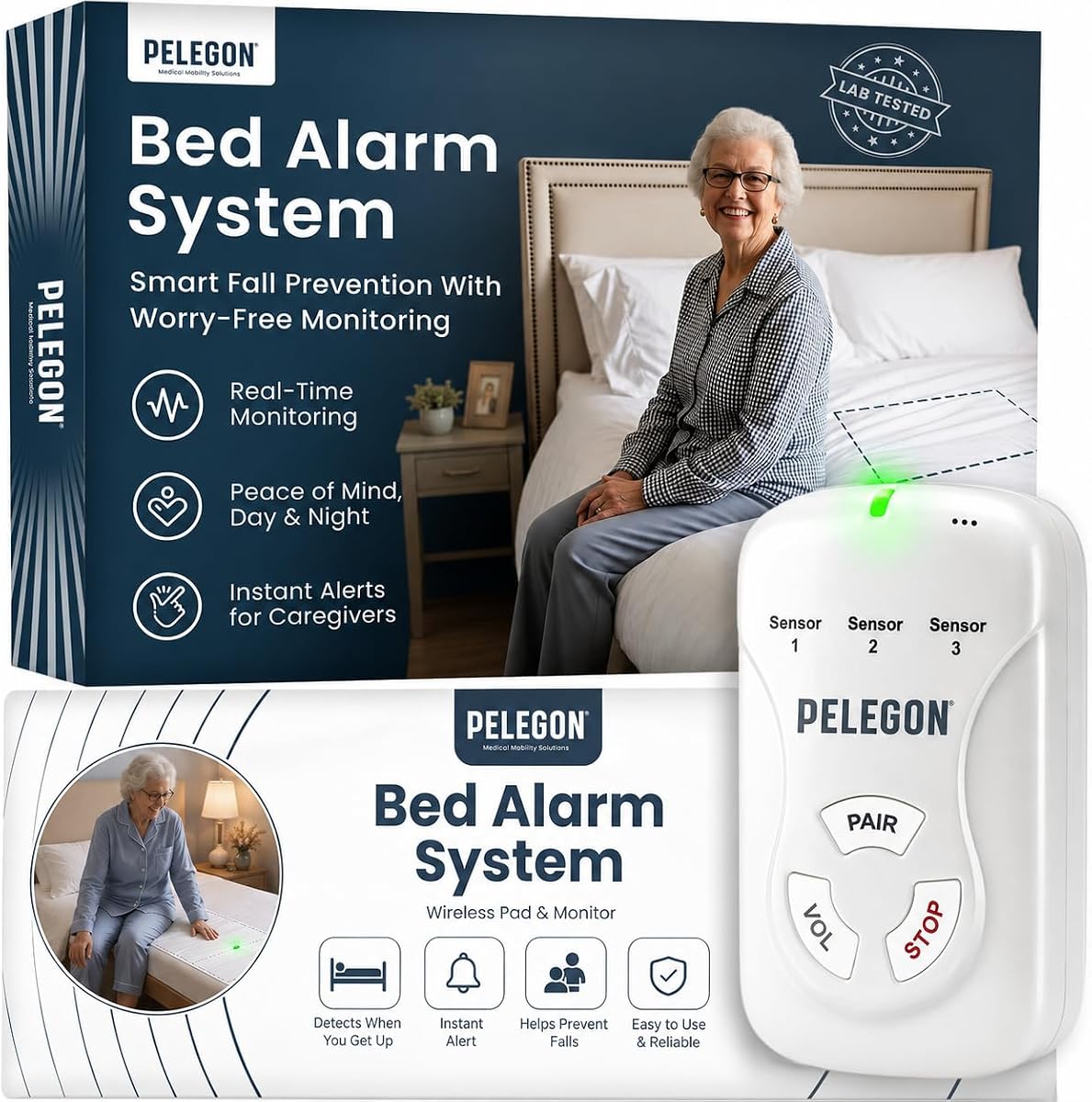


The PELEGON bed alarm is a wireless, under-sheet sensor system designed to notify caregivers when a loved one begins to move and rise. It carries a 4.7 rating, making it one of the strongest customer-rated options in this guide. Its main attraction is the combination of customizable sound, adjustable volume, vibration-only operation, and a lightweight pager that can be carried throughout the home.
We may earn a commission when you buy through this link, at no additional cost to you.
The sensor is placed beneath the sheet and is intended to detect movement as the patient starts to get up, potentially giving a caregiver additional time to intervene. Its stated wireless range extends up to 328 feet, which is useful for a caregiver working in another room or moving around a home. The pager can be clipped to a belt or carried in a pocket, while vibration mode allows monitoring without producing a sound in the bedroom.
The main trade-off is that mattress pressure sensors can be influenced by body position, bed movement, or how the pad is installed. The product information emphasizes simple setup, but careful placement under the appropriate part of the sheet remains important. Caregivers should also test the alert after installation and whenever bedding or sleeping position changes. Despite that need for proper setup, the flexible alert modes and simple operation make this system broadly useful.
This is a strong choice for households seeking a bed-exit alarm with both audible and discreet vibration alerts. It is especially relevant for dementia care when nighttime wandering or an unsupported trip to the bathroom may concern the caregiver. Families that tolerate a mattress sensor and want a tool-free installation should find this product practical. It is less attractive for someone who needs a floor-based sensor that can detect feet before full weight is placed on the mattress.
The selectable alert modes let caregivers adjust the system to the setting. Vibration-only operation is especially helpful at night or in shared rooms, while adjustable sound provides a more obvious warning during daytime wandering risk.
Installation requires placing the sensor beneath the sheet and connecting the system. Its wireless design removes long bedside cables, giving caregivers more freedom to move around the home.
We may earn a commission when you buy through this link, at no additional cost to you.
This Smart Caregiver bed alarm uses a 10-by-30-inch vinyl pressure pad to notify a caregiver when weight is removed from the bed. It has a 4.2 rating and prioritizes straightforward operation. The monitor offers two volume levels, a front reset button, and status lights for battery and sensor condition, making it approachable for caregivers who want essential alerts without a complicated interface.
We may earn a commission when you buy through this link, at no additional cost to you.
The sealed soft-vinyl pad has a foam interior and is described as protected against incontinence and easy to wipe clean. It can sit under the lower fitted sheet around the shoulder blades or hips, depending on the patient’s movement. The connected monitor may be mounted to the bed or wall or placed on a nearby surface. An optional wireless add-on kit can relay alerts to a caregiver instead of sounding in the patient’s room.
There are two important limitations. Caregivers who want remote paging must purchase the add-on kit separately, and the listed alternative AC-02 Adapter is also not included. The monitor itself has only high and low sound levels, so it offers less alert customization than systems with multiple tones, brightness controls, or vibration-only modes. The cord connecting the pad to the monitor may also be less convenient for some bedroom layouts.
This product is a practical option for a caregiver who wants a conventional bed pad, an accessible reset control, and simple status feedback. It may be particularly useful in care settings where an in-room warning is acceptable and the monitor can be mounted close to the patient. Buyers seeking cordless placement from the start should choose a system that includes a wireless pager.
Separate low-battery and sensor-status indicators help caregivers confirm that the system is functioning. These are useful features in home, hospital, and residential care environments where alarms must remain dependable.
The monitor can be clipped to the bed, attached to a wall, or set on a nearby surface. That flexibility makes it easier to keep the visible control within reach without placing it where it could become tangled.
We may earn a commission when you buy through this link, at no additional cost to you.
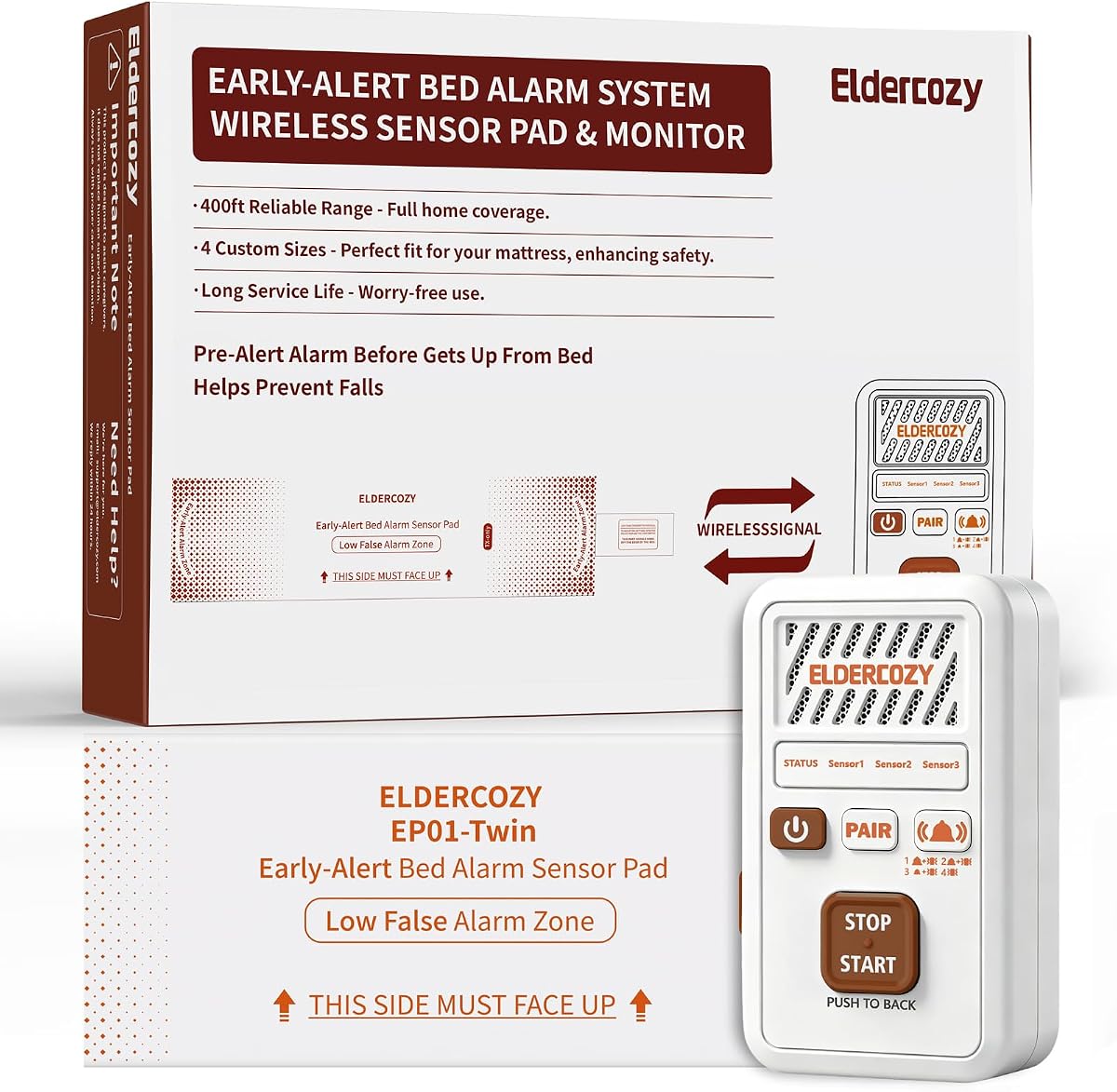
The Twin Size Wireless Bed Alarms system combines a waterproof TPU sensor pad, a wireless transmitter, and a portable caregiver pager. Its 4.8 rating is the highest among the ten products covered. It is particularly well suited to dementia care because the product description emphasizes early detection at the hip level, quiet materials, customizable alerts, and a caregiver mode that can pause the alarm temporarily.
We may earn a commission when you buy through this link, at no additional cost to you.
Unlike noisy PVC pads, the stated TPU composite is designed to remain quiet when the patient rolls over. The waterproof surface resists urine and wipes clean, making it suitable for long-term nightly use. The wireless signal reaches up to 400 feet, and the pager can connect to up to three transmitters. Replaceable 1.5V AAA batteries in both transmitter and receiver support continued use without replacing a sealed disposable pad.
A particularly thoughtful feature is Caregiver Mode, which temporarily pauses the bed-exit alert for 20 minutes after a long press of the prominent stop/start button. Dim status lights are intended to avoid disrupting sleep, and the pager offers adjustable volume plus vibration-only operation. The trade-off is that the pad is size-specific, with Twin, Full, Queen, and King options described, so buyers need to match the mattress carefully. The three-transmitter ceiling is also lower than that of the Smart Caregiver system supporting six sensors.
This is the strongest all-around choice in the guide for a household wanting quiet materials, wireless paging, useful nighttime controls, and durable replaceable batteries. It is especially appropriate when the patient turns frequently, needs a low-noise sleeping environment, and may wander after getting out of bed. Caregivers should confirm the available pad size and test the system before relying on it overnight.
The product places the sensor at hip level to help identify the moment a patient sits on the edge of the mattress. This positioning may provide more useful warning than a shoulder-area pad that reacts to ordinary rolling and tossing.
Soft TPU construction reduces crinkling, dim status lights limit visual disruption, and vibration-only alerts allow discreet supervision. Caregiver Mode adds a short pause when assistance is already being provided.
We may earn a commission when you buy through this link, at no additional cost to you.
The Upgraded Version Bed Sensor Alarm uses a wireless motion sensor rather than a mattress pad. It has a 4.5 rating and is a practical lower-cost choice for caregivers who want to monitor a patient’s feet as they leave bed. The sensor may be positioned on the floor beneath the bed, where it can alert when a foot is about to touch down, or placed near a doorway to warn of a possible exit.
We may earn a commission when you buy through this link, at no additional cost to you.
The product includes a caregiver pager, a motion sensor, batteries, a Micro USB cable, mounting tape, a screw kit, and a manual. Its receiver has five volume levels, while both LED and sound notifications are supported. The sensor and receiver can run on alkaline batteries or Micro USB power, reducing the chance that a nearby outlet becomes necessary. Stated open-area transmission range is up to 918 feet.
The distance figure should not be treated as a guaranteed range through walls or across multiple floors. The sensor also performs a self-test when switched on and should be checked for sensing direction before it is fixed in place. Floor placement can be affected by furniture, floor level, and the patient’s normal movement path. Nevertheless, the sensor avoids the limitations of a pressure pad, including alerts caused by incontinence or minor repositioning.
This system is a strong choice for families seeking straightforward wireless monitoring without a large floor mat. It works well when the principal concern is detecting feet reaching the floor or a person approaching a doorway. Caregivers should complete the self-test, verify the direction, and test the pager from the intended monitoring location. Its alert system also avoids placing a loud sound in the patient’s room.
The same sensor can monitor under-bed movement or a doorway. That versatility lets caregivers address both getting out of bed and nighttime wandering without changing the core device.
The warning is transmitted to the caregiver receiver rather than sounded near the patient. This may reduce startling, though caregivers should still use quiet tones during sleeping hours when appropriate.
We may earn a commission when you buy through this link, at no additional cost to you.
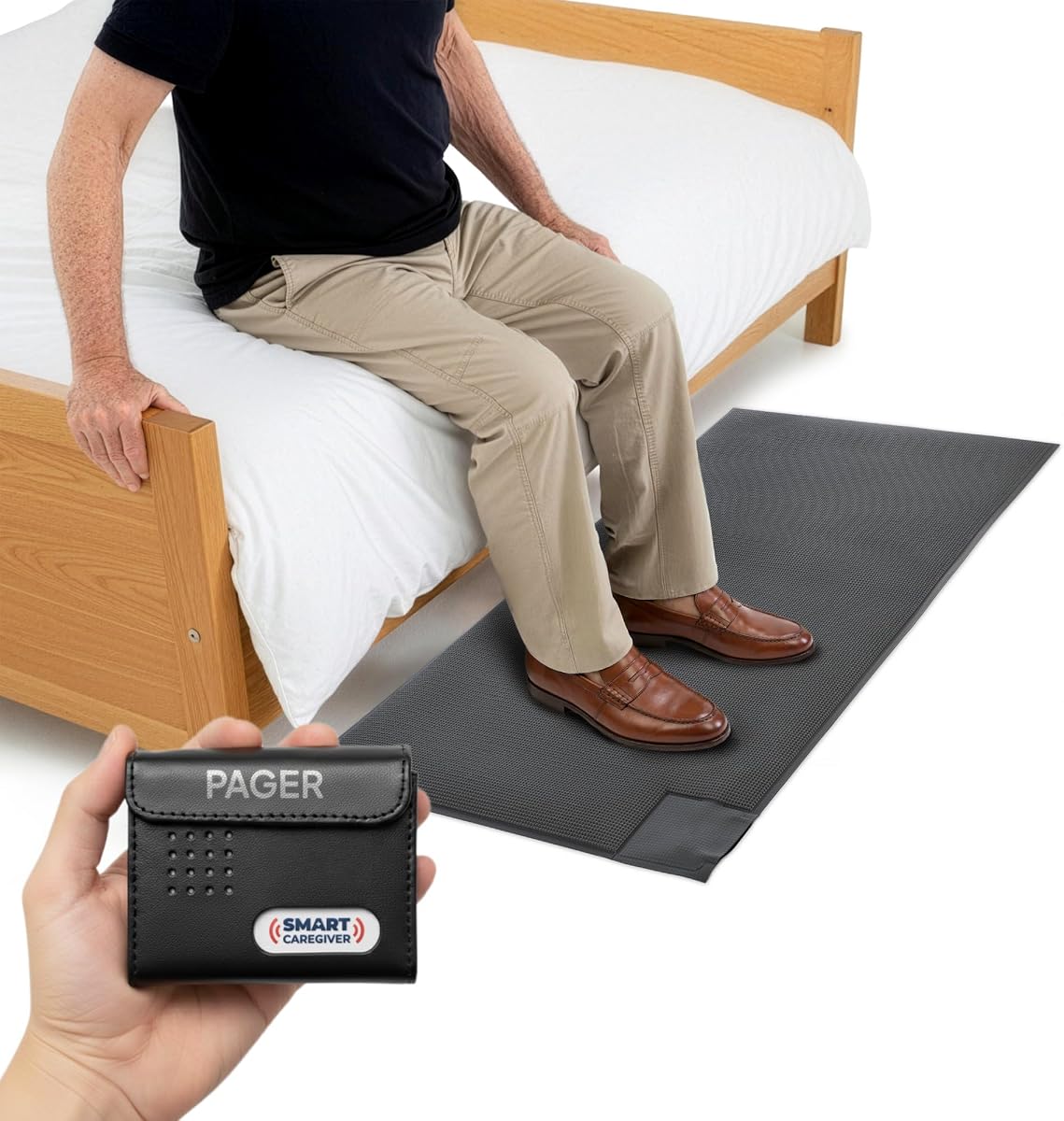
The Smart Caregiver Floor Mat Alarm uses a large 24-by-48-inch weight-sensing mat to notify a caregiver when a patient steps onto it. It has a 4.6 rating and stands out for its broad detection area, durable construction, and compatibility with a wider Smart Caregiver monitoring setup. It can be placed beside the bed or near an exit door.
We may earn a commission when you buy through this link, at no additional cost to you.
The included caregiver pager supports audible and vibration alerts, allowing a resident to avoid a loud alarm while the caregiver receives a discreet notification. Wireless communication is stated to reach up to 300 feet. Caregivers can monitor multiple compatible devices through the pager, including optional call buttons, motion sensors, bed pads, and chair pads sold separately. A one-year manufacturer warranty is included.
Unlike a narrow floor sensor, the larger mat may be easier for patients to step onto consistently, but it also requires adequate clear floor space. It should not be covered by furniture, bedding, or other objects. The pager requires two AA batteries, which are not included, so caregivers should install and test them before relying on the system. It also detects a person stepping on the mat rather than providing the same type of early warning as an under-bed foot sensor.
This is the best premium option for a care setting that wants one substantial mat covering both bedside and doorway applications or a broader connected monitoring system. It is particularly useful where a patient is known to wander toward an exit. Caregivers should evaluate the available floor area and make sure the path cannot be bypassed accidentally. The expandable device support and included pager make it a long-term monitoring platform rather than a single-purpose alarm.
The 24-by-48-inch mat gives a patient a broad target when leaving bed or approaching a door. Its unobstructed placement is essential for consistent weight detection.
The included pager can coordinate with separately sold bed pads, chair pads, motion sensors, and call buttons. This makes the floor mat useful as one component of a broader fall-prevention plan.
We may earn a commission when you buy through this link, at no additional cost to you.
The Smart Caregiver Bed Exit Alarm combines a soft 10-by-30-inch weight-sensing pad with a wireless caregiver pager. Its 4.4 rating reflects a well-regarded system centered on uncomplicated bed-exit detection. The pager provides sound or vibration alerts, and its compatibility with up to six sensors gives it more expansion capacity than several other products in the guide.
We may earn a commission when you buy through this link, at no additional cost to you.
The product is intended to notify caregivers when pressure is removed and the patient has left bed. The manufacturer says an extra-large contact sensor is used to reduce false alarms, and recommends placing the pad under the shoulders for an immediate alert as the patient starts to get up. The soft pad and wireless pager eliminate the need for a bedside cable, allowing the caregiver to carry the receiver around the home.
As with any weight-based bed system, sensitivity depends on correct placement and the patient’s behavior. Restless sleepers may move the pad’s effective pressure relationship, while a shoulder placement may need adjustment to avoid triggering during ordinary repositioning. The product information does not mention a temporary caregiver-pause function, so users may need to silence the pager manually during direct assistance. Its value also depends on using compatible Smart Caregiver accessories for the advertised six-sensor capacity.
This system is best for a household that wants wireless bed-exit alerts and may eventually monitor a chair, doorway, or multiple sleeping areas with the same pager. It is a sensible option when the patient sleeps relatively still and a caregiver prefers a broad sensor pad over a small floor detector. Testing the alert before bedtime and reviewing positioning if the patient is restless will help establish dependable operation.
Support for up to six compatible sensors makes this a flexible choice for multiple care points. The receiver can serve as the central alert device for an expanding home or facility setup.
The 10-by-30-inch sensor is described as soft and designed for full coverage beneath the bed linens. Proper positioning remains central to achieving an early and reliable alert.
We may earn a commission when you buy through this link, at no additional cost to you.
The CallToU system uses an infrared motion sensor positioned beside the bed to detect feet touching the ground before the patient is fully standing. It has a 4.1 rating and distinguishes itself through extensive receiver customization, including 18 ringtones, five volume levels, and a vibration-only mode. The system is designed for portable monitoring in homes, hospitals, and other care environments.
We may earn a commission when you buy through this link, at no additional cost to you.
The sensor has a stated detection range of three to ten feet and supports 360-degree rotation, allowing caregivers to aim it along the expected path of movement. It does not need to touch the patient and is intended to be less affected by bed repositioning than a pressure pad. The receiver has a Type-C charging port, while the sensor uses three replaceable AAA batteries, avoiding the need to discard a sealed transmitter unit.
The most important limitation is its comparatively short detection distance compared with the broad wireless transmission ranges of several competing products. It also requires a carefully chosen floor-side position rather than a large, unmistakable stepping surface. The product data does not state that it uses Wi-Fi, an app, or a caregiver pause mode. Users should test the direction and distance in the actual room because walls, furniture, and the patient’s usual movement can affect infrared detection.
This is a useful pick when the priority is a quiet receiver with many selectable tones, a portable caregiver device, and early detection of a foot leaving bed. It is particularly appealing to caregivers who want vibration-only monitoring without buying a large mat. The sensor’s adjustable orientation and replaceable batteries improve its practicality, but buyers should verify that the bedside geometry provides reliable coverage.
Five volume levels and 18 ringtone choices make it easier to select a notification that is noticeable to the caregiver without being harsh in the patient’s room.
The sensor can rotate through 360 degrees, allowing it to be aimed toward the floor area where feet are most likely to appear. This helps focus detection and may reduce irrelevant movement triggers.
We may earn a commission when you buy through this link, at no additional cost to you.
The Upgrade Professional Bed Sensor is a wireless motion alarm that can be placed under the bed or in a doorway. It has a 4.5 rating and offers factory-paired components, two power methods, and four alert styles. Its receiver is designed for caregivers who want both audible and visual notifications without running a cable from the sensor to a bedside monitor.
We may earn a commission when you buy through this link, at no additional cost to you.
The sensor is said to detect a patient’s feet as they approach the floor and to transmit that signal to the receiver across up to 918 feet in an open area. The mode button cycles through sound with flashing light, flashing light alone, LED light, and a 113-decibel alarm. Separate volume and brightness adjustment gives the caregiver more control over how prominent the notification will be.
The stated 918-foot range applies under favorable open-area conditions and should not be assumed through multiple walls. The manufacturer recommends loading the batteries, allowing the sensor’s 20-second self-test to finish, and testing the sensing direction before securing it. Several controls are adjusted by continuously pressing side buttons, which may be less intuitive than dedicated controls. Despite these setup details, battery operation and Micro USB power make the system adaptable to different rooms.
This is a good selection for caregivers who want the sensor to function without occupying an outlet and value visual alert options. It is useful in a home where the patient approaches a doorway as well as in a bedroom setup. People who prefer tactile feedback rather than sound can use the light-based modes. A careful initial setup and periodic test will help ensure that placement and range are appropriate for the real environment.
The receiver can combine sound and light, flash only, show an LED, or deliver a high-volume alarm. These options let the caregiver tailor warnings to different rooms and times of day.
Both the sensor and receiver can use batteries or Micro USB power. This reduces installation constraints and provides a way to maintain the system during charging when the included power cable is used.
We may earn a commission when you buy through this link, at no additional cost to you.
The Smart Caregiver Bed and Chair Exit Alarm System includes both a 10-by-30-inch bed pad and a 10-by-15-inch chair pad. It has a 4.2 rating and is a versatile choice for households where a patient moves between a bed and a chair. Pressure-sensitive pads trigger the monitor when the person attempts to rise, supporting fall and wandering prevention.
We may earn a commission when you buy through this link, at no additional cost to you.
The monitor has high and low volume controls, a front reset button, and indicator lights for low battery and sensor status. A phone-style clip makes it easy to move the monitor between the bed and chair pad, while the bed pad can sit under the fitted sheet and the chair pad can rest on the seat. The soft vinyl pads have sealed foam interiors designed to resist incontinence and simplify cleaning.
The primary trade-off is the wired connection between each pad and monitor. While that cable can be secured along the mattress, it is less tidy than a fully wireless system and may be less suitable for a patient moving around several rooms. Only one monitor is included, so a household that wants simultaneous bed and chair alerts would need another compatible monitor. The alert controls are also basic compared with products offering tones, brightness levels, and vibration-only operation.
This set is best for a caregiver who wants one economical monitoring system for both bed and chair exits. It is useful where a patient spends part of the day in a chair and may attempt to stand without assistance. The product information also provides practical placement guidance: shoulder-blade alignment can offer an earlier alert, while hip placement can reduce sensitivity for restless sleepers. Testing under the patient’s normal conditions is essential.
The included bed and chair pads broaden coverage without requiring a separate alarm for each piece of furniture. A clip-on monitor makes moving the control between them straightforward.
Placing the bed pad beneath the shoulder blades is suggested for earlier notification, while moving it beneath the hips can reduce sensitivity in a restless sleeper. This gives caregivers a way to tune the system to the patient.
We may earn a commission when you buy through this link, at no additional cost to you.
The Bed Sensor Pad and Pager combines a 32-by-13-inch sensor pad with a portable wireless receiver for caregivers. It has a 3.7 rating, the lowest among the products reviewed, but it offers a large pad, multiple alert styles, and an advertised range of up to 300 feet. The stated applications include homes, hospitals, nursing homes, and rehabilitation centers.
We may earn a commission when you buy through this link, at no additional cost to you.
The pad uses pressure and motion detection to monitor the patient and trigger an alert when someone attempts to leave the bed. The receiver supports adjustable volume, music, and vibration, allowing a caregiver to select a discreet notification for nighttime use. Clips are provided for securing the pad under a fitted sheet, while the wireless pager can be carried around the care environment.
The product information is less specific about several practical details than the descriptions for competing systems. It does not state the sensor’s trigger threshold, how the pad responds to rolling or repositioning, which batteries are required, or whether the receiver can be paired with more than one transmitter. The lowest customer rating in the group also suggests that buyers should examine recent feedback carefully for issues involving consistency, setup, or durability.
This product may suit a facility or household that wants a generous sensor-pad area, water-resistant materials, and a pager offering music as well as vibration. It is less suitable as an automatic choice for a restless patient because the available information does not explain how the pad filters ordinary movement. Prospective buyers should verify the complete package contents, power requirements, pairing procedure, and alert sensitivity before installation.
The elongated 32-by-13-inch pad offers a substantial area beneath the fitted sheet. Its secure clips are intended to keep the sensor positioned during normal bedding changes and nighttime movement.
Caregivers can select volume, music, or vibration according to the environment. Vibration is useful for minimizing disturbance, while a stronger audible setting can help during daytime wandering risk.
We may earn a commission when you buy through this link, at no additional cost to you.
Choosing a bed alarm requires matching the sensor to the patient’s behavior, the bedroom layout, and the caregiver’s need for timely but non-disruptive alerts. The most important considerations are detection method, placement, alert delivery, reliability, and ongoing maintenance.
Pressure-sensitive pads detect a change in weight and can provide an early warning when a patient shifts toward the edge of the bed. Their effectiveness depends heavily on correct placement, the patient’s body position, and whether the person tends to roll or sit up. Floor motion sensors instead detect feet approaching the ground, while weight-sensing mats respond when someone steps onto a defined area. Each method has a different blind spot, so the patient’s normal behavior matters more than any general claim about detection speed.
Choose based on movement patterns. A pressure pad may suit a relatively still sleeper, while a floor sensor may work better when rolling commonly triggers mattress alarms. A broad floor mat can be useful at a doorway but requires a clear, consistent path.
A bed alarm should deliver a notice that is noticeable to the caregiver without unnecessarily startling the patient. Look for adjustable volume, multiple tones, LED or flashing-light warnings, and vibration-only operation. Vibration and silent visual modes are particularly valuable at night, in shared rooms, or in facilities where loud alarms may increase confusion. A reset control is also important for silencing or pausing a warning during direct assistance.
Prioritize at least two notification styles and easy controls. The best alert is one the caregiver can perceive in the surrounding noise of a home or care setting without waking the patient unnecessarily.
Wireless range gives a caregiver freedom to move between rooms, but the advertised maximum is usually an open-area figure. Walls, floors, furniture, and the location of the receiver can reduce practical coverage. A stated range of several hundred feet may be more than enough for a nearby bedroom, while a shorter range can still be appropriate if the receiver stays on the nightstand or in a hallway. The product should state whether the sensor and receiver are factory paired and how far the signal travels.
Test the receiver from the places where caregiving actually happens. Do not assume an open-area maximum will carry reliably through several walls or across building levels.
A mattress pad should be thin, quiet, skin-friendly, and secure enough not to shift during the night. Soft TPU or sealed vinyl materials can reduce crinkling, protect against incontinence, and simplify cleaning. The system should alert the caregiver without sounding loudly in the patient’s room whenever possible. Patient comfort and privacy are especially important in dementia care because a confusing or startling alarm can increase agitation.
Choose quiet, low-profile components where possible. Confirm that bedding does not bunch over the sensor, and avoid creating a trip hazard with cords or floor equipment.
Some systems are designed only for under the shoulders or hips, while others can be moved under the bed, beside the mattress, or near a doorway. Flexible placement helps caregivers cover both bed-exit falls and wandering toward exits. A wide floor mat offers a clear target but uses more floor space, while a compact under-bed sensor can be easier to position around furniture. A dual bed-and-chair system adds value when the patient spends time in both locations.
Match the sensor to the actual route the patient takes. Test the normal path from bed to bathroom or doorway before relying on the alert.
A pager that supports multiple transmitters or sensors can grow with a care plan. This is useful when a bedroom must be monitored alongside a chair, hallway, or exit door. Expansion is most valuable if the accessories use the same system and can be paired without complicated programming. The maximum number of supported sensors should be verified, as well as whether simultaneous alerts are possible or whether each new device requires separate pairing.
For a facility or multi-patient household, standardized compatible equipment may simplify training. For a single bedroom, a simpler one-sensor setup may be easier to maintain.
Rechargeable or USB-powered systems can simplify routine charging, while replaceable batteries keep each component independent. Low-battery indicators are important because a silent depleted battery can remove protection without anyone noticing. Replaceable batteries in both transmitter and receiver are convenient when the sensor is far from an outlet, but caregivers should establish a testing and replacement routine. Mattress pads that require disposable transmitters may create recurring replacement work and expense.
Choose a system with visible status indicators and accessible power requirements. Test the entire alert path regularly, not merely the sensor.
Wireless reach, sensor size, alert customization, and included components all affect the value of a system. A more advanced device may be worthwhile when it solves a specific problem such as noisy PVC, incompatible accessories, or limited pager capacity. Warranty coverage, manufacturer support, and customer feedback can also influence the decision. Ratings should be considered alongside the stated features, especially for a safety product where fit and setup are essential.
Prioritize dependable operation and appropriate alerts over features that will not be used. Confirm that the package includes everything needed for the intended room, then review current customer feedback before buying.
Before the first night of use, read the included instructions, identify the sensor and receiver, install the required batteries, and complete any self-test procedure. Position the sensor according to the manufacturer’s guidance: under the appropriate part of the fitted sheet for a bed pad, beneath the bed for a foot detector, or on an unobstructed floor mat beside the bed or doorway. Secure the unit firmly without creating a wrinkle, trip hazard, or pressure point.
Have the caregiver walk through the patient’s normal route while another person monitors the pager. Confirm that the alert is visible or audible from the primary caregiving location, then test the battery indicators, reset control, vibration mode, and chosen volume. If several sensors share a receiver, test each one individually. Bedtime is a poor time to discover that the sensor is poorly positioned, so complete a daytime test and repeat it whenever furniture, bedding, or the patient’s behavior changes.
Ongoing care includes checking that the pad remains flat, the floor sensor stays aimed correctly, and the pager remains charged or fitted with fresh batteries. Clean the sensor with the recommended method, especially after incontinence, and never immerse a powered unit. Test the complete system at a regular interval even when nothing seems wrong. If a patient begins falling before the alarm sounds, reassess the sensor placement and consider adding a doorway or mat alert as a second layer of protection.
Reliability depends on the patient’s movement and the room layout rather than one universally superior sensor. A pressure pad can work well for a relatively still sleeper, while an under-bed motion sensor may reduce alerts caused by rolling and repositioning. A floor mat can be effective for detecting a consistent path toward a doorway. The best approach is to test several placement methods during the day and choose the one that reliably detects actual attempts to leave.
A bed alarm can provide early notice that allows a caregiver to assist before a patient walks unsteadily or wanders into a hazardous area. It does not replace supervision, appropriate lighting, grab bars, a clear path to the bathroom, or other fall-prevention measures. It is best viewed as one layer of a broader safety plan and should be tested regularly to ensure alerts are reaching the caregiver.
Vibration is often preferable at night because it can alert a caregiver without producing a loud sound in the patient’s room. Sound remains useful during the day and may be easier to notice in a noisy environment. The best systems provide both options, along with adjustable volume, so caregivers can select a warning suited to the time of day and the patient’s sensitivity to noise.
Follow the manufacturer’s instructions for the selected product. Bed pads are commonly placed under the fitted sheet near the shoulder blades or hips, while motion sensors may be positioned on the floor beneath the bed or near a doorway. The correct area depends on how the patient moves. Test the device while the patient is awake and walking through their normal route, then reposition it if alerts are missed or occur during harmless movement.
Wireless performance depends on the system, distance, building materials, and interference. Many advertised ranges refer to open areas and should not be assumed to apply through several walls or across floors. Place the receiver where the caregiver will actually be and test the signal from the bedroom, hallway, bathroom, and other relevant locations. A system with a shorter range can still be effective if the receiver remains nearby.
Test the complete system at least regularly and whenever the patient’s behavior, bedding, furniture, or placement changes. A practical routine includes checking battery indicators, confirming the sensor is secure, and triggering the alert from the patient’s normal movement path. Many caregivers find a quick test before bedtime and periodic daytime checks especially useful, with additional checks whenever a caregiver notices an unusual delay or accidental activation.
Some products support multiple transmitters, while others are designed for one sensor. For example, the Twin Size Wireless Bed Alarms pager supports up to three transmitters, and the Smart Caregiver Bed Exit Alarm pager supports up to six compatible sensors. Check the stated limit, required accessories, and pairing procedure before buying, because expandable systems can be useful for monitoring a bed, chair, and doorway.
Several products in this guide are designed for home, hospital, nursing, or rehabilitation environments. Facility buyers should consider wireless compatibility, standardized components, status indicators, sanitation, and the support available from the manufacturer. A one-year warranty and established customer-support options may also matter. Devices should be incorporated into staff workflows so that alarms are checked and answered promptly.
The Twin Size Wireless Bed Alarms stands out as the strongest overall option because it combines the highest customer rating with quiet TPU construction, replaceable batteries, a four-mode caregiver pager, and a temporary caregiver pause. The Upgraded Bed Sensor Alarm is a compelling budget choice for under-bed or doorway monitoring, while the Smart Caregiver Floor Mat System offers the most premium and expandable setup.
The right choice depends on the patient’s behavior and the risks in the home. Restless sleepers may be better served by a floor-side motion sensor, while a wide floor mat can monitor a consistent wandering route. Caregivers should prioritize early warning, an alert they can perceive, placement that will not cause a trip, and a system that can be tested and maintained without difficulty.
Before making a final selection, verify the current package contents, compatible accessories, power requirements, sensor placement, and warranty. Prices and product configurations can change, so compare current listings and recent customer feedback rather than relying on a previous purchase experience. Most importantly, test the complete alarm path before relying on it overnight.