
Autel Original 20 Pin to 16 Pin OBD2 Cable for BMW
4.5Editor score
BMW-specific 20-pin connection
Compatible with listed legacy models
Extension reduces connector wear
Industrial-grade connector construction
Looking for the right OBD1 to OBD2 Adapter? This guide compares 10 cables for GM, Ford, and BMW vehicles, including pin layouts, protocols, and scanner
An OBD1 to OBD2 adapter connects an older vehicle’s original diagnostic port to a modern 16-pin scanner. Because connectors, wiring layouts, and communication protocols vary by manufacturer and model year, the right cable depends on matching the vehicle port, scanner type, and required diagnostic functions rather than simply choosing a generic adapter.
This guide compares ten adapter cables intended for GM, Ford, BMW, and broadly compatible 12-pin vehicles. We evaluated the stated connector configurations, supported vehicle applications, physical design, protocol cautions, scanner compatibility claims, construction details, and customer ratings, while giving particular attention to the important distinction between an adapter cable and a diagnostic scanner.
The list shows why pin compatibility is only the first step: some cables provide a physical connection but cannot guarantee communication with every scanner or vehicle. Each review highlights the best use case and trade-offs, while the buying guide explains how to verify protocol support and connector shape. As with all automotive products, availability and pricing can change over time.
4.5Editor score

4.0Editor score

5.0Editor score
The comparison below covers all ten cables, emphasizing vehicle connector type, stated scanner support, physical construction, and important compatibility limitations. Because these products are adapters rather than scanners, protocol support and pin-level wiring remain the decisive buying considerations.


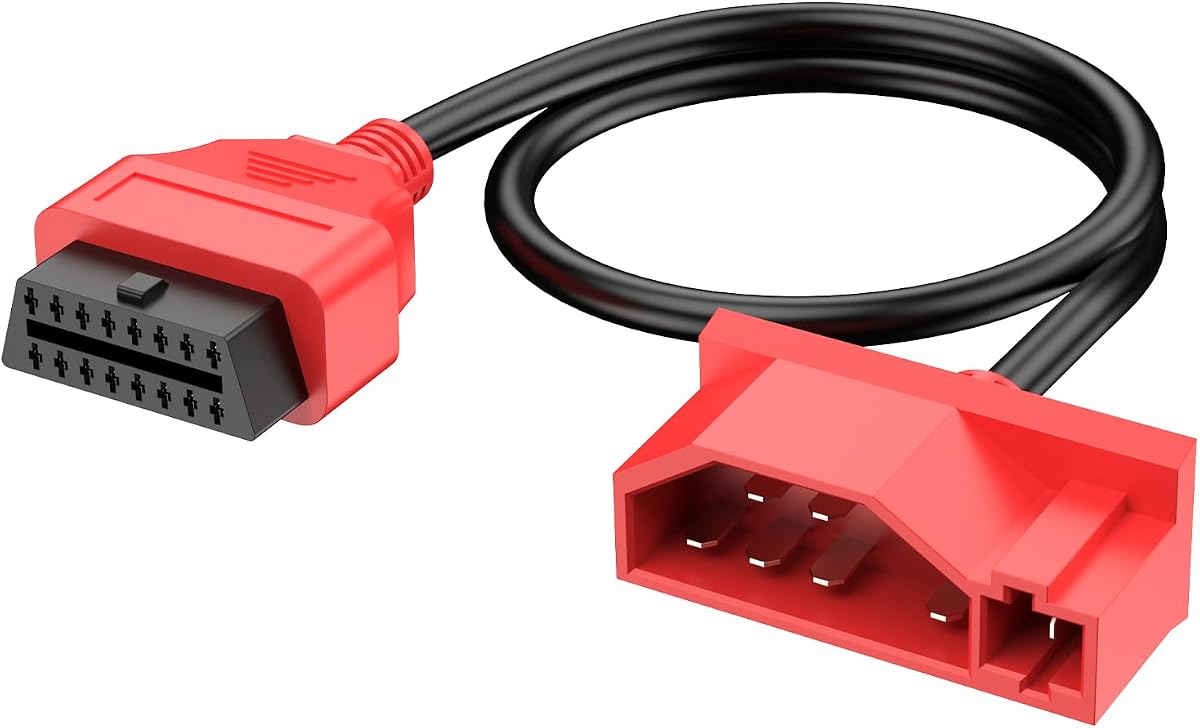


This Autel cable is a purpose-built 20-pin-to-16-pin adapter for selected older BMW models. It carries a 4.5 customer rating, the highest among the ten products in this guide, and stands out for its clearly defined vehicle applications. Unlike a general-purpose 12-pin cable, it is designed around BMW’s distinctive diagnostic connector and the functions available through a compatible OBD2 scanner.
We may earn a commission when you buy through this link, at no additional cost to you.
The product information identifies compatibility with the E28, E30, E32, E34, E36, E38, E39, E46, E52, E53, R50, R52, and R53 models. It also describes a total cable length of 15.75 inches, allowing the scanner to sit away from the diagnostic port and reducing wear from repeated direct connection. The listed materials include industrial-grade components, precision molding, and a 20-pin male-to-16-pin female configuration.
The main limitation is unavoidable: this is not a universal OBD1 adapter and cannot be used with a 12-pin GM socket or a seven-pin Ford port. It also does not provide power, so the connected scanner must have its own supply. Protocol support remains the user’s responsibility, as the cable changes the physical interface without guaranteeing that every scanner supports the selected BMW model.
This is the strongest pick for a BMW owner who has verified the 20-pin port and needs a model-specific cable for a compatible OBD2 tool. The explicit compatibility list and extension design make it more informative than a generic alternative, while its warranty and support terms add confidence. It is not appropriate for vehicles with a different connector shape.
A dedicated 20-pin interface helps reduce uncertainty when working on the listed BMW models. It is especially useful when a technician or owner wants to reuse a 16-pin scanner instead of locating a vehicle-specific diagnostic cable.
The 15.75-inch cable provides separation between the scanner and vehicle socket. That can reduce repeated plug and unplug wear while making the scanner more comfortable to operate, particularly with a larger display or housing.
We may earn a commission when you buy through this link, at no additional cost to you.
The Autel Original OBD1 to OBD2 GM Adapter Cable is designed to bridge a GM vehicle with a 12-pin OBD1 socket and a scanner equipped with a 16-pin OBD2 connection. Its 3.8 rating reflects a practical, focused accessory rather than a feature-rich diagnostic package. The product is a cable only, so users must already own a compatible scanner and understand which vehicle functions it supports.
We may earn a commission when you buy through this link, at no additional cost to you.
Its strongest feature is straightforward integration. The description calls for connecting the 12-pin male end to the vehicle and the 16-pin female end to the existing scanner, with no driver installation required. The cable is also intended to reduce wear on the vehicle’s diagnostic connector by acting as an extension. Metal and plastic materials, precision molding, and repeated plugging and unplugging testing support its positioning as a durable option.
The 3.8 rating is a reminder that buyer satisfaction can vary even when the product description is clear. A physical adapter cannot create protocol support that the scanner lacks, and the 12-pin port does not provide power. GM vehicles from different eras and scanners with different capabilities may therefore produce different experiences. The adapter is not a substitute for a diagnostic device.
Choose this cable when you have confirmed a 12-pin GM diagnostic socket and already own a scanner known to support that vehicle. It is a sensible choice for general GM owners who value a simple branded extension and want to avoid repeatedly connecting a scanner directly to the vehicle port. It is unsuitable for seven-pin Ford, 20-pin BMW, or unrelated 12-pin applications.
The straightforward sequence reduces setup complexity: connect the vehicle-side 12-pin plug, attach the 16-pin scanner end, and begin the scanner’s diagnostic process. No adapter driver or separate installation is indicated.
This adapter’s specialization makes it easier to evaluate than a cable marketed only for most vehicles. GM owners can understand its intended use immediately, provided they verify their socket is the correct 12-pin format.
We may earn a commission when you buy through this link, at no additional cost to you.
This 12-pin-to-16-pin GM cable is a basic diagnostic extension with a 3.7 customer rating. Its product title is lengthy, but its role is simple: it connects an existing OBD2 scanner to a GM vehicle using a 12-pin OBD1 socket. It does not include a scanner, and the product information explicitly distinguishes the cable from a diagnostic tool.
We may earn a commission when you buy through this link, at no additional cost to you.
One practical advantage is the claim that multiple cables can be daisy chained to create a longer distance between the vehicle and scanner. That makes the adapter more flexible for a larger screen or a workspace where direct access to the diagnostic socket is awkward. The cable uses metal and premium PVC materials, and its molded construction is intended to resist breakage during regular use.
The trade-off is that the description offers no specific list of GM models or years. That means the buyer must inspect the vehicle’s socket and confirm that the scanner supports the relevant GM protocols. Its rating is slightly below the more specialized Autel GM cable, but the daisy-chain capability gives it a distinct practical benefit for users who need more reach.
This is a practical option for a GM owner who wants a flexible extension and already has a suitable 16-pin scanner. It is less compelling as a first-time purchase for someone who has not yet identified the vehicle’s connector or diagnostic requirements. Confirm the physical socket, scanner protocol, and desired cable arrangement before ordering.
The stated daisy-chain support can create a longer working distance between the scanner and vehicle. That may be helpful for a large scanner display or a repair task where access to the socket is limited.
The cable lets an owner reuse a 16-pin diagnostic device rather than purchase another scanner. Value therefore depends on the quality and compatibility of the scanner already in hand.
We may earn a commission when you buy through this link, at no additional cost to you.
This Autel cable converts a seven-pin Ford OBD1 diagnostic interface into a 16-pin OBD2 connection. It is aimed at Ford EFI vehicles from 1985 through 1991 and receives a 3.9 customer rating. Importantly, the product information clearly warns that physical conversion does not guarantee communication with every scanner, including all Autel models.
We may earn a commission when you buy through this link, at no additional cost to you.
The most useful technical detail is the mention of older protocols such as Ford EEC-IV. A modern scanner may have the correct 16-pin socket while still lacking the protocol required by an early vehicle. The product also notes that the seven-pin port is commonly located below the brake master cylinder on the relevant Ford EFI vehicles, which helps owners locate the connection point before beginning work.
Its limitations are more explicit than those of many generic cables, but that clarity is valuable. This is not a scanner, and it does not solve protocol incompatibilities. The cable is also limited to the seven-pin application and a defined model range. Those constraints make it a more specialized purchase than a broadly compatible 12-pin adapter.
This cable is best for an owner of a 1985-1991 Ford EFI vehicle who has confirmed that the scanner supports the appropriate early Ford protocol. Its detailed warning may prevent frustration before purchase. For later or differently configured Ford vehicles, another cable or scanner may be required, so connector and protocol checks should come first.
A 16-pin plug does not automatically make a modern scanner compatible with an early Ford. The scanner must support the vehicle’s legacy communication protocol, with Ford EEC-IV specifically identified in the product guidance.
The stated 1985-1991 Ford EFI range and typical port location make this product more practical for a defined ownership scenario. Drivers can inspect the socket and locate it before ordering.
We may earn a commission when you buy through this link, at no additional cost to you.
This Ford-specific adapter is one of the more approachable choices in the guide. It has a 4.0 customer rating, connects a seven-pin Ford OBD1 port to a standard 16-pin OBD2 device, and explicitly states compatibility with ELM327 scanners and code readers. The result is a recognizable pairing for owners who already use one of those common scanner platforms.
We may earn a commission when you buy through this link, at no additional cost to you.
The product information emphasizes simple plug-and-play operation: attach the adapter to the Ford’s OBD1 port and connect the OBD2 end to the diagnostic tool. It claims access to real-time vehicle data, fault codes, and other advanced functions, while the compact design makes the adapter easy to store and transport. It is presented as useful for DIY mechanics, professional technicians, and Ford enthusiasts working with older models.
As with every physical adapter, the scanner remains responsible for the actual diagnostic capabilities. The cable does not create functions that ELM327 hardware or its software does not support. The description also provides less model-year specificity than some competing Ford cables, so users should compare the connector shape and confirm scanner protocol support before purchasing.
This is a compelling choice for a Ford owner with a seven-pin port who uses an ELM327-based scanner. The 4.0 rating, clear device compatibility, and simple setup give it a balanced presentation. It is less suitable for a buyer seeking detailed model-year guidance, but it remains one of the most straightforward Ford options in the comparison.
Naming ELM327 support gives buyers a concrete compatibility check before buying. If the existing scanner uses that common platform, the connection plan is much easier to understand.
The compact form is useful for a vehicle toolkit, repair shop, or mobile mechanic. It takes little space and can remain with the scanner when diagnostic work moves between vehicles.
We may earn a commission when you buy through this link, at no additional cost to you.
This general-purpose 12-pin-to-16-pin adapter is intended for most vehicles using that connector arrangement, allowing an existing scanner to be reused with an OBD1 vehicle. Its 3.4 rating is the lowest in this comparison, so buyers should weigh the product’s simple design against the more highly rated alternatives. The package contains one cable and no scanner.
We may earn a commission when you buy through this link, at no additional cost to you.
The stated construction uses wear-resistant PVC that is described as rugged, resistant to deformation, and environmentally friendly. Installation requires no tools: the 12-pin end goes into the vehicle and the 16-pin end connects to the scanner. At 16.14 by 1.83 inches, the cable is small enough for a trunk, toolbox, or glove compartment.
Its primary weakness is the lack of detailed vehicle and protocol information. The phrase “most models” is broad, but many 12-pin systems communicate through different protocols or pin assignments. A successful physical connection therefore does not guarantee that every command will work. The 3.4 rating may reflect differences between owners who had compatible equipment and those who did not.
The adapter is most appropriate for a buyer who has verified a 12-pin socket and already owns a scanner with suitable protocol support. It is a straightforward extension rather than a complete diagnostic solution. Buyers who need explicit model guidance or brand-specific construction may find a more targeted cable more reassuring.
The 12-pin male-to-16-pin female format addresses a common older-vehicle connector. It is useful when the goal is to connect an existing 16-pin diagnostic device without changing the scanner.
Keeping the scanner connected through an extension can reduce repeated handling of the vehicle’s original diagnostic port. The compact dimensions also make the arrangement easy to transport.
We may earn a commission when you buy through this link, at no additional cost to you.
This 40-centimeter adapter cable offers a relatively long connection between a 12-pin vehicle socket and a 16-pin OBD2 scanner. It has a 3.0 rating, the lowest score among the listed products, so its selection should be based on a clear fit with the buyer’s vehicle and scanner rather than on customer satisfaction alone.
We may earn a commission when you buy through this link, at no additional cost to you.
The cable is described as flexible, durable, and capable of supporting frequent diagnostic use. Its connection method is straightforward: the OBD1 end enters the vehicle, and the OBD2 end attaches to the scanner. The 15.7-inch length gives the scanner more working room than a very short connector, while the package includes one cable for straightforward storage.
Compatibility is described broadly as covering most vehicles with OBD1 interfaces. That is not the same as guaranteeing protocol compatibility for each one. The product information focuses on physical connection and stable transmission rather than naming specific manufacturers, model years, or legacy protocols. That makes it less suitable for a buyer who needs precise vehicle selection guidance.
The cable is best for a user who has already confirmed the 12-pin connector shape and wants a flexible extension of around 40 centimeters. Its simple design is useful for routine code reading, but buyers expecting model-specific assurance should consult the vehicle manual and scanner documentation. A lower-rated product can still fill a basic physical-adapter need when those conditions are met.
The 40-centimeter length separates the scanner from the vehicle socket, which can improve access and handling. It is particularly helpful when the diagnostic port is recessed or awkward to reach.
The described flexible material should make repeated connection and repositioning more manageable. It is a simple accessory for owners who already understand their scanner’s compatibility.
We may earn a commission when you buy through this link, at no additional cost to you.
The CERRXIAN adapter is a 12-pin-to-16-pin GM cable with a 3.5 rating. Its most useful distinction is the disclosed pin mapping: pins 4, 5-A, 7-M, and 16-G are connected, while the remaining pins are not. That level of detail helps buyers understand the cable’s limitations before installation.
We may earn a commission when you buy through this link, at no additional cost to you.
The product is intended to connect a vehicle with a 12-pin GM OBD1 socket to an existing 16-pin OBD2 diagnostic device. Once connected, it can support operations such as reading or clearing codes and complete system diagnostics when the scanner and vehicle support those functions. The cable also does not provide power, so the scanner must have a built-in supply.
The partial mapping is the central trade-off. It makes the adapter less universal than a cable claiming a complete 12-to-16 connection, even though it can be an appropriate solution for the supported diagnostic signals. The 3.5 rating suggests moderate satisfaction, and the product provides no detailed model-year list to help buyers establish whether their GM configuration matches the available connections.
This cable suits a GM owner who has checked the vehicle socket, understands the published pin mapping, and owns a suitably powered scanner. It is also attractive as a port-protecting extension. Buyers who require every pin to be connected or need broad vehicle coverage should compare the alternatives before settling on this option.
Listing the connected pins is unusually helpful in an adapter category where some descriptions remain vague. It gives informed buyers a way to assess whether the cable matches the signals their vehicle and scanner require.
The cable contains no power source, so it cannot operate independently. Users must select a scanner with suitable power and communications before the adapter can be useful.
We may earn a commission when you buy through this link, at no additional cost to you.
This black Ford adapter connects a seven-pin OBD1 socket to a 16-pin scanner, and its 3.5 rating places it in the middle of the comparison. The product information defines a broad 1985-1993 Ford range and calls it suitable for most Ford EFI vehicles, offering more specificity than a cable advertised for every vehicle.
We may earn a commission when you buy through this link, at no additional cost to you.
Construction combines metal and PVC through precision injection molding, with an emphasis on reliable connection and stable communication with scanning software. The plug-and-play format requires no special installation. As an extension, it can also keep the scanner separated from the vehicle port, reducing wear from frequent connection and disconnection.
An important warning is that the adapter is incompatible with the 1992 Ford F350. It also includes only the cable, not a scanner, and compatibility still depends on the diagnostic device supporting the vehicle’s protocol. Those qualifications should be reviewed before ordering because the broad year range can otherwise be interpreted too widely.
This is a good choice for a Ford owner with a seven-pin port who has ruled out the listed exclusion and uses a compatible scanner. The explicit caveat is helpful and shows attention to fitment detail. It is not the safest choice for a buyer who has not yet identified the exact vehicle or connector configuration.
Naming the 1992 Ford F350 exclusion helps prevent an expensive mismatch. Buyers should still compare the pictured socket with the actual port, since broad model-year descriptions cannot cover every connector variation.
Metal and molded PVC components support regular use, while the extension format can reduce wear on the vehicle socket. The result is a focused accessory for owners with a compatible Ford diagnostic setup.
We may earn a commission when you buy through this link, at no additional cost to you.
This 12-pin-to-16-pin extension cable is the best-value selection in the guide and carries a perfect 5.0 customer rating. It is designed to connect an OBD1 vehicle port with a 16-pin diagnostic device, supporting common tasks such as fault-code reading, data-stream monitoring, and sensor-status checks when the connected tool provides those functions.
We may earn a commission when you buy through this link, at no additional cost to you.
The product lists high-quality copper cores and a flame-retardant PVC housing. It also provides unusually concrete dimensions: a total length of 16 inches, a 12-pin male connector measuring 1.8 by 2.2 by 0.7 inches, and a 16-pin female connector measuring 1.8 by 1.9 by 0.8 inches. Those details help buyers compare the physical design with their vehicle socket and available space.
The broad “most models” claim still requires caution. A 12-pin socket does not automatically mean the adapter communicates with every scanner, particularly on older vehicles that use manufacturer-specific protocols. The product is therefore best understood as a physical and signal extension, not a scanner or a guarantee of complete diagnostic coverage.
This cable is a strong pick for a budget-conscious owner with a verified 12-pin OBD1 port and a compatible 16-pin scanner. The five-star rating, detailed dimensions, and copper-core construction make it a compelling general-purpose option. Confirm protocol support before relying on advanced functions, and keep the cable away from moisture, excessive heat, and pin damage.
Copper cores are intended to support stable signal transmission, while the flame-retardant housing offers a practical protective enclosure. These features make the cable look well suited to routine diagnostic use.
Published connector measurements allow a buyer to compare the adapter with the vehicle port and scanner socket before ordering. The 16-inch length also provides a practical balance between reach and compact storage.
We may earn a commission when you buy through this link, at no additional cost to you.
The most important buying decision is not the connector shape alone but whether the cable, vehicle, and scanner form a compatible three-part system. Use the following factors to narrow the field before choosing a model.
A 12-pin-to-16-pin label does not guarantee that all signals are carried. The CERRXIAN GM cable, for example, specifically identifies pins 4, 5-A, 7-M, and 16-G as connected and notes that the remaining pins are not connected. This level of disclosure helps determine whether the adapter is appropriate for the scanner functions that matter.
Look for a product description that explains the wiring mapping or connects logically to the specific vehicle configuration. If pin details are absent, ask the seller or consult the vehicle wiring documentation. The short summary is that connector count is a starting point, while actual pin mapping determines coverage.
Older OBD1 vehicles may communicate through manufacturer-specific or legacy protocols. The Ford adapter for 1985-1991 models explicitly names Ford EEC-IV as an example and warns that a physical adapter cannot guarantee normal communication with all scanners. A scanner may have a 16-pin connector and still lack the protocol required to communicate with an early vehicle.
Review the scanner manufacturer’s compatibility list and the vehicle’s protocol before ordering. The adapter itself may be physically correct yet unable to deliver reliable data. In practical terms, protocol confirmation is often more important than the adapter’s material or appearance because a wired connection cannot communicate in a language the scanner does not understand.
Specialized adapters provide clearer fitment information. The Autel BMW cable lists numerous compatible models and describes the 20-pin interface explicitly, while the Ford options define seven-pin applications and, in some cases, model-year ranges. A generic 12-pin cable may be convenient for several brands, but it offers less assurance about the particular vehicle in front of you.
Use a specialist cable when fitment is narrow, valuable, or uncertain. A universal-style cable makes more sense when the exact connector and protocol are already established. The summary is to choose the most specific adapter that matches the vehicle rather than assuming a broad compatibility statement is more versatile in practice.
The adapter must work with a scanner that has a 16-pin connection and supports the vehicle’s protocol. The Ford seven-pin adapter naming ELM327 provides a useful example of concrete guidance, while the Autel Ford cable warns that not all Autel scanners are suitable. Diagnostic applications, firmware, vehicle coverage, and subscription access can all affect which functions are available.
If the adapter is for a scanner the buyer already owns, check the scanner documentation and the adapter’s requirements before purchase. If buying both together, avoid assuming that every 16-pin scanner can diagnose every OBD1 vehicle. The practical takeaway is to treat the scanner as a separate specification decision rather than assuming the adapter guarantees complete functionality.
Some diagnostic operations need more pins than others. A cable that carries only a selected subset of connections may work for basic code reading but not every live-data, coding, or service function. The product information for the CERRXIAN adapter makes this distinction visible by naming connected and unconnected pins, while other products make broader claims without the same detail.
Compare the operations you expect to use with the available connections. Coding, bidirectional control, sensor checks, and complete system diagnostics are not interchangeable requests. The short version is to buy for the highest level of vehicle support you need, not merely for a connection that can display a generic code.
An adapter cable can make a scanner more comfortable to use by keeping it away from a recessed or awkwardly positioned diagnostic socket. The BMW cable measures 15.75 inches, the 40-centimeter option offers a similar working distance, and the best-value 12-pin cable measures 16 inches. Longer extensions can improve positioning, while the daisy-chain feature claimed by one GM cable can provide even more reach.
Length should be balanced against storage and cable management. A short lead is convenient but may leave the scanner resting on the vehicle. A longer lead offers better access but can be harder to coil. Choose a length that improves usability while remaining easy to store, and remember that a correctly sized adapter can reduce wear on the vehicle socket.
Look for a molded connector body, robust cable jacket, and secure pin alignment. Products in this list describe combinations of metal, PVC, copper cores, precision molding, and repeated connection testing. These attributes can indicate attention to durability, but construction claims should be considered alongside the manufacturer’s stated compatibility information and warranty terms.
Handle the connector by its housing rather than the cable, and keep the pins clean and dry. A durable adapter still depends on careful storage. The summary is to favor a well-finished cable with credible materials, but never allow a material claim to override a protocol or connector mismatch.
Support can be especially valuable because a failed connection may involve the vehicle, adapter, scanner, or protocol. The Autel products in the list mention warranty and technical-support periods, while other cables provide less detail. For a specialized vehicle application, a seller that can answer connector and protocol questions is particularly helpful.
Keep the original listing, receipt, and product documentation so support can be contacted if the connector or cable is defective. Also preserve the return window described by the seller. The practical advice is to verify support terms before ordering, especially if the vehicle application is unusual or the adapter is being bought for professional use.
Before connecting anything, identify the vehicle’s original diagnostic port and compare its shape and pin count with the adapter. Confirm that the adapter is designed for that manufacturer or connector format, then verify that the scanner supports the vehicle’s legacy protocol. For Ford examples, check the stated model range and exclusions; for BMW, compare the 20-pin port with the listed compatible models; for GM, confirm the 12-pin socket and required pin connections.
Turn the ignition to the appropriate accessory position and connect the adapter to the vehicle with the engine off. Next, attach the 16-pin end to the powered OBD2 scanner. Once the scanner is ready, start its diagnostic software and select the correct vehicle information. If communication fails, check seating, power, protocol support, and the scanner’s coverage rather than assuming the adapter can correct an incompatible protocol.
After the session, disconnect the scanner first and then remove the adapter from the vehicle. Hold the molded connector housings rather than pulling on the cable, and avoid twisting the plug while it is seated. Store the adapter in a dry location with its pins protected from dirt, moisture, impact, and heat. Inspect the connector and cable periodically, especially if diagnostic communication becomes intermittent.
It is a passive cable that lets a vehicle with an older diagnostic connector communicate with a modern 16-pin OBD2 scanner. It does not perform diagnostics by itself and normally does not supply vehicle power. A compatible scanner, diagnostic software, and vehicle protocol are still required.
No. The scanner must have a compatible 16-pin connection, support the vehicle’s communication protocol, and offer the diagnostic functions you need. Some scanners can fit physically while lacking legacy protocols such as Ford EEC-IV, so checking both hardware and software compatibility is essential.
Inspect the original diagnostic socket and count the pins and compare its shape with the adapter. The relevant GM products in this guide use a 12-pin male vehicle connector and a 16-pin female scanner connector. Vehicle documentation can confirm the port and associated protocol if the socket is concealed or difficult to identify.
The Ford choices in this guide use a seven-pin OBD1 connector, but their stated year ranges differ. One targets 1985-1991 Ford EFI vehicles and emphasizes older protocols, while another lists 1985-1993 and excludes the 1992 Ford F350. Confirm the model year, socket, protocol, and scanner support before choosing.
No. It is designed for BMW vehicles with a 20-pin diagnostic connector and lists specific compatible chassis models. It will not work with a seven-pin Ford socket, a 12-pin GM socket, or another 20-pin vehicle whose electrical configuration differs without further verification.
The GM and BMW options in this guide explicitly state that their vehicle-side ports do not provide power. The scanner must have its own internal or external power source. Connecting the cable is not a substitute for powering the diagnostic tool correctly.
A physical connection does not prove protocol compatibility. Check that the adapter matches the connector, the scanner supports the vehicle’s protocol, the correct vehicle profile is selected in the software, and the scanner has adequate power. Inspect the pins and cable for damage as well, since a loose or corroded connection can also prevent communication.
One GM cable in this guide states that multiple cables can be daisy chained for greater distance. That claim is specific to that product and should not be assumed for every adapter. Even when chaining is possible, each added connection can introduce another potential point of looseness or signal disruption.
The best choice depends first on the vehicle connector: 12-pin for many GM applications, seven-pin for selected Ford EFI models, or 20-pin for the listed BMW vehicles. The Autel BMW cable is the most clearly specialized premium option, the ELM327-compatible Ford cable offers a straightforward setup for compatible scanners, and the copper-core 12-pin adapter is a strong value choice for owners who have already confirmed their fitment.
Prioritize protocol support over marketing language such as “most models.” Verify the vehicle socket, required diagnostic functions, scanner compatibility, and any model-year exclusions before ordering. An adapter can change the physical connection, but it cannot make an unsupported scanner understand an older vehicle, and no cable should be mistaken for a diagnostic scanner.
Finally, check current availability and pricing before making a final decision, as both can change. Compare the current listing details against the compatibility facts in this guide, confirm what is included in the package, and retain the return and warranty information provided by the seller.