
AI Kids Alarm Clock with ChatGPT
Interactive ChatGPT conversations
Ok-to-Wake light training
Customizable nap timers
Seven color night lights
AI Kids Alarm Clock guide comparing ten models for voice control, sleep training, stories, focus timers, multilingual support, and usability for children.
An AI kids alarm clock does more than ring at a set time. The strongest options combine gentle wake-up routines, voice interaction, bedtime stories, focus timers, multilingual support, and child-friendly controls in one compact device. For toddlers, gradual sound and light may be especially useful, while school-age children can benefit more from study timers, weather information, and hands-free assistance.
The products in this guide were compared using the features and specifications provided for each model. We looked for the breadth of the alarm and sleep-training tools, the usefulness of the AI voice features, ease of child operation, language options, battery details, connectivity requirements, and any included story, music, or focus libraries. The list includes models for toddlers, elementary students, and older children.
Each review explains where a particular clock stands out, where setup or connectivity may require help, and which type of family it may suit best. Ratings reflect the available customer feedback, while unrated products are evaluated from their listed functions rather than a numerical score. Product features and prices can change, so readers should confirm the current listing and terms before buying.

4.4Editor score

4.0Editor score
This side-by-side overview highlights the principal differences among the ten clocks, including their AI assistants, sleep-training tools, timer options, and connectivity requirements.




The VoxNimbus AI Kids Alarm Clock is a portable smart clock aimed at families that want conversation, education, and routine-building tools in one device. Its available rating is 3.5, so it does not lead the field on customer feedback, but its feature set is distinctive. The standout element is the adaptive AI partner, which is described as learning from a child's vocabulary and curiosity while supporting two-way conversations, stories, and answers to age-appropriate questions.
We may earn a commission when you buy through this link, at no additional cost to you.
This product is more than an alarm. It includes a study interval timer intended to help children develop focused work habits, along with translation support for English, French, Spanish, German, Russian, Chinese, and additional languages. A TF card slot permits offline content, which is valuable if families want familiar stories or audio available without a live connection. The listed 1200mAh rechargeable battery, Type-C charging, and included AAA backup battery add flexibility for temporary use away from an outlet.
The privacy design deserves attention in a category aimed at children. VoxNimbus states that it uses encrypted data processing, parental controls, and no camera, which may appeal to adults who want voice interaction without a camera-equipped device. The trade-off is that AI functionality requires 2.4GHz Wi-Fi, and the clock's more advanced features may not be equally convenient for children whose home network does not support that band. Parents may also need to help with initial setup and the system-update process used to select 12- or 24-hour time.
This is a good fit for families that value adaptive conversation, privacy controls, and a combined focus-and-bedtime device. It may be less attractive for buyers who prioritize the highest available customer rating, a very large built-in story library, or completely network-independent operation. With careful parental setup, however, it offers a thoughtful combination of learning and sleep-routine tools for children who are ready to explore a voice assistant with adult guidance.
The AI is described as adapting to a child's vocabulary and questions, making the experience more conversational than a fixed prompt-and-response toy. Parents can use it for simple story requests or age-appropriate learning prompts while still maintaining supervision.
The absence of a camera, combined with parental controls and encrypted processing, helps distinguish this model from screen-heavy connected devices. Offline TF-card content also provides a practical alternative when the child does not need live AI features.
We may earn a commission when you buy through this link, at no additional cost to you.
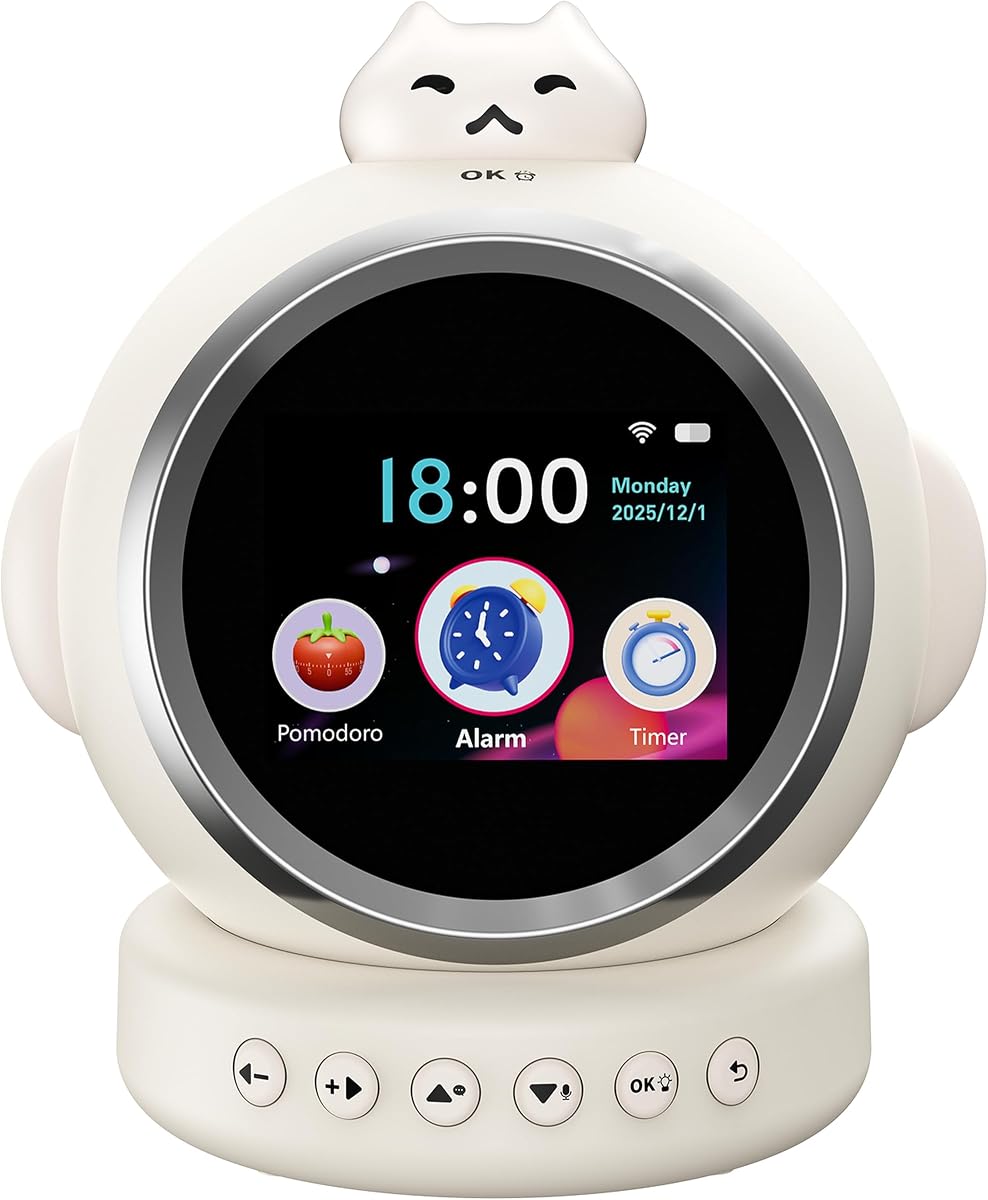
This ChatGPT Kids Alarm Clock is positioned as a premium all-in-one option for toddlers and children through elementary school. No numerical customer rating is available, so its evaluation rests on the listed functions rather than a rating comparison. Its primary appeal is the integration of a ChatGPT-powered assistant with a conventional sleep-training clock, allowing children to request educational content, ask questions, or hear bedtime stories using voice commands.
We may earn a commission when you buy through this link, at no additional cost to you.
The Ok-to-Wake system is a significant benefit for families trying to move away from a parent repeatedly entering the bedroom at dawn. Gentle alarms, customizable nap timers, and gradual night-light dimming make it possible to establish a consistent sequence from sleep to wake time. The entertainment functions are also broad, with a music player, lullabies, white noise, time-teaching games, more than ten soothing sounds, and seven color options for the night light.
Parent-oriented features include independent volume control, timeout settings, and straightforward physical controls. That matters because an AI device intended for toddlers should not become frustrating at bedtime or difficult to quiet when an adult needs the room to remain dark. One honest limitation is the absence of a published rating, which makes long-term customer feedback harder to assess. The product also places a meaningful share of the bedtime experience in the hands of voice software, so families should establish boundaries for what children can request and when the assistant is available.
This clock is best for households seeking a broad premium feature set, especially those interested in conversational stories and gradual light-based wake training. It is less suitable for a buyer who relies on verified customer ratings or wants a simple, offline-only clock for very young children. Used with clear household rules, it can support both preschool routines and the changing needs of primary-school children.
Children can use voice requests for stories, questions, and educational content, reducing the need to navigate a small touchscreen after lights-out. The interaction is most useful when parents establish a predictable sequence and keep the allowed content range consistent.
The Ok-to-Wake light, gentle alarms, dimming night light, and varied sound library give caregivers several ways to introduce a consistent sleep routine. These cues can make the transition from sleep to morning feel less abrupt for children who resist sudden alarms.
We may earn a commission when you buy through this link, at no additional cost to you.
The Kinglucky Smart Alarm Clock has a 4.4 rating and offers one of the most comprehensive feature sets in this guide. Described as an eight-in-one device, it combines a sleep-training alarm, Pomodoro focus timer, countdown timer, MP3 player, weather forecast, AI voice assistant, an 800-plus story library, and a white-noise sleep machine. That combination makes it more of a compact daily companion than a single-purpose bedside clock.
We may earn a commission when you buy through this link, at no additional cost to you.
Its Timi assistant responds to the phrase Hello Timi and supports hands-free requests for stories, weather, alarms, and questions. The children's content library is particularly compelling, offering more than 800 bedtime stories alongside twelve natural white-noise sounds and a dimmable night light. Families can also use dual timing modes for organized study sessions, with cycle statistics, or voice-controlled multi-alarm routines for waking, school, homework, and bedtime.
The blue-light-filtered touchscreen, large icons, and top shortcut buttons are designed to make the clock manageable for young children. The breadth of functionality is also a drawback: a child may need guidance when navigating less familiar modes until the layout becomes familiar. The listed warranty and support commitment adds reassurance, although the extensive feature set still requires an adult to set up alarms, content preferences, and network access properly.
This is the strongest all-around recommendation for a family seeking one device to cover sleep, stories, weather, focus training, and voice interaction. It works particularly well for children who enjoy narrated content and routines that change throughout the day. Buyers primarily interested in a simple, display-only alarm may find it unnecessarily elaborate, but for a versatile child smart clock, its rating, content range, and child-oriented controls are hard to ignore.
A library exceeding 800 stories gives children substantial variety without requiring a separate streaming device for every bedtime session. The programmable shutoff and gradually dimming light reinforce the wind-down routine as content changes.
The Pomodoro mode tracks study cycles and records efficiency, while the separate countdown supports ordinary household tasks. This makes the clock useful for both school-age homework and shorter blocks of reading, practice, or chores.
We may earn a commission when you buy through this link, at no additional cost to you.
The Bewinner AI Alarm Clock is a Wi-Fi touchscreen clock designed to combine story narration, sleep support, reminders, and interactive focus training. It does not have a numerical customer rating in the supplied information, but its multilingual support is a notable strength. The device lists English, French, Spanish, Portuguese, German, Russian, Chinese, Vietnamese, and Indonesian, which can be useful in multilingual households or families introducing more than one language.
We may earn a commission when you buy through this link, at no additional cost to you.
Its voice-activated story feature is designed to help children relax before sleep while satisfying curiosity. The clock also combines memo reminders with schedule management, so it can serve as a basic household organizer rather than only a wake-up tool. At bedtime, white noise, ocean waves, lullabies, and a gentle night light can establish a calm environment. During the day, the Pomodoro timer introduces sound effects and rewards to make focus practice feel more like a game.
The 1500mAh battery and Type-C charging are useful for moving the clock between a bedroom, study area, or travel setting. Connectivity is the primary caveat: AI features require 2.4GHz Wi-Fi. Families with newer router configurations may need to adjust their network before setup. The touchscreen also places more emphasis on visual interaction than the most voice-first options, although voice narration is included for bedtime use.
This model is a practical recommendation for multilingual families that want storytelling, organization, sleep sounds, and positive focus tools in a single unit. It is less compelling for shoppers who need established customer feedback or a very large preloaded story catalog. For households willing to handle a brief network setup, it offers a broad and balanced set of daily features.
Nine listed languages make this clock more adaptable than a single-language bedside device. Families can select the language that best fits the child and use narrated stories as part of a regular wind-down ritual.
The Pomodoro system adds interactive sounds and rewards after completed sessions. This can make a short focus block feel achievable for a child who is not yet comfortable with long, uninterrupted work periods.
We may earn a commission when you buy through this link, at no additional cost to you.
The Kids Alarm Clock with Stories has the highest available numerical rating among the products reviewed, at 4.6. It is marketed for ages 3 through 15 and offers a particularly balanced combination of voice nursery stories, alarms, a gamified focus timer, multilingual content, sleep sounds, and a night light. It does not use a named large-language-model assistant in the provided specifications, but it still delivers many of the convenience and entertainment features families seek from an AI-oriented kids clock.
We may earn a commission when you buy through this link, at no additional cost to you.
Children can request narrated nursery stories by voice, while the broader content system is described as multilingual. The Pomodoro tool turns concentration practice into an exploration-like activity with interactive reminders, sound effects, and rewards. For bedtime, users can choose among white noise, waves, lullabies, and a soft light. This combination allows the same device to support a preschool child's story routine and an older child's homework schedule.
Its 1500mAh rechargeable battery and Type-C charging support daily portability. The network limitation is important: the clock requires 2.4GHz Wi-Fi and explicitly does not support 5GHz networks. Some modern dual-band routers can serve both bands, but others may require the user to select a compatible network. That setup consideration is minor for a motivated adult but could disappoint a buyer expecting effortless automatic pairing.
This clock is a strong all-round choice for families seeking the best available customer feedback alongside a broad mix of sleep, story, and concentration features. It is particularly suitable for a household where a child needs help learning time management but still enjoys narrative audio. Buyers should verify 2.4GHz Wi-Fi availability and establish which content and interactive features they want to allow before regular use.
Voice-requested nursery stories can become a predictable transition into sleep or a reward after a completed task. The range of listed languages also allows households to preserve familiar story time as the child's language abilities grow.
Interactive reminders and rewards give younger children immediate feedback on completed Pomodoro sessions. The format is particularly helpful for short reading, practice, or chore blocks that need a clear beginning and end.
We may earn a commission when you buy through this link, at no additional cost to you.
This ChatGPT Kids Alarm Clock shares a broad feature set with the other ChatGPT-branded options, including voice-controlled conversation, an Ok-to-Wake light, customizable nap timers, and a gradual night-light dimming function. It is presented for children ages 3 to 12, although some of the listed sleep-training language more directly addresses toddlers and younger children. No numerical customer rating is available.
We may earn a commission when you buy through this link, at no additional cost to you.
The main distinction is a child-oriented blend of educational content and household routine tools. Interactive time-learning games can help children understand the clock, while the music player, lullabies, and white-noise function provide background audio for naps and nighttime. A voice-controlled assistant can tell stories, answer questions, and offer educational content, making it possible to begin an activity without navigating a detailed menu.
The parental timeout option is a useful control for caregivers who want to limit extended use, particularly late in the evening. Volume controls, soft edges, and child-friendly materials support everyday use in a bedroom or classroom. As with any conversational system for young children, the listed benefits do not replace adult oversight. Families should decide when AI access is permitted and use the timer features to keep bedtime from turning into open-ended screen or voice use.
This option is best for households that want the flexibility of custom nap schedules alongside a voice assistant and time-learning activities. It is less suitable for a buyer who needs verified customer feedback or who prefers a clock with no conversational AI component. For families prepared to establish clear usage rules, it delivers a useful combination of learning, sleep, and entertainment functions.
Customizable nap timers are useful for households where daytime sleep changes frequently. Pairing the timer with a gradual night-light dimming routine provides visual cues that can help connect daytime and nighttime schedules.
Time-learning games, stories, and educational responses can be accessed through voice, reducing menu navigation for younger users. Adults can still use volume and timeout settings to define the boundaries of the experience.
We may earn a commission when you buy through this link, at no additional cost to you.
The Smart Alarm Clock with AI Voice has a 3.6 rating and focuses on flexible time management alongside sleep support. Its assistant uses the wake word Helo Timi and can set alarms, check the weather, converse, and play stories. The child-friendly approach extends to multiple alarms, three themed sounds, independent controls for system and alarm volume, and an Ok-to-Wake night light.
We may earn a commission when you buy through this link, at no additional cost to you.
The timer suite is particularly flexible. Instead of limiting the device to a basic alarm, it includes Pomodoro, countdown, and count-up modes. The Pomodoro timer provides sound effects and interactive reminders for homework, reading, chores, play, and naps. Sleep mode offers twelve types of white noise or calming music, along with a timer that can be set from 15 to 120 minutes. This makes the clock easy to adapt to different parts of a child's day.
A TF card slot turns the unit into a portable music player for children's songs, story audio, or study material. The setup process requires plugging it in, holding the top knob to turn it on, and following the on-screen prompts. The AI voice and automatic date and time updates need 2.4GHz Wi-Fi. The 3.6 rating indicates some mixed customer experience, so potential buyers should consider the more concrete feature list and their own network compatibility.
This model is a good match for a child who benefits from clear time blocks and has different sleep, study, and play needs. It is less compelling for a parent who wants a large, explicitly described story catalog or a highly simplified toddler interface. With the three timing modes, separate volume controls, and offline TF-card playback, however, it offers strong practical flexibility for the listed rating.
Pomodoro, countdown, and count-up modes serve different needs: structured focus intervals, bounded tasks, and elapsed-time awareness. This variety lets one clock support schoolwork, naps, chores, and free play without relying on separate timers.
The top knob gives quick access to twelve sleep sounds or calming music. A selectable sleep timer from 15 to 120 minutes helps audio fade on schedule rather than continuing all night.
We may earn a commission when you buy through this link, at no additional cost to you.
The third ChatGPT Kids Alarm Clock listing in this guide offers voice-controlled interaction, a gradual Ok-to-Wake light, customizable nap timers, and a broad entertainment library. It has no numerical customer rating, and its core feature description closely matches the other ChatGPT-branded products. Buyers should therefore compare the final listing details carefully rather than assuming every listing is completely identical.
We may earn a commission when you buy through this link, at no additional cost to you.
The clock's strongest combination is conversational assistance with a structured bedtime system. Children can ask questions, request stories, or obtain educational content by voice, while the light system and customizable timers help structure nighttime and daytime rest. The music player, lullabies, white noise, time-learning games, ten-plus sounds, and seven night-light colors create many ways to build a routine without switching to a separate sleep machine.
Volume controls and parental timeout settings let adults manage how and when the device is used. Soft edges and child-friendly materials are appropriate for a bedside environment, and the listed age range extends from toddler years into elementary school. The main drawback is limited evidence in the form of customer feedback. It is also difficult to distinguish this listing from the similarly described models solely through the supplied information, so availability, included accessories, warranty, and current product details should be confirmed.
This version is a reasonable option for households that prioritize child-friendly operation and a full set of bedtime and learning features. It is best suited to a family that values the broad routine toolkit and voice assistant more than the depth of published reviews. If another equivalent listing is better supported or available, that difference may justify choosing it instead.
Soft edges, simple controls, and voice-led operation make the device less intimidating for children who cannot yet read menus reliably. The time-teaching games also support independent exploration under parental supervision.
Instead of requiring separate devices for white noise, lullabies, a night light, and a nap timer, this clock combines them. The seven color choices provide variety while gradual dimming supports a calmer transition to sleep.
We may earn a commission when you buy through this link, at no additional cost to you.
The PRUNUS AI Companion Alarm Clock has a 4.0 rating and stands out for its ability to serve an unusually broad age range, listed from three to 18. Rather than focusing only on toddler sleep training, it combines an AI companion, weather forecasts, an MP3 player, hands-free schedule management, and a visual Pomodoro timer. This makes it particularly relevant to school-age children, teenagers, and families trying to support homework without constant verbal prompting.
We may earn a commission when you buy through this link, at no additional cost to you.
The AI can tell stories, answer questions, set reminders, and manage schedules through voice commands. Its Pomodoro function is built around the 25/5 method, with visual progress bars and rewards to encourage productive work. The TF card supports favorite music, while daily and weekly forecasts appear on the display. These features make the device feel more like a small productivity companion than a conventional bedside clock.
Its sleep-training proposition is less developed than that of models with explicit Ok-to-Wake lights, extensive white-noise libraries, and dimmable night lights. Families whose main goal is a gradual toddler wake-up routine may therefore find a different model more suitable. The AI also requires an online connection, and the stated age range includes children and teens with very different privacy and supervision needs. Adults should define which functions remain available and avoid treating the companion as an unsupervised adviser.
This is a compelling choice for older children who can manage a visual timer and use voice commands responsibly. It also works for younger children when the goal is storytelling and routine building rather than toddler sleep training. Its 4.0 rating, broad feature set, and focus on reducing procrastination make it a practical value-oriented pick for a shared family device.
The 25/5 method turns a large assignment into manageable intervals, while visual bars and rewards provide immediate progress feedback. Parents can establish the routine without continually asking whether the work is complete.
Stories and weather questions appeal to younger children, while reminders, school planning, and visual timers become more useful as they grow. The device can therefore remain relevant beyond the toddler years when its controls and rules are adjusted appropriately.
We may earn a commission when you buy through this link, at no additional cost to you.
The Jiawu AI Alarm Clock places interactive storytelling at the center of its child-friendly design. No numerical customer rating is available, but the supplied features suggest a practical device for families that want voice-requested stories, sleep preparation, and daily organization in one unit. The storytelling feature is intended to comfort children, stimulate imagination, and make the transition to sleep easier.
We may earn a commission when you buy through this link, at no additional cost to you.
The clock includes memo reminders and schedule management, which extend its role beyond bedtime. Its Pomodoro timer turns focus training into a series of enjoyable challenges with interactive sounds and a reward system. After a child finishes homework, reading practice, or another structured activity, the clock can provide positive feedback without requiring an adult to deliver every encouragement.
At night, users can select white noise, ocean waves, lullabies, or other sleep sounds and pair them with a soft night light. The 1500mAh rechargeable battery and Type-C charging support portability, while 2.4GHz Wi-Fi is required for stable connected features. As with other conversational products, adult supervision remains important, particularly when children are using the assistant independently near bedtime.
This clock is best for households seeking a soothing story-led bedtime experience and a friendly focus tool. It is less suitable for a buyer who needs verified customer feedback or extensive information about a preloaded story catalog. Its mix of scheduling, stories, rewards, and calming audio nevertheless makes it a well-rounded option for a child's bedroom and study routine.
A familiar narrated story can become a consistent signal that the day is ending. Voice activation gives the child some control over the story while the sleep-sound and night-light options create a calm surrounding environment.
Memo reminders, schedules, and reward-based focus sessions allow the device to support the whole day. A parent can introduce a task in the morning, let the timer mark the work period, and then shift the clock to a quiet bedtime role.
We may earn a commission when you buy through this link, at no additional cost to you.
The right clock depends on the child's age, daily schedule, family's language needs, network setup, and tolerance for conversational technology. Comparing these factors before buying is more useful than focusing only on the number of advertised features.
A conventional alarm is familiar and effective for many school-age children, but a gradual routine can be especially useful for younger sleepers. Models with an Ok-to-Wake light, gentle sounds, dimming night lights, and adjustable alarms offer more ways to communicate that it is time to rise. Consider whether the child wakes easily, whether a sudden sound tends to cause frustration, and whether a visual cue alone will be noticed.
Choose a gradual wake system for toddlers or light sleepers, and test a traditional alarm for older children who respond well to a clear sound. Multiple options are useful because the best method may change as the child's sleep habits change.
The most useful AI functions are the ones a family will actually use. Some clocks tell stories and answer questions, while others also set alarms, report weather, create reminders, or manage multiple schedules. A large-language-model assistant may provide broader conversation, but it should still be treated as a supervised entertainment and learning tool rather than an authority.
Prioritize understandable voice activation, useful child-safe responses, and controls that let adults limit use. A simple wake word, story requests, and hands-free alarm setting are more valuable than a long list of capabilities that are difficult to access consistently.
A good sleep routine benefits from a consistent combination of audio, light, and stories. Look for white noise, nature sounds, lullabies, a dimmable night light, and a story library that will remain interesting over time. The Kinglucky model stands out for its stated library of more than 800 stories, while other products emphasize voice-requested stories without providing a comparable catalog size.
Check both the number and variety of available sounds and stories. For children who become attached to one routine, a modest library can still work well, but a broader collection reduces repetition and makes the device more useful over several years.
Older children benefit from a timer that turns a vague instruction such as finish homework into a defined period. Pomodoro modes can divide work into focused blocks and breaks, while countdown timers are simpler for chores, reading, or a specific task. Visual progress bars and reward sounds are especially helpful for younger children, and cycle statistics can be useful for older students.
Match the timer to the child's attention span and task. A young child may benefit from short, rewarding intervals, while a teenager may prefer a conventional 25/5 schedule with progress information and minimal visual stimulation.
Most listed AI functions require a 2.4GHz Wi-Fi connection, and several products explicitly do not support 5GHz networks. This is a crucial compatibility check because a clock can look ideal but deliver limited functionality if it cannot join the home network. Some listings also mention automatic date and time updates, while voice conversations, weather, and other online tools need live access.
Check the router before ordering and be prepared to create or select a 2.4GHz network. Offline functionality varies: some products accept TF cards for music and stories, while the most interactive assistant features remain online.
Multilingual support can make a clock more useful in bilingual or multilingual homes. The listed options range from five or eight languages on some models to nine on the Bewinner clock, with English, French, Spanish, German, Russian, and Chinese appearing across multiple products. The VoxNimbus model also advertises a ten-language translator, which may be useful for children learning basic concepts in another language.
Choose based on the languages actually used at home rather than the total count. A larger selection is helpful only if the desired language is supported for stories, instructions, and voice interaction at the same quality.
A device intended for independent use should be easy for a child to operate but still configurable by an adult. Large icons, top shortcut buttons, voice commands, and simple prompts reduce frustration. Parent settings such as volume limits, timeout periods, and dedicated system and alarm controls help maintain predictable use.
Give a younger child access to a limited set of routines first, such as one alarm, one story mode, and one timer. Older children can gradually learn to set their own alarms and schedules once they understand the wake word and touch controls.
Rechargeable batteries and Type-C charging make it easier to move a clock between a bedroom, study desk, or travel bag. Listed battery capacities include 1200mAh for the VoxNimbus model and 1500mAh for the Bewinner, generic story-focused clock, and Jiawu clock. The Kinglucky model also includes an AAA backup battery according to its description.
Treat stated battery capacity as a comparative feature rather than a guarantee of runtime, since playback, brightness, Wi-Fi use, and volume can affect consumption. Keep the charging cable accessible and verify whether the clock can operate safely while charging.
Begin by deciding which functions the child will use and which remain under adult control. Charge the clock fully, connect it to the required 2.4GHz Wi-Fi network, and complete the on-screen setup before moving it into the bedroom. Check the date, time, time format, alarm volume, and the brightness or color of the night light. A parent should also test the voice wake phrase and decide when AI conversation is permitted.
Create a simple routine around the clock. Use gradual light or sound for waking, a short story or quiet audio for bedtime, and a visible focus timer for homework. Assign different alarms for school, naps, and weekends rather than relying on a single generic alarm. Keep an eye on screen and voice time, particularly for toddlers, and encourage children to ask for stories or information rather than treating the assistant as an unrestricted conversational companion.
For care, keep the clock on a stable surface away from water, excessive heat, and heavy objects. Clean the outer surface with a lightly damp cloth and avoid spraying liquid directly into openings. Update the system when instructed, keep the TF-card content appropriate, and periodically review voice history, reminders, and permissions if the available settings allow it. Charging the unit regularly and replacing backup batteries on schedule helps prevent a failed alarm from disrupting the household routine.
Most of the listed models need 2.4GHz Wi-Fi for AI conversation, weather information, automatic time updates, or online content. Basic alarm and timer functions may still work without a connection, depending on the model. Several clocks also accept TF cards for locally stored music or stories, providing a useful alternative for selected offline use.
Several models explicitly include toddler-focused tools such as Ok-to-Wake lights, gradual dimming, nap timers, lullabies, and simple voice controls. The best fit still depends on the child's developmental stage and whether they can safely operate a connected device without constant supervision. Adults should set usage limits and keep conversational access appropriate for the child's age.
A standard alarm clock primarily produces a sound or visual signal at a selected time. A sleep trainer adds cues designed to teach a consistent sleep and wake routine, such as gradual illumination, dimming night lights, soothing sounds, story cues, and nap timers. A model can perform both functions, but the presence of an AI assistant does not automatically make it a good sleep trainer.
Yes, several models provide time-teaching games, visual countdowns, or simple time displays alongside alarms. The games can make the concept more engaging, but a child should also learn the basic clock face or digital display. The timer functions help children connect elapsed time with everyday tasks such as reading, practicing, or completing chores.
Several listings explicitly require 2.4GHz and state that 5GHz is not supported. Dual-band routers may provide both networks, but the 2.4GHz option may need to be selected or enabled. Check the router and product requirements before purchase, especially if the parent expects voice or weather features to work immediately after setup.
The listed capabilities include stories, weather reports, question answering, educational prompts, music, reminders, and time-management assistance. Parents should review available controls, establish rules for bedtime and school use, and supervise younger children. No connected assistant should replace guidance from a parent, teacher, doctor, or other qualified professional.
The Kinglucky Smart Alarm Clock lists a library of more than 800 bedtime stories, making it the clearest choice in this group for content volume. Other products emphasize voice-requested stories, interactive narration, or multilingual support but do not provide an equally large stated catalog. Buyers should consider both library size and whether the included material is age-appropriate.
Battery capacity can improve convenience when the clock is used throughout the day for music, stories, timers, and voice interaction. Listed models include 1200mAh and 1500mAh rechargeable batteries, but actual runtime depends on volume, display brightness, network activity, and selected features. A backup-battery option may be worthwhile for a clock relied upon to wake a child every morning.
The Kinglucky Smart Alarm Clock is the strongest all-around selection, combining a 4.4 rating with an eight-in-one feature set, a large bedtime library, dual timers, and a hands-free assistant. The ChatGPT Kids Alarm Clock is the leading premium option for families that prioritize conversational stories, gradual Ok-to-Wake lighting, and customizable sleep routines, while the PRUNUS AI Companion is the best budget-oriented choice for older children who need a visual Pomodoro timer and schedule support.
Before buying, prioritize the features your child will genuinely use. A toddler may need gentle light, dimming, lullabies, and a parent-controlled routine; an elementary child may benefit more from stories, multilingual content, and short focus timers; a teenager may value visual progress, reminders, and less overtly childish design. Also confirm that the clock works with your 2.4GHz network and that the control layout is appropriate for the intended user.
Prices, availability, ratings, and included features can change over time, so check the current listing before making a final decision. The affiliate links in this guide are provided to make it easier to review the products, but the best choice is the clock that matches the child's age, routine, language, and family's privacy expectations.

