
VIOFO A229 Pro
4.2Editor score
Dual STARVIS 2 sensors
4K front, 2K rear
GPS route and speed data
Three parking modes
Discover the best dash cams for semi trucks, comparing multi-camera coverage, night vision, GPS, parking mode, storage, and installation ease.
A semi-truck dash cam must do more than record the road ahead. It needs to handle long cables, demanding electrical systems, large blind spots, variable lighting, and extended periods behind the wheel while preserving useful evidence. The best options combine front, side, rear, or interior coverage with dependable parking protection and secure file management.
We compared all ten products by examining their camera channels, recording resolutions, low-light capabilities, GPS functions, display options, storage support, parking features, and installation requirements. The list includes dedicated commercial-truck systems, dual-camera highway setups, and integrated truck navigators, so drivers can compare both complete recording packages and more conventional solutions.
Each recommendation highlights the product's strongest use case while noting practical limitations, such as required accessories, upscaled rather than native recording, or the absence of a memory card. Product availability and pricing can change, so check the current listing and verify that the camera, storage card, power adapter, and mounting hardware meet your particular truck and routing needs.
4.2Editor score

4.5Editor score

4.3Editor score
This side-by-side comparison evaluates recording channels, image resolution, navigation features, and practical suitability for long-haul and commercial trucking use.



The ROVE R2-4K Dual is our Editor's Choice because it balances recording quality, navigation data, phone connectivity, and parked-vehicle monitoring without requiring a multi-screen commercial camera kit. Its 4.5 rating reflects a generally strong feature set, particularly the inclusion of a 128GB memory card and the Sony STARVIS 2 IMX675 sensor in the front camera.
We may earn a commission when you buy through this link, at no additional cost to you.
The front camera records at 2.5K and upscales to 4K for playback, while the rear records at 1080P. That distinction matters when reading the specifications carefully, but the upscaled output is designed to retain more usable detail than a standard 1080P image. Dual-band 5.8GHz and 2.4GHz WiFi supports transfers stated at up to 20MB per second, and the built-in GPS records routes, speed, and compass information.
Its most attractive feature for a truck owner may be the flexible 24-hour parking menu. The system can use time-lapse footage, motion detection, or collision detection, while a hardwire installation enables operation after the truck is parked. A supercapacitor and built-in thermal protection improve resilience, although a suitable hardwire kit must be obtained separately for parked operation.
This is a strong recommendation for drivers who want straightforward front-and-rear coverage without a complicated multi-camera DVR. It is especially attractive because the memory card is included and the installation kit contains both cameras, mounts, cables, and a dual USB charger. Choose it if a two-camera layout meets your blind-spot needs; consider a three-channel system if blind spots beside the trailer are your primary concern.
The STARVIS 2 front sensor, wide aperture, and HDR processing provide useful detail in dusk, darkness, and tunnels. While no dash cam guarantees a readable plate in every condition, this sensor package is designed to preserve more foreground and background information than a typical fixed dash cam.
Built-in GPS adds speed, location, and compass data to recordings, which can make a fleet review more informative. The included storage card and fast wireless downloads also reduce the setup work required to begin reviewing footage.
We may earn a commission when you buy through this link, at no additional cost to you.
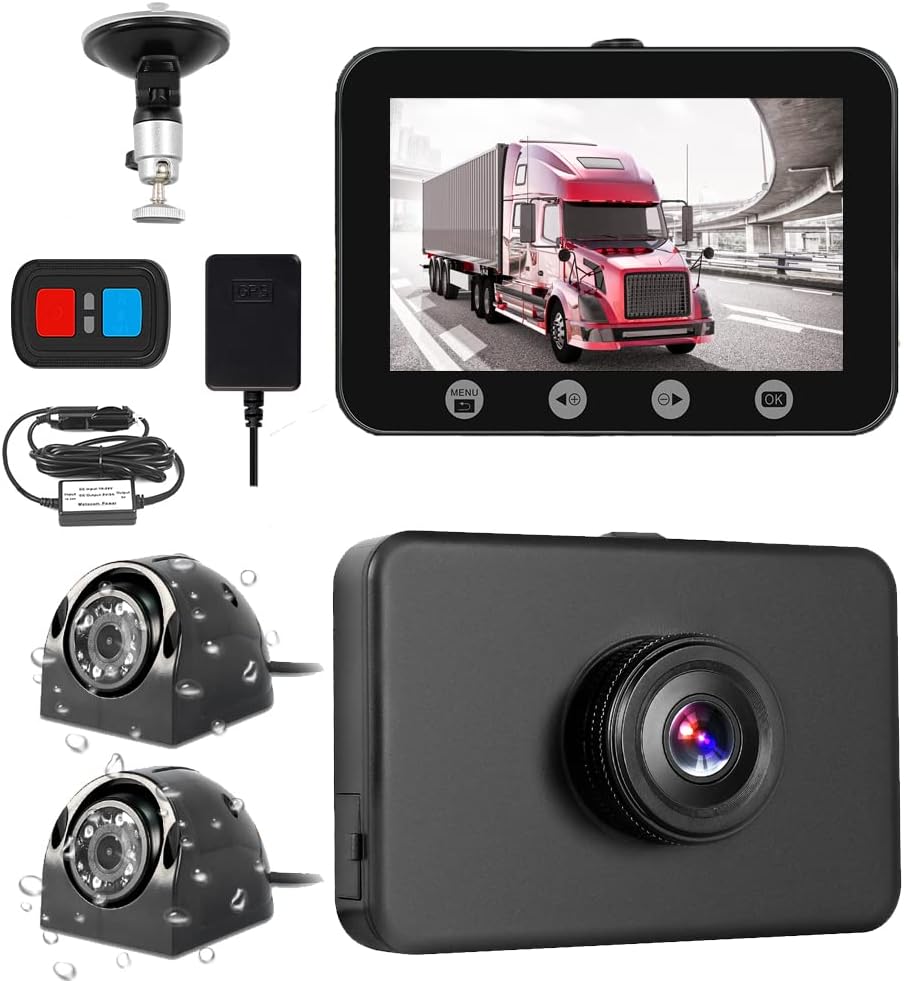
The VSYSTO 3CH Truck is built specifically for broad commercial-vehicle coverage, recording the front and two additional angles at the same time. Its 4.0 rating reflects a capable package aimed at semis, trailers, vans, tractors, recreational vehicles, and other large vehicles, with a 4.5-inch display that makes choosing among views straightforward.
We may earn a commission when you buy through this link, at no additional cost to you.
The front camera records at 1080P, while the two side or rear cameras operate at 720P with infrared illumination for low-light visibility. The system can switch automatically to the relevant camera when a turn signal is detected, allowing the driver to monitor a changing blind spot without manually changing screens. Its dedicated app supports live viewing, downloads, editing, and sharing over WiFi.
GPS records speed, coordinates, altitude, and atmospheric pressure, while the G-sensor locks collision footage. Loop recording is configurable from one to five minutes, and the system can continue recording after power is removed for a selected period. Low-voltage protection can disable that function if the vehicle battery falls below the configured threshold.
This system makes sense for long-haul operators who want side and rear visibility in a single package. The trade-offs are a lower side-camera resolution than some competing systems, no specified card capacity in the supplied information, and an emergency-video limit after which the oldest locked clip is deleted. Verify truck power polarity, camera placement, and memory-card compatibility before installation.
Three simultaneous channels provide more situational awareness than a conventional front-and-rear setup. Automatic turn-signal switching is particularly useful on a long rig because the relevant exterior view appears before the driver commits to a wider turn.
The GPS and downloadable route information can help drivers or fleet managers correlate video with position, speed, and trip data. Review the app and desktop playback software on your own device before relying on it for formal fleet records.
We may earn a commission when you buy through this link, at no additional cost to you.
The REDTIGER F7NP combines a 4K front camera, 1080P rear camera, STARVIS 2 sensor, and a free memory card in a conventional two-channel package. Its 4.1 rating indicates a solid feature set, particularly for drivers who prioritize high-resolution road detail and a broad front field of view.
We may earn a commission when you buy through this link, at no additional cost to you.
The front camera combines 4K recording with a 170-degree lens, while the rear uses a 140-degree lens at 1080P. WDR and HDR help balance bright sky and darker road areas, and the F1.5 aperture supports low-light recording. Built-in 5.8GHz WiFi is advertised at transfer speeds up to 20MB per second through the Redtiger Cam app.
Parking surveillance can operate in time-lapse or collision-detection mode when a hardwire kit is installed. The G-sensor protects event footage during ordinary loop recording, and the supercapacitor is designed to tolerate heat better than a conventional lithium battery. An 18-month guarantee and customer support add reassurance for an installation exposed to vibration and temperature changes.
The F7NP is a good fit for owner-operators and fleets wanting straightforward front-and-rear evidence with high-resolution front footage. It does not provide side or cabin cameras, so it cannot fill every tractor-trailer blind spot. Compare its two-camera simplicity with a three-channel commercial system if side visibility is essential.
The native 4K front channel gives reviewers more pixels to work with when identifying vehicles, road signs, and lane position. The wide 170-degree view captures a broad section of the roadway, though edge distortion can make the image look stretched.
A supplied memory card and fast 5.8GHz WiFi make the system easier to start using than models that require immediate card purchases. Downloading a full event to a phone is generally more convenient than repeatedly removing and reconnecting the card.
We may earn a commission when you buy through this link, at no additional cost to you.
The REDTIGER F17 offers the flexibility of a three-channel system with a 4K front camera, 1080P cabin and rear cameras, GPS, and dual-band WiFi. Its 4.4 rating is among the stronger results in this list, and its two recording modes let drivers choose between higher front resolution and simultaneous multi-camera coverage.
We may earn a commission when you buy through this link, at no additional cost to you.
The STARVIS 2 IMX675 front sensor works with HDR and WDR to improve low-light and dynamic-range performance. Wide viewing angles of 150 degrees at the front, 160 degrees inside the cabin, and 155 degrees at the rear broaden situational awareness. The included 64GB card, 5GHz and 2.4GHz WiFi, and app-based route review improve day-to-day usability.
Drivers can record 4K front plus 1080P rear with the interior camera disabled, or use 2.5K for dual-channel operation. Parking time-lapse and collision detection modes are available with an extra hardwire kit. A supercapacitor supports reliability in changing temperatures, while the 18-month guarantee provides a defined support period.
The F17 is attractive for long-haul drivers who want both cabin and exterior coverage but do not need dedicated side cameras. Its main drawback is that a complete parking installation requires additional hardware. It also performs best when the 64GB card is regularly maintained and its recommended power accessories are used.
The dual-recording modes let drivers decide whether maximum front detail or three-angle coverage matters more on a given trip. This adaptability makes the F17 useful for solo drivers who sometimes need cabin evidence and sometimes need the highest available road resolution.
HDR, WDR, and the STARVIS 2 sensor work together to balance dark and bright areas. The wide cabin lens also helps document the interior, which can be relevant during safety reviews or route-specific fleet monitoring.
We may earn a commission when you buy through this link, at no additional cost to you.
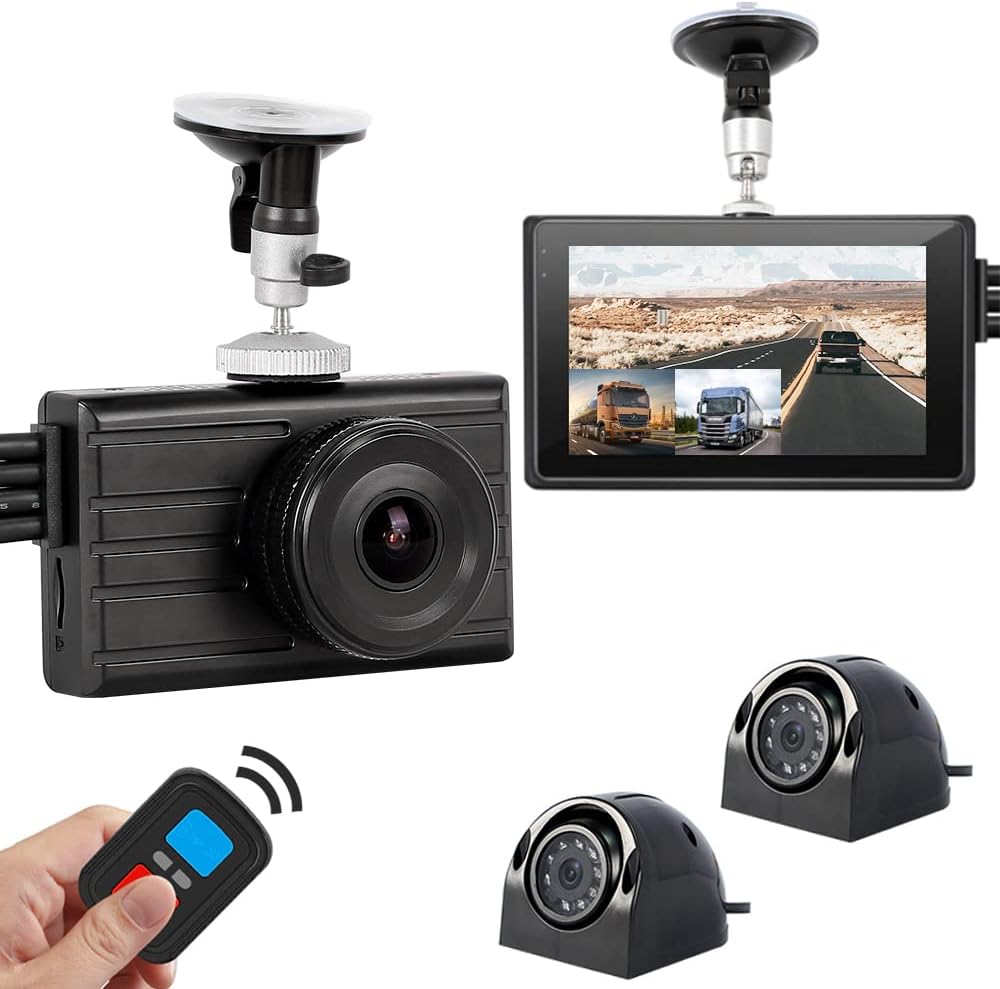
The VSYSTO T4.5M is a purpose-built commercial system with a 1080P front camera, two 720P side cameras, waterproof exterior hardware, and support for 12–30V electrical systems. Its 3.4 rating is lower than those of the premium two-channel units, but the feature set directly addresses common tractor-trailer installation requirements.
We may earn a commission when you buy through this link, at no additional cost to you.
The three cameras can cover front, left, and rear positions, with adjustable lens mounts and cables measuring 6.6, 19.7, and 19.7 feet. A 4.5-inch HD monitor supports full-screen and split-screen viewing. Connecting the trigger wire to a turn signal automatically displays the associated camera, while a 2.4GHz remote provides manual control.
WiFi app access allows live viewing, video management, and route playback through the supplied GPS tracker. The monitor displays speed, battery voltage, coordinates, and atmospheric pressure. Loop recording protects recent footage, and the G-sensor locks collision events so they are less likely to be overwritten during normal recording.
This system is worth considering for older commercial vehicles or rigs operating across a broad voltage range. It supports memory cards up to 256GB and includes features that are more common on dedicated truck recorders. The side cameras' 720P resolution and lower customer rating are the main reasons to compare it carefully with newer three-channel systems.
Long camera cables and adjustable mounts make it easier to position exterior cameras around a trailer or commercial body. The 12–30V compatibility is particularly relevant when the available power source differs from a passenger vehicle's 12V accessory socket.
The built-in GPS displays speed, coordinates, pressure, and voltage, while route playback is available through the app. These details can help a driver notice unsafe speed habits or provide context when footage is reviewed after an incident.
We may earn a commission when you buy through this link, at no additional cost to you.
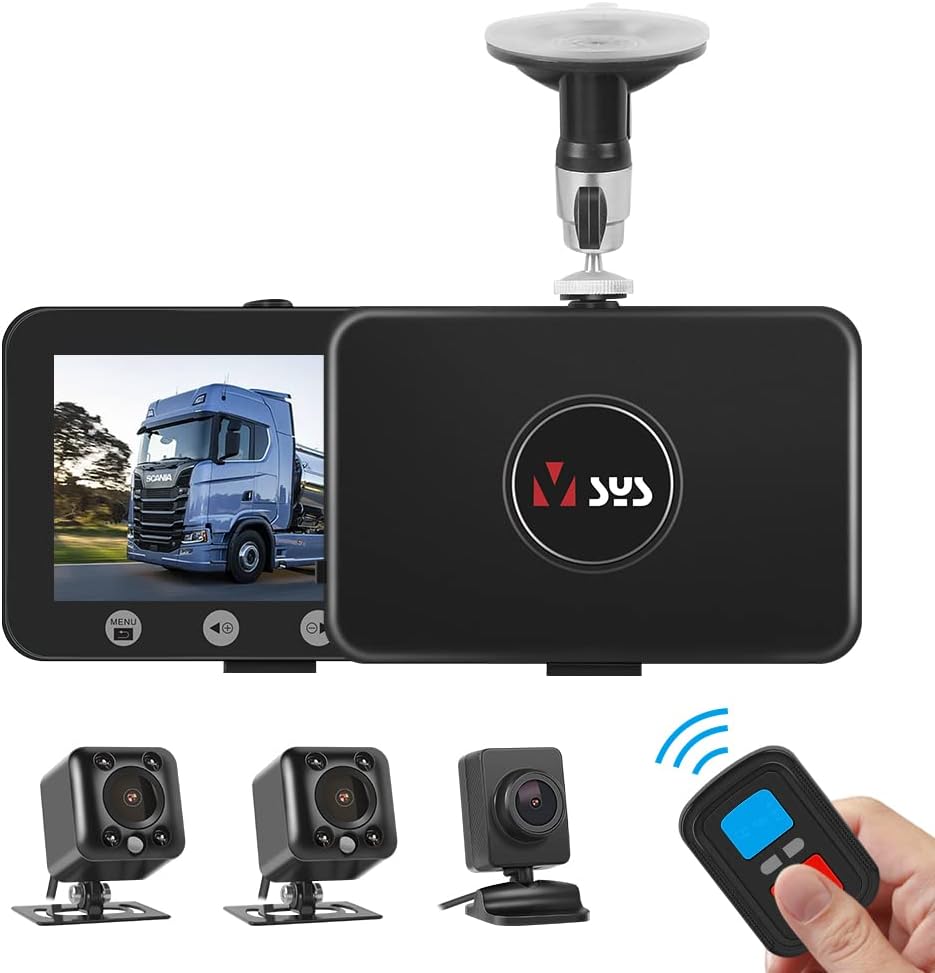
The VSYSTO T3 delivers three-camera recording in a package designed for trucks, vans, trailers, buses, and recreational vehicles. Its 3.7 rating reflects a practical commercial system with a 3-inch monitor, 1080P front camera, 720P side or rear cameras, IP67 waterproof lenses, and infrared illumination.
We may earn a commission when you buy through this link, at no additional cost to you.
The display can show one camera full-screen or divide the screen among up to three views. Connecting the yellow trigger wire to a turn or reverse signal automatically changes the visible camera, while the included 2.4GHz wireless remote provides manual switching. These controls are useful in a cab where reaching toward a conventional camera menu would be inconvenient.
Loop recording can use 1-, 3-, or 5-minute files, and the G-sensor protects emergency footage from routine overwriting. A microSD card up to 256GB is supported. Built-in WiFi and the companion app permit phone-based viewing and file handling, while the cigarette-lighter power adapter converts a 9–24V DC vehicle source into the required 5V/2A output.
The T3 is a practical selection for drivers who prioritize exterior camera count, weather resistance, and simple in-cab switching over a large display or high-resolution side footage. Its 3-inch screen is more compact than the displays on the other VSYSTO systems, and the power arrangement may not be ideal for every heavy-duty electrical configuration.
IP67 waterproof camera lenses and integrated infrared LEDs support operation in rain, darkness, and other demanding roadside environments. Mounting quality remains as important as the camera rating, so protect connectors and secure each cable away from moving bodywork.
Turn and reverse signal triggering reduces the need to manually operate the camera system during critical maneuvers. The wireless remote remains useful for checking another angle or returning the display to a chosen split-screen layout.
We may earn a commission when you buy through this link, at no additional cost to you.
The ROVE R2-4K is our Best Budget selection because it combines 4K recording, WiFi 6, GPS, parking features, and a supercapacitor in a comparatively straightforward single-camera package. Its 4.3 rating is strong, although users must purchase a suitable microSD card separately.
We may earn a commission when you buy through this link, at no additional cost to you.
The camera uses an 8MP Sony IMX415 sensor, a six-piece glass lens, and an F1.5 aperture to support 2160p Ultra HD recording and low-light visibility. Its 150-degree lens captures a broad road view, while HDR-like processing, G-sensor locking, loop recording, motion detection, and time-lapse functions cover the basic dash-cam needs of a professional driver.
WiFi 6 allows the ROVE app to preview recordings and download 4K files at up to 6MB per second. Built-in GPS records routes and speed that can be viewed through the app or desktop player. The supercapacitor is preferable to a traditional internal battery for heat resistance and long-term parking use, although a hardwire arrangement may still be required.
This camera is best for a driver who wants reliable forward evidence, route context, and phone connectivity without paying for three or more channels. It lacks rear and side cameras, so a long-haul operator with significant blind-spot concerns should consider a dual or triple-camera system instead.
A 4K front image and wide 150-degree field of view provide more detail than a basic 1080P dash cam. The SONY IMX415 sensor and F1.5 aperture also make the package better suited to night and twilight driving than an unspecified low-resolution model.
WiFi 6 and built-in GPS make it convenient to review a route and download important clips without repeatedly handling the memory card. Because no card is included, budget for a durable card with adequate capacity for continuous 4K recording.
We may earn a commission when you buy through this link, at no additional cost to you.
The renewed Garmin dēzlCam OTR725 combines a seven-inch truck navigator with a built-in 1080P dash camera. Its 3.4 rating makes it one of the lower-scoring products here, but the renewed format may appeal to drivers who prioritize mature truck routing and navigation features over multi-camera resolution.
We may earn a commission when you buy through this link, at no additional cost to you.
The integrated camera records at 1080p through a 140-degree lens and automatically saves incident video to a pre-installed memory card. The large touchscreen is designed for in-cab readability, while custom truck routing accounts for vehicle size and weight. Alerts can identify bridge heights, sharp curves, and other route concerns, subject to local feature availability.
Drivers can also use BirdsEye Direct satellite imagery to preview loading docks, truck entrances, and security gates. The compatible dēzl app can display community-rated truck parking, loading dock, and gate information, as well as nearby CAT Scale locations. A wind speed overlay can highlight potentially hazardous conditions along the route.
This renewed unit is best for a driver who wants navigation and dash recording in one device and does not require side, rear, or cabin cameras. The 1080P single camera is modest compared with newer multi-channel systems, while the renewed condition and 3.4 rating warrant careful expectation-setting and inspection.
Truck-aware routing, height and curve alerts, and truck parking information make the navigator more useful than a generic consumer GPS. Always follow posted signs and current road conditions even when a suggested route appears available.
The built-in camera removes the need to install a separate forward-facing recorder and helps minimize windshield clutter. Automatic incident saving preserves key clips, but rear and side evidence requires a separate camera system.
We may earn a commission when you buy through this link, at no additional cost to you.
The Garmin dēzlCam OTR725 integrates a seven-inch truck navigator with a built-in 1080P HD dash camera. It earns a 4.2 rating and is most appropriate for drivers who see route planning, load-dock navigation, and forward incident evidence as a combined in-cab workflow.
We may earn a commission when you buy through this link, at no additional cost to you.
The built-in camera uses a wide 140-degree field of view and automatically stores footage from detected incidents on the pre-installed memory card. Custom truck routing uses size and weight information, while alerts cover bridge heights and sharp curves. Birdseye satellite imagery helps drivers identify loading docks, security gates, and truck entrances before arrival.
The dēzl app can add community-rated parking, loading dock, and gate information, along with nearby CAT Scale locations. Wind speed data appears as a route overlay. This version also supports PrePass notifications for weigh-station and bypass information when an active PrePass account and compatible phone setup are available.
Choose the OTR725 when a large truck-specific navigator and basic forward recording are your main requirements. It is not a substitute for a multi-camera evidence system when you need to monitor the trailer's sides, rear, or cabin. Its 1080P single camera also provides less detail than premium 4K front-and-rear setups.
Custom routes, vehicle alerts, CAT Scale lookup, and truck-friendly parking information support a more informed trip. These tools are particularly helpful for unfamiliar routes and complex pickup or delivery schedules.
Automatic incident saving and a wide field of view provide useful evidence with minimal installation complexity. For complete fleet visibility, pair it with a dedicated multi-camera dash cam rather than expecting rear coverage from this navigator.
We may earn a commission when you buy through this link, at no additional cost to you.
The VIOFO A229 Pro is our Best Premium recommendation for its combination of dual STARVIS 2 sensors, 4K front video, 2K rear video, advanced HDR, and flexible parking protection. Its 4.2 rating reflects a highly capable two-channel system with features aimed at serious drivers and evidence-focused use.
We may earn a commission when you buy through this link, at no additional cost to you.
The front camera uses an IMX678 sensor for 2160p recording, while the IMX675 rear camera captures 1440p. HDR on both channels is designed to balance highlights and shadows and improve plate readability during high-speed or nighttime driving. The included circular polarizing filter reduces reflections from glass and road surfaces, while the standard rear cable measures six meters.
Three parking modes are available: automatic event detection, low-bitrate recording, and time-lapse. In event mode, the system buffers 15 seconds before motion and records 30 seconds afterward, which is valuable context when a vehicle approaches while the truck is unattended. A hardwire kit is not included, and neither is a memory card.
This is the most refined high-resolution option in the list for drivers who do not need a three-camera commercial monitor. Voice commands reduce distraction by allowing the driver to lock clips, change camera views, toggle WiFi, or take photos. The supercapacitor, GPS module, and broad operating-temperature claim further support long-term use.
The two STARVIS 2 sensors apply high sensitivity and HDR to both viewing directions. This helps retain detail when headlights, streetlights, and dark surroundings create difficult exposure conditions.
The event buffer records footage before and after detected motion rather than saving only the moment of impact. This extra context can clarify how an event unfolded, although a hardwire kit and suitable high-endurance card are required for the full parked-protection experience.
We may earn a commission when you buy through this link, at no additional cost to you.
The right truck dash cam depends on the coverage you need, the electrical system in your vehicle, the routes you drive, and how you plan to review or retain footage. Evaluate these factors together rather than focusing only on a headline resolution.
Choose two channels for efficient highway evidence and three for broader exterior monitoring.
Prioritize a capable low-light sensor and balanced HDR over resolution alone.
Verify voltage, cable reach, signal wires, and mounting strength before purchase.
Budget for a hardwire kit and choose heat-resistant power management.
Check card inclusion, maximum capacity, endurance rating, and loop behavior.
Confirm app support, route metadata, exports, and fleet-review requirements.
Look for HDR, sensitive sensors, IR illumination, and weather resistance.
Prioritize signal-triggered views and simple controls for active driving.
Plan the installation before mounting any camera. Identify the windshield or rear-cab position for a two-channel system, the best exterior locations for side cameras, and a secure route for every cable. Keep connectors away from sharp metal edges, hinges, suspension, exhaust heat, and moving components. Test the display and trigger functions before closing trim panels or hiding the DVR.
Install a suitable high-endurance microSD card, format it in the camera, and confirm that all channels record correctly. Connect the power according to the manual, using the included or explicitly recommended adapter and hardwire kit. After a test drive, check image alignment, reflections, cable tension, storage capacity, GPS reception, and turn-signal switching. Clear the windshield regularly so the camera is not recording through dirt, salt, or glare.
Review important clips through the official app or desktop software, then transfer them to a separate drive or approved fleet repository. Maintain a routine for checking recording status, card condition, mounting security, and firmware updates. Do not expose a camera to extreme heat beyond its rated conditions, and disconnect it if it becomes unusually hot or behaves incorrectly.
Two channels are usually sufficient for front-and-rear evidence, while three channels add a side, rear, or cabin perspective. A commercial system with three exterior cameras may be more useful for blind-spot monitoring than a higher-resolution two-camera setup. Choose based on the truck's geometry, fleet policy, and the incidents you need to document.
It can help establish what occurred, subject to local laws and the policies of your insurer, employer, or fleet operator. Preserve the original file, note the date and location, and avoid editing the source clip. Dash cam recordings are one source of evidence, not a replacement for official police or insurance processes.
Higher resolution can improve vehicle and sign detail, but sensor quality, lens performance, lighting, and stable mounting are equally important. A well-equipped 1080P system with good exposure may be more useful than a poorly aligned 4K camera. Consider both the front and rear resolutions when assessing a dual-channel model.
A hardwire kit is generally required for reliable parking surveillance because it provides continuous power without depending on the vehicle's accessory socket. It is not included with several products in this guide. Follow the manufacturer's voltage, fuse, low-voltage, and parking-time instructions, especially on vehicles with complex electrical systems.
Use a high-endurance microSD card with adequate capacity and a speed class supported by the camera. Continuous 4K recording needs substantially more storage than standard-definition footage. Format the card in the device, inspect it periodically, and replace it if the camera repeatedly reports a card error or fails to save files.
A passenger-car model can record the forward road in a truck, but it may lack the cables, voltage support, heat management, weather resistance, or viewing angles needed for a tractor-trailer. Commercial systems are more appropriate when side, rear, parking, or exterior coverage is required.
Choose locations that provide a clear view without creating glare, blocked by trailer components, or exposed to excessive heat and road spray. Use the supplied adjustable mounts, secure every cable, and verify alignment after a drive. Check local regulations and company policies before mounting a camera where it could obstruct the driver's view.
WiFi is best used while parked for downloading, reviewing, or changing settings. VIOFO includes voice commands for managing certain functions hands-free, but drivers should not handle a phone or operate controls while the truck is moving. Keep interaction with recording devices limited to moments when the vehicle is safely stopped.
The ROVE R2-4K Dual stands out as the most balanced choice, combining a front and rear system, a STARVIS 2 front sensor, GPS, fast WiFi, and an included 128GB card. The VIOFO A229 Pro is the premium alternative for drivers who prioritize two high-quality sensors, 4K front footage, 2K rear footage, event buffering, and voice controls.
For broader blind-spot coverage, the VSYSTO 3CH system and the REDTIGER F17 deserve close attention, while the Garmin dēzlCam OTR725 is primarily a navigation solution with a forward camera. Prioritize the number and placement of channels, low-light performance, power design, storage support, and the quality of the software you will actually use.
Before buying, confirm that all required cables, mounts, storage, adapters, and hardwire kits are included or budgeted for. Product specifications, availability, and pricing can change, so review the current listing and retailer details before making a final purchase decision.