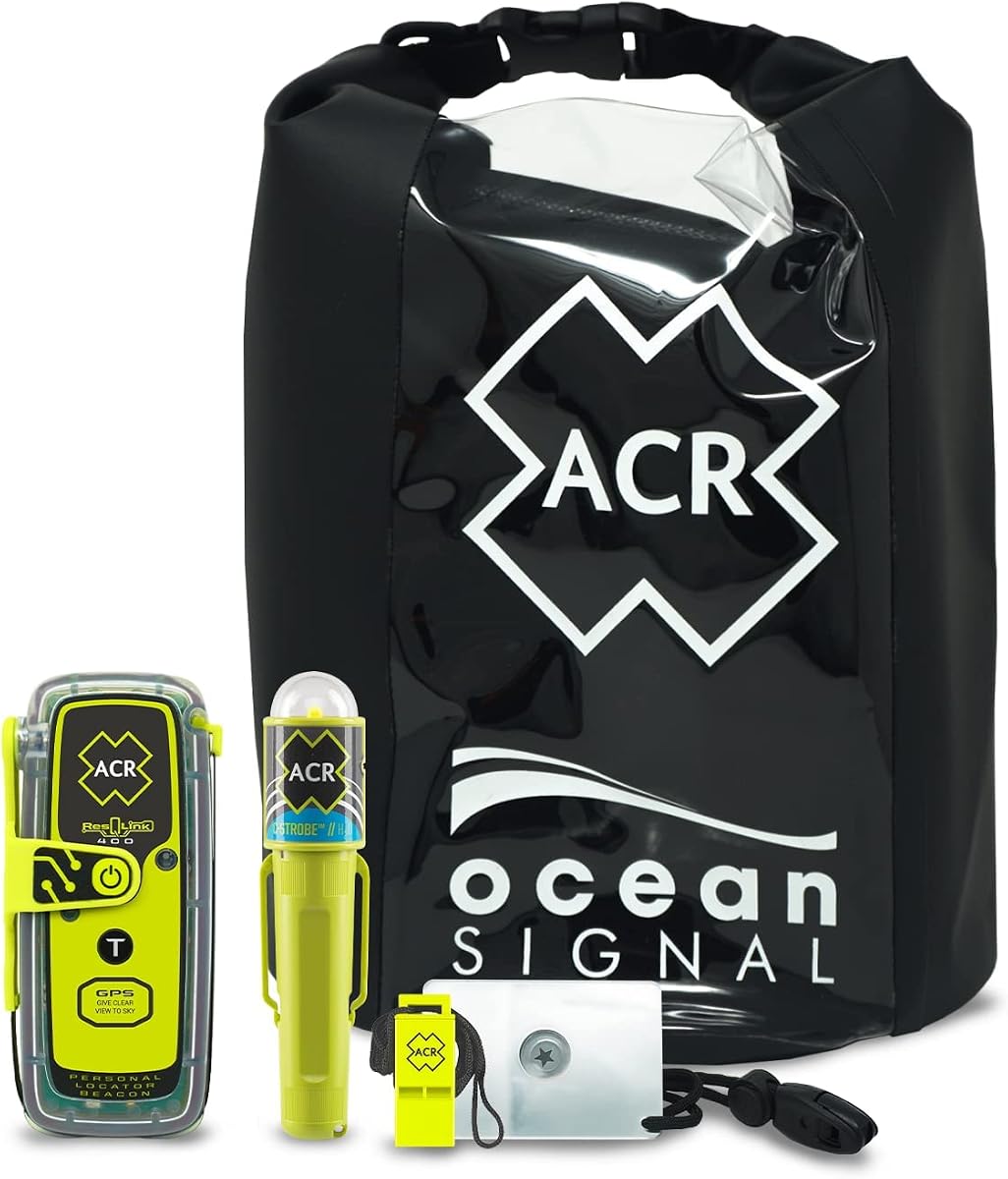
ACR ResQLink 400 Survival Kit
4.7Editor score
Beacon with GPS tracking
Waterproof rescue light included
Complete signaling accessory kit
Discover the best Acr Personal Locator Emergency Beacons, comparing satellite signaling, GPS positioning, RLS, AIS, durability, and rescue accessories.
A personal locator beacon can turn an isolated emergency into a coordinated rescue, but choosing the right model requires more than comparing size and convenience. The strongest options combine satellite distress signaling, accurate positioning, visible strobes, dependable battery life, and easy attachment to clothing, life vests, or outdoor gear.
This guide compares ten ACR personal locator emergency beacon and survival-kit options across the features that matter most in remote terrain and on the water. It examines Return Link Service, AIS, GPS and Galileo GNSS compatibility, MEOSAR support, 406 MHz signaling, local homing signals, strobes, buoyancy, battery endurance, displays, and included rescue accessories.
Each pick reveals what makes it best suited to a particular type of traveler, from hikers and boaters to offshore users who need a category 2 EPIRB package. Amazon ratings, current listings, and availability can change, so readers should verify the latest specifications, regulatory details, and price directly before making a purchase.
4.7Editor score

4.8Editor score

4.4Editor score
The comparison below covers ten ACR personal locator beacons and coordinated survival packages, highlighting their core signaling, positioning, visibility, power, and accessory features to help distinguish the strongest options for land, coastal, and offshore emergencies.



The ACR ResQLink View RLS PLB is a highly rated personal locator beacon with a 4.8 rating, and it stands out as the most complete general-purpose option in this guide. It combines satellite SOS signaling, a digital display, GPS and Galileo GNSS positioning, MEOSAR compatibility, and a five-year battery life without requiring a subscription.
We may earn a commission when you buy through this link, at no additional cost to you.
Return Link Service is the feature that most clearly distinguishes it from simpler PLBs. It confirms that Search and Rescue has received the distress signal, which can provide valuable reassurance while the user is waiting for physical rescue. The display gives the wearer access to beacon status and positioning information, while the infrared strobe can help rescuers detect the unit when it is dark or obscured.
There are trade-offs. A display and infrared system make the device less minimalist than the no-display ResQLink 400, and the special visibility benefits of infrared may not matter to every recreational user. Even so, these limitations are modest for a device intended to improve emergency awareness and rescue coordination rather than replace every other safety system.
This is the strongest recommendation for hikers, climbers, campers, paddlers, and boaters who want a capable beacon with visible status information. It is particularly suitable for solo travel because it combines confirmable distress delivery with positioning and multiple visibility features in one compact, buoyant unit.
Return Link Service provides confirmation that the emergency alert has reached Search and Rescue. That feedback distinguishes the model from units that transmit without providing direct receipt confirmation to the user.
GPS and Galileo GNSS support accurate location acquisition, while the display, standard strobe, and infrared strobe make the unit easier to see under different rescue conditions. The combination is useful across both daylight and darkness.
We may earn a commission when you buy through this link, at no additional cost to you.
The ACR ResQLink View PLB425 is a buoyant GPS personal locator beacon rated 4.6 by customers. It is a proven all-around choice for hikers, campers, climbers, RV travelers, and boaters who need satellite distress signaling without a subscription.
We may earn a commission when you buy through this link, at no additional cost to you.
Its emergency alert uses a 406 MHz distress signal alongside a 121.5 MHz homing signal. Global coverage comes through the COSPAS-SARSAT satellite system, sending distress messages directly to Search and Rescue agencies around the world. A bright LED strobe and infrared strobe provide visible signals, while the supplied belt clip, oral inflation tube clip, straps, and lanyards make the device flexible to carry.
Unlike the newer Return Link Service models in this list, this beacon does not confirm receipt of the emergency signal to its owner. The optional 406Link subscription is also associated with non-emergency self-tests and GPS test messages, although the core distress-alert operation is described as requiring no subscription. Buyers who prioritize direct receipt confirmation may prefer a newer RLS model.
The PLB425 remains well suited to people who want a straightforward, capable GPS beacon with both satellite and local homing signals. It is a strong fit for general outdoor use, especially for users who appreciate the broad selection of included attachment methods.
The 406 MHz satellite alert communicates the emergency and location, while the 121.5 MHz homing signal can help nearby rescuers pinpoint the beacon direction during a search.
Belt, oral inflation tube, strap, and lanyard attachments give the PLB425 more carrying options than a fixed-use device. Buoyancy also makes it appropriate for marine environments.
We may earn a commission when you buy through this link, at no additional cost to you.
The ACR ResQLink 410 RLS PLB has a 4.5 rating and delivers the central benefit of Return Link Service in a small, buoyant design. It sends a satellite SOS signal with GPS positioning, supports Galileo GNSS and MEOSAR, and does not require a subscription for its emergency operation.
We may earn a commission when you buy through this link, at no additional cost to you.
Its five-year battery life supports long-term readiness, while more than 24 hours of operational life provides emergency endurance. A multifunction clip system, compact dimensions, and low weight make it easy to attach to outdoor clothing, packs, or other equipment. Both strobe and infrared strobe lights improve nighttime visibility.
The most notable disadvantage is the absence of the digital display found on the ResQLink View RLS PLB. Users who want to see detailed status information will sacrifice that visibility for a smaller format. Its stated operating life is also shorter than the longer duration attributed to the top-ranked View RLS model, though 24-plus hours remains substantial for emergency use.
This beacon is a compelling option for users who prioritize Return Link Service, compactness, and long battery storage without needing a screen. It is particularly useful for hikers, paddlers, and travelers who want confirmable satellite alerts in a lightweight package.
The small, lightweight housing and multifunction clip make the PLB easier to keep on a person or attached to gear. A beacon is most useful when it is carried consistently, not left behind at a trailhead or marina.
A five-year battery life supports storage, and the listed 24-plus-hour operating period provides meaningful endurance after activation. Together, these figures make the unit practical for long trips and infrequent emergencies.
We may earn a commission when you buy through this link, at no additional cost to you.
The no-display ACR ResQLink 400 carries a 4.8 rating and offers a deliberately simple approach to personal locator beacon use. Its compact format makes it suitable for people who want satellite emergency signaling without a display competing for attention or space.
We may earn a commission when you buy through this link, at no additional cost to you.
The main appeal is focused utility. Rather than offering visible status screens or Return Link Service confirmation, the device is positioned as a straightforward personal locator beacon that can be carried on outdoor adventures. This simplicity can reduce the number of features that users must learn before an emergency.
The supplied product information provides less detail about this listing's exact signaling, battery, and attachment specifications than it does for the other models. As a result, buyers should review the current product page and manufacturer documentation before assuming that features found on a related ResQLink model are included. The lack of a display is the defining disadvantage.
This product is best for experienced outdoor users who prioritize a straightforward, compact beacon and do not need a visual interface. It may also appeal to buyers seeking an established ResQLink model at a lower tier than the feature-rich RLS offerings.
A no-display design reduces the controls and visual information users must manage. For a device intended for infrequent emergency use, that simplicity can be a virtue rather than a limitation.
Because the listing description supplies fewer technical details than several other entries, buyers should confirm the exact model features on the current product page. This is especially important when comparing signaling, battery, and attachment options.
We may earn a commission when you buy through this link, at no additional cost to you.
The ACR RESQLINK AIS PLB-450 is a 4.0-rated personal locator beacon that broadens emergency communication with both local AIS and global satellite signaling. It is designed for users who want a PLB capable of alerting nearby vessels as well as Search and Rescue services.
We may earn a commission when you buy through this link, at no additional cost to you.
Its AIS feature sends a distress alert over VHF frequencies to vessels equipped with AIS receivers or plotters within approximately five miles under applicable conditions. Return Link Service confirms receipt by Search and Rescue. Between these systems, the beacon can provide both nearby and global layers of emergency communication.
NFC technology adds another practical layer by giving a compatible mobile phone access to battery status, test information, activation time, and detailed GNSS results, including a map and accuracy readout. The 406 MHz COSPAS-SARSAT alert is MEOSAR compatible, and a 121.5 MHz local homing signal supports nearby search efforts. As with any VHF-based function, AIS performance depends on local conditions and nearby equipped receivers.
This model is a good fit for boaters, paddlers, and other users who want a compact beacon with integrated PFD attachment. It may be overengineered for land-only travelers, but its combination of AIS, Return Link Service, and NFC status access makes it one of the most feature-rich personal locator options here.
AIS can notify nearby AIS-equipped vessels of a distress event before or alongside a satellite rescue process. The stated range is approximately five miles and remains subject to operating conditions.
With a compatible phone, NFC access can reveal battery life, test history, activation details, and GNSS accuracy. This reduces the need to open the beacon housing during routine inspections.
We may earn a commission when you buy through this link, at no additional cost to you.
The ACR ResQLink 400 Survival Kit has a 4.7 rating and combines a GPS personal locator beacon with several backup signaling tools. It is a well-rounded budget bundle for hikers, campers, paddlers, and boaters who want more than a beacon alone.
We may earn a commission when you buy through this link, at no additional cost to you.
The included C-Strobe H2O rescue light provides a bright waterproof LED strobe for day or night visibility. The Res-Q Whistle produces a loud, clear sound for close-range attention, and the signal mirror can reflect sunlight toward distant rescuers. A RapidDitch drybag protects essential gear and keeps it accessible.
The trade-off is that this package does not highlight Return Link Service or a display, unlike the View RLS models. It also adds more components to pack and organize. However, those accessories create several independent ways to attract attention if the beacon is damaged, hidden, or unable to transmit effectively.
This is an excellent choice for buyers who want a coordinated survival kit at a more accessible tier than the premium EPIRB packages. It is especially appealing for weekend hikers, family camping trips, and boaters who prefer carrying dedicated visual, audible, and reflective backup signals.
The strobe, whistle, and mirror cover different needs: high-intensity light, nearby audible attention, and long-distance reflected sunlight. Redundancy is valuable when people need to respond from different distances or conditions.
The RapidDitch drybag protects the collection from wet conditions and organizes essentials for quick access. The result is more usable than several loose signaling devices stored in different pockets.
We may earn a commission when you buy through this link, at no additional cost to you.
The ACR ResQLink View Survival Kit earns a 4.7 rating and pairs the display-equipped ResQLink View beacon with a coordinated collection of emergency signaling accessories. It sits between the basic ResQLink kit and the larger maritime EPIRB bundles.
We may earn a commission when you buy through this link, at no additional cost to you.
The beacon contributes GPS tracking, a visual display, and a bright strobe, giving the wearer more status information than a no-screen model. The C-Strobe H2O adds a separate waterproof LED signal, while the Res-Q Whistle, signal mirror, and RapidDitch drybag broaden the package's communication and protection capabilities.
Its disadvantages are mainly related to size and incomplete information about Return Link Service. The supplied description does not state that the beacon includes RLS, so users should not infer that capability from similarly named newer models. Carrying a full collection also takes more space than carrying a single PLB.
This kit is a strong choice for campers, hikers, and boaters who prefer visible beacon feedback and multiple backup signals. It suits users who value an organized, ready-to-pack emergency setup rather than the smallest possible personal beacon.
The visual display adds a layer of information that a screenless PLB cannot provide. It is useful for owners who want to check the device more directly rather than relying solely on a mobile application or a separate tester.
The rescue light, whistle, mirror, and drybag complement rather than duplicate the satellite beacon. Together, they provide visual, audible, reflective, and moisture-resistant support for a broad range of emergencies.
We may earn a commission when you buy through this link, at no additional cost to you.
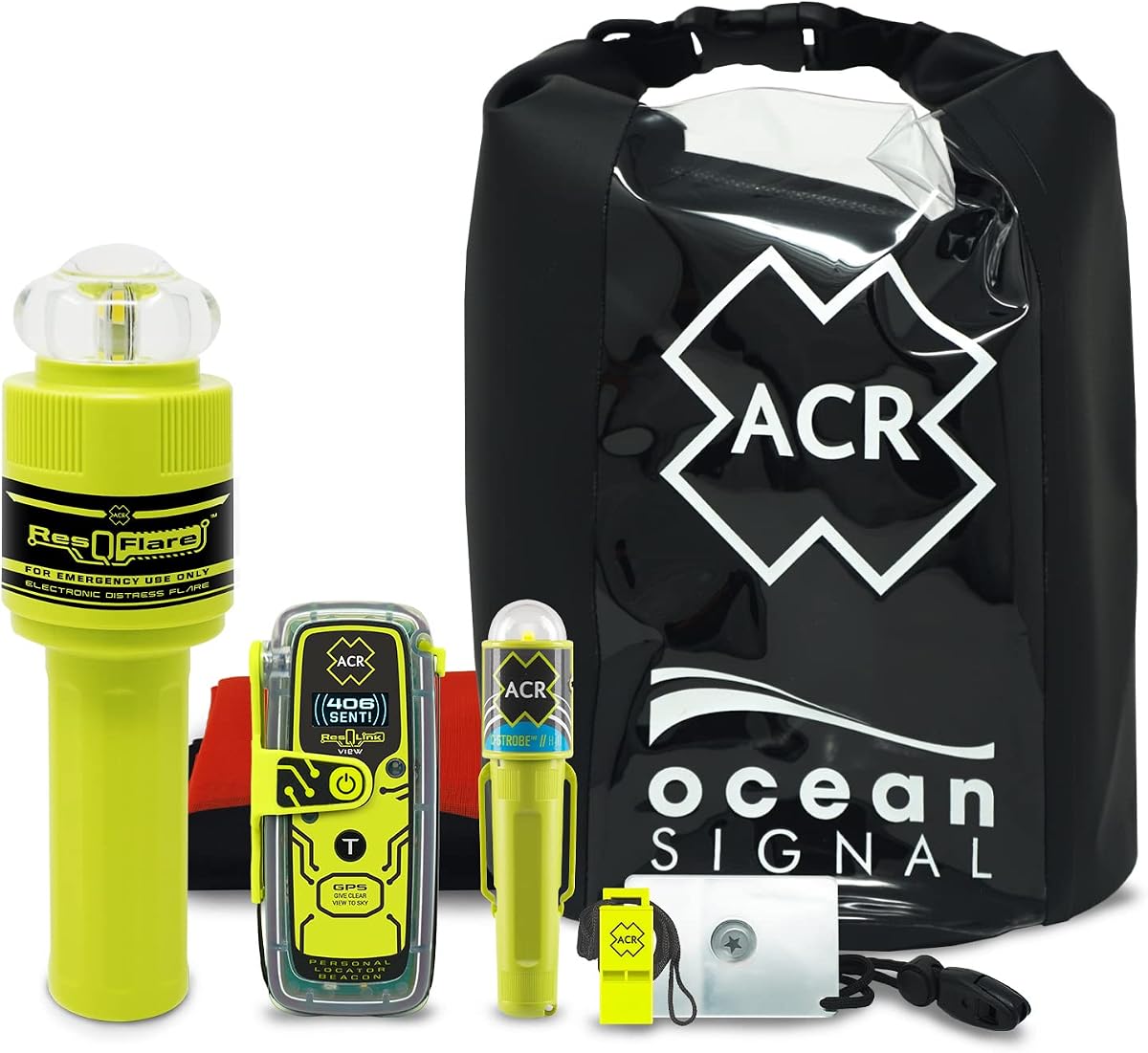
The ResQLink View and ResQFlare Kit holds the highest customer rating in this guide at 4.9. It is a comprehensive safety collection combining a GPS personal locator beacon, an electronic distress flare, a waterproof rescue light, a signal mirror, a USCG-approved whistle, a dry bag, and a daytime distress flag.
We may earn a commission when you buy through this link, at no additional cost to you.
The ResQLink View provides the core emergency locator function, while the ResQFlare adds a powerful electronic distress signal for marine or open-water visibility. The C-Strobe H2O supplies another waterproof LED strobe, and the mirror, whistle, and flag cover reflected, audible, and daytime visual signaling needs.
The main drawback is the amount of equipment. A coordinated kit is more useful than an assortment of unrelated items, but it still requires thought about what to carry on a hike, in a boat, or on a hunting trip. Users should also follow the manufacturer's instructions for the electronic flare and preserve the drybag for items that need moisture protection.
This package is an excellent pick for boaters, anglers, hunters, hikers, and families that want several emergency methods organized in one purchase. Its 4.9 rating and varied signaling tools make it a particularly well-rounded choice for general outdoor safety.
Satellite location, electronic flare illumination, waterproof strobes, reflected sunlight, whistle sound, and a daytime flag cover very different communication conditions. This creates practical redundancy if one method becomes ineffective.
The kit's electronic flare and waterproof rescue light are especially relevant on the water, while the PLB, mirror, whistle, and flag remain useful for hiking, hunting, camping, and other outdoor settings.
We may earn a commission when you buy through this link, at no additional cost to you.
The ACR GlobalFix V6 RLS Survival Kit is the leading premium option for serious maritime preparedness. Rated 4.4, it combines an FCC-approved category 2 GlobalFix V6 RLS EPIRB with an FCC-approved ResQLink 410 RLS PLB, creating both vessel-oriented and personal emergency signaling capability.
We may earn a commission when you buy through this link, at no additional cost to you.
The GlobalFix V6 provides GPS tracking and RLS confirmation for maritime emergencies, while the ResQLink 410 adds a wearable beacon with its own RLS system, 24-plus-hour operating life, and a five-year battery life. The RapidDitch Express bag, HemiLight 3, Firefly PRO Waterbug SOLAS strobe, and WW-3 whistle provide storage and high-visibility support.
This premium package is more complex and requires a larger commitment than a single personal locator beacon. Category 2 EPIRBs are designed for vessels and involve installation considerations that differ from simply clipping a PLB to a life jacket. Buyers should confirm mounting, hydrostatic-release, registration, and activation requirements for their specific boat and use case.
The kit is best suited to boaters who want both a registered vessel beacon and a personal locator for crew members. It is also appropriate for expedition or coastal travelers who understand the value of redundant Return Link Service devices and a complete suite of waterproof emergency signaling equipment.
The package addresses two related but distinct roles: alerting Search and Rescue through a category 2 EPIRB and protecting individual crew with a portable ResQLink PLB. Neither device fully replaces the other.
A waterproof express bag and two purpose-built strobe lights support organization and visibility in marine settings. The EPIRB and PLB add satellite signaling layers that remain valuable when visual searches are difficult.
We may earn a commission when you buy through this link, at no additional cost to you.
The ACR GlobalFix V5 AIS Kit is a 4.4-rated maritime survival package built around an FCC-approved category 2 AIS EPIRB and a ResQLink View RLS PLB 435. It is a comprehensive choice for boaters who want satellite beacons, local AIS information, personal protection, and visual signaling equipment together.
We may earn a commission when you buy through this link, at no additional cost to you.
The EPIRB serves the vessel, while the ResQLink View gives individual crew a wearable locator with a display and Return Link Service. The package also includes a USCG-approved ResQFlare electronic boat flare and distress SOS flag, a RapidDitch Express bag, HemiLight 3, Firefly Pro Waterbug, WW-3 whistle, and signal mirror.
The breadth of the package creates a significant learning and organization requirement. Category 2 installation and activation must be handled correctly, and owners should maintain the required registration and servicing. Carrying the entire collection on every outing may also be unnecessary, so users can plan which components belong aboard the vessel, on a life vest, and in a grab bag.
This kit is best for serious cruisers, offshore anglers, and other boaters who want both AIS and RLS options with extensive visual backups. It is less compelling for casual paddlers or land hikers who only need a lightweight personal locator beacon.
AIS provides local vessel awareness, while RLS supports confirmation that a satellite distress message reached Search and Rescue. Combining both systems in one maritime package adds useful layers of information and notification.
The electronic flare, SOS flag, strobes, whistle, signal mirror, and ditch bag extend the package well beyond the two beacon systems. It offers several ways to make the vessel or survivors visible in different environments.
We may earn a commission when you buy through this link, at no additional cost to you.
Selecting a personal locator emergency beacon means balancing emergency architecture, intended environment, carrying method, information visibility, and complementary rescue equipment. The right device should be carried consistently, understood before an emergency, and matched to the risks associated with a particular trip.
Prioritize genuine satellite distress signaling, regional compatibility, and a device that does not require a subscription for emergency operation. Check the current manufacturer documentation for registration, activation, and service details.
Choose RLS when receiving confirmation of distress delivery is important. Standard 406 MHz models remain appropriate when a simpler device better suits the trip.
Look for GPS, GNSS, and MEOSAR support. Position accuracy is central to reducing the search area and improving rescue efficiency.
Consider AIS when boating with other vessels or traveling on crowded water. It adds local awareness but remains condition-dependent.
Prefer multiple visual and audible signals when the kit must support a broad range of environments. Match each signal to how rescuers will actually approach.
Compare both storage life and post-activation operating time. Follow the prescribed inspection and battery-replacement schedule.
Choose a display or NFC if easier status checks are important. Practice the core controls regardless of the interface.
Prioritize secure, accessible attachment and appropriate buoyancy. A durable device carried poorly is less useful than one mounted correctly.
Before any trip, read the current manual and complete the manufacturer's self-test or GPS test procedure. Verify the battery status, test history, registration information, and any required service interval. For models supporting the optional 406Link subscription, use the appropriate testing service where available, but do not allow a testing convenience to replace the standard physical checks specified by ACR.
Carry the beacon on your person or in the required approved mounting location, following the attachment guidance for your activity. Familiarize yourself with the activation sequence, the difference between test and emergency modes, the meaning of Return Link Service or AIS indicators, and the behavior of the visible and infrared strobes. Practice with the device powered down, and never rely on memory alone during a crisis.
After use or an outing, inspect the housing, clips, lanyards, strobe windows, and waterproof accessories for damage, corrosion, dirt, or wear. Keep the device dry, protect the battery contacts, and follow the prescribed battery and service schedule. If a unit has been activated, submerged, damaged, or used in a real emergency, contact the appropriate rescue authority and the manufacturer before returning it to service.
A personal locator beacon is primarily designed for an individual and is commonly carried on a person, life vest, or pack. An emergency position-indicating radio beacon is generally associated with a vessel and follows a registered category and mounting framework. The premium ACR packages here combine a category 2 EPIRB with a personal ResQLink beacon so the vessel and its occupants have separate signaling options.
No. These devices send distress signals through satellite systems and 406 MHz infrastructure rather than relying on a cellular network. Some optional testing or status features may use subscriptions, applications, or phones, but the core emergency signaling described for the selected products is designed to work without a subscription.
Return Link Service confirms that the distress signal has been received by Search and Rescue. That confirmation can reassure the user that the alert entered the rescue system, although it does not guarantee that physical rescue will arrive immediately. Users should still remain in a safe location, preserve battery life, and follow all instructions received from emergency services.
Many models in this guide feature built-in buoyancy, and several survival-kit accessories are explicitly described as waterproof, including the C-Strobe H2O rescue light and RapidDitch drybag. Buoyancy should not automatically be interpreted as a claim of unlimited waterproofing. Check the exact IP rating, model manual, and current manufacturer instructions before exposing a specific device to prolonged or deep immersion.
The appropriate requirement depends on the vessel, operating area, trip, and applicable regulations. A category 2 EPIRB is generally associated with vessels that may travel more than a short distance from shore, but boaters should verify current maritime requirements and installation rules for their specific craft. A personal PLB can provide additional protection for individual crew even when it is not a substitute for a properly registered vessel beacon.
Follow the manufacturer's stated self-test schedule and service instructions, checking the product's current manual or official documentation for exact requirements. Users should also inspect the device before remote trips and confirm that the battery, attachment, and status indicators appear normal. Never perform an unapproved transmission that could be mistaken for a real distress alert.
No. AIS is primarily a local vessel-identification and alerting system, with useful but condition-dependent range. The 406 MHz satellite alert remains the central global rescue mechanism in these products, while AIS can provide an additional layer of awareness for nearby equipped vessels.
The ResQLink 410 RLS PLB offers a compact, lightweight, buoyant design with Return Link Service, GNSS support, dual strobes, and a multifunction clip. The ResQLink View RLS PLB adds a display and longer stated operating life for people who value more visible status information. Either is more focused than the large EPIRB survival bundles.
The ACR ResQLink View RLS PLB is the strongest overall choice because it combines a digital display, Return Link Service, multi-constellation positioning, MEOSAR compatibility, dual strobes, buoyancy, and subscription-free operation. For buyers seeking a coordinated value bundle, the ResQLink 400 Survival Kit adds practical visual, audible, reflective, and waterproof accessories without the complexity of a vessel system.
Maritime users should match the product to the setting. The GlobalFix V6 RLS package offers a category 2 EPIRB and a separate ResQLink 410 for crew protection, while the GlobalFix V5 AIS package adds AIS-equipped vessel signaling and an extensive set of marine accessories. Hikers and campers may benefit more from a compact PLB, and boaters should verify registration, installation, and activation requirements before relying on any beacon.
Ratings, product contents, and prices can change on Amazon, so check the current listing and manufacturer documentation immediately before purchasing. The most important decision is not simply the feature count: it is choosing a properly carried, regularly inspected beacon whose signaling system and accessories match the environment you will actually enter.