
Bambu Lab Multi-Surface Build Plate
4.3Editor score
Multiple surface technologies
Broad filament compatibility
High-temperature PEI option
Scratch-resistant construction
Our Flexible Build Plate for Easy Print Removal guide compares 10 magnetic, PEI, and spring steel options, highlighting adhesion, compatibility, cleaning, and
A flexible build plate makes removing a finished print easier by allowing the surface to bend and release the object without aggressive scraping. The right plate must also match your printer, provide dependable first-layer adhesion, tolerate compatible filament temperatures, and remain flat enough for accurate printing.
This guide compares ten magnetic, PEI-coated, and spring-steel build plates based on their published dimensions, materials, printer compatibility, surface finishes, temperature guidance, removal methods, and customer ratings. It includes options for Bambu Lab, Creality, Anycubic, and other FDM or resin printers.
Each pick highlights a particular balance of features, from broad FDM compatibility to a dedicated textured surface or a specialized resin build tray. Product details and ratings reflect the supplied information, while availability and prices can change, so confirm the latest listing details before purchasing.
4.3Editor score

4.7Editor score
4.7Editor score
The comparison below covers the plate dimensions, surface construction, printer fit, and removal approach of all ten products, making it easier to identify the option that suits your printer and preferred filaments.




This two-piece Creality magnetic build surface carries a 4.4 customer rating and is designed around a simple goal: make completed models easier to remove from an FDM printer. Its upper printing surface separates from a lower adhesive base, allowing the flexible portion to be bent until the model releases without a spatula or knife.
We may earn a commission when you buy through this link, at no additional cost to you.
The main strength is adaptability. The sheet can be cut to fit different build areas, while the installation system is described as compatible with FDM printers and both heated and non-heated beds. Creality also recommends heating the bed for two to three minutes before using removal tools, giving users a controlled way to loosen a part when required.
Installation requires care. The soft magnetic sticker and upper layer must attract correctly, and the instructions suggest rotating the sheet 90 degrees if it does not attach. Users must also identify the magnetic direction before placing the adhesive base on the build plate, which makes setup less effortless than a rigid drop-in sheet.
This is a strong choice for a mixed printer fleet or anyone who values removable-sheet convenience over a permanently mounted rigid plate. It is particularly attractive for FDM users who want to flex the surface away from a delicate model instead of levering against it with a metal tool.
The ability to trim the flexible upper sheet makes this option useful when the same system must serve printers with different bed shapes or sizes. It also allows users to retain the adhesive base while changing the working surface when needed.
Peeling away the magnetic layer and bending the sheet distributes release force across the print rather than concentrating a scraper edge against one corner. That can help protect thin features and delicate bottom surfaces.
We may earn a commission when you buy through this link, at no additional cost to you.
This 257 mm double-sided PEI steel plate has a 4.7 rating and is tailored to Bambu Lab X1, X1C, P1P, P1S, and A1 printers. It is explicitly excluded from the A1 mini category, an important compatibility detail for buyers who own the compact model.
We may earn a commission when you buy through this link, at no additional cost to you.
Its two textured sides are intended to provide useful adhesion without glue, while the flexible steel construction supports removal after the bed cools. The listed guidance calls for roughly 60°C for strong adhesion and about 80–85°C when printing PETG, and the product is also described as suitable for PLA, PLA-plus, and ABS when the correct temperature profile is selected.
The product is not a universal sheet. Compatibility is limited to the named Bambu Lab models and their 256–257 mm platform format. PETG may also demand more careful bed-temperature control because the required range differs from that of PLA, and adhesion can change according to filament formulation.
For owners of the listed Bambu Lab printers, however, it offers a convincing balance of textured adhesion, two-sided utility, and bend-based removal. It is a particularly solid all-around option for mixed PLA and PETG workflows, provided the printer model and required bed temperature are confirmed before ordering.
A double-sided textured sheet adds useful flexibility without requiring a second plate. Users can compare both sides when judging surface finish, grip, and release behavior across different filament types and model geometries.
The stated removal method begins with allowing the bed to reach room temperature. If a sticky print does not release readily, gentle bending of the steel plate provides a secondary release method without requiring a sharp tool.
We may earn a commission when you buy through this link, at no additional cost to you.
This multi-surface build plate offers the broadest material-selection concept in the roundup. Its flexible spring-steel core supports bend release, while different faces are described as PET, PEO, PEY, and PEI surfaces designed to create different visual textures and accommodate different printing needs.
We may earn a commission when you buy through this link, at no additional cost to you.
The claimed material range is extensive. PET and PEO surfaces are listed for PLA, TPU, and PETG up to 120°C; PEY is listed for those materials up to 90°C; and PEI supports a larger selection including PLA, PETG, ABS, TPU, ASA, PVA, PET, PA, and PC up to 260°C. The plate also has scratch- and chemical-resistant surface materials.
That versatility comes with a learning curve. Users must adjust print settings for the selected face, filament, and model, and a texture that grips aggressively may not be ideal when a perfectly smooth underside is the main goal. The flexible spring steel is beneficial for release but must remain flat and properly supported.
This premium-style choice makes the most sense for established users who alternate among several filament families or want different surface finishes from one plate. It is especially relevant to the listed Bambu Lab A1, X2D, P2S, X1, X1C, X1E, P1P, and P1S models, but size should always be verified first.
Different surface technologies can transfer distinct bottom textures to printed models. That makes the plate useful when a project benefits from a textured, matte, or otherwise visibly finished base rather than a uniform smooth appearance.
The maximum temperatures differ substantially by face. Checking the intended filament and selecting the appropriate surface is more important than assuming every side behaves identically.
We may earn a commission when you buy through this link, at no additional cost to you.
This 310 x 310 mm removable build surface is a straightforward option for larger heated beds. It has a 4.1 customer rating, a stated thickness of 1.7 mm, and a simple installation approach that suits users seeking an uncomplicated replacement surface.
We may earn a commission when you buy through this link, at no additional cost to you.
The product description emphasizes a flatter bottom for printed parts and easy cleaning with alcohol. It is also presented as suitable for FDM printers and both heated and non-heated beds, giving it broader potential use than plates designed around a specific printer ecosystem.
The available information is limited compared with several competing products. It does not provide a detailed range of supported filament temperatures or a textured-surface specification, so buyers should treat it as a general flexible surface rather than a material-specific performance upgrade.
Its main appeal is the combination of a large 310 mm format, simple installation, and flexible removal. It may suit owners of a compatible large-bed printer who want a cleaner way to release a part, although checking bed measurements and magnetic mounting details before ordering is essential.
The listing specifically highlights improved flatness at the bottom of prints. A stable, flat surface can reduce the need for aggressive correction after removal and may benefit models whose visible underside is important.
Alcohol-compatible cleaning makes routine maintenance more convenient, especially when the surface collects resin-like residues, fingerprints, or filament residue. The plate should still be cooled and handled carefully during cleaning.
We may earn a commission when you buy through this link, at no additional cost to you.
The Official Creality Ultra-Flexible surface has a 4.2 rating and is aimed at 310 x 310 mm beds used by models including the CR-10, CR-10S, Ender 3 Max, Ender 3 Max Neo, SV06 Plus, SV04 IDEX, and Longer LK5 Pro. Its core feature is a removable magnetic printing layer mounted over an adhesive base.
We may earn a commission when you buy through this link, at no additional cost to you.
Removing the upper layer and bending the flexible sheet is presented as an alternative to spatulas, knives, and other hard tools. Because the surface can be cut to fit, it also offers some freedom for custom build areas, while the lower adhesive layer provides a familiar mounting method.
The phrase universal should be treated as a general design benefit rather than a guarantee that every machine is mechanically identical. Users should compare the exact bed dimensions, edge clearance, mounting requirements, and bed level before assuming compatibility.
This is a practical choice for owners of listed Creality-family machines and other compatible 310 mm FDM printers. It prioritizes a clear removal method and a replaceable flexible layer, making it useful for delicate prints that should not be pried loose with a hard implement.
Bending the flexible layer changes the geometry under the model and can free it with less concentrated force. This is especially helpful when the part has a narrow base, a fragile first layer, or a finish that would mark from a scraper.
Separating the printing surface from the adhesive base allows the user to remove the model away from the printer bed. The fixed lower layer can remain in place while the flexible upper surface bends.
We may earn a commission when you buy through this link, at no additional cost to you.
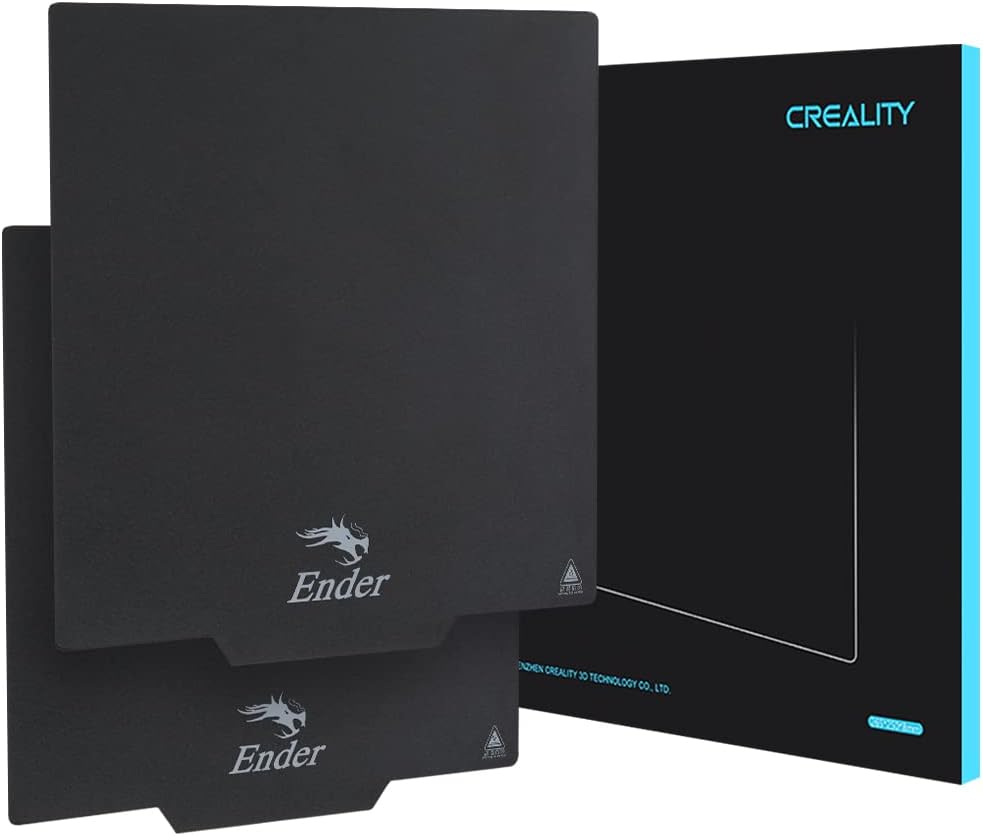
This two-pack of Creality magnetic build surfaces is sized at 235 x 235 mm and carries a 4.4 rating. It is designed for Ender 3 and Ender 3 V2 families, with the product title also naming the Ender 3 Neo, V2 Neo, S1, S1 Pro, and V3 SE.
We may earn a commission when you buy through this link, at no additional cost to you.
The upper layer uses a soft magnetic sheet in a PC frame. According to the supplied information, it is waterproof, dustproof, wear-resistant, scratch-resistant, heat-resistant, and capable of long-term use at temperatures up to 70°C without demagnetizing. Bending the soft sheet releases a finished model without a hard removal tool.
Compatibility is not entirely plug-and-play for every named printer. The instructions state that users of the Ender 3 S1, S1 Pro, Ender 5 S1, Ender 3 Neo, V2 Neo, V3 SE, and CR 10 SE may need to remove two bed-positioning screws first. The listed filament focus is PLA and PLA-plus substrates.
For Ender 3 owners, the combination of a 235 mm size, two included surfaces, and tool-free release is compelling. The need to check for mounting screws and to avoid demanding high-temperature materials keeps it from being the broadest choice, but it remains a focused upgrade for compatible PLA printers.
The two-pack allows one plate to remain in service while the other is cleaned, trimmed, or used for a different setup. Rotation can also make it easier to compare how a textured surface affects the model finish.
The PC-framed magnetic material is described as resistant to water, dust, wear, scratches, oxidation, and heat. The 70°C demagnetization guidance provides a clear limit to consider when selecting filament settings.
We may earn a commission when you buy through this link, at no additional cost to you.
This upgraded two-pack contains 257 x 257 mm PEI-coated spring-steel plates for Bambu Lab X2D, X1, X1C, P1P, P1S, P2S, and A1 printers. Its 4.5 rating reflects a well-documented package with identification codes, double-sided fine powder texture, and explicit care and leveling guidance.
We may earn a commission when you buy through this link, at no additional cost to you.
The plates use durable stainless spring steel and a textured PEI coating. The listing claims heat resistance up to 300°C and compatibility with PLA, ABS, PETG, and PC. Models can be released after cooling or by gently bending the steel, reducing the need for scraping or adhesives.
The maintenance instructions are unusually specific: cleaning with 75% alcohol or mild soapy water, treating stubborn stains with gentle heat and a soft brush, checking spring tension, and cleaning every 50 hours. It also recommends a 0.2–0.3 mm nozzle-to-platform distance and warns that contamination or damage affects longevity and print quality.
This is a strong choice for Bambu Lab users who want two plates and value clear maintenance guidance. The caveats are meaningful, however, because spring tension, leveling, nozzle clearance, and surface contamination all influence long-term performance.
Allowing the printed plate to cool can promote automatic separation, reducing the force needed during removal. Gentle bending then acts as a controlled secondary method for stubborn adhesion.
Because a textured PEI coating is a consumable contact surface, regular cleaning and inspection can prevent residue from becoming embedded. A soft brush and controlled heat are recommended for stubborn marks.
We may earn a commission when you buy through this link, at no additional cost to you.
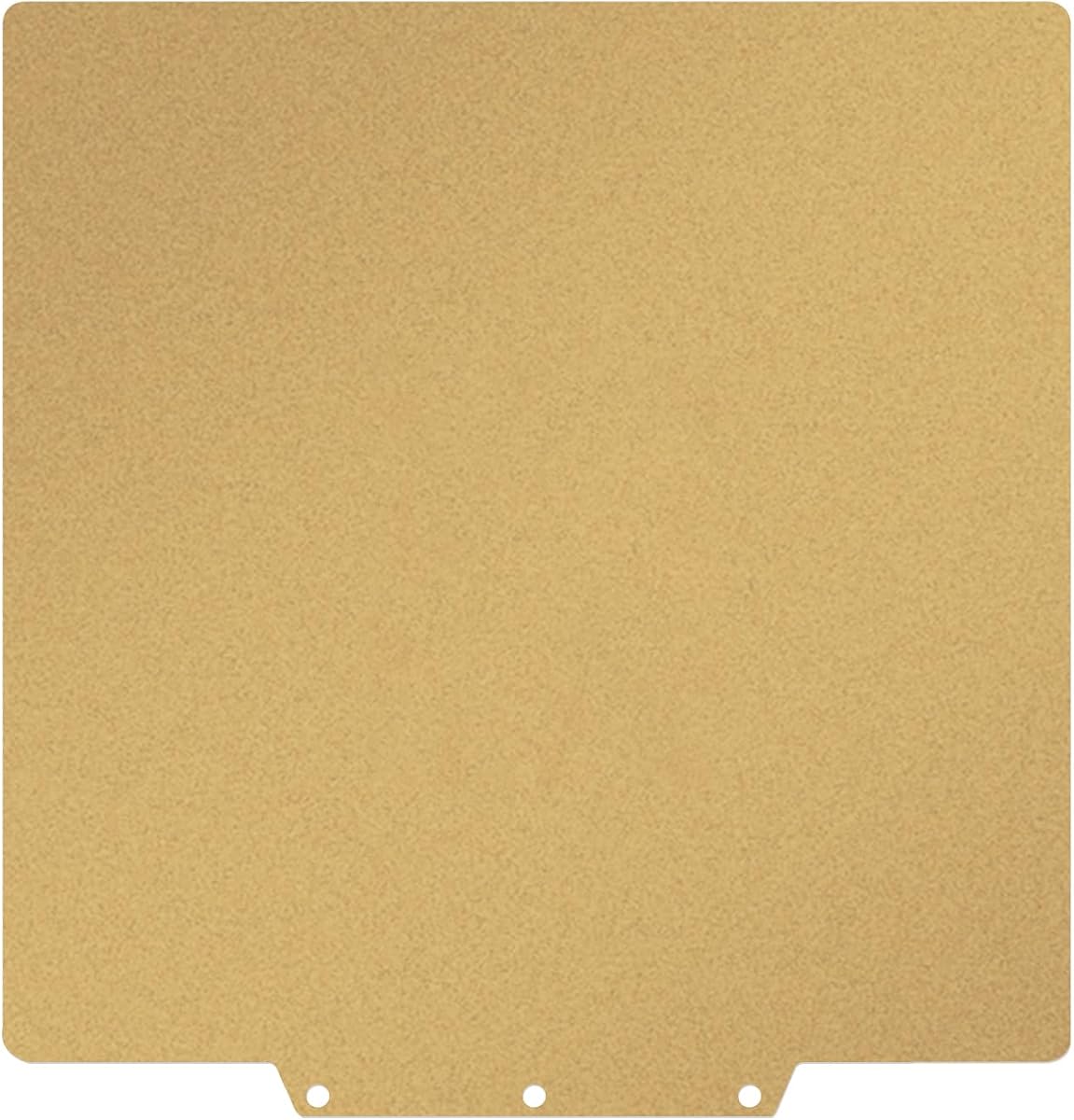
This gold PEI spring-steel plate has a 4.7 rating and is aimed primarily at 235 x 235 mm printers, including the Adventurer 5M, 5M Pro, and AD5X. It also lists compatibility with numerous Kobra, Ender, CR 20, Neptune, and SV-series machines of similar platform size.
We may earn a commission when you buy through this link, at no additional cost to you.
Both sides carry a frosted powder-coated PEI surface intended to enhance adhesion and reduce warping. The spring-steel body can be bent after cooling to release a print, while the textured surface is described as resistant to temperatures up to 300°C. Listed materials include PLA, PLA-plus, PETG, PETG-CF, ABS, TPU, nylon, PC, PA, ASA, and PVA.
The long compatibility list requires a size check rather than a model-name-only decision. Bed dimensions, mounting method, and sensor position all matter, and the product itself advises buyers to confirm platform size before ordering. Users who need a perfectly smooth bottom should also account for the deliberate frosted texture.
For a compatible 235 mm printer, the plate offers an appealing mix of strong customer feedback, double-sided utility, high-temperature capability, and tool-free bend release. It is a particularly attractive choice for users who switch between several common engineering and everyday filaments.
Two frosted PEI sides extend usable life and make it possible to compare finish choices. The texture can also improve grip, but the resulting bottom appearance may suit functional models better than display pieces requiring a flawless smooth underside.
The broad material list makes the plate useful for PLA, PETG, ABS, TPU, PA, PC, ASA, PVA, and fiber-reinforced PETG workflows. Actual settings still need to follow the filament manufacturer’s recommendations.
We may earn a commission when you buy through this link, at no additional cost to you.
This flexible spring-steel build plate has the highest listed customer rating in the roundup at 4.8. At 310 x 174 mm, it is specifically designed for Anycubic Photon M3 Max, Photon Mono M7 Max, and Creality Halot Max resin printers rather than conventional FDM beds.
We may earn a commission when you buy through this link, at no additional cost to you.
Its brushed grid surface is designed to create micro-friction that holds a resin model while still permitting release by bending. The listing says this avoids scraping, helping protect thin miniatures and delicate support structures. A pre-coated self-adhesive magnetic backing provides the attachment layer.
Installation deserves attention. Users are instructed to remove the protective liner, place the sheet level on the stock build tray, leave it undisturbed for 24 hours for the adhesive to cure, and then reset the Z-axis height. Poor leveling or an incorrect height can cause failed prints or a scratched surface.
This is the specialist choice for resin users who regularly release small or fragile parts. Its focused compatibility and careful installation process narrow its audience, but for the listed printers it offers a fast, tool-free way to remove completed models and reduce wear on the original tray.
Resin prints often include small miniatures and fragile support structures that can chip when pried away. Bending the spring-steel surface offers a gentler alternative to a rigid scraper.
A flexible plate installed above a stock tray changes the effective print height. Resetting the Z-axis after installation is therefore necessary to maintain a clear gap between the model and the intended surface.
We may earn a commission when you buy through this link, at no additional cost to you.
This 315 x 310 mm double-sided PEI build plate is designed for printers with a large, slightly rectangular heated bed. It has no numerical customer rating in the supplied data, but its specification summary is focused and practical: matte PEI on both sides, a spring-steel composite, and bend-based model release.
We may earn a commission when you buy through this link, at no additional cost to you.
The plate combines 75% PEI thickness with 25% spring-steel thickness according to the description. Handles and positioning holes support accurate installation, while the magnetic properties are intended to remain effective at elevated temperatures. Common filaments such as PLA, ABS, PETG, and TPU are listed as compatible.
Its stated operating limit is up to 120°C, which is lower than several spring-steel PEI products in this comparison. That distinction matters for users printing temperature-demanding polymers or using aggressive bed-temperature profiles. A protective film is also recommended to guard against scratches and dust when the plate is not in use.
The product is best suited to someone who has verified the unusual 315 x 310 mm dimensions and wants a roomy double-sided surface with convenient handling features. Its combination of adhesion, simple detachment, and straightforward installation makes it a practical large-bed option, though the lack of a supplied rating should be considered.
Using both faces extends the working life of the coating and provides more than one finish choice. The matte texture is intended to support adhesion and help reduce first-layer warping.
The listed handles make a large plate easier to lift and position. Positioning holes can also help preserve repeatable placement, which is valuable when a printer depends on a consistent surface height.
We may earn a commission when you buy through this link, at no additional cost to you.
Choose a flexible build plate by prioritizing accurate printer fit, material compatibility, surface grip, and a release method that suits your models. Dimensions, thermal limits, cleaning needs, and mounting details matter as much as the flexible construction itself.
Measure both the length and width of the usable bed rather than relying only on a printer model name. Some listings describe nominal 235 mm or 257 mm platforms, while others use 256, 257, 310, 315, and other dimensions that can appear inconsistent. Also check whether the plate must sit inside raised edges, clear magnets, sensors, screws, or a textured glass bed before ordering.
Most flexible plates in this guide serve FDM printers, where adhesion during the first layer and easy separation after cooling are the main concerns. The Anycubic option is different: it is designed for resin build trays and a brushed steel surface. A resin plate should not be selected simply because its dimensions resemble an FDM bed, because installation height and curing behavior differ.
Textured PEI and powder-coated surfaces generally increase mechanical grip, which can help reduce first-layer movement and warping. Fine texture is useful for functional parts but can leave a visible pattern on the bottom. Smooth surfaces may produce a cleaner finish but often need more careful temperature and adhesion control, particularly with PETG.
Every plate has a practical thermal range, and those limits differ considerably. Some listings support 300°C, one multi-surface plate offers a PEI side rated to 260°C, and the large double-sided plate is described as suitable up to 120°C. The plate rating should comfortably exceed the bed temperature needed by your filament and printer profile.
The defining benefit is reduced reliance on scrapers, knives, and forceful prying. Some plates release by bending the steel core, while magnetic-sheet systems allow the entire flexible upper layer to be peeled away. These methods still require the part to be cooled, and sticky filaments may need more careful heat management than the manufacturer suggests.
A surface that grips well will gradually collect residue, especially when using PETG, filled filaments, or resin on a dedicated tray. PEI plates can generally be cleaned with alcohol or mild soapy water according to their individual instructions. A soft brush and controlled heating may help with stubborn marks, but harsh scraping can damage the coating.
Flexible does not automatically mean unstable. A spring-steel plate should sit evenly, and the printer’s Z-offset must be adjusted when replacing a rigid bed. Keep the nozzle clear of the PEI coating, inspect for dents or contamination, and follow any stated nozzle-height guidance to avoid scoring the surface.
Useful extras include double-sided coatings, positioning holes, handles, identification codes, replacement packs, and protected adhesive backing. These details can improve repeatability, rotation, installation, and maintenance. However, the most important features remain accurate fit, dependable adhesion, a safe temperature range, and a release method that suits the parts you print.
Begin by confirming the plate dimensions, printer compatibility, and required mounting method. Clean and dry the bed before installation. For an adhesive-backed system, remove the protective liner, position the sheet carefully, and apply even pressure. For a magnetic system, make sure the magnetic surfaces are fully attracted and that no grit is trapped between them. If a magnetic sheet does not attach, rotate it as directed by its instructions.
Level the installed plate and set the correct Z-offset or nozzle-to-platform distance. The nozzle should not scrape the coating. Load the filament and select a bed temperature appropriate for both the material and the plate’s published limits. Maintain the surface texture by keeping it free of fingerprints, fused filament, and other residue, particularly when switching between materials with different adhesion behavior.
After printing, allow the bed and part to cool before attempting removal. For a spring-steel plate, lift one edge and bend it gently until the model releases. For a removable magnetic sheet, peel the flexible upper layer away from its base and bend the sheet over a clean surface. Clean with the approved method, inspect the coating and spring tension, and store the plate flat or in its intended protective arrangement.
A flexible plate can help with release, but it does not eliminate the causes of first-layer curling. Surface adhesion, bed temperature, chamber conditions, nozzle height, filament dryness, and print settings all influence whether a part stays flat. Use a texture that provides reliable grip and follow the filament manufacturer’s recommended temperature range.
No. The available plates have different temperature limits and surface characteristics. PLA is broadly supported, but PETG, ABS, ASA, PA, PC, TPU, and filled filaments may require different bed temperatures, higher plate temperatures, or more careful release. Always check the plate’s stated material and temperature guidance before changing filament.
Cooling first is generally preferable because the plate and part contract as they cool, which can make separation easier and reduce accidental damage. Some magnetic systems allow additional warming to loosen a stubborn part, but follow the product instructions and avoid forcing a model off a hot surface.
Yes, if the replacement plate changes the height of the printing surface. Spring-steel and removable-sheet systems can sit above or below a stock bed, so check the first layer and calibrate the Z-offset. For resin build trays, the product instructions specifically recommend resetting the Z-axis after installation.
Allow the plate to cool, then use 75% alcohol, mild soapy water, or another method explicitly approved by the manufacturer. A soft brush can help with residue, and moderate heat may loosen stubborn marks. Avoid sharp tools and abrasive pads because they can permanently scratch the coating.
Only when the manufacturer specifically allows customization. The two Creality magnetic products state that their flexible surfaces can be cut to different dimensions, but cutting may affect magnetic alignment or structural support. Measure carefully and avoid compromising the working area or attachment points.
A flexible plate usually offers easier mechanical release because the surface can bend away from the model. Textured glass can still provide excellent adhesion and dimension stability, so the better choice depends on the printer, available space, and how often you print parts that are difficult to remove.
The part may have cooled unevenly, the filament may be sticky, the bed temperature may be high, or residue may be creating extra adhesion. Let the assembly cool fully, confirm that the plate is actually flexing, and check the filament and temperature settings. Avoid levering with a knife if the goal is to protect the model.
The BCZAMD dual-sided PEI steel plate stands out for supported Bambu Lab printers, useful texture on both faces, and a strong 4.7 rating. The multi-surface Bambu Lab plate offers the greatest material and finish versatility, while the BCZAMD gold PEI option delivers broad 235 mm printer support, double-sided texture, and a high 4.7 rating.
Prioritize exact dimensions, printer technology, and thermal limits before focusing on the finish. For FDM users, a textured spring-steel plate with cooling and bending release is a dependable all-around choice. Resin users should consider the dedicated flexible tray, while Ender 3 owners may prefer the two-pack of 235 mm magnetic sheets.
Finally, check the latest product listing, compatibility notes, customer feedback, and current price before purchasing. Plate specifications and printer designs can change, and installation requirements vary substantially between FDM beds and resin trays. A little verification before ordering can prevent both poor fit and avoidable print damage.
