
BrighRoad 1000Lumens Bike Helmet Light
4.7Editor score
1000-lumen maximum output
Wide 180-degree visibility
Adjustable helmet mounting
IPX6 water resistance
Our expert guide compares the best headlamps for mountain biking, covering brightness, beam control, comfort, battery life, mounting options, and weather
A mountain biking headlamp must illuminate the trail without distracting the rider, obstruct the helmet, or fail when conditions turn wet and rough. The best options balance a controlled beam, dependable runtime, secure placement, and enough durability for technical descents, forest tracks, and long evening rides.
The products in this guide were compared using the supplied specifications and customer ratings, with particular attention to usable light output, beam adjustment, mounting hardware, weight, charging method, water resistance, and mode flexibility. The list includes purpose-built helmet lights, compact recreational headlamps, and rugged premium models.
Each review explains how the headlamp fits into a nighttime riding setup, where its design is strongest, and where compromises may appear. Rankings reflect the available product information rather than personal field testing, while specifications and current availability can change as manufacturers revise their products.
4.7Editor score

4.7Editor score
4.5Editor score
This side-by-side comparison highlights the differences in output, beam control, power source, mounting flexibility, and weather protection among ten headlamps suited to nighttime mountain biking.




The BrighRoad 1000Lumens Bike Helmet Light is the most directly aligned product in this roundup. It is designed specifically for helmet-mounted night riding rather than being adapted from a general camping headlamp. With a 4.7 customer rating, it combines 1000 lumens of stated maximum output, a 650-foot beam throw, five operating modes, and a 180-degree visibility claim.
We may earn a commission when you buy through this link, at no additional cost to you.
Its strongest mountain biking feature is the GoPro-compatible mounting arrangement. A 100-degree adjustable base lets the rider align the beam with the direction of travel, which is more useful on trails than a fixed, downward-facing handlebar beam. The compact 3.74-ounce housing helps prevent helmet instability, while the aircraft-grade aluminum shell adds a purposeful, rugged appearance and useful structural weight without becoming bulky.
Weather protection is another strength. Its IPX6 rating indicates resistance to powerful water jets, making it better suited to wet trails and unpredictable rain than basic splash-resistant headlamps. Smart thermal protection monitors heat in real time, while a hardware lockout helps prevent accidental activation while the light is stored or carried. The 2500mAh battery is rated for up to 25 hours, although real runtime naturally depends on which of the five modes is used.
This is a compelling choice for riders who want a dedicated helmet light with ample output, broad awareness, and straightforward charging. The main limitation is that its primary advantage comes from helmet placement, so riders who prefer a handlebar setup may find a conventional headlamp more adaptable. Even so, the combination of adjustability, low weight, and IPX6 protection makes it the strongest all-around recommendation here.
The adjustable 100-degree mounting base is especially important when the trail changes elevation or curves around obstacles. Riders can keep the illuminated area aligned with their gaze instead of relying on a fixed beam position, which helps reveal roots, rocks, and transitions earlier.
IPX6 water resistance and an aluminum housing add confidence in muddy or rainy conditions. Thermal monitoring also complements a high-output light by helping the manufacturer manage heat during prolonged bright-mode use.
We may earn a commission when you buy through this link, at no additional cost to you.
The High-end 220000 Lux Super Bright Headlamp earns the Best Budget designation because it combines high stated brightness, many lighting patterns, helmet accessories, and a long claimed standby period in one comparatively accessible package. Its 4.6 rating reflects a generally favorable customer response, although the unusually broad feature set requires careful comparison against the listing details.
We may earn a commission when you buy through this link, at no additional cost to you.
The light offers a 60-degree spotlight and a 125-degree flood beam, allowing the wearer to favor either a narrower distance beam or broader nearby coverage. Its controls include flood, spot, zoom, motion-sensor, camping, and emergency-strobe functions. The product title refers to 17 modes, while the supplied feature list describes 12 principal high-lumen modes, so riders should treat the exact count cautiously rather than assume every advertised variation is distinct.
For cycling, the integrated rear-light display is unusual and potentially useful. The battery cover includes green, red, alternating red-and-green, solid red, and flashing red rear riding patterns. That gives riders more signaling options than a conventional headlamp, while the included helmet clips allow the light to be installed without relying solely on the headband.
This model is a strong choice for budget-conscious riders who want more control than a basic three-mode light. Its Type-C charging system, IP65 sealing, long standby time, and broad beam options add practical value. The crowded control scheme and discrepancy over the total number of modes are the main drawbacks, but neither prevents it from serving as a versatile helmet or trail light.
Integrated red and green rear displays make this headlamp more useful for group rides than a standard all-white model. Riders can select steady or flashing rear patterns to improve communication with people traveling behind.
Separate spotlight and flood tilts make it possible to transition between distant trail detail and broad peripheral illumination. That flexibility is valuable on winding routes where both near obstacles and farther turns matter.
We may earn a commission when you buy through this link, at no additional cost to you.
The BLACK DIAMOND Storm 500-R is a compact, trail-oriented headlamp with a 4.4 customer rating. It produces up to 500 lumens and includes full-strength, dimming, strobe, and red night-vision modes. Rather than competing on extreme headline output, it focuses on a practical balance of brightness, compactness, and stable wear for outdoor activities such as hiking, climbing, trail running, and mountain biking.
We may earn a commission when you buy through this link, at no additional cost to you.
Its integrated 2400mAh lithium-ion battery eliminates disposable batteries, which is convenient for repeated rides. Micro-USB charging is less universal than USB-C, but the rechargeable format still supports a more sustainable routine than replacing cells. The durable housing and stated resistance to heavy rain and snow suit variable mountain conditions, while the low-profile body helps the lamp remain comparatively unobtrusive under a helmet.
Mode variety is another advantage. Dimming is useful for close trail inspection without dazzling glare, while the red mode can help preserve night vision and reduce the likelihood of impairing the vision of nearby riders. Strobe provides an additional signaling or awareness option, although it should be selected deliberately rather than left on for continuous trail illumination.
The Storm 500-R is best for riders who want a proven outdoor brand, a stable fit, and useful low-output modes. It is not the strongest choice for riders seeking maximum distance illumination or the newest charging connection. Within a premium trail-headlamp context, however, its compact design and focused feature set make it a refined and practical option.
The compact housing and adjustable headband are intended to keep the light from shifting during active movement. That stability is particularly useful during technical descents or fast sections where a bouncing, off-center beam can be distracting.
Dimmable output and red night-vision lighting give riders more than a single high setting. These modes can reduce glare, support group riding, and provide less obtrusive illumination around other trail users.
We may earn a commission when you buy through this link, at no additional cost to you.
The LHKNL Rechargeable Headlamp 2-Pack has a 4.6 rating and stands out by supplying two complete lights. That arrangement is especially useful for couples, riding groups, or households that want a backup for long mountain routes. Each light weighs only 1.76 ounces, making it one of the least substantial options for riders concerned about helmet stability and neck fatigue.
We may earn a commission when you buy through this link, at no additional cost to you.
Its eight-mode system covers main and side beams at strong and weak levels, a red beam, and an SOS red strobe. Motion-sensor operation can switch the light on or off with a wave of the hand, which is useful when both hands are occupied on the bike. The lamp head also rotates through 60 degrees, giving the wearer some control over where the light points without adding complicated adjustment hardware.
A 1500mAh internal battery supports a stated four to ten hours of operation after charging, and the light can be used while connected to a power source. Long-pressing the button shuts it off directly, avoiding the need to cycle through every mode before switching it off. Its IPX4 rating provides basic protection from rain and snow but is not as robust as the IPX6 or IP68 options in this list.
This two-pack is a practical choice for riders who prioritize low weight and shared equipment. Its limitations are the modest ingress-protection rating and the absence of a dedicated side-facing visibility system. Even so, the combination of two lamps, motion sensing, red lighting, and a secure adjustable headband makes it well suited to recreational night rides and emergency preparedness.
Two complete headlamps make group preparation simpler and provide a ready backup for a partner or family member. Each unit also has red and emergency-strobe functions that are useful around other people.
At 1.76 ounces, the lamp places little demand on the headband. Motion activation also allows control without touching the housing, which is convenient after a muddy ride or when the rider is wearing full gloves.
We may earn a commission when you buy through this link, at no additional cost to you.
The Coast XPH30R combines a 4.7 customer rating with an unusually wide range of output levels and a user-controlled focus system. It can produce 1500 lumens in turbo mode, 530 lumens at high, 175 at medium, 48 at low, and 16 in moon-glow mode. The result is a headlamp that can serve both short, close-range trail work and longer-distance illumination.
We may earn a commission when you buy through this link, at no additional cost to you.
Its patented twist-focus optic is the defining feature. Riders can transition between short and long-range viewing without changing physical modes, and the manufacturer describes the beam as free of halos and hot spots. This is valuable on a mountain trail because a single rigid beam pattern cannot suit every section equally, whether the route is enclosed by trees, descending across open ground, or crossing technical rock.
The lamp body detaches from the head strap and mounting bracket, becoming a handheld flashlight with a built-in magnetic base. That versatility allows it to attach to compatible metal surfaces or be carried away from the rider's head. It also offers a straightforward USB-C charging arrangement, while its stated eight-and-a-half-hour high-mode runtime gives brighter settings more practical endurance than the headline turbo figure might imply.
The XPH30R is an excellent recommendation for riders who value precise beam control and flexibility. Its IP54 rating and one-meter drop protection support rugged use, though a dedicated helmet mount may need to be purchased separately. Turbo mode should also be reserved for short bursts, because sustained maximum output is likely less practical on long rides than the lower settings.
The twist-focus system lets riders reshape the illumination without navigating a complicated menu. Broad light is useful for slow technical sections, while a tighter beam helps reveal farther down straighter trails or across descents.
The detachable body and magnetic base make the XPH30R useful for inspecting a bicycle, checking a campsite, or lighting a metallic surface. One light can therefore support both the ride and post-ride tasks.
We may earn a commission when you buy through this link, at no additional cost to you.
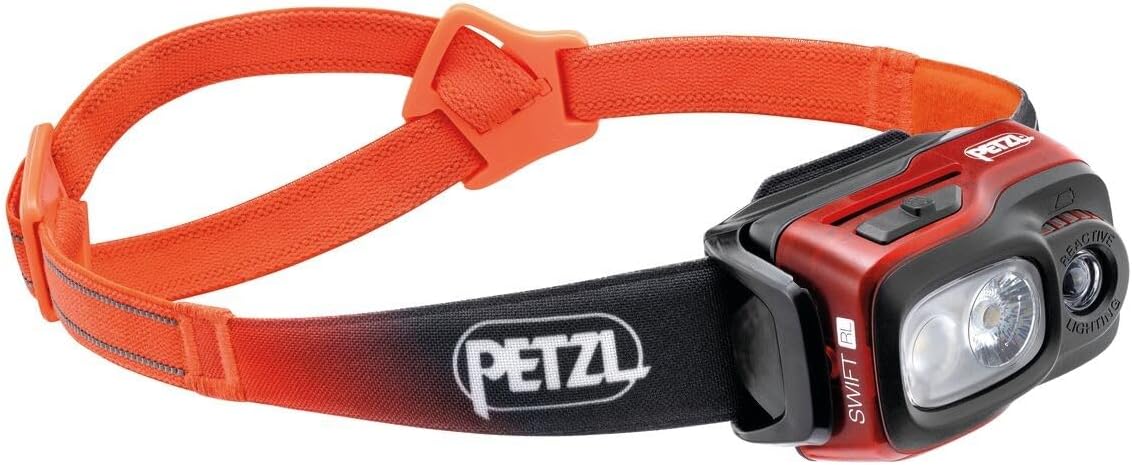
The Petzl Swift RL is a premium performance headlamp with a 4.5 rating, 1100 lumens of maximum output, and a listed weight of 100 grams. It is designed for fast outdoor activities such as trail running, mountaineering, and skiing, all of which require the sort of secure fit and rapid adaptation that also make sense during energetic mountain biking.
We may earn a commission when you buy through this link, at no additional cost to you.
Reactive lighting is the feature that most clearly separates it from simpler headlamps. A built-in sensor automatically adjusts brightness and beam pattern to ambient conditions, potentially preserving burn time and reducing the need for manual mode changes. This can be useful during transitions between exposed descents, wooded sections, and trail-side rest stops, although riders who prefer exact manual control may disable or override the behavior.
The split headband provides stability without relying on a conventional single strap. Reflective detailing adds passive visibility when the lamp itself is not pointed toward another road user. Red continuous lighting preserves night vision, while a red strobe provides an emergency signaling option. These features are particularly relevant when riding with companions or crossing areas where another cyclist may approach.
The Swift RL uses a rechargeable 2350mAh lithium-ion battery and a five-level charge indicator, so checking remaining power is straightforward. USB-C charging adds convenience for riders who already carry modern cables. This is a strong premium option for technical riders who prioritize fit, automated output, and a refined mode system, though it may offer less value than simpler models for occasional trail use.
The ambient-light sensor can reduce the need to switch modes repeatedly as the environment changes. Automatic beam adjustment also makes the lamp more convenient for fast rides where stopping to check controls is inconvenient.
The 100-gram weight and split headband distribute the load effectively and help prevent the lamp from rocking. Reflective details improve passive visibility without requiring the main light to face rearward traffic.
We may earn a commission when you buy through this link, at no additional cost to you.
The Petzl Actik Lamp has a 4.7 rating and offers a refreshingly simple approach to trail lighting. Its 350 lumens are modest compared with many high-output models, but the light weighs only 86 grams and offers flood or mixed beam patterns, multiple white brightness levels, and red lighting. That balance can be enough for familiar, well-maintained routes ridden at moderate speeds.
We may earn a commission when you buy through this link, at no additional cost to you.
Its standout advantage is battery flexibility. Three AAA/LR03 batteries are included, but the lamp also accepts compatible CORE rechargeable batteries. It can use alkaline, lithium, or Ni-MH rechargeable cells in the stated configuration. This makes it a practical choice for riders who want emergency backup without committing entirely to a built-in rechargeable battery, or who prefer standard cells for long, unpredictable trips.
The single-button design keeps operation straightforward, and the lock function helps prevent accidental activation while the light is carried or stored. A detachable, washable headband can be replaced or cleaned after muddy rides. Petzl also states that the Actik is compatible with mounting accessories for helmets and bicycles, although the supplied data does not confirm that a specific cycling mount is included.
The Actik is a strong pick for recreational riders who prioritize low weight, straightforward controls, and battery options over maximum brightness. Its IPX4 rating is suitable for general weather resistance but is less advanced than the higher ratings of several alternatives. Riders tackling technical, unlit trails may prefer a brighter model, but the Actik remains a proven, adaptable choice for night rides.
Compatibility with AAA batteries and the optional CORE rechargeable battery allows riders to adapt the light to the trip. Standard cells can be especially reassuring when extended time away from charging facilities makes a built-in battery less dependable.
A single button reduces control complexity, which is useful when operating the lamp with cold or gloved hands. The lock function further reduces the chance of the light turning on unintentionally inside a pack.
We may earn a commission when you buy through this link, at no additional cost to you.
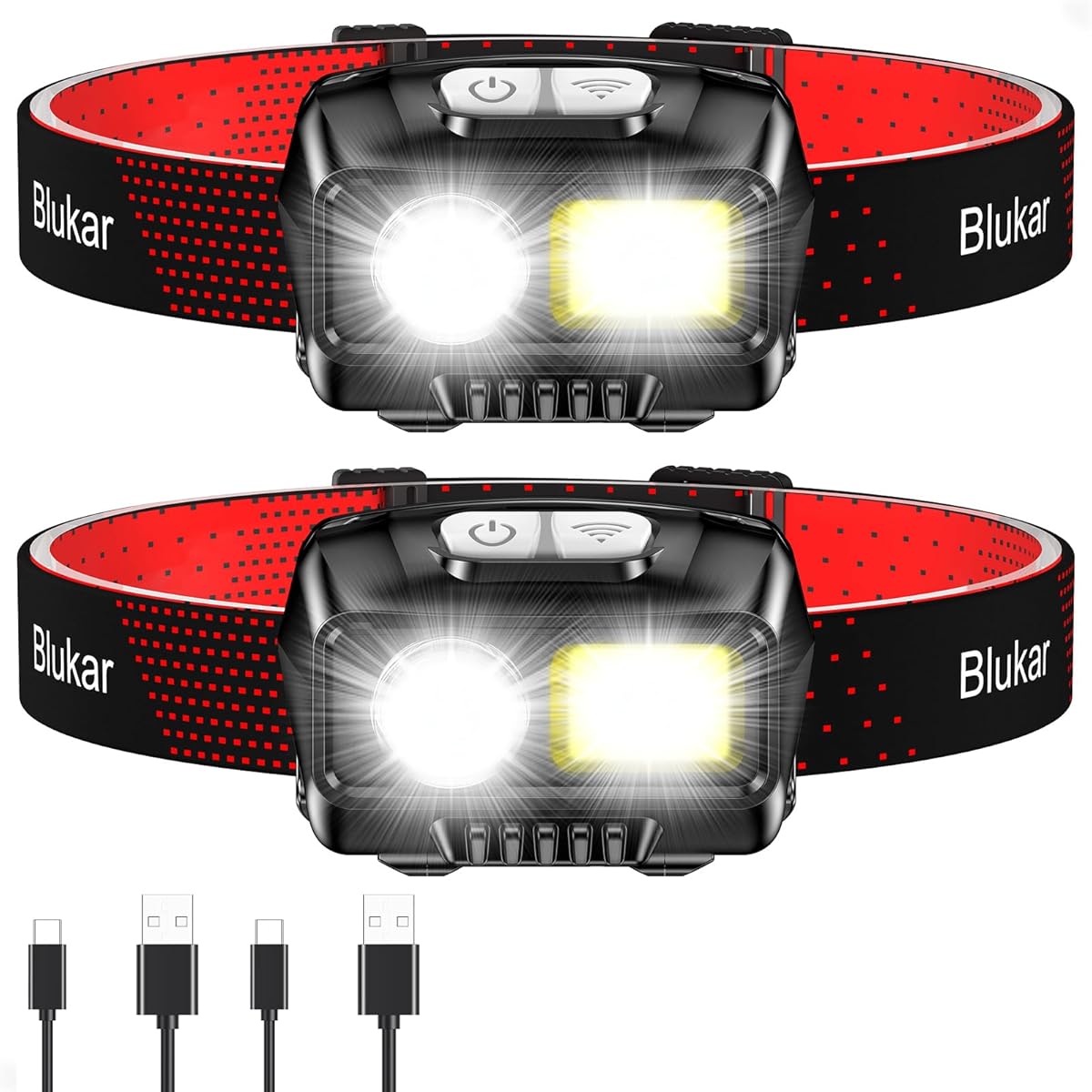
The Blukar LED Headlamp Rechargeable has a 4.5 rating and a feature set built around flexible, hands-free operation. It uses XPG and COB LED technology, offers five normal lighting configurations and three motion-activated configurations, and provides a 2000-lumen stated maximum. Stepless dimming from 100 percent down to 30 percent gives riders more precise control than a simple three-step brightness menu.
We may earn a commission when you buy through this link, at no additional cost to you.
The available patterns include XPG white, COB white, a combined XPG and COB white mode, red light, and red strobe. The same main white combinations can be activated through the motion sensor, allowing a rider to wave a hand instead of reaching for the switch. This is useful on technical trails where both hands need to remain on the bike or handlebars and when the housing may be covered with mud.
A 1200mAh rechargeable battery, USB-C cable, and IPX5 water-resistance rating make it suitable for typical wet outdoor conditions. The removable, washable breathable headband is a useful feature for riders who sweat heavily or share equipment. At 2.96 ounces, the light is also reasonably light, while a 45-degree downward tilt helps aim illumination toward the trail without removing it from the headband.
The Blukar is most compelling for general-purpose riders who value many modes, smooth dimming, and motion control more than premium construction or standardized beam measurements. The 2000-lumen claim is difficult to interpret without a stated beam distance or runtime by mode. It is still a feature-rich and convenient option, particularly for cycling, camping, and nighttime household tasks.
Stepless adjustment lets riders reduce glare while preserving useful visibility. That is especially helpful on shared trails, near campgrounds, or when a bright wide beam would wash out nearby obstacles.
Motion activation keeps the light under control while riding. Waving to switch it on or off is faster than finding a small button, and it avoids leaving the lamp active after a brief stop.
We may earn a commission when you buy through this link, at no additional cost to you.
The Lepro Rechargeable LED Headlamp 2-Pack has a 4.6 rating and provides a useful combination of shared equipment and long advertised operation. Each light is rated for up to 15 hours of continuous illumination and includes a rechargeable battery, USB-C cable, adjustable headband, spot and flood modes, and red lighting. The two-pack format makes it especially suitable for paired rides or carrying a backup.
We may earn a commission when you buy through this link, at no additional cost to you.
Its claimed output is expressed as up to 2000 lux with a beam distance of 500 feet or 150 meters, which differs from the lumen measurements used by many manufacturers. That distinction matters when comparing products: lux describes illumination at a particular point, while lumens measure total light output. As a result, the Lepro should be judged on its supplied features and modes rather than directly matched against products advertising a higher lumen figure.
Six lighting options cover high and low spotlight, high and low flood, plus steady and flashing red modes. A 45-degree adjustable angle makes it possible to point the beam farther down the trail or toward nearby footing, while the 2.65-ounce weight limits bulk. The sweat-proof elastic band is designed to remain comfortable during longer use.
The Lepro is a sensible choice for riders who want a pair of lights with extended runtime and a balanced set of beam and red-light options. Its IPX4 rating is appropriate for rain and snow exposure but does not match the heavier sealing of rugged metal models. The lack of motion sensing is minor, and the two included units partly offset the absence of premium smart features.
A stated 15-hour maximum runtime makes the lamp practical for long rides and multi-use emergency kits. The most useful benefit is that one unit can remain available for navigation while another is used as a dedicated spare.
Steady and flashing red modes improve visibility around other trail users and help preserve night vision. These settings are most valuable when riding with companions or passing through areas where people may be walking.
We may earn a commission when you buy through this link, at no additional cost to you.
The Nitecore HC65 UHE is the most ruggedly constructed headlamp in this group, with a 4.6 customer rating and an IP68 waterproof rating. Its aero-grade aluminum alloy body is impact resistant up to two meters, making it a convincing choice for riders who regularly ride rough trails, drop the equipment, or expose it to mud, rain, and dust.
We may earn a commission when you buy through this link, at no additional cost to you.
Maximum output is 2000 lumens with a stated beam distance of 243 yards. The light includes a primary white LED with four output levels, SOS and beacon functions, two low reading-light levels, and an auxiliary red light. That range makes it more versatile than a simple two-mode trail lamp and allows riders to choose appropriate brightness for technical sections, map checks, signaling, and low-light camp tasks.
A built-in waterproof USB-C port, power-status indicator, two-hour recharge time, and maximum stated runtime of 82 hours make the HC65 UHE straightforward to prepare for long outings. The 82-hour figure naturally applies to the lowest output rather than the 2000-lumen setting, but the broad range gives riders a better chance of matching energy use to the ride.
Its main tradeoff is bulk. A metal body and multifunction housing will feel more substantial under a helmet than ultra-light polymer models. Even so, for riders who put a premium on durability, sealing, long-term charging convenience, and precise output data, the HC65 UHE is a technically impressive and dependable recommendation.
The IP68 rating and two-meter impact resistance provide substantial protection in environments where a lightweight recreational lamp could be vulnerable. The metal housing also feels suited to frequent transport and repeated outdoor use.
Multiple brightness levels, red lighting, reading illumination, SOS, and beacon functions make the headlamp adaptable beyond the ride. Riders can conserve energy with low settings while retaining the option of maximum illumination for a short, difficult section.
We may earn a commission when you buy through this link, at no additional cost to you.
The right mountain biking headlamp depends on trail speed, technical difficulty, ride length, helmet compatibility, and exposure to rain. Output matters, but beam control, secure placement, runtime, and reliable controls often have a greater effect on real-world usability.
Maximum lumens indicate how much light the lamp can produce, but they do not reveal beam shape, throw, or usability. A bright wide beam can illuminate peripheral roots and approaching turns, while a focused beam reaches farther along a trail. On fast descents, a wide beam is often useful for seeing the entire usable trail corridor; on narrow forest tracks, a controlled spot can reduce spill and help reveal distant obstacles. Compare brightness against runtime as well, because maximum output is usually the shortest-lived setting.
A secure mount keeps the beam aligned with the rider's gaze and prevents bouncing over rough surfaces. Helmet compatibility, strap geometry, and adjustment range all affect stability. Some lights include a headband and helmet clips, while others require a separate bicycle or helmet bracket. A detachable body can be valuable if the rider wants to remove the light for walking or use it as a handheld torch. Under a helmet, low weight and a low-profile housing are particularly valuable.
Long rides require a realistic balance between output and runtime. Check the stated duration for the mode you expect to use, not merely the maximum figure. Built-in rechargeable batteries are convenient because the rider can top up the light between outings, while replaceable batteries offer redundancy in remote areas. USB-C is broadly convenient, whereas micro-USB requires its own cable. A battery indicator, ability to operate while charging, and fast recharge time can all improve preparation.
Mountain biking often places lights in direct rain, mud, dust, and moving debris. An IPX4 rating suits general splash exposure, IPX5 and IPX6 offer stronger water protection, and IP68 provides the highest level of sealing in this group. Water-resistance ratings do not mean a lamp is suitable for submersion unless the manufacturer states that explicitly. Material and impact ratings also matter because helmet falls, branches, and trail-side contacts can damage a housing or compromise controls.
A headlamp that feels comfortable during setup can become distracting over an hour of riding. Weight is only one part of the equation; band padding, adjustability, and balanced placement also influence stability. The BrighRoad light is listed at 3.74 ounces, the LHKNL at 1.76 ounces, and the Petzl Swift RL at 100 grams. Split headbands and detachable housings can improve fit, but a rider should also consider whether the light will interfere with helmet vents, straps, or glasses.
Fast trail riding favors simple controls that can be used with gloves. Long-press shutoff, motion sensing, and one-button selection can reduce interruptions, although some riders may prefer deliberate manual control. White light is appropriate for trail illumination, while red light and strobes improve signaling and can preserve night vision. A useful headlamp should also provide a close-range mode for checking equipment and a bright mode for fast or technical sections.
Rechargeable and replaceable-battery designs serve different riding styles. Rechargeable lights are simpler to maintain and often provide more advanced electronics, but a depleted internal battery can be a problem far from a outlet. Standard-cell models are less common among high-output options, although the Petzl Actik supports both standard batteries and a compatible rechargeable system. Riders who travel across remote regions should consider a second battery, a companion headlamp, or another independent light.
Before the first ride, fully charge the headlamp and learn every control while the bike is stationary. Mount it securely to the helmet, confirm that the beam follows the rider's line of sight, and check that the strap does not interfere with helmet retention hardware. If a light can be detached, verify that the mounting connection locks firmly and that the adjustment mechanism will not loosen over rough terrain.
Select brightness according to the trail rather than leaving the lamp on maximum. Use a focused beam for distant corners and a broader pattern for nearby obstacles, but avoid setting the light so brightly that its spill blinds other trail users. Red and flashing modes should be used for visibility and signaling rather than as the primary forward beam. Motion-sensitive models can be tested with a wave before riding to confirm they respond as expected.
After the ride, switch the headlamp off, disconnect any charging cable, and wipe away mud and moisture with a soft cloth. Let the housing dry before storage, especially if the lens seal or charging port was exposed to dirt. Keep the battery partially charged for longer storage, inspect the mount for looseness, and follow the manufacturer's guidance for battery replacement. Periodic checks of output, controls, seals, and strap tension can reveal problems before an important night ride.
The right brightness depends on speed, trail width, and technical difficulty. A 350- to 500-lumen light can work well on familiar, moderate routes, while 1000 lumens or more offers greater reach for fast descents and remote trails. Beam control, runtime, and mounting stability matter as much as the maximum rating, so riders should compare the entire lighting setup rather than focus only on headline output.
A headlamp generally follows the rider's gaze, helping reveal the exact section of trail being evaluated. It is therefore especially useful for technical riding and tight turns. A handlebar light may illuminate farther ahead and provide broader road coverage, but it remains fixed to the bike. Riders who want maximum stability can use both, provided their beams do not create confusing glare or reflections.
Yes, provided the mounting system and housing are compatible with the helmet design. Check that the strap does not interfere with vents, the rear retention dial, or the rider's glasses. Helmet-mounted models or models with included clips are usually more stable than a loose headband, and the light should be tested over several rides before relying on it in technical terrain.
IPX4 is suitable for ordinary rain and snow exposure, while IPX5 and IPX6 offer more substantial protection from water. IP68 offers the strongest sealing among the listed products. A higher rating is helpful on muddy, exposed, or high-rain routes, but every light should still be protected from prolonged submersion unless the manufacturer explicitly permits it.
A light that lasts the full planned ride at the preferred brightness provides the best margin. High-output settings generally consume power quickly, so riders should check the stated runtime for the mode they will actually use. Carrying a second light, using a model with replaceable batteries, or choosing a lower-output mode for easier sections can reduce the risk of being left in darkness.
Motion sensors make a headlamp quicker to operate when the rider's hands are on the bike or handlebars. They are particularly useful after muddy stops or when wearing gloves. However, riders should test the sensor for unwanted activation before relying on it, and they should still understand how to switch the light off with the main button.
Red light is most useful for preserving night vision, signaling other riders, and remaining visible around other trail users. It generally provides less useful detail for riding quickly because the human eye is less sensitive to red wavelengths. A practical setup uses bright white light forward while riding and reserves red or strobe modes for stops, communication, and group visibility.
Test it after a full charge, then check every brightness mode, red mode, motion control, and charging connection. Walk or ride briefly in a familiar area to confirm the beam is aimed correctly and the mount does not shift. Check that the headband or helmet attachment does not interfere with protective gear, and carry a backup light for remote routes.
The BrighRoad 1000Lumens Bike Helmet Light is the strongest dedicated cycling choice, offering adjustable helmet placement, broad visibility, 1000 lumens, and IPX6 protection. The Coast XPH30R is the most flexible option because its twist-focus beam, detachable magnetic body, and broad output range suit changing trail conditions. For premium riders, the Petzl Swift RL combines 1100 lumens, reactive lighting, and a stable 100-gram design.
Most riders should prioritize secure mounting, controlled beam placement, usable runtime, and weather resistance before chasing the largest output figure. A lighter model is valuable on long rides, while a brighter model can help on technical descents. Red lighting, motion control, and detachable housings are useful secondary features, especially when the bike is shared with other riders or used for camping afterward.
Ratings, product specifications, accessories, and current prices can change over time, so confirm the latest listing before purchasing. Check the mount contents, charging cable, battery arrangement, and included accessories against your own helmet and riding setup, and carry a backup light whenever the route is remote.