
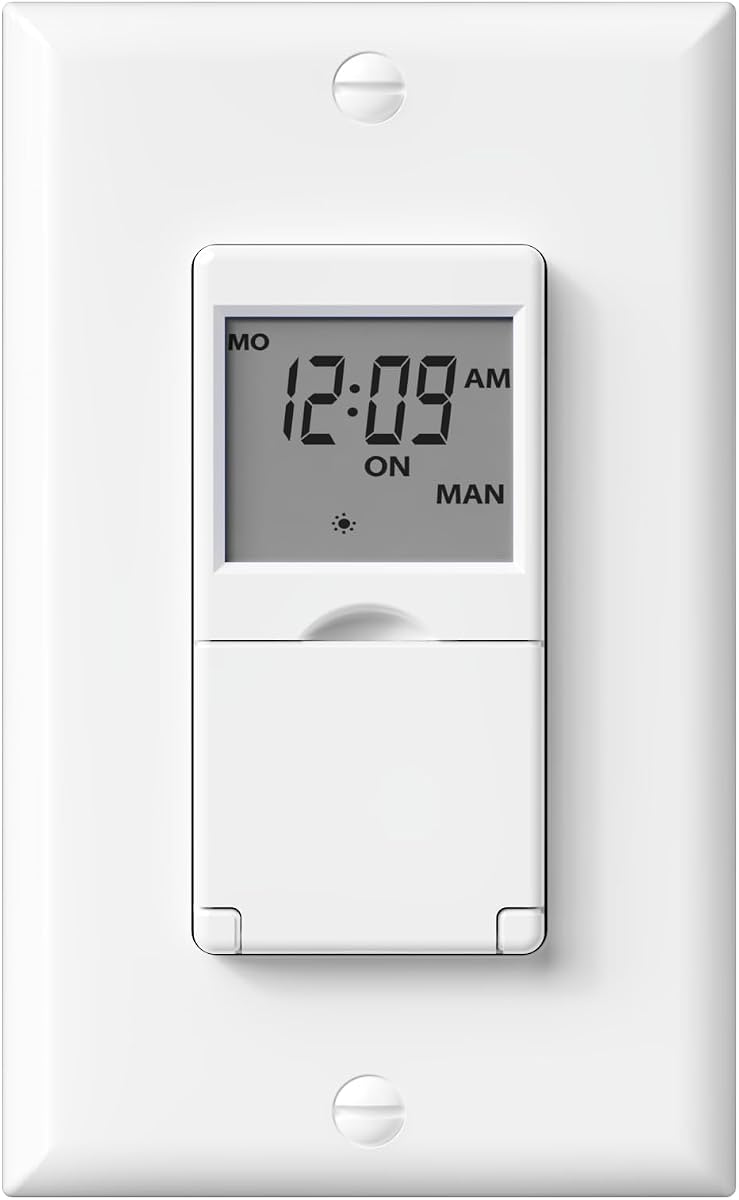
BN-LINK 7 Day Programmable Astronomical in-Wall Timer Switch
4.4Editor score
Automatic sunrise and sunset control
Eighteen on-off programs
Random vacation mode
Daylight saving time adjustment
Rechargeable backup battery
Our automated light switch timer guide compares models for scheduling, compatibility, installation, lighting control, energy savings, and everyday convenience.
An automated light switch timer removes the daily need to remember switching lights, fans, and other connected loads on or off. The most useful models combine flexible scheduling, intuitive controls, reliable automation, and compatibility with common household wiring. The right timer can improve convenience, support a lived-in appearance while you are away, and reduce unnecessary electricity use.
This guide compares ten in-wall digital switches, astronomical controls, programmable outlet timers, and one mechanical option. The evaluation considers the number of programs, seven-day scheduling, sunrise and sunset automation, manual overrides, backup power, wiring requirements, load ratings, and intended indoor or outdoor use. It also distinguishes wall switches from plug-in timers so readers can choose the correct format.
Each review explains the product's strongest benefits, practical limitations, and ideal installation environment. Ratings reflect the supplied customer feedback, while technical details are drawn from the listed product information. Availability, ratings, features, and pricing can change, so readers should confirm current specifications and prices on the linked product pages before purchasing.
4.4Editor score

4.3Editor score

4.4Editor score
The comparison below highlights the most important differences among the ten timers, including control format, scheduling capacity, astronomical capability, wiring needs, manual override options, and load support.



The BN-LINK 7 Day Programmable in Wall Digital Timer Switch combines generous scheduling capacity with a clear set of everyday controls, earning a 4.3 customer rating. It supports up to 18 on/off programs across seven days, with intervals that can be as short as one minute. That level of control suits homes where lighting, fans, or other connected loads follow a detailed routine rather than a simple daily cycle.
We may earn a commission when you buy through this link, at no additional cost to you.
Its most useful features include a blue backlight, one-touch daylight saving time mode, manual operation, random vacation mode, and a rechargeable backup battery. The random mode varies the lighting pattern to create a lived-in appearance while occupants are away. Backlit programming is particularly useful in dim hallways or garages, while AUTO and MANUAL modes make it possible to bypass the schedule when immediate control is required.
The switch supports both single-pole and 3-way installations, including use with SPDT switches, and includes a wall plate. Its electrical rating is 15A/1875W resistive, 10A/1250W tungsten, 10A/1250W ballast, and 1/2HP at 125VAC and 60Hz. Neutral wire is required, so compatibility with an existing switch box should be confirmed before installation. The broad feature set is more involved than a basic mechanical timer, but the extra flexibility justifies that tradeoff for most users.
This is a strong all-around choice for readers who want detailed seven-day automation without paying for astronomical calculations. It is especially suitable for hallways, entryways, garages, patios, porch lights, and ceiling fans. Buyers seeking a plug-in solution may find the outlet timer on this list easier to install, while those with several lighting zones can appreciate the 18-program capacity and 3-way compatibility.
With 18 on/off programs and one-minute intervals, the timer can separate weekday, weekend, and selected-day routines without requiring repeated manual changes. Preset day combinations also reduce the effort involved in building a schedule for lights or fans that do not run at the same time every day.
The blue backlight improves visibility during setup, while AUTO and MANUAL modes provide a clear path between scheduled and immediate control. Random vacation mode and a rechargeable backup battery add convenience for extended absences and temporary power interruptions.
We may earn a commission when you buy through this link, at no additional cost to you.
The GE 7-Day in-Wall Digital Timer Switch has a 4.2 customer rating and differentiates itself with SunSmart technology. Rather than relying on a fixed time for exterior lighting, it adjusts sunrise and sunset settings throughout the year according to the region. This makes it a natural fit for porch, landscape, and other lights that should follow daylight conditions.
We may earn a commission when you buy through this link, at no additional cost to you.
The timer supports up to seven ON/OFF programs over the week, allowing schedules to vary by day. Its random security feature alters programmed timing by as much as 30 minutes, helping the home appear occupied when residents travel. An optional daylight saving time setting allows the clock to accommodate seasonal clock changes without being reprogrammed.
The switch is designed to replace single-pole or three-way switches that include a neutral wire. It can control LED, CFL, incandescent, and halogen bulbs as well as other permanently installed fixtures. Its program count is lower than the 18-program options offered by several BN-LINK models, but automatic sunrise and sunset adjustment compensates for that in applications where environmental lighting changes are more important than dense scheduling.
This is an attractive recommendation for users who want exterior lighting to respond to local daylight without manually resetting a sunset program every few months. It may be less attractive for households needing dozens of distinct daily events, but it is a focused and understandable system for standard weekly routines.
SunSmart technology changes the effective operating times as sunrise and sunset move throughout the year. This is particularly useful for exterior fixtures that should not remain active at the same clock time in every season.
The random security function varies scheduled times by up to 30 minutes. That variation helps avoid an unnaturally exact repetition in the home's lighting pattern while residents are away.
We may earn a commission when you buy through this link, at no additional cost to you.
The BN-LINK 7 Day Programmable Astronomical in-Wall Timer Switch earned a 4.4 customer rating and combines solar timing with the flexibility of 18 on/off programs. Once the correct time zone and location details are entered, the switch calculates sunrise and sunset so exterior lights can operate according to local daylight instead of a fixed clock schedule.
We may earn a commission when you buy through this link, at no additional cost to you.
Programming remains highly adaptable. Users can choose individual days, use preset combinations, and set intervals as short as one minute. The timer also includes random vacation mode, daylight saving time adjustment, a manual override, and a built-in backup battery. These features make it suitable for outdoor lights, porches, entries, hallways, garages, patios, and ceiling fans when installed where the listed environmental conditions are appropriate.
Compared with the standard BN-LINK 7 Day in-wall timer, the principal addition is astronomical control. That makes this model particularly compelling for users who want a once-programmed solution that responds to seasonal daylight changes. The trade-off is that installation is restricted to single-pole configurations, and correct setup is important. Six preset time-zone choices are provided: PAC, MOU, CEN, EAS, HAW, and ALA.
The product is listed at 15A/1875W resistive, 10A/1250W tungsten, 10A/1250W ballast, and 1/2HP at 125VAC and 60Hz. Neutral wire is required, and the product is ETL listed. It is a premium choice for readers who prioritize automatic solar timing alongside extensive weekly scheduling, while a standard digital timer may be easier for single-location indoor lighting.
Astronomical automation determines sunrise and sunset locally, while 18 independent programs can handle fixtures that do not follow the same pattern. This creates a versatile balance for exterior and mixed indoor-outdoor lighting.
Random mode varies the lighting pattern during an absence, and the rechargeable backup battery helps preserve programming through a power interruption. The AUTO and MANUAL controls also allow immediate operation when the schedule is not appropriate.
We may earn a commission when you buy through this link, at no additional cost to you.
This BN-LINK 7 Day Programmable in Wall Digital Timer Switch has a 4.2 customer rating and delivers the same core 18-program, seven-day scheduling platform used by many programmable in-wall controls. It can manage lights and fans with intervals as short as one minute, making it suitable for detailed routines involving several days or times of day.
We may earn a commission when you buy through this link, at no additional cost to you.
The most valuable distinction is broad installation flexibility. It supports single-pole and 3-way configurations, including SPDT switches, which makes it appropriate for stairways, hallways, garages, large rooms, and entryways. A wall plate is included. Users can switch between scheduled AUTO operation and direct MANUAL control, adjust daylight saving time, and activate random vacation mode.
A rechargeable backup battery helps retain programming during a power outage. The electrical specifications include 15A/1875W resistive, 10A/1250W tungsten, 10A/1250W ballast, and 1/2HP at 125VAC and 60Hz. As with other digital in-wall timers in this category, neutral wire is required. The absence of automatic sunrise and sunset calculation means exterior users must set their own seasonal times.
This model is best for households that need to control the same light or fan from more than one location or need a dense weekly schedule. It offers a straightforward feature set without the setup of an astronomical timer, although buyers should be comfortable programming a digital control.
Three-way compatibility makes the timer useful in long hallways, stairways, garages, and large rooms. A single connected fixture can be operated from two switch locations while retaining the programmed schedule.
Eighteen programs, selectable days, and one-minute intervals give users more control than a basic daily timer. This is useful for fans or lights that follow different patterns throughout the week.
We may earn a commission when you buy through this link, at no additional cost to you.
The Leviton Decora VPT24-1LW has a 4.4 customer rating and stands out for its combination of programmable scheduling, astronomical control, countdown operation, and support for motor loads. It can control up to 10 on/off events by day or combination of days, while its astronomical clock adjusts for sunrise, sunset, and daylight saving time.
We may earn a commission when you buy through this link, at no additional cost to you.
The included countdown timer provides another layer of control, and a preset six-hour countdown is designed to meet CA Title 24 Part 6 and IECC requirements. Potential loads include porch, patio, and landscape lights, pool and pond pumps, interior lighting, and ceiling or exhaust fans. Electrical support extends to 600W LED/CFL, 1800W incandescent/halogen, 15A resistive or inductive loads, and 1HP motors.
The switch works in single-pole or 3-way configurations when paired with a 3-way switch. It is intended for indoor use only and requires a neutral wire. That limitation matters for anyone hoping to place the main control unit in an exposed exterior box, even if it is intended to operate outdoor lighting. Setup is described as fast and intuitive, with 10 event programs, astronomical timing, daylight saving adjustment, and countdown functions available in one device.
This is a strong premium-oriented recommendation for users who need to automate mixed loads, especially fans or pumps in addition to lighting. Its 10-event limit is lower than the 18-program BN-LINK alternatives, but motor support and a built-in countdown compensate for that. Users primarily seeking an exterior-rated control should verify the indoor-use restriction before buying.
Support for lighting, resistive or inductive loads, and motors makes this timer more versatile than controls designed only for standard fixtures. It can serve fans, pumps, and multiple lighting technologies when loads remain within the stated ratings.
The countdown function is useful when a load should stop after a known period, while the preset six-hour option supports the cited energy-code applications. The astronomical clock further reduces seasonal schedule maintenance.
We may earn a commission when you buy through this link, at no additional cost to you.
The BN-LINK Indoor 7-Day Programmable Digital Timer Outlet has a 4.4 customer rating and provides an accessible route into automated lighting without modifying a switch box. Each of the two included timers controls two grounded 3-prong outlets, making the pack useful for multiple indoor locations or for separating holiday lighting, fans, and small appliances.
We may earn a commission when you buy through this link, at no additional cost to you.
Each timer supports up to eight on/off programs, with settings as short as one minute. Users can select individual days or preset combinations, and a button activates daylight saving mode. The long-lasting backup battery preserves settings during a power outage, while random vacation mode varies the programmed pattern to give the home a more natural occupied appearance.
Unlike an in-wall switch, this model plugs into a standard outlet. That installation simplicity is its defining advantage, although it means the connected load may remain plugged in and visible. Both outlets are controlled at the same time, which is convenient for paired devices but prevents independent scheduling within each unit. The red indicator shows when the outlets are on.
The product is ETL listed and rated at 120V, 60Hz, and 15A/1725W. It is designed for indoor lights, coffee machines, fans, and other compatible devices. Buyers should verify that the load and intended location meet the product requirements. For renters or homeowners avoiding in-wall electrical work, it is one of the most convenient selections in the guide.
The plug-in format makes this model useful when neutral wire is unavailable or when a wall switch is not convenient. Setup requires a compatible outlet rather than opening and modifying an electrical box.
The two-pack can place a timer in two different rooms or control several compatible devices in each location. Eight programs per timer are enough for many daily and weekly routines without creating an overly complex schedule.
We may earn a commission when you buy through this link, at no additional cost to you.
The BN-LINK 7 Day Programmable in Wall Digital Timer Switch has a 4.3 customer rating and focuses on visibility and flexible control. Its blue backlight makes the interface easier to read while programming, particularly in locations such as garages, hallways, and utility areas where lighting may be limited.
We may earn a commission when you buy through this link, at no additional cost to you.
The switch supports 18 on/off programs over seven days, with intervals as short as one minute. Users can select individual days or convenient combinations. Daylight saving time functionality, manual override, random vacation mode, and a rechargeable backup battery round out a control package designed to reduce ongoing adjustment.
Installation flexibility is another advantage because the device supports single-pole and 3-way setups, including SPDT switches. It is intended for lights and ceiling fans in areas such as porches, entryways, halls, garages, and patios. A wall plate is included, but neutral wire is required. Listed electrical limits are 15A/1875W resistive, 10A/1250W tungsten, 10A/1250W ballast, and 1/2HP at 125VAC and 60Hz.
This option is well suited to buyers who want the detailed scheduling of a digital timer but value easy-to-read controls. It does not calculate sunrise or sunset, so exterior users must adjust programs for changing daylight unless the required operation is not time-sensitive. Its broad feature set and backlit interface make it a practical alternative to the first-ranked BN-LINK model.
The blue backlight illuminates the control area, making schedule selection easier in dim spaces. It is a practical usability improvement for users who may program a timer in a garage, basement, or hallway at night.
With 18 programs, one-minute intervals, and selectable days, the timer handles detailed routines while retaining familiar wall-switch operation. Automatic and manual modes provide a clear alternative when the programmed schedule is not needed.
We may earn a commission when you buy through this link, at no additional cost to you.
The myTouchSmart In-Wall Digital Timer has a 4.7 customer rating, the highest among the products in this guide. Instead of asking users to navigate a dense digital programming menu, it presents four programmable on/off buttons, two easy on/off buttons, and blue LED indicators that show active or selected programs.
We may earn a commission when you buy through this link, at no additional cost to you.
Its schedules operate on 24-hour daily cycles, making the device a strong option for lights and fans that follow the same routine every day. The two override buttons allow immediate control outside the programmed times, while the programmable buttons make individual schedules easier to identify. Compatible loads include LED, CFL, incandescent, and halogen bulbs, including dimmable LED and dimmable CFL bulbs.
The timer can replace an existing switch and includes screw-terminal installation, which the manufacturer says improves space efficiency compared with flying leads. A neutral wire is required, and a wall plate is not included. Electrical ratings are 120VAC at 60Hz, 15A general/resistive, 1200W tungsten, 1200VA ballast, and 1/2HP, and the product is UL listed.
This model is ideal for users who value straightforward physical controls over complex day-by-day scheduling. Its daily cycle structure is simpler than a full seven-day calendar, but the dedicated buttons can make the timer easier for household members to operate. It is a compelling choice for people who want an immediate override and visible status without navigating complicated settings.
Programmed and override buttons divide automatic control from immediate use. Blue indicators provide at-a-glance feedback, making it easier to see which schedule is selected or active.
The backup battery maintains the programmed settings when power is interrupted. That is particularly useful for recurring schedules that should resume without being rebuilt after a temporary outage.
We may earn a commission when you buy through this link, at no additional cost to you.
The BN-LINK U47 Indoor Mini 24-Hour Mechanical Outlet Timer has a 4.4 customer rating and offers a simple alternative to digital controls. Its operating principle is immediately understandable: pins up mean off, while pins down mean on. Users set the daily timing by pressing the pins down or pulling them up.
We may earn a commission when you buy through this link, at no additional cost to you.
The timer provides up to 24 on and off settings per day in intervals as small as 30 minutes. Once configured, that schedule repeats every day. This makes it appropriate for lamps, small appliances, Christmas trees, compact fluorescent lighting, LED bulbs, and other compatible electrical devices that follow a consistent daily routine.
The package includes two mini three-prong outlet timers, allowing use in two locations. No wall wiring or neutral wire is involved, and the compact format is helpful where outlet space is limited. The listed ratings are 125V at 60Hz, 15A/1875W resistive, 8A/1000W tungsten, and 5A ballast.
This is the right choice when a digital display and detailed weekly scheduling are unnecessary. Mechanical operation removes batteries, firmware concerns, and menu complexity. The trade-offs are meaningful: users cannot select different schedules for each day, and the shortest interval is 30 minutes rather than one minute. It is a practical everyday automation tool, but not a solution for complex household routines.
The pin-based system communicates on and off states visually and works without an app, display, or electronic setup. It is a straightforward option for users who want dependable daily timing without detailed programming.
Two mini timers can be placed in separate outlets or used to organize different types of connected devices. The plug-in format also makes the timers more portable than permanently installed wall controls.
We may earn a commission when you buy through this link, at no additional cost to you.
The Honeywell PLS750C1000 Timer Switch has a 4.6 customer rating and offers an in-wall solution centered on sunrise and sunset control. The product title identifies support for both single-pole and 3-way installations, giving it the basic configuration flexibility expected from a permanent light-control device.
We may earn a commission when you buy through this link, at no additional cost to you.
Astronomical operation is the defining feature. Instead of requiring the same daily activation time throughout the year, the timer can adjust exterior lighting around local sunrise and sunset. This is particularly relevant to porch, entry, garden, and other outdoor lights whose useful operating window changes with the seasons.
The supplied product information includes the country of origin and package dimensions but does not provide a detailed program count, load ratings, wiring requirements, or operating modes. Buyers should therefore review the current listing, installation manual, and compatibility information carefully rather than assuming features from similarly named models.
This timer is a good choice for buyers seeking a high-rated, permanent wall control with astronomical timing and 3-way flexibility. The lack of detailed specifications in the available listing information makes it a less straightforward recommendation than the thoroughly documented digital and plug-in alternatives. Confirm the current technical details before installation.
Sunrise and sunset control is the most prominent listed benefit. It reduces the need to make repeated manual changes as daylight hours vary during the year.
The single-pole and 3-way designation makes the device relevant to both ordinary rooms and multi-location control. A permanent in-wall format also keeps the connected load and schedule together at the switch.
We may earn a commission when you buy through this link, at no additional cost to you.
The most suitable automated light switch timer depends on wiring, location, load type, and scheduling needs. Compare the installation method, automation style, control features, and electrical limits before choosing a model.
An in-wall timer replaces a conventional switch and generally provides a cleaner, more permanent installation. It is appropriate when the existing box has the required wiring and when lights or fans need to be controlled at a standard wall location. Plug-in timers are easier to move and require no switch-box work, making them useful for holiday lights, lamps, fans, coffee machines, and other indoor appliances. Their visible form and dependence on a nearby outlet may be less suitable for a finished or frequently used control point.
A fixed digital schedule runs according to the clock time and day selected by the user. It is ideal for indoor routines, including weekday and weekend differences. An astronomical timer uses local sunrise and sunset information to adjust activation automatically through the year. This is especially useful for exterior lighting and reduces seasonal reprogramming. Users must select the correct time zone during setup, and astronomical capability does not replace a need for manual override or day-specific programs in some models.
The number of on/off events determines how many separate routines a timer can manage. Models with 18 programs offer highly detailed schedules, while seven- or ten-event options may be easier for simple weekly patterns. Consider not only the number of events but also the minimum interval. One-minute intervals support precise short cycles, whereas mechanical timers with 30-minute intervals are better for broad daily windows. Also check whether individual days and preset combinations are supported.
Most digital in-wall timers in this guide require a neutral wire. A neutral wire provides a continuous electrical reference and cannot always be added easily, particularly in older homes or finished walls. Single-pole and 3-way capability are separate considerations: a 3-way installation controls the same fixture from two locations and may require compatible SPDT switches or another 3-way switch. Confirm the box configuration, wire count, switch type, and load before purchasing any permanent timer.
A timer should be selected for the type and amount of load it will control. Lighting, ceiling fans, motors, pumps, resistive loads, and ballast-driven fixtures can have different limits. Look for explicit LED, CFL, incandescent, halogen, tungsten, ballast, motor, and horsepower ratings where applicable. Do not treat the overall wattage limit as permission to combine several fixtures if the device has separate limitations for that load category. If a load falls outside the published specifications, choose a timer explicitly designed for it.
Automatic programming should not prevent immediate control. AUTO and MANUAL modes make it easy to bypass a schedule, while dedicated override buttons can make operation clearer for every household member. Random or vacation modes vary programmed times to create a less predictable pattern while the home is empty. These features are useful for security and energy management, but random mode should not replace ordinary precautions such as locking doors, securing valuables, or informing a monitoring service.
A backup battery or other power-retention feature can preserve settings during an outage, reducing the need to rebuild a schedule after power returns. This is especially valuable for timers controlling security-related or frequently used exterior lights. When evaluating battery-backed models, consider how the battery is maintained and whether the supplied information identifies it as rechargeable. Mechanical timers do not need program memory, but they also lack electronic vacation and daylight adjustment features.
The listed indoor-only designation matters even when a timer controls an outdoor light. If the control device itself is mounted in an exposed location, it may need an exterior-rated enclosure and a weatherproof installation. Some in-wall models are described for indoor or outdoor lights but still specify environmental constraints. Compare operating and storage temperatures where provided, and ensure the switch box, cover, and connected fixture are suitable for the location.
Begin by confirming that the selected timer's wiring, load type, and installation method fit the location. For an in-wall model, switch off the circuit, verify the wiring, and follow the product's installation guide. Neutral wire, 3-way switches, and special load categories should be handled according to the manufacturer's instructions. If the existing electrical setup is uncertain, consult a qualified electrician rather than forcing the unit into service.
Program the timer while the power is on and the connected load is easy to observe. Begin with one or two simple events, set the correct time, and assign the intended days. For astronomical models, select the appropriate time zone and location information so sunrise and sunset calculations are accurate. Test AUTO mode, MANUAL mode, random vacation mode, and any countdown function before relying on the schedule for security or energy management.
For care, keep the cover and buttons clean and dry, and follow the operating and storage temperature limits. Replace or maintain backup batteries according to the instructions, especially if programs begin disappearing after outages. Periodically confirm that the clock remains accurate, that daylight saving time changes have been applied, and that connected lights or fans still operate normally. Review the schedule whenever household routines change.
Most digital in-wall timers included in this guide do require a neutral wire, including the BN-LINK, GE, Leviton, and myTouchSmart models. The plug-in BN-LINK outlet timers and mechanical U47 timers do not replace a wall switch and therefore avoid that wiring requirement. Check the product listing and existing switch box before buying an in-wall model.
A digital timer follows clock times and selected days chosen by the user. An astronomical timer also calculates local sunrise and sunset, allowing exterior lights to follow changing daylight automatically. Astronomical control is especially useful for porch, garden, and landscape lighting because it reduces the need to adjust sunset schedules throughout the year.
Several models in this guide explicitly support lights and fans, including the BN-LINK in-wall switches and Leviton Decora model. Check the motor, horsepower, ballast, and other electrical ratings to ensure the fan falls within the timer's limits. A light-only schedule may not provide the safest or most useful operation for every fan, so use a compatible control and follow the manufacturer's guidance.
The appropriate number depends on how many different routines you need. Seven or ten events are sufficient for many basic weekly patterns, while 18-program models allow more separate daily and selected-day schedules. More events are not automatically better, because a complex schedule can be harder to configure, understand, and maintain.
Yes. The BN-LINK digital timer outlet and the BN-LINK U47 mechanical timer plug directly into a standard outlet and require no switch-box modification. This makes them convenient for renters, indoor holiday lights, lamps, fans, and other compatible devices. The connected load remains plugged into the timer and may be more visible than a permanent in-wall control.
Random vacation mode varies the timing of scheduled lights so the home does not follow an identical, easily predictable pattern. It can create a more natural lived-in appearance during an absence. It is an added convenience rather than a substitute for locks, alarm systems, property security, or other standard precautions.
The listed digital models with backup battery features are designed to retain their settings during a power interruption. The BN-LINK in-wall models use a rechargeable backup battery, while the myTouchSmart and digital outlet models also list backup power. Actual battery condition and the timer's operating status should still be checked periodically, especially before leaving home for an extended period.
Several models support 3-way configurations, allowing a connected light to be operated from two switch locations. This is useful in stairways, long hallways, garages, and large rooms. Installation may require compatible SPDT switches or another specified 3-way switch, and not every in-wall model in the guide supports this arrangement.
The BN-LINK 7 Day Programmable in Wall Digital Timer Switch is the most balanced overall recommendation because it combines 18 programs, seven-day scheduling, random mode, backup power, and both single-pole and 3-way support. The astronomical BN-LINK model is the stronger premium choice for automatic sunrise and sunset operation, while the two-pack digital outlet timer is the easiest budget option for users who prefer plug-in installation.
Prioritize the installation method and wiring first, then choose a timer that matches your load and schedule. A fixed seven-day control is sufficient for indoor routines, an astronomical timer reduces seasonal adjustments for exterior lights, and a mechanical model is attractive when simplicity matters more than fine scheduling. Always confirm current ratings, environmental limits, and included accessories before installation.
Ratings, product details, availability, and prices can change over time, and the current cost of an in-wall installation may also depend on the existing wiring. Review the linked listing and manufacturer's instructions, compare the electrical ratings with the intended devices, and confirm the latest information before purchasing.